REVIEW 7 minor 49 references
User guide on Hopf bifurcation and time periodic orbits with pde2path
T0 review · 0 major / 7 minor · reviewed 2026-08-14 · deepseek-v4-flash
Pith's one-line read A user-facing pde2path workflow detects Hopf bifurcations, continues time-periodic orbits, computes Floquet multipliers, and handles continuous symmetries via phase conditions and relative equilibria, as demonstrated through its demo…
desk verdict A practical, honest user guide for pde2path's Hopf library that earns its place as a manual, even though the algorithms themselves come from earlier papers. read the letter →
The pith
A machine-rendered reading of the paper's core claim, the machinery that carries it, and where it could break.
The reading
What carries the argument
The load-bearing object is the augmented boundary-value problem for one period: after rescaling $t\mapsto Tt$, the periodic-orbit condition $M\dot u=-T G(u,\lambda)$, $u(\cdot,0)=u(\cdot,1)$; the unknown period $T$; the time-translational phase condition $\int_0^1\langle u,\dot u_0\rangle\,dt=0$; the arclength equation; and optional constraint equations $Q_H(u)=0$ for symmetries. This system is discretized in time with the TOM collocation routine and solved by Newton with bordered elimination, with the user supplying only the spatial residual, its Jacobian, and, for symmetries, phase-condition functions. Floquet multipliers come from the same time-discretization matrices, either by forming the monodromy product (floq) or by a periodic Schur decomposition (floqps). For relative equilibria, the same machinery reduces to a steady problem in a comoving frame, which is what makes traveling and rotating waves cheap to continue.
What would settle it
Run the cGL demo at double spatial and temporal resolution and compare the first three detected Hopf points and the period curves against the analytic values $r=0$, $1/4$, $1$ and the accompanying analytic period-frequency formula; failure to converge to these values would show the documented continuation pipeline is not faithfully implemented.
Extended reading notes
Core claim
The central claim is that the pde2path library, with the auxiliary functions documented here, reliably detects Hopf bifurcation points in discretized PDEs, switches to and continues branches of time-periodic orbits with unknown period $T$, computes Floquet multipliers with either a monodromy product or a periodic Schur decomposition, and treats continuous symmetries by appending phase conditions and by continuing traveling or rotating waves as steady relative equilibria in a moving frame. For the O(2)-equivariant cases this yields standing waves, traveling waves, rotating spiral waves, and their modulated counterparts from one unified setup. The paper also claims that Hopf points can be continued in a second parameter through an extended system, that fixed-period continuation and non-autonomous forcing fit in the same framework, and that period-doubling or pitchfork bifurcations from periodic orbits can be started with a simple predictor based on the critical Floquet multiplier.
Load-bearing premise
The load-bearing premise is that the pde2path implementation actually carries out the algorithms described in the companion paper [Uec19], since this guide supplies no independent verification of that implementation beyond running the demo scripts.
Editorial extensions
If this is right
- A user with access to pde2path can reproduce all reported branches by running the demo scripts and can adapt them to new PDE systems by supplying only residual, Jacobian, and constraint functions.
- Hopf-point continuation maps codimension-2 boundaries such as the Turing-Hopf and Hopf lines in parameter planes, turning two-parameter bifurcation diagrams into routine output.
- In O(2)-equivariant systems, traveling waves and rotating spirals are continued as steady relative equilibria, and their secondary Hopf bifurcations yield modulated waves that would be expensive or inaccessible as direct periodic orbits in the lab frame.
- Floquet multipliers computed along a branch give a stability index, so users can locate folds, period doublings, and torus bifurcations of periodic orbits without separate time-stepping.
- Fixed-period continuation and explicit time-dependent forcing are handled by the same interface, allowing continuation of non-autonomous and forced periodic orbits.
Reading between the lines
- Editorial inference: if the demos are as reproducible as claimed, the same continuation framework can replace trial-and-error time stepping as the primary way to locate spatiotemporal patterns, since each computed branch gives a whole family of solutions instead of one trajectory.
- Editorial inference: the ad hoc coefficient selection for multiple Hopf points could be systematized by implementing an equivariant Hopf normal-form branch selector, which would remove the user trial-and-error that the guide currently accepts.
- Editorial inference: because Floquet multipliers are computed without removing the neutral directions introduced by constraints, stability conclusions for symmetric orbits should be checked against time integration; a projected Floquet method would close this gap.
- Editorial inference: for the optimal-control setting, the success of floqps on the backward-diffusion example opens a concrete route to connecting orbits to saddle-type periodic orbits, extending the existing steady-state canonical-path continuation.
Signed reviews
Editorial analysis
A structured set of objections, weighed in public.
Referee Report
Summary. The manuscript is a user guide for the Hopf bifurcation and time-periodic orbit routines of the pde2path software package. It walks the reader through the demo directories cgl, brussel, pollution, mass-cons, kspbc4/kspbc2, symtut/breathe, cglpbc, cgldisk, gksspirals, and cglext, explaining initialization, continuation of steady branches, detection and branch switching at Hopf points, continuation of periodic orbits with free or fixed period, Floquet multiplier computation, Hopf point continuation, treatment of continuous symmetries via phase conditions, traveling and rotating waves as relative equilibria, and secondary bifurcations from periodic orbits. The guide claims that, with the documented procedures, users can reliably compute these objects, and it supports this claim with annotated scripts, output figures, comparisons with analytic results for the complex Ginzburg–Landau equation, convergence checks in the temporal discretization, and candid statements of where the methods are preliminary.
Significance. As a software manual, the paper's central claim is usability rather than a new mathematical result. That claim is largely supported: the demos are reproducible in principle, the cGL examples are checked against closed-form Hopf locations and periods, Floquet accuracy is monitored through the trivial multiplier, and the text explicitly flags known weak points (Remark 3.1, Remark 6.3, Remark A.2, and the failure of floqps in §5.2). The main residual risk is the standard one for a software guide: a fresh installation may not reproduce the displayed output, and the correctness of the underlying algorithms is delegated to [Uec19] and [RU17]. For this genre the division of labor is appropriate. The section on O(2)-equivariant Hopf bifurcation is a useful extension that goes beyond the companion algorithm paper, and the code listings make the setup transferable to new problems.
minor comments (7)
- [§5.2, Fig. 11] The statement 'These results all fully agree with those in [BvVF17]' is stronger than the evidence shown. Since no quantitative comparison of bifurcation values or branch-point locations is given, the claim should be qualified (e.g., 'qualitatively agree') or supplemented with a comparison table.
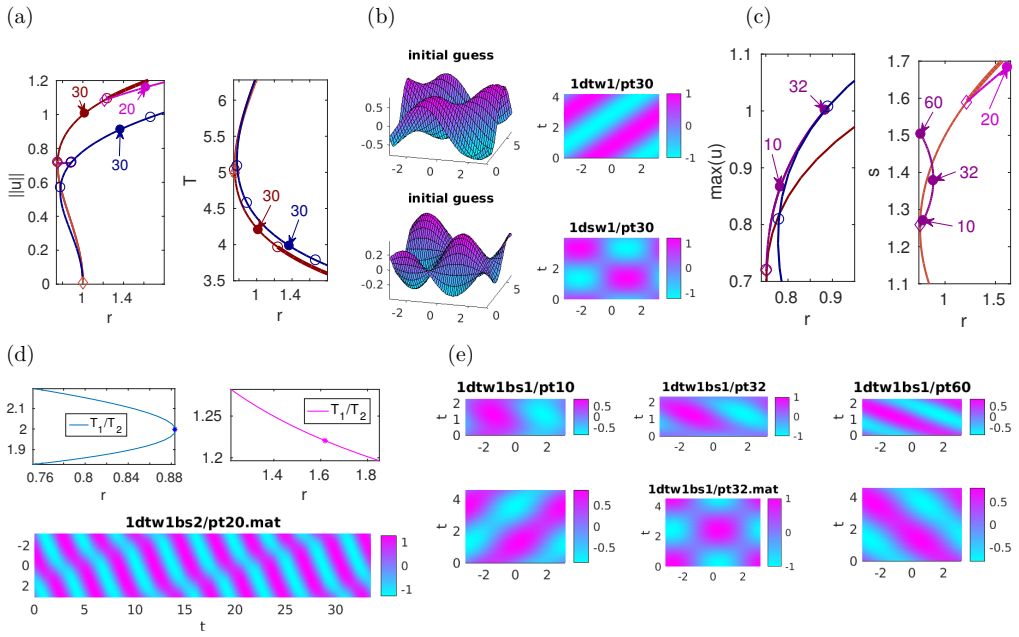
- [Figs. 8 and 11 captions] Figure 8(c) contains an unresolved placeholder '( ??)' for the formula that yields the guess ω1=0.9375, and Figure 11 refers to 'Fig. ??' for multiplier plots. Both cross-references should be replaced by explicit citations or figure numbers.
- [§3.1.1, Eqs. (3.6)–(3.7)] The second block in the displayed directional derivatives and the subsequent description of brussel/hpjac.m should involve ∂u(Guφi), not ∂u(Guφr). As written, the notation repeats ∂u(Guφr) and obscures the structure of the extended-system Jacobian.
- [§2.5, paragraph after Fig. 5] The sentence 'The script cmds2d.m follows the same principles as the 1D and 2D scripts' should refer to cmds3d.m, since the surrounding discussion is about the 3D demo.
- [§2.1, paragraph before Listing 1] The cross-reference 'Listings 5-4 discuss the dimension independent files' appears to mean Listings 1–5. This should be corrected.
- [§5.2, Listing 22] The inline comment that floqps sometimes fails and floq is reliable only for large multipliers implies that the stability information at larger amplitudes is incomplete; a sentence in the main text stating this caveat would help readers who do not inspect the listing.
- [Fig. 16 caption] The panel labels in the caption are ordered (d), (e), (g), (f), while the text refers to (f) before (g). Please align the labels with the panel references.
Circularity Check
No circularity: the guide's usability claim is supported by reproducible demos and external benchmarks; deferrals to [Uec19] are references, not reductions.
full rationale
The paper is a user guide rather than a derivation: its central claim is that the documented pde2path Hopf demos work as described and reproduce the reported outputs. That claim is supported by the included scripts, by convergence checks (e.g., cmds1dconv and the period-convergence panel in Fig. 1(d)), and by external benchmarks: cGL Hopf points and periods are checked against the explicit formulas r=|k|^2 and (6.8); the Brusselator bifurcation lines are compared with [YDZE02]; the KS results are compared with [BvVF17]; the GKS spirals with [GKS00]; and the pollution example follows [Wir00]. The self-citations to [Uec19] and [RU17] are references for the algorithms and mathematical background, but the guide's usability claim does not reduce to those citations: the demos are reproducible by third parties and are not fitted predictions. Remarks 3.1, 6.2, and A.2 candidly state where the methods are preliminary or fail (bisection for critical multipliers, FA1 failure on non-dissipative problems, Floquet multipliers with constraints). No equation in the paper is defined in terms of the quantity it is said to predict, and no fitted parameter is renamed as a prediction. The only imprecision, the unquantified 'fully agree' in §5.2, is a side remark comparing with an external paper, not a load-bearing circular step.
Assumptions & free parameters
assumptions (3)
- standard math The bifurcation and continuation theory for periodic orbits, including Hopf detection, branch switching, and Floquet multipliers, is correct as presented in [Uec19].
- domain assumption The finite element spatial discretization and the temporal collocation converge to the continuum problem on the chosen meshes.
- domain assumption The phase conditions used for continuous symmetries remove neutral directions without altering the bifurcation structure.
Cite this review
Pith. "Pith review of User guide on Hopf bifurcation and time periodic orbits with pde2path." pith.science (2026). https://pith.science/paper/GO52TNVQ
@misc{pith2026190800905,
  author       = {Pith},
  title        = {Pith review of: User guide on Hopf bifurcation and time periodic orbits with pde2path},
  year         = {2026},
  howpublished = {\url{https://pith.science/paper/GO52TNVQ}},
  note         = {Machine review of arXiv:1908.00905}
}
read the original abstract
We explain the setup for using the pde2path libraries for Hopf bifurcation and continuation of branches of periodic orbits and give implementation details of the associated demo directories. See [Uecker, Comm. in Comp. Phys., 2019] for a description of the basic algorithms and the mathematical background of the examples. Additionally we explain the treatment of Hopf bifurcations in systems with continuous symmetries, including the continuation of traveling waves and rotating waves in O(2) equivariant systems as relative equilibria, the continuation of Hopf bifurcation points via extended systems, and some simple setups for the bifurcation from periodic orbits associated to critical Floquet multipliers going through +-1.
Figures


Figures from the paper (16 more)




Reference graph
Works this paper leans on
-
[1]
D. Barkley. Spiral meandering. In Chemical Waves and Patterns, edited by R. Kapral and K. Showalter . Kluwer, 1995
work page 1995
-
[2]
A. Bojanczyk, G.H. Golub, and P. Van Dooren. The periodic S chur decomposition; algorithm and applications. In Proc. SPIE Conference, Volume 1770 , pages 31--42. 1992
work page 1992
-
[3]
D. Barkley, M. Kness, and L. S. Tuckerman. Spiral-wave dynamics in a simple model of excitable media: the transition from simple to compound rotation. Phys. Rev. A (3) , 42(4):2489--2491, 1990
work page 1990
-
[4]
M. Bollh \"o fer. ILUPACK V2.4, www.icm.tu-bs.de/ bolle/ilupack/ , 2011
work page 2011
- [5]
- [6]
-
[7]
T. Dohnal, J.D.M. Rademacher, H. Uecker, and D. Wetzel. pde2path 2.0 . In H. Ecker, A. Steindl, and S. Jakubek, editors, ENOC 2014 - Proceedings of 8th European Nonlinear Dynamics Conference, ISBN: 978-3-200-03433-4 , 2014
work page 2014
-
[8]
T. Dohnal and H. Uecker. Periodic boundary conditions in pde2path , 2017
work page 2017
Show all 49 references
-
[9]
H. de Witt. Fold continuation in systems -- a pde2path tutorial, 2017
2017
-
[10]
de Witt, T
H. de Witt, T. Dohnal, J.D.M. Rademacher, H. Uecker, and D. Wetzel. pde2path - Quickstart guide and reference card , 2020
2020
-
[11]
de Witt and H
H. de Witt and H. Uecker. Infinite time--horizon spatially distributed optimal control problems with pde2path -- algorithms and tutorial examples, arxiv:1912.11135, 2019
1912 arXiv
-
[12]
Th. F. Fairgrieve and A. D. Jepson. O. K . F loquet multipliers. SIAM J. Numer. Anal. , 28(5):1446--1462, 1991
1991
-
[13]
Grass, J.P
D. Grass, J.P. Caulkins, G. Feichtinger, G. Tragler, and D.A. Behrens. Optimal Control of Nonlinear Processes: With Applications in Drugs, Corruption, and Terror . Springer, 2008
2008
-
[14]
Golubitsky, E
M. Golubitsky, E. Knobloch, and I. Stewart. Target patterns and spirals in planar reaction-diffusion systems. J. Nonlinear Sci. , 10(3):333--354, 2000
2000
-
[15]
Govaerts
W. Govaerts. Numerical methods for bifurcations of dynamical equilibria. SIAM , 2000
2000
-
[16]
Golubitsky and I
M. Golubitsky and I. Stewart. The symmetry perspective . Birkh\"auser, Basel, 2002
2002
-
[17]
Grass and H
D. Grass and H. Uecker. Optimal management and spatial patterns in a distributed shallow lake model. Electr. J. Differential Equations , 2017(1):1--21, 2017
2017
-
[18]
R.B. Hoyle. Pattern formation . Cambridge University Press., 2006
2006
-
[19]
Jahnke, W
W. Jahnke, W. E. Skaggs, and A. T. Winfree. Chemical vortex dynamics in the B elousov- Z habotinskii reaction and in the two-variable oregonator model. J. Phys. Chem , 93(2):740--749, 1989
1989
-
[20]
Kopell and L.N
N. Kopell and L.N. Howard. Target pattern and spiral solutions to reaction-diffusion equations with more than one space dimension. Advances in Applied Mathematics , 2(4):417--449, 1981
1981
-
[21]
Kielh\"ofer
H. Kielh\"ofer. Hopf bifurcation at multiple eigenvalues. Arch. Rational Mech. Anal. , 69(1):53--83, 1979
1979
-
[22]
Kressner
D. Kressner. An efficient and reliable implementation of the periodic qz algorithm. In IFAC Workshop on Periodic Control Systems . 2001
2001
-
[23]
Kressner
D. Kressner. A periodic K rylov- S chur algorithm for large matrix products. Numer. Math. , 103(3):461--483, 2006
2006
-
[24]
Kuramoto and T
Y. Kuramoto and T. Tsuzuki. Persistent propagation of concentration waves in dissipative media far from thermal equilibrium. Prog. Theoret. Phys. , 55(2):356--369, 1976
1976
-
[25]
Yu. A. Kuznetsov. Elements of applied bifurcation theory , volume 112 of Applied Mathematical Sciences . Springer-Verlag, New York, third edition, 2004
2004
-
[26]
K. Lust. Improved numerical F loquet multipliers. Internat. J. Bifur. Chaos , 11(9):2389--2410, 2001
2001
-
[27]
Numerical bifurcation analysis for reaction-diffusion equations
Zhen Mei. Numerical bifurcation analysis for reaction-diffusion equations . Springer, 2000
2000
-
[28]
Mazzia and D
F. Mazzia and D. Trigiante. A hybrid mesh selection strategy based on conditioning for boundary value ODE problems. Numerical Algorithms , 36(2):169--187, 2004
2004
-
[29]
Paullet, B
J. Paullet, B. Ermentrout, and W. Troy. The existence of spiral waves in an oscillatory reaction-diffusion system. SIAM J. Appl. Math. , 54(5), 1994
1994
-
[30]
Rademacher and H
J.D.M. Rademacher and H. Uecker. Symmetries, freezing, and Hopf bifurcations of modulated traveling waves in pde2path , 2017
2017
-
[31]
Rademacher and H
J.D.M. Rademacher and H. Uecker. The OOPDE setting of pde2path -- a tutorial via some Allen-Cahn models , 2019
2019
-
[32]
A. Scheel. Bifurcation to spiral waves in reaction-diffusion systems. SIAM journal on mathematical analysis , 29(6):1399--1418, 1998
1998
-
[33]
R. Seydel. Practical bifurcation and stability analysis. 3rd ed. Springer , 2010
2010
-
[34]
Sivashinsky
G. Sivashinsky. Nonlinear analysis of hydrodynamic instability in laminar flames. I - D erivation of basic equations. Acta Astronautica , 4:1177--1206, 1977
1977
-
[35]
S\'anchez and M
J. S\'anchez and M. Net. On the multiple shooting continuation of periodic orbits by N ewton- K rylov methods. Internat. J. Bifur. Chaos Appl. Sci. Engrg. , 20(1):43--61, 2010
2010
-
[36]
S\'anchez and M
J. S\'anchez and M. Net. Numerical continuation methods for large-scale dissipative dynamical systems. Eur. Phys. J. Special Topics , 225:2465--2486, 2016
2016
-
[37]
Sandstede and A
B. Sandstede and A. Scheel. Curvature effects on spiral spectra: Generation of point eigenvalues near branch points. PRE , 016217:1--8, 2006
2006
-
[38]
Sandstede and A
B. Sandstede and A. Scheel. Period-doubling of spiral waves and defects. SIAM J. Appl. Dyn. Syst. , 6(2):494--547, 2007
2007
-
[39]
Sandstede, A
B. Sandstede, A. Scheel, and C. Wulff. Bifurcations and dynamics of spiral waves. J. Nonlinear Sci. , 9(4):439--478, 1999
1999
-
[40]
H. Uecker. Optimal harvesting and spatial patterns in a semi arid vegetation system. Natural Resource Modelling , 29(2):229--258, 2016
2016
-
[41]
H. Uecker. Hopf bifurcation and time periodic orbits with pde2path -- algorithms and applications . Comm. in Comp. Phys , 25(3):812--852, 2019
2019
-
[42]
H. Uecker. Pattern formation with pde2path -- a tutorial, 2020
2020
-
[43]
H. Uecker. www.staff.uni-oldenburg.de/hannes.uecker/pde2path , 2020
2020
-
[44]
Uecker and D
H. Uecker and D. Wetzel. The pde2path linear system solvers -- a tutorial, 2017
2017
-
[45]
Uecker, D
H. Uecker, D. Wetzel, and J.D.M. Rademacher. pde2path -- a Matlab package for continuation and bifurcation in 2D elliptic systems . NMTMA , 7:58--106, 2014
2014
-
[46]
Wheeler and D
P. Wheeler and D. Barkley. Computation of spiral spectra. SIADS , 5:157--177, 2006
2006
-
[47]
Fr. Wirl. Optimal accumulation of pollution: Existence of limit cycles for the social optimum and the competitive equilibrium. Journal of Economic Dynamics and Control , 24(2):297--306, 2000
2000
-
[48]
L. Yang, M. Dolnik, A. M. Zhabotinsky, and I. R. Epstein. Pattern formation arising from interactions between T uring and wave instabilities. J. Chem. Phys. , 117(15):7259--7265, 2002
2002
-
[49]
L. Yang, A. M. Zhabotinsky, and I. R. Epstein. Stable squares and other oscillatory T uring patterns in a reaction--diffusion model. PRL , 92(19):198303--1--4, 2004
2004
Reviewed August 14, 2026 · model on record in the stance chip above.
Discussion (0). Continue with ORCID to comment.