REVIEW 3 major objections 6 minor 7 cited by
DeepInverse: A Python package for solving imaging inverse problems with deep learning
T0 review · 3 major / 6 minor · reviewed 2026-08-07 · deepseek-v4-flash
Pith's one-line read DeepInverse claims that one unified PyTorch-based framework can cover every major step of learning-based imaging inverse problems—forward operators, solvers, and training—in a single open-source library.
desk verdict A genuinely useful library paper whose strongest unification claim is asserted but not yet verified; it deserves peer review with requests for the missing repo link and feature matrix. read the letter →
The pith
A machine-rendered reading of the paper's core claim, the machinery that carries it, and where it could break.
The reading
What carries the argument
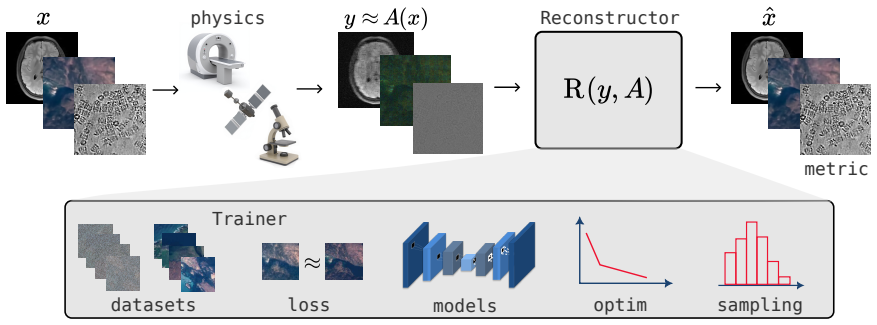
The central object is the Physics class, which wraps the forward model $A_\xi$ and noise model $\mathcal{N}_\sigma$ behind a single callable, together with the Reconstructor and Trainer classes. The forward model is parameterized by $\xi$ (projection angles, blur kernels, MRI masks), and the library supplies matrix-free implementations, adjoints, pseudoinverses, proximal operators, and norm estimators so that solvers and gradients can be computed without forming dense matrices. This parameterization is the load-bearing mechanism: it lets the same training loop handle blind deblurring, system calibration, acquisition-design optimization, and robust training, and it is what lets solvers transfer across imaging modalities.
What would settle it
Implement a representative method from each family—an unfolded MRI network, a plug-and-play ADMM solver, and a diffusion posterior sampler—twice, once with DeepInverse and once in native code, and compare wall-clock time, memory, and reconstruction quality on identical data. If any listed method cannot be expressed through the public interfaces, or runs with substantially degraded efficiency, the unification claim fails.
Extended reading notes
Core claim
The claimed discovery is that the diversity of modern learning-based image reconstruction can be organized around three compact interfaces: writing the forward model as $y = \mathcal{N}_\sigma(A_\xi(x))$, writing any reconstruction method as $\hat{x} = R_\theta(y, A_\xi, \sigma)$, and writing any training loss as $\ell = \mathcal{L}(\hat{x}, x, y, A_\xi, R_\theta)$. Everything in the library—matrix-free linear operators, adjoints, pseudoinverses, proximal operators, denoisers used as priors, diffusion samplers, GANs, and self-supervised losses—is expressed through these interfaces, so that a method developed for one imaging modality can be dropped into another by swapping the physics object. The authors further assert that this learning-focused scope and the range of realistic operators distinguish DeepInverse from existing computational imaging libraries, which they characterize as optimization-only, tomography-only, or uncertainty-quantification-only.
Load-bearing premise
The claim that the library unifies all these methods rests on the assumption that its three shared interfaces can express each listed solver without significant workarounds or hidden performance penalties.
Editorial extensions
If this is right
- A solver written for one modality, such as MRI, can be evaluated on another, such as tomography or optics, by swapping the Physics object, because the reconstructor interface does not depend on the operator's internals.
- Parameterized forward operators make blind inverse problems, system calibration, and joint acquisition-reconstruction design expressible in the same training pipeline as ordinary reconstruction.
- The included self-supervised losses—splitting losses, SURE-type estimators, and nullspace losses—allow training without ground-truth images on measurement data alone, directly matching operators such as MRI undersampling masks.
- Reproducibility is supported by a common dataset interface, seeded random generation, and automatically tested documentation examples, so published methods can be re-run without reimplementation.
Reading between the lines
- If the unified abstractions hold at scale, the practical bottleneck in computational imaging could shift from re-implementing baseline methods to designing new physics and priors, because comparison across methods becomes nearly free.
- The parameterized-operator design may make co-design workflows routine: jointly optimizing acquisition parameters and network weights could become the default way to build new imaging systems.
- A concrete testable extension is a benchmark that measures wall-clock time, memory, and reconstruction quality of methods implemented in DeepInverse against hand-written native implementations; low overhead would strengthen the unification claim.
- Because the library bundles both distortion metrics (PSNR, SSIM, LPIPS) and no-reference perceptual metrics, it could push the field to report the perception-distortion tradeoff more explicitly in every imaging task.
Signed reviews
Editorial analysis
A structured set of objections, weighed in public.
Referee Report
Summary. This paper presents DeepInverse, an open-source PyTorch library for imaging inverse problems. The library provides forward operators (MRI, tomography, blur, etc.), noise models, solvers spanning optimization-based, sampling-based, and non-iterative methods, training losses (supervised, self-supervised, adversarial), datasets, and evaluation metrics. The paper describes the design choices and claims that DeepInverse is the only library with a strong focus on learning-based reconstruction and that it unifies the wide variety of solvers through common abstractions. It is a snapshot of release v0.3.0 and contains no benchmark results, code listings, or repository link.
Significance. If the claims are accurate, DeepInverse could be a genuinely useful community resource: it would lower the barrier to entry for practitioners, provide realistic operators across many imaging modalities, and improve reproducibility through shared abstractions and test-driven development. The paper's strengths are its broad scope, the explicit coverage of both classical optimization and modern deep learning methods, and the integration of self-supervised and adversarial losses. However, the central claim of unification is not evidenced in the manuscript, and the absence of a repository URL or commit hash prevents independent verification. The value of the library is plausible but not yet demonstrated in the paper.
major comments (3)
- [Section 3 and Table 2] The central claim that DeepInverse 'unifies the wide variety of solvers' is asserted without demonstration. The method families listed in Table 2 have structurally different execution patterns: unconditional generative reconstruction (Eq. 6) requires an inner optimization over latent code z, sampling methods (Section 3.2) require iterative stochastic Markov-chain execution, and deep equilibrium models (Section 3.1) require implicit differentiation of a fixed point. The paper provides no feature matrix, no minimal code examples, and no runtime or memory benchmarks to show that the Reconstructor/Trainer abstractions express all of these families without per-method workarounds. This is an evidence gap in the paper's main claim, not an internal contradiction.
- [Abstract and Section 8] The manuscript never gives a repository URL, DOI, or commit hash, despite claiming in the Abstract that the library is open-source and in Section 8 that the paper is a snapshot of v0.3.0. Without a persistent link and version identifier, readers cannot verify any of the described functionality, and the paper's reproducibility claims (Section 1) are not actionable. Please add a permanent identifier (e.g., Zenodo DOI) and the exact commit or release.
- [Section 4.1, Eq. (7)] The loss framework is said to unify supervised, self-supervised, regularization, and adversarial losses, but these categories have structurally different training loops. For example, splitting losses require operator-specific masks, SURE losses require noise-level handling, and adversarial losses require discriminator updates. The paper does not show how the Trainer class accommodates these differences, or whether doing so requires subclassing or bypassing the base class. A short API example or a table listing each loss family and its required arguments would make this claim credible.
minor comments (6)
- [Section 2, Eq. (1)] The forward operation is described as 'x = physics(y, **params)', which inverts the mapping in Eq. (1); it should be 'y = physics(x, **params)' (or an equivalent form).
- [Section 2] The text references 'Table 2' for forward operators, but the forward operators appear in Table 1; Table 2 is the reconstruction-methods table.
- [Section 7.2] The hyperlinks labeled 'user guide' and 'quickstart' are empty in the manuscript; include the URLs.
- [Section 2] Reference [17] is cited as an operator norm and condition number estimator, but [17] is the LSQR paper; please verify and correct the citation.
- [Section 1] The claim that DeepInverse is 'the only one with a strong focus on learning-based methods, providing a larger set of realistic imaging operators' would be more convincing with a small comparison table against SCICO, Pyxu, ODL, and CIL listing supported operator families and training utilities.
- [Sections 3 and 4] A single basic usage example (e.g., defining a Physics, building a Reconstructor, and running Trainer.train for one epoch) would greatly help readers evaluate the API design claims.
Circularity Check
No circularity: DeepInverse is a software description whose claims are supported by code, not by a self-referential derivation chain.
full rationale
DeepInverse is a software system paper, not a derivation: Equations (1) through (7) define a forward model, a generic reconstructor interface, and method families (optimization, sampling, generative, and losses). None of these equations produces a result that was not already put in as an assumption or design choice. The paper's strongest claims are comparative and empirical ('the only one with a strong focus on learning-based methods, providing a larger set of realistic imaging operators') and architectural ('our framework unifies the wide variety of solvers'), neither of which is derived from fitted parameters or from a self-citation chain. Self-citations such as [24], [60], [62], [63], [64], and [65] appear where the library implements methods from those papers, but they are used as implementation references, not as justification for the library's own validity, and they are externally falsifiable through the open-source code. The absence of benchmarks or a feature matrix is an evidence gap about the strength of the unification claim, not circularity. No circular step can be exhibited, so the score is 0.
Assumptions & free parameters
assumptions (2)
- domain assumption The forward model y = Nσ(Aξ(x)) (Eq. 1) captures all imaging inverse problems of interest.
- domain assumption Deep learning is an effective and appropriate framework for imaging inverse problems.
Cite this review
Pith. "Pith review of DeepInverse: A Python package for solving imaging inverse problems with deep learning." pith.science (2026). https://pith.science/paper/GO54BWS2
@misc{pith2026250520160,
  author       = {Pith},
  title        = {Pith review of: DeepInverse: A Python package for solving imaging inverse problems with deep learning},
  year         = {2026},
  howpublished = {\url{https://pith.science/paper/GO54BWS2}},
  note         = {Machine review of arXiv:2505.20160}
}
read the original abstract
DeepInverse is an open-source PyTorch-based library for solving imaging inverse problems. The library covers all crucial steps in image reconstruction from the efficient implementation of forward operators (e.g., optics, MRI, tomography), to the definition and resolution of variational problems and the design and training of advanced neural network architectures. In this paper, we describe the main functionality of the library and discuss the main design choices.
Figures
Forward citations
Cited by 7 Pith papers
-
P-Flow: Proxy-gradient Flows for Linear Inverse Problems
P-Flow stabilizes flow-matching models for inverse problems via proxy gradients and Gaussian spherical projections, avoiding long-chain differentiation while maintaining prior consistency.
-
A Morse-Bott Framework for Blind Inverse Problems: Local Recovery Guarantees and the Failure of the MAP
MAP blind deconvolution fails with diffusion priors because blurry images are more likely, while true solutions persist only as local minima reachable with good initialization.
-
Deep Scene-Driven Ordering of Hadamard Basis for Single-Pixel Spectral Imaging
A scene-driven neural network orders Hadamard sensing patterns for single-pixel spectral imaging, improving VIS/NIR reconstructions over fixed orderings at low sampling ratios.
-
PnP-IPA: A Provably Convergent Plug-and-Play Inexact Proximal Algorithm for Nonconvex Imaging Problems
An inexact proximal PnP algorithm with adaptive line search converges globally for nonconvex imaging objectives without any bound on the regularization parameter.
-
MRpro - open PyTorch-based MR reconstruction and processing package
MRpro is a new PyTorch-based, open-source framework that unifies classical and deep-learning MRI reconstruction and quantitative parameter estimation in one package.
-
Stabilizing RED using the Koopman Operator
A Koopman-operator-based monitor shrinks the RED step size whenever a low-dimensional model of the iterates predicts divergence, preventing PSNR collapse.
-
Learned iterative networks: An operator learning perspective
Learned iterative reconstruction networks can be uniformly described as operator learning: the unrolled architecture fixes how to compute while the loss and data fix what to compute; for nonlinear inverse problems the...
Reference graph
Works this paper leans on
-
[1]
Pytorch: An impera- tive style, high-performance deep learning library
Adam Paszke, Sam Gross, Francisco Massa, Adam Lerer, James Bradbury, Gregory Chanan, Trevor Killeen, Zeming Lin, Natalia Gimelshein, Luca Antiga, et al. Pytorch: An impera- tive style, high-performance deep learning library. Advances in neural information processing systems, 32, 2019
2019
-
[2]
Scientific computational imaging code (scico)
Thilo Balke, Fernando Davis, Cristina Garcia-Cardona, Soumendu Majee, Michael McCann, Luke Pfister, and Brendt Wohlberg. Scientific computational imaging code (scico). Journal of Open Source Software, 7(78):4722, 2022
2022
-
[3]
pyxu-org/pyxu: pyxu, 2024
Matthieu Simeoni, Sepand Kashani, Joan Ru´ e-Queralt, and Pyxu Developers. pyxu-org/pyxu: pyxu, 2024
2024
- [4]
-
[5]
Ander Biguri, Tomoyuki Sadakane, Reuben Lindroos, Yi Liu, Malena Sabat´ e Landman, Yi Du, Manasavee Lohvithee, Stefanie Kaser, Sepideh Hatamikia, Robert Bryll, et al. Tigre v3: Effi- cient and easy to use iterative computed tomographic reconstruction toolbox for real datasets. Engineering Research Express, 7(1):015011, 2025
work page 2025
-
[6]
Jonas Adler, Holger Kohr, Axel Ringh, Julian Moosmann, sbanert, Matthias J. Ehrhardt, Gre- gory R. Lee, niinimaki, bgris, Olivier Verdier, Johan Karlsson, zickert, Willem Jan Palenstijn, Ozan ¨Oktem, Chong Chen, Hector Andrade Loarca, and Michael Lohmann. odlgroup/odl: Odl 0.7.0, September 2018
work page 2018
-
[7]
Core Imaging Library-part I: a versatile python framework for tomographic imaging
Jakob S Jørgensen, Evelina Ametova, Genoveva Burca, Gemma Fardell, Evangelos Papoutsellis, Edoardo Pasca, Kris Thielemans, Martin Turner, Ryan Warr, William RB Lionheart, et al. Core Imaging Library-part I: a versatile python framework for tomographic imaging. Philosophical Transactions of the Royal Society A , 379(2204):20200192, 2021
work page 2021
-
[8]
Fast and flexible x-ray tomography using the astra toolbox
Wim Van Aarle, Willem Jan Palenstijn, Jeroen Cant, Eline Janssens, Folkert Bleichrodt, Andrei Dabravolski, Jan De Beenhouwer, K Joost Batenburg, and Jan Sijbers. Fast and flexible x-ray tomography using the astra toolbox. Optics express, 24(22):25129–25147, 2016
work page 2016
Show all 83 references
-
[9]
Pytomography: a python library for medical image reconstruction
Lucas A Polson, Roberto Fedrigo, Chenguang Li, Maziar Sabouri, Obed Dzikunu, Shadab Ahamed, Nicolas Karakatsanis, Sara Kurkowska, Peyman Sheikhzadeh, Pedro Esquinas, et al. Pytomography: a python library for medical image reconstruction. SoftwareX, 29:102020, 2025
2025
-
[10]
Sigpy: A python package for high performance iterative recon- struction, 2019
Frank Ong and Michael Lustig. Sigpy: A python package for high performance iterative recon- struction, 2019
2019
-
[11]
Pylops–a linear-operator python library for large scale optimization
Matteo Ravasi and Ivan Vasconcelos. Pylops–a linear-operator python library for large scale optimization. arXiv preprint arXiv:1907.12349 , 2019. 9
1907 arXiv
-
[12]
Pocket guide to solve inverse problems with globalbioim
Emmanuel Soubies, Ferr´ eol Soulez, Michael T McCann, Thanh-an Pham, Laur` ene Donati, Thomas Debarre, Daniel Sage, and Michael Unser. Pocket guide to solve inverse problems with globalbioim. Inverse Problems, 35(10):104006, 2019
2019
-
[13]
Ir tools: a matlab package of iterative regularization methods and large-scale test problems
Silvia Gazzola, Per Christian Hansen, and James G Nagy. Ir tools: a matlab package of iterative regularization methods and large-scale test problems. Numerical Algorithms , 81(3):773–811, 2019
2019
-
[14]
Methods of conjugate gradients for solving linear systems
Magnus R Hestenes, Eduard Stiefel, et al. Methods of conjugate gradients for solving linear systems. Journal of research of the National Bureau of Standards , 49(6):409–436, 1952
1952
-
[15]
Solution of sparse indefinite systems of linear equations
Christopher C Paige and Michael A Saunders. Solution of sparse indefinite systems of linear equations. SIAM journal on numerical analysis , 12(4):617–629, 1975
1975
-
[16]
Bi-cgstab: A fast and smoothly converging variant of bi-cg for the solution of nonsymmetric linear systems
Henk A Van der Vorst. Bi-cgstab: A fast and smoothly converging variant of bi-cg for the solution of nonsymmetric linear systems. SIAM Journal on scientific and Statistical Computing , 13(2):631–644, 1992
1992
-
[17]
Lsqr: An algorithm for sparse linear equations and sparse least squares
Christopher C Paige and Michael A Saunders. Lsqr: An algorithm for sparse linear equations and sparse least squares. ACM Transactions on Mathematical Software (TOMS) , 8(1):43–71, 1982
1982
-
[18]
Deep-blur: Blind identification and deblurring with con- volutional neural networks
Valentin Debarnot and Pierre Weiss. Deep-blur: Blind identification and deblurring with con- volutional neural networks. Biological Imaging, 4:e13, 2024
2024
-
[19]
Parallel diffusion models of operator and image for blind inverse problems
Hyungjin Chung, Jeongsol Kim, Sehui Kim, and Jong Chul Ye. Parallel diffusion models of operator and image for blind inverse problems. In Proceedings of the IEEE/CVF Conference on Computer Vision and Pattern Recognition , pages 6059–6069, 2023
2023
-
[20]
Sparkling: variable-density k-space filling curves for accelerated t2*-weighted MRI
Carole Lazarus, Pierre Weiss, Nicolas Chauffert, Franck Mauconduit, Loubna El Gueddari, Christophe Destrieux, Ilyess Zemmoura, Alexandre Vignaud, and Philippe Ciuciu. Sparkling: variable-density k-space filling curves for accelerated t2*-weighted MRI. Magnetic resonance in med...
2019
-
[21]
Deepstorm3d: dense 3d local- ization microscopy and psf design by deep learning
Elias Nehme, Daniel Freedman, Racheli Gordon, Boris Ferdman, Lucien E Weiss, Onit Alalouf, Tal Naor, Reut Orange, Tomer Michaeli, and Yoav Shechtman. Deepstorm3d: dense 3d local- ization microscopy and psf design by deep learning. Nature methods, 17(7):734–740, 2020
2020
-
[22]
Training adaptive reconstruction networks for blind inverse problems
Alban Gossard and Pierre Weiss. Training adaptive reconstruction networks for blind inverse problems. SIAM Journal on Imaging Sciences , 17(2):1314–1346, 2024
2024
-
[23]
Meta-prior: Meta learning for adaptive inverse problem solvers
Matthieu Terris and Thomas Moreau. Meta-prior: Meta learning for adaptive inverse problem solvers. arXiv preprint arXiv:2311.18710 , 2023
2023 arXiv
-
[24]
Reconstruct any- thing model: a lightweight foundation model for computational imaging
Matthieu Terris, Samuel Hurault, Maxime Song, and Julian Tachella. Reconstruct any- thing model: a lightweight foundation model for computational imaging. arXiv preprint arXiv:2503.08915, 2025
2025
-
[25]
An introduction to continuous optimization for imaging
Antonin Chambolle and Thomas Pock. An introduction to continuous optimization for imaging. Acta Numerica, 25:161–319, 2016
2016
-
[26]
An introduction to compressive sampling
Emmanuel J Cand` es and Michael B Wakin. An introduction to compressive sampling. IEEE signal processing magazine, 25(2):21–30, 2008. 10
2008
-
[27]
Nonlinear total variation based noise removal algorithms
Leonid I Rudin, Stanley Osher, and Emad Fatemi. Nonlinear total variation based noise removal algorithms. Physica D: nonlinear phenomena , 60(1-4):259–268, 1992
1992
-
[28]
A wavelet tour of signal processing
Stephane Mallat. A wavelet tour of signal processing . Elsevier, 1999
1999
-
[29]
From learning models of natural image patches to whole image restoration
Daniel Zoran and Yair Weiss. From learning models of natural image patches to whole image restoration. In 2011 international conference on computer vision , pages 479–486. IEEE, 2011
2011
-
[30]
Sparse regression using mixed norms
Matthieu Kowalski. Sparse regression using mixed norms. Applied and Computational Harmonic Analysis, 27(3):303–324, 2009
2009
-
[31]
From learning models of natural image patches to whole image restoration
Daniel Zoran and Yair Weiss. From learning models of natural image patches to whole image restoration. In 2011 International Conference on Computer Vision , pages 479–486, 2011
2011
-
[32]
Patchnr: learning from very few images by patch normalizing flow regulariza- tion
Fabian Altekr¨ uger, Alexander Denker, Paul Hagemann, Johannes Hertrich, Peter Maass, and Gabriele Steidl. Patchnr: learning from very few images by patch normalizing flow regulariza- tion. Inverse Problems, 39(6):064006, 2023
2023
-
[33]
Plug-and-play priors for model based reconstruction
Singanallur V Venkatakrishnan, Charles A Bouman, and Brendt Wohlberg. Plug-and-play priors for model based reconstruction. In 2013 IEEE global conference on signal and information processing, pages 945–948. IEEE, 2013
2013
-
[34]
The little engine that could: Regulariza- tion by denoising (RED)
Yaniv Romano, Michael Elad, and Peyman Milanfar. The little engine that could: Regulariza- tion by denoising (RED). SIAM Journal on Imaging Sciences , 10(4):1804–1844, 2017
2017
-
[35]
Beyond a gaussian denoiser: Residual learning of deep cnn for image denoising
Kai Zhang, Wangmeng Zuo, Yunjin Chen, Deyu Meng, and Lei Zhang. Beyond a gaussian denoiser: Residual learning of deep cnn for image denoising. IEEE transactions on image processing, 26(7):3142–3155, 2017
2017
-
[36]
Plug-and- play image restoration with deep denoiser prior
Kai Zhang, Yawei Li, Wangmeng Zuo, Lei Zhang, Luc Van Gool, and Radu Timofte. Plug-and- play image restoration with deep denoiser prior. IEEE Transactions on Pattern Analysis and Machine Intelligence , 44(10):6360–6376, 2021
2021
-
[37]
Denoising diffusion probabilistic models
Jonathan Ho, Ajay Jain, and Pieter Abbeel. Denoising diffusion probabilistic models. Advances in neural information processing systems , 33:6840–6851, 2020
2020
-
[38]
Score-based generative modeling through stochastic differential equations
Yang Song, Jascha Sohl-Dickstein, Diederik P Kingma, Abhishek Kumar, Stefano Ermon, and Ben Poole. Score-based generative modeling through stochastic differential equations. arXiv preprint arXiv:2011.13456, 2020
2011 arXiv
-
[39]
Optimization with first order algo- rithms
Charles Dossal, Samuel Hurault, and Nicolas Papadakis. Optimization with first order algo- rithms. arXiv preprint arXiv:2410.19506 , 2024
2024 arXiv
-
[40]
Learning fast approximations of sparse coding
Karol Gregor and Yann LeCun. Learning fast approximations of sparse coding. In Proceedings of the 27th international conference on international conference on machine learning , pages 399–406, 2010
2010
-
[41]
Deep equilibrium models
Shaojie Bai, J Zico Kolter, and Vladlen Koltun. Deep equilibrium models. Advances in neural information processing systems, 32, 2019
2019
-
[42]
Diffusion posterior sampling for general noisy inverse problems
Hyungjin Chung, Jeongsol Kim, Michael T Mccann, Marc L Klasky, and Jong Chul Ye. Diffusion posterior sampling for general noisy inverse problems. arXiv preprint arXiv:2209.14687 , 2022. 11
2022 arXiv
-
[43]
Denoising diffusion restoration models
Bahjat Kawar, Michael Elad, Stefano Ermon, and Jiaming Song. Denoising diffusion restoration models. Advances in Neural Information Processing Systems , 35:23593–23606, 2022
2022
-
[44]
Denoising diffusion models for plug-and-play image restoration
Yuanzhi Zhu, Kai Zhang, Jingyun Liang, Jiezhang Cao, Bihan Wen, Radu Timofte, and Luc Van Gool. Denoising diffusion models for plug-and-play image restoration. In Proceedings of the IEEE/CVF Conference on Computer Vision and Pattern Recognition , pages 1219–1229, 2023
2023
-
[45]
Bayesian imaging using plug & play priors: when Langevin meets Tweedie
R´ emi Laumont, Valentin De Bortoli, Andr´ es Almansa, Julie Delon, Alain Durmus, and Marcelo Pereyra. Bayesian imaging using plug & play priors: when Langevin meets Tweedie. SIAM Journal on Imaging Sciences , 15(2):701–737, 2022
2022
-
[46]
Zygalakis
Marcelo Pereyra, Luis Vargas Mieles, and Konstantinos C. Zygalakis. Accelerating proximal markov chain monte carlo by using an explicit stabilized method. SIAM Journal on Imaging Sciences, 13(2):905–935, 2020
2020
-
[47]
Deep convolu- tional neural network for inverse problems in imaging
Kyong Hwan Jin, Michael T McCann, Emmanuel Froustey, and Michael Unser. Deep convolu- tional neural network for inverse problems in imaging. IEEE transactions on image processing , 26(9):4509–4522, 2017
2017
-
[48]
Compressed sensing using generative models
Ashish Bora, Ajil Jalal, Eric Price, and Alexandros G Dimakis. Compressed sensing using generative models. In International conference on machine learning , pages 537–546. PMLR, 2017
2017
-
[49]
Ambientgan: Generative models from lossy measurements
Ashish Bora, Eric Price, and Alexandros G Dimakis. Ambientgan: Generative models from lossy measurements. In International conference on learning representations , 2018
2018
-
[50]
Deep image prior
Dmitry Ulyanov, Andrea Vedaldi, and Victor Lempitsky. Deep image prior. In Proceedings of the IEEE conference on computer vision and pattern recognition , pages 9446–9454, 2018
2018
-
[51]
Image-to-image translation with conditional adversarial networks
Phillip Isola, Jun-Yan Zhu, Tinghui Zhou, and Alexei A Efros. Image-to-image translation with conditional adversarial networks. In Proceedings of the IEEE conference on computer vision and pattern recognition, pages 1125–1134, 2017
2017
-
[52]
A regularized conditional gan for pos- terior sampling in image recovery problems
Matthew Bendel, Rizwan Ahmad, and Philip Schniter. A regularized conditional gan for pos- terior sampling in image recovery problems. In A. Oh, T. Naumann, A. Globerson, K. Saenko, M. Hardt, and S. Levine, editors, Advances in Neural Information Processing Systems , vol- ume 3...
2023
-
[53]
Benchmarking self-supervised methods for accelerated MRI reconstruction
Andrew Wang and Mike Davies. Benchmarking self-supervised methods for accelerated MRI reconstruction. arXiv preprint arXiv:2502.14009 , 2025
2025
-
[54]
Noise2self: Blind denoising by self-supervision
Joshua Batson and Loic Royer. Noise2self: Blind denoising by self-supervision. In International conference on machine learning , pages 524–533. PMLR, 2019
2019
-
[55]
Noise2void-learning denoising from single noisy images
Alexander Krull, Tim-Oliver Buchholz, and Florian Jug. Noise2void-learning denoising from single noisy images. In Proceedings of the IEEE/CVF conference on computer vision and pattern recognition, pages 2129–2137, 2019
2019
-
[56]
Neighbor2neighbor: Self- supervised denoising from single noisy images
Tao Huang, Songjiang Li, Xu Jia, Huchuan Lu, and Jianzhuang Liu. Neighbor2neighbor: Self- supervised denoising from single noisy images. In Proceedings of the IEEE/CVF conference on computer vision and pattern recognition , pages 14781–14790, 2021. 12
2021
-
[57]
Self-supervised learning of physics-guided reconstruction neu- ral networks without fully sampled reference data
Burhaneddin Yaman, Seyed Amir Hossein Hosseini, Steen Moeller, Jutta Ellermann, Kˆ amil U˘ gurbil, and Mehmet Ak¸ cakaya. Self-supervised learning of physics-guided reconstruction neu- ral networks without fully sampled reference data. Magnetic resonance in medicine, 84(6):317...
2020
-
[58]
Phase2phase: respiratory motion-resolved reconstruction of free-breathing magnetic resonance imaging using deep learn- ing without a ground truth for improved liver imaging
Cihat Eldeniz, Weijie Gan, Sihao Chen, Tyler J Fraum, Daniel R Ludwig, Yan Yan, Jiaming Liu, Thomas Vahle, Uday Krishnamurthy, Ulugbek S Kamilov, et al. Phase2phase: respiratory motion-resolved reconstruction of free-breathing magnetic resonance imaging using deep learn- ing w...
2021
-
[59]
Rare: Image reconstruction using deep priors learned without groundtruth
Jiaming Liu, Yu Sun, Cihat Eldeniz, Weijie Gan, Hongyu An, and Ulugbek S Kamilov. Rare: Image reconstruction using deep priors learned without groundtruth. IEEE Journal of Selected Topics in Signal Processing, 14(6):1088–1099, 2020
2020
-
[60]
Unsure: self-supervised learning with unknown noise level and stein’s unbiased risk estimate
Juli´ an Tachella, Mike Davies, and Laurent Jacques. Unsure: self-supervised learning with unknown noise level and stein’s unbiased risk estimate. InInternational Conference on Learning Representations, 2025
2025
-
[61]
Recorrupted-to-recorrupted: Unsu- pervised deep learning for image denoising
Tongyao Pang, Huan Zheng, Yuhui Quan, and Hui Ji. Recorrupted-to-recorrupted: Unsu- pervised deep learning for image denoising. In Proceedings of the IEEE/CVF conference on computer vision and pattern recognition , pages 2043–2052, 2021
2021
-
[62]
Generalized recorrupted-to-recorrupted: Self-supervised learning beyond gaussian noise
Brayan Monroy, Jorge Bacca, and Juli´ an Tachella. Generalized recorrupted-to-recorrupted: Self-supervised learning beyond gaussian noise. In Proceedings of the IEEE/CVF conference on computer vision and pattern recognition , 2025
2025
-
[63]
Equivariant imaging: Learning beyond the range space
Dongdong Chen, Juli´ an Tachella, and Mike E Davies. Equivariant imaging: Learning beyond the range space. In Proceedings of the IEEE/CVF International Conference on Computer Vision, pages 4379–4388, 2021
2021
-
[64]
Unsupervised learning from incomplete mea- surements for inverse problems
Juli´ an Tachella, Dongdong Chen, and Mike Davies. Unsupervised learning from incomplete mea- surements for inverse problems. Advances in Neural Information Processing Systems , 35:4983– 4995, 2022
2022
-
[65]
Perspective-equivariance for unsupervised imaging with cam- era geometry
Andrew Wang and Mike Davies. Perspective-equivariance for unsupervised imaging with cam- era geometry. IEEE/CVF European Conference on Computer Vision (ECCV) Workshop on Traditional Computer Vision in the Age of Deep Learning , 2024
2024
-
[66]
Learning maxi- mally monotone operators for image recovery
Jean-Christophe Pesquet, Audrey Repetti, Matthieu Terris, and Yves Wiaux. Learning maxi- mally monotone operators for image recovery. SIAM Journal on Imaging Sciences , 14(3):1206– 1237, 2021
2021
-
[67]
Ntire 2017 challenge on single image super-resolution: Dataset and study
Eirikur Agustsson and Radu Timofte. Ntire 2017 challenge on single image super-resolution: Dataset and study. In The IEEE Conference on Computer Vision and Pattern Recognition (CVPR) Workshops , July 2017
2017
-
[68]
Enhanced deep residual networks for single image super-resolution
Bee Lim, Sanghyun Son, Heewon Kim, Seungjun Nah, and Kyoung Mu Lee. Enhanced deep residual networks for single image super-resolution. In Proceedings of the IEEE conference on computer vision and pattern recognition workshops , pages 136–144, 2017. 13
2017
-
[69]
On single image scale-up using sparse- representations
Roman Zeyde, Michael Elad, and Matan Protter. On single image scale-up using sparse- representations. In Curves and Surfaces: 7th International Conference, Avignon, France, June 24-30, 2010, Revised Selected Papers 7 , pages 711–730. Springer, 2012
2010
-
[70]
Martin, C
D. Martin, C. Fowlkes, D. Tal, and J. Malik. A database of human segmented natural images and its application to evaluating segmentation algorithms and measuring ecological statistics. In Proc. 8th Int’l Conf. Computer Vision , volume 2, pages 416–423, July 2001
2001
-
[71]
Lsdir: A large scale dataset for image restoration
Yawei Li, Kai Zhang, Jingyun Liang, Jiezhang Cao, Ce Liu, Rui Gong, Yulun Zhang, Hao Tang, Yun Liu, Denis Demandolx, et al. Lsdir: A large scale dataset for image restoration. In Proceedings of the IEEE/CVF Conference on Computer Vision and Pattern Recognition , pages 1775–1787, 2023
2023
-
[72]
fastMRI: An open dataset and benchmarks for accelerated MRI
Jure Zbontar, Florian Knoll, Anuroop Sriram, Tullie Murrell, Zhengnan Huang, Matthew J Muckley, Aaron Defazio, Ruben Stern, Patricia Johnson, Mary Bruno, et al. fastMRI: An open dataset and benchmarks for accelerated MRI. arXiv preprint arXiv:1811.08839 , 2018
2018 arXiv
-
[73]
CMRxRecon: A publicly available k-space dataset and benchmark to advance deep learning for cardiac MRI
Chengyan Wang, Jun Lyu, Shuo Wang, Chen Qin, Kunyuan Guo, Xinyu Zhang, Xiaotong Yu, Yan Li, Fanwen Wang, Jianhua Jin, et al. CMRxRecon: A publicly available k-space dataset and benchmark to advance deep learning for cardiac MRI. Scientific Data , 11(1):687, 2024
2024
-
[74]
The lung image database consortium (lidc) and image database resource initiative (idri): a completed reference database of lung nodules on ct scans
Samuel G Armato III, Geoffrey McLennan, Luc Bidaut, Michael F McNitt-Gray, Charles R Meyer, Anthony P Reeves, Binsheng Zhao, Denise R Aberle, Claudia I Henschke, Eric A Hoff- man, et al. The lung image database consortium (lidc) and image database resource initiative (idri): a...
2011
-
[75]
A poisson-gaussian denoising dataset with real fluorescence microscopy images
Yide Zhang, Yinhao Zhu, Evan Nichols, Qingfei Wang, Siyuan Zhang, Cody Smith, and Scott Howard. A poisson-gaussian denoising dataset with real fluorescence microscopy images. In Proceedings of the IEEE/CVF Conference on Computer Vision and Pattern Recognition , pages 11710–11718, 2019
2019
-
[76]
Record- ing and playback of camera shake: Benchmarking blind deconvolution with a real-world database
Rolf K¨ ohler, Michael Hirsch, Betty Mohler, Bernhard Sch¨ olkopf, and Stefan Harmeling. Record- ing and playback of camera shake: Benchmarking blind deconvolution with a real-world database. In Computer Vision–ECCV 2012: 12th European Conference on Computer Vision, Florence, ...
2012
-
[77]
A large-scale benchmark data set for evaluat- ing pansharpening performance: Overview and implementation
Xiangchao Meng, Yiming Xiong, Feng Shao, Huanfeng Shen, Weiwei Sun, Gang Yang, Qiangqiang Yuan, Randi Fu, and Hongyan Zhang. A large-scale benchmark data set for evaluat- ing pansharpening performance: Overview and implementation. IEEE Geoscience and Remote Sensing Magazine , ...
2021
-
[78]
The perception-distortion tradeoff
Yochai Blau and Tomer Michaeli. The perception-distortion tradeoff. In Proceedings of the IEEE conference on computer vision and pattern recognition , pages 6228–6237, 2018
2018
-
[79]
Image quality assessment: from error visibility to structural similarity
Zhou Wang, Alan C Bovik, Hamid R Sheikh, and Eero P Simoncelli. Image quality assessment: from error visibility to structural similarity. IEEE transactions on image processing, 13(4):600– 612, 2004
2004
-
[80]
The unreason- able effectiveness of deep features as a perceptual metric
Richard Zhang, Phillip Isola, Alexei A Efros, Eli Shechtman, and Oliver Wang. The unreason- able effectiveness of deep features as a perceptual metric. In Proceedings of the IEEE conference on computer vision and pattern recognition , pages 586–595, 2018. 14
2018
-
[81]
completely blind
Anish Mittal, Rajiv Soundararajan, and Alan C Bovik. Making a “completely blind” image quality analyzer. IEEE Signal processing letters , 20(3):209–212, 2012
2012
-
[82]
Objective quality assessment of tone-mapped images
Hojatollah Yeganeh and Zhou Wang. Objective quality assessment of tone-mapped images. IEEE Transactions on Image processing , 22(2):657–667, 2012
2012
-
[83]
Shih, Jake Vanderplas, Jody Klymak, Alex Rockhill, John Muradeli, Thomas A Caswell, Bane Sullivan, Alyssa Batula, and Patrick Kunzmann
Oscar Najera, Eric Larson, Lucy Liu, Loic Esteve, Gael Varoquaux, Jaques Grobler, Elliott Sales de Andrade, Chris Holdgraf, Alexandre Gramfort, Mainak Jas, Joel Nothman, Steffen Rehberg, Olivier Grisel, Nelle Varoquaux, Steven Hiscocks, alexis, Emmanuelle Gouillart, Tim Hoffma...
2023
Reviewed August 7, 2026 · model on record in the stance chip above.
Discussion (0). Continue with ORCID to comment.