REVIEW 3 major objections 4 minor 1 cited by
The link surgery formula and equivariant surgeries
T0 review · 3 major / 4 minor · reviewed 2026-08-06 · deepseek-v4-flash
Pith's one-line read The paper proves an equivariant link surgery formula: for a diffeomorphism of strongly framed links inducing a diffeomorphism of the surgered manifold, the link surgery complex carries the induced map on Heegaard Floer homology, up to a…
desk verdict A novel and substantial equivariant surgery formula whose load-bearing naturality depends on an omitted proof of Proposition 8.3; worth serious refereeing, conditional on filling that gap. read the letter →
The pith
A machine-rendered reading of the paper's core claim, the machinery that carries it, and where it could break.
The reading
What carries the argument
The load-bearing object is the link surgery complex $C_\Lambda(Y,L)=\mathrm{CF}^-(\alpha, B_\Lambda)$, a hypercube of Lagrangians with local systems built from a meridional complete system of Heegaard diagrams; the paper shows this complex is natural, so each diffeomorphism of strongly framed links induces a chain map $C(\varphi)$ that is well defined up to chain homotopy. The equivariant statement is phrased with type-D modules over the surgery algebra: the map $X(\varphi)$ on $X_\Lambda(Y,L)_K$ is tensored with the solid-torus module $K_D$ and then corrected by the elliptic-involution bimodule $K[E]_K$ and the projection $\Omega_\varphi$ when $\varphi$ reverses orientations or permutes components. For computations, the key reductions are the local equivalence classes: $\varphi$-complexes and almost $\varphi$-complexes, modeled on standard complexes $C(a_1,b_2,\ldots)$, together with the $\varphi_K$-complexes $(\mathrm{CFK}(K),\varphi_K)$ that determine the surgery class for knots in $S^3$.
What would settle it
A concrete check: take the unknot or trefoil in $S^3$ and two meridional surgery diagrams whose knot shadows differ by an isotopy that crosses a distinguished disk; move (5) of Proposition 8.3 requires the simultaneous isotopy of shadow and surgery curve to stay disjoint from the distinguished disks, so if such a pair cannot be connected by the six listed moves, the transition maps of Theorem 1.13 are not defined and the equivariant surgery formula could compute the wrong map. Checking this for framings $0$ and $1$ would settle the naturality claim.
Extended reading notes
Core claim
The central claim is Theorem 9.1: for a Morse framed link $(L,\Lambda)$ in a 3-manifold $Y$ and a diffeomorphism $\varphi$ of strongly framed links inducing $\Phi$ on $Y_\Lambda(L)$, there is a homotopy equivalence $\Gamma$ from $\mathrm{CF}^-(Y_\Lambda(L))$ to the link surgery complex $C_\Lambda(Y,L)$ that intertwines $\mathrm{CF}^-(\Phi)$ with $C(\varphi)$, the latter defined by tensoring the induced type-D morphism $X(\varphi)$ with the solid-torus module and composing with the bimodule maps that handle orientation reversal and permutation of components. The special case of knots is Theorem 1.1, and in $S^3$ the whole equivariant surgery map is determined by the knot Floer map $\mathrm{CFK}(\varphi)$. The proof passes through a naturality theorem (Theorem 1.13) asserting that transition maps between link surgery complexes for meridional complete systems are well defined up to chain homotopy and compose correctly. From the local class perspective, the paper derives small models: for strongly invertible knots the surgery $\varphi$-complex is locally equivalent to $(A_0(K), \varphi_K)$ or to a two-copy swap complex, and for even-periodic knots to $(A_s(K), \varphi_K)$; these yield formulas for the equivariant correction terms and, for the knots $2T_{2n,2n+1} \# -2T_{2n,2n+1}$ with odd $n$, the almost-$\varphi$ class $C(-1,n)$ that detects a $\mathbb{Z}^\infty$-summand in the kernel of the forgetful map.
Load-bearing premise
The naturality theorem, and with it both equivariant surgery formulas, rests on Proposition 8.3, the claim that any two meridional surgery diagrams are related by six listed moves; the proof is omitted, so if that move set is incomplete the transition maps $\Psi_{H\to H'}$ may fail to exist or to compose, and the formulas could compute the wrong map on Floer homology.
Editorial extensions
If this is right
- For knots in $S^3$, Corollary 5.6 makes the equivariant knot surgery map $X(\varphi)$ a function of the knot Floer map $\mathrm{CFK}(\varphi)$, up to chain homotopy.
- The local formulas of Theorems 1.4, 1.5, 1.6, 6.17 and 6.19 compute the $\varphi$-complex of rational surgeries from small subcomplexes $A_s(K)$ and $B_n(K)$, yielding correction-term formulas $d_\varphi$ and $d^{\varphi}$ in terms of $V_s^\varphi(K)$.
- The equivariant link surgery formula (Theorem 9.1) extends the intertwining to links with components permuted or orientation-reversed, on the level of homology.
- The naturality theorem (Theorem 1.13 and Theorem 13.1) applies also to the bordered type-D modules $X_\lambda(Y,K)_K$ over the surgery algebra, giving naturality of that formulation.
- Theorem 1.9: the kernel of the forgetful map from $\Theta^\mathrm{inv}_\mathbb{Z}$ and $\Theta^\mathrm{diff}_\mathbb{Z}$ to $\Theta^3_\mathbb{Z}$ contains a $\mathbb{Z}^\infty$-summand, detected by the homomorphisms $\varphi_n$ on almost $\varphi$-complexes.
Reading between the lines
- Not pursued in the paper: if the naturality maps behave tensorially under gluing and connected sums, the same machinery would give equivariant connected-sum and gluing formulas for surgery complexes; the paper lists this as a future direction, so this is an editorial projection.
- A testable extension of the periodic local formulas: for knots with an even-order periodic symmetry, the surgery formula reduces the whole equivariant complex to $(A_s(K),\varphi_K)$; the same reduction should hold for odd-order periodic symmetries up to the triviality observation in Remark 1.7, so the genuinely new cases would be higher-order even periodic symmetries whose $\varphi_K$ has nontriv
- The $\mathbb{Z}^\infty$-summand detected by $\varphi_n$ likely persists under refinements that remember the involution condition, since the generators are strong inversions composed with swap symmetries; checking whether the summand survives the map $\Theta^\mathrm{inv}_\mathbb{Z} \to \Theta^\mathrm{diff}_\mathbb{Z}$ would separate the two forgetful kernels.
- If the six-move set of Proposition 8.3 is complete, a natural next step would be to derive an equivariant rational link surgery formula by combining Theorem 9.1 with rational surgery coefficients; the paper only states rational results for knots, so this is an extension rather than a claim.
Editorial analysis
A structured set of objections, weighed in public.
Referee Report
Summary. The paper develops an equivariant version of the Heegaard Floer link surgery formula. For a strongly framed diffeomorphism of a Morse framed link, the authors construct a chain map C(phi) on the link surgery complex C_Lambda(Y,L) and prove, via a naturality theorem for meridional complete systems, that this map is intertwined with the diffeomorphism action on CF^-(Y_Lambda(L)). In the knot case they obtain local formulas for strongly invertible and periodic symmetries, compute correction terms, and work out examples including surgeries on the figure-eight knot. As an application, they prove that the kernel of the forgetful map from the equivariant homology cobordism group to the ordinary homology cobordism group contains a Z^infty-summand.
Significance. If the proofs are completed as promised, this is a substantial contribution. It provides a systematic, computable equivariant surgery formula, extends naturality of the link surgery formula to a class of diagrams suitable for diffeomorphism actions, and gives a new application to equivariant homology cobordism. The paper is carefully structured, states explicit intertwining maps, and includes concrete local formulas and worked examples. The reliance on the authors' earlier bordered-module framework [Zem21, Zem23] and on [JTZ21] is appropriate, and the paper makes clear which new constructions are added. However, the current version contains load-bearing omitted proofs, most prominently the generation statement for meridional surgery diagrams in Proposition 8.3, so the central naturality claim is not yet fully certified.
major comments (3)
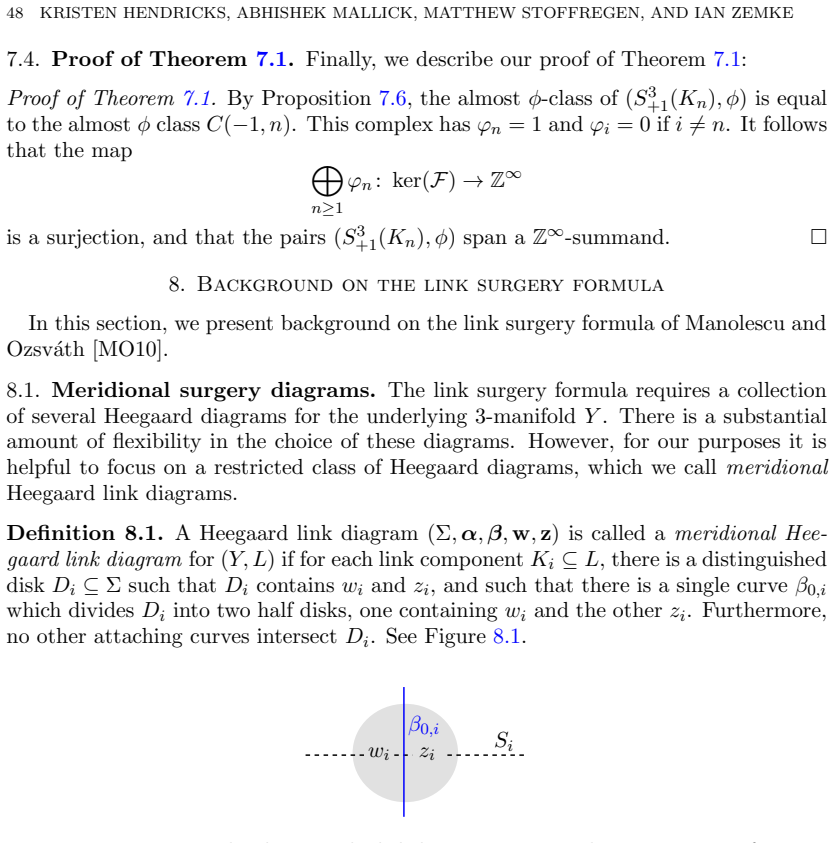
- [§8.1, Proposition 8.3] Proposition 8.3 asserts that any two meridional surgery diagrams are related by the six listed moves, with the proof omitted because it allegedly follows from standard techniques. This proposition is load-bearing: the transition maps Psi_{H -> H'} in Theorem 1.13 and Theorem 13.1 are defined by composing maps across such moves, and the well-definedness of the equivariant link surgery formula in Theorem 9.1 depends on the completeness of this move set. The listed moves are plausible, but they are not obviously complete; in particular, it is not clear how moves (1)-(5) account for changes involving the distinguished disks D_i, the shadows S_i, and the relative positions of beta_{0,i} and beta_{Lambda,i}, and move (6) is stated too tersely to settle all such configurations. The authors need to supply a proof of Proposition 8.3, or an explicit reference that proves exactly this generation statement for this class of diagrams, together with the coherence data showing that different sequences of moves induce chain-homotopic transition maps.
- [§13.1, Theorem 13.1] The proof of the main naturality theorem is presented as a verification of the distinguished rectangles from [JTZ21, Definition 2.29], but the actual verification for meridional surgery diagrams with local systems and knot shadows is not fully written out. In particular, the independence of Psi_{H -> H'} from the chosen sequence of moves in Proposition 8.3, and the homotopy commutativity of rectangles involving move (6) together with the shadow and twisted-coefficient data, are not demonstrated. Since Theorem 13.1 is the foundation for the chain-level intertwining statement in Theorem 9.1, the authors should either provide the missing verifications or state precisely which assertions in [JTZ21] or [Zem23] imply each step in the meridional setting.
- [§6.2, proof of Theorem 1.4] The proof of Theorem 1.4 leaves essential details to the reader: for n > 1 the map F is said to be defined by a diagram similar to (6.4), and the null-homotopy of F composed with X(phi_K) is left to the reader because it is claimed to be identical to [HHSZ20, Proposition 3.21(a)]. This theorem is one of the main local surgery formulas and is used later in Proposition 7.6 to compute the almost phi-class of +1 surgery on K_n, which drives the application in Theorem 1.9. The argument may indeed be a routine adaptation, but because it is load-bearing for the application, the authors should either include the missing details or give a precise statement of the cited result that covers exactly this equivariant setting.
minor comments (4)
- [§3.3] The phrase 'Mauer-Cartan equation' should be 'Maurer-Cartan equation'.
- [§6.2, Theorem 6.17] The notation for Spin^c structures in the statement of Theorem 6.17 appears garbled (for example 'h q-1 2 i'); the authors should fix the typesetting for the congruence classes.
- [§2.3, Definition 2.6] The condition 'satisfies phi^2 = id on S^3' is clear in context, but the formatting of phi^2 should be unified with the rest of the paper.
- [§10.3] The proof of Proposition 10.12 is elaborate and uses several homotopies whose compatibility with non-chain maps is handled via the Leibniz rule; a short summary of the notational conventions for colorings before the proof would improve readability.
Circularity Check
No circularity: the equivariant surgery formula is built from independent prior theorems and new proofs; the omitted proof of Proposition 8.3 is a rigor gap, not a circular step.
full rationale
I traced the derivation chain from the equivariant knot and link surgery formulas (Theorems 1.1, 5.2, 9.1) back to their stated inputs. The main inputs are: the nonexotic nonequivariant link surgery formula of Manolescu–Ozsvath [MO10] and the last author [Zem23]; naturality of Heegaard Floer homology [JTZ21]; algebraic models of the surgery algebra and elliptic involutions from [Zem21, Zem23]; and local equivalence computations adapted from [HHSZ20, DMS23, DHST23]. In each case the cited theorem is published and its assumptions are stated independently of the present paper's new equivariant intertwining result; I found no passage in which the conclusion of Theorem 9.1, Theorem 1.1, or Theorem 1.4 is assumed in order to prove itself or to prove a result that directly feeds back into it. The local formulas (e.g., Theorem 1.4) are proved by truncating the mapping cone and constructing explicit local maps using homotopies such as id + phi_K^2; they borrow the structure of [HHSZ20, Proposition 3.21] but do not import the equivariant surgery formula. The application to the equivariant homology cobordism group (Theorem 7.1) uses the algebraic invariants phi_n of [DHST23] and local classes computed via DMS23's strong-inversion formulas; no fitted parameter is renamed as a prediction, and no prediction reduces by construction to a fit. The clearest mathematical weakness is Proposition 8.3, which asserts that any two meridional surgery diagrams are related by the six listed moves and states: "The proof follows from standard techniques, so we omit it." This completeness/coherence statement is load-bearing for the transition maps Psi_{H to H'} and hence for Theorems 1.13 and 9.1, but an omitted proof is a rigor or correctness risk, not a circular dependency: the move set is an input geometric fact about diagram spaces, not a restatement of the target surgery formula. The paper also relies heavily on prior work by the authors (e.g., [Zem21, Zem23, JTZ21, DMS23, DHST23]), but those are externally established arguments whose statements do not include the equivariant link surgery formula itself, so this does not make the derivation circular. I therefore find no significant circularity and score 0.
Assumptions & free parameters
assumptions (6)
- standard math Heegaard Floer homology and its naturality under diffeomorphisms of pointed 3-manifolds, as in [OS04b, OS04c, JTZ21].
- standard math The Manolescu-Ozsvath link surgery formula [MO10], including hypercube and hyperbox formalisms and the isomorphism C_Lambda(L) with HF^-(Y_Lambda(L)).
- standard math The bordered type-A and type-D module framework and the surgery algebra K from [Zem21, Zem23], including the elliptic involution bimodule K[E]K.
- domain assumption Meridional complete systems suffice to compute the link surgery formula, and any two such systems are related by the moves in Proposition 8.3.
- standard math Smith conjecture: the fixed set of a strong inversion on S^3 is an unknot.
- standard math Classification of almost phi complexes and the homomorphisms phi_n from [DHST23, Theorem 6.2].
Cite this review
Pith. "Pith review of The link surgery formula and equivariant surgeries." pith.science (2026). https://pith.science/paper/GOB2NLRS
@misc{pith2026250712809,
  author       = {Pith},
  title        = {Pith review of: The link surgery formula and equivariant surgeries},
  year         = {2026},
  howpublished = {\url{https://pith.science/paper/GOB2NLRS}},
  note         = {Machine review of arXiv:2507.12809}
}
abstract
We prove an equivariant version of the Heegaard Floer link surgery formula. As a special case, this gives an equivariant knot surgery formula for equivariant knots in $S^3$. Our proof goes by way of a naturality theorem for certain bordered modules described by the last author. As a sample application, we prove the kernel of the forgetful map from the equivariant homology cobordism group to the homology cobordism group contains a $\Z^\infty$-summand.
Figures


Figures from the paper (12 more)



Forward citations
Cited by 1 Pith paper
-
Unbounded Gaps Between Ordinary and Equivariant Dehn Surgery Numbers
For every k, a 3-manifold with an involution has ordinary Dehn surgery number k and equivariant Dehn surgery number 2k.
Reference graph
Works this paper leans on
-
[1]
[AKS20] Antonio Alfieri, Sungkyung Kang, and Andr´ as I Stipsicz, Connected Floer homology of covering involutions, Mathematische Annalen 377 (2020), no. 3, 1427–1452. [Ati61] M. F. Atiyah, Bordism and cobordism, Proc. Cambridge Philos. Soc. 57 (1961), 200–208. [Ban97] Augustin Banyaga, The structure of classical diffeomorphism groups , Mathematics and it...
work page 2020
-
[11]
[Sak86] , On strongly invertible knots , Algebraic and topological theories (Kinosaki, 1984), 1986, pp. 176–196. [Sar11] Sucharit Sarkar, Maslov index formulas for Whitney n-gons, J. Symplectic Geom. 9 (2011), no. 2, 251–270. [Sei08] Paul Seidel, Fukaya categories and Picard-Lefschetz theory , Zurich Lectures in Advanced Mathematics, European Mathematical...
work page 2011
-
[44]
Invariant splitting principles for the Lipshitz--Ozsv\'ath--Thurston correspondence
[GK24] Gary Guth and Sungkyung Kang, Invariant splitting principles for the Lipshitz–Ozsv´ ath– Thurston correspondence, arXiv preprint arXiv:2404.06618 (2024). [HHSZ20] Kristen Hendricks, Jennifer Hom, Matthew Stoffregen, and Ian Zemke, Surgery exact tri- angles and involutive Heegaard Floer homology ,
work page Pith review arXiv 2024
-
[58]
Milnor, Spin structures on manifolds , Enseign
[Mil63] J. Milnor, Spin structures on manifolds , Enseign. Math. (2) 9 (1963), 198–203. THE LINK SURGERY FORMULA AND EQUIV ARIANT SURGERIES 99 [MO10] Ciprian Manolescu and Peter S. Ozsv´ ath, Heegaard Floer homology and integer surgeries on links ,
work page 1963
-
[112]
1, 2 (Z¨ urich, 1994), 1995, pp
[Kon95] Maxim Kontsevich, Homological algebra of mirror symmetry , Proceedings of the Interna- tional Congress of Mathematicians, Vol. 1, 2 (Z¨ urich, 1994), 1995, pp. 120–139. [Lip06] Robert Lipshitz, A cylindrical reformulation of Heegaard Floer homology, Geom. Topol. 10 (2006), 955–1097. [LLP23] Adam Simon Levine, Tye Lidman, and Lisa Piccirillo, New c...
arXiv 2006
-
[1974]
[NW15] Yi Ni and Zhongtao Wu, Cosmetic surgeries on knots in S3, J. Reine Angew. Math. 706 (2015), 1–17. [OS04a] Peter Ozsv´ ath and Zolt´ an Szab´ o,Holomorphic disks and knot invariants , Adv. Math. 186 (2004), no. 1, 58–116. [OS04b] , Holomorphic disks and topological invariants for closed three-manifolds , Ann. of Math. (2) 159 (2004), no. 3, 1027–115...
work page 2015
-
[1997]
[BK90] A. I. Bondal and M. M. Kapranov, Enhanced triangulated categories, Mat. Sb. 181 (1990), no. 5, 669–683. [CZZ24] Daren Chen, Ian Zemke, and Hugo Zhou, L-space satellite operations and knot Floer ho- mology,
work page 1990
-
[2003]
arXiv:math/ 0306378. [Sak01] Makoto Sakuma, Surgery description of orientation-preserving periodic maps on compact orientable 3-manifolds , Rend. Istit. Mat. Univ. Trieste 32 (2001), no. suppl
work page 2001
Show all 15 references
-
[2008]
[Thu74] William Thurston, Foliations and groups of diffeomorphisms , Bull. Amer. Math. Soc. 80 (1974), 304–307. [Zem15] Ian Zemke, Graph cobordisms and Heegaard Floer homology,
1974
-
[2010]
[Mon75] Jos´ e M
arXiv:1011.1317. [Mon75] Jos´ e M. Montesinos,Surgery on links and double branched covers of S3, Knots, groups, and 3-manifolds (Papers dedicated to the memory of R. H. Fox), 1975, pp. 227–259. Ann. of Math. Studies, No
1975
-
[2015]
[Zem17] , Quasistabilization and basepoint moving maps in link Floer homology , Algebr
arXiv:1512.01184. [Zem17] , Quasistabilization and basepoint moving maps in link Floer homology , Algebr. Geom. Topol. 17 (2017), no. 6, 3461–3518. [Zem19a] , Connected sums and involutive knot Floer homology , Proc. Lond. Math. Soc. (3) 119 (2019), no. 1, 214–265. [Zem19b] , ...
2017
-
[2020]
[HHSZ22] , On the quotient of the homology cobordism group by Seifert spaces , Trans
arXiv:2011.00113. [HHSZ22] , On the quotient of the homology cobordism group by Seifert spaces , Trans. Amer. Math. Soc. Ser. B 9 (2022), 757–781. [HHSZ24] , Naturality and functoriality in involutive Heegaard Floer homology , Quantum Topol. (2024). DOI 10.4171/QT/210. [HM17] ...
2022 arXiv
-
[2021]
[Zem23] , A general Heegaard Floer surgery formula ,
arXiv: 2109.11520. [Zem23] , A general Heegaard Floer surgery formula ,
-
[2023]
arXiv2308.15658. 100 KRISTEN HENDRICKS, ABHISHEK MALLICK, MATTHEW STOFFREGEN, AND IAN ZEMKE Department of Mathematics, Rutgers University, New Brunswick, NJ, USA Email address : kristen.hendricks@rutgers.edu Department of Mathematics, Dartmouth College, Hanover, NH, USA Email ...
-
[2024]
[DHM23] Irving Dai, Matthew Hedden, and Abhishek Mallick, Corks, involutions, and Heegaard Floer homology, J
arXiv2412.05755. [DHM23] Irving Dai, Matthew Hedden, and Abhishek Mallick, Corks, involutions, and Heegaard Floer homology, J. Eur. Math. Soc. (JEMS) 25 (2023), no. 6, 2319–2389. [DHST23] Irving Dai, Jennifer Hom, Matthew Stoffregen, and Linh Truong,An infinite-rank summand of...
2023 arXiv
Reviewed August 6, 2026 · model on record in the stance chip above.
Discussion (0). Continue with ORCID to comment.