Ray-Tracing vs. 3GPP TDL: Power Delay Profile Analysis in Outdoor-to-Indoor and Indoor Channels
Pith reviewed 2026-05-25 03:06 UTC · model grok-4.3
The pith
Ray-tracing shows 3GPP TDL models produce longer delay spreads and miss site-specific multipath spikes in urban O2I and indoor channels.
A machine-rendered reading of the paper's core claim, the machinery that carries it, and where it could break.
Core claim
3GPP TDL models generally exhibit longer delay spreads and often fail to capture deterministic, site-specific features such as late-arriving energy and irregular spikes, while ray-tracing better represents fine multipath structures; therefore TDL models suit large-scale system evaluation but deterministic or hybrid approaches are more appropriate for site-specific physical-layer design.
What carries the argument
Comparison of power-normalized power delay profiles between ray-tracing and TDL models evaluated via RMS delay spread, mean excess delay, effective maximum delay, and Kullback-Leibler divergence.
If this is right
- TDL models can still approximate primary channel features for broad system-level evaluations.
- Site-specific physical-layer design requires deterministic modeling to account for geometry-dependent multipath.
- Hybrid statistical-deterministic models could address the observed gaps in fine structure.
- Reliance on ensemble-averaged statistics inherently limits TDL fidelity for irregular delay profiles.
Where Pith is reading between the lines
- Similar mismatches may occur in other city layouts or frequency bands, suggesting a need for location calibration of models.
- The work implies that 3GPP standards could incorporate optional geometry inputs for higher accuracy in targeted deployments.
- Extending the comparison to measured data would provide a direct test of whether ray-tracing or TDL better matches reality.
Load-bearing premise
The ray-tracing model implemented in Remcom Wireless InSite provides a sufficiently accurate representation of actual propagation physics in the chosen Washington D.C. scenarios to serve as the reference for evaluating the 3GPP models.
What would settle it
Field measurements of power delay profiles collected at the same Washington D.C. locations and link conditions, compared directly to both the ray-tracing results and the TDL model outputs for agreement on delay spread values and presence of late energy spikes.
Figures


read the original abstract
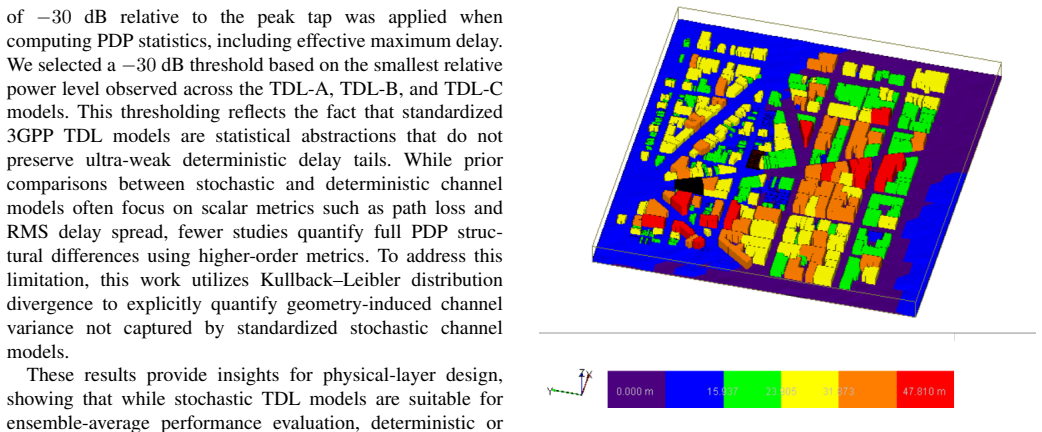
3rd Generation Partnership Project (3GPP) Technical Report (TR) 38.901 channel models (Releases 15-19) are widely used for physical-layer design and system-level evaluation in dense urban outdoor-to-indoor (O2I) and indoor environments. These models capture ensemble-averaged channel statistics but do not account for site-specific geometry. In this paper, we compare Power Delay Profiles (PDPs) derived from a deterministic ray-tracing model (Remcom Wireless InSite software) with those from the 3GPP TR 38.901 Tapped Delay Line (TDL) channel models. This comparative analysis is performed using a dense urban O2I scenario and a representative single-story indoor layout modeled in Washington, D.C., under matched link-distance and Non-Line-of-Sight (NLOS) conditions. All Wireless InSite PDPs are power-normalized to enable comparison of relative multipath delay structure. We evaluate root-mean-square (RMS) delay spread, mean excess delay, effective maximum delay, and Kullback-Leibler (KL) distribution divergence. Results indicate that 3GPP TDL models generally exhibit longer delay spreads and often fail to capture deterministic, site-specific features such as late-arriving energy and irregular spikes. While TDL models can approximate primary channel features in some cases, their reliance on ensemble-averaged statistics rather than geometry limits their representation of fine multipath structures. We conclude that while 3GPP TDL models are suitable for large-scale system evaluation, deterministic or hybrid approaches are more appropriate for site-specific physical-layer design.
Editorial analysis
A structured set of objections, weighed in public.
Referee Report
Summary. The paper performs an empirical comparison of power delay profiles (PDPs) generated by Remcom Wireless InSite ray-tracing against 3GPP TR 38.901 TDL models in matched NLOS outdoor-to-indoor and indoor scenarios modeled in Washington, D.C. It normalizes all PDPs to unit power and evaluates RMS delay spread, mean excess delay, effective maximum delay, and Kullback-Leibler divergence, concluding that the TDL models produce longer delay spreads and miss deterministic site-specific features such as late-arriving energy and irregular spikes.
Significance. If the ray-tracing PDPs were shown to be a validated reference, the work would usefully illustrate the limitations of ensemble-averaged TDL models for site-specific physical-layer design and support the recommendation for deterministic or hybrid approaches. The comparison itself is direct and non-circular, but the absence of measurement validation limits the strength of any claim that observed differences reflect shortcomings of the TDL models rather than modeling artifacts.
major comments (2)
- [Abstract] Abstract and methods description: the paper provides no information on the number of Monte Carlo realizations, statistical significance tests, specific ray-tracing parameters (maximum reflection/diffraction orders, material permittivities, foliage modeling), or the exact criteria used to select the Washington D.C. building layouts and link distances. These omissions make it impossible to assess whether the reported differences in delay spread and PDP shape are robust or sensitive to unstated modeling choices.
- [Abstract] Abstract and conclusion: the central claim that 3GPP TDL models 'fail to capture deterministic, site-specific features' and 'exhibit longer delay spreads' treats the Wireless InSite ray-tracing PDPs as the reference truth. No comparison of these PDPs against field measurements (channel sounding) is reported for the modeled O2I or indoor scenarios, so discrepancies could arise from ray-tracing artifacts rather than TDL shortcomings.
minor comments (1)
- [Abstract] The abstract states that 'all Wireless InSite PDPs are power-normalized' but does not specify whether normalization is performed per realization or across an ensemble, nor how this affects the KL-divergence calculation.
Simulated Author's Rebuttal
We thank the referee for the constructive feedback. We address each major comment below and indicate where revisions will be made to the manuscript.
read point-by-point responses
-
Referee: [Abstract] Abstract and methods description: the paper provides no information on the number of Monte Carlo realizations, statistical significance tests, specific ray-tracing parameters (maximum reflection/diffraction orders, material permittivities, foliage modeling), or the exact criteria used to select the Washington D.C. building layouts and link distances. These omissions make it impossible to assess whether the reported differences in delay spread and PDP shape are robust or sensitive to unstated modeling choices.
Authors: We agree that these methodological details were omitted and are needed for reproducibility and assessment of robustness. In the revised manuscript we will add a methods subsection specifying: ray-tracing is deterministic (no Monte Carlo realizations), maximum reflection order of 6 and diffraction order of 2, material electromagnetic properties (permittivity and conductivity values for concrete, glass, brick, etc.), foliage modeling (none applied, as the scenarios contain no vegetation), and scenario selection criteria (representative NLOS O2I and indoor links with distances 25-90 m chosen from dense urban Washington D.C. building footprints to match typical 3GPP O2I deployment assumptions). No statistical significance tests were performed because the comparison is between deterministic outputs for fixed geometries rather than statistical ensembles. revision: yes
-
Referee: [Abstract] Abstract and conclusion: the central claim that 3GPP TDL models 'fail to capture deterministic, site-specific features' and 'exhibit longer delay spreads' treats the Wireless InSite ray-tracing PDPs as the reference truth. No comparison of these PDPs against field measurements (channel sounding) is reported for the modeled O2I or indoor scenarios, so discrepancies could arise from ray-tracing artifacts rather than TDL shortcomings.
Authors: We partially agree. The paper's purpose is a direct comparison of PDP structure produced by a geometry-based deterministic tool versus the ensemble-averaged TDL models under matched conditions; it does not claim the ray-tracing outputs are ground truth. We will revise the abstract and conclusion to use more qualified phrasing (e.g., 'suggest longer delay spreads' and 'do not reproduce certain site-specific multipath features observed in the ray-tracing results') and will add an explicit limitations statement noting the absence of measurement validation. We cannot add channel-sounding data, as this work is limited to model-to-model comparison. revision: partial
- Empirical validation of the ray-tracing PDPs against field measurements, which is outside the scope of the current study.
Circularity Check
No circularity: direct empirical model comparison
full rationale
The paper conducts a side-by-side simulation comparison of PDPs generated by Wireless InSite ray-tracing versus 3GPP TR 38.901 TDL models in two fixed Washington D.C. geometries. No parameters are fitted to data, no predictions are derived from prior results, and no self-citations or uniqueness theorems are invoked to justify the methodology. All reported metrics (RMS delay spread, KL divergence, etc.) are computed directly from the two independent simulation outputs under matched link conditions. The assumption that ray-tracing serves as reference is an external modeling choice, not a reduction of the claimed results to the paper's own inputs. This is a standard self-contained empirical study with no load-bearing circular steps.
Axiom & Free-Parameter Ledger
axioms (2)
- domain assumption Ray-tracing in Remcom Wireless InSite accurately captures electromagnetic propagation physics for the modeled buildings and materials
- domain assumption The selected O2I and indoor layouts in Washington D.C. are representative of dense urban NLOS conditions
Reference graph
Works this paper leans on
-
[1]
Study on channel model for frequencies from 0.5 to 100 GHz,
3GPP, “Study on channel model for frequencies from 0.5 to 100 GHz,” 3rd Generation Partnership Project (3GPP), Technical Report (TR) 38.901, 4 2026, release 19. [Online]. Available: https://www.3gpp.org/ftp/Specs/archive/38 series/38.901/
work page 2026
-
[2]
P. Ky ¨osti, J. Meinil ¨a, L. Hentil ¨a, X. Zhao, T. J ¨ams¨a, M. Narandzic, M. Milojevi ´c, A. Hong, J. Ylitalo, V .-M. Holappa, M. Alatossava, R. J. C. Bultitude, Y . Jong, and T. Rautiainen, “WINNER II Channel Models,” IST-4-027756 WINNER II D1.1.2 V1.2, Technical Report, Feb. 2008. [Online]. Available: https://www.researchgate.net/ publication/2340557...
-
[3]
The COST 2100 MIMO Channel Model,
L. Liu, C. Oestges, J. Poutanen, K. Haneda, P. Vainikainen, F. Quitin, F. Tufvesson, and P. De Doncker, “The COST 2100 MIMO Channel Model,”IEEE Wireless Communications, vol. 19, no. 6, pp. 92–99, 2012
work page 2012
-
[4]
A Ray Tracing Technique to Predict Path Loss and Delay Spread Inside Buildings,
S. Y . Seidel and T. S. Rappaport, “A Ray Tracing Technique to Predict Path Loss and Delay Spread Inside Buildings,” inProc. IEEE Global Telecommunications Conference (GLOBECOM), vol. 2, Orlando, FL, USA, Dec. 1992, pp. 649–653
work page 1992
-
[5]
A Ray Tracing Method for Predicting Path Loss and Delay Spread in Microcellular Environments,
K. R. Schaubach, N. J. Davis, and T. S. Rappaport, “A Ray Tracing Method for Predicting Path Loss and Delay Spread in Microcellular Environments,” inProc. IEEE 42nd V ehicular Technology Conference (VTC), vol. 2, Denver, CO, USA, May 1992, pp. 932–935
work page 1992
-
[6]
60 GHz Channel Measurements and Ray Tracing Modeling in an Indoor Environment,
A. Zhou, J. Huang, J. Sun, Q. Zhu, C.-X. Wang, and Y . Yang, “60 GHz Channel Measurements and Ray Tracing Modeling in an Indoor Environment,” inProc. 9th International Conference on Wireless Communications and Signal Processing (WCSP), Nanjing, China, Oct. 2017, pp. 1–6
work page 2017
-
[7]
Wireless InSite: 3D Wireless Prediction Software,
Remcom, Inc., “Wireless InSite: 3D Wireless Prediction Software,” 2026, [Online]. Accessed: May 8, 2026. [Online]. Available: https://www.remcom.com/wireless-insite-propagation-software
work page 2026
-
[8]
Bounding the Practical Error of Path Loss Models,
C. Phillips, D. Sicker, and D. Grunwald, “Bounding the Practical Error of Path Loss Models,”International Journal of Antennas and Propagation, vol. 2012, no. 1, p. 754158, 2012. [Online]. Available: https://onlinelibrary.wiley.com/doi/abs/10.1155/2012/754158
-
[9]
On information and sufficiency,
S. Kullback and R. A. Leibler, “On information and sufficiency,”The annals of mathematical statistics, vol. 22, no. 1, pp. 79–86, 1951
work page 1951
-
[10]
Modeling underwater acoustic chan- nels in short-range shallow water environments,
H. Kulhandjian and T. Melodia, “Modeling underwater acoustic chan- nels in short-range shallow water environments,” inProceedings of the 9th International Conference on Underwater Networks & Systems, 2014, pp. 1–5
work page 2014
discussion (0)
Sign in with ORCID, Apple, or X to comment. Anyone can read and Pith papers without signing in.