REVIEW 2 major objections 5 minor 1 cited by
Green-Lazarsfeld Condition for Toric Edge Ideals of Bipartite Graphs
T0 review · 2 major / 5 minor · reviewed 2026-08-14 · deepseek-v4-flash
Pith's one-line read A bipartite graph's toric edge ideal is linearly presented exactly when its bipartite complement is essentially a tree of diameter at most 3, and the whole $\mathbf{N}_p$ ladder is classified.
desk verdict Completes the N_p classification for toric edge ideals of bipartite graphs; N2 proof is solid, but the N3 exceptional-characteristic claim rests on an unreproduced Macaulay2 computation. read the letter →
The pith
A machine-rendered reading of the paper's core claim, the machinery that carries it, and where it could break.
The reading
What carries the argument
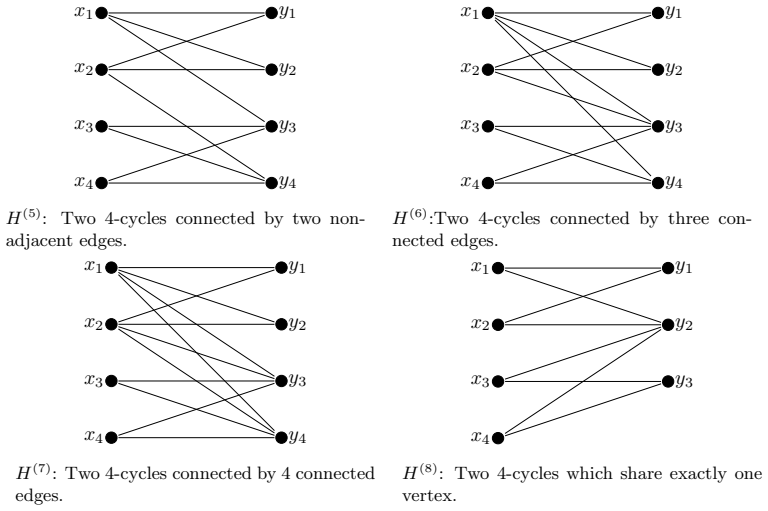
The load-bearing objects are the bipartite complement $\overline{G}$ (same bipartition, edges reversed) and the notion of being essentially a tree (a tree after deleting isolated vertices). The engine is a local-to-global Betti obstruction: $\beta_{i,\alpha}(I_G)=\dim_k \tilde H_i(\Gamma(\alpha);k)$, where $\Gamma(\alpha)$ is the simplicial complex of monomials of multidegree $\alpha$; consequently every nonzero $\beta_{i,j}$ is witnessed by an induced subgraph on at most $2j$ vertices. This reduces each $\mathbf{N}_p$ failure to a finite forbidden-subgraph check. For $\mathbf{N}_2$, Proposition 5.1 — first syzygies in a Koszul ring are generated by linear syzygies and Koszul syzygies, the latter being the ones coming directly from pairs of quadratic relations — permits a five-case check of pairs of $4$-cycles, and Theorem 4.2 guarantees that whenever the bipartite complement is not essentially a tree of diameter at most $3$, one of the eight graphs $H^{(1)},\dots,H^{(8)}$ appears as an induced subgraph.
What would settle it
Compute the graded Betti table, over a field of characteristic not $3$, of the toric edge ideal of $K_{3,3}$ with one edge deleted; the paper's $\mathbf{N}_3$ argument predicts $\beta_{2,5}=1$, so a computation returning $\beta_{2,5}=0$ would refute the classification.
Extended reading notes
Core claim
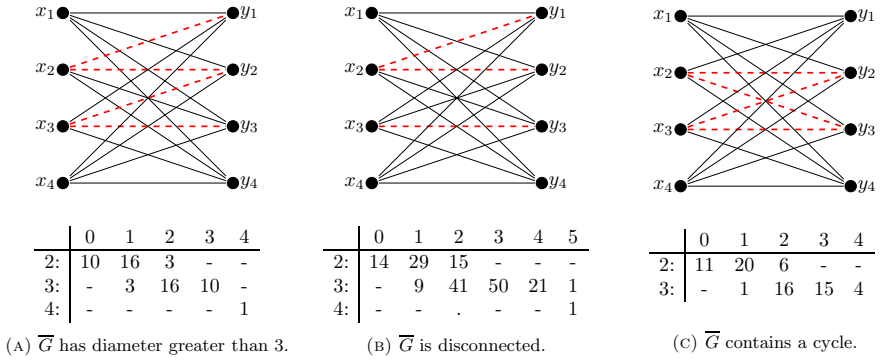
The central claim is Theorem 1.2. For a bipartite graph $G$ with minimum vertex degree at least $2$ over a field $k$, the toric edge ideal $I_G$ satisfies $\mathbf{N}_1$ exactly when every cycle of length at least $6$ has a chord; $\mathbf{N}_2$ exactly when the bipartite complement of $G$ is essentially a tree of diameter at most $3$; $\mathbf{N}_3$ exactly when $G$ is complete bipartite, except that $K_{m,n}$ with $\min\{m,n\}\ge 5$ fails $\mathbf{N}_3$ in characteristic $3$; and $\mathbf{N}_p$ for any $p\ge 4$ exactly when $G=K_{2,n}$. The proof route is: Theorem 3.2 turns a nonzero graded Betti number of $I_G$ into an induced subgraph on at most $2j$ vertices, Lemmas 3.3–3.6 exhibit the obstructions to $\mathbf{N}_2,\mathbf{N}_3,\mathbf{N}_4$, Theorem 4.2 converts the absence of eight forbidden induced subgraphs into the tree-complement statement, and Proposition 5.1 lets the $\mathbf{N}_2$ case be checked by examining the five configurations of two distinct $4$-cycles. The classification is then translated to convex polyomino ideals and used to rule out a family of linearly presented bipartite toric edge ideals with slow regularity growth.
Load-bearing premise
The $\mathbf{N}_2$ half of the theorem rests on the assumption that in a Koszul ring every first syzygy is generated by linear syzygies together with the syzygies coming directly from pairs of quadratic relations; if that decomposition misses a syzygy type, the proof's five-case check of pairs of $4$-cycles is incomplete.
Editorial extensions
If this is right
- If $I_G$ satisfies $\mathbf{N}_2$, linear presentation can be read off by deleting isolated vertices from the bipartite complement and checking whether the rest is a tree of diameter at most $3$.
- A failure of $\mathbf{N}_3$ for a non-complete bipartite graph shows up as a nonzero second syzygy in degree $5$, so only complete bipartite graphs can reach $\mathbf{N}_3$.
- Once $\mathbf{N}_4$ holds, the graph is $K_{2,n}$ and the resolution is fully linear via the Eagon–Northcott complex, so $\mathbf{N}_4$ is the same as having a linear free resolution for these ideals.
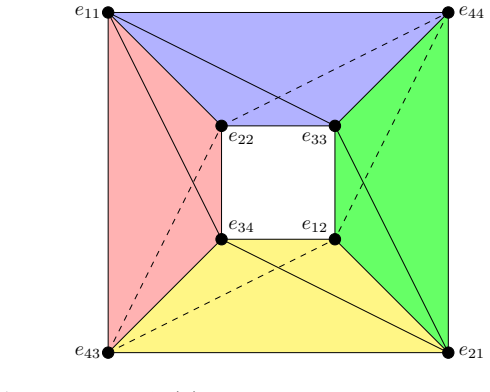
- For convex polyominoes, the translated criterion says $\mathbf{N}_2$ holds exactly when all missing cells lie in the first row or first column, $\mathbf{N}_3$ when the polyomino is an interval (with the same characteristic-$3$ caveat for large intervals), and $\mathbf{N}_4$ when the interval has one side of length $2$.
- No family of bipartite graphs with linearly presented toric edge ideals can give a positive answer to the open question about linearly presented ideals with positive regularity-to-projective-dimension ratio: if the projective dimension tends to infinity, the ratio tends to $0$.
Reading between the lines
- The same local-obstruction method suggests a finite decision procedure for $\mathbf{N}_p$ in any toric ring generated by quadrics: list the finitely many multidegrees of total degree $2j$ and check the reduced homology of their fibers; for bipartite graphs the list collapses to eight forbidden subgraphs, while for other normal toric rings it will be longer but still finite.
- The $\mathbf{N}_2$ characterization doubles as a generator of examples: start with any tree of diameter at most $3$ on a fixed bipartition, take its bipartite complement, and the resulting graph has a linearly presented toric edge ideal, giving a large family on which regularity bounds can be tested.
- The isolated characteristic-$3$ failure at $\mathbf{N}_3$ for large complete bipartite graphs hints that modular representation theory of symmetric groups controls higher linear syzygies of Segre varieties; the present classification shows such effects cannot survive past $\mathbf{N}_4$ for bipartite graphs, but they may appear in other toric ideals.
- The paper's correction to the polyomino criterion illustrates a general caution: when a graph-theoretic theorem is transported through a dictionary such as convex polyominoes to bipartite graphs, configurations can be silently dropped, so the image of the dictionary should be rechecked against the full graph classification.
Signed reviews
Editorial analysis
A structured set of objections, weighed in public.
Referee Report
Summary. The paper characterizes the Green-Lazarsfeld conditions N_p for toric edge ideals of bipartite graphs with minimum degree at least 2. The main theorem gives a complete combinatorial description: N_1 is Ohsugi-Hibi chordality of cycles of length at least 6; N_2 holds exactly when the bipartite complement is essentially a tree of diameter at most 3; N_3 holds exactly for complete bipartite graphs except in characteristic 3 when both parts have size at least 5; and N_p for p at least 4 holds exactly for K_{2,n}. The proofs combine multigraded Betti-number obstructions and induced-subgraph reductions (Theorem 3.2), a graph-theoretic classification of the obstructions (Theorem 4.2), a Koszul-algebra reduction to linear and Koszul syzygies (Proposition 5.1 and the five-configuration analysis in Theorem 5.2), and known resolutions of Segre and determinantal ideals. The paper also translates the results to convex polyomino ideals, corrects a characterization in [10], and applies the N_2 result to a regularity question of Constantinescu, Kahle, and Varbaro.
Significance. If the results hold, they provide a complete and elegant combinatorial description of all Green-Lazarsfeld conditions for toric edge ideals of bipartite graphs, interpolating between Ohsugi-Hibi's quadratic-generation theorem and Ohsugi-Hibi's linear-resolution theorem. The N_2 proof supplies explicit syzygy decompositions for all five possible configurations of pairs of 4-cycles, and the global statement is checked against external benchmarks (Lascoux, Pragacz-Weyman, Hashimoto, Eagon-Northcott) rather than assumed. The polyomino application identifies an error in [10] and replaces it with a criterion that is consistent with the graph-theoretic classification. The regularity corollary for the Constantinescu-Kahle-Varbaro question is a clean consequence of the N_2 characterization. The main weakness is a load-bearing, unreproduced Macaulay2 computation in the proof of Theorem 5.5.
major comments (2)
- [§5, proof of Theorem 5.5] The assertion that p=3 is the only characteristic less than 20 in which I_{K_{5,5}} fails to satisfy N_3 is load-bearing for Theorem 1.2(3), but the only evidence supplied is 'A quick Macaulay2 [22] calculation shows...' with no script, log, or reproducible output. The surrounding argument only proves failure in characteristic 3 and success in characteristic 0 and p>20; therefore, a second bad prime among 2,5,7,11,13,17,19 would falsify the theorem. Please provide the Macaulay2 code and output, or replace the computation with an invariant-theoretic or representation-theoretic argument. The sentence describing the p>20 reduction ('the number of boxes in the last partition...') is also too terse as written; the integral Lascoux complex should be shown explicitly to be a resolution over the relevant localized integer ring.
- [§5, proof of Theorem 5.2 (Proposition 5.1)] The reduction of N_2 to checking five configurations of two distinct 4-cycles rests on Proposition 5.1, quoted from [21, Proposition 2.8], but the proposition is not stated in the paper and the term 'Koszul syzygy' is not defined. Because this proposition is load-bearing for the N_2 classification, the paper should state the proposition precisely, define the Koszul syzygies being considered, and justify that the five-configuration taxonomy together with the additional edges imposed by Theorem 4.2 exhausts all minimal Koszul syzygies in the relevant graphs. As written, a reader must take on faith both the validity of the quoted proposition in this setting and the exhaustiveness of the case analysis.
minor comments (5)
- [Abstract vs. Theorem 1.2] The abstract states that N_2 holds if and only if the bipartite complement of G is a tree of diameter at most 3, while Theorem 1.2 and the main body state the condition as 'essentially a tree of diameter at most 3'; these statements should be aligned.
- [Title and Section 6] There are several typographical errors: the title contains 'BIP ART ITE', Proposition 6.2 says 'every chord with length ≥ 6 has a chord' where 'cycle' is meant, and 'polynomo' appears in Proposition 6.2.
- [Proof of Theorem 5.5] The phrase 'the only characteristic less than 20 which in which IG fails to satisfy N3' contains a duplicated 'which in'.
- [Proposition 4.1] Proposition 4.1 as stated is not true for graphs with isolated vertices under the convention used in its proof, where a graph with no edges is counted as essentially connected; for example, a graph consisting of one edge plus an isolated vertex has every induced subgraph essentially connected and acyclic but is not a tree. The proposition is applied only to graphs without isolated vertices, so this does not affect the main theorem, but the statement should be restricted or the convention clarified.
- [Section 6, after Remark 6.1] The sentence 'The ideal I_{H^{(1)}} ... is clearly not associated to any convex polyomino, which cannot have exactly 2 minimal generators' is ambiguous: 'which' appears to refer to a convex polyomino ideal rather than to a polyomino. Please rephrase for clarity.
Circularity Check
No significant circularity; the paper derives new equivalences from external cited theorems and independent Betti-number and graph-theoretic arguments.
full rationale
The derivation chain is self-contained in the relevant sense. Theorem 1.2(1) is a restatement of Ohsugi–Hibi (Theorem 1.1), an externally cited result; Theorem 5.2 proves the N2 classification using the external Koszul-syzygy decomposition [21, Proposition 2.8], a purely graph-theoretic classification Theorem 4.2, and explicit induced-subgraph Betti computations in Lemmas 3.3–3.4. No parameter is fitted, and no 'prediction' is set equal to an input by construction. Theorem 5.5 uses the external Lascoux/Pragacz–Weyman resolutions and [2, Main Theorem (2)]; the only unexpanded step is the sentence 'A quick Macaulay2 [22] calculation shows that p = 3 is the only characteristic less than 20 which in which IG fails to satisfy N3.' That is a finite computational check, and although it is load-bearing and not reproducible from the text, it is a computation about the same object being classified, not an assumption of the target equivalence. It is therefore a correctness/reproducibility risk, not circularity. Theorem 5.6 is likewise a short reduction to K3,3 and the Eagon–Northcott resolution. There are no author self-citations carrying the argument, no uniqueness theorem imported from the same authors, and no ansatz smuggled in by citation. The correction to [10] in Section 6 is a translation of the independently proved N2 theorem to polyomino ideals, not a renaming of a known result as a new one.
Assumptions & free parameters
assumptions (5)
- standard math Ohsugi-Hibi Theorem 1.1: N1 iff every cycle of length at least 6 has a chord, equivalent to a quadratic Grobner basis and Koszul property.
- standard math Mastroeni Proposition 5.1: in a Koszul algebra, the first syzygies of I are minimally generated by linear syzygies and Koszul syzygies.
- standard math Avramov-Conca-Iyengar Main Theorem (2): for linearly presented Koszul algebras, beta_{2,j} vanishes for all j at least 6.
- standard math Lascoux and Pragacz-Weyman resolutions of determinantal ideals, with characteristic independence results of Hashimoto-Kurano and Akin-Buchsbaum-Weyman.
- domain assumption Macaulay2 computation showing that p=3 is the only characteristic below 20 for which K5,5 fails N3.
Cite this review
Pith. "Pith review of Green-Lazarsfeld Condition for Toric Edge Ideals of Bipartite Graphs." pith.science (2026). https://pith.science/paper/GPABM7TU
@misc{pith2026190802744,
  author       = {Pith},
  title        = {Pith review of: Green-Lazarsfeld Condition for Toric Edge Ideals of Bipartite Graphs},
  year         = {2026},
  howpublished = {\url{https://pith.science/paper/GPABM7TU}},
  note         = {Machine review of arXiv:1908.02744}
}
abstract
Previously, Ohsugi and Hibi gave a combinatorial description of bipartite graphs $G$ whose toric edge ideal $I_G$ is generated by quadrics, showing that every cycle of $G$ of length at least $6$ must have a chord. This corresponds to the Green-Lazarsfeld condition $\mathbf{N}_1$. In this paper, we investigate the higher syzygies of $I_G$ and give combinatorial descriptions of the Green-Lazarsfeld conditions $\mathbf{N}_p$ of toric edge ideals of bipartite graphs for all $p \ge 1$. In particular, we show that $I_G$ is linearly presented (i.e. satisfies condition $\mathbf{N}_2$) if and only if the bipartite complement of $G$ is a tree of diameter at most $3$. We also investigate the regularity of linearly presented toric edge ideals and give criteria for polyomino ideals to satisfy the Green-Lazarsfeld conditions.
Figures
Figures from the paper (2 more)


Forward citations
Cited by 1 Pith paper
-
Edge rings of bipartite graphs with linear resolutions
A connected bipartite graph whose edge ring has a q-linear resolution, q≥3, has exactly one minimal even cycle, so its edge ring is a hypersurface.
Reference graph
Works this paper leans on
-
[10]
V. Ene, J. Herzog, T. Hibi, Linearly related polyominoe s. J. Algebr. Comb. (2015) 41:949–968
work page 2015
-
[22]
D. Grayson, and M. Stillman, Macaulay2, a software syst em for research in algebraic geometry, Available at http://www.math.uiuc.edu/Macaulay2/
-
[1]
K. Akin, D. Buchsbaum, J. W eyman, Resolutions of determi nantal ideals: the submaximal minors. Adv. in Math. 39 (1981), no. 1, 1–30
work page 1981
-
[2]
L. Avramov, A. Conca and S. Iyengar, Free resolutions ove r commutative Koszul algebras. Math. Res. Lett. 17 (2010), no. 2, 197–210
work page 2010
-
[3]
J. Biermann, A. O’Keefe, A. Van Tuyl, Bounds on the regula rity of toric ideals of graphs. Adv. in Appl. Math. 85 (2017), 84–102
work page 2017
-
[4]
D.A. Buchsbaum, D. Eisenbud, Algebra structures for fini te free resolutions, and some structure theorems for ideals of codimension 3, Am. J. Math. 99 (3) (1977) 447–485
work page 1977
-
[5]
Conca, Koszul algebras and their syzygies
A. Conca, Koszul algebras and their syzygies. Combinato rial algebraic geometry, 1–31, Lecture Notes in Math., 2108 , Fond. CIME/CIME Found. Subser., Springer, Cham, 2014
work page 2014
-
[6]
A. Constantinescu, T. Kahle, M. Varbaro, Linear syzygie s, hyperbolic Coxeter groups and regularity. Compos. Math. 155 (2019), no. 6, 1076–1097
work page 2019
Show all 32 references
-
[7]
D. Cox, J. Little, D. O’Shea, Using algebraic geometry, S econd edition. Graduate Texts in Mathematics, 185. Springe r, New York, 2005. 19
2005
-
[8]
H. Dao, C. Huneke, J. Schweig, Bounds on the regularity an d projective dimension of ideals associated to graphs, Jour nal of Algebraic Combinatorics 38 (2013), no. 1, 37–55
2013
-
[9]
Eisenbud, M
D. Eisenbud, M. Green, K. Hulek, S. Popescu, Restricting linear syzygies: algebra and geometry. Compos. Math. 141 (2005), no. 6, 1460–1478
2005
-
[11]
Green and R
M. Green and R. Lazarsfeld, The nonvanishing of certain Koszul cohomology groups, J. Differential Geom. 19 (1984), 168–170
1984
-
[12]
Green and R
M. Green and R. Lazarsfeld, On the projective normality of complete linear series on an algebraic curve, Invent. Mat h. 83 (1985), 73–90
1985
-
[13]
Gulliksen, O
T. Gulliksen, O. Neg ˙ ard, Un complexe r´ esolvant pour certains ideaux d´ eterminantiels. C. R. Acad. Sci. Paris Ser . A-B 274 (1972), A16–A18
1972
-
[14]
H. T. H´ a, S. Kara, A O’Keefe, Algebraic properties of to ric rings of graphs. Comm. Algebra 47 (2019), no. 1, 1–16
2019
-
[15]
Hashimoto, Determinantal ideals without minimal fr ee resolutions, Nagoya Math
M. Hashimoto, Determinantal ideals without minimal fr ee resolutions, Nagoya Math. J. 118 (1990), 203–216
1990
-
[16]
Hashimoto and K
M. Hashimoto and K. Kurano, Resolutions of determinant al ideals: n-minors of (n+2)-square matrices, Adv. in Math. 94 (1992), 1–66
1992
-
[17]
Herzog, T
J. Herzog, T. Hibi, H. Ohsugi, Binomial ideals. Graduat e Texts in Mathematics, 279. Springer, Cham, 2018
2018
-
[18]
T. Hibi, K. Matsuda, A. Tsuchiya, Edge rings with 3-line ar resolutions, to appear in Proc. of Amer. Math. Soc., doi: 10.1090/proc/14382
-
[19]
S. Kwak, E. Park, Some effects of property Np on the higher normality and defining equations of nonlinearly normal varieties, J. Reine Angew. Math. 582 (2005) 87–105
2005
-
[20]
Lascoux, Syzygies des vari´ et´ es determinantales,Adv
A. Lascoux, Syzygies des vari´ et´ es determinantales,Adv. Math. 30 (1978) 202–237
1978
-
[21]
Mastroeni, Koszul almost complete intersections
M. Mastroeni, Koszul almost complete intersections. J . Algebra 501 (2018), 285–302
2018
-
[23]
Matsuda, S
K. Matsuda, S. Murai, Regularity bounds for binomial ed ge ideals. J. Commut. Algebra 5 (2013), 141–149
2013
-
[24]
Ohsugi, T
H. Ohsugi, T. Hibi, Toric ideals generated by quadratic binomials. J. Algebra 218 (1999), 509–527
1999
-
[25]
Ohsugi, T
H. Ohsugi, T. Hibi, Koszul bipartite graphs, Adv. in App l. Math. 22 (1999) 25–28
1999
-
[26]
Ottaviani, R
G. Ottaviani, R. Paoletti, Syzygies of Veronese embedd ings, Compositio Math. 125 (2001) 31–37
2001
-
[27]
Roberts, A minimal free complex associated to the min ors of a matrix
P. Roberts, A minimal free complex associated to the min ors of a matrix. (English summary) J. Commut. Algebra 10 (2018), no. 2, 213–242
2018
-
[28]
Peeva, Graded syzygies
I. Peeva, Graded syzygies. Algebra and Applications, 14, Springer-Verlag London, Ltd., London, 2011
2011
-
[29]
Pragacz, J
P. Pragacz, J. W eyman, Complexes associated with trace and evaluation. Another approach to Lascoux’s resolution, Adv. Math. 57 (1985) 163–207
1985
-
[30]
Qureshi, Ideals generated by 2-minors, collections of cells and stack polyominoes, J.Algebra 357 (2012) 279–303
A. Qureshi, Ideals generated by 2-minors, collections of cells and stack polyominoes, J.Algebra 357 (2012) 279–303
2012
-
[31]
Rubei, Resolutions of Segre embeddings of projectiv e spaces of any dimension, J
E. Rubei, Resolutions of Segre embeddings of projectiv e spaces of any dimension, J. Pure Appl. Algebra 208 (2007), no. 1, 29–37
2007
-
[32]
Villarreal, Monomial algebras
R.H. Villarreal, Monomial algebras . Marcel Dekker, Inc., New York, 2001. E-mail address : zgreif@iastate.edu E-mail address : jmccullo@iastate.edu Iow a State University, Department of Mathematics, Ames, IA 50 011 20
2001
Reviewed August 14, 2026 · model on record in the stance chip above.
Discussion (0). Continue with ORCID to comment.