ND-TNN: Tensor-Neural-Network Approximation for High-Dimensional Nonlocal Diffusion Models
Pith reviewed 2026-06-27 17:51 UTC · model grok-4.3
The pith
Tensor neural network reduces high-dimensional nonlocal diffusion integrals to low-dimensional products while preserving asymptotically compatible error bounds.
A machine-rendered reading of the paper's core claim, the machinery that carries it, and where it could break.
Core claim
The TNN ansatz, when combined with the separable Gaussian kernel, reduces the nonlocal energy integrals exactly to products of low-dimensional integrals that are computed by quadrature; the resulting approximation satisfies the asymptotically compatible L2 estimate ||u_loc - u_δ,p||_L2(Ω) ≤ C(ε_f/√δ + ε_g/δ + ε_u/√δ + η_opt) + C√δ for Dirichlet conditions and an improved O(ε_f + ε_g/√δ + ε_u + η_opt + δ) bound together with a smoothed H1 estimate for Neumann conditions.
What carries the argument
The tensor neural network (TNN) ansatz paired with the separable Gaussian kernel, which factors the high-dimensional nonlocal integrals into products of one-dimensional integrals evaluated by Gauss-Legendre quadrature.
If this is right
- The L2 error for Dirichlet conditions remains controlled by data approximation errors, optimization residual, and a term of order √δ as the nonlocal horizon δ approaches zero.
- Neumann conditions yield an improved L2 rate of order δ and permit an H1 estimate after a smoothing post-processing step.
- The method scales to tensor-product domains of dimension up to twenty without the integrals becoming prohibitive.
- A TNN-based preconditioning step extends the scheme to non-separable source and boundary data.
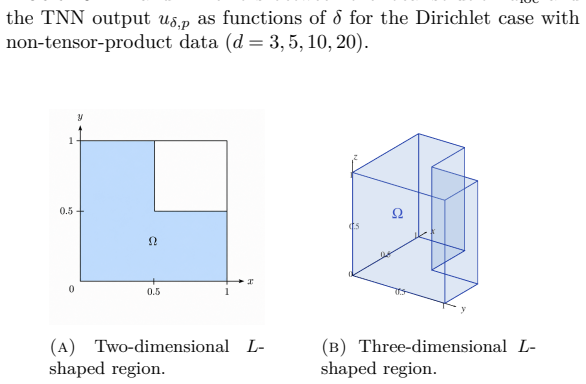
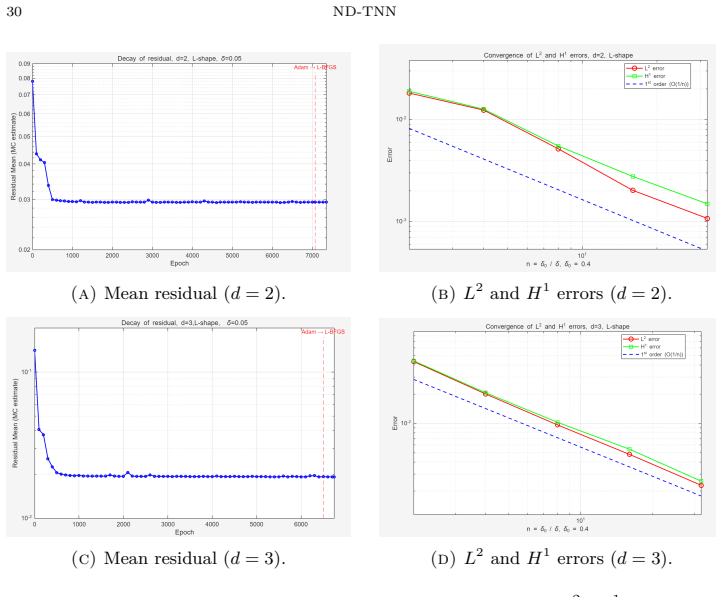
- The approach remains practically accurate on L-shaped domains even though the analysis assumes smooth tensor-product domains.
Where Pith is reading between the lines
- The same separability reduction could be applied to other nonlocal operators whose kernels admit a product structure.
- Quadrature accuracy on the reduced integrals may become the dominant error source once network optimization reaches machine precision.
- The smoothing step used for the H1 estimate suggests a general post-processing route for recovering derivatives from L2 approximations in nonlocal settings.
- Adaptive choice of quadrature nodes per dimension could further improve performance in dimensions beyond twenty.
Load-bearing premise
The Gaussian kernel is separable and the domain admits a tensor-product structure that lets the high-dimensional integrals factor exactly into products of low-dimensional integrals.
What would settle it
A computation on a five-dimensional tensor-product domain that, after driving the optimization residual below 10^-8, produces an L2 error larger than twice the sum of the predicted approximation terms plus √δ would falsify the error bound.
Figures

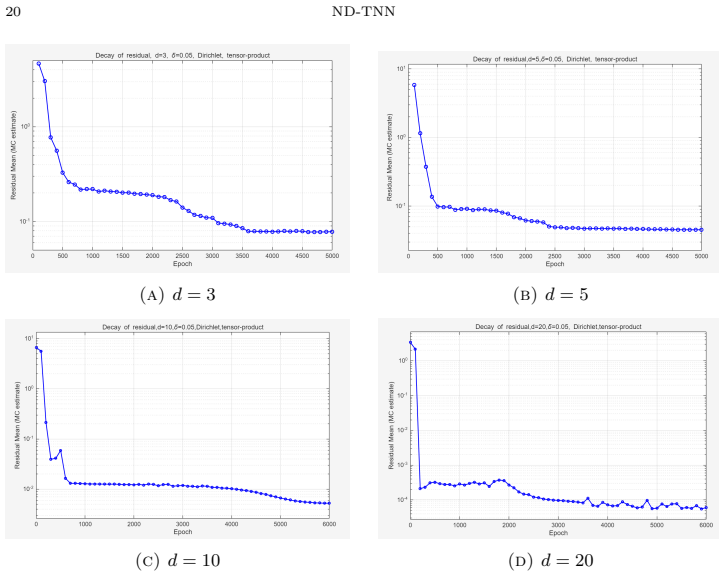

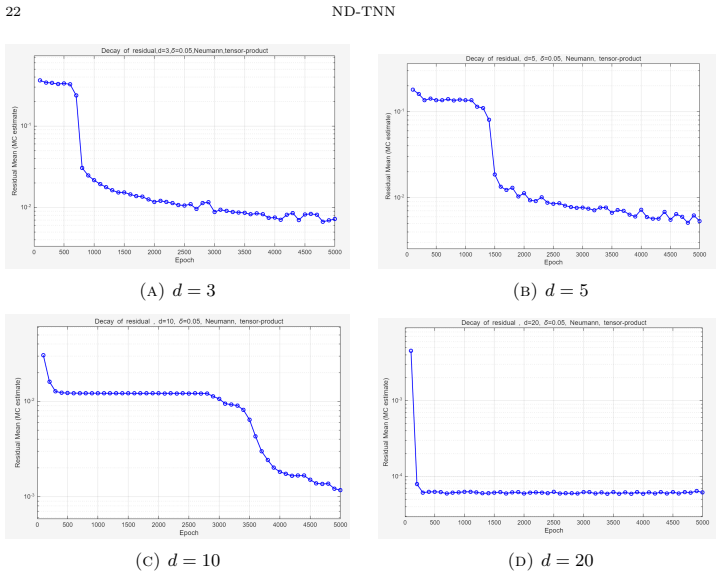

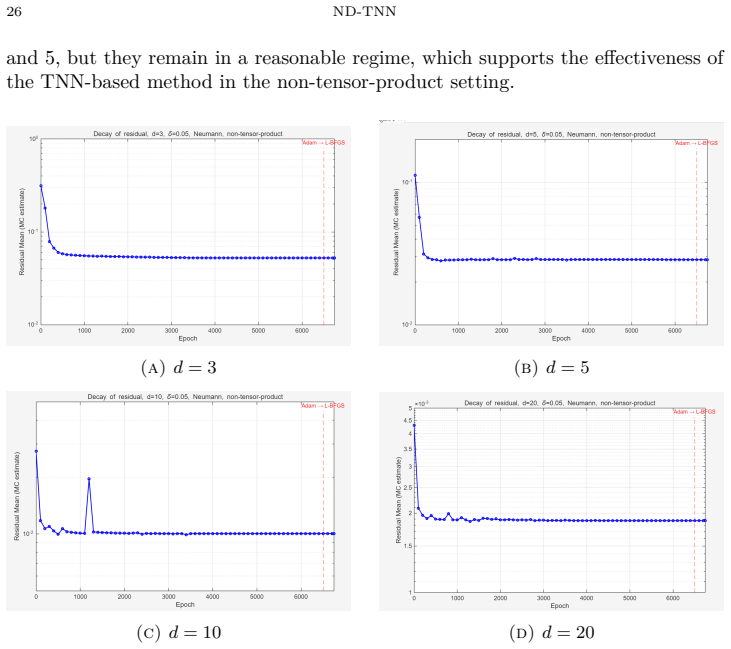

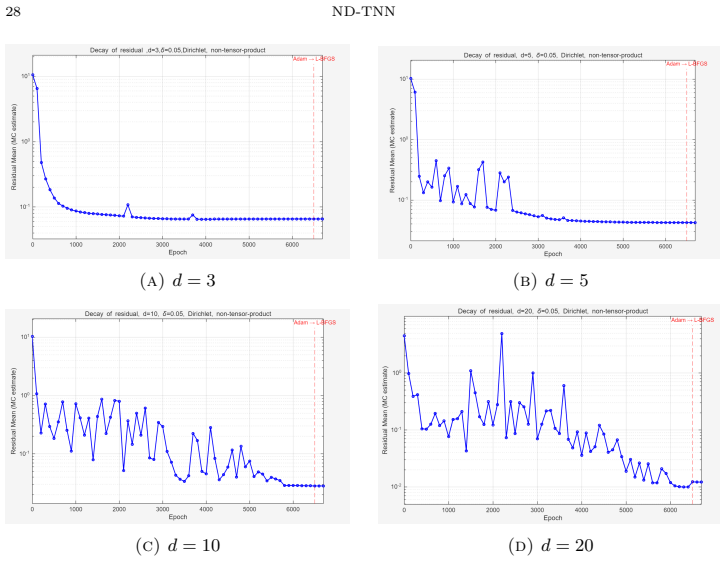
read the original abstract
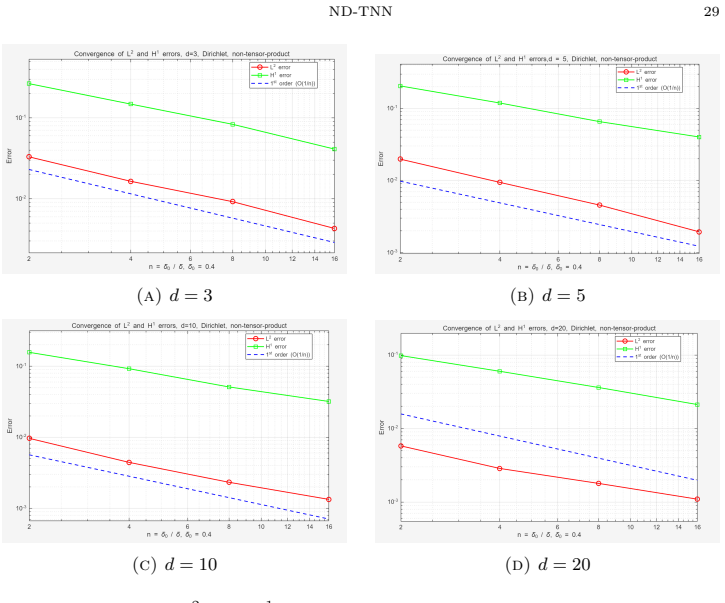
We study a numerical method, built on the tensor neural network (TNN) architecture introduced in \cite{wang2022tensor}, for solving nonlocal diffusion models in high-dimensional spaces. The tensor-product structure of the TNN ansatz, combined with the separability of the Gaussian kernel, reduces the high-dimensional integrals in the nonlocal energy to products of low-dimensional integrals, which are evaluated by Gauss--Legendre quadrature; nonseparable source and boundary data are handled by a TNN-based preconditioning step. For the Dirichlet boundary condition, we establish the asymptotically compatible $L^2$ error estimate \[ \|u_{\mathrm{loc}}-u_{\delta,p}\|_{L^2(\Omega)} \le C\!\left(\frac{\varepsilon_f}{\sqrt\delta} +\frac{\varepsilon_g}{\delta} +\frac{\varepsilon_u}{\sqrt\delta} +\eta_{\mathrm{opt}}\right) +C\sqrt\delta, \] where $\varepsilon_f$, $\varepsilon_g$ and $\varepsilon_u$ are the data and trial-class approximation errors and $\eta_{\mathrm{opt}}$ is the optimization residual. For the Neumann boundary condition, the $L^2$ estimate is improved to $O(\varepsilon_f+\varepsilon_g/\sqrt\delta+\varepsilon_u +\eta_{\mathrm{opt}}+\delta)$, and an $H^1$ gradient estimate is further obtained through a smoothing post-processing step. Numerical experiments on tensor-product domains up to $d=20$ support the theoretical results, and additional tests on two- and three-dimensional $L$-shaped domains demonstrate the practical robustness of the method beyond the smooth-domain setting covered by the analysis.
Editorial analysis
A structured set of objections, weighed in public.
Referee Report
Summary. The manuscript develops ND-TNN, a tensor-neural-network method for high-dimensional nonlocal diffusion problems. It uses the tensor-product structure of the TNN ansatz together with separability of the Gaussian kernel to reduce the nonlocal energy integrals to products of low-dimensional quadratures; non-separable data are handled via a TNN preconditioner. Asymptotically compatible L² error bounds are stated that explicitly incorporate data-approximation errors (ε_f, ε_g), trial-space error (ε_u), optimization residual (η_opt), and the standard O(√δ) consistency term; improved L² and post-processed H¹ bounds are given for Neumann conditions. Numerical tests on tensor-product domains up to dimension 20 and on L-shaped domains are reported in support of the theory.
Significance. If the stated error estimates are valid, the work supplies a scalable, theoretically supported route to high-dimensional nonlocal models whose cost grows only linearly with dimension under the tensor-product assumption. The explicit inclusion of optimization residuals and data-approximation terms inside the bounds, together with the numerical demonstration in d=20, constitutes a concrete advance over purely heuristic neural-network approaches for nonlocal problems.
minor comments (3)
- [Section 2] §2 (or wherever the TNN construction is recalled): the precise definition of the trial-class approximation error ε_u should be stated explicitly, including its dependence on the TNN rank and quadrature parameters, so that the error bound can be read without reference to the cited prior work.
- [Numerical experiments] The numerical section should report the observed scaling of the optimization residual η_opt with respect to the number of training iterations or network size, so that readers can judge whether the term remains negligible in the high-dimensional regime.
- [Numerical experiments] Figure captions and the text around the L-shaped-domain tests should clarify whether the reported errors are measured against a reference solution obtained on a fine mesh or against the local limit; this affects interpretation of the O(√δ) term.
Simulated Author's Rebuttal
We thank the referee for the positive summary of our work on ND-TNN and for recommending minor revision. No specific major comments appear in the provided report, so we have no individual points to address. We remain available to incorporate any editorial suggestions.
Circularity Check
No significant circularity detected
full rationale
The derivation of the asymptotically compatible L2 error bound proceeds from standard approximation properties of the TNN trial space, quadrature accuracy for the separable Gaussian kernel, and the known nonlocal-to-local consistency term O(√δ). The TNN ansatz is imported from an external citation (wang2022tensor) with no author overlap indicated, and the error terms ε_f, ε_g, ε_u, η_opt are defined as independent inputs measuring data and optimization residuals rather than being fitted or redefined to match the target bound. No self-definitional steps, fitted predictions, or load-bearing self-citations appear in the analysis or numerical method.
Axiom & Free-Parameter Ledger
axioms (2)
- domain assumption The Gaussian kernel admits a separable product representation that allows the nonlocal integral to factor into products of one-dimensional integrals.
- standard math Gauss-Legendre quadrature accurately approximates the resulting low-dimensional integrals to sufficient precision.
Reference graph
Works this paper leans on
-
[1]
Abdulle, Y
A. Abdulle, Y. Bai, and G. Vilmart. Reduced basis finite element heterogeneous multiscale method for quasilinear elliptic homogenization problems. Discrete and Continuous Dynamical Systems-Series S , 8(1):91–118, 2015
2015
-
[2]
Ainsworth and C
M. Ainsworth and C. Glusa. Towards an efficient finite element method for the integral fractional laplacian on polygonal domains. In Contemporary Computational Mathematics-A Celebration of the 80th Birthday of Ian Sloan , pages 17–57. Springer, 2018
2018
-
[3]
Askari, F
E. Askari, F. Bobaru, R. Lehoucq, M. Parks, S. A. Silling, and O. Weckner. Peridynamics for multiscale materials modeling. In Journal of Physics: Conference Series , volume 125, page 012078, 2008
2008
-
[4]
B. Bahr, M. Faustmann, and J. M. Melenk. An implementation of hp-fem for the fractional laplacian. Computers & Mathematics with Applications , 176:324–348, 2024
2024
-
[5]
Bonito, J
A. Bonito, J. P. Borthagaray, R. H. Nochetto, E. Otárola, and A. J. Salgado. Numerical methods for fractional diffusion. Computing and Visualization in Science , 19(5):19–46, 2018
2018
-
[6]
Bourgain, H
J. Bourgain, H. Brezis, and P. Mironescu. Another look at sobolev spaces. 2001
2001
-
[7]
Buades, B
A. Buades, B. Coll, and J.-M. Morel. Image denoising methods. a new nonlocal principle. SIAM review , 52(1):113–147, 2010
2010
-
[8]
Chen and M
X. Chen and M. Gunzburger. Continuous and discontinuous finite element methods for a peridynamics model of mechanics. Computer Methods in Applied Mechanics and Engineering , 200(9-12):1237–1250, 2011
2011
-
[9]
Q. Du. Nonlocal Modeling, Analysis, and Computation: Nonlocal Modeling, Analysis, and Computation. SIAM, 2019
2019
- [10]
-
[11]
Q. Du, L. Ju, L. Tian, and K. Zhou. A posteriori error analysis of finite element method for linear nonlocal diffusion and peridynamic models. Mathematics of computation, 82(284):1889– 1922, 2013
1922
-
[12]
Du and J
Q. Du and J. Yang. Asymptotically compatible fourier spectral approximations of nonlocal allen–cahn equations. SIAM Journal on Numerical Analysis , 54(3):1899–1919, 2016
1919
-
[13]
L. C. Evans. Partial differential equations , volume 19. American mathematical society, 2022
2022
-
[14]
Gilboa and S
G. Gilboa and S. Osher. Nonlocal linear image regularization and supervised segmentation. Multiscale Modeling & Simulation , 6(2):595–630, 2007
2007
-
[15]
Gilboa and S
G. Gilboa and S. Osher. Nonlocal operators with applications to image processing. Multiscale Modeling & Simulation , 7(3):1005–1028, 2009
2009
-
[16]
Griebel and S
M. Griebel and S. Knapek. Optimized tensor-product approximation spaces. Constructive Approximation, 16(4):525–540, 2000
2000
-
[17]
Y. D. Ha and F. Bobaru. Characteristics of dynamic brittle fracture captured with peridy- namics. Engineering Fracture Mechanics, 78(6):1156–1168, 2011
2011
- [18]
-
[19]
Z. Li, Z. Shi, and J. Sun. Point integral method for solving poisson-type equations on man- ifolds from point clouds with convergence guarantees. Communications in Computational Physics, 22(1):228–258, 2017
2017
-
[20]
Z. Lin, Q. Ma, H. Xie, and X. Yin. Solving time-fractional partial integro-differential equations using tensor neural network. SIAM Journal on Scientific Computing , 48(1):C164–C189, 2026. 36 ND-TNN
2026
-
[21]
D. J. Littlewood. Simulation of dynamic fracture using peridynamics, finite element modeling, and contact. In ASME International mechanical engineering congress and exposition , volume 44465, pages 209–217, 2010
2010
-
[22]
Y. Meng and Z. Shi. Maximum principle preserving nonlocal diffusion model with dirichlet boundary condition. arXiv preprint arXiv:2310.01221 , 2023
-
[23]
Meng and Z
Y. Meng and Z. Shi. Asymptotically compatible error bound of finite element method for nonlocal diffusion model with an efficient implementation. Journal of Scientific Computing , 107(2):71, 2026
2026
-
[24]
Z. Shi. Enforce the dirichlet boundary condition by volume constraint in point integral method. arXiv preprint arXiv:1506.02343 , 2015
work page internal anchor Pith review Pith/arXiv arXiv 2015
-
[25]
Z. Shi, S. Osher, and W. Zhu. Weighted nonlocal laplacian on interpolation from sparse data. Journal of Scientific Computing , 73(2):1164–1177, 2017
2017
-
[26]
Shi and J
Z. Shi and J. Sun. Convergence of the point integral method for laplace–beltrami equation on point cloud. Research in the Mathematical Sciences , 4(1):22, 2017
2017
-
[27]
S. A. Silling. Reformulation of elasticity theory for discontinuities and long-range forces. Journal of the Mechanics and Physics of Solids , 48(1):175–209, 2000
2000
-
[28]
Y. Tao, Q. Sun, Q. Du, and W. Liu. Nonlocal neural networks, nonlocal diffusion and nonlocal modeling. Advances in Neural Information Processing Systems , 31, 2018
2018
-
[29]
Tian and Q
X. Tian and Q. Du. Analysis and comparison of different approximations to nonlocal diffusion and linear peridynamic equations. SIAM Journal on Numerical Analysis , 51(6):3458–3482, 2013
2013
-
[30]
X. Wang, R. Girshick, A. Gupta, and K. He. Non-local neural networks. In Proceedings of the IEEE conference on computer vision and pattern recognition , pages 7794–7803, 2018
2018
- [31]
-
[32]
Wang and H
Y. Wang and H. Xie. Computing multi-eigenpairs of high-dimensional eigenvalue problems using tensor neural networks. Journal of Computational Physics , 506:112928, 2024
2024
-
[33]
Zhang, M
X. Zhang, M. Gunzburger, and L. Ju. Nodal-type collocation methods for hypersingular integral equations and nonlocal diffusion problems. Computer Methods in Applied Mechanics and Engineering , 299:401–420, 2016
2016
-
[34]
Zhou and Q
K. Zhou and Q. Du. Mathematical and numerical analysis of linear peridynamic models with nonlocal boundary conditions. SIAM Journal on Numerical Analysis , 48(5):1759–1780, 2010
2010
- [35]
-
[36]
X. Zhu, Z. Ghahramani, and J. D. Lafferty. Semi-supervised learning using gaussian fields and harmonic functions. In Proceedings of the 20th International conference on Machine learning (ICML-03), pages 912–919, 2003. Ziyue Cai: Qiuzhen College, Tsinghua University, Beijing, China, 100084. Email address : cai-zy22@mails.tsinghua.edu.cn Zuoqiang Shi: Yau M...
2003
discussion (0)
Sign in with ORCID, Apple, or X to comment. Anyone can read and Pith papers without signing in.