REVIEW 4 major objections 7 minor 40 references
Braidoids
T0 review · 4 major / 7 minor · reviewed 2026-08-14 · deepseek-v4-flash
Pith's one-line read This paper proves that planar multi-knotoids are exactly the closures of labeled braidoid diagrams up to L-equivalence.
desk verdict A credible analogue of Markov's theorem for braidoids, with a load-bearing obstruction check in §5.2.1 that is asserted rather than proved; worth refereeing but needs a real case analysis. read the letter →
The pith
A machine-rendered reading of the paper's core claim, the machinery that carries it, and where it could break.
The reading
What carries the argument
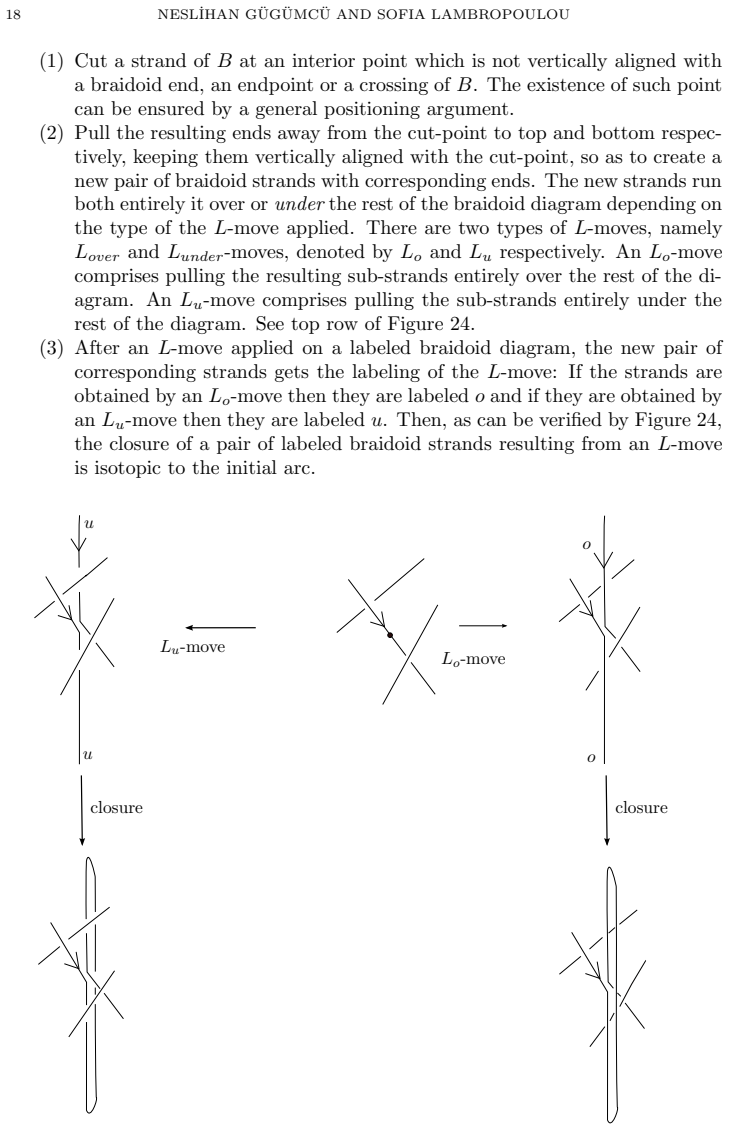
The central object is the labeled braidoid diagram: a finite set of downward-oriented strands in a vertical strip, with exactly two free strands ending at the leg and head, and with corresponding top and bottom ends labeled $o$ or $u$ to say whether the closure arcs pass over or under. The argument runs on the braidoiding algorithm, which cuts every up-arc of a planar multi-knotoid diagram at its topmost point, pulls the two pieces to the top and bottom lines all over or all under the rest of the diagram, and records the label $o$ or $u$; the sliding triangle of each up-arc, the endpoint triangle condition, and the classical triangle condition guarantee that no forbidden move is forced. The equivalence side is carried by the L-moves: cut a strand at an interior point and pull the two new ends to top and bottom, both over ($L_o$) or both under ($L_u$), labeling the new pair accordingly, together with restricted swing moves and the fake swing moves that become ordinary isotopy after closure. These moves are exactly what the closure operation cannot see, which is what makes the equivalence theorem work.
What would settle it
An exhaustive computer search over all small planar multi-knotoid diagrams with three or four up-arcs whose sliding triangles intersect, checking whether every configuration either satisfies the two bullet conditions or is resolved by reordering, relabeling a free up-arc, or subdividing, would settle the claim: one unresolvable configuration would refute the 'only if' direction of Theorem 3, and a complete enumeration supporting the two-pattern list would confirm it.
Extended reading notes
Core claim
The central claim of the paper is that the closure operation gives a bijection between L-equivalence classes of labeled braidoid diagrams and isotopy classes of planar multi-knotoids. In the paper's formulation, Theorem 3 states that the closures of two labeled braidoid diagrams are isotopic multi-knotoids in the plane if and only if the labeled braidoid diagrams are related by L-equivalence moves. The forward direction is direct from the definitions: an L-move creates a pair of strands whose closure is isotopic to the original arc. The reverse direction uses the braidoiding map, which turns any multi-knotoid diagram, after putting it in general position and subdividing and labeling its up-arcs, into a labeled braidoid diagram; the paper shows this map is well-defined on L-classes and is inverse to the closure map on L-classes. A corollary is the uniform closure theorem: every planar multi-knotoid is isotopic to the closure of a braidoid diagram with all joining arcs running under.
Load-bearing premise
The proof depends on the claim, verified by inspection rather than by formal enumeration, that the only obstructions to the braidoiding algorithm are the two listed patterns of interacting up-arcs; if some other obstruction exists, the inverse braidoiding map would not be defined for every multi-knotoid.
Editorial extensions
If this is right
- Every planar multi-knotoid can be represented by a labeled braidoid diagram up to L-equivalence, so invariants of knotoids can be studied through braidoid representatives.
- The L-moves give a single move family that detects equality of closures: two labeled braidoid diagrams close to isotopic multi-knotoids exactly when they are L-equivalent.
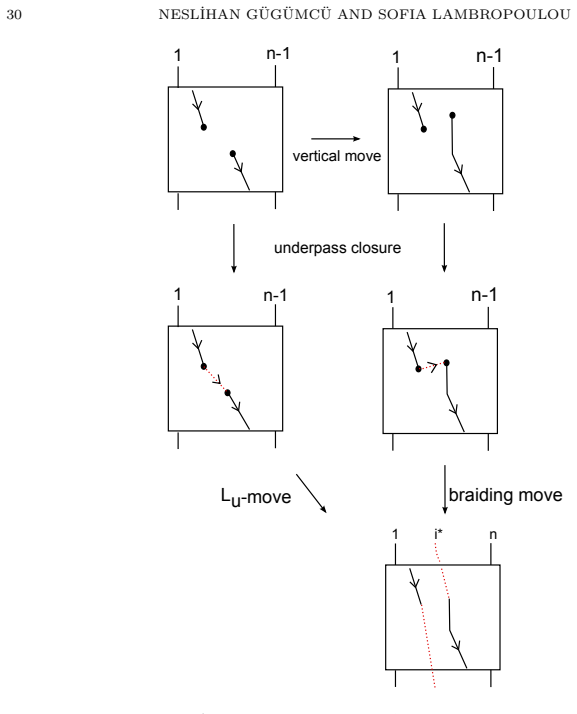
- The underpass closure maps braidoids onto L-equivalence classes of classical braids, and the virtual closure maps virtual braidoids onto virtual L-equivalence classes, connecting planar knotoids to classical and virtual braid theory.
- The uniform closure theorem ensures every multi-knotoid has a braidoid representative whose closing arcs all run under the diagram, simplifying the closure operation.
Reading between the lines
- Beyond the paper: the bijection invites a search for braidoid-specific invariants, such as representations, polynomials, or categorifications, that are invariant under L-moves, mirroring how braid closures once generated new knot polynomials.
- Beyond the paper: the obstruction classification could be stress-tested by exhaustive computer enumeration of all configurations of up to three or four up-arcs; confirming the two-pattern list would strengthen the theorem, while a single unlisted obstructing configuration would narrow its scope.
- Beyond the paper: the elementary-block decomposition of braidoids could be developed into an actual tabulation scheme for open protein chains once L-equivalence classes are known to admit finite normal forms.
- Beyond the paper: since the paper leaves the underlying algebraic structure of braidoids open, the action of L-equivalence on elementary blocks is a natural place to look for a group or monoid structure.
Signed reviews
Editorial analysis
A structured set of objections, weighed in public.
Referee Report
Summary. The paper develops the theory of braidoids, a diagrammatic counterpart to planar knotoids. A braidoid diagram is a set of descending strands in a rectangle in which one or two 'free strands' terminate at the leg and head endpoints, located anywhere in the diagram. The authors define labeled braidoid diagrams and a closure operation joining corresponding top/bottom ends by arcs running entirely over or under the rest of the diagram, yielding planar (multi-)knotoids. The main results are Theorem 1, an Alexander-type theorem: every (multi-)knotoid diagram in R^2 is isotopic to the closure of some labeled braidoid diagram, via an explicit braidoiding algorithm; and Theorem 3, a Markov-type theorem: closures of two labeled braidoid diagrams are isotopic (multi-)knotoids if and only if the diagrams are L-equivalent, L-equivalence being generated by labeled braidoid isotopy, L-moves, and fake swing moves. The proof of Theorem 3 constructs a braidoiding map br on multi-knotoids and shows it inverts the closure map cl_L on L-equivalence classes. A final section defines underpass and virtual closures and proves they induce well-defined surjective maps from (virtual) braidoids to L-equivalence classes of (virtual) braids.
Significance. If Theorem 3 is correct, it gives a complete geometric bridge between planar (multi-)knotoids and labeled braidoid diagrams up to L-moves, extending the Alexander/Markov paradigm to the open-ended setting. The L-move formulation is well chosen, since braidoids do not obviously carry an algebraic structure. The paper is explicit about provenance: Theorem 1 was already proved in the authors' earlier work [18,19] and is reproved in a more rigid form, while Theorem 3 is stated as coming from [19]; the contribution here is the written proof. The definitions of restricted swing moves, fake swing moves, and L-equivalence are natural and will likely be useful in subsequent work on knotoids and protein topology. The braidoiding algorithm and the inverse-map strategy for Theorem 3 are concrete and checkable, which is a strength. The main weakness is that several load-bearing technical points are asserted by inspection or deferred to the classical papers [31,32]: the obstruction classification in §5.2.1, the proof of Lemma 3, and the verification that br and cl_L are mutual inverses.
major comments (4)
- [§5.2.1] The obstruction classification is load-bearing and is asserted rather than proved: the text states that the clasp obstruction 'may occur only if' the two bullet conditions hold, with the justification 'It can be verified by checking all possible positionings, labelings and orderings of any two up-arcs.' No enumeration or formal case analysis is given, and the check is phrased for pairs of up-arcs, whereas the algorithm processes an ordered list of all up-arcs of the diagram; the paper does not argue that interactions involving more than two up-arcs, or between a newly braidoided strand and several previously processed strands, reduce to the pairwise case. This matters because br, which the proof of Theorem 3 needs as the inverse of cl_L, is defined only if the braidoiding algorithm terminates for every (multi-)knotoid diagram, and the resolutions of §5.2.2 cover only the stated obstruction type; the same gap affects the termination claim in the proof of Theorem 1 (§5.2.4). An unlisted obstruction would break the equation cl_L ∘ br = id. I recommend a complete case analysis of the possible obstruction configurations, or an argument showing that a subdivision satisfying the classical triangle condition (Lemma 3) makes the algorithm order-free so that the pairwise classification is a consequence rather than an assumption.
- [§5.2.3 (Lemma 3)] Lemma 3 is the main existence result ensuring that a subdivision satisfying both the classical triangle condition and the endpoint triangle condition exists, and the proof of Theorem 1 relies on it. The proof is a sketch: it states that the lemma 'is proved similarly with Lemma 1 in [31]' and then asserts that a subdivision with step ε < ½ min{d1,d2} 'provides a subdivision of K satisfying the classical triangle condition and also the triangle condition for the endpoints.' The adaptation is not carried out: the argument bounds the length of sub-arcs, but the classical triangle condition concerns pairs of non-adjacent sliding triangles, and the endpoint triangle condition concerns the two endpoints, so a uniform bound on sub-arc length does not by itself establish either condition. A complete proof, or a precise reduction to [31, Lemma 1] that accounts for the endpoints, is needed.
- [§6 (proof of Theorem 3, inverse compositions)] The proof that br and cl_L are mutual inverses is too terse. For br ∘ cl_L = id, the paper states that the closure B̂ of a labeled braidoid diagram B 'is a knotoid diagram in general position whose only up-arcs are the connection arcs' and that braidoiding these arcs yields a diagram 'isotopic to B.' This requires checking that the connection arcs (which run close to vertical lines and pass entirely over or under the rest of the diagram) satisfy the general-position requirements of Definition 11, that braidoiding multiple connection arcs of different labels can be performed without new obstructions, and that the result is L-equivalent to B rather than merely isotopic as a closure. The sentence establishing cl_L ∘ br = id is likewise asserted. Since these two identities are the core of Theorem 3, the argument should be spelled out in detail.
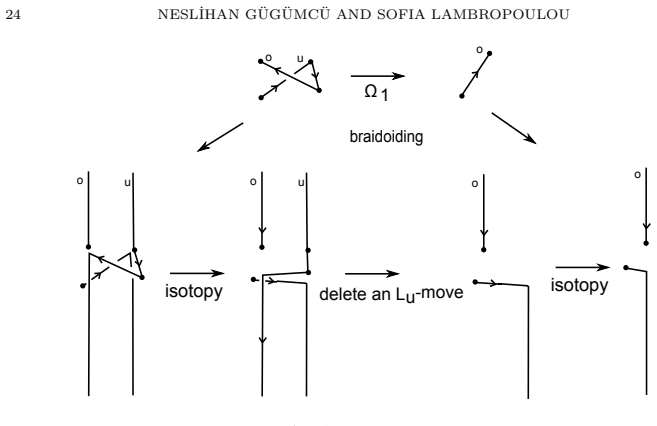
- [§6 (Lemmas 7 and 8)] Proposition 1, which is needed for the well-definedness of br, rests on Lemmas 7 and 8, but both are justified largely by figures and by analogy with the classical case. Lemma 7 illustrates only the Ω1-move (Figure 29) and states that the Ω2 and Ω3 cases follow 'similarly' to [32,31]; in the presence of endpoints, free strands, and multiple components, the reduction is not automatic. Lemma 8 is said to be 'verified' by Figure 32. Because these lemmas carry the independence of the braidoiding map from knotoid isotopy, the endpoint and free-strand configurations should be treated explicitly rather than by reference to the classical setting.
minor comments (7)
- [References [33]] In reference [33], 'Hring-Oldenburg' should be 'Häring-Oldenburg' (or 'Haring-Oldenburg').
- [§5.1.5, proof of Lemma 2] The phrase 'the small line segment whose boundary is the union of the two intersection points' should be replaced by 'the line segment whose endpoints are the two intersection points.'
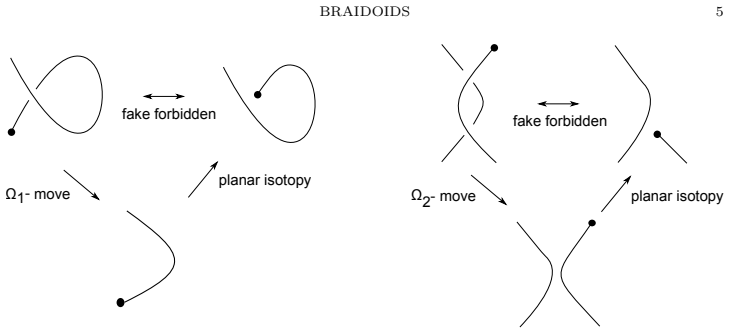
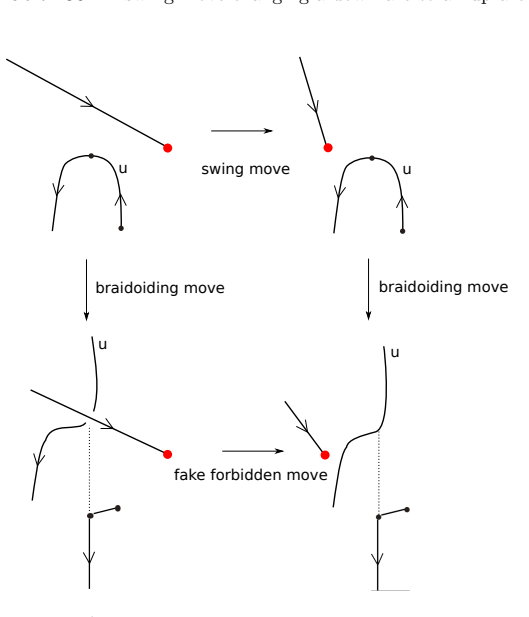
- [§6, Definition 9] The definitions of fake forbidden moves and fake swing moves on labeled braidoid diagrams are formulated through their effect on the closure. Since these moves are primitive generators of L-equivalence, a purely local description (beyond the examples in Figures 25 and 32) would improve clarity.
- [§5.2.1 / §5.2.3] The logical relationship between the obstruction-resolution discussion of §5.2.1-5.2.2 and the classical triangle condition of §5.2.3 is not explained: the former resolves obstructions after they occur, while the latter aims to prevent them by subdivision. Because the proof of Theorem 1 uses both, the authors should state explicitly which role each plays and why the classical triangle condition does not make the obstruction analysis redundant.
- [§5.2, Step 1(3)] The condition 'no subdividing points are vertically aligned with each other unless they share a common edge and neither with the endpoints or with any of the crossings' should be rephrased for clarity, e.g., 'no subdividing point is vertically aligned with another subdividing point, an endpoint, or a crossing, unless the two points share an edge of the subdivision.'
- [§6, Definition 11] The note after Definition 11 says a (multi-)knotoid diagram 'can be always brought to general position by small ∆-moves'; this conflates isotopy moves with the choice of subdivision. The endpoint and classical triangle conditions depend on the subdivision (Lemma 3), not only on the diagram's isotopy class, so the two procedures should be stated separately.
- [§7.2, proof of Proposition 2] In the surjectivity argument, 'the original braidoid (resp. virtual braidoid) diagram' should read 'the original braid (resp. virtual braid) diagram.'
Circularity Check
Self-citations are minor and non-load-bearing; the §5.2.1 assertion is a proof gap, not circularity.
full rationale
The claimed derivation chain is not circular. The closure operation (Definition 5), L-moves (Definition 8), and fake swing moves (Definition 9) are introduced independently of the theorem they support, and Theorem 1 (Alexander analogue) is proved by an explicit braidoiding algorithm in Section 5 rather than assumed from the authors' earlier papers. Theorem 3's bijection is established by constructing two maps, cl_L and br, with br defined by the same algorithm; the inverse identities are geometric checks on closures, not definitions of the equivalence. Self-citations to [18,19,30,31,32] supply the source of the theory and the classical-braid template for L-move arguments; these are parameter-free results from prior work and are adapted here, not imported as the braidoid Markov theorem. The reviewer concern in §5.2.1—'It can be verified by checking all possible positionings, labelings and orderings of any two up-arcs...'—is a real rigor gap (an exhaustive case check asserted without enumeration), but it is a missing proof of a geometric fact, not a reduction of the conclusion to the premises. Hence no circular step is identified; score 2 reflects minor non-load-bearing self-citation.
Assumptions & free parameters
assumptions (5)
- standard math Reidemeister moves and planar isotopy generate knotoid equivalence
- standard math Piecewise-linear approximation preserves isotopy classes of knotoid diagrams
- standard math Classical Alexander and Markov theorems for braids
- standard math L-move equivalence for classical braids is a one-move version of the Markov theorem
- domain assumption General position assumptions for knotoid diagrams (no vertical/horizontal arcs, no alignments)
invented entities (3)
-
Braidoid diagram
-
Labeled braidoid diagram
-
L-moves and fake swing moves for braidoids
Cite this review
Pith. "Pith review of Braidoids." pith.science (2026). https://pith.science/paper/GQBRYUK5
@misc{pith2026190806053,
  author       = {Pith},
  title        = {Pith review of: Braidoids},
  year         = {2026},
  howpublished = {\url{https://pith.science/paper/GQBRYUK5}},
  note         = {Machine review of arXiv:1908.06053}
}
abstract
Braidoids generalize the classical braids and form a counterpart theory to the theory of planar knotoids, just as the theory of braids does for the theory of knots. In this paper, we introduce basic notions of braidoids, a closure operation for braidoids, we prove an analogue of the Alexander theorem, that is, an algorithm that turns a knotoid into a braidoid, and we formulate and prove a geometric analogue of the Markov theorem for braidoids using the $L$-moves.
Figures

Figures from the paper (33 more)










Reference graph
Works this paper leans on
-
[19]
On Knotoids, Braidoids and Their Applications.PhD thesis, 2017
G¨ ug¨ umc¨ u, N. On Knotoids, Braidoids and Their Applications.PhD thesis, 2017
work page 2017
-
[31]
A study of braids in 3-manifolds
Lambropoulou, S. A study of braids in 3-manifolds. PhD thesis, University of Warwick, 1993
work page 1993
-
[1]
Adams, C., Henrich, A., Kearney, K., and Scoville, N., Knots related by knotoids, to appear in American Mathematical Monthly (2019)
work page 2019
-
[2]
A lemma on systems of knotted curves
Alexander, J.W. A lemma on systems of knotted curves. Proc. Nat. Acad. Sci. U.S.A.(1923) 9, 93–95
work page 1923
-
[3]
Artin E. Theorie der Z¨ opfe.Abh. Math. Sem. Hamburg Univ. (1926) 4, 47–72
work page 1926
- [4]
-
[5]
Double branched covers of knotoids, arXiv:1811.09121 [math.GT] (2018)
Barbensi, A., Buck, D., Harrington, H.A., and Lackenby M. Double branched covers of knotoids, arXiv:1811.09121 [math.GT] (2018)
arXiv 2018
-
[6]
The virtual and universal braids, Fundamenta Mathematicae 184 (2004) 159–186
Bardakov, V.G. The virtual and universal braids, Fundamenta Mathematicae 184 (2004) 159–186
work page 2004
Show all 40 references
-
[7]
Knotoids, A
Bartholomew, A. Knotoids, A. Bartholomew’s mathematical page, www.layer8.co.uk/maths. knotoids/index.htm, Jan. 2015
2015
-
[8]
Entrlacements et ´ equations de Pfaffe,Asterisque 107-108 (1983) 87–161
Bennequin, D. Entrlacements et ´ equations de Pfaffe,Asterisque 107-108 (1983) 87–161
1983
-
[9]
Braids, links and mapping class groups
Birman J.S. Braids, links and mapping class groups. Annals of Mathematics Studies (1974) 82, Princeton University Press, Princeton
1974
-
[10]
On Markov’s Theorem
Birman J.S., Menasco W.W. On Markov’s Theorem. J. Knot Theory& Ramifications(2002)11 no.3, 295–310
2002
-
[11]
¨Uber verknotete Curven
Brunn H. ¨Uber verknotete Curven. Verh. des intern. Math. Congr. (1897) 1, 256–259
-
[12]
Knots, de Gruyter Stud
Burde, G., Zieschang, H. Knots, de Gruyter Stud. Math. , vol. 5, Walter de Gruyter, New York, 2003, 559 pp
2003
-
[13]
Studies of global and local entanglements of individual protein chains using the concept of knotoids
Goundaroulis D., Dorier J., Benedetti F., Stasiak A. Studies of global and local entanglements of individual protein chains using the concept of knotoids. Sci. Reports(2017) 7, 6309
2017
-
[14]
Topological models for open knotted protein chains using the concepts of knotoids and bonded knotoids
Goundaroulis D., G¨ ug¨ umc¨ u N., Lambropoulou S., Dorier J., Stasiak A., Kauffman L.H. Topological models for open knotted protein chains using the concepts of knotoids and bonded knotoids. Polymers, Special issue on Knotted and Catenated Polymers, Dusan Racko and Andrzej Sta...
2017 doi
-
[15]
DOI: 10.1093/nar/gky1140
Dabrowski-Tumanski, P., Rubach, P., Goundaroulis, D., Dorier, J., Sukowski, P., Millett, K.C., Rawdon, E.J., Stasiak, A., and Sukowska, J.I.KnotProt 2.0: a database of pro- teins with knots and other entangled structures, Nucleic Acids Research 1 (2018). DOI: 10.1093/nar/gky1140
2018 doi
-
[16]
On a move reducing the genus of a knot diagram,Indi- ana University Mathematics Journal 61.3 (2012), pp
Daikoku, K., Sakai, K., and Takase, M.. On a move reducing the genus of a knot diagram,Indi- ana University Mathematics Journal 61.3 (2012), pp. 1111–1127. ISSN: 00222518, 19435258. url: http://www.jstor.org/stable/24904076
2012
-
[17]
New invariants of knotoids.European J
G¨ ug¨ umc¨ u, N., Kauffman, L.H. New invariants of knotoids.European J. of Combinatorics (2017), 65C, 186-229
2017
-
[18]
Knotoids, Braidoids and Applications.Symmetry, Special Issue:Knot Theory and Its Applications (2017)
G¨ ug¨ umc¨ u, N., Lambropoulou, S. Knotoids, Braidoids and Applications.Symmetry, Special Issue:Knot Theory and Its Applications (2017)
2017
-
[20]
Knot Theory & Ram- ifications, Vol
G¨ ug¨ umc¨ u, N., Nelson, S., Biquandle coloring invariants of knotoids,J. Knot Theory & Ram- ifications, Vol. 28, No. 04, 1950029 (2019)
2019
-
[21]
Jones, V.F.R., A polynomial invariant for knots via von Neumann algebras, Bull. Amer. Math. Soc. (N.S.) 12(1) (1985), 103–111
1985
-
[22]
Hecke algebra representations of braid groups and link polynomials, Ann
Jones, V.F.R. Hecke algebra representations of braid groups and link polynomials, Ann. Math. 126 (1987), 335–388
1987
-
[23]
Braid representation of virtual knots and welded knots, Osaka J
Kamada, S. Braid representation of virtual knots and welded knots, Osaka J. Math. 44 (2007), no. 2, 441–458. See also arXiv:math.GT/0008092
2007
-
[24]
Braid groups, Volume 247 of Graduate Texts in Mathematics, Springer, New York, 2008
Kassel, C., Turaev, V. Braid groups, Volume 247 of Graduate Texts in Mathematics, Springer, New York, 2008
2008
-
[25]
Virtual Knot Theory, European J
Kauffman, L.H. Virtual Knot Theory, European J. Comb. 20 (1999) 663–690
1999
-
[26]
H., Lambropoulou, S
Kauffman, L. H., Lambropoulou, S. Virtual braids. Fundamenta Mathematicae (2004), 184, 159-186
2004
-
[27]
Virtual braids and the L-move, J
Kauffman, L.H., Lambropoulou, S. Virtual braids and the L-move, J. Knot Theory & Ramif. 15(6) (2006), 773-811
2006
-
[28]
Knot Theory & Ramif
Kodokostas, D., Lambropoulou, S., Rail knotoids, to appear in J. Knot Theory & Ramif. (2019), arXiv:1812.09493. 32 NESL ˙IHAN G ¨UG ¨UMC ¨U AND SOFIA LAMBROPOULOU
2019 arXiv
-
[29]
[Russian, English abstract]
Korablev, P.G., May, Y.K., Tarkaev, V., Classification of low complexity knotoids, Siberian Electronic Mathematical Reports (2018), 15, 1237-1244. [Russian, English abstract]. DOI: 10.17377/semi.2018.15.100
2018 doi
-
[30]
Short proofs of Alexander’s and Markov’s theorems
Lambropoulou, S. Short proofs of Alexander’s and Markov’s theorems. Warwick preprint, 1990
1990
-
[32]
Lambropoulou S., Rourke C. P. Markov’s theorem in 3-manifolds. Topology and its Applica- tions(1997), 78, 95-122
1997
-
[33]
Knot Theory Ramif
Lambropoulou S., Hring-Oldenburg R., Knot theory in handlebodies, J. Knot Theory Ramif. (2002), 11, No. 6, 921-943, https://doi.org/10.1142/S0218216502002050
2002 doi
-
[34]
Markov, A. A. ¨Uber die freie ¨Aquivalenz geschlossener Z¨ opfe.Rec. Math. Moscou (1936), 1 (43), 73-78
1936
-
[35]
Morton, H. R. Threading knot diagrams. Mathematical Proceedings of the Cambridge Philo- sophical Society(1986), 99, 247-260
1986
-
[36]
A new proof of Markov’s braid theorem
Traczyk, P. A new proof of Markov’s braid theorem. Banach Center Publications 1992, 42, Institute of Mathematics Polish Academy of Sciences, Warszawa (1998)
1998
-
[37]
Knotoids
Turaev V. Knotoids. Osaka J. Math. 49 (2012), 195–223
2012
-
[38]
Representation of links by braid: A new algorithm
Vogel P. Representation of links by braid: A new algorithm. Commentarii Mathematici Helvetici (1990), 65, 104-113
1990
-
[39]
Sur l’ equivalence libre des tresses ferm´ ee
Weinberg N. Sur l’ equivalence libre des tresses ferm´ ee. Comptes Rendus (Doklady) de l’ Acad´ emie des Sciences de l’ URSS(1939), 23(3), 215–216
1939
-
[40]
The minimal number of Seifert circles equals the braid index of a link
Yamada S. The minimal number of Seifert circles equals the braid index of a link. Invent. Math.(1987), 89, 347–356. Izmir Institute of Technology Department of Mathematics G ¨ulbahc ¸e Mah. URLA 35430 ˙Izmir, TURKEY E-mail address: neslihangugumcu@iyte.edu.tr School of Applied...
1987
Reviewed August 14, 2026 · model on record in the stance chip above.
Discussion (0). Continue with ORCID to comment.