MeloDISinger: Melody-Aware & Duration-Preserving Singing Voice Editing with Audio Infilling
Pith reviewed 2026-06-30 03:16 UTC · model grok-4.3
The pith
A flow-matching model revises sung lyrics while keeping the original melody and total duration unchanged.
A machine-rendered reading of the paper's core claim, the machinery that carries it, and where it could break.
Core claim
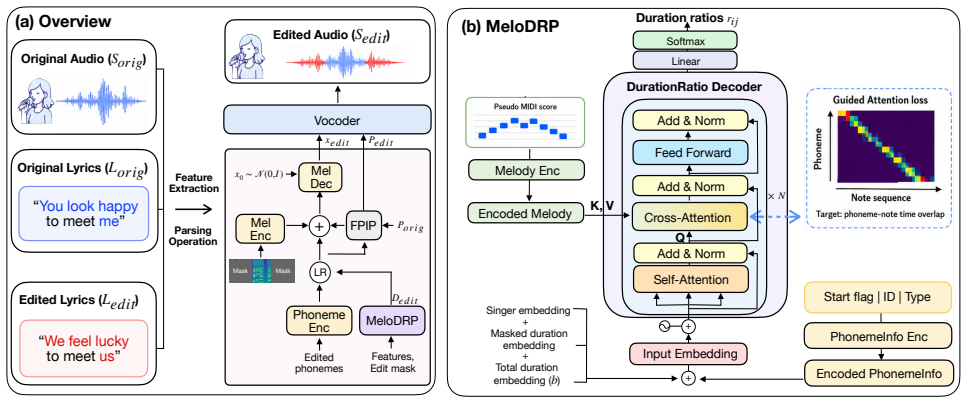
MeloDISinger performs melody-aware and duration-preserving singing voice editing by using MeloDRP to predict fixed-budget duration ratios via cross-attention between phonetic cues and pseudo-MIDI, applying temporal-overlap supervision for soft phoneme-note correspondences, and employing a flow-matching mel decoder for context-preserving audio infilling; the model achieves state-of-the-art results in objective and subjective evaluations.
What carries the argument
MeloDRP module that predicts fixed-budget duration ratios by fusing phonetic cues with pseudo-MIDI melodic context through cross-attention plus temporal-overlap supervision for phoneme-note alignment.
If this is right
- Explicit span-wise duration control becomes possible without altering total length.
- Non-edited regions and surrounding audio context remain unchanged during synthesis.
- Melody-aware duration allocation follows from the cross-attention fusion of phonetic and pseudo-MIDI signals.
- The duration-aware lyric generation pipeline produces feasible test cases for evaluation.
- Objective and subjective metrics reach state-of-the-art levels compared with earlier editing methods.
Where Pith is reading between the lines
- The same duration-ratio approach could be tested on spoken voice editing tasks outside singing.
- Better pseudo-MIDI extraction might reduce errors when the input melody is noisy or complex.
- The infilling decoder could be applied to other audio domains that require context preservation such as music remixing.
- Scaling the model to longer clips would require checking whether the fixed-budget ratio prediction still holds without drift.
Load-bearing premise
Fusing phonetic cues with pseudo-MIDI via cross-attention in MeloDRP together with temporal-overlap supervision produces duration allocations that preserve melody and total duration without artifacts.
What would settle it
An edited audio sample whose measured pitch contour deviates from the original melody by more than a small threshold or whose total duration differs measurably from the source.
Figures
read the original abstract
Text-based singing voice editing (SVE) aims to revise sung lyrics while preserving the original melody, total duration, and non-edited regions. In this paper, we propose MeloDISinger, a flow-matching-based SVE model for melody-aware and duration-preserving editing. Its core module, MeloDRP, predicts fixed-budget duration ratios, enabling explicit span-wise duration control. For melody-aware duration allocation, MeloDRP fuses phonetic cues with pseudo-MIDI melodic context through cross-attention, while temporal-overlap supervision encourages soft phoneme--note correspondences. We further use a flow-matching mel decoder for audio infilling to synthesize edited regions while preserving surrounding context. In addition, we introduce a duration-aware edited-lyric generation pipeline using WhisperX and an LLM to construct feasible evaluation scenarios. Experiments demonstrate state-of-the-art performance in both objective and subjective evaluations.
Editorial analysis
A structured set of objections, weighed in public.
Referee Report
Summary. The paper proposes MeloDISinger, a flow-matching-based model for text-based singing voice editing that preserves melody, total duration, and non-edited regions. Its core MeloDRP module predicts fixed-budget duration ratios by fusing phonetic cues with pseudo-MIDI melodic context via cross-attention and applies temporal-overlap supervision for soft phoneme-note alignment. A flow-matching mel decoder performs audio infilling, and a WhisperX+LLM pipeline generates duration-aware edited lyrics for evaluation. Experiments are reported to achieve state-of-the-art objective and subjective results.
Significance. If the SOTA claims hold with proper controls, the work advances singing voice editing by introducing explicit, melody-aware duration control that addresses a key practical limitation in prior SVE systems. The fixed-budget ratio prediction and flow-matching infilling are technically coherent contributions; the evaluation pipeline also supplies a reusable method for constructing realistic test cases.
major comments (2)
- [Abstract, §4] Abstract and §4 (Experiments): the central SOTA claim is asserted without any reported objective metrics, dataset sizes, baseline names, or statistical significance tests in the visible abstract; if these details are absent from the full experimental section as well, the claim cannot be verified and the evaluation is load-bearing for acceptance.
- [§3.2] §3.2 (MeloDRP): the temporal-overlap supervision is described as encouraging soft correspondences, but no equation or ablation is referenced showing its isolated contribution to duration accuracy versus a plain cross-attention baseline; this directly supports the duration-preservation claim.
minor comments (2)
- [§3.1] Notation for pseudo-MIDI extraction and the exact cross-attention implementation (query/key/value dimensions) should be stated explicitly rather than left to supplementary material.
- [Figure 5] Figure captions and axis labels in the subjective listening-test plots need clearer indication of the number of listeners and statistical error bars.
Simulated Author's Rebuttal
We thank the referee for the constructive comments. We address the major comments point by point below.
read point-by-point responses
-
Referee: [Abstract, §4] Abstract and §4 (Experiments): the central SOTA claim is asserted without any reported objective metrics, dataset sizes, baseline names, or statistical significance tests in the visible abstract; if these details are absent from the full experimental section as well, the claim cannot be verified and the evaluation is load-bearing for acceptance.
Authors: The full experimental section (§4) reports objective metrics (e.g., MCD, F0 RMSE, duration error), dataset sizes and splits, baseline names (including prior SVE systems), and statistical significance tests. To improve self-containment of the abstract, we will revise it to include the key quantitative results and dataset information. revision: yes
-
Referee: [§3.2] §3.2 (MeloDRP): the temporal-overlap supervision is described as encouraging soft correspondences, but no equation or ablation is referenced showing its isolated contribution to duration accuracy versus a plain cross-attention baseline; this directly supports the duration-preservation claim.
Authors: We agree that the isolated contribution should be shown explicitly. In the revised manuscript we will add the equation for the temporal-overlap supervision loss and include an ablation comparing it against a plain cross-attention baseline to quantify its effect on duration accuracy. revision: yes
Circularity Check
No significant circularity detected
full rationale
The provided abstract and method description outline an architectural pipeline (MeloDRP cross-attention fusion, temporal-overlap supervision, flow-matching decoder) without any visible equations, parameter-fitting steps presented as predictions, or self-citation chains that reduce the claimed duration preservation or SOTA performance to inputs by construction. No self-definitional loops, fitted-input renamings, or uniqueness theorems imported from prior author work appear in the text. The derivation remains self-contained, relying on standard flow-matching and attention mechanisms whose correctness can be evaluated externally.
Axiom & Free-Parameter Ledger
Reference graph
Works this paper leans on
-
[1]
As a musical component, it must remain aligned with the accompaniment in melody and rhythm
Introduction Singing voice plays a crucial role in music by conveying lin- guistic content and emotional expression [1]. As a musical component, it must remain aligned with the accompaniment in melody and rhythm. In music production, recorded vocals often require modifications, such as correcting mispronunciations, in- serting missing words, or replacing ...
-
[2]
MeloDISinger: Melody-Aware & Duration-Preserving Singing Voice Editing with Audio Infilling
Method 2.1. Overview As shown in Fig. 1, MELODISINGERfollows the three-step pipeline of EditSinger [2]: feature extraction, parsing operation, and modeling. LetS orig,S edit,L orig, andL edit denote the original audio, edited audio, original lyrics, and edited lyrics, respectively. Feature Extraction.FromS orig, we extract acoustic fea- tures: mel-spectro...
work page internal anchor Pith review Pith/arXiv arXiv 2026
-
[3]
Experiments 3.1. Experimental Setup Dataset and preprocessing.We conduct experiments on GTSinger-En [25], which contains 13 hours of English singing voices from three singers. Each audio sample is segmented into chunks of up to 11.6 seconds, corresponding to 1000 mel frames, while preserving word boundaries using phoneme du- ration annotations. Following ...
-
[4]
Objective Evaluation Table 1 reports the objective results across all edit scenarios
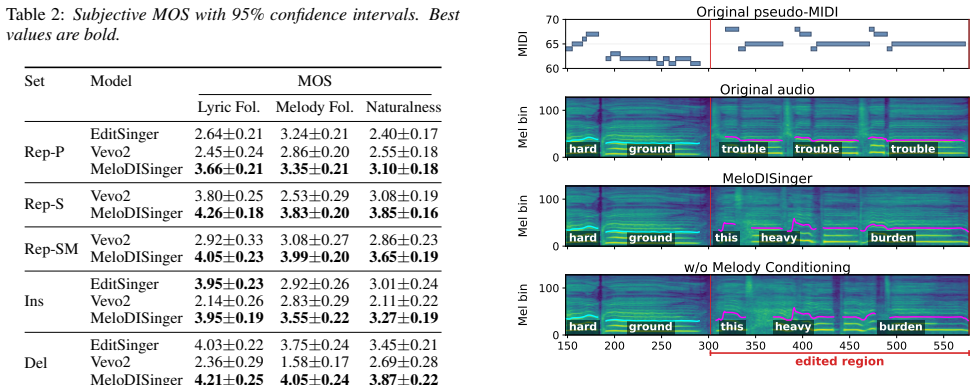
Results 4.1. Objective Evaluation Table 1 reports the objective results across all edit scenarios. All metrics are reported in % except DDUR, which is reported in seconds; DDUR values shown as 0.00 correspond to a residual deviation of about 0.004 s due to the STFT hop size. Overall, MELODISINGERachieves the best performance in most met- rics and scenario...
-
[5]
Experimental results show that MELO- DISINGERachieves state-of-the-art performance in both objec- tive and subjective evaluations
Conclusion We proposed MELODISINGERfor text-based singing voice editing, combining melody-aware duration-ratio prediction with a flow-matching-based infilling decoder to generate melody-consistent edits while preserving total duration and non-edited regions. Experimental results show that MELO- DISINGERachieves state-of-the-art performance in both objec- ...
-
[6]
RS- 2023-00222383) and the Institute of Infor- mation & communications Technology Planning & Evaluation (IITP) grant funded by the Korea government (MSIT) (No
Acknowledgments This work was supported by the National Research Founda- tion of Korea (NRF) grant funded by the Korea government (MSIT) (No. RS- 2023-00222383) and the Institute of Infor- mation & communications Technology Planning & Evaluation (IITP) grant funded by the Korea government (MSIT) (No. RS-2019-II190075, Artificial Intelligence Graduate Scho...
2023
-
[7]
All technical content, experimental design, implementation, results, and conclusions were produced and verified by the authors
Generative AI Use Disclosure Generative AI tools were used solely to assist with English editing and polishing of the manuscript. All technical content, experimental design, implementation, results, and conclusions were produced and verified by the authors. No generative AI tool was used to generate new scientific claims, results, or to act as an author
-
[8]
The singing voice,
J. Sundberg, “The singing voice,”The Oxford handbook of voice perception, pp. 117–142, 2018
2018
-
[9]
Editsinger: Zero- shot text-based singing voice editing system with diverse prosody modeling
L. Zhang, Z. Zhao, Y . Ren, and L. Deng, “Editsinger: Zero- shot text-based singing voice editing system with diverse prosody modeling.” inIJCAI, 2022, pp. 4503–4509
2022
-
[10]
Vevo2: A unified and controllable framework for speech and singing voice generation,
X. Zhang, J. Zhang, Y . Wang, C. Wang, Y . Chen, D. Jia, Z. Chen, and Z. Wu, “Vevo2: A unified and controllable framework for speech and singing voice generation,”IEEE ACM Trans. Audio Speech Lang. Process., 2026
2026
-
[11]
J. Zheng, C. Hao, G. Ma, X. Zhang, G. Chen, C. Ding, Z. Chen, and L. Xie, “Yingmusic-singer: Zero-shot singing voice synthesis and editing with annotation-free melody guidance,”arXiv preprint arXiv:2512.04779, 2025
-
[12]
Songcreator: Lyrics-based universal song generation,
S. Lei, Y . Zhou, B. Tang, M. W. Lam, H. Liu, J. Wu, S. Kang, Z. Wu, H. Menget al., “Songcreator: Lyrics-based universal song generation,”Advances in Neural Information Processing Systems, vol. 37, pp. 80 107–80 140, 2024
2024
-
[13]
Attentionstitch: How attention solves the speech editing problem,
A. Alexos and P. Baldi, “Attentionstitch: How attention solves the speech editing problem,” 2024. [Online]. Available: https://arxiv.org/abs/2403.04804
-
[14]
V oicecraft: Zero-shot speech editing and text-to-speech in the wild,
P. Peng, P.-Y . Huang, S.-W. Li, A. Mohamed, and D. Harwath, “V oicecraft: Zero-shot speech editing and text-to-speech in the wild,” inProceedings of the 62nd Annual Meeting of the Asso- ciation for Computational Linguistics (Volume 1: Long Papers), 2024, pp. 12 442–12 462
2024
-
[15]
V oicebox: Text-guided multilingual universal speech generation at scale,
M. Le, A. Vyas, B. Shi, B. Karrer, L. Sari, R. Moritz, M. Williamson, V . Manohar, Y . Adi, J. Mahadeokaret al., “V oicebox: Text-guided multilingual universal speech generation at scale,”Advances in neural information processing systems, vol. 36, pp. 14 005–14 034, 2023
2023
-
[16]
arXiv preprint arXiv:2006.04558 , year=
Y . Ren, C. Hu, X. Tan, T. Qin, S. Zhao, Z. Zhao, and T.-Y . Liu, “Fastspeech 2: Fast and high-quality end-to-end text to speech,” arXiv preprint arXiv:2006.04558, 2020
-
[17]
Montreal forced aligner: Trainable text-speech align- ment using kaldi
M. McAuliffe, M. Socolof, S. Mihuc, M. Wagner, and M. Son- deregger, “Montreal forced aligner: Trainable text-speech align- ment using kaldi.” inInterspeech, vol. 2017, 2017, pp. 498–502
2017
-
[18]
Natural tts synthesis by condi- tioning wavenet on mel spectrogram predictions,
J. Shen, R. Pang, R. J. Weiss, M. Schuster, N. Jaitly, Z. Yang, Z. Chen, Y . Zhang, Y . Wang, R. Skerrv-Ryan, R. A. Saurous, Y . Agiomvrgiannakis, and Y . Wu, “Natural tts synthesis by condi- tioning wavenet on mel spectrogram predictions,” in2018 IEEE International Conference on Acoustics, Speech and Signal Pro- cessing (ICASSP), 2018, pp. 4779–4783
2018
-
[19]
E2 tts: Embarrassingly easy fully non-autoregressive zero-shot tts,
S. E. Eskimez, X. Wang, M. Thakker, C. Li, C.-H. Tsai, Z. Xiao, H. Yang, Z. Zhu, M. Tang, X. Tan, Y . Liu, S. Zhao, and N. Kanda, “E2 tts: Embarrassingly easy fully non-autoregressive zero-shot tts,”2024 IEEE Spoken Language Technology Workshop (SLT), pp. 682–689, 2024. [Online]. Available: https://api.semanticscholar.org/CorpusID:270738197
2024
-
[20]
F5-TTS: A Fairytaler that Fakes Fluent and Faithful Speech with Flow Matching
Y . Chen, Z. Niu, Z. Ma, K. Deng, C. Wang, J. Zhao, K. Yu, and X. Chen, “F5-tts: A fairytaler that fakes fluent and faithful speech with flow matching,”arXiv preprint arXiv:2410.06885, 2024
work page internal anchor Pith review Pith/arXiv arXiv 2024
-
[21]
Diffsinger: Singing voice synthesis via shallow diffusion mechanism,
J. Liu, C. Li, Y . Ren, F. Chen, and Z. Zhao, “Diffsinger: Singing voice synthesis via shallow diffusion mechanism,” inProceedings of the AAAI conference on artificial intelligence, vol. 36, no. 10, 2022, pp. 11 020–11 028
2022
-
[22]
Tcsinger: Zero-shot singing voice synthesis with style transfer and multi-level style control,
Y . Zhang, Z. Jiang, R. Li, C. Pan, J. He, R. Huang, C. Wang, and Z. Zhao, “Tcsinger: Zero-shot singing voice synthesis with style transfer and multi-level style control,” in Proceedings of the 2024 Conference on Empirical Methods in Natural Language Processing. Association for Computational Linguistics, 2024, p. 1960–1975. [Online]. Available: http: //dx...
-
[23]
Visinger: Variational inference with adversarial learning for end-to-end singing voice synthesis,
Y . Zhang, J. Cong, H. Xue, L. Xie, P. Zhu, and M. Bi, “Visinger: Variational inference with adversarial learning for end-to-end singing voice synthesis,” inICASSP 2022-2022 IEEE Interna- tional Conference on Acoustics, Speech and Signal Processing (ICASSP). IEEE, 2022, pp. 7237–7241
2022
-
[24]
Xiaoicesing: A high-quality and integrated singing voice synthesis system,
P. Lu, J. Wu, J. Luan, X. Tan, and L. Zhou, “Xiaoicesing: A high-quality and integrated singing voice synthesis system,”arXiv preprint arXiv:2006.06261, 2020
-
[25]
Müller, Karla Pizzi, and Jennifer Williams
T. Wang, R. Fu, J. Yi, Z. Wen, and J. Tao, “Singing- tacotron: Global duration control attention and dynamic filter for end-to-end singing voice synthesis,” inProceedings of the 1st International Workshop on Deepfake Detection for Audio Multimedia, ser. DDAM ’22. New York, NY , USA: Association for Computing Machinery, 2022, p. 53–59. [Online]. Available:...
-
[26]
Hifisinger: To- wards high-fidelity neural singing voice synthesis,
J. Chen, X. Tan, J. Luan, T. Qin, and T.-Y . Liu, “Hifisinger: Towards high-fidelity neural singing voice synthesis,” 2020. [Online]. Available: https://arxiv.org/abs/2009.01776
-
[27]
H. Tachibana, K. Uenoyama, and S. Aihara, “Efficiently trainable text-to-speech system based on deep convolutional networks with guided attention,” in2018 IEEE International Conference on Acoustics, Speech and Signal Processing (ICASSP). IEEE, Apr. 2018, p. 4784–4788. [Online]. Available: http://dx.doi.org/10.1109/ICASSP.2018.8461829
-
[28]
Deepsinger: Singing voice synthesis with data mined from the web,
Y . Ren, X. Tan, T. Qin, J. Luan, Z. Zhao, and T.-Y . Liu, “Deepsinger: Singing voice synthesis with data mined from the web,” inProceedings of the 26th ACM SIGKDD International Conference on Knowledge Discovery & Data Mining, 2020, pp. 1979–1989
2020
-
[29]
Laugh now cry later: Controlling time-varying emotional states of flow- matching-based zero-shot text-to-speech,
H. Wu, X. Wang, S. E. Eskimez, M. Thakker, D. Tompkins, C.-H. Tsai, C. Li, Z. Xiao, S. Zhao, J. Liet al., “Laugh now cry later: Controlling time-varying emotional states of flow- matching-based zero-shot text-to-speech,”IEEE Spoken Lan- guage Technology Workshop (SLT), 2024
2024
-
[30]
Flow Matching for Generative Modeling
Y . Lipman, R. T. Chen, H. Ben-Hamu, M. Nickel, and M. Le, “Flow matching for generative modeling,”arXiv preprint arXiv:2210.02747, 2022
work page internal anchor Pith review Pith/arXiv arXiv 2022
-
[31]
WhisperX: Time- Accurate Speech Transcription of Long-Form Audio,
M. Bain, J. Huh, T. Han, and A. Zisserman, “WhisperX: Time- Accurate Speech Transcription of Long-Form Audio,” inInter- speech 2023, 2023, pp. 4489–4493
2023
-
[32]
Gtsinger: A global multi-technique singing corpus with realistic music scores for all singing tasks,
Y . Chen, X. Cheng, W. Guo, J. He, Z. Hong, Z. Jiang, R. Li, J. Lu, C. Pan, C. Wang, J. Wang, W. Xu, C. Yang, L. Zhang, Y . Zhang, Z. Zhao, J. Zhou, and Z. Zhu, “Gtsinger: A global multi-technique singing corpus with realistic music scores for all singing tasks,” inAdvances in Neural Information Processing Systems 37, ser. NeurIPS 2024. Neural Information...
-
[33]
WaveNet: A Generative Model for Raw Audio
A. Van Den Oord, S. Dieleman, H. Zen, K. Simonyan, O. Vinyals, A. Graves, N. Kalchbrenner, A. Senior, K. Kavukcuogluet al., “Wavenet: A generative model for raw audio,”arXiv preprint arXiv:1609.03499, no. 1, 2016
work page internal anchor Pith review Pith/arXiv arXiv 2016
-
[34]
Robust speech recognition via large-scale weak supervision,
A. Radford, J. W. Kim, T. Xu, G. Brockman, C. McLeavey, and I. Sutskever, “Robust speech recognition via large-scale weak supervision,” inInternational conference on machine learning. PMLR, 2023, pp. 28 492–28 518
2023
-
[35]
The singing voice conversion challenge 2023,
W.-C. Huang, L. P. Violeta, S. Liu, J. Shi, and T. Toda, “The singing voice conversion challenge 2023,” in2023 IEEE Auto- matic Speech Recognition and Understanding Workshop (ASRU). IEEE, 2023, pp. 1–8
2023
discussion (0)
Sign in with ORCID, Apple, or X to comment. Anyone can read and Pith papers without signing in.