Numerical study of vanishing and spreading dynamics of chemotaxis systems with logistic source and a free boundary
Pith reviewed 2026-05-24 21:47 UTC · model grok-4.3
The pith
Front-fixing finite difference method tracks free boundaries in chemotaxis models and matches theoretical vanishing-spreading results.
A machine-rendered reading of the paper's core claim, the machinery that carries it, and where it could break.
Core claim
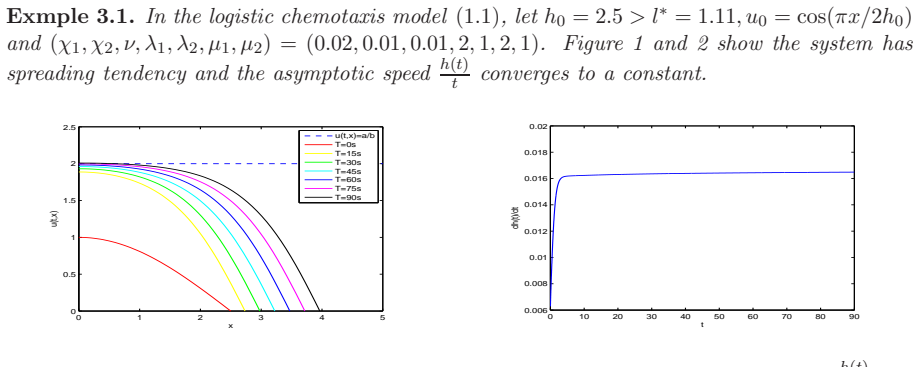
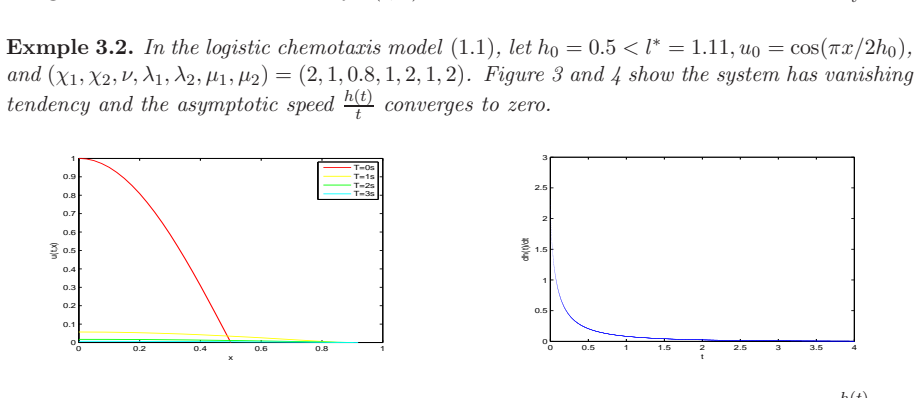
The front-fixing finite difference discretization of the chemotaxis model with free boundary produces solutions that remain positive and stable, and that exhibit the vanishing-spreading dichotomy, local persistence, and stability in agreement with existing theory while also confirming parameter dependencies conjectured for future analysis.
What carries the argument
Front-fixing transformation that converts the time-dependent spatial domain into a fixed interval, paired with a finite-difference scheme that handles the nonlinear chemotaxis terms.
If this is right
- The numerical results support using the scheme to investigate the dependence of spreading behavior on the initial population u0 and initial habitat size h0.
- Simulations can test the influence of the moving speed ν and chemotactic coefficients χ1, χ2 on whether the population vanishes or spreads.
- The method enables long-time numerical studies of stability properties in these systems.
- Agreement with theory validates the approach for exploring regimes without complete analytical results.
Where Pith is reading between the lines
- If the scheme avoids artificial spreading, it could be applied to similar free-boundary problems in other reaction-diffusion systems.
- Parameter studies from the numerics might suggest specific functional forms for the critical thresholds in the vanishing-spreading transition.
- Extension to two space dimensions would require generalizing the front-fixing approach to handle curved boundaries.
Load-bearing premise
The chosen front-fixing transformation and finite-difference discretization maintains positivity and stability of the solution without creating spurious oscillations or unphysical spreading at the free boundary.
What would settle it
Running the scheme on a parameter set where theory predicts vanishing but obtaining a solution that spreads to the entire domain, or observing negative densities, would indicate the method fails to capture the true dynamics.
Figures
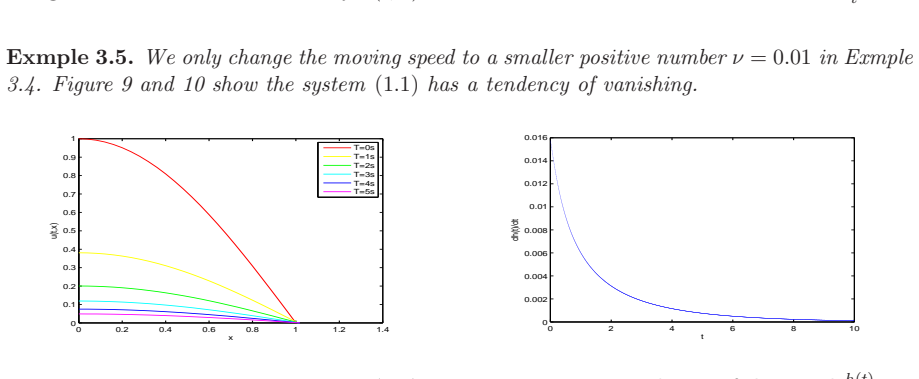
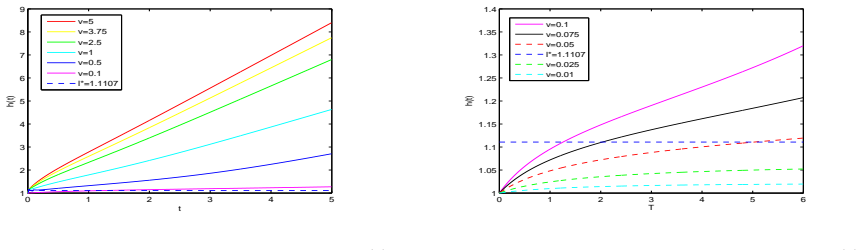
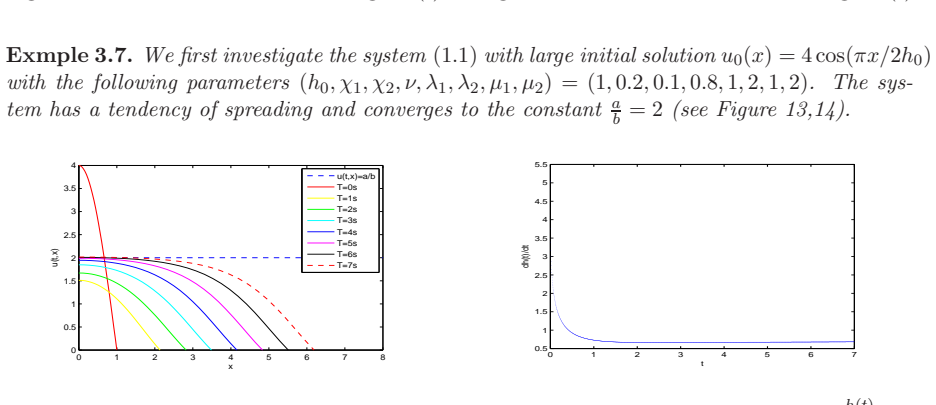
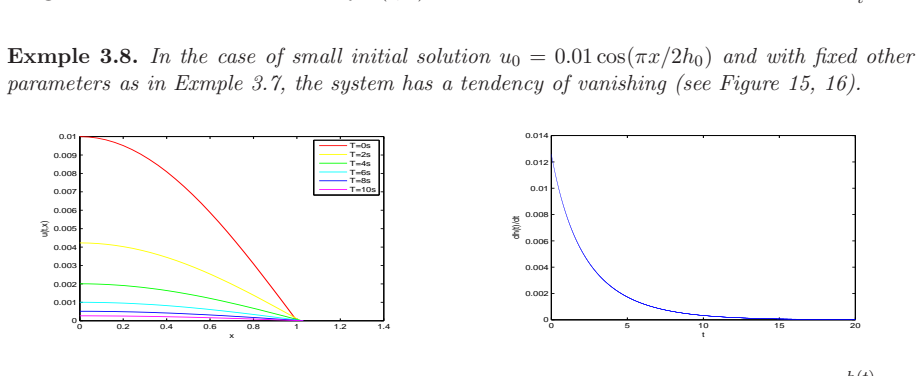
read the original abstract
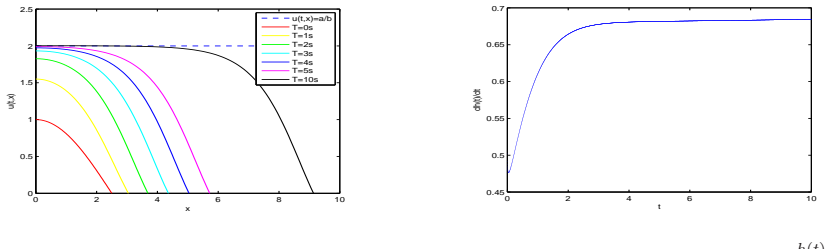
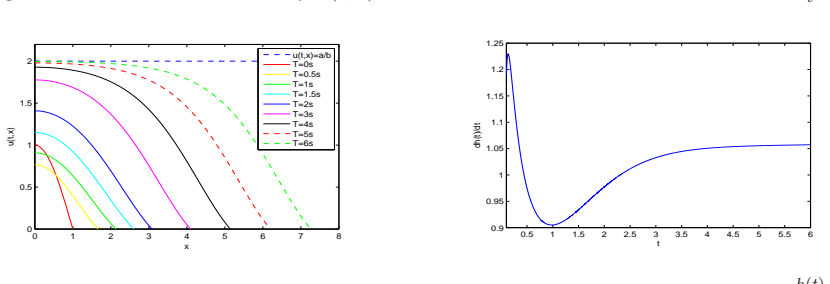
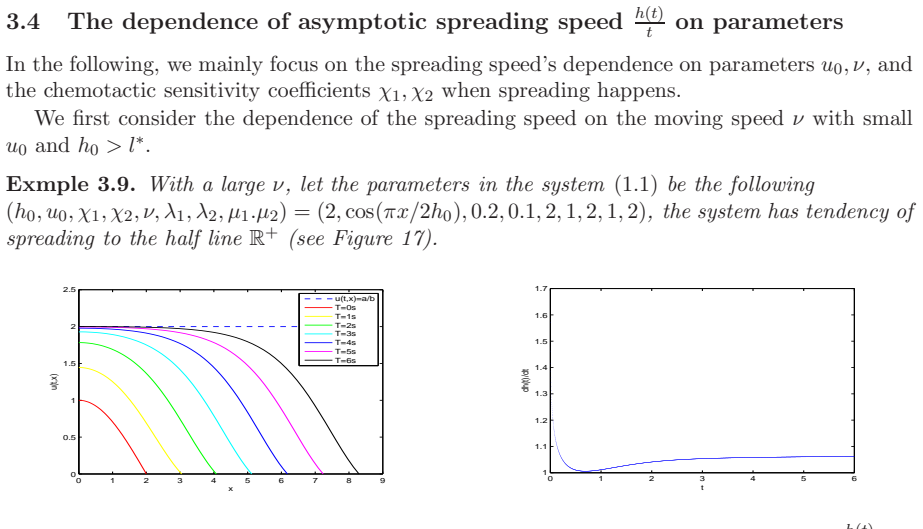
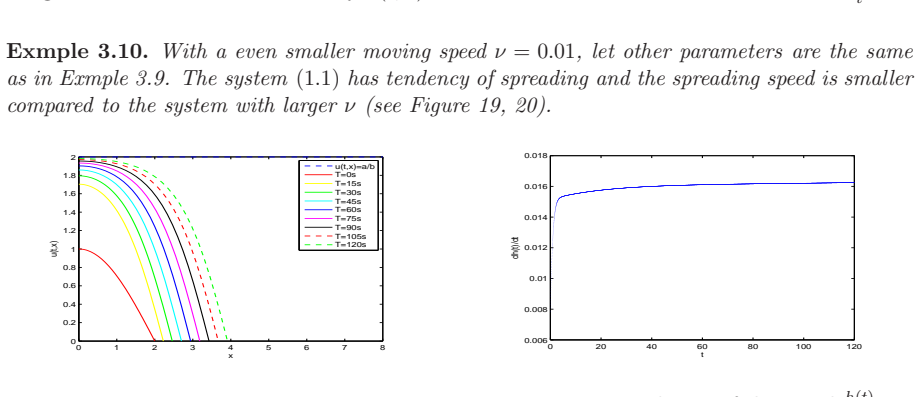
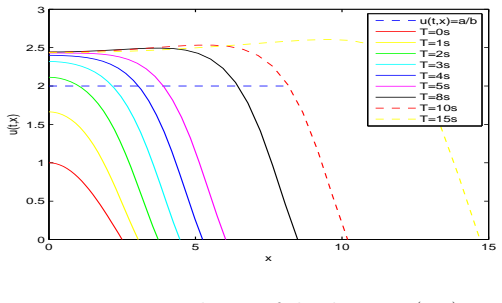
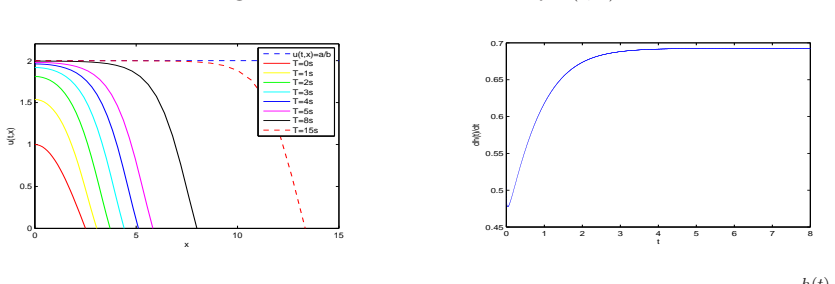
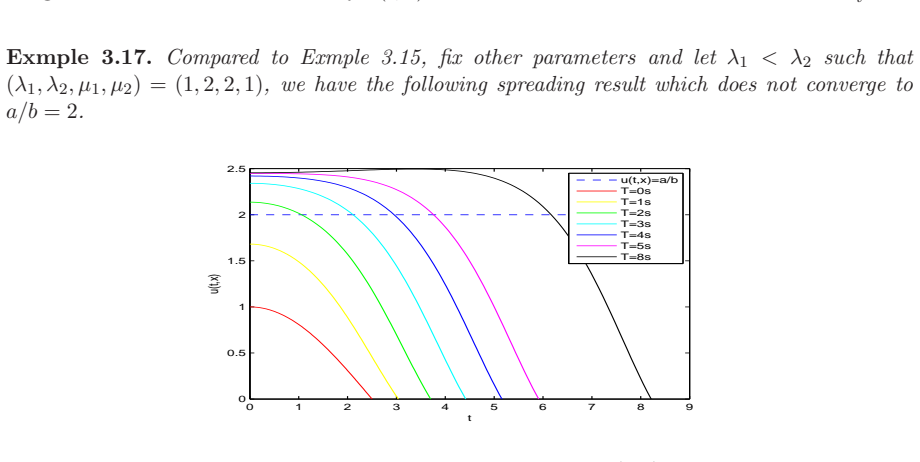
The current paper is to investigate the numerical approximation of logistic type chemotaxis models in one space dimension with a free boundary. Such a model with a free boundary describes the spreading of a new or invasive species subject to the influence of some chemical substances in an environment with a free boundary representing the spreading front (see Bao and Shen [1], [2]). The main challenges in the numerical studies lie in tracking the moving free boundary and the nonlinear terms from chemical. To overcome them, a front fixing framework coupled with finite difference method is introduced. The accuracy of the proposed method, the positivity of the solution, and the stability of the scheme are discussed.The numerical simulations agree well with theoretical results such as the vanishing spreading dichotomy, local persistence, and stability. These simulations also validate some conjectures in our future theoretical studies such as the dependence of the vanishing-spreading dichotomy on the initial solution u0, initial habitat h0, the moving speed {\nu} and the chemotactic sensitivity coefficients \c{hi}1,\c{hi}2.
Editorial analysis
A structured set of objections, weighed in public.
Referee Report
Summary. The manuscript develops a front-fixing finite-difference scheme for a one-dimensional chemotaxis system with logistic source and free boundary. It asserts that the method's accuracy, positivity, and stability are discussed, and that the resulting simulations reproduce the vanishing-spreading dichotomy, local persistence, and stability while validating conjectures on the dependence of the dichotomy on u0, h0, ν, χ1, and χ2.
Significance. If the discretization is shown to preserve positivity and not introduce artificial spreading, the numerical results would supply concrete computational support for existing theoretical dichotomies and would help prioritize parameters for future analysis of spreading speed and persistence.
major comments (2)
- [Abstract] Abstract: the assertion that accuracy, positivity, and stability 'are discussed' is not accompanied by quantitative evidence (error tables, observed convergence rates, or explicit checks across the tested range of χ1, χ2), so the claim that the simulations reliably confirm the theoretical dichotomy rests on an unverified premise.
- The front-fixing transformation together with the chosen finite-difference treatment of the nonlinear chemotactic cross-diffusion terms is not shown to satisfy a discrete maximum principle or to control truncation error at the transformed boundary; without such control the reported agreement with the vanishing-spreading dichotomy could be an artifact of the scheme rather than confirmation of the PDE dynamics.
Simulated Author's Rebuttal
We thank the referee for the detailed review and valuable suggestions. We will revise the manuscript to address the concerns regarding quantitative evidence and the properties of the numerical scheme.
read point-by-point responses
-
Referee: [Abstract] Abstract: the assertion that accuracy, positivity, and stability 'are discussed' is not accompanied by quantitative evidence (error tables, observed convergence rates, or explicit checks across the tested range of χ1, χ2), so the claim that the simulations reliably confirm the theoretical dichotomy rests on an unverified premise.
Authors: We agree with this observation. The current manuscript discusses these properties qualitatively but lacks quantitative verification. In the revision, we will add error tables, convergence rate computations, and explicit checks for positivity and stability over the parameter ranges of χ1 and χ2. This will provide the necessary support for the reliability of the simulations. revision: yes
-
Referee: The front-fixing transformation together with the chosen finite-difference treatment of the nonlinear chemotactic cross-diffusion terms is not shown to satisfy a discrete maximum principle or to control truncation error at the transformed boundary; without such control the reported agreement with the vanishing-spreading dichotomy could be an artifact of the scheme rather than confirmation of the PDE dynamics.
Authors: This is a valid concern. While the manuscript discusses positivity and stability, it does not explicitly establish a discrete maximum principle or detailed truncation error control at the boundary. We will revise to include a more rigorous analysis of the scheme's properties, such as bounds on the truncation error and numerical verification that no artificial spreading occurs. If a complete proof is beyond scope, we will clearly state the limitations and rely on extensive numerical tests. revision: partial
Circularity Check
Numerical validation of external theory; no reduction of claims to inputs by construction
full rationale
The manuscript introduces a front-fixing finite-difference scheme for a free-boundary chemotaxis model and reports that computed solutions reproduce the vanishing-spreading dichotomy, local persistence, and stability already established in the cited prior theoretical work. These agreements constitute independent numerical checks rather than fitted predictions or self-definitional identities. The additional use of simulations to explore open conjectures for future theory does not create circularity, as no parameter is tuned to the same data that is later reported as a prediction. Self-citation to the model origin papers is present but supplies the PDE system, not the numerical outcomes or their interpretation. No step in the reported chain reduces by construction to its own inputs.
Axiom & Free-Parameter Ledger
axioms (1)
- domain assumption The transformed fixed-domain problem obtained by front fixing is equivalent to the original moving-boundary problem for the purposes of numerical approximation.
Reference graph
Works this paper leans on
- [1]
- [2]
-
[3]
N. Bellomo, A. Bellouquid, Y. Tao, and M. Winkler, Toward a mathematical theory of Keller-Segel models of pattern formation in biological tis sues. Math. Models Methods Appl. Sci., (25):1663–1763, 2015
work page 2015
-
[4]
C. C. Chiu and J. L. Yu, An optimal adaptive time-stepping scheme for solving reaction- diffusion-chemotaxis systems. Math. Biosci. Eng. , 4(2):187–203, 2007
work page 2007
-
[5]
J. I. Diaz and T.Nagai, Symmetrization in a parabolic-el liptic system related to chemotaxis. Advances in Mathematical Science and Applications , (5):659–680, 1995
work page 1995
-
[6]
J. I. Diaz, T.Nagai, and J.-M Rakotoson, Symmetrization techniques on unbounded do- mains: Application to a chemotaxis system on RN . J. Differential Equations , (145):156– 183, 1998
work page 1998
-
[7]
Y.-H. Du and Z.-G. Lin, Spreading-vanishing dichotomy i n the diffusive logistic model with a free boundary. SIAM J. Math. Anal. , 42, 377-405, 2010
work page 2010
- [8]
-
[9]
E. Galakhov, O. Salieva, and J. I. Tello, On a parabolic-e lliptic system with chemotaxis and logistic type growth. J. Differential Equations , 261(8):4631–4647, 2016
work page 2016
-
[10]
D. Horstmann and M. Winkler, Boundedness vs. blow-up in a chemotaxis system, J. Differential Equations , 215(1):52–107, 2005
work page 2005
-
[11]
Tahir B. Issa and W. Shen, Dynamics in chemotaxis models of parabolic-elliptic type on bounded domain with time and space dependent logistic sourc es, SIAM J. Appl. Dyn. Syst. , 16 (2):926-973, 2017
work page 2017
-
[12]
K. Kanga and A. Steven, Blowup and global solutions in a c hemotaxis-growth system, Nonlinear Analysis, (135):57–72, 2016
work page 2016
-
[13]
E. F. Keller and L. A. Segel, Initiation of slime mold agg regation viewed as an instability, J. Theoret. Biol. , (26):399–415, 1970
work page 1970
-
[14]
E. F. Keller and L. A. Segel, A Model for chemotaxis, J. Theoret. Biol. , (30):225–234, 1971
work page 1971
-
[15]
H. G. Landau, Heat conduction in a melting solid Quaterly of Applied Mathematics, 1 (1950), no. 8, 81-94
work page 1950
-
[16]
F. Li, X. Liang, and W. Shen, Diffusive KPP equations with f ree boundaries in time almost periodic environments: I. Spreading and vanishing d ichotomy, Discrete Contin. Dyn. Syst ,36(6), 3317-3338, 2016
work page 2016
-
[17]
F. Li, X. Liang, and W. Shen, Diffusive KPP equations with f ree boundaries in time almost periodic environments: II. Spreading speeds and sem i-wave solutions, J. Differential Equations, 261 (4), 2403-2445, 2016
work page 2016
-
[18]
R. H. Li, Z. Y. Chen, and W. Wu, Generalized difference meth ods for differential equations- Numerical analysis of finite volume methods. Marcel Dekker, Inc, 2000
work page 2000
-
[19]
X. J. Li, C. W. Shu, and Y. Yang, Local discontinuous Gale rkin method for the Keller-Segel chemotaxis model, J. Sci. Comput. , 73, 943-967, 2017
work page 2017
-
[20]
J. G. Liu, L. Wang, and Z. N. Zhou, Positivity-preservin g and asymptotic preserving method for 2D Keller-Segal equations, Math. Comp. , 87 (311), 1165-1189, 2018
work page 2018
-
[21]
S. Liu, X. F. Liu, Numerical methods for a wwo-species co mpetition-diffusion model with free boundaries, Mathematics, 6 (5), 72-96, 2018
work page 2018
-
[22]
S. Liu, Y. H. Du, and X. F. Liu, Numerical Studies of a Clas s of Reaction-Diffusion Equations with Stefan Conditions, International Journal of Computer Mathematics , 2019
work page 2019
-
[23]
J. L. Lockwood, M. F. Hoopes, and M. P. Marchetti, Invasion Ecology, Blackwell Publish- ing, 2007
work page 2007
-
[24]
M.-A. Piqueras, R. Company, L. L´odar, A front-fixing numerical method for a free boundary nonlinear diffusion logistic population model, J. Comput. Appl. Math. , 309, 473-481, 2017. 26
work page 2017
- [25]
-
[26]
N. Saito and T. Suzuki, Notes on finite difference schemes t o a parabolic-elliptic system modelling chemotaxis, Appl. Math. Comput. , 171, 72-90, 2005
work page 2005
-
[27]
R. B. Salako and W. Shen, Spreading Speeds and Traveling waves of a parabolic-elliptic chemotaxis system with logistic source on RN , Discrete Contin. Dyn. Syst. , 37(12), 6189– 6225, 2017
work page 2017
-
[28]
R. B. Salako, W. Shen, and S. W. Xue, Can chemotaxis speed up or slow down the spatial spreading in parabolic-elliptic chemotaxis systems with l ogistic source? preprint
-
[29]
N. Shigesada and K. Kawasaki, Biological Invasions: Theory and Practice, Oxford Series in Ecology and Evolution , Oxford Univ. Press., Oxford, 1997
work page 1997
-
[30]
Y. Sugiyama, Global existence in sub-critical cases an d finite time blow up in super critical cases to degenerate Keller-Segel systems, Differential Integral Equations , 19(8):841–876, 2006
work page 2006
-
[31]
Y. Sugiyama and H. Kunii, Global Existence and decay pro perties for a degenerate keller- Segel model with a power factor in drift term, J. Differential Equations , 227:333–364, 2006
work page 2006
-
[32]
J. I. Tello and M. Winkler, A chemotaxis system with logi stic source, Communications in Partial Differential Equations , (32):849–877, 2007
work page 2007
-
[33]
L. Wang, C. Mu, and P. Zheng, On a quasilinear parabolic- elliptic chemotaxis system with logistic source, J. Differential Equations , 256:1847–1872, 2014
work page 2014
-
[34]
M. Winkler, Aggregation vs. global diffusive behavior in the higher-dimensional Keller-Segel model, J. Differential Equations , 248:2889–2905, 2010
work page 2010
-
[35]
M. Winkler, Blow-up in a higher-dimensional chemotaxi s system despite logistic growth restriction, Journal of Mathematical Analysis and Applications , 384:261–272, 2011
work page 2011
-
[36]
Winkler, Finite-time blow-up in the higher-dimensi onal parabolic-parabolic Keller-Segel system, J
M. Winkler, Finite-time blow-up in the higher-dimensi onal parabolic-parabolic Keller-Segel system, J. Math. Pures Appl. , 100:748–767, 2013
work page 2013
-
[37]
M. Winkler, Global asymptotic stability of constant eq uilibria in a fully parabolic chemo- taxis system with strong logistic dampening, J. Differential Equations , 257(4):1056–1077, 2014
work page 2014
-
[38]
Winkler, How far can chemotactic cross-diffusion enfo rce exceeding carrying capacities? J
M. Winkler, How far can chemotactic cross-diffusion enfo rce exceeding carrying capacities? J. Nonlinear Sci. , 24:809–855, 2014
work page 2014
-
[39]
T. Yokota and N. Yoshino, Existence of solutions to chem otaxis dynamics with logistic source, Discrete Contin. Dyn. Syst. Dynamical systems, differential equations and applica- tions. 10th AIMS Conference. Suppl. , pages 1125–1133, 2015
work page 2015
- [40]
discussion (0)
Sign in with ORCID, Apple, or X to comment. Anyone can read and Pith papers without signing in.