REVIEW 3 major objections 4 minor 68 references
Slow and fat: low-spin SMBHs are more massive
T0 review · 3 major / 4 minor · reviewed 2026-08-14 · deepseek-v4-flash
Pith's one-line read This paper argues that supermassive black holes with low spin end up more massive than high-spin ones in the same host galaxy, because the mass a black hole must add to clear its host galaxy scales as the inverse square of the…
desk verdict A short analytic paper predicting that low-spin SMBHs end up more massive at fixed σ; the direction is robust but the claimed magnitude rests almost entirely on the least-constrained coupling parameter. read the letter →
The pith
A machine-rendered reading of the paper's core claim, the machinery that carries it, and where it could break.
The reading
What carries the argument
The load-bearing object is the energy-balance equation between the binding energy of the galactic gas and the mechanical energy of the AGN wind that must expel it. Writing the wind energy as $E_w = (\eta/2) E_{\rm AGN} = (\eta^2/2) \Delta M_{\rm BH} c^2$, and equating $f E_w$ with $E_{\rm bind} \sim 2 f_g \sigma^4 R/G$ yields $\Delta M_{\rm BH} \propto \sigma^4 R/(f \eta^2)$; using $R_v \propto \sigma$ gives $\Delta M_{\rm BH} \propto \sigma^5$ and, relative to $M_{\rm crit} \propto \sigma^4$, an extra growth $\Delta M_{\rm BH}/M_{\rm crit} \propto \eta^{-2}$. The spin enters only through the average radiative efficiency $\eta$, defined as the mean of the prograde and retrograde efficiencies over many small accretion episodes, so the mechanism is deliberately parameter-free apart from the coupling efficiency $f$.
What would settle it
Measure spins and masses for a large sample of SMBHs in galaxies with a narrow range of $\sigma$. The prediction fails if high-spin black holes ($a > 0.9$) are found systematically above the $M{-}\sigma$ relation, or if the mass residual of a galaxy shows no anti-correlation with spin once selection effects are accounted for.
Extended reading notes
Core claim
The central claim is that SMBH growth continues by a factor of a few after the black hole reaches the critical mass $M_{\rm crit}$ at which it can drive a large-scale outflow, and that the mass increment $\Delta M_{\rm BH}$ depends on spin as $\Delta M_{\rm BH} \propto \eta^{-2}$, where $\eta$ is the average radiative efficiency of accretion. Since $\eta$ ranges from about 0.055 for a non-spinning black hole to about 0.23 for typical accretion on to a maximally spinning one, the increment can differ by a factor of up to 20 between slow and fast spinners. Combined with the observed size-velocity-dispersion relation, this gives $\Delta M_{\rm BH} \propto \sigma^5$ and steepens the overall $M{-}\sigma$ relation beyond $M \propto \sigma^4$. The paper therefore predicts that at fixed $\sigma$, the most massive black holes have the lowest spins, and that mass residuals from the $M{-}\sigma$ relation correlate strongly with spin.
Load-bearing premise
The calculation assumes a single constant feedback coupling efficiency $f$, estimated at about 0.15 from the observed offset between early- and late-type galaxy $M{-}\sigma$ relations; if the true $f$ is near the upper bound of 0.75, the predicted spin dependence of the extra mass growth nearly vanishes.
Editorial extensions
If this is right
- At any fixed $\sigma$, the most massive black holes should have the lowest spins, and the slow-spinning population should trace the upper edge of the observed $M{-}\sigma$ scatter.
- The residuals of the $M{-}\sigma$ relation should anti-correlate with SMBH spin, consistent with the observed anti-correlation between mass offset and Eddington ratio.
- The $M{-}\sigma$ relation steepens because the late growth scales as $\sigma^5$, bringing the predicted slope closer to observed values around $\alpha \approx 5$.
- Before reaching $M_{\rm crit}$, high-spin SMBHs grow more slowly by up to a factor of about 12, so at fixed galaxy mass and redshift there should be a mass-spin anti-correlation that strengthens at high redshift.
- The effect is largest in massive, high-$\sigma$ galaxies and in small isolated galaxies least affected by mergers, which are the best laboratories for detecting the mass-spin correlation.
Reading between the lines
- Editorial inference: If the spin distribution is bottom-heavy, the predicted effect would inflate the scatter of the $M{-}\sigma$ relation at the high-mass end; if it is top-heavy, the relation should show few outliers above the mean, so the shape of the scatter could constrain the spin distribution without direct spin measurements.
- Editorial inference: The same energy argument implies that two galaxies with the same $M_{\rm BH}$ and $\sigma$ but different spins have released different amounts of feedback energy, so integrated outflow and star-formation signatures may offer an independent, qualitative spin diagnostic for quenched ellipticals.
- Editorial inference: The prediction could be tested by combining reverberation-mapping masses with X-ray reflection spin measurements for a $\sigma$-selected sample; existing samples are too sparse, but a few dozen objects would separate the $a < 0.65$ and $a > 0.9$ predictions at the factor-of-2 level.
- Editorial inference: A merger-dominated growth history would produce many high-spin SMBHs and thus many massive outliers above the $M{-}\sigma$ relation; the absence of such outliers would independently support chaotic accretion and slow spins.
Signed reviews
Editorial analysis
A structured set of objections, weighed in public.
Referee Report
Summary. The paper presents an analytic model for supermassive black hole (SMBH) growth after the black hole reaches the critical mass Mcrit at which its wind can drive a large-scale outflow. Equating the energy required to unbind the host galaxy's gas to the fraction of AGN wind energy absorbed by that gas, the authors derive an additional mass growth ΔMBH ∝ f^{-1} η^{-2} σ^4 R, where f is the wind coupling efficiency, η is the spin-dependent radiative efficiency, and R is the radius to which gas must be expelled. Since η depends on spin, slowly spinning black holes accumulate more mass while clearing their hosts; combining this with a galaxy size–velocity dispersion relation yields a steepening of the M–σ relation. The paper predicts that at fixed σ the most massive black holes have the lowest spins, that M–σ residuals anti-correlate with spin, and that this becomes more pronounced at high σ. The predictions are compared with the observed M–σ relations of McConnell & Ma (2013) and with current, sparse spin estimates, and future observational tests are discussed.
Significance. If the central claim holds, the paper offers a simple physical mechanism linking SMBH spin to the scatter and slope of the M–σ relation, with a falsifiable prediction that can be tested with large samples of spin and mass measurements. The derivation is transparent, uses standard general-relativistic radiative efficiencies, and yields explicit scaling relations rather than a purely numerical fit. The model also correctly identifies that the direction of the effect is robust: because a constant f multiplies all spin-dependent terms, slower spins always produce larger ΔMBH. However, the quantitative strength of the effect and its observability depend heavily on the poorly constrained coupling efficiency f and on the adopted galaxy size scaling, and the current observational comparison is partly circular. These issues do not invalidate the qualitative direction of the prediction, but they materially affect the strength of the claims as written.
major comments (3)
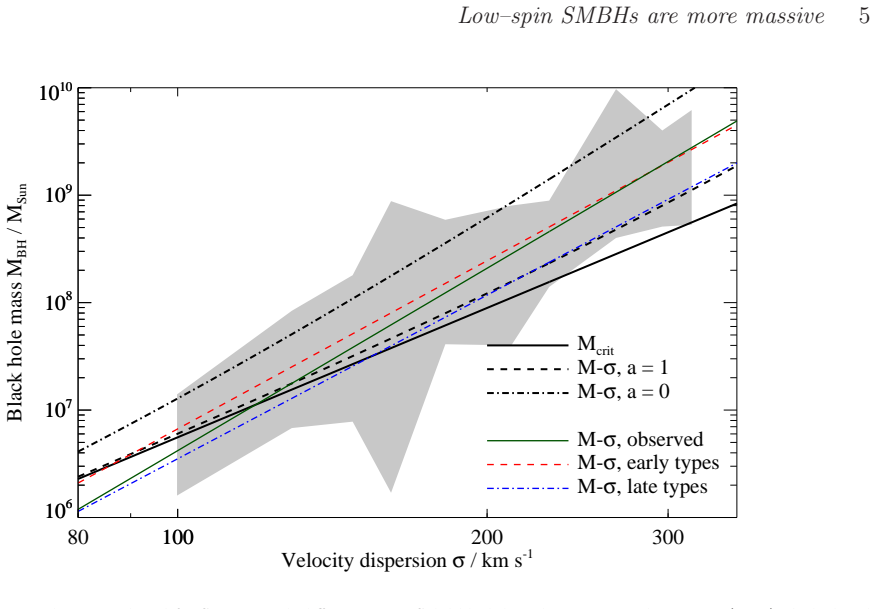
- [Section 3, eqs. (6), (7), and Fig. 2] The abstract and Section 3 state that ΔMBH ∝ σ^5, but the size–velocity dispersion relation actually used for Figure 2, Rv = 293 σ_{200}^{2.19} kpc, gives ΔMBH ∝ σ^4 Rv ∝ σ^{6.19}, not σ^5. The σ^5 result follows only from the alternative relation Rv ∝ σ mentioned in the text, which is not the relation used in the comparison plot. Please reconcile this inconsistency: either justify and consistently adopt Rv ∝ σ, or revise the scaling claim to match the adopted Rv(σ) relation.
- [Section 3, f calibration and Fig. 2] The feedback coupling efficiency f ≈ 0.15 is estimated from the observed offset between the M–σ intercepts of early-type and late-type galaxies (McConnell & Ma 2013), and the same observed early-type and late-type relations are then used as the comparison data in Figure 2. This makes the apparent agreement in Figure 2 partly a consistency check rather than an independent test of the spin-dependent predictions. The paper should state this explicitly, and ideally show the model predictions for a range of f values against the data so that the sensitivity of the comparison to the calibrated parameter is transparent.
- [Equations (10), (11) and Fig. 1; abstract] The headline claim that 'slowly-spinning SMBHs gain potentially 20 times more mass' refers to the ratio of incremental masses ΔM, not the ratio of final black hole masses. At the paper's own upper-limit value f = 0.75, eqs. (10) and (11) give ΔM/Mcrit ≈ 0.67 for a = 0 and ≈ 0.037 for a = 1, so the final masses differ by only about 60%, which is comparable to or smaller than the observed intrinsic scatter of the M–σ relation. Even at the adopted f = 0.15, the final mass contrast is only a factor of about 3.6. The observability of the predicted mass–spin correlation therefore rests almost entirely on the least-constrained parameter f. The authors should quantify this sensitivity in the abstract and discussion, and temper the '20 times' phrasing so that it is not read as a prediction for the final mass ratio.
minor comments (4)
- [General] There are several typographical and formatting issues, including 'et a l.' in the affiliation line, 'approximatey' in the discussion of Figure 2, and repeated uses of '∼−' where a single approximation sign is intended (e.g., 'f ∼− 0.75' and '∆MBH ∼− 6.5Mcrit').
- [Section 3, after eq. (7)] The sentence 'Substituting this relation into eq. (6) gives ∆MBH ∝ σ^5' implicitly refers to Rv ∝ σ, but the preceding paragraph does not give the normalization or scatter of that relation; adding the explicit relation would help the reader reproduce the scaling.
- [Section 5] The statement that available data show 'a general trend of more massive black holes spinning more slowly' is supported only by a list of references without quantitative scatter or sample definitions; a brief statement of the evidence strength would be useful, especially since the next sentence notes selection effects.
- [Figure 2] The figure caption and text use fg = 0.05 for the predicted curves while earlier equations use fg = 0.16; the switch is explained in the text but should be reiterated in the caption to avoid confusion.
Circularity Check
Spin ordering is a genuine derivation from GR efficiencies, but the absolute M-σ offset used as evidence is calibrated to the same McConnell & Ma data it is compared against.
-
fitted input called prediction
[Section 3, after Eq. (7); Figure 2 and surrounding text]
"considering the difference in the intercepts of M − σ relation for elliptical and spiral galaxies (McConnell & Ma 2013) leads to ∆MBH ∼− Mcrit and f ∼ 0.15. ... We also adopt f = 0.15. ... the predicted relations for black holes with different spins agree with observations rather well. In particular, the relation for the slowest-spinning SMBHs approximately traces the upper edge of the locus of data points."
The coupling efficiency f is not independently predicted; it is calibrated so that the model reproduces the observed early-type/late-type intercept offset of McConnell & Ma (2013). Figure 2 then adopts this same f = 0.15 and compares the resulting absolute M−σ curves with that same McConnell & Ma sample, claiming the slow-spin curve traces the upper envelope. The amplitude of the predicted offset is therefore partly built into the model from the comparison data. The spin ordering and the factor ∼20 in ΔMBH between a=0 and a≈1 are independent of f, since f cancels in the efficiency ratio, so the circularity is partial rather than total.
full rationale
The core claim, ΔMBH ∝ η^{-2}, follows from the paper's energy balance (Eqs. 5-7) together with standard GR radiative efficiencies (η_a=0 = 0.055 and ⟨η⟩_max = 0.23), neither of which is fitted to the spin data. The often-quoted factor of ~20 is the square of the ratio of these efficiencies, not a fitted parameter. No uniqueness theorem is invoked, and the self-citations (King 2010; Zubovas & King 2012a) anchor the outflow model with the relevant equations presented in the text. The one partially circular element is the calibration of f: it is chosen to match the McConnell & Ma (2013) early/late-type offset, and the same sample and value are then used to claim that the a=0 curve traces the upper envelope of the data. This affects the normalization of the predicted M−σ offset, but not the spin ordering, so the score is 4 rather than higher. Whether the effect remains observable at f = 0.75 is a robustness concern, not circularity.
Assumptions & free parameters
free parameters (3)
- Feedback coupling efficiency f =
~0.15
- Gas fraction fg =
0.16 in analytic estimates; 0.05 in Figure 2
- Virial radius scaling Rv = 293 sigma^2.19 kpc =
normalization 293, exponent 2.19
assumptions (7)
- domain assumption Momentum-driven outflow criterion gives Mcrit ∝ sigma^4 (equation 1).
- domain assumption Isothermal sphere distribution for gas and dark matter with binding energy ~ Mg sigma^2 (equations 2 and 3).
- domain assumption Wind energy is Ew = (eta/2) EAGN = eta^2 ΔM c^2 / 2 (equation 5).
- domain assumption Average radiative efficiency over many accretion episodes is the arithmetic mean of prograde and retrograde efficiencies (equation 9).
- ad hoc to paper Coupling efficiency f is constant across spin and galaxy type.
- domain assumption Black hole spin stays roughly constant during the extra growth phase.
- domain assumption Gas must be expelled to the virial radius to halt further SMBH growth.
Cite this review
Pith. "Pith review of Slow and fat: low-spin SMBHs are more massive." pith.science (2026). https://pith.science/paper/GRK7TXYV
@misc{pith2026190802630,
  author       = {Pith},
  title        = {Pith review of: Slow and fat: low-spin SMBHs are more massive},
  year         = {2026},
  howpublished = {\url{https://pith.science/paper/GRK7TXYV}},
  note         = {Machine review of arXiv:1908.02630}
}
abstract
Active galactic nuclei (AGN) probably control the growth of their host galaxies via feedback in the form of wide-angle wind-driven outflows. These establish the observed correlations between supermassive black hole (SMBH) masses and host galaxy properties, e.g. the spheroid velocity dispersion $\sigma$. In this paper we consider the growth of the SMBH once it starts driving a large-scale outflow through the galaxy. To clear the gas and ultimately terminate further growth of both the SMBH and the host galaxy, the black hole must continue to grow its mass significantly, by up to a factor of a few, after reaching this point. The mass increment $\Delta M_{\rm BH}$ depends sensitively on both galaxy size and SMBH spin. The galaxy size dependence leads to $\Delta M_{\rm BH} \propto \sigma^5$ and a steepening of the $M-\sigma$ relation beyond the analytically calculated $M \propto \sigma^4$, in agreement with observation. Slowly--spinning black holes are much less efficient in producing feedback, so at any given $\sigma$ the slowest--spinning black holes should be the most massive. Current observational constraints are consistent with this picture, but insufficient to test it properly; however, this should change with upcoming surveys.
Figures

Reference graph
Works this paper leans on
-
[1]
Aversa R., Lapi A., de Zotti G., Shankar F., Danese L., 2015, @doi [ ] 10.1088/0004-637X/810/1/74 , https://ui.adsabs.harvard.edu/abs/2015ApJ...810...74A 810, 74
-
[2]
Barret D., Cappi M., 2019, arXiv e-prints, https://ui.adsabs.harvard.edu/abs/2019arXiv190602734B p. arXiv:1906.02734
work page Pith review arXiv 2019
-
[3]
B \'e ky B., Kocsis B., 2013, @doi [ ] 10.1088/0004-637X/762/1/35 , https://ui.adsabs.harvard.edu/abs/2013ApJ...762...35B 762, 35
-
[4]
Berti E., Volonteri M., 2008, @doi [ ] 10.1086/590379 , https://ui.adsabs.harvard.edu/abs/2008ApJ...684..822B 684, 822
doi:10.1086/590379 2008
-
[5]
Brenneman L., 2013, Measuring the Angular Momentum of Supermassive Black Holes , @doi 10.1007/978-1-4614-7771-6
-
[7]
Cappellari M., et al., 2013, @doi [ ] 10.1093/mnras/stt562 , https://ui.adsabs.harvard.edu/abs/2013MNRAS.432.1709C 432, 1709
-
[8]
Cicone C., et al., 2015, @doi [ ] 10.1051/0004-6361/201424980 , http://adsabs.harvard.edu/abs/2015A
-
[9]
Comparat J., et al., 2019, arXiv e-prints, https://ui.adsabs.harvard.edu/abs/2019arXiv190110866C p. arXiv:1901.10866
arXiv 2019
Show all 68 references
-
[10]
N., Kochanek C
Dai X., Bregman J. N., Kochanek C. S., Rasia E., 2010, @doi [ ] 10.1088/0004-637X/719/1/119 , https://ui.adsabs.harvard.edu/abs/2010ApJ...719..119D 719, 119
2010 doi
-
[11]
A., 2009, @doi [ ] 10.1088/0004-637X/696/1/L32 , https://ui.adsabs.harvard.edu/abs/2009ApJ...696L..32D 696, L32
Daly R. A., 2009, @doi [ ] 10.1088/0004-637X/696/1/L32 , https://ui.adsabs.harvard.edu/abs/2009ApJ...696L..32D 696, L32
2009 doi
-
[12]
A., 2016, @doi [ ] 10.1093/mnrasl/slw010 , https://ui.adsabs.harvard.edu/abs/2016MNRAS.458L..24D 458, L24
Daly R. A., 2016, @doi [ ] 10.1093/mnrasl/slw010 , https://ui.adsabs.harvard.edu/abs/2016MNRAS.458L..24D 458, L24
2016 doi
-
[13]
A., 2019, arXiv e-prints, https://ui.adsabs.harvard.edu/abs/2019arXiv190511319D p
Daly R. A., 2019, arXiv e-prints, https://ui.adsabs.harvard.edu/abs/2019arXiv190511319D p. arXiv:1905.11319
2019 arXiv
-
[14]
A., Sprinkle T
Daly R. A., Sprinkle T. B., 2014, @doi [ ] 10.1093/mnras/stt2433 , https://ui.adsabs.harvard.edu/abs/2014MNRAS.438.3233D 438, 3233
2014 doi
-
[15]
B., Hennawi J
Davies F. B., Hennawi J. F., Eilers A.-C., 2019, arXiv e-prints, https://ui.adsabs.harvard.edu/abs/2019arXiv190610130D p. arXiv:1906.10130
2019 arXiv
-
[16]
Djorgovski S., Davis M., 1987, @doi [ ] 10.1086/164948 , http://adsabs.harvard.edu/abs/1987ApJ...313...59D 313, 59
1987 doi
-
[17]
Dotti M., Colpi M., Pallini S., Perego A., Volonteri M., 2013, @doi [ ] 10.1088/0004-637X/762/2/68 , https://ui.adsabs.harvard.edu/abs/2013ApJ...762...68D 762, 68
2013 doi
-
[18]
arXiv:1306.2331
Dovciak M., et al., 2013, arXiv e-prints, https://ui.adsabs.harvard.edu/abs/2013arXiv1306.2331D p. arXiv:1306.2331
2013 arXiv
-
[19]
Feruglio C., Maiolino R., Piconcelli E., Menci N., Aussel H., Lamastra A., Fiore F., 2010, @doi [ ] 10.1051/0004-6361/201015164 , http://adsabs.harvard.edu/abs/2010A
2010 doi
-
[20]
A., Durier F., de Araujo J
Filloux C., de Preitas Pacheco J. A., Durier F., de Araujo J. C. N., 2012, in Journal of Physics Conference Series. p. 012046, @doi 10.1088/1742-6596/363/1/012046
2012 doi
-
[21]
Fiore F., et al., 2017, @doi [ ] 10.1051/0004-6361/201629478 , http://adsabs.harvard.edu/abs/2017A
2017 doi
-
[22]
\'A ., Biermann P
Gergely L. \'A ., Biermann P. L., 2012, arXiv e-prints, https://ui.adsabs.harvard.edu/abs/2012arXiv1208.5251G p. arXiv:1208.5251
2012 arXiv
-
[24]
J., Lacey C
Griffin A. J., Lacey C. G., Gonzalez-Perez V., Lagos C. d. P., Baugh C. M., Fanidakis N., 2018, arXiv e-prints, https://ui.adsabs.harvard.edu/abs/2018arXiv180608370G p. arXiv:1806.08370
2018 arXiv
-
[25]
Habouzit M., Volonteri M., Dubois Y., 2017, @doi [ ] 10.1093/mnras/stx666 , http://adsabs.harvard.edu/abs/2017MNRAS.468.3935H 468, 3935
2017 doi
-
[26]
J rgensen I., Chiboucas K., 2013, @doi [ ] 10.1088/0004-6256/145/3/77 , https://ui.adsabs.harvard.edu/abs/2013AJ....145...77J 145, 77
2013 doi
-
[27]
R., 2010, @doi [ ] 10.1111/j.1365-2966.2009.16013.x , http://adsabs.harvard.edu/abs/2010MNRAS.402.1516K 402, 1516
King A. R., 2010, @doi [ ] 10.1111/j.1365-2966.2009.16013.x , http://adsabs.harvard.edu/abs/2010MNRAS.402.1516K 402, 1516
2010
-
[28]
King A., Nealon R., 2019, @doi [ ] 10.1093/mnras/stz1569 , https://ui.adsabs.harvard.edu/abs/2019MNRAS.487.4827K 487, 4827
2019 doi
-
[29]
King A., Nixon C., 2015, @doi [ ] 10.1093/mnrasl/slv098 , http://adsabs.harvard.edu/abs/2015MNRAS.453L..46K 453, L46
2015 doi
-
[30]
R., Pringle J
King A. R., Pringle J. E., 2006, @doi [ ] 10.1111/j.1745-3933.2006.00249.x , http://adsabs.harvard.edu/abs/2006MNRAS.373L..90K 373, L90
2006
-
[31]
R., Lubow S
King A. R., Lubow S. H., Ogilvie G. I., Pringle J. E., 2005, @doi [ ] 10.1111/j.1365-2966.2005.09378.x , http://adsabs.harvard.edu/abs/2005MNRAS.363...49K 363, 49
2005
-
[33]
C., 2013, @doi [ ] 10.1146/annurev-astro-082708-101811 , http://adsabs.harvard.edu/abs/2013ARA
Kormendy J., Ho L. C., 2013, @doi [ ] 10.1146/annurev-astro-082708-101811 , http://adsabs.harvard.edu/abs/2013ARA
2013 doi
-
[34]
M., 2018, @doi [ ] 10.1093/mnras/stx2704 , https://ui.adsabs.harvard.edu/abs/2018MNRAS.473.5237K 473, 5237
Krajnovi \'c D., Cappellari M., McDermid R. M., 2018, @doi [ ] 10.1093/mnras/stx2704 , https://ui.adsabs.harvard.edu/abs/2018MNRAS.473.5237K 473, 5237
2018 doi
-
[35]
V., 2013, @doi [ ] 10.1088/2041-8205/764/2/L31 , https://ui.adsabs.harvard.edu/abs/2013ApJ...764L..31K 764, L31
Kravtsov A. V., 2013, @doi [ ] 10.1088/2041-8205/764/2/L31 , https://ui.adsabs.harvard.edu/abs/2013ApJ...764L..31K 764, L31
2013 doi
-
[36]
J., Gergely L
Kun E., Wiita P. J., Gergely L. \'A ., Keresztes Z., Gopal-Krishna Biermann P. L., 2013, @doi [Astronomische Nachrichten] 10.1002/asna.201211986 , https://ui.adsabs.harvard.edu/abs/2013AN....334.1024K 334, 1024
2013 doi
-
[37]
K., 2003, @doi [ ] 10.1086/375804 , http://adsabs.harvard.edu/abs/2003ApJ...589L..21M 589, L21
Marconi A., Hunt L. K., 2003, @doi [ ] 10.1086/375804 , http://adsabs.harvard.edu/abs/2003ApJ...589L..21M 589, L21
2003 doi
-
[38]
Martin-Navarro I., Mezcua M., 2018, preprint, http://adsabs.harvard.edu/abs/2018arXiv180207277M ( @eprint arXiv 1802.07277 )
2018 arXiv
-
[39]
J., Ma C.-P., 2013, @doi [ ] 10.1088/0004-637X/764/2/184 , http://adsabs.harvard.edu/abs/2013ApJ...764..184M 764, 184
McConnell N. J., Ma C.-P., 2013, @doi [ ] 10.1088/0004-637X/764/2/184 , http://adsabs.harvard.edu/abs/2013ApJ...764..184M 764, 184
2013 doi
-
[40]
J., Ma C.-P., Gebhardt K., Wright S
McConnell N. J., Ma C.-P., Gebhardt K., Wright S. A., Murphy J. D., Lauer T. R., Graham J. R., Richstone D. O., 2011, , http://adsabs.harvard.edu/abs/2011Natur.480..215M 480, 215
2011
-
[41]
Merloni A., Heinz S., 2008, @doi [ ] 10.1111/j.1365-2966.2008.13472.x , http://adsabs.harvard.edu/abs/2008MNRAS.388.1011M 388, 1011
2008
-
[42]
Mo \'s cibrodzka M., Falcke H., Noble S., 2016, @doi [ ] 10.1051/0004-6361/201629157 , https://ui.adsabs.harvard.edu/abs/2016A&A...596A..13M 596, A13
2016 doi
-
[43]
arXiv:1306.2307
Nandra K., et al., 2013, arXiv e-prints, https://ui.adsabs.harvard.edu/abs/2013arXiv1306.2307N p. arXiv:1306.2307
2013 arXiv
-
[44]
F., Frenk C
Navarro J. F., Frenk C. S., White S. D. M., 1997, @doi [ ] 10.1086/304888 , http://adsabs.harvard.edu/abs/1997ApJ...490..493N 490, 493
1997 doi
-
[45]
I., King A., 2009, @doi [ ] 10.1111/j.1745-3933.2009.00709.x , http://adsabs.harvard.edu/abs/2009MNRAS.398L..54N 398, L54
Nayakshin S., Wilkinson M. I., King A., 2009, @doi [ ] 10.1111/j.1745-3933.2009.00709.x , http://adsabs.harvard.edu/abs/2009MNRAS.398L..54N 398, L54
2009
-
[46]
arXiv:1705.06064
Padovani P., et al., 2017, arXiv e-prints, https://ui.adsabs.harvard.edu/abs/2017arXiv170506064P p. arXiv:1705.06064
2017 arXiv
-
[47]
Y., Buliga S
Piotrovich M. Y., Buliga S. D., Gnedin Y. N., Mikhailov A. G., Natsvlishvili T. M., 2016, @doi [Astrophysics] 10.1007/s10511-016-9447-4 , https://ui.adsabs.harvard.edu/abs/2016Ap.....59..439P 59, 439
2016 doi
-
[48]
R., 2011, @doi [ ] 10.1111/j.1745-3933.2011.01048.x , http://adsabs.harvard.edu/abs/2011MNRAS.413L.110P 413, L110
Power C., Zubovas K., Nayakshin S., King A. R., 2011, @doi [ ] 10.1111/j.1745-3933.2011.01048.x , http://adsabs.harvard.edu/abs/2011MNRAS.413L.110P 413, L110
2011
-
[49]
P \"u rrer M., Hannam M., Ohme F., 2016, @doi [ ] 10.1103/PhysRevD.93.084042 , https://ui.adsabs.harvard.edu/abs/2016PhRvD..93h4042P 93, 084042
2016 doi
-
[50]
I., Walker M
Read J. I., Walker M. G., Steger P., 2019, @doi [ ] 10.1093/mnras/sty3404 , https://ui.adsabs.harvard.edu/abs/2019MNRAS.484.1401R 484, 1401
2019 doi
-
[51]
S., 2013, @doi [Classical and Quantum Gravity] 10.1088/0264-9381/30/24/244004 , https://ui.adsabs.harvard.edu/abs/2013CQGra..30x4004R 30, 244004
Reynolds C. S., 2013, @doi [Classical and Quantum Gravity] 10.1088/0264-9381/30/24/244004 , https://ui.adsabs.harvard.edu/abs/2013CQGra..30x4004R 30, 244004
2013 doi
-
[52]
S., 2019, @doi [Nature Astronomy] 10.1038/s41550-018-0665-z , https://ui.adsabs.harvard.edu/abs/2019NatAs...3...41R 3, 41
Reynolds C. S., 2019, @doi [Nature Astronomy] 10.1038/s41550-018-0665-z , https://ui.adsabs.harvard.edu/abs/2019NatAs...3...41R 3, 41
2019 doi
-
[53]
J., Faucher-Gigu \`e re C.-A., 2018a, @doi [ ] 10.1093/mnras/stx3014 , http://adsabs.harvard.edu/abs/2018MNRAS.474.3673R 474, 3673
Richings A. J., Faucher-Gigu \`e re C.-A., 2018a, @doi [ ] 10.1093/mnras/stx3014 , http://adsabs.harvard.edu/abs/2018MNRAS.474.3673R 474, 3673
-
[54]
J., Faucher-Gigu \`e re C.-A., 2018b, @doi [ ] 10.1093/mnras/sty1285 , http://adsabs.harvard.edu/abs/2018MNRAS.478.3100R 478, 3100
Richings A. J., Faucher-Gigu \`e re C.-A., 2018b, @doi [ ] 10.1093/mnras/sty1285 , http://adsabs.harvard.edu/abs/2018MNRAS.478.3100R 478, 3100
-
[55]
M., Brook C
Santos-Santos I. M., Brook C. B., Stinson G., Di Cintio A., Wadsley J., Dom \' nguez-Tenreiro R., Gottl \"o ber S., Yepes G., 2016, @doi [ ] 10.1093/mnras/stv2335 , https://ui.adsabs.harvard.edu/abs/2016MNRAS.455..476S 455, 476
2016 doi
-
[56]
S., Schutz B
Sathyaprakash B. S., Schutz B. F., 2009, @doi [Living Reviews in Relativity] 10.12942/lrr-2009-2 , https://ui.adsabs.harvard.edu/abs/2009LRR....12....2S 12, 2
2009 doi
-
[57]
F., 2015, @doi [ ] 10.1093/mnras/stv1136 , http://adsabs.harvard.edu/abs/2015MNRAS.451.2517S 451, 2517
Schawinski K., Koss M., Berney S., Sartori L. F., 2015, @doi [ ] 10.1093/mnras/stv1136 , http://adsabs.harvard.edu/abs/2015MNRAS.451.2517S 451, 2517
2015 doi
-
[58]
Scheuer P. A. G., Feiler R., 1996, @doi [ ] 10.1093/mnras/282.1.291 , https://ui.adsabs.harvard.edu/abs/1996MNRAS.282..291S 282, 291
1996 doi
-
[59]
Soltan A., 1982, , http://adsabs.harvard.edu/abs/1982MNRAS.200..115S 200, 115
1982
-
[60]
V., Fabian A
Vasudevan R. V., Fabian A. C., Reynolds C. S., Aird J., Dauser T., Gallo L. C., 2016, @doi [ ] 10.1093/mnras/stw363 , https://ui.adsabs.harvard.edu/abs/2016MNRAS.458.2012V 458, 2012
2016 doi
-
[61]
J., 2005, @doi [ ] 10.1086/426858 , https://ui.adsabs.harvard.edu/abs/2005ApJ...620...69V 620, 69
Volonteri M., Madau P., Quataert E., Rees M. J., 2005, @doi [ ] 10.1086/426858 , https://ui.adsabs.harvard.edu/abs/2005ApJ...620...69V 620, 69
2005 doi
-
[62]
Volonteri M., Sikora M., Lasota J.-P., 2007, @doi [ ] 10.1086/521186 , https://ui.adsabs.harvard.edu/abs/2007ApJ...667..704V 667, 704
2007 doi
-
[63]
W., Wei J
Wang J., Xu Y., Xu D. W., Wei J. Y., 2016, @doi [ ] 10.3847/2041-8205/833/1/L2 , https://ui.adsabs.harvard.edu/abs/2016ApJ...833L...2W 833, L2
2016 doi
-
[64]
J., Greene J
Xiao T., Barth A. J., Greene J. E., Ho L. C., Bentz M. C., Ludwig R. R., Jiang Y., 2011, @doi [ ] 10.1088/0004-637X/739/1/28 , https://ui.adsabs.harvard.edu/abs/2011ApJ...739...28X 739, 28
2011 doi
-
[65]
Yang G., et al., 2018, @doi [ ] 10.1093/mnras/stx2805 , http://adsabs.harvard.edu/abs/2018MNRAS.475.1887Y 475, 1887
2018 doi
-
[66]
Zoghbi A., et al., 2019, in . p. 62 ( @eprint arXiv 1903.05469 )
2019 arXiv
-
[67]
Zubovas K., 2019, @doi [ ] 10.1093/mnras/sty3211 , https://ui.adsabs.harvard.edu/abs/2019MNRAS.483.1957Z 483, 1957
2019 doi
-
[68]
R., 2012a, @doi [ ] 10.1111/j.1365-2966.2012.21845.x , http://adsabs.harvard.edu/abs/2012MNRAS.426.2751Z 426, 2751
Zubovas K., King A. R., 2012a, @doi [ ] 10.1111/j.1365-2966.2012.21845.x , http://adsabs.harvard.edu/abs/2012MNRAS.426.2751Z 426, 2751
2012
-
[69]
Zubovas K., King A., 2012b, @doi [ ] 10.1088/2041-8205/745/2/L34 , http://adsabs.harvard.edu/abs/2012ApJ...745L..34Z 745, L34
-
[70]
R., 2014, @doi [ ] 10.1093/mnras/stt2472 , http://adsabs.harvard.edu/abs/2014MNRAS.439..400Z 439, 400
Zubovas K., King A. R., 2014, @doi [ ] 10.1093/mnras/stt2472 , http://adsabs.harvard.edu/abs/2014MNRAS.439..400Z 439, 400
2014 doi
-
[71]
S., et al., 2019, @doi [The Messenger] 10.18727/0722-6691/5117 , https://ui.adsabs.harvard.edu/abs/2019Msngr.175....3D 175, 3
de Jong R. S., et al., 2019, @doi [The Messenger] 10.18727/0722-6691/5117 , https://ui.adsabs.harvard.edu/abs/2019Msngr.175....3D 175, 3
2019 doi
Reviewed August 14, 2026 · model on record in the stance chip above.
Discussion (0). Continue with ORCID to comment.