Adaptive and ultrabroadband thermal control with solid-state nanophotonic emitters
Pith reviewed 2026-05-22 08:34 UTC · model grok-4.3
The pith
Chalcogenide phase-change nanophotonic emitters enable solid-state switching of thermal emissivity with high contrast across solar to infrared wavelengths.
A machine-rendered reading of the paper's core claim, the machinery that carries it, and where it could break.
Core claim
Neural-network-guided design produces nanophotonic structures integrated with chalcogenide phase-change layers that deliver adaptive emissivity control over a spectrum spanning solar wavelengths to thermal infrared. The structures exhibit very low solar absorptivity together with high-contrast, switchable thermal-infrared emissivity. In a space-like radiative environment in the stratosphere, a simplified GeSbTe-225 device shows a 31.5 °C temperature difference between its amorphous and crystalline solid-state phases. The work indicates that such emitters could modulate radiative heat fluxes exceeding 600 W/m² at 100 °C while requiring no continuous power to hold a chosen state.
What carries the argument
Neural-network-optimized nanophotonic geometry integrated with a chalcogenide phase-change layer that produces phase-dependent emissivity switching across broad wavelengths.
If this is right
- The emitters can modulate more than 600 W/m² of radiative heat at 100 °C with minimal solar heating in vacuum.
- No continuous electrical power is needed to hold either thermal state once the phase is set.
- The solid-state mechanism supports high-speed switching suitable for dynamic environments.
- The same platform applies to terrestrial radiative cooling and to thermal regulation of satellites or lunar habitats.
Where Pith is reading between the lines
- Large-area versions could reduce active cooling loads on spacecraft by replacing mechanical shutters.
- The same phase-change stack might be combined with sensors to create fully passive thermal logic elements.
- Extending the design to other phase-change alloys could target different temperature or wavelength windows.
Load-bearing premise
The neural-network-optimized nanophotonic pattern can be fabricated and bonded to the chalcogenide film without scattering losses or interface degradation that would erase the designed spectral contrast.
What would settle it
A stratospheric or vacuum-chamber test that measures a temperature differential well below 31.5 °C between the two phases under comparable radiative conditions, or laboratory spectra that show substantially reduced emissivity contrast after fabrication.
Figures


read the original abstract
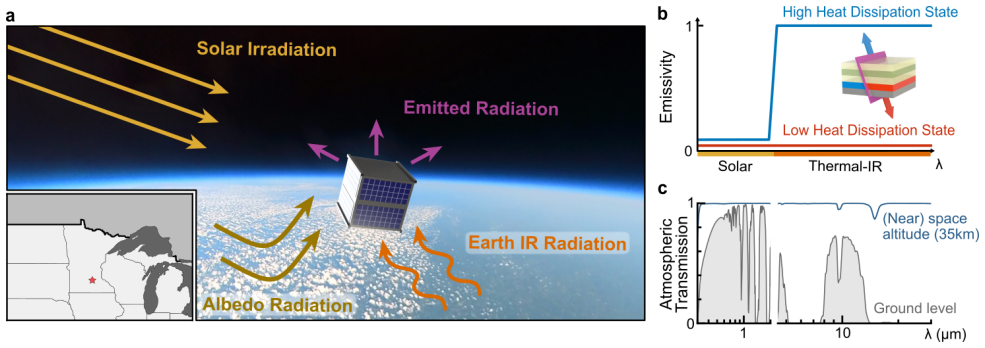
Managing the emission and absorption of thermal radiation is crucial for a wide range of technologies, from radiative cooling of buildings and vehicles to thermal regulation of satellites and future lunar and Mars habitats. Despite this universal and critical need, thermal emitters capable of adaptively modulating emissivity in a broadband, high-contrast, and fully solid-state manner remain elusive. Here, we leverage neural-network-guided photonic design to enable adaptive, solid-state thermal emitters based on chalcogenide phase-change materials capable of emissivity switching with extreme spectral contrast and bandwidth. These engineered nanophotonic emitters operate over a broad spectrum$-$from solar through thermal infrared$-$providing very low solar absorptivity while enabling switchable thermal infrared emissivity with high contrast. We experimentally demonstrate the core functionality of our approach in the space-like radiative environment in the stratosphere, observing a 31.5 {\deg}C temperature differential between the two solid-state phases of a simplified chalcogenide GeSbTe-225 thermal emitter. Our results point to even more significant capabilities, such as the potential to modulate >600 W/m$^2$ of radiative heat (at 100 {\deg}C) with minimal solar heating in the vacuum of space. The proposed nanophotonic solid-state adaptive emitter could provide high-power and high-speed heat modulation while requiring no power to maintain state, offering transformative capabilities for thermal control in dynamic radiative environments on Earth and in space.
Editorial analysis
A structured set of objections, weighed in public.
Referee Report
Summary. The manuscript introduces neural-network-guided nanophotonic design for solid-state thermal emitters based on chalcogenide phase-change materials (GeSbTe-225). These emitters are claimed to achieve adaptive emissivity switching with extreme spectral contrast and ultrabroadband operation spanning solar to thermal infrared wavelengths, enabling low solar absorptivity and high-contrast switchable IR emissivity. The core experimental result is a 31.5 °C temperature differential observed between the two solid-state phases of a simplified (non-nanophotonic) emitter tested in a stratospheric, space-like radiative environment. The work also projects a potential radiative heat modulation exceeding 600 W/m² at 100 °C in vacuum with minimal solar heating.
Significance. If the neural-network-optimized nanophotonic geometry can be fabricated and integrated without introducing scattering losses or interface degradation that degrade the intended spectral contrast, the approach would represent a meaningful advance in power-free, solid-state thermal control for dynamic environments such as satellites and planetary habitats. The stratospheric demonstration of phase-change switching under realistic radiative conditions provides concrete evidence of functionality, and the broadband design targets a genuine gap in existing adaptive emitters.
major comments (2)
- [Abstract and experimental results] The experimental validation (abstract and results section) is performed exclusively on a simplified chalcogenide GeSbTe-225 emitter without the neural-network-optimized nanophotonic structure. Because the central innovation is the NN-guided geometry enabling ultrabroadband high-contrast switching, the absence of direct experimental data on the fabricated nanophotonic device leaves the link between design, fabrication, and reported performance unverified; this is load-bearing for the claim that the approach delivers the projected capabilities.
- [Abstract] The projection of >600 W/m² radiative heat modulation (abstract) is presented as potential rather than measured, and the manuscript provides no full methods, error bars, or data exclusion criteria for the 31.5 °C differential. Without these, independent verification of the temperature differential and its attribution to emissivity switching is not possible from the provided text.
minor comments (2)
- [Methods or results] Clarify the exact definition of 'simplified' emitter versus the full NN-optimized nanophotonic design, including any differences in layer stack or geometry, to help readers assess how closely the experiment tests the proposed approach.
- [Results] Add quantitative metrics (e.g., measured emissivity spectra, contrast ratios, or solar absorptivity values) for both phases of the tested emitter to support the temperature differential claim.
Simulated Author's Rebuttal
We thank the referee for their constructive and detailed review of our manuscript. We address each major comment point by point below, clarifying the scope of our experimental results and projections while outlining planned revisions for improved clarity and verifiability.
read point-by-point responses
-
Referee: [Abstract and experimental results] The experimental validation (abstract and results section) is performed exclusively on a simplified chalcogenide GeSbTe-225 emitter without the neural-network-optimized nanophotonic structure. Because the central innovation is the NN-guided geometry enabling ultrabroadband high-contrast switching, the absence of direct experimental data on the fabricated nanophotonic device leaves the link between design, fabrication, and reported performance unverified; this is load-bearing for the claim that the approach delivers the projected capabilities.
Authors: We acknowledge that the stratospheric experiments were conducted on a simplified planar GeSbTe-225 emitter to demonstrate the core phase-change switching functionality under realistic radiative conditions, yielding the observed 31.5°C temperature differential. The neural-network-guided nanophotonic geometry is validated through extensive electromagnetic simulations that predict the targeted ultrabroadband spectral contrast and low solar absorptivity. In the revised manuscript, we will explicitly distinguish the experimental validation of material switching from the simulated performance of the optimized structure and add a dedicated section discussing fabrication considerations and pathways for future experimental realization of the full nanophotonic device. revision: partial
-
Referee: [Abstract] The projection of >600 W/m² radiative heat modulation (abstract) is presented as potential rather than measured, and the manuscript provides no full methods, error bars, or data exclusion criteria for the 31.5 °C differential. Without these, independent verification of the temperature differential and its attribution to emissivity switching is not possible from the provided text.
Authors: We agree that the >600 W/m² value is a projection based on integrating the simulated emissivity spectra with radiative heat transfer models for vacuum conditions at 100°C. We will revise the abstract to clearly label it as a projected capability and expand the methods and supplementary information to include the complete calculation details, assumptions, material optical constants, and sensitivity analysis. For the 31.5°C differential, we will add full experimental methods, including the stratospheric payload setup, temperature measurement protocols, error bars, statistical analysis, and data inclusion criteria to enable independent verification and confirm attribution to emissivity switching. revision: yes
- Direct experimental data on a fabricated neural-network-optimized nanophotonic emitter is not available, as device fabrication and testing represent ongoing work beyond the current manuscript.
Circularity Check
No circularity: experimental claim stands on direct measurement, not self-referential derivation
full rationale
The paper reports an experimental temperature differential of 31.5 °C between phases of a simplified GeSbTe-225 emitter in stratospheric conditions. No equations, derivations, or fitted parameters are presented in the abstract or described claims that would reduce this observed value to a quantity defined by the same data or by a self-citation chain. The neural-network-guided design is invoked as an enabling method but is not shown to produce any prediction that is statistically forced by the reported measurement itself. The central result is therefore an independent experimental outcome rather than a quantity that reduces to its inputs by construction.
Axiom & Free-Parameter Ledger
axioms (1)
- standard math Maxwell's equations and material optical constants govern the nanophotonic response.
Reference graph
Works this paper leans on
-
[1]
Zhu, W. & Liu, A.-Q. Metasurfaces: Towards Tunable and Reconfigurable Meta-Devices. (Springer, Singapore, Singapore, 2022). 12. Xiao, C. et al. Ultrabroadband and band-selective thermal meta-emitters by machine learning. Nature 643, 80–88 (2025). 13. Evans, A. L. Design and Testing of the CubeSat Form Factor Thermal Control Louvers. https://ntrs.nasa.gov/...
-
[2]
Hale, J. S. & Woollam, J. A. Prospects for IR emissivity control using electrochromic structures 1 presentented at the ICMCTF ’97 Conference, San Diego, CA, USA, April 1997. 1. Thin Solid Films 339, 174–180 (1999). 22. Taylor, S., Yang, Y. & Wang, L. Vanadium dioxide based Fabry-Perot emitter for dynamic radiative cooling applications. J. Quant. Spectrosc...
work page 1997
-
[3]
Guo, P., Sarangan, A. M. & Agha, I. A Review of Germanium-Antimony-Telluride Phase Change Materials for Non-Volatile Memories and Optical Modulators. NATO Adv. Sci. Inst. Ser. E Appl. Sci. 9, 530 (2019). 31. Zheng, J. et al. GST-on-silicon hybrid nanophotonic integrated circuits: a non-volatile quasi-continuously reprogrammable platform. Opt. Mater. Expre...
-
[4]
Qu, Y. et al. Dynamic thermal emission control based on ultrathin plasmonic metamaterials including phase-changing material GST. Laser Photon. Rev. 11, 1700091 (2017). 40. Ríos, C. et al. Integrated all-photonic non-volatile multi-level memory. Nat. Photonics 9, 725–732 (2015). 41. Kim, H. J. et al. Versatile spaceborne photonics with chalcogenide phase-c...
-
[5]
Amotchkina, T., Trubetskov, M., Hahner, D. & Pervak, V. Characterization of e-beam evaporated Ge, YbF3, ZnS, and LaF3 thin films for laser-oriented coatings. Appl. Opt. 59, A40–A47 (2020). 52. Querry, M. Optical Constants of Minerals and Other Materials from the Millimeter to the Ultraviolet. (1987). 53. Rakic, A. D., Djurisic, A. B., Elazar, J. M. & Maje...
work page 2020
discussion (0)
Sign in with ORCID, Apple, or X to comment. Anyone can read and Pith papers without signing in.