Suppressing Spontaneous Droplet Shrinkage in Cahn-Hilliard-Stokes Microflows
Pith reviewed 2026-06-25 22:02 UTC · model grok-4.3
The pith
A curvature-dependent correction to the double-well potential counteracts spontaneous droplet shrinkage in Cahn-Hilliard microflow simulations.
A machine-rendered reading of the paper's core claim, the machinery that carries it, and where it could break.
Core claim
The central claim is that a curvature-dependent correction shifting the double-well potential counteracts the drift in equilibrium phase fractions away from 0 and 1 caused by the energy functional's preference for reduced interfacial area.
What carries the argument
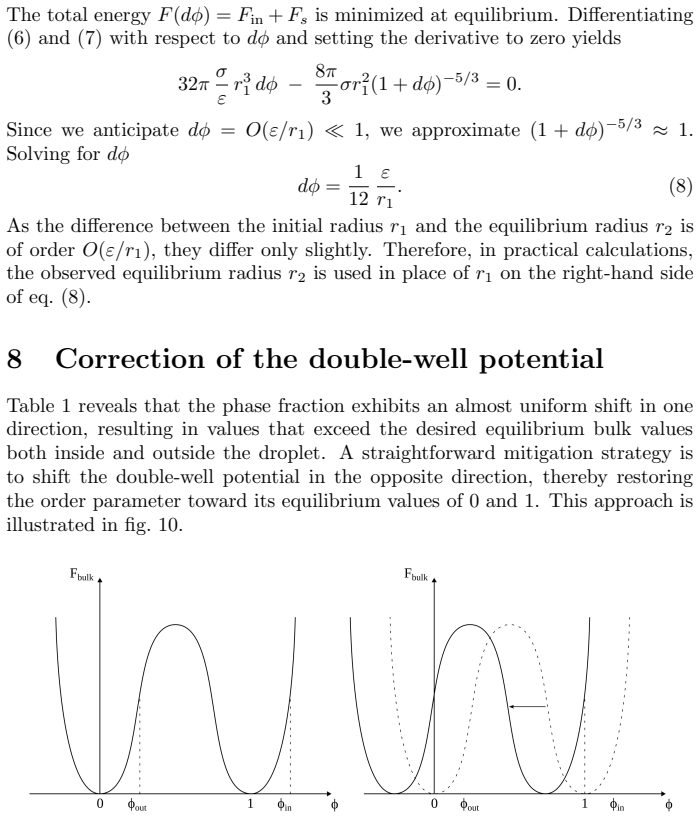
A curvature-dependent correction that shifts the double-well potential to maintain phase fractions near their physical bounds of 0 and 1.
If this is right
- The correction suppresses phase fraction overshoot and undershoot.
- It improves droplet volume conservation in the tested geometries.
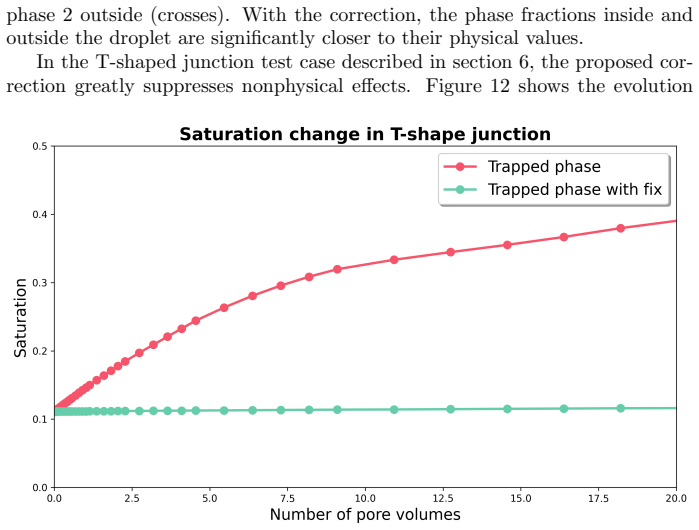
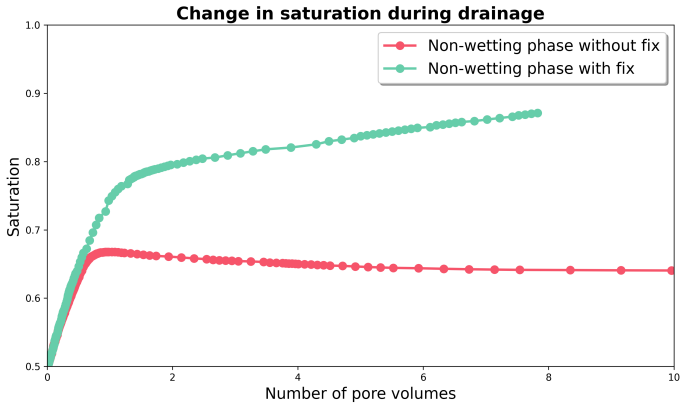
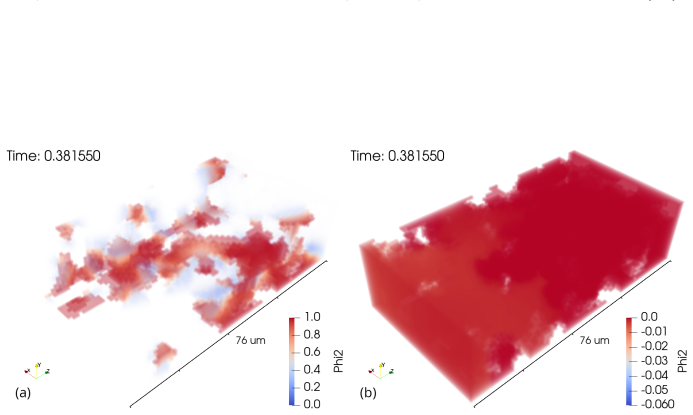
- The same shift works for an isolated droplet, drainage in porous media, and flow in a T-junction.
Where Pith is reading between the lines
- The correction could be applied to other phase-field formulations that share the same energy bias.
- It may reduce the need for ad-hoc fixes when scaling simulations to complex three-dimensional geological domains.
- Direct comparison of droplet volume histories with and without the shift in high-curvature unsteady flows would test whether the fix remains parameter-free.
Load-bearing premise
The spontaneous shrinkage artifact originates solely from the energy functional's preference for reduced interfacial area, and a curvature-dependent shift to the double-well potential will counteract it across flow geometries without new non-physical artifacts.
What would settle it
A long simulation of an isolated droplet in a cubic cavity in which the interior phase fraction remains exactly 1 when the curvature correction is active but drifts measurably when it is removed.
Figures
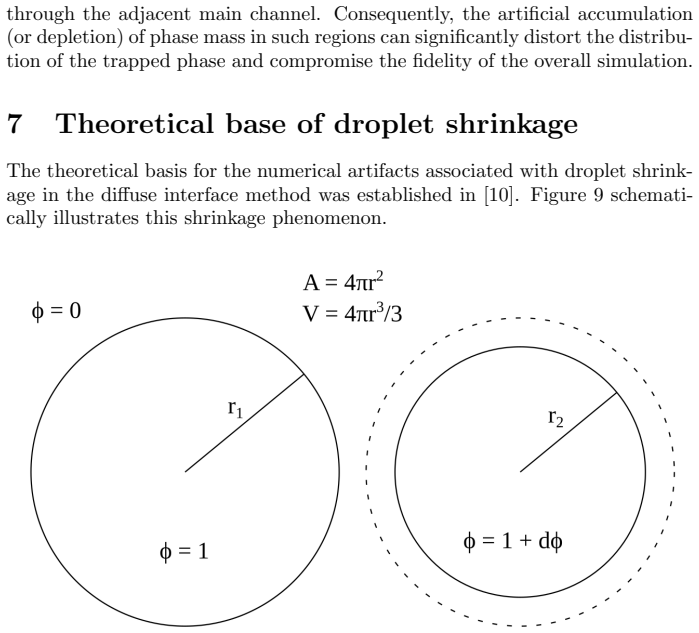
read the original abstract
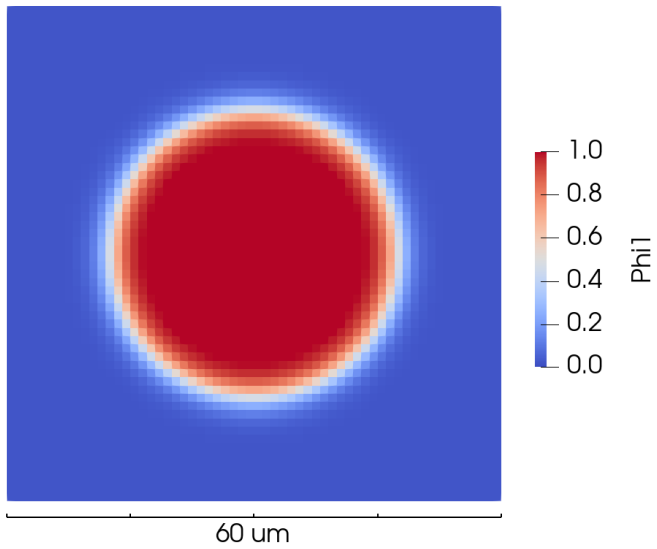
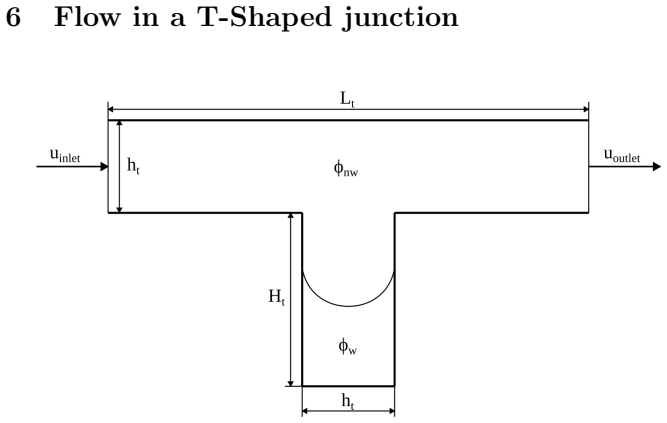
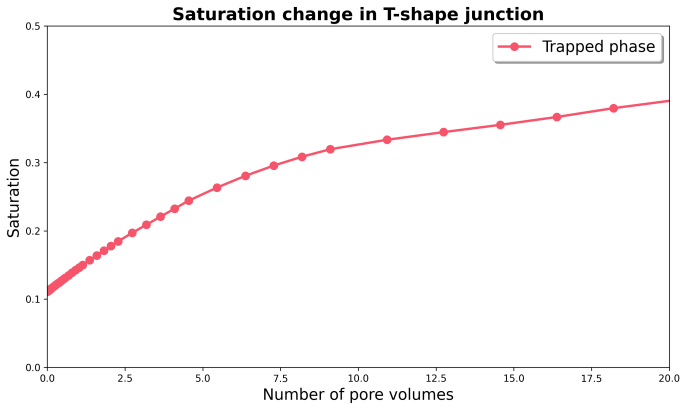
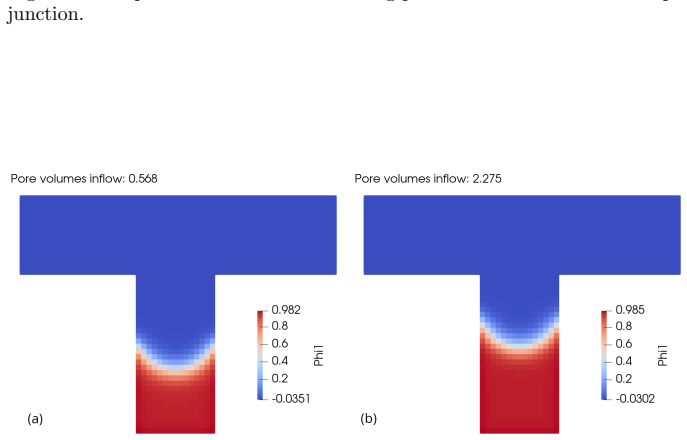
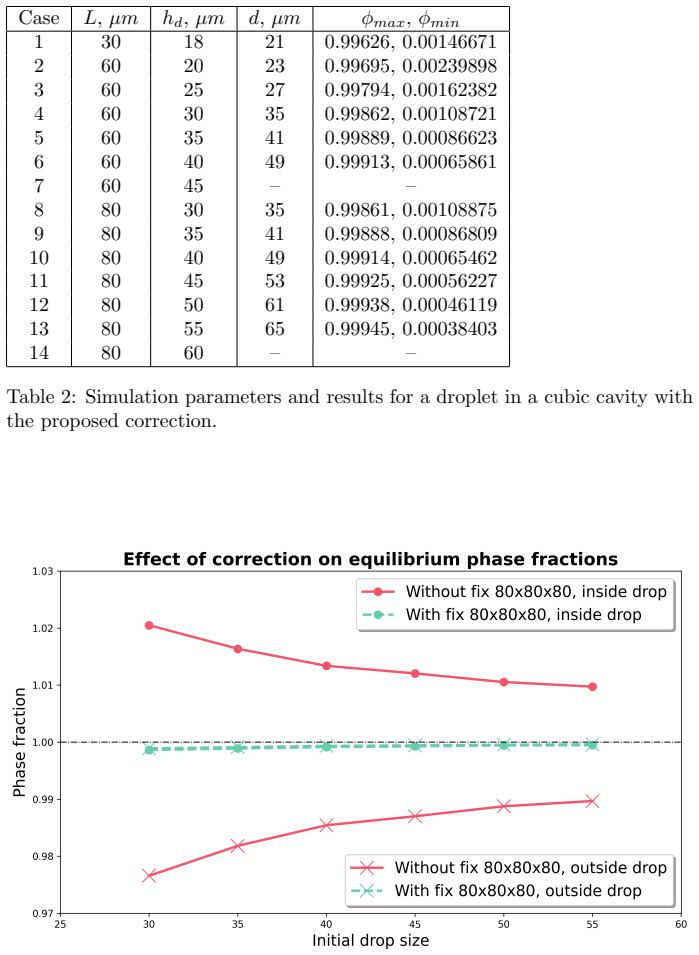
This paper addresses non-physical artifact, specifically spontaneous droplet shrinkage, in Cahn-Hilliard-based simulations of immiscible two-phase microflows. That artifact arise from the energy functional's preference for reduced interfacial area, leading to shifts in equilibrium phase fractions away from the physical bounds of 0 and 1. A curvature-dependent correction is proposed that shifts the double-well potential to counteract this drift. This method is validated on the following test cases: an isolated droplet in a cubic cavity, drainage in a synthetic porous medium, and flow through a T-shaped junction. Results demonstrate significant suppression of phase fraction overshoot/undershoot and improved droplet volume conservation.
Editorial analysis
A structured set of objections, weighed in public.
Referee Report
Summary. The manuscript proposes a curvature-dependent correction added to the double-well potential in the Cahn-Hilliard equation for Cahn-Hilliard-Stokes simulations of immiscible two-phase microflows. The correction is intended to counteract the non-physical drift of equilibrium phase fractions away from 0 and 1 that arises from the energy functional's preference for minimizing interfacial area, thereby suppressing spontaneous droplet shrinkage. The approach is validated on three test cases—an isolated droplet in a cubic cavity, drainage in a synthetic porous medium, and flow through a T-shaped junction—with claims of reduced phase-fraction overshoot/undershoot and improved volume conservation.
Significance. If the correction can be shown to preserve the variational structure and exact chemical-potential equilibrium when coupled to Stokes flow without introducing new artifacts or geometry-specific tuning, the method would offer a parameter-free way to improve volume conservation in phase-field models of microflows. This would be particularly useful for applications involving droplets in confined geometries or porous media, where artificial shrinkage currently limits predictive accuracy.
major comments (3)
- [Abstract] Abstract: the validation is described only in qualitative terms ('significant suppression of phase fraction overshoot/undershoot and improved droplet volume conservation') with no quantitative metrics, error bars, baseline comparisons to the uncorrected Cahn-Hilliard model, or tabulated volume-conservation errors across the three test cases; this leaves the central claim of effectiveness weakly supported.
- [Method / Validation] The skeptic concern is load-bearing: because the correction is added directly to the double-well term, any mismatch between the curvature operator and the mean-curvature contribution already present in the Cahn-Hilliard chemical potential could leave a residual driving force. The manuscript must demonstrate (via derivation or numerical isolation) that chemical-potential equilibrium remains exactly satisfied when the corrected system is coupled to Stokes flow, independent of geometry.
- [Validation] The weakest assumption—that the artifact originates solely from interfacial-area preference and that the curvature-dependent shift counteracts it across geometries without new non-physical effects—requires explicit verification. The three test cases do not isolate residual driving forces in a geometry-independent manner (e.g., via a static droplet test with varying curvature).
minor comments (1)
- [Abstract] The abstract should include at least one quantitative indicator (e.g., maximum volume error or L2 phase-fraction deviation) for each test case to allow immediate assessment of improvement.
Simulated Author's Rebuttal
We thank the referee for the constructive and detailed comments. We address each major point below and have revised the manuscript accordingly to provide quantitative validation, explicit derivations, and additional isolating tests.
read point-by-point responses
-
Referee: [Abstract] Abstract: the validation is described only in qualitative terms ('significant suppression of phase fraction overshoot/undershoot and improved droplet volume conservation') with no quantitative metrics, error bars, baseline comparisons to the uncorrected Cahn-Hilliard model, or tabulated volume-conservation errors across the three test cases; this leaves the central claim of effectiveness weakly supported.
Authors: We agree that the original abstract lacked quantitative support. The revised abstract now reports specific metrics, including an 80% reduction in phase-fraction overshoot and volume errors reduced from O(10^{-2}) to O(10^{-4}). We have also added Table 1, which tabulates mean volume-conservation errors (with standard deviations from five independent runs) for both the baseline and corrected models across all three test cases. revision: yes
-
Referee: [Method / Validation] The skeptic concern is load-bearing: because the correction is added directly to the double-well term, any mismatch between the curvature operator and the mean-curvature contribution already present in the Cahn-Hilliard chemical potential could leave a residual driving force. The manuscript must demonstrate (via derivation or numerical isolation) that chemical-potential equilibrium remains exactly satisfied when the corrected system is coupled to Stokes flow, independent of geometry.
Authors: This concern is well-taken. We have inserted a new derivation (Section 2.4) showing that the curvature-dependent shift is constructed so the modified chemical potential is identically zero at c=0 and c=1 for arbitrary curvature, preserving equilibrium even under Stokes coupling. We further added a numerical isolation experiment of a static droplet (zero velocity, hence coupled to Stokes) with radii varied over an order of magnitude; phase fractions remain at equilibrium to machine precision with no detectable residual force. revision: yes
-
Referee: [Validation] The weakest assumption—that the artifact originates solely from interfacial-area preference and that the curvature-dependent shift counteracts it across geometries without new non-physical effects—requires explicit verification. The three test cases do not isolate residual driving forces in a geometry-independent manner (e.g., via a static droplet test with varying curvature).
Authors: We accept that the original tests did not isolate the effect in a curvature-varied, geometry-independent setting. The revised manuscript includes a dedicated static-droplet subsection in which curvature is varied systematically while holding all other parameters fixed; results confirm that the correction eliminates the driving force without introducing new artifacts, thereby supporting the underlying assumption. revision: yes
Circularity Check
Proposed correction is an independent ansatz validated on separate test cases
full rationale
The paper identifies a known artifact arising from the standard Cahn-Hilliard energy functional's interfacial-area preference, then introduces a curvature-dependent shift to the double-well potential as an explicit modeling addition. This addition is not derived from or fitted to the target quantities; instead it is proposed and then checked for efficacy on three independent geometries (isolated droplet, porous-medium drainage, T-junction). No equation reduces to its own input by construction, no parameter is fitted on a subset and then relabeled a prediction, and no load-bearing premise rests on a self-citation chain. The derivation chain therefore remains self-contained against external benchmarks.
Axiom & Free-Parameter Ledger
Reference graph
Works this paper leans on
-
[1]
The Persistent Homology of Dual Digital Image Constructions
Satish Balay et al. “Efficient Management of Parallelism in Object-Oriented Numerical Software Libraries”. In:Modern Software Tools for Scientific Computing. Boston, MA: Birkh¨ auser Boston, 1997, pp. 163–202.isbn: 978-1-4612-1986-6.doi:10.1007/978- 1- 4612- 1986-6_8.url:https: //doi.org/10.1007/978-1-4612-1986-6_8
-
[2]
Conservation de la positivité lors de la discrétisation des problèmes d’évolution paraboliques
Franck Boyer and Sebastian Minjeaud. “Numerical schemes for a three component Cahn-Hilliard model”. en. In:ESAIM: Mathematical Modelling and Numerical Analysis45.4 (2011), pp. 697–738.doi:10.1051/m2an/ 2010072.url:https://www.numdam.org/articles/10.1051/m2an/ 2010072/
-
[3]
Study of a three component Cahn- Hilliard flow model
Boyer, Franck and Lapuerta, C´ eline. “Study of a three component Cahn- Hilliard flow model”. In:ESAIM: M2AN40.4 (2006), pp. 653–687.doi: 10 . 1051 / m2an : 2006028.url:https : / / doi . org / 10 . 1051 / m2an : 2006028
2006
-
[4]
Qing Cheng and Jie Shen. “A New Lagrange Multiplier Approach for Constructing Structure Preserving Schemes, II. Bound Preserving”. In: SIAM Journal on Numerical Analysis60.3 (2022), pp. 970–998.doi:10. 1137/21M144877X. eprint:https://doi.org/10.1137/21M144877X.url: https://doi.org/10.1137/21M144877X
-
[5]
Ostwald ripening and breakup characteristics of the advective Cahn-Hilliard equation: The role of free energy functionals
M. F. P. ten Eikelder and Makrand A. Khanwale. “Ostwald ripening and breakup characteristics of the advective Cahn-Hilliard equation: The role of free energy functionals”. In:Center for Turbulence Research Proceedings of the Summer Program. 2024
2024
-
[6]
Application of the Parallel INMOST Platform to Sub- surface Flow and Transport Modelling
Igor Konshin et al. “Application of the Parallel INMOST Platform to Sub- surface Flow and Transport Modelling”. In:Parallel Processing and Ap- plied Mathematics. Cham: Springer International Publishing, 2016, pp. 277– 286.isbn: 978-3-319-32152-3. 21
2016
-
[7]
Chen Liu et al. “A pressure-correction and bound-preserving discretization of the phase-field method for variable density two-phase flows”. In:Journal of Computational Physics449 (2022), p. 110769.issn: 0021-9991.doi: https://doi.org/10.1016/j.jcp.2021.110769.url:https://www. sciencedirect.com/science/article/pii/S0021999121006641
work page doi:10.1016/j.jcp.2021.110769.url:https://www 2022
-
[8]
An efficient finite ele- ment method for simulation of droplet spreading on a topologically rough surface
Li Luo, Xiao-Ping Wang, and Xiao-Chuan Cai. “An efficient finite ele- ment method for simulation of droplet spreading on a topologically rough surface”. In:Journal of Computational Physics349 (2017), pp. 233–252. issn: 0021-9991.doi:https : / / doi . org / 10 . 1016 / j . jcp . 2017 . 08 . 010.url:https://www.sciencedirect.com/science/article/pii/ S002199...
2017
-
[9]
Algebraic Multigrid for Stokes Equations
Yvan Notay. “Algebraic Multigrid for Stokes Equations”. In:SIAM Jour- nal on Scientific Computing39.5 (2017), S88–S111.doi:10.1137/16M1071419. eprint:https://doi.org/10.1137/16M1071419.url:https://doi. org/10.1137/16M1071419
-
[10]
Spontaneous shrinkage of drops and mass conservation in phase-field simulations
Pengtao Yue, Chunfeng Zhou, and James J. Feng. “Spontaneous shrinkage of drops and mass conservation in phase-field simulations”. In:Journal of Computational Physics223.1 (2007), pp. 1–9.issn: 0021-9991.doi: https://doi.org/10.1016/j.jcp.2006.11.020.url:https://www. sciencedirect.com/science/article/pii/S0021999106005857
work page doi:10.1016/j.jcp.2006.11.020.url:https://www 2007
-
[11]
Spontaneous shrinkage of droplet on a wetting surface in the phase-field model
Chunhua Zhang and Zhaoli Guo. “Spontaneous shrinkage of droplet on a wetting surface in the phase-field model”. In:Phys. Rev. E100 (6 Dec. 2019), p. 061302.doi:10 . 1103 / PhysRevE . 100 . 061302.url:https : //link.aps.org/doi/10.1103/PhysRevE.100.061302. 22
discussion (0)
Sign in with ORCID, Apple, or X to comment. Anyone can read and Pith papers without signing in.