REVIEW 3 major objections 5 minor 20 references
Expansion properties for finite subdivision rules II
T0 review · 3 major / 5 minor · reviewed 2026-08-14 · deepseek-v4-flash
Pith's one-line read Every sufficiently large iterate of a Thurston map with no Levy cycle and no contracting torus lift is isotopic to the subdivision map of a finite subdivision rule, making finite subdivision rules the generic combinatorial description of…
desk verdict Genuinely broad realizability theorem with a clean proof; the local-connectivity worry is a citation, not a gap, and the only real blemish is an overstatement in Theorem 3.1(1). read the letter →
The pith
A machine-rendered reading of the paper's core claim, the machinery that carries it, and where it could break.
The reading
What carries the argument
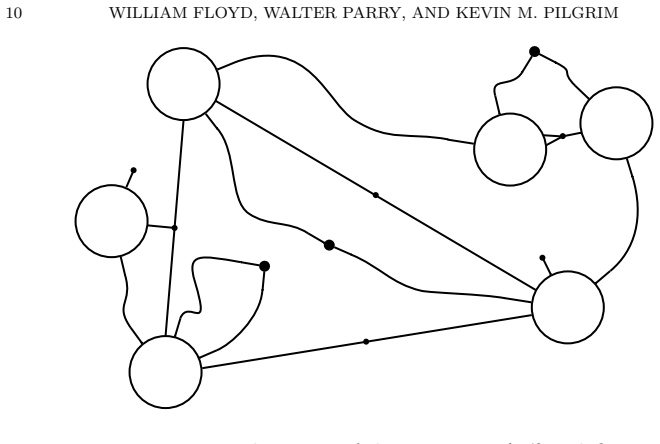
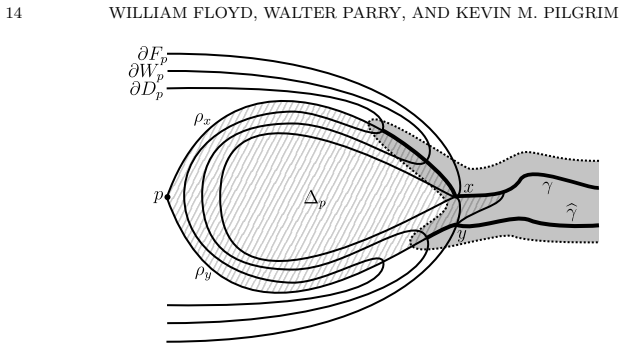
The load-bearing mechanism is the Böttcher-expanding property: a complete length metric on the sphere minus the attracting periodic critical cycles that is uniformly compressed by $f$, with each attracting cycle locally modeled on $z\mapsto z^k$. The proof also relies on local connectivity of immediate basins, which makes each basin a closed topological disk whose boundary is completely visible by rays, so boundary points can be manipulated by ray-tails and equipotentials. On that structure the paper assembles three finite sets of curves $A$, $B$, $C$: equipotentials plus postcritical points, ray tails, and connecting arcs satisfying ten explicit combinatorial conditions; their union is a graph $G$ invariant up to isotopy. Pulling back the cell complex induced by $G$ under $f^n$ and adding subdivisions inside the Fatou disks produces the finite subdivision rule, with finiteness lemmas --- finitely many rays landing at a preperiodic boundary point, at most two accessible boundary points from outside, and finitely many separating boundary points --- closing the construction.
What would settle it
Look for a Thurston map satisfying the hypotheses of Theorem 2.6 (no Levy cycle, and if it lifts to a torus endomorphism the affine eigenvalues lie outside the unit circle) whose pullback relation on arcs has a wandering orbit, as defined in Section 4. Theorem 4.1 would then imply that no iterate is Thurston equivalent to a subdivision map, contradicting Theorem 2.6; if such a map exists, the proof must fail at the local-connectivity or finiteness step.
Extended reading notes
Core claim
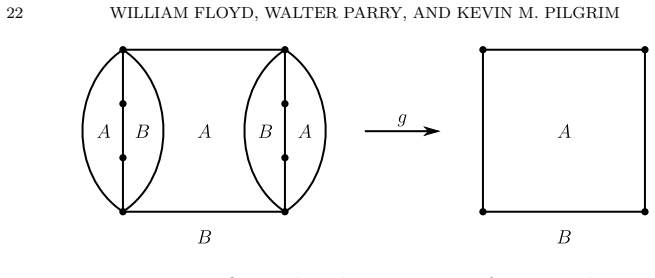
The central claim is Theorem 2.6: if $f$ is a Thurston map such that (i) it has no Levy cycles when it does not lift to a torus endomorphism, and (ii) when it does lift, the associated affine map $x\mapsto Ax+b$ has eigenvalues outside the unit circle, then every sufficiently large iterate $f^n$ is isotopic rel the postcritical set to the subdivision map of a finite subdivision rule. The proof constructs a finite graph $G\subseteq S^2$ containing the postcritical set, built from three finite families of curves --- equipotentials, ray tails in immediate basins, and connecting arcs --- and shows $G$ is invariant up to isotopy. The Böttcher-expanding property then forces the pullbacks of the induced cell structure to have arbitrarily small tiles, and subdividing the Fatou disks yields the required finite subdivision rule. Theorem 3.1 completes the torus-covered case: eigenvalues outside the unit circle put every sufficiently large iterate in the subdivision-map class, an eigenvalue $\pm 1$ makes $f$ itself a subdivision map with one tile type, and a contracting eigenvalue forbids every iterate. Theorem 4.1 supplies an obstruction from pullback dynamics: wandering orbits of arcs, or of curves with univalent pullback, imply that no iterate is Thurston equivalent to a subdivision map.
Load-bearing premise
The load-bearing premise is that every immediate basin of attraction is a closed topological disk with a locally connected boundary, so that the conjugating maps extend to the closed disk and every boundary point is the landing point of at least one ray; if some basin boundary failed to be locally connected, the finite sets of arcs used to build the invariant graph $G$ need not exist and the proof of Theorem 2.6 would collapse.
Editorial extensions
If this is right
- For every map satisfying the two hypotheses of Theorem 2.6, all sufficiently large iterates are isotopic rel postcritical set to subdivision maps of finite subdivision rules; finite subdivision rules are thus universal for the expanding side of Thurston dynamics up to isotopy and passing to an iterate.
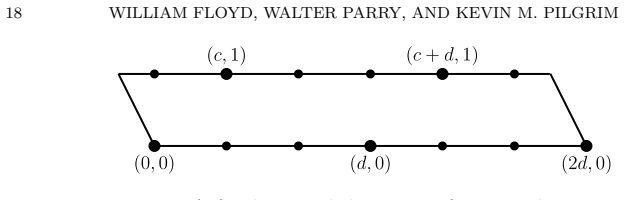
- A map doubly covered by an affine torus endomorphism with eigenvalues of absolute value greater than 1 has every sufficiently large iterate equal (not just isotopic) to a subdivision map; eigenvalue $\pm 1$ yields a subdivision map with one tile type.
- A map doubly covered by an affine torus endomorphism with an eigenvalue of absolute value less than 1 has no iterate that is Thurston equivalent to a subdivision map, completing the classification of this exceptional family.
- Wandering orbits under the pullback relation on arcs, or wandering univalent orbits on curves, form a necessary obstruction: no iterate of such a map is Thurston equivalent to a subdivision map.
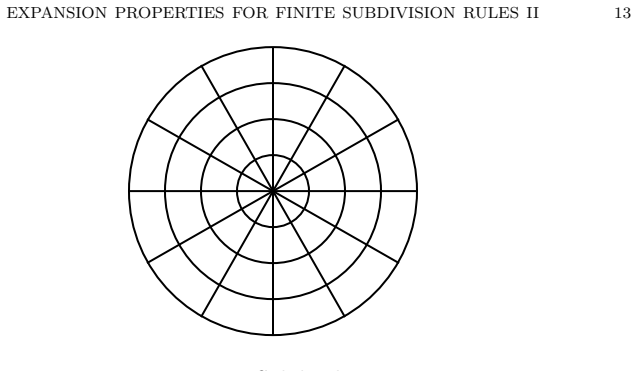
- The proof produces, for each large $n$, a finite cell structure $\mathcal{S}$ whose pullback by $f^n$ refines it, so each such map carries explicit cellular Markov partitions.
Reading between the lines
- The construction is sufficiently explicit that, given a Böttcher expanding map, a finite subdivision rule for a large iterate could in principle be computed; making the finiteness constants effective would turn the theorem into an algorithm for producing cellular Markov partitions.
- The theorem suggests the obstruction to being a subdivision map, as opposed to an iterate of one, is concentrated in the early dynamics: a map that fails must fail before its Böttcher-expanding behavior dominates, so the class of maps with subdivision-map iterates is the closure of the expanding class under finite iterates.
- The fat-path distance argument behind Theorem 3.1 is a general necessary condition --- any map with a subdivision-map iterate has bounded pullback complexity --- and could be applied to maps outside the theorem's scope, such as those with Levy cycles, to test for non-realizability.
- The wandering-orbit criterion, combined with canonical-decomposition constructions, suggests a systematic family of non-realizable maps: take an elliptic piece with at least four marked points and twist it by a pseudo-Anosov map so that curves inside the piece wander under pullback; such maps would lie just beyond the boundary of Theorem 2.6.
Signed reviews
Editorial analysis
A structured set of objections, weighed in public.
Referee Report
Summary. The paper studies which Thurston maps have large iterates isotopic to subdivision maps of finite subdivision rules. The main theorem (Theorem 2.6) asserts that every sufficiently large iterate of a Thurston map that is not doubly covered by a torus endomorphism and has no Levy cycle is isotopic to the subdivision map of a finite subdivision rule. The proof reduces to the Böttcher expanding case via the Bartholdi–Dudko characterization, then constructs a finite graph G whose 1-skeleton supports a finite subdivision rule and proves that the nth pullback of a suitable cell structure is isotopic to G. Section 3 treats Thurston maps with Euclidean orbifold of signature (2,2,2,2), giving a trichotomy in terms of the eigenvalues of the affine lift. Section 4 gives nonrealizability conditions: no iterate is Thurston equivalent to a subdivision map if the pullback relation has wandering arcs or wandering univalent curves, with examples.
Significance. If the main theorem is correct, it is a substantial advance: after passing to an iterate and allowing isotopy, finite subdivision rules capture essentially all Thurston maps except those with Levy cycles and contracting torus covers. The proof strategy is coherent, and the paper is explicit about its dependence on the deep Bartholdi–Dudko theorem and on earlier work in [12] for the fat path distance lemma. The nonrealizability criteria in Section 4 are concrete and falsifiable. However, several load-bearing topological claims, especially the local connectivity of immediate basins and the existence of landing rays, are asserted rather than fully justified, and these need to be substantiated before the central theorem can be considered established.
major comments (3)
- [Section 2, 'Fatou and Julia sets' (before Lemma 2.3)] The assertion that each ψ_p: D → F_p extends continuously to D and that every boundary point of F_p is the landing point of at least one ray is stated by saying that the Douady–Hubbard proof 'carries over', citing [2, Lemma 4.7] and Milnor's paper. This assertion is load-bearing: the finiteness of the set B (Lemma 2.3), the definition of B using rays landing at every p∈P^1_f, and the final isotopy near ∂F_p in the proof of Theorem 2.6 all rely on ray landing. The manuscript does not reproduce the argument, and the exact statement and hypotheses of [2, Lemma 4.7] are not given. Please either prove the local connectivity and ray-landing statement or quote a theorem that covers the full class of Böttcher expanding Thurston maps considered here, including non-rational maps and maps with periodic critical points.
- [Section 2, Lemma 2.3] The proof that only finitely many rays land at a preperiodic boundary point is compressed at the point where an infinite sequence R_1,R_2,... of rays is said to converge to a ray in R fixed by f, and then Milnor's Lemma 18.12 is invoked to conclude finiteness. The convergence to a ray in R and the applicability of Milnor's lemma in the present non-rational setting need to be justified. If the sequence of rays can converge to a non-landing ray, or if Milnor's lemma has hypotheses not satisfied here, then the finiteness of B is not established, and the construction of the finite graph G in Theorem 2.6 would fail.
- [Section 3, Theorem 3.1(3)] The contradiction argument relies on the fat path distance nonincreasing property of lifts of inverse maps of subdivision maps, quoted from [12, Lemma 6.1]. It should be explicitly verified that the lift G^{-1} of g^{-1} satisfies the hypotheses of that lemma, in particular that the lifted initial cell structure on the covering space is such that G^{-1} maps initial tiles to initial tiles. As written, the proof says only that 'the discussion at the beginning of this section applies'; since this is the mechanism that produces the contradiction, the verification should be spelled out.
minor comments (5)
- [Throughout] The open unit disk is denoted D, but in Lemma 2.3 a closed topological disk bounded by two rays is also denoted D. Rename one of these to avoid ambiguity.
- [Section 2, paragraph after Theorem 2.1] In the definition of P^0_f, the expression 'p < union' appears to be a typo; it should read 'p ∉ union'.
- [Section 4, opening] The symbols used for the union of inessential and peripheral classes ('⊙' and the symbol following it) are not rendered cleanly in the arXiv text; please use readable notation and define all symbols explicitly.
- [Section 4, proof of Theorem 4.1] The sentence 'Because α0,α1,α2,... are mutually not homotopic rel Pf, the order of Pf must be at least 4' is not justified and appears too strong; the subsequent statement that the universal cover is the open disk only needs at least three points. Please correct or justify this.
- [General] The proof of Theorem 2.6 is very long and refers repeatedly to Figures 1–5; the submitted manuscript should ensure all figures are included and clear, since several topological arguments (e.g., the construction of the disk Δ_p and the disk D in Lemma 2.5) are described with reference to these figures.
Circularity Check
No circularity: the core construction is self-contained once the external Bartholdi-Dudko expanding-map theorem is granted; self-citations are prior published lemmas, not restatements of the conclusions.
full rationale
The paper's central derivation, Theorem 2.6, begins by importing the Bartholdi-Dudko characterization of Böttcher expanding maps ([1, Theorem C], [2, Theorem A]), which is external to this paper and is not derived from the target conclusion. The remainder of the proof constructs a finite invariant graph using four lemmas, three of which are proved in the paper and one of which, Lemma 2.2, is quoted from the authors' earlier [6] but is an independent combinatorial-topology statement. The only potentially fragile ingredient is the asserted local connectivity of immediate basins (the extension of ψ_p to the closed disk), which is cited to [2, Lemma 4.7] and the Douady-Hubbard argument; even if that assertion were incomplete, it would be a correctness gap, not a circular one, because it is not equivalent to the paper's conclusion. Similarly, the fat-path distance nonincreasing lemma from the authors' [12] is used in Sections 3 and 4 as an established, separate result about subdivision maps; it is not a renamed version of the nonrealizability theorems being proved. No parameter is fitted to data, no prediction is statistically forced, and no equation reduces to an input by construction. The self-citations are not load-bearing in a circular way, and the result would stand or fall on the validity of the external expanding-map theorem and the geometric lemmas.
Assumptions & free parameters
assumptions (5)
- domain assumption Bartholdi-Dudko expansion criterion (Theorem 2.1): a Thurston map with non-(2,2,2,2) orbifold is isotopic to a smooth Bottcher expanding map iff it has no Levy cycles; for (2,2,2,2) orbifolds, the affine lift has eigenvalues outside the closed unit disk.
- domain assumption Immediate basins of attraction are Jordan disks with locally connected boundaries: each conjugating map psi_p: D -> F_p extends continuously to the closed disk (local connectivity from [2, Lemma 4.7] and [11]).
- domain assumption Fat path distance nonincreasing lemma from [12, Lemma 6.1] for subdivision maps.
- standard math Milnor's lemma on finitely many rays landing at a fixed boundary point.
- standard math Lefschetz fixed point theorem for the restricted map on a stable simple closed curve.
Cite this review
Pith. "Pith review of Expansion properties for finite subdivision rules II." pith.science (2026). https://pith.science/paper/GSGTGG44
@misc{pith2026190807571,
  author       = {Pith},
  title        = {Pith review of: Expansion properties for finite subdivision rules II},
  year         = {2026},
  howpublished = {\url{https://pith.science/paper/GSGTGG44}},
  note         = {Machine review of arXiv:1908.07571}
}
read the original abstract
We prove that every sufficiently large iterate of a Thurston map which is not doubly covered by a torus endomorphism and which does not have a Levy cycle is isotopic to the subdivision map of a finite subdivision rule. We determine which Thurston maps doubly covered by a torus endomorphism have iterates that are isotopic to subdivision maps of finite subdivision rules. We give conditions under which no iterate of a given Thurston map is isotopic to the subdivision map of a finite subdivision rule.
Figures

Figures from the paper (4 more)

Reference graph
Works this paper leans on
-
[2]
Laurent Bartholdi and Dzmitry Dudko, Algorithmic aspects of branched cov- erings, IV/V. Expanding maps , Trans. Amer. Math. Soc. 370 (2018), 7679– 7714
work page 2018
-
[12]
Pilgrim, Expansion properties for finite subdivision rules I , Sci
William Floyd, Walter Parry, and Kevin M. Pilgrim, Expansion properties for finite subdivision rules I , Sci. China Math. 61 (2018), 2237–2266
work page 2018
-
[1]
Laurent Bartholdi and Dzmitry Dudko, Algorithmic aspects of branched cov- erings, Ann. Fac. Sci. Toulouse Math 26 (2017), 1219–1296
work page 2017
-
[3]
Mario Bonk and Daniel Meyer, Expanding Thurston maps, Amer. Math. Soc. Mathematical Surveys and Monographs 225, 2017
work page 2017
-
[4]
James Cannon, William Floyd, and Walter Parry, Finite subdivision rules , Conform. Geom. Dyn. 5 (2001), 153–196 (electronic)
work page 2001
-
[5]
Geometric group theory down under (Canberra, 1996), 71–102, de Gruyter, Berlin, 1999
James Cannon, William Floyd, and Walter Parry, Conformal modulus: the graph paper invariant or the conformal shape of an algorithm. Geometric group theory down under (Canberra, 1996), 71–102, de Gruyter, Berlin, 1999
work page 1996
-
[6]
James Cannon, William Floyd, and Walter Parry, Constructing subdivision rules from rational maps , Conform. Geom. Dyn. 11 (2007), 128–136 (elec- tronic)
work page 2007
-
[7]
James Cannon, William Floyd, and Walter Parry, Latt` es maps and finite subdivision rules, Conform. Geom. Dyn. 14 (2010), 113–140 (electronic)
work page 2010
Show all 20 references
-
[8]
Pilgrim, Nearly Euclidean Thurston maps , Conform
James Cannon, William Floyd, Walter Parry, and Kevin M. Pilgrim, Nearly Euclidean Thurston maps , Conform. Geom. Dyn. 16 (2012), 209–255
2012
-
[9]
Invariant graphs of rational maps , https://arxiv.org/abs/1907.02870
Guizen Cui, Yan Gao, and Jinsong Zeng. Invariant graphs of rational maps , https://arxiv.org/abs/1907.02870
1907 arXiv
-
[10]
Douady and J
A. Douady and J. H. Hubbard, A proof of Thurston’s topological characteri- zation of rational functions , Acta. Math. 171(2) 1993, 263–297. 24 WILLIAM FLOYD, W ALTER PARRY, AND KEVIN M. PILGRIM
1993
-
[11]
Douady and J
A. Douady and J. H. Hubbard, ´Etude dynamique des polynˆ omes complexes, I, with the collaboration of P. Lavaurs, Tan Lei and P. Sentenac, Publications Math´ ematiques d’Orsay, 84–02, 1984
1984
-
[13]
and Dynamical Systems, 38 (2016), 583–600
Yan Gao, Peter Ha¨ ıssinsky, Daniel Meyer, and Jinsong Zeng,Invariant Jor- dan curves of Sierpi´ nski carpet rational maps, Ergodic Thy. and Dynamical Systems, 38 (2016), 583–600
2016
-
[14]
Ha¨ ıssinsky and K
P. Ha¨ ıssinsky and K. Pilgrim, An algebraic characterization of expanding Thurston maps, J. Mod. Dyn. 6 (2012), no. 4, 451–476
2012
-
[15]
Curtis McMullen, Complex Dynamics and Renormalization , Princeton Uni- versity Press, Annals of Mathematics Studies, 1994
1994
-
[16]
Vieweg & Sohn, Braunschweig, 1999
John Milnor, Dynamics in one complex variable: introductory lectures, Friedr. Vieweg & Sohn, Braunschweig, 1999
1999
-
[17]
Bonahon, R
John Milnor, Hyperbolic components, Conformal Dynamics and Hyperbolic Geometry, F. Bonahon, R. Devaney, R. Gardiner and D. ˇSari´ c eds., Amer. Math. Soc. Contemporary Math. 573, Providence, 2012
2012
-
[18]
Pilgrim, Cylinders for iterated rational maps , Thesis (Ph.D.), Uni- versity of California, Berkeley
Kevin M. Pilgrim, Cylinders for iterated rational maps , Thesis (Ph.D.), Uni- versity of California, Berkeley. 1994. 202 pp. ProQuest LLC
1994
-
[19]
Pilgrim, Combinations of complex dynamical systems, Springer Lec- ture Notes in Mathematics 1827, 2003
Kevin M. Pilgrim, Combinations of complex dynamical systems, Springer Lec- ture Notes in Mathematics 1827, 2003
2003
-
[20]
Nikita Selinger and Mikhail Yampolsky, Constructive geometrization of Thurston maps and decidability of Thurston equivalence , Arnold Math. J. 1 (2015), no. 4, 361–402. Department of Mathematics, Virginia Tech, Blacksburg, V A 24061, U.S.A. E-mail address: floyd@math.vt.edu UR...
2015
Reviewed August 14, 2026 · model on record in the stance chip above.
Discussion (0). Continue with ORCID to comment.