Multiplicity of the Orion Trapezium stars
Pith reviewed 2026-05-25 14:07 UTC · model grok-4.3
The pith
Component D in the Orion Trapezium is a double star with a 53-day orbit and mass ratio 0.5, while Component F is probably unrelated.
A machine-rendered reading of the paper's core claim, the machinery that carries it, and where it could break.
Core claim
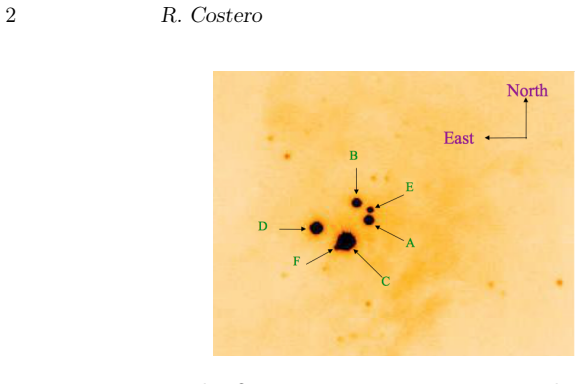
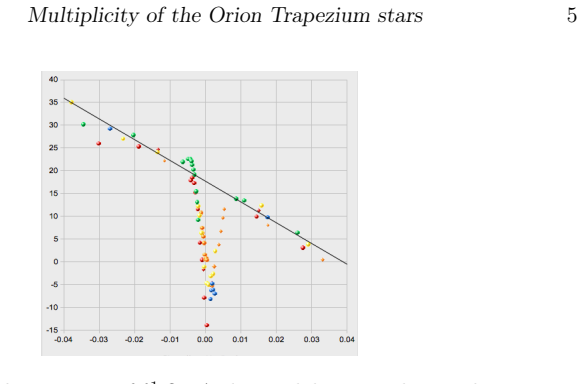
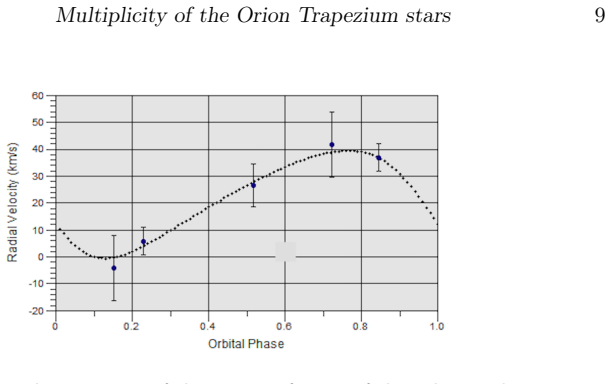
Component D is a spectroscopic and interferometric double star with a relatively high-mass companion (q=M2/M1=0.5) and period 52.90±0.05 d. Component F is a CP star (B7.5 p Si) whose radial velocity of 23.2±4.2 km s^{-1} is smaller than that of all other Trapezium members; its evolutionary stage may also be more advanced than that of members with similar mass. Consequently Component F is probably not physically related to the Trapezium. The orbit of the secondary in the eclipsing Component A is highly inclined relative to the primary's equator, and the eclipsing binary BM Ori (Component B) has a tertiary member with period about 3.5 years.
What carries the argument
Combined spectroscopic radial-velocity curves and interferometric data used to solve for orbital periods, mass ratios, and inclinations of the Trapezium subsystems.
If this is right
- The Trapezium contains at least two confirmed binaries and one triple system whose orbits will influence the group's long-term dynamical evolution.
- The extreme youth of the system follows from the presence of short-period massive binaries and the lack of more evolved members among the bright stars.
- The high orbital inclination of the secondary around Component A implies that its formation involved processes that misaligned the orbit with the primary's spin.
- Continued monitoring can test whether additional companions exist and whether the group will remain bound.
Where Pith is reading between the lines
- If Component F is a foreground or background object, the Trapezium's total mass and binding energy estimates must exclude it.
- The 3.5-year tertiary around Component B could be checked for consistency with the GRAVITY interferometric detection by searching for corresponding radial-velocity variations.
- Similar multiplicity surveys in other young massive clusters could test whether short-period high-mass binaries are a common outcome of the formation process.
Load-bearing premise
All true physical members of the Trapezium share essentially the same radial velocity within the precision of the measurements.
What would settle it
A radial-velocity measurement of Component F that matches the mean velocity of the other Trapezium stars to within a few km/s would falsify the claim that it is not associated.
Figures
read the original abstract
Preliminary results on the ongoing spectroscopic study of the six brightest Orion Trapezium stars is presented here. The main purpose of this work is to better understand the multiplicity and stability of each of these subsystems and the dynamical future of the group. So far the most interesting results reached are: 1) The orbit of the secondary star of the eclipsing Component A (V1016 Ori) is highly inclined with respect to the equatorial plane of its primary star. 2) The also eclipsing binary BM Ori (Trapezium Component B) does have a tertiary member with period about 3.5 years, as proposed by Vitrichenko & Klochkova (2004), and is the same as the companion recently found by the GRAVITY collaboration et al. (2018}. 3) Component D is indeed a spectroscopic and interferometric double star with a relatively high-mass companion ($q=M_2/M_1=0.5$) and period $52.90\pm0.05\,d$. 4) Component F, is a CP star (B7.5 p Si); its radial velocity, $23.2\pm4.2\,km\,s^{-1}$, is smaller than that of all other Trapezium members and, possibly, the evolutionary stage of the star is more advanced than that of members with similar mass. Consequently, Component F is probably not physically related to the Trapezium. Several evidences point to the extreme youth of this stellar group; its further study, most likely, will shed light on the formation processes of massive stars.
Editorial analysis
A structured set of objections, weighed in public.
Referee Report
Summary. The manuscript presents preliminary spectroscopic results on the multiplicity of the six brightest Orion Trapezium stars. It claims an inclined orbit for the secondary of the eclipsing Component A, a ~3.5-year tertiary for BM Ori (Component B) matching GRAVITY interferometry, Component D as a spectroscopic/interferometric binary with mass ratio q=0.5 and period 52.90±0.05 d, and that Component F (B7.5p Si) is likely not a physical member due to its RV of 23.2±4.2 km/s being lower than other members, plus possible advanced evolutionary stage.
Significance. Confirmation of the orbital parameters for Components B and D would add useful constraints on the multiplicity and dynamical evolution of this extremely young massive-star group. The non-membership suggestion for F, if substantiated, could refine Trapezium membership criteria, though the current evidence is insufficient to support it.
major comments (2)
- [Abstract] Abstract, point 4: The claim that Component F is probably not physically related rests solely on its RV (23.2±4.2 km/s) being smaller than that of all other Trapezium members. No radial velocities are reported for Components A–E, no cluster mean velocity is given, and no intrinsic velocity dispersion is estimated, so it is impossible to determine whether the offset exceeds the expected 2–5 km/s dispersion plus measurement error.
- [Abstract] Abstract: The quoted uncertainties and derived parameters (e.g., period and q for Component D) are presented without any description of the spectroscopic data reduction, radial-velocity extraction method, orbital fitting procedure, or error budget, which are required to assess the reliability of the central multiplicity claims.
minor comments (2)
- [Abstract] The abstract refers to 'several evidences' for the extreme youth of the group but does not list or cite them.
- [Abstract] The mass-ratio notation q=M2/M1 should be explicitly defined on first use.
Simulated Author's Rebuttal
We thank the referee for the careful review and constructive comments on our preliminary results manuscript. We respond to each major comment below.
read point-by-point responses
-
Referee: [Abstract] Abstract, point 4: The claim that Component F is probably not physically related rests solely on its RV (23.2±4.2 km/s) being smaller than that of all other Trapezium members. No radial velocities are reported for Components A–E, no cluster mean velocity is given, and no intrinsic velocity dispersion is estimated, so it is impossible to determine whether the offset exceeds the expected 2–5 km/s dispersion plus measurement error.
Authors: We agree the abstract claim is insufficiently supported as presented. This short note reports only the new RV for F; RVs for A–E come from our ongoing campaign but were omitted here. We will revise the abstract to qualify the non-membership statement as tentative, reference the expected 2–5 km/s dispersion, and state that a full RV dataset and statistical comparison will appear in the follow-up paper. revision: partial
-
Referee: [Abstract] Abstract: The quoted uncertainties and derived parameters (e.g., period and q for Component D) are presented without any description of the spectroscopic data reduction, radial-velocity extraction method, orbital fitting procedure, or error budget, which are required to assess the reliability of the central multiplicity claims.
Authors: Because the manuscript is a brief preliminary report, detailed methods were deferred. To address the concern we will insert a concise methods paragraph summarizing the spectrograph, reduction pipeline, cross-correlation RV technique, and basic error sources (including the quoted uncertainties for D). Full procedures and error budget remain for the comprehensive paper. revision: yes
Circularity Check
No circularity; purely observational reporting of measured parameters
full rationale
The manuscript reports direct spectroscopic and interferometric measurements: radial velocities (e.g., 23.2±4.2 km s^{-1} for Component F), orbital periods (52.90±0.05 d for D), mass ratios (q=0.5), and inclinations. These are presented as empirical results from ongoing observations without any claimed first-principles derivations, model predictions, or parameter fits that are then re-labeled as independent outputs. No self-citations are invoked to justify uniqueness or load-bearing premises. The non-membership inference for F rests on a comparative RV statement, but this is a straightforward observational comparison rather than a reduction to prior fitted values by construction. The work is self-contained against external benchmarks.
Axiom & Free-Parameter Ledger
free parameters (2)
- orbital period of Component D =
52.90 d
- mass ratio q for Component D =
0.5
axioms (2)
- domain assumption Stars with discrepant radial velocities are not physically associated with the cluster.
- domain assumption Orbital periods can be reliably extracted from combined spectroscopic and interferometric observations.
Reference graph
Works this paper leans on
-
[1]
A., Levato H., Grosso M., 2002, , 573 , 359
Abt H. A., Levato H., Grosso M., 2002, , 573 , 359
work page 2002
-
[2]
Albrecht S., Reffert S., Snellen I. A. G., Winn J. N., 2009, , 461 , 373
work page 2009
-
[3]
Albrecht S., Winn J. N., Carter J. A., Snellen I. A. G., de Mooij E. J. W., 2011, , 726 , 68
work page 2011
-
[4]
Allen C., Costero R., Hern \'a ndez M., 2015, , 150(6) , 167
work page 2015
-
[5]
Allen C., Costero R., Ruelas-Mayorga A., S \'a nchez L. J., 2017, , 466(4) , 4937
work page 2017
-
[6]
Balega Y. Y., Chentsov E. L., Rzaev A. K., Weigelt G., 2015, Y. Y. Balega , I. I. Romanyuk , and D. O. Kudryavtsev (eds.), Physics and Evolution of Magnetic and Related Stars , Vol. 494 of Astronomical Society of the Pacific Conference Series , p. 57
work page 2015
-
[7]
Bondar' N. I., Vitrichenko \'E . A., Zakirov M. M., 2000, Astronomy Letters , 26 , 452
work page 2000
-
[8]
Bossi M., Gaspani A., Scardia M., Tadini M., 1989, , 222 , 117
work page 1989
-
[9]
G., 2008, Revista Mexicana de Astronomia y Astrofisica Conference Series , Vol
Costero R., Allen C., Echevarr \' a J., Georgiev L., Poveda A., Richer M. G., 2008, Revista Mexicana de Astronomia y Astrofisica Conference Series , Vol. 34, pp 102--105
work page 2008
-
[10]
Doremus C., 1970, , 82(487) , 745
work page 1970
-
[11]
A., Loinard L., Rodr \' guez L
Dzib S. A., Loinard L., Rodr \' guez L. F., G \'o mez L., Forbrich J., Menten K. M., Kounkel M. A., Mioduszewski A. J., Hartmann L., Tobin J. J., Rivera J. L., 2017, , 834 , 139
work page 2017
-
[12]
B., Catarzi M., Churchwell E., Kurtz S., 1993, , 101 , 127
Felli M., Taylor G. B., Catarzi M., Churchwell E., Kurtz S., 1993, , 101 , 127
work page 1993
- [13]
-
[14]
Gravity Collaboration , Karl M., Pfuhl O., Eisenhauer F., Genzel R., Grellmann R., Habibi M., Abuter R., Accardo M., Amorim A., Anugu N., \'A vila G., Benisty M., Berger J.-P., Blind N., Bonnet H., Bourget P., Brandner W., Brast R., Buron A., Caratti O Garatti A., Chapron F., Cl \'e net Y., Collin C., Coud \'e Du Foresto V., de Wit W.-J., de Zeeuw T., Dee...
work page 2018
- [15]
-
[16]
Kounkel M., Hartmann L., Loinard L., Ortiz-Le \'o n G. N., Mioduszewski A. J., Rodr \' guez L. F., Dzib S. A., Torres R. M., Pech G., Galli P. A. B., Rivera J. L., Boden A. F., Evans II N. J., Brice \ n o C., Tobin J. J., 2017, , 834 , 142
work page 2017
-
[17]
Kozai Y., 1962, , 67 , 591
work page 1962
-
[18]
Lehmann H., Vitrichenko E., Bychkov V., Bychkova L., Klochkova V., 2010, , 514 , A34
work page 2010
-
[19]
L., 1962, Planetary and Space Science , 9 , 719
Lidov M. L., 1962, Planetary and Space Science , 9 , 719
work page 1962
-
[20]
J., 1999, Information Bulletin on Variable Stars , 4809
Lloyd C., Stickland D. J., 1999, Information Bulletin on Variable Stars , 4809
work page 1999
-
[21]
Lohsen E., 1975, Information Bulletin on Variable Stars , 988 , 1
work page 1975
-
[22]
Lohsen E., 1976, Information Bulletin on Variable Stars , 1211 , 1
work page 1976
- [23]
- [24]
-
[25]
Morales-Calder \'o n M., Stauffer J. R., Stassun K. G., Vrba F. J., Prato L., Hillenbrand L. A., Terebey S., Covey K. R., Rebull L. M., Terndrup D. M., 2012, , 753(2) , 149
work page 2012
-
[26]
J., Ruelas-Mayorga A., Allen C., Costero R., Poveda A., 2013, , 146 , 106
Olivares J., S \'a nchez L. J., Ruelas-Mayorga A., Allen C., Costero R., Poveda A., 2013, , 146 , 106
work page 2013
-
[27]
P., 1954, Trudy Gosudarstvennogo Astronomicheskogo Instituta , 25 , 3
Parenago P. P., 1954, Trudy Gosudarstvennogo Astronomicheskogo Instituta , 25 , 3
work page 1954
-
[28]
G., Coud \'e du Foresto V., Beckwith S
Petr M. G., Coud \'e du Foresto V., Beckwith S. V. W., Richichi A., McCaughrean M. J., 1998, , 500(2) , 825
work page 1998
-
[29]
Petr-Gotzens M. G., Massi M., 2008, S. Hubrig , M. Petr-Gotzens , and A. Tokovinin (eds.), Multiple Stars Across the H-R Diagram , p. 281
work page 2008
- [30]
- [31]
-
[32]
Sim \'o n-D \' az S., Herrero A., Esteban C., Najarro F., 2006, , 448 , 351
work page 2006
-
[33]
J., Lloyd C., 2000, The Observatory , 120 , 141
Stickland D. J., Lloyd C., 2000, The Observatory , 120 , 141
work page 2000
-
[34]
Struve O., Titus J., 1944, , 99 , 84
work page 1944
-
[35]
Valle Lira J., 2011, Estudio espectroscopico del sistema estelar V1016 Ori
work page 2011
-
[36]
Vasileiskii A. S., Vitrichenko E. A., 2000, Astronomy Letters , 26 , 529
work page 2000
-
[37]
A., 2002a, Astronomy Letters , 28 , 843
Vitrichenko \'E . A., 2002a, Astronomy Letters , 28 , 843
-
[38]
A., 2002b, Astronomy Letters , 28 , 324
Vitrichenko \'E . A., 2002b, Astronomy Letters , 28 , 324
-
[39]
A., 2008, Astrophysics , 51 , 424
Vitrichenko \'E . A., 2008, Astrophysics , 51 , 424
work page 2008
- [40]
-
[41]
Vitrichenko E. A., Klochkova V. G., Plachinda S. I., 1998, Astronomy Letters , 24 , 352
work page 1998
-
[42]
Vitrichenko \'E . A., Klochkova V. G., Tsymbal V. V., 2006, Astrophysics , 49 , 96
work page 2006
-
[43]
Vitrichenko E. I., Plachinda S. I., 2001, Astronomy Letters , 27 , 581
work page 2001
-
[44]
Windemuth D., Herbst W., Tingle E., Fuechsl R., Kilgard R., Pinette M., Templeton M., Henden A., 2013, , 768(1) , 67
work page 2013
-
[45]
W., 1994, Experimental Astronomy , 5(1-2) , 61
Wolf G. W., 1994, Experimental Astronomy , 5(1-2) , 61
work page 1994
- [46]
-
[47]
Bohr N., Heisenberg W., 1940, , 13 , 778
work page 1940
-
[48]
Bravais A., 1879, , 66 , 21
-
[49]
Chandrasekhar S., 1960, Radiative transfer
work page 1960
-
[50]
Eddington A. S., Shapley H., Leavitt H. S., 1929, , 28 , 113
work page 1929
-
[51]
Einstein A., 1934, , 11 , 212
work page 1934
-
[52]
P., Fermi E., Hawking S., 1980, , 56 , 1
Feynman R. P., Fermi E., Hawking S., 1980, , 56 , 1
work page 1980
- [53]
- [54]
-
[55]
Joel B., 1990, ``We didn't start the fire'', in Storm Front, M. Jones (ed.)
work page 1990
-
[56]
Joule J., 1850, , 92 , 2876
-
[57]
Kelvin L., 1892, Journal of the British Astronomical Association , 2 , 245
-
[58]
Maxwell J. C., Amp\'ere A.-M., Oersted H. C., et al. , 1934, , 34 , 172
work page 1934
discussion (0)
Sign in with ORCID, Apple, or X to comment. Anyone can read and Pith papers without signing in.