REVIEW 4 major objections 5 minor 134 references
Naut your everyday jellyfish model: Exploring how tentacles and oral arms impact locomotion
T0 review · 4 major / 5 minor · reviewed 2026-08-14 · deepseek-v4-flash
Pith's one-line read Jellyfish tentacles and oral arms suppress the vortex wake that drives swimming, cutting speed by up to ~400 percent.
desk verdict First systematic sweep of tentacle effects in a jellyfish IB model; the central trend is credible, though the vortex-suppression mechanism is under-quantified and the 2D setup likely exaggerates the effect. read the letter →
The pith
A machine-rendered reading of the paper's core claim, the machinery that carries it, and where it could break.
The reading
What carries the argument
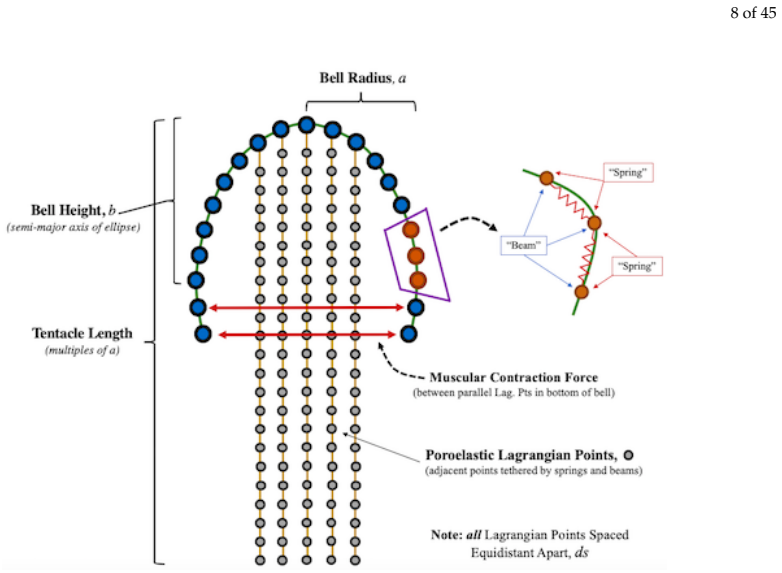
The central object is an idealized two-dimensional semi-elliptical jellyfish bell with poroelastic tentacles/oral arms hanging inside, solved by the immersed boundary method in a viscous incompressible fluid. The bell is made of virtual springs and beams; the tentacles/oral arms are modeled as poroelastic structures with a Brinkman-type slip velocity controlled by a permeability coefficient; and contraction is driven by sinusoidally varying muscle springs. This machinery allows a systematic sweep over Reynolds number, appendage number, length, density, and placement, with output metrics of average forward speed, Strouhal number, cost of transport, and flow-mixing fields. The key work it does is to isolate the appendages' wake effect by holding bell geometry and kinematics fixed while varying only tentacle morphology.
What would settle it
A three-dimensional immersed-boundary simulation, or a laboratory particle-image-velocimetry study of a tethered or swimming medusa with and without oral arms at $\mathrm{Re}\approx 150$, could check whether the starting vortex is actually suppressed and whether the ~400 percent speed gap survives outside two dimensions.
Extended reading notes
Core claim
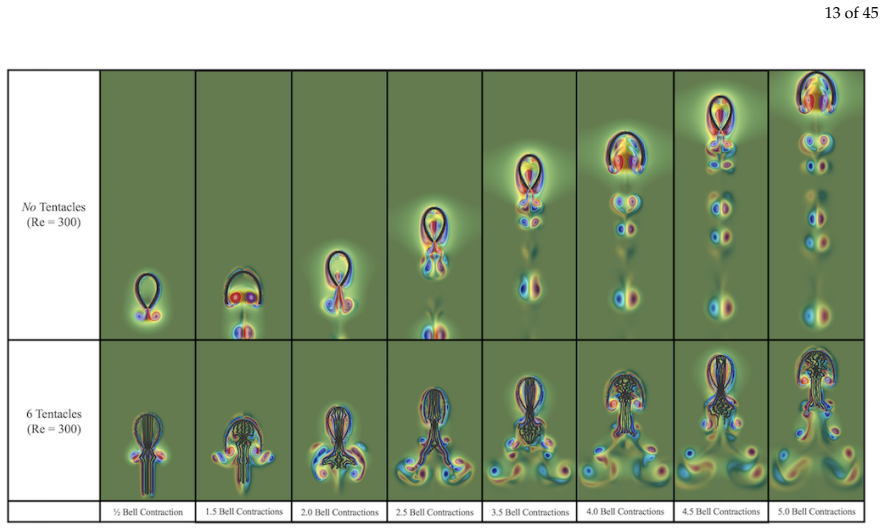
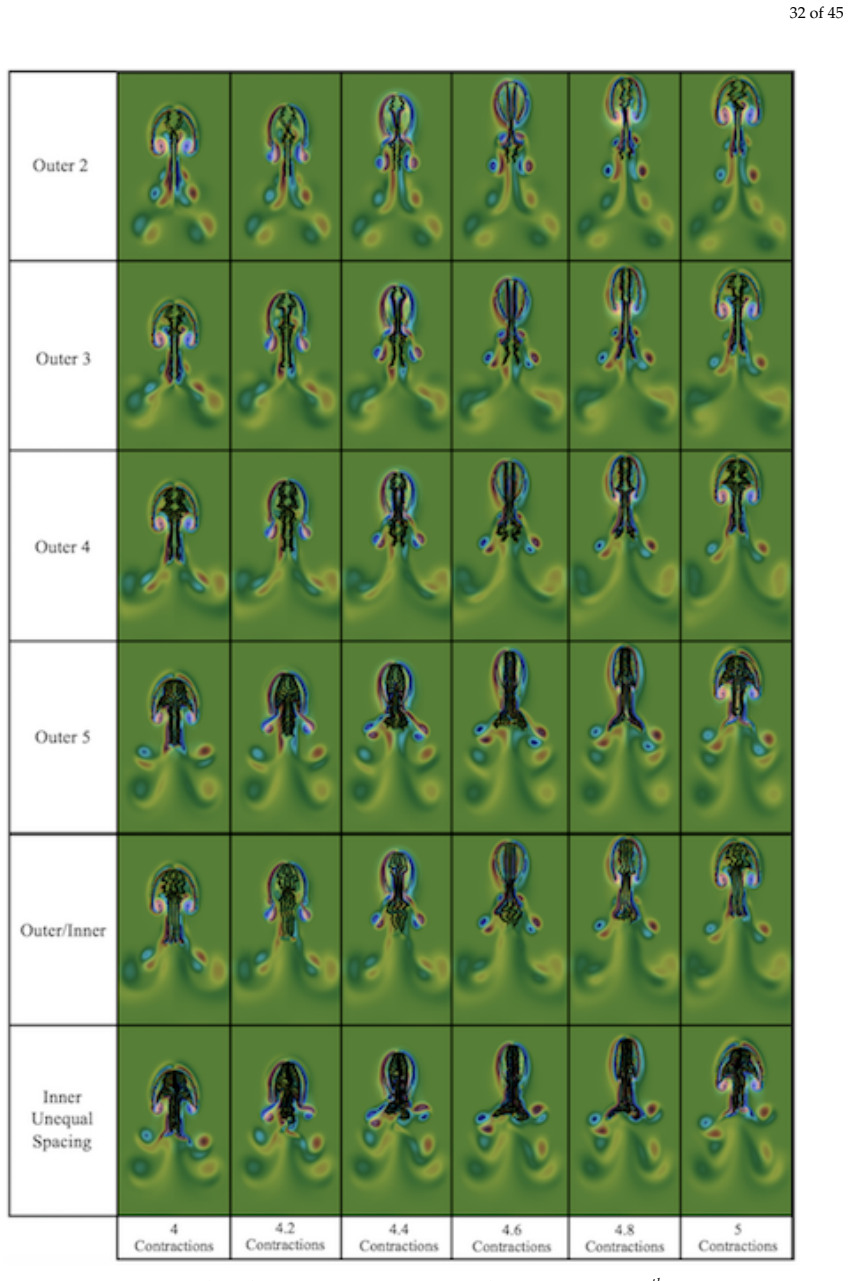
The central claim is that tentacles and oral arms are not passive drag: in the idealized model, adding poroelastic appendages monotonically decreases forward swimming speed, and the apparent mechanism is that the appendages suppress vortex formation and alter the vortex ring wake. The paper quantifies this as a fraction of bodylengths per bell contraction, noting that the no-appendage case is about 400 percent faster than the eight-appendage case at the same contraction kinematics. It further claims nonlinear relationships between appendage length, number, density, and placement and swimming speed, with three regimes for length (negligible effect, sharp drop, plateau), and ties the differences to changes in wake topology and flow-mixing structures rather than to a simple drag penalty.
Load-bearing premise
The results rest on the assumption that a two-dimensional fluid model, with no out-of-plane motion or vortex stretching, faithfully reproduces how poroelastic tentacles/oral arms suppress the vortex wake; if two-dimensional confinement artificially enhances the appendage-vortex interaction, the reported speed reductions would be too large.
Editorial extensions
If this is right
- Adding more symmetric tentacles/oral arms monotonically reduces forward swimming speed; the eight-appendage bell swims roughly four times slower than the appendage-free bell at the same contraction.
- Appendage length acts in three regimes: very short appendages barely change speed, moderate lengths cause a sharp decline, and very long appendages plateau so that further lengthening no longer matters.
- When placement and density vary, fewer appendages do not always mean faster swimming; clustered or uneven configurations can outperform uniform ones, so morphology and fluid scale couple nonlinearly.
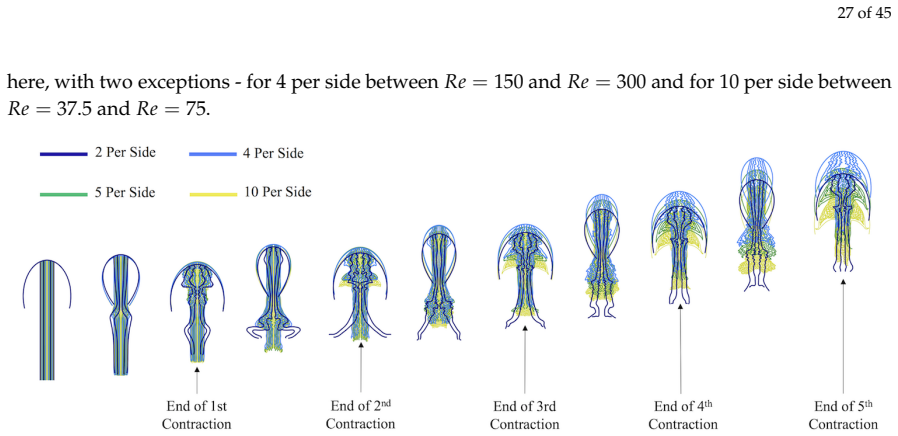
- The appendages redirect the wake: instead of a vertically advected vortex ring, vortices bounce laterally off the appendages, increasing horizontal mixing near the bell and reducing mixing downstream.
- Because the appendage-free bell is the only case that falls in the presumed efficient Strouhal band ($0.2 < \mathrm{St} < 0.4$) for $\mathrm{Re}\gtrsim 50$, tentacle/oral arm load shifts the jellyfish outside the efficient cruising regime.
Reading between the lines
- If the two-dimensional mechanism carries to three dimensions, appendage morphology should be treated as a first-order determinant of medusan ecology: species with many long, dense tentacles/oral arms are paying a large swimming-speed tax that favors passive foraging over active hunting.
- The two-dimensional geometry has no vortex stretching or out-of-plane motion, so the observed inelastic-wall effect may be stronger or weaker in a real three-dimensional wake; a three-dimensional simulation at the same $\mathrm{Re}$ and appendage count would test whether the ~400 percent gap survives.
- A natural experimental extension would be to track wake vorticity and swimming speed in a live medusa before and after temporarily removing or folding back its oral arms, checking whether suppression of the starting vortex is visible in particle-image velocimetry.
- Because the paper reports that varying the poroelasticity coefficient did not strongly change speeds over the range tested, the model's insensitivity to appendix permeability may not hold at higher densities or longer lengths; this is a testable parameter-space point, not a claim the paper makes.
Signed reviews
Editorial analysis
A structured set of objections, weighed in public.
Referee Report
Summary. The paper presents a two-dimensional immersed-boundary study of an idealized flexible jellyfish bell with poroelastic tentacles/oral arms, using the open-source IB2d code. The authors vary Reynolds number, tentacle/oral arm number, length, placement, and density, and report forward swimming speeds, Strouhal number, cost of transport, vorticity fields, and FTLE-based mixing diagnostics. The central claim is that tentacles and oral arms inhibit forward swimming, by suppressing vortex formation, and that the relationship between morphology and swimming performance is nonlinear. The results are presented as a comparative parameter sweep, with percentage reductions in swimming speed relative to a no-tentacle case, and the paper includes an appendix on the sensitivity to the poroelasticity coefficient alpha.
Significance. If the central claim holds, the paper identifies tentacle and oral arm morphology as a first-order determinant of jellyfish swimming performance, moving beyond the common treatment of appendages as passive drag elements. The work also provides a reusable open-source modeling framework for poroelastic appendages in IB2d, and the main qualitative result—that appendages slow forward swimming—is consistent with the single prior observation by Katija (2015). The parameter sweeps are systematic and the alpha-robustness check in Appendix B, although limited, supports the comparability of the different sections. The main weakness is that the proposed mechanism, vortex suppression, is supported almost entirely by qualitative visualizations rather than quantitative wake diagnostics, and the 2D geometry may strengthen the appendage–vortex interaction relative to real three-dimensional jellyfish. The paper is a useful contribution if the mechanism claim is backed by quantitative measures or explicitly softened.
major comments (4)
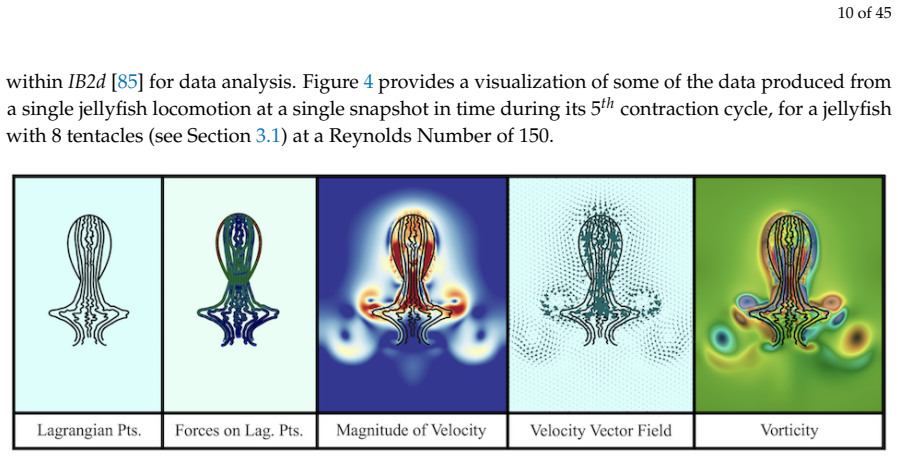
- [Section 3.1, Figures 7 and 12] The central mechanistic claim that tentacles/oral arms inhibit swimming by suppressing vortex formation is inferred from vorticity colormaps and FTLE fields, but no quantitative wake diagnostic is reported. A direct drag force on the appendages, or a change in bell deformation due to the added elastic load, could also produce the observed speed reductions. Please compute a quantitative measure such as circulation of the leading vortex ring, total enstrophy in the wake, vortex impulse, or wake momentum for the no-tentacle and tentacle cases, and show that it correlates with the speed changes.
- [Section 2.1 and Section 2.2] The grid and domain convergence checks cited from Miles et al. 2019 and Battista et al. 2019 were performed on jellyfish models without tentacles, so they do not validate the tentacle–vortex interaction itself. In the present 2D geometry every poroelastic tentacle is effectively an infinite cylinder spanning the out-of-plane direction, which may exaggerate its blocking effect on the vortex wake compared with finite, separated tentacles in a real jellyfish. Please add a sensitivity test for the tentacle resolution or Lagrangian mesh spacing, discuss the expected 3D effects quantitatively, or explicitly state that the magnitude of the speed reductions is a 2D result that requires 3D confirmation.
- [Appendix B and Section 2.2] The poroelasticity coefficient alpha is set to 500,000 in Section 3.1, 10,000 in Section 3.2, and 25,000 in Section 3.3, with the justification that varying alpha does not significantly affect speeds. However, the supporting Figure A1 is presented only for Re = 150, and the text notes numerical stability issues for alpha below 10^4. Since cross-section comparisons are used in Sections 3.3.1–3.3.3, please report alpha sensitivity at additional Reynolds numbers, or restrict the cross-section claims to the range where alpha robustness has been demonstrated.
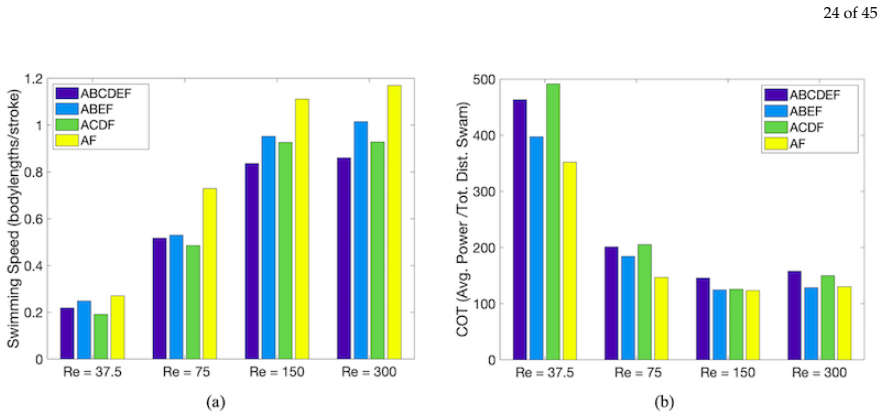
- [Section 3.1 and Tables 3–5] All percentage differences and qualitative rankings are based on a single simulation per configuration; no error bars, repeated trials, or variability estimates are reported. Some comparisons are close enough that run-to-run variation could change the ranking, for example the Re = 300 entries in Table 4 (49.3% vs 49.5%) and the Re = 37.5 entries in Table 5. Please provide at least a small number of repeated simulations for selected cases, or a convergence-based uncertainty estimate, to establish that the reported ordering of configurations is robust.
minor comments (5)
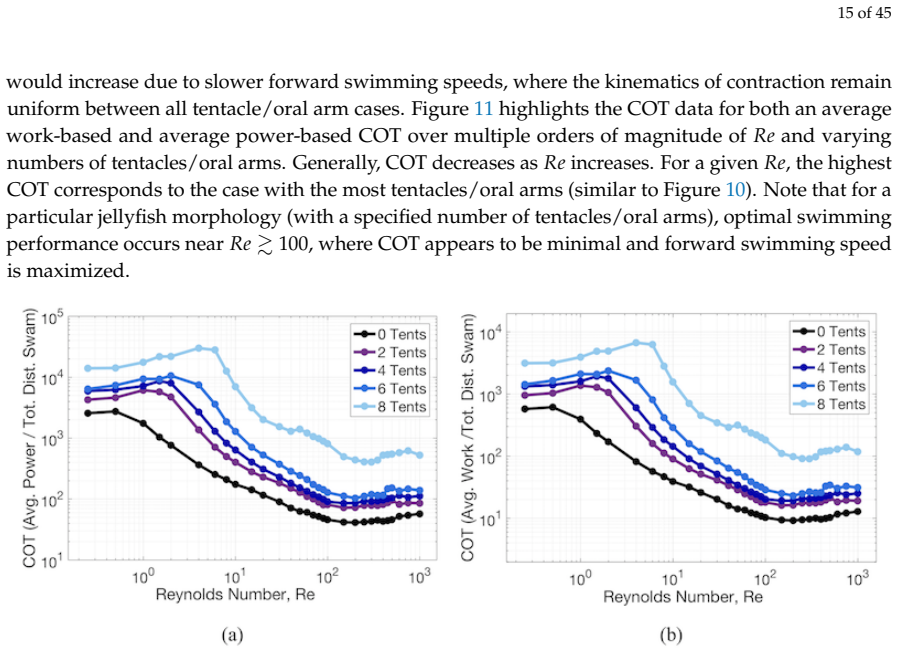
- [Abstract and Section 3.1] The phrase 'downwards of 400%' in the abstract and '~400% faster' in Section 3.1 is not consistent with the tabulated percentage decreases of roughly 40–80% in Tables 3–5; please report the comparison as a speed ratio or correct the percentage wording.
- [Figure 1 caption and Section 2.2] There are several typos, including 'tenatcles' in the Figure 1 caption, 'oral hands' in Section 2.2, 'poroelastsic' in Section 3, and repeated 'Lyanpunov' in figure captions for FTLE; these should be corrected.
- [Figure A5 caption] The caption for Figure A5 is missing a closing parenthesis: '... of varying lengths (in multiples of the bell radius, a, between the 4th and 5th contraction cycle.' should be completed.
- [Equations (8) and (9)] The definitions of N and dS in the cost-of-transport formulas are slightly ambiguous; please state explicitly which time interval and which distance are used, and whether the same normalization is applied in both the work-based and power-based definitions.
- [Section 3.3.1] The discussion of why ABCDEF can be faster than ACDF for Re < 75 is speculative ('rigid wall' versus 'cushioned' interactions) without supporting quantitative evidence; either add a diagnostic that distinguishes these scenarios or present the explanation as a hypothesis.
Circularity Check
No circularity: swimming speeds are simulation outputs, not fits; the tentacle effect is not constructed from its own conclusion.
full rationale
The central claim — that tentacles/oral arms inhibit forward swimming by suppressing vortex formation — is read directly from immersed-boundary simulations in which tentacle morphology is an input and the swimming speed is an output. Nothing in the method sets the speed or the speed ratios to the morphology by construction: U_avg emerges from the coupled Navier-Stokes/poroelastic-IB solve (Eqs. A1-A4 and Eq. 5), and the reported ~400% comparison is a ratio of independently measured simulated speeds. The Katija 2015 comparison is external, not a fitted target. The self-citations to IB2d and to the prior no-tentacle models are not load-bearing in a circular way: IB2d is open source and externally documented, and the convergence checks cited from Miles et al. 2019 and Battista et al. 2019 are explicitly for the base no-tentacle model, so they cannot by construction manufacture the tentacle effect. The alpha-insensitivity test in Appendix B is an internal parameter check, and Appendix B itself notes numerical stability limits rather than tuning to a desired outcome. The paper's own stated limitations — that convergence studies were not rerun with tentacles (Section 2.1) and that tentacle/oral arm stiffness was not thoroughly investigated (Section 4) — are quantitative-confidence concerns, not evidence that any prediction reduces to an input. No equation is equivalent to another by definition, and no fitted parameter is renamed as a prediction. Thus there is no significant circularity.
Assumptions & free parameters
free parameters (10)
- Bell semi-minor axis a =
0.5 m
- Bell semi-major axis b =
0.75 m
- Spring stiffness kspr =
1e7 kg*m/s^2
- Beam stiffness kbeam =
2.5e5 kg*m/s^2
- Muscle spring stiffness kmuscle =
1e5 kg*m/s^2
- Contraction frequency f =
0.8 Hz
- Poroelasticity coefficient alpha, Section 3.1 =
500000 m^-2
- Poroelasticity coefficient alpha, Section 3.2 =
10000 m^-2
- Poroelasticity coefficient alpha, Section 3.3 =
25000 m^-2
- Tentacle morphology parameters =
varied
assumptions (8)
- standard math Incompressible Navier-Stokes with immersed-boundary delta-function coupling describes jellyfish locomotion.
- domain assumption A 2D semi-elliptical model represents the 3D jellyfish bell and its wake.
- domain assumption Tentacles and oral arms are poroelastic structures with slip velocity U_b = u + f_elastic/(alpha*mu), Eq. (5).
- domain assumption Bell contraction is prescribed by the sinusoidal muscle rest length RL(t) = 2a(1 - |sin(pi f t)|), Eq. (6).
- domain assumption Tentacles and oral arms are structurally identical; no distinction is made between them.
- ad hoc to paper Varying alpha does not significantly affect speeds, so sections with different alpha can be compared.
- ad hoc to paper Prior grid and domain convergence results for the no-tentacle jellyfish apply to the tentacle cases.
- domain assumption Tentacles are initially placed within the bell interior and interact with the fluid only through the immersed-boundary coupling.
Cite this review
Pith. "Pith review of Naut your everyday jellyfish model: Exploring how tentacles and oral arms impact locomotion." pith.science (2026). https://pith.science/paper/GU3ZVZMH
@misc{pith2026190804202,
  author       = {Pith},
  title        = {Pith review of: Naut your everyday jellyfish model: Exploring how tentacles and oral arms impact locomotion},
  year         = {2026},
  howpublished = {\url{https://pith.science/paper/GU3ZVZMH}},
  note         = {Machine review of arXiv:1908.04202}
}
read the original abstract
Jellyfish - majestic, energy efficient, and one of the oldest species that inhabits the oceans. It is perhaps the second item, their efficiency, that has captivated scientists for decades into investigating their locomotive behavior. Yet, no one has specifically explored the role that their tentacles and oral arms may have on their potential swimming performance, arguably the very features that give jellyfish their beauty while instilling fear into their prey (and beach-goers). We perform comparative in silico experiments to study how tentacle/oral arm number, length, placement, and density affect forward swimming speeds, cost of transport, and fluid mixing. An open source implementation of the immersed boundary method was used (IB2d) to solve the fully coupled fluid-structure interaction problem of an idealized flexible jellyfish bell with poroelastic tentacles/oral arms in a viscous, incompressible fluid. Overall tentacles/oral arms inhibit forward swimming speeds, by appearing to suppress vortex formation. Non-linear relationships between length and fluid scale (Reynolds Number) as well as tentacle/oral arm number, density, and placement are observed, illustrating that small changes in morphology could result in significant decreases in swimming speeds, in some cases by downwards of 400% between cases with to without tentacles/oral arms.
Figures

Figures from the paper (27 more)









Reference graph
Works this paper leans on
-
[1]
Transitions in morphology, nematocyst distribution, fluid motions, and prey capture during development of the scyphomedusa Cyanea capillata
Higgins, J.E.; Ford, M.D.; Costello, J.H. Transitions in morphology, nematocyst distribution, fluid motions, and prey capture during development of the scyphomedusa Cyanea capillata. Biological Bulletin 2008, 214, 29–41
2008
-
[2]
The nematocyst: a molecular map of the cnidarian stinging organelle
Beckmann, A.; Özbek, S. The nematocyst: a molecular map of the cnidarian stinging organelle. Int. J. Dev. Biol. 2012, 56(6-8), 577–582
2012
-
[3]
Nanosecond-scale kinetics of nematocyst discharge
Nüchter, T.; Benoit, M.; Engel, U.; Özbek, S.; Holstein, T.W. Nanosecond-scale kinetics of nematocyst discharge. Current Biology 2006, 16(9), PR316–R318
2006
-
[4]
Fluid Dynamics of Nematocyst Prey Capture
Strychalski, W.; S.Bryant.; Jadamba, B.; Kilikian, E.; Lai, X.; Shahriyari, L.; Segal, R.; Wei, N.; Miller, L.A. Fluid Dynamics of Nematocyst Prey Capture. In Understanding Complex Biological Systems with Mathematics; Radunskaya, A.; Segal, R.; Shtylla, B., Eds.; Springer: New York, NY, 2018; chapter 6, pp. 123–144
2018
-
[5]
Jellyfish Anatomy, 2008
Deretsky, Z. Jellyfish Anatomy, 2008. [National Science Foundation, Online; accessed June 29, 2019]
2008
-
[6]
Jellyfish Stings and Their Management: A Review
Cegolon, L.; Heymann, W.C.; Lange, J.H.; Mastrangelo, G. Jellyfish Stings and Their Management: A Review. Marine Drugs 2013, 11, 523–550
2013
-
[7]
Pacific Coast pelagic invertebrates: A guide to the common gelatinous animals ; Sea Challengers: Monterey, CA, 2003
Wrobel, D.; Mills, C. Pacific Coast pelagic invertebrates: A guide to the common gelatinous animals ; Sea Challengers: Monterey, CA, 2003
2003
-
[8]
Ontogenetic propulsive transitions bySarsia tubulosa medusae
Katija, K.; Colin, S.P .; Costello, J.H.; Jiang, H. Ontogenetic propulsive transitions bySarsia tubulosa medusae. J. Exp. Biol 2015, 218, 2333–2343
2015
Show all 134 references
-
[9]
Lion’s Mane Jellyfish: Cyanea capillata, 2019
National Aquarium in Baltimore. Lion’s Mane Jellyfish: Cyanea capillata, 2019. [Online; accessed June 29, 2019]
2019
-
[10]
The Jelly Gallery: Moon Jellyfish, 2017
Two Oceans Aquarium. The Jelly Gallery: Moon Jellyfish, 2017. [Photographer: N. A. Battista; taken July 2, 2017]
2017
-
[11]
The Jelly Gallery: Moon Jellyfish, 2017
Audubon Aquarium of the Americas. The Jelly Gallery: Moon Jellyfish, 2017. [Photographer: N. A. Battista; taken January 7, 2017]
2017
-
[12]
Aliens of the Sea: Australian Spotted Jellyfish, 2019
Aquarium of Niagara. Aliens of the Sea: Australian Spotted Jellyfish, 2019. [Photographer: N. A. Battista; taken June 21, 2019]
2019
-
[13]
Blue Blubber Jellyfish, 2014
Steiger, H. Blue Blubber Jellyfish, 2014. [Online; accessed June 29, 2019]
2014
-
[14]
Flame jellyfish, 2015
Abbott, B. Flame jellyfish, 2015. [Taken at Monterey Bar Aquarium, Online; accessed June 29, 2019, ]
2015
-
[15]
Jellyfish: Flame Jellyfish, 2014
Osaka Aquarium Kaiyukan. Jellyfish: Flame Jellyfish, 2014. [Photographer: N. A. Battista; taken July 30, 2014]
2014
-
[16]
Jellies Invasion: Oceans Out of Balance - Japanese Sea Nettle, 2019
National Aquarium In Baltimore. Jellies Invasion: Oceans Out of Balance - Japanese Sea Nettle, 2019. [Photographer: N. A. Battista; taken January 19, 2019]
2019
-
[17]
Cassiopea: Upside Down Jellyfish, 2017
Key Largo Marine Research Lab. Cassiopea: Upside Down Jellyfish, 2017. [William Fitt’s Key Largo Lab, Photographer: N. A. Battista; taken March 15, 2018]
2017
-
[18]
Spiegeleikwal voor de westkust van het, 2015
Fredski2013. Spiegeleikwal voor de westkust van het, 2015. [Taken at Mangiabarche beach, Online; accessed June 29, 2019, ]
2015
-
[19]
Cassiopea Jellyfish (Cotylorhiza tuberculata), 2008
Sontuoso, A. Cassiopea Jellyfish (Cotylorhiza tuberculata), 2008. [Taken at Mar Jonio, Italy, Online; accessed June 29, 2019, ]
2008
-
[20]
Jellies Invasion: Oceans Out of Balance - Cannonball Jellyfish, 2019
National Aquarium In Baltimore. Jellies Invasion: Oceans Out of Balance - Cannonball Jellyfish, 2019. [Photographer: N. A. Battista; taken January 19, 2019]
2019
-
[21]
A Lion’s mane jelly, 2006
Hershman, D. A Lion’s mane jelly, 2006. [Online; accessed June 29, 2019]
2006
-
[22]
A box jellyfish ( Chironex sp.) - tiny but dangerous, 2007
Port of Nagoya Public Aquarium. A box jellyfish ( Chironex sp.) - tiny but dangerous, 2007. [Photographer: G. Gautsch; taken August 26, 2007; accessed July 5, 2019]
2007
-
[23]
Open Sea: Purple Striped Jellyfish, 2017
Monterey Bay Aquarium. Open Sea: Purple Striped Jellyfish, 2017. [Online; accessed June 29, 2019]
2017
-
[24]
Sarsia tubulosa, 2012
Semenov, A. Sarsia tubulosa, 2012. [Online; accessed June 29, 2019]
2012
-
[25]
Moon Jelly, 2019
Monterey Bay Aquarium. Moon Jelly, 2019. [Online; accessed June 29, 2019]
2019
-
[26]
Reappearance and seasonality of Phyllorhiza punctata von Lendenfeld (Cnidaria, Scyphozoa, Rhizostomeae) medusae in southern Brazil
Haddad, M.A.; Júnior, M. Reappearance and seasonality of Phyllorhiza punctata von Lendenfeld (Cnidaria, Scyphozoa, Rhizostomeae) medusae in southern Brazil. Revista Brasileira de Zoologia 2006, 23(3), 824–831
2006
-
[27]
Morphological Characterization of Selected Scyphozoan Jellyfish Species and Geometric Morphometric Analysis of Chrysaora chinensis in Peninsular Malaysia
Boon, L.L. Morphological Characterization of Selected Scyphozoan Jellyfish Species and Geometric Morphometric Analysis of Chrysaora chinensis in Peninsular Malaysia. Master’s thesis, University of Malaya Kuala Lumpur, Kuala Lumpur, Malaysia, 2017
2017
-
[28]
Blue Blubber Jellyfish, 2019
Monterey Bay Aquarium. Blue Blubber Jellyfish, 2019. [Online; accessed June 29, 2019]. 41 of 45
2019
-
[29]
Jellyfish Blooms: Causes, Consequences and Recent Advances
Pitt, K.A.; Purcell, J.E. Jellyfish Blooms: Causes, Consequences and Recent Advances. Proceedings of the Second International Jellyfish Blooms Symposium; Springer Science & Business Media: Queensland, Australia, 2009; pp. 116–118
2009
-
[30]
Sea Nettle: Chrysaora melanaster, 2010
ArcticOceanDiversity. Sea Nettle: Chrysaora melanaster, 2010. [Census of Marine Life Arctic Ocean Diversity Project, Online; accessed June 29, 2019]
2010
-
[31]
Upside Down Jellyfish, 2019
Georgia Aquarium. Upside Down Jellyfish, 2019. [Online; accessed June 29, 2019]
2019
-
[32]
Cotylorhiza tuberculata (Cnidaria: Scyphozoa) - Life History of a Stationary Population
Kikinger, R. Cotylorhiza tuberculata (Cnidaria: Scyphozoa) - Life History of a Stationary Population. Marine Ecology 1992, 13, 333–362
1992
-
[33]
Cannonball Jellyfish: Stomolophus meleagris, 2011
Griffin, D.B.; Murphy, T.M. Cannonball Jellyfish: Stomolophus meleagris, 2011. [South Carolina Department of Natural Resources, accessed; June 30, 2019]
2011
-
[34]
Sizing ocean giants: patterns of intraspecific size variation in marine megafauna
McClain, C.R.; Balk, M.A.; Benfield, M.C.; Branch, T.A.; Chen, C.; Cosgrove, J.; Dove, A.D.; Gaskins, L.C.; Helm, R.R.; Hochberg, F.G.; Lee, F.B.; Marshall, A.; McMurray, S.E.; Schanche, C.; Stone, S.N.; Thaler, A.D. Sizing ocean giants: patterns of intraspecific size variation ...
2015
-
[35]
Chironex fleckeri and Chiropsalmus quadrigatus morphological distinctions
Barnes, J.H. Chironex fleckeri and Chiropsalmus quadrigatus morphological distinctions. North Queensland Naturalist 1965, 32, 13–22
1965
-
[36]
Clarifying the identity of the Japanese Habu-kurage, Chironex yamaguchii, sp nov (Cnidaria: Cubozoa: Chirodropida)
Lewis, C.; Bentlage, B. Clarifying the identity of the Japanese Habu-kurage, Chironex yamaguchii, sp nov (Cnidaria: Cubozoa: Chirodropida). Zootaxa 2009, 32, 59–65
2009
-
[37]
Purple Striped Jellyfish, 2019
Georgia Aquarium. Purple Striped Jellyfish, 2019. [Online; accessed June 29, 2019]
2019
-
[38]
More Barnes on box jellyfish; Sir George Fisher Centre for Tropical Marine Studies, James Cook University of North Queensland: North Queensland, AUS, 1988
Kinsey, B. More Barnes on box jellyfish; Sir George Fisher Centre for Tropical Marine Studies, James Cook University of North Queensland: North Queensland, AUS, 1988
1988
-
[39]
Systema Naturae per regna tria naturae, secundum classes, ordines, genera, species, cum characteribus, differentiis, synonymis, locis
Linnaeus, C. Systema Naturae per regna tria naturae, secundum classes, ordines, genera, species, cum characteribus, differentiis, synonymis, locis. Editio decima, reformata. Laurentius Salvius: Holmiae. ii 1758, p. 824
-
[40]
Acute lion’s mane jellyfish, Cyanea capillata (Cnideria: Scyphozoa), exposure to Atlantic salmon (Salmo salar L.)
Powell, M.D.; Atland, D.A. Acute lion’s mane jellyfish, Cyanea capillata (Cnideria: Scyphozoa), exposure to Atlantic salmon (Salmo salar L.). J. Fish Dis. 2018, 41(5), 751–759
2018
-
[41]
Feeding currents of the upside-down jellyfish in the presence of background flow
Hamlet, C.; Miller, L.A. Feeding currents of the upside-down jellyfish in the presence of background flow. Bull. Math. Bio. 2012, 74(11), 2547–2569
2012
-
[42]
Flow structure and transport characteristics of feeding and exchange currents generated by upside-down Cassiopea jellyfish
Santhanakrishnan, A.; Dollinger, M.; Hamlet, C.L.; Colin, S.P .; Miller, L.A. Flow structure and transport characteristics of feeding and exchange currents generated by upside-down Cassiopea jellyfish. J. Exp. Biol. 2011, 215, 2369–2381
2011
-
[43]
The Broad-Scale Distribution and Abundance of Scyphomedusae in Irish Waters (Ph.D
Bastian, T. The Broad-Scale Distribution and Abundance of Scyphomedusae in Irish Waters (Ph.D. Thesis). University College Cork 2011
2011
-
[44]
Tracking the lion’s mane jellyfish: Horizontal and vertical movements of Cyanea capillata (Scyphozoa) in a shallow coastal environment, 2012
Bastian, T.; Haberlin, D.; Gallagher, M.C.; Rooney, S.; Hays, G.C.; Doyle, T.K. Tracking the lion’s mane jellyfish: Horizontal and vertical movements of Cyanea capillata (Scyphozoa) in a shallow coastal environment, 2012. [Poster: ; PISCES 2012 Annual Meeting]
2012
-
[45]
Vertical and horizontal movement patterns of scyphozoan jellyfish in a fjord-like estuary
Moriarty, P .E.; Andrews, K.S.; Harvey, C.J.; Kawase, M. Vertical and horizontal movement patterns of scyphozoan jellyfish in a fjord-like estuary. Marine Ecol. Prog. Series 2012, 455, 1–12
2012
-
[46]
In situ time budgets of the scyphomedusae Aurelia aurita, Cyanea sp., and Chrysaora quinquecirrha
Costello, J.H.; Klos, E.; Ford, M.D. In situ time budgets of the scyphomedusae Aurelia aurita, Cyanea sp., and Chrysaora quinquecirrha. J. Plankton Res. 1998, 20, 383–391
1998
-
[47]
Interactions of pelagic cnidarians and ctenophores with fish: a review
Purell, J.E.; Arai, M.N. Interactions of pelagic cnidarians and ctenophores with fish: a review. Hydrobiologia 2001, 451(1-3), 27–44
2001
-
[48]
Predation on zooplankton by large jellyfish (Aurelia labiata, Cyanea capillata, Aequorea aequorea) in Prince William Sound, Alaska
Purell, J.E. Predation on zooplankton by large jellyfish (Aurelia labiata, Cyanea capillata, Aequorea aequorea) in Prince William Sound, Alaska. Mar. Ecol. Prog. Ser 2003, 246, 137–152
2003
-
[49]
Occurrence of a gelatinous predator ( Cyanea capillata) may affect the distribution of Boreogadus saida, a key Arctic prey fish species
Crawford, R.E. Occurrence of a gelatinous predator ( Cyanea capillata) may affect the distribution of Boreogadus saida, a key Arctic prey fish species. Polar Biology 2016, 39(6), 1049–1055
2016
-
[50]
Quantifying movement of the tropical Australian cubozoan Chironex fleckeri using acoustic telemetry
Gordon, M.R.; Seymour, J.E. Quantifying movement of the tropical Australian cubozoan Chironex fleckeri using acoustic telemetry. Hydrobiologia 2009, 616, 87–97
2009
-
[51]
Barnes on box jellyfish, 1986
Kinsey, B.E. Barnes on box jellyfish, 1986. [Unpublished folio manuscripts held in the Archives of James Cook University]
1986
-
[52]
Jellyfish Mechanisms
Rifkin, J. Jellyfish Mechanisms. In Venomous and Poisonous Marine Animals - A Medical and Biological Handbook; Williamson, J.A.; Fenner, P .J.; Burnett, J.W.; Rifkin, J., Eds.; University of New South Wales Press: Randwick, AUS, 1996. 42 of 45
1996
-
[53]
Quantifying ecological aspects of the seasonally abundant box jellyfish Chironex fleckeri within coastal and estuarine waters of Far North Queensland (Ph.D
Bastian, T. Quantifying ecological aspects of the seasonally abundant box jellyfish Chironex fleckeri within coastal and estuarine waters of Far North Queensland (Ph.D. Thesis). James Cook University 2014
2014
-
[54]
Propulsion in Cubomedusae: Mechanisms and Utility
Colin, S.P .; Costello, J.H.; Katija, K.; Seymour, J.; Kiefer, K. Propulsion in Cubomedusae: Mechanisms and Utility. PLoS ONE 2013, 8(2), e56393
2013
-
[55]
Kinematic analysis of swimming in Australian box jellyfish, Chiropsalmus sp
Shorten, M.; Davenport, J.; Seymour, J.E.; Cross, M.C.; Carrette, T.J.; Woodward, G.; Cross, T.F. Kinematic analysis of swimming in Australian box jellyfish, Chiropsalmus sp. and Chironex fleckeri (Cubozoa, Cnidaria: Chirodropidae). J. Zoology 2005, 267, 371–380
2005
-
[56]
A numerical study of the benefits of driving jellyfish bells at their natural frequency
Hoover, A.P .; Miller, L.A. A numerical study of the benefits of driving jellyfish bells at their natural frequency. J. Theor. Biol. 2015, 374, 13–25
2015
-
[57]
Quantifying performance in the medusan mechanospace with an actively swimming three-dimensional jellyfish model
Hoover, A.P .; Griffith, B.E.; Miller, L.A. Quantifying performance in the medusan mechanospace with an actively swimming three-dimensional jellyfish model. J. Fluid. Mech. 2017, 813, 1112–1155
2017
-
[58]
Prey Capture Ecology of the Cubozoan Carukia barnesi
Courtney, R.; Sachlikidis, N.; Jones, R.; Seymour, J. Prey Capture Ecology of the Cubozoan Carukia barnesi. PLoS ONE 2015, 10(5), e0124256
2015
-
[59]
Hunting in Bioluminescent Light: Vision in the Nocturnal Box Jellyfish Copula sivickisi
Garm, A.; Bielecki, J.; Petie, R.; Nilsson, D.E. Hunting in Bioluminescent Light: Vision in the Nocturnal Box Jellyfish Copula sivickisi. Front. Physiol. 2016, 7, 99
2016
-
[60]
Grzimek’s Animal Ecyclopedia, Vol
Grzimek, D. Grzimek’s Animal Ecyclopedia, Vol. 1, Lower Animals; Van Nostrand Reinhold Company: New York, USA, 1972
1972
-
[61]
Variability of the swimming ‘rhythm’ in a hydromedusa
Leonard, J.L. Variability of the swimming ‘rhythm’ in a hydromedusa. Am. Zool. 1978, 18, 589
1978
-
[62]
Temporal organization of swimming activity in Sarsia tubulosa M
Leonard, J.L. Temporal organization of swimming activity in Sarsia tubulosa M. Sara (Hydrozoa). J. Comp. Physiol. 1980, 136, 219–335
1980
-
[63]
Morphology, swimming performance and propulsive mode of six co-occurring hydromedusae
Colin, S.P .; Costello, J.H. Morphology, swimming performance and propulsive mode of six co-occurring hydromedusae. J. Exp. Biol. 2002, 205, 427–437
2002
-
[64]
The numerical comparison of flow patterns and propulsive performances for the hydromedusae Sarsia tubulosa and Aequorea victoria
Sahin, M.; Mohseni, K.; Colin, S.P . The numerical comparison of flow patterns and propulsive performances for the hydromedusae Sarsia tubulosa and Aequorea victoria. J. Exp. Biol. 2009, 212, 2656–2667
2009
-
[65]
Don’t be jelly: Exploring effective jellyfish locomotion
Miles, J.G.; Battista, N.A. Don’t be jelly: Exploring effective jellyfish locomotion. arXiv: https://arxiv.org/abs/1904.09340 2019
1904 arXiv
-
[66]
Numerical Investigation of Flow in the Vicinity of a Swimming Jellyfish
Dular, J.; Bajcar, T.; Sirok, B. Numerical Investigation of Flow in the Vicinity of a Swimming Jellyfish. Eng. Appl. Comp. Fluid Mech. 2009, 3(2), 258–270
2009
-
[67]
Lagrangian coherent structures in low reynolds number swimming
Wilson, M.M.; Peng, J.; Dabiri, J.O.; Eldredge, J.D. Lagrangian coherent structures in low reynolds number swimming. J. Phys.: Condens. Matter 2009, 21(20), 204105
2009
-
[68]
Reynolds number limits for jet propulsion: a numerical study of simplified jellyfish
Hershlag, G.; Miller, L.A. Reynolds number limits for jet propulsion: a numerical study of simplified jellyfish. J. Theor. Biol. 2011, 285, 84–95
2011
-
[69]
Efficient kinematics for jet-propelled swimming
Alben, S.; Miller, L.A.; Peng, J. Efficient kinematics for jet-propelled swimming. J. Fluid Mech. 2013, 733, 100–133
2013
-
[70]
A Numerical Study of Jet Propulsion of an Oblate Jellyfish Using a Momentum Exchange-Based Immersed Boundary-Lattice Boltzmann Method
Yuan, H.; Shu, S.; Niu, X.; Li, M. A Numerical Study of Jet Propulsion of an Oblate Jellyfish Using a Momentum Exchange-Based Immersed Boundary-Lattice Boltzmann Method. Adv. in Appl. Math. and Mech. 2014, 6(3), 307–326
2014
-
[71]
Pump or coast: the role of resonance and passive energy recapture in medusan swimming performance
Porras, A.P .H.A.J.; Miller, L.A. Pump or coast: the role of resonance and passive energy recapture in medusan swimming performance. J. Fluid. Mech. 2019, 863, 1031–1061
2019
-
[72]
From Single Neurons to Behavior in the Jellyfish Aurelia aurita
PAllasdies, F.; Goedeke, S.; Braun, W.; Memmesheimer, R. From Single Neurons to Behavior in the Jellyfish Aurelia aurita . biorXiv: https://www.biorxiv.org/content/10.1101/698548v1 2019. https://doi.org/10.1101/698548
2019 doi
-
[73]
Vortex motion in the ocean: In situ visualization of jellyfish swimming and feeding flows
Dabiri, J.O.; Gharib, M.; Colin, S.P .; Costello, J.H. Vortex motion in the ocean: In situ visualization of jellyfish swimming and feeding flows. Physics of Fluids 2005, 17, 091108
2005
-
[74]
Flow patterns generated by oblate medusan jellyfish: field measurements and laboratory analyses
Dabiri, J.O.; Colin, S.P .; Costello, J.H.; Gharib, M. Flow patterns generated by oblate medusan jellyfish: field measurements and laboratory analyses. J. Exp. Biol. 2005, 208, 1257–1265
2005
-
[75]
Fast-swimming hydromedusae exploit velar kinematics to form an optimal vortex wake
Dabiri, J.O.; Colin, S.P .; Costello, J.H. Fast-swimming hydromedusae exploit velar kinematics to form an optimal vortex wake. J. Exp. Biol. 2006, 209, 2025–2033
2006
-
[76]
Kinematic properties of the jellyfishAurelia sp
Bajcar, T.; Malacic, V .; Malej, A.; Sirok, B. Kinematic properties of the jellyfishAurelia sp. In Jellyfish Blooms: Causes, Consequences, and Recent Advances; Pitt, K.A.; Purcell, J.E., Eds.; Springer: Dordrecht, Netherlands, 2008; Vol. 206, Developments in Hydrobiology
2008
-
[77]
Transport of inertial particles by lagrangian coherent structures: application to predator- prey interaction in jellyfish feeding
Peng, J.; Dabiri, J.O. Transport of inertial particles by lagrangian coherent structures: application to predator- prey interaction in jellyfish feeding. J. Fluid Mech. 2009, 623, 75–84. 43 of 45
2009
-
[78]
Passive energy recapture in jellyfish contributes to propulsive advantage over other metazoans
Gemmell, B.; Costello, J.; Colin, S.P .; Stewart, C.; Dabiri, J.; Tafti, D.; Priya, S. Passive energy recapture in jellyfish contributes to propulsive advantage over other metazoans. PNAS 2013, 110, 17904–17909
2013
-
[79]
Exploring vortex enhancement and manipulation mechanisms in jellyfish that contributes to energetically efficient propulsion
Gemmell, B.; Costello, J.; Colin, S.P . Exploring vortex enhancement and manipulation mechanisms in jellyfish that contributes to energetically efficient propulsion. Communicative & Integrative Biology 2014, 7, e29014
2014
-
[80]
Suction-based propulsion as a basis for efficient animal swimming
Gemmell, B.; Costello, J.; Colin, S.P .; Dabiri, J. Suction-based propulsion as a basis for efficient animal swimming. Nature Communications 2015, 6, 8790
2015
-
[81]
Hydrodynamics of Vortex Generation during Bell Contraction by the Hydromedusa Eutonina indicans (Romanes, 1876)
Costello, J.H.; Colin, S.P .; Gemmell, B.J.; Dabiri, J.O. Hydrodynamics of Vortex Generation during Bell Contraction by the Hydromedusa Eutonina indicans (Romanes, 1876). Biomimetics 2019, 4(3), 44
2019
-
[82]
Lagrangian description of the unsteady flow induced by a single pulse of a jellyfish
Kim, J.; Chamorro, L.P . Lagrangian description of the unsteady flow induced by a single pulse of a jellyfish. Phys. Rev. Fluids 2019, 4, 064605
2019
-
[83]
Morphology Alters Fluid Transport and the Ability of Organisms to Mix Oceanic Waters
Katija, K. Morphology Alters Fluid Transport and the Ability of Organisms to Mix Oceanic Waters. Int. Comp. Biol. 2015, 55(4), 698–705
2015
-
[84]
A Mathematical Model and MATLAB Code for Muscle-Fluid-Structure Simulations
Battista, N.A.; Baird, A.J.; Miller, L.A. A Mathematical Model and MATLAB Code for Muscle-Fluid-Structure Simulations. Integr. Comp. Biol. 2015, 55(5), 901–911
2015
-
[85]
IB2d: a Python and MATLAB implementation of the immersed boundary method
Battista, N.A.; Strickland, W.C.; Miller, L.A. IB2d: a Python and MATLAB implementation of the immersed boundary method. Bioinspir. Biomim. 2017, 12(3), 036003
2017
-
[86]
IB2d Reloaded: a more powerful Python and MATLAB implementation of the immersed boundary method
Battista, N.A.; Strickland, W.C.; Barrett, A.; Miller, L.A. IB2d Reloaded: a more powerful Python and MATLAB implementation of the immersed boundary method. Math. Method. Appl. Sci 2018, 41, 8455–8480
2018
-
[87]
Undulatory and oscillatory swimming
Smits, A.J. Undulatory and oscillatory swimming. J. Fluid Mech. 2019, 874, P1
2019
-
[88]
ad T. V . Buren, D.F.; Smits, A.J. Swimmers’ wakes are not reliable indicators of swimming performance,
-
[89]
Flow patterns around heart valves: A numerical method
Peskin, C. Flow patterns around heart valves: A numerical method. J. Comput. Phys. 1972, 10(2), 252–271
1972
-
[90]
Numerical analysis of blood flow in the heart
Peskin, C. Numerical analysis of blood flow in the heart. J. Comput. Phys. 1977, 25, 220–252
1977
-
[91]
The immersed boundary method
Peskin, C.S. The immersed boundary method. Acta Numerica 2002, 11, 479–517
2002
-
[92]
Truncated Newton methods and the modeling of complex immersed elastic structures
Fauci, L.; Fogelson, A. Truncated Newton methods and the modeling of complex immersed elastic structures. Commun. Pure Appl. Math 1993, 46, 787–818
1993
-
[93]
An Immersed Boundary Method with Formal Second-Order Accuracy and Reduced Numerical Viscosity
Lai, M.C.; Peskin, C.S. An Immersed Boundary Method with Formal Second-Order Accuracy and Reduced Numerical Viscosity. J. Comp. Phys. 2000, 160, 705–719
2000
-
[94]
The Blob Projection Method for Immersed Boundary Problems
Cortez, R.; Minion, M. The Blob Projection Method for Immersed Boundary Problems. J. Comp. Phys. 2000, 161, 428–453
2000
-
[95]
On the order of accuracy of the immersed boundary method: higher order convergence rates for sufficiently smooth problems
Griffith, B.E.; Peskin, C.S. On the order of accuracy of the immersed boundary method: higher order convergence rates for sufficiently smooth problems. J. Comput. Phys 2005, 208, 75–105
2005
-
[96]
Immersed boundary methods
Mittal, R.; Iaccarino, C. Immersed boundary methods. Annu. Rev. Fluid Mech. 2005, 37, 239–261
2005
-
[97]
An adaptive, formally second order accurate version of the immersed boundary method
Griffith, B.E.; Hornung, R.; McQueen, D.; Peskin, C.S. An adaptive, formally second order accurate version of the immersed boundary method. J. Comput. Phys. 2007, 223, 10–49
2007
-
[98]
An adaptive and distributed-memory parallel implementation of the immersed boundary (IB) method, 2014
Griffith, B.E. An adaptive and distributed-memory parallel implementation of the immersed boundary (IB) method, 2014. https://github.com/IBAMR/IBAMR
2014
-
[99]
Hybrid finite difference/finite element version of the immersed boundary method
Griffith, B.E.; Luo, X. Hybrid finite difference/finite element version of the immersed boundary method. Int. J. Numer. Meth. Engng. 2012, 0, 1–26
2012
-
[100]
Recent trends and progresses in the immersed boundary method
Huang, W.X.; Tian, F.B. Recent trends and progresses in the immersed boundary method. Proceedings of the Institution of Mechanical Engineers, Part C: Journal of Mechanical Engineering Science. 2019
2019
-
[101]
Fluid Dynamics of Ventricular Filling in the Embryonic Heart
Miller, L.A. Fluid Dynamics of Ventricular Filling in the Embryonic Heart. Cell Biochem. Biophys. 2011, 61, 33–45
2011
-
[102]
Immersed boundary model of aortic heart valve dynamics with physiological driving and loading conditions
Griffith, B.E. Immersed boundary model of aortic heart valve dynamics with physiological driving and loading conditions. Int. J. Numer. Meth. Biomed. Eng. 2012, 28(3), 317–345
2012
-
[103]
On the dynamic suction pumping of blood cells in tubular hearts
Battista, N.A.; Lane, A.N.; Miller, L.A. On the dynamic suction pumping of blood cells in tubular hearts. In Women in Mathematical Biology: Research Collaboration; Layton, A.; Miller, L.A., Eds.; Springer: New York, NY, 2017; chapter 11, pp. 211–231
2017
-
[104]
Fluid Dynamics of Heart Development: Effects of Trabeculae and Hematocrit
Battista, N.A.; Lane, A.N.; Liu, J.; Miller, L.A. Fluid Dynamics of Heart Development: Effects of Trabeculae and Hematocrit. Math. Med. & Biol. 2017, 35, 493–516
2017
-
[105]
Fluid-Structure Interaction for the Classroom: Interpolation, Hearts, and Swimming! arXiv: https://arxiv.org/abs/1808.08122 2018
Battista, N.A. Fluid-Structure Interaction for the Classroom: Interpolation, Hearts, and Swimming! arXiv: https://arxiv.org/abs/1808.08122 2018. 44 of 45
2018 arXiv
-
[106]
A forced damped oscillation framework for undulatory swimming provides new insights into how propulsion arises in active and passive swimming
Bhalla, A.; Griffith, B.E.; Patankar, N. A forced damped oscillation framework for undulatory swimming provides new insights into how propulsion arises in active and passive swimming. PLOS Comput. Biol. 2013, 9, e1003097
2013
-
[107]
A unified mathematical frame- work and an adaptive numerical method for fluid-structure interaction with rigid, deforming, and elastic bodies
Bhalla, A.; Griffith, B.E.; Patankar, N. A unified mathematical frame- work and an adaptive numerical method for fluid-structure interaction with rigid, deforming, and elastic bodies. J. Comput. Phys. 2013, 250, 446–476
2013
-
[108]
The effect of intrinsic muscular nonlinearities on the energetics of locomotion in a computational model of an anguilliform swimmer
Hamlet, C.; Fauci, L.J.; Tytell, E.D. The effect of intrinsic muscular nonlinearities on the energetics of locomotion in a computational model of an anguilliform swimmer. J. Theor. Biol. 2015, 385, 119–129
2015
-
[109]
When vortices stick: an aerodynamic transition in tiny insect flight
Miller, L.A.; Peskin, C.S. When vortices stick: an aerodynamic transition in tiny insect flight. J. Exp. Biol. 2004, 207, 3073–3088
2004
-
[110]
A computational fluid dynamics of clap and fling in the smallest insects
Miller, L.A.; Peskin, C.S. A computational fluid dynamics of clap and fling in the smallest insects. J. Exp. Biol. 2009, 208, 3076–3090
2009
-
[111]
Lift- vs
Jones, S.K.; Laurenza, R.; Hedrick, T.L.; Griffith, B.E.; Miller, L.A. Lift- vs. drag-based for vertical force production in the smallest flying insects. J. Theor. Biol. 2015, 384, 105–120
2015
-
[112]
Adaptive mesh refinement for hyperbolic partial-differential equations
Berger, M.J.; Oliger, J. Adaptive mesh refinement for hyperbolic partial-differential equations. J. Comput. Phys. 1984, 53, 484–512
1984
-
[113]
An adaptive version of the immersed boundary method
Roma, A.M.; Peskin, C.S.; Berger, M.J. An adaptive version of the immersed boundary method. J. Comp. Phys. 1999, 153, 509–534
1999
-
[114]
Fluid-Structure Interaction for the Classroom: Speed, Accuracy, Convergence, and Jellyfish! arXiv: https://arxiv.org/abs/1902.07615 2019
Battista, N.A.; Mizuhara, M.S. Fluid-Structure Interaction for the Classroom: Speed, Accuracy, Convergence, and Jellyfish! arXiv: https://arxiv.org/abs/1902.07615 2019
1902 arXiv
-
[115]
A calculation of the viscous force exerted by a flowing fluid on a dense swarm of particles
Brinkman, H.C. A calculation of the viscous force exerted by a flowing fluid on a dense swarm of particles. Applied Scientific Researc 1949, 1, 27–34
1949
-
[116]
Convection in Porous Media; Springer-Verlag: New York, NY, USA, 1992
Nield, D.A.; Bejan, A. Convection in Porous Media; Springer-Verlag: New York, NY, USA, 1992
1992
-
[117]
VisIt: An End-User Tool For Visualizing and Analyzing Very Large Data
Childs, H.; Brugger, E.; Whitlock, B.; Meredith, J.; Ahern, S.; Pugmire, D.; Biagas, K.; Miller, M.; Harrison, C.; Weber, G.H.; Krishnan, H.; Fogal, T.; Sanderson, A.; Garth, C.; Bethel, E.W.; Camp, D.; Rübel, O.; Durant, M.; Favre, J.M.; Navrátil, P . VisIt: An End-User Tool ...
2012
-
[118]
Flying and swimming animals cruise at a Strouhal number tuned for high power efficiency
Taylor, G.K.; Nudds, R.L.; Thomas, A.L. Flying and swimming animals cruise at a Strouhal number tuned for high power efficiency. Nature 2003, 425, 707–711
2003
-
[119]
Locomotion: energy cost of swimming, flying, and running
Schmidt-Nielsen, K. Locomotion: energy cost of swimming, flying, and running. Science 1972, 177, 222–228
1972
-
[120]
Energy efficiency and allometry of movement of swimming and flying animals
Bale, R.; Hao, M.; Bhalla, A.; Patankar, N.A. Energy efficiency and allometry of movement of swimming and flying animals. Proc. Natl. Acad. Sci. 2014, 111(21), 7517–7521
2014
-
[121]
Finding finite-time invariant manifolds in two-dimensional velocity fields
Haller, G. Finding finite-time invariant manifolds in two-dimensional velocity fields. Chaos 2000, 10, 99–108
2000
-
[122]
Definition and properties of Lagrangian coherent structures from finite-time Lyapunov exponents in two-dimensional aperiodic flows
Shadden, S.C.; Lekien, F.; Marsden, J.E. Definition and properties of Lagrangian coherent structures from finite-time Lyapunov exponents in two-dimensional aperiodic flows. Physica D 2005, 212(3-4), 271–304
2005
-
[123]
Lagrangian Coherent Structures
Haller, G. Lagrangian Coherent Structures. Annual Review of Fluid Mechanics 2015, 47(1), 137–162
2015
-
[124]
Instabilities on prey dynamics in jellyfish feeding
Sapsis, T.; Peng, J.; Haller, G. Instabilities on prey dynamics in jellyfish feeding. Bull. Math. Biol. 2011, 73(8), 1841–1856
2011
-
[125]
Geometry of unsteady fluid transport during fluid–structure interactions
Franco, E.; Pekarek, D.; Peng, J.; Dabiri, J.O. Geometry of unsteady fluid transport during fluid–structure interactions. J. Fluid Mech. 2007, 125-145, 589
2007
-
[126]
Identification of Lagrangian Coherent Structures around Swimming Jellyfish from Experimental Time-series Data (Senior Thesis)
Zhang, Z.J. Identification of Lagrangian Coherent Structures around Swimming Jellyfish from Experimental Time-series Data (Senior Thesis). California Institute of Technology 2008, pp. 1–30
2008
-
[127]
Flow structures and fluid transport for the hydromedusae Sarsia tubulosa and Aequorea victoria
Lipinski, D.; Mohseni, K. Flow structures and fluid transport for the hydromedusae Sarsia tubulosa and Aequorea victoria. J. Exp. Biol. 2009, 212, 2436–2447
2009
-
[128]
Lagrangian coherent structures and the smallest finite-time Lyapunov exponent
Haller, G.; Sapsis, T. Lagrangian coherent structures and the smallest finite-time Lyapunov exponent. Chaos 2011, 21(2), 023115
2011
-
[129]
Lagrangian Coherent Structure Analysis of Jellyfish Swimming Using Immersed Boundary FSI Simulations
Taheri, A. Lagrangian Coherent Structure Analysis of Jellyfish Swimming Using Immersed Boundary FSI Simulations. J. of Mech. and Civil Engineering 2018, 15, 69–74
2018
-
[130]
Rainbow trout provide the first experimental evidence for adherence to a distinct Strouhal number during animal oscillatory propulsion
Nudds, R.L.; John, E.L.; Keen, A.N.; Shiels, H.A. Rainbow trout provide the first experimental evidence for adherence to a distinct Strouhal number during animal oscillatory propulsion. J. Exp. Biol. 2014, 217, 2244–2249
2014
-
[131]
Constraints and consequences in medusan evolution.Invert Biol 2008, 127, 265–290
Costello, J.H.; Colin, S.P .; Dabiri, J.O. Constraints and consequences in medusan evolution.Invert Biol 2008, 127, 265–290. 45 of 45
2008
-
[132]
Reversing the Life Cycle: Medusae Transforming into Polyps and Cell Transdifferentiation in Turritopsis nutricula (Cnidaria, Hydrozoa)
Piraino, S.; Boero, F.; Aeschbach, B.; Schmid, V . Reversing the Life Cycle: Medusae Transforming into Polyps and Cell Transdifferentiation in Turritopsis nutricula (Cnidaria, Hydrozoa). Biol. Bull. 1996, 190(3), 302–312
1996
-
[133]
Life in Moving Fluids: The Physical Biology of Flow; Princeton Paperbacks: Princeton, NJ, USA, 1996
Vogel, S. Life in Moving Fluids: The Physical Biology of Flow; Princeton Paperbacks: Princeton, NJ, USA, 1996
1996
-
[2019]
[arXiv, Online; accessed June 27, 2019]
2019
Reviewed August 14, 2026 · model on record in the stance chip above.
Discussion (0). Continue with ORCID to comment.