REVIEW 3 major objections 5 minor 1 cited by
Conformal module of the exterior of two rectilinear slits
T0 review · 3 major / 5 minor · reviewed 2026-08-14 · deepseek-v4-flash
Pith's one-line read A finite ODE system governs conformal maps onto two-slit exteriors and yields their conformal module.
desk verdict The ODE method is genuine and the numerics back it up, but the printed equation for y0 has a typo; the Mathematica code implements the corrected version, and Theorem 4 needs a fixing pass. read the letter →
The pith
A machine-rendered reading of the paper's core claim, the machinery that carries it, and where it could break.
The reading
What carries the argument
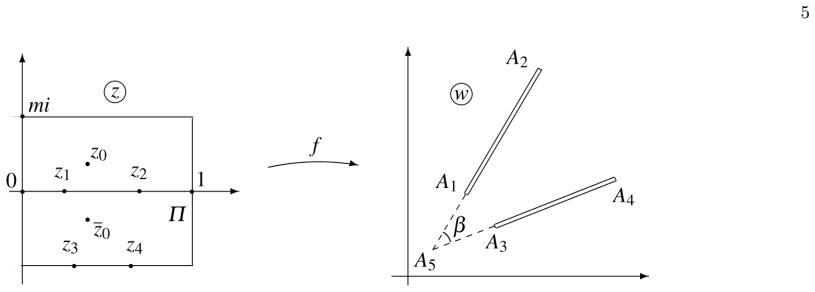
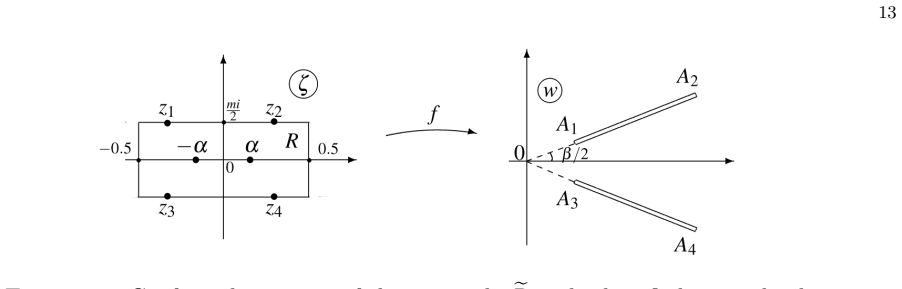
The load-bearing object is the integral representation $$f(z)=C\int_0^z $e^{{\gamma\xi}}$\frac{\prod_{k=1}^4\$\sigma$(\xi-z_k)}{\$sigma^{2}$(\xi-z_0)\$sigma^{2}$(\xi-\bar z_0)}\,d\xi+C_1,$$ where $\sigma$ is the Weierstrass $\sigma$-function, $z_k$ are preimages of the slit endpoints, and $z_0$ is the preimage of infinity. The paper writes the time derivative of the family as $h=\dot f/f'$, expresses $h$ through Weierstrass zeta functions and the accessory parameters $\gamma_k=\dot A_k/D_k$, and imposes the period conditions to obtain the evolution equations. Equation (40), for $y_0$, additionally uses a cited formula for $\partial\zeta/\partial\omega_2$.
What would settle it
Take a two-slit family with $\beta=\pi/2$ in which one slit moves uniformly while the other is fixed, integrate (36), (39), and (40) from the symmetric initial data, and compare the final module with an independent boundary-integral solver; a mismatch beyond the $10^{-6}$ level of Table 2 would refute the ODE system. Separately, compute $\partial\zeta(z;1,im)/\partial\omega_2$ by finite differences and compare it with Theorem 1's closed form.
Extended reading notes
Core claim
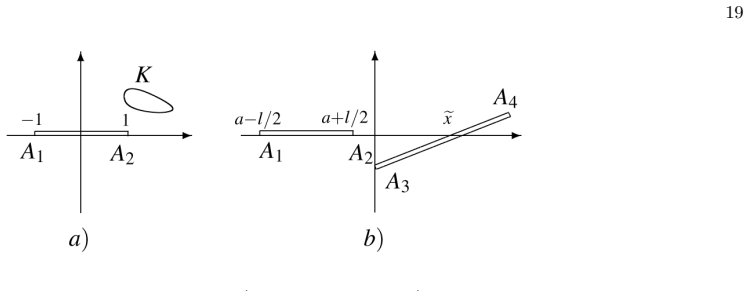
On the paper's own terms, the discovery is that the accessory parameters of the integral representation (8) satisfy the closed system (36), (39), (40), with $a=\log d_{-1}$ and $y_0=\operatorname{Im}z_0$, while the conformal module evolves by Corollary 1: $\dot m(t)=\pi\sum_{j=1}^4\gamma_j(t)$, where $\gamma_k=\dot A_k/D_k$ and $D_k=f''(z_k)$. This turns the conformal module of the exterior of two rectilinear slits into the solution of a Cauchy problem for ODEs, starting from explicit symmetric configurations. The same evolution equation also yields a monotonicity criterion for a slit of fixed length sliding along a line: the module decreases or increases according to which endpoint has larger $|f''|$, with symmetrization arguments deciding the comparison in the stated configurations.
Load-bearing premise
The derivation rests on a formula quoted from an earlier paper for how the Weierstrass zeta function changes when its period changes, together with the assumption that the angle between the two supporting lines stays fixed; if either fails, the ODE system need not describe the moving slits.
Editorial extensions
If this is right
- The conformal module of a two-slit exterior can be computed by numerical integration of a finite ODE system from explicitly known symmetric initial data, avoiding a full two-dimensional Laplace solve.
- Because the system does not require monotonicity of the moving domains, it covers families in which slits slide back and forth along their supporting lines, unlike the classical Loewner-Komatu setting.
- The identity $\dot m(t)=\pi\sum\gamma_j(t)$ gives a variational formula for capacity: the change of module is a linear functional of endpoint velocities with coefficients $1/f''(z_k)$.
- For a slit of fixed length sliding along a line, the module's monotonicity reduces to comparing $|f''|$ at the two endpoints; symmetrization decides this comparison in the configurations considered.
- The numerical experiments in Table 2 report agreement with an independent solver to about $10^{-6}$, so the method appears to be numerically viable as well as analytic.
Reading between the lines
- Because the derivation uses only the polar structure of $\dot f/f'$, the same continuation scheme may generalize to exteriors of several rectilinear slits or to polygonal slits; the paper does not make this claim.
- The rate formula could be used as a cheap sensitivity gradient for shape optimization of condensers, since the ODE solution already provides all quantities in $\sum\gamma_j$; the paper does not pursue optimization.
- A reader could test the one external input, Theorem 1, by finite-differencing $\zeta$ with respect to the period; this would isolate the part of the argument not proved here.
Signed reviews
Editorial analysis
A structured set of objections, weighed in public.
Referee Report
Summary. The manuscript studies the conformal module of planar ring domains whose complementary components are two disjoint rectilinear slits. It constructs an integral representation of the conformal map from a rectangle (annulus) to the exterior of the slits using Weierstrass sigma-functions (Theorem 2), derives a Loewner-type PDE for smooth one-parameter families of such maps with fixed slit angle (Theorem 3), and obtains a finite ODE system for the accessory parameters and the module (Theorem 4 and Corollary 1). The authors implement the ODE system in Mathematica, compare computed capacities against independent numerical results (Table 2), and prove monotonicity results for the module in Section 6 via symmetrization.
Significance. The paper proposes an explicit, parameter-free computational route to a classical conformal invariant, complementing existing Schwarz-Christoffel and boundary-integral techniques. The numerical agreement with an independent solver to about 1e-6 is a genuine strength, as is the reproducible Mathematica code. The derivation is largely coherent, and the use of polarization in Lemma 1 is elegant. However, the printed statement of Theorem 4 contains a serious inconsistency in equation (40), which must be corrected before the central claim can be accepted.
major comments (3)
- [§4, Eq. (40)] Equation (40) as printed is not the ODE for y0 that follows from the preceding complex equation. The denominator D = 4P(z0−\bar z0) − Σ_{k=1}^4 P(z0−zk) is complex in general, so the expression −Σ_k (Im P(z0−zk))/D \dot x_k is not real-valued, and the displayed formula cannot hold for a real y0. The correct equation, obtained from D \dot z0 = −Σ P(z0−zk)\dot zk + iB \dot m with \dot z0 = i\dot y0, is \dot y0 = −Im(Σ P(z0−zk)\dot zk / D) + Re(B\dot m / D). The Mathematica code in Step 4 implements this correct form via z0' == I*Im[(-Σ P z')/D] + I*Re[(B m')/D], not Eq. (40). Thus Theorem 4 as stated is internally inconsistent, and Table 2 validates the code, not the printed equation. This is a load-bearing error and must be fixed.
- [§4, Theorem 4 / §2, Theorem 1] The derivation of the ODE for y0 in Theorem 4 invokes the period-derivative formula for ∂ζ/∂ω2 stated as Theorem 1 from the authors' own paper [25], but no proof or precise statement of hypotheses is given here. Since this formula is an essential input to both the ODE system and the numerical code, the authors should either provide a self-contained proof in an appendix or quote the exact result with hypotheses and a precise reference. As it stands, a reader cannot verify the central derivation without consulting a separate paper.
- [§5, Table 2] The numerical validation compares only capacities, not the accessory parameters or the module m(t) along the trajectory. Since Theorem 4 is a statement about the full ODE system, a comparison of zk(t), z0(t), or m(t) against an independent solver would substantially strengthen the claim. The current evidence supports the integrated capacity but does not directly validate each component of the ODE system.
minor comments (5)
- [§4, Eq. (36)] The inequality '1 ≤ l ≤ n' should read '1 ≤ l ≤ 4'.
- [§5, Step 4] The initial condition z0[0] == -I*y00 has the opposite sign to the convention z0 = i y0, y0 ≥ 0 stated in §4; please clarify whether this is intentional and, if so, reconcile the statement of Theorem 4 with the code.
- [§5, Example 1] The sentence 'Since in the non-symmetric case we have Im z0 = 0 in (8)' appears to contain a sign error; the convention in §4 is Im z0 = y0 > 0.
- [§2, Theorem 1] When applying the period-derivative formula to ζ(z;1,2mi) in §4, the substitution ω2 = 2mi should be stated explicitly to avoid ambiguity about which periods enter ∂ζ/∂ω2.
- [References] Reference [24] is listed as a manuscript from August 2019; for reproducibility, the authors should provide a stable preprint or publication identifier or describe Nasser's algorithm in enough detail.
Circularity Check
No significant circularity; the ODE derivation is self-contained and numerical checks are external.
full rationale
The paper's central result (Theorem 4) is obtained by differentiating the periodicity and residue conditions of the integral representation (16), with the new quantities gamma_k(t)=Adot_k(t)/D_k(t) defined from local expansions (21)-(22) rather than fitted to any capacity value. The module relation mdot(t)=pi*sum(gamma_j(t)) follows algebraically from (31) via omega_2=2mi, and no target module is inserted as an input. Initial symmetric data come from explicit theta/sigma mappings (41) and equations (42)-(43), not from solving for the predicted capacities. Table 2 compares computed capacities with an independent numerical solver (Nasser's MATLAB algorithm), so the numerical 'prediction' is not forced by a fitted parameter. The only self-citation in the derivation chain is Theorem 1, quoted from [25], supplying the period-derivative partial zeta / partial omega_2 used in (40); it is a technical, parameter-free lemma with stated assumptions that do not include the slit-module result, and it is not equivalent to the target theorem. Even the reviewer's concern that printed equation (40) may not match the code's complex arithmetic is a correctness/typo issue, not a circularity, because the computation still tests the derived ODE structure rather than an input to it. Accordingly, no circular step is exhibited.
Assumptions & free parameters
assumptions (6)
- standard math Elliptic function identities including σ(z+ω) transformation, ω2η1 - ω1η2 = 2πi, and (6) linking σ and theta functions
- standard math Riemann-Schwarz reflection principle extends f to a meromorphic function on C with periods 1 and 2mi
- domain assumption Theorem 1: explicit partial derivatives of ζ(z) with respect to periods, cited from [25]
- domain assumption Smooth dependence of the one-parameter family f(z,t) and the constancy of the angle β between the two slit-supporting lines
- standard math Dubinin's polarization theorem [12, thrm 1.2]
- domain assumption Closed-form mappings for the symmetric case from [23]
Cite this review
Pith. "Pith review of Conformal module of the exterior of two rectilinear slits." pith.science (2026). https://pith.science/paper/GUAA5GI7
@misc{pith2026190802459,
  author       = {Pith},
  title        = {Pith review of: Conformal module of the exterior of two rectilinear slits},
  year         = {2026},
  howpublished = {\url{https://pith.science/paper/GUAA5GI7}},
  note         = {Machine review of arXiv:1908.02459}
}
read the original abstract
We study moduli of planar ring domains whose complements are linear segments and establish formulas for their moduli in terms of the Weierstrass elliptic functions. Numerical tests are carried out to illuminate our results.
Figures
Figures from the paper (1 more)
Forward citations
Cited by 1 Pith paper
-
Computation of conformal invariants
A boundary integral equation method computes conformal capacity, hyperbolic capacity, and elliptic capacity for a wide class of planar doubly connected domains, with relative errors near 1e-14 on smooth test cases.
Reference graph
Works this paper leans on
-
[25]
Nasyrov, Uniformization of One-Parametric Families of Complex Tori
S.R. Nasyrov, Uniformization of One-Parametric Families of Complex Tori. Russian Ma thematics, 2017, Vol. 61, No. 8, 36–45
work page 2017
-
[1]
M. Abramowitz and I. A. Stegun, Handbook of mathematical functions with formulas, graphs, and mathematical tables. National Bureau of Standards Applied Ma thematics Series, 55 For sale by the Superintendent of Documents, U.S. Government Printing Office , Washington, D.C. 1964 xiv+1046 pp
work page 1964
-
[2]
Akhiezer, Elements of the Theory of Elliptic Functions
N.I. Akhiezer, Elements of the Theory of Elliptic Functions. Transl. of Mathematica l Monographs, vol. 79, American Mathematical Soc., RI, 1990
work page 1990
-
[3]
Aleksandrov, Parametric continuations in the theory of univalent functions
I.A. Aleksandrov, Parametric continuations in the theory of univalent functions. Nau ka, Moscow, 1976 (Russian)
work page 1976
-
[4]
D. Betsakos, K. Samuelsson, and M. Vuorinen, The computation of capacity of planar con- densers. Publ. Inst. Math. (Beograd) (N.S.) 75(89) (2004), 233 –252
work page 2004
-
[5]
S. Bezrodnykh, A. Bogatyrev, S. Goreinov, O. Grigoriev, H. H akula, and M. Vuorinen : On capacity computation for symmetric polygonal condensers. J. Comput. Appl. Math. 361 (2019), 271–282, https://doi.org/10.1016/j.cam.2019.03.030
-
[6]
M.D. Contreras, S. Diaz-Madrigal, and P. Gumenyuk, Loewner theory in annulus I: Evolution families and differential equations. Trans. Amer. Math. Soc. 365 (2 013), 2505–2543
-
[7]
M.D. Contreras, S. Diaz-Madrigal, and P. Gumenyuk, Loewner theory in annulus II: Loewner chains. Analysis and Mathematical Physics, 2011, Volume 1, Issue 4 , 351–385
work page 2011
Show all 31 references
-
[8]
Crowdy, Schwarz-Christoffel mappings to unbounded multiply connected po lygonal regions
D. Crowdy, Schwarz-Christoffel mappings to unbounded multiply connected po lygonal regions. Math. Proc. Cambridge Philos. Soc. 142 (2007), no. 2, 319–339
2007
-
[9]
DeLillo, A.R
T.K. DeLillo, A.R. Elcrat, and J.A. Pfaltzgraff, Schwarz–Christoffel Mapping of the Annu- lus. SIAM Rev., 2001, 43(3), 469–477. 20 D. DAUTOV A, S. NASYROV, AND M. VUORINEN
2001
-
[10]
DeLillo, T.A
T.K. DeLillo, T.A. Driscoll, A.R. Elcrat, and J.A. Pfaltzgr aff, Computation of Multiply Connected Schwarz-Christoffel Maps for Exterior Domains. Comp utational Methods and Function Theory. 2006, Volume 6, Issue 2, pp 301–315
2006
-
[11]
Driscoll and L.N
T.A. Driscoll and L.N. Trefethen, Schwarz-Christoffel mapping. Cambridge Monographs on Applied and Computational Mathematics, 8. Cambridge University Pr ess, Cambridge, 2002. xvi+132 pp
2002
-
[12]
Dubinin, Symmetrization in the geometric theory of functions of a complex va riable
V.N. Dubinin, Symmetrization in the geometric theory of functions of a complex va riable. Russian Mathematical Surveys, 1994, 49:1, 1–79
1994
-
[13]
Dubinin, Condenser capacities and symmetrization in geometric function the ory
V.N. Dubinin, Condenser capacities and symmetrization in geometric function the ory. Translated from the Russian by Nikolai G. Kruzhilin, Springer, Basel, 2014, xii+34 4
2014
-
[14]
Dubinin and M
V.N. Dubinin and M. Vuorinen, On conformal moduli of polygonal quadrilaterals. Israel J. Math. 171, 111–125 (2009)
2009
-
[15]
Garnett, D.E
J.B. Garnett, D.E. Marshall, Harmonic measure. Reprint of the 2005 original. New Mathematical Monographs, 2. Cambridge University Press, Cambridge, 2008. xv i+571 pp
2005
-
[16]
Goluzin, On the parametric representation of functions univalent in a ring
G.M. Goluzin, On the parametric representation of functions univalent in a ring. M at. Sb. (N.S.), 29(71):2 (1951), 469–476 (Russian)
1951
-
[17]
Goluzin, Geometric Theory of Functions of a Complex Variable
G.M. Goluzin, Geometric Theory of Functions of a Complex Variable. Translations o f Mathematical Monographs, AMS, 1969
1969
-
[18]
Hakula, A
H. Hakula, A. Rasila and M. Vuorinen, On moduli of rings and quadrilaterals: algorithms and experiments. SIAM J. Sci. Comput. 33 (2011), no. 1, 279–302
2011
-
[19]
Hakula, A
H. Hakula, A. Rasila, and M. Vuorinen, Conformal modulus and planar domains with strong singularities and cusps. Electron. Trans. Numer. Anal. 48 (2018), 462–478
2018
-
[20]
Henrici, Applied and Computational Complex Analysis, Vol
P. Henrici, Applied and Computational Complex Analysis, Vol. 3: Discrete Fourier Analysis, Cauchy Integrals, Construction of Conformal Maps, Univalent Functions . Wiley, New York, 1986
1986
-
[21]
Komatu, Untersuchungen ¨ uber konforme Abbildung zweifach zusammenh¨angender Bereiche
Yu. Komatu, Untersuchungen ¨ uber konforme Abbildung zweifach zusammenh¨angender Bereiche. Proc. Phys., Math. Soc. Japan 25(1943), 1–42
1943
-
[22]
Komatu, Darstellungen der in einem Kreisringe analytischen Funktionen nebst den Anwendun- gen auf konforme Abbildung ¨ uber Polygonalringgebiete
Yu. Komatu, Darstellungen der in einem Kreisringe analytischen Funktionen nebst den Anwendun- gen auf konforme Abbildung ¨ uber Polygonalringgebiete. Jap. J. Ma th. 19 (1945), 203-215 (German)
1945
-
[23]
Koppenfels and F
W. Koppenfels and F. Stallmann, Praxis der konformen Abbildung. Berlin: Springer, 1959 (German)
1959
-
[24]
Nasser and M
M. Nasser and M. Vuorinen, Computation of conformal invariants. Manuscript, August 2019
2019
-
[26]
Nasyrov, Families of elliptic functions and uniformization of complex tori with a un ique point over infinity
S.R. Nasyrov, Families of elliptic functions and uniformization of complex tori with a un ique point over infinity. Probl. Anal. Issues Anal., 2018, Vol. 7(25):2, 98–111
2018
-
[27]
Nasyrov, Uniformization of Simply-Connected Ramified Coverings of the Spher e by Rational Functions
S.R. Nasyrov, Uniformization of Simply-Connected Ramified Coverings of the Spher e by Rational Functions. Lobachevskii Journal of Mathematics. 2018, V.39, No .2 252–258
2018
-
[28]
Olver, D.W
F.W.J. Olver, D.W. Lozier, R.F. Boisvert, and Ch.W.Clark (eds.) NIST Handbook of Math- ematical Functions. U.S. Department of Commerce, National Inst itute of Standards and Technology, Washington, DC; Cambridge University Press, Cambridge, 2010. xv i+951 pp
2010
-
[29]
Papamichael and N
N. Papamichael and N. Stylianopoulos, Numerical conformal mapping. Domain decomposition and the mapping of quadrilaterals. World Scientific Publishing Co. Pte. Ltd., Hackensack, NJ, 2010. xii+229 pp
2010
-
[30]
Reinhardt, P.L
W.P. Reinhardt, P.L. W alker Digital Library of Mathematical functions. Chapter 20. Theta Functions. https://dlmf.nist.gov/20
-
[31]
Reinhardt, P.L
W.P. Reinhardt, P.L. W alker Digital Library of Mathematical functions. Chapter 23. Weierstra ss Elliptic and Modular Functions. https://dlmf.nist.gov/23. 21 Kazan Federal University, Kazan, Russia E-mail address , dautovadn@gmail.com: dautovadn@gmail.com Kazan Federal Univers...
Reviewed August 14, 2026 · model on record in the stance chip above.
Discussion (0). Continue with ORCID to comment.