Development of an RPC-based gaseous photodetector with picosecond resolution
Pith reviewed 2026-05-20 04:13 UTC · model grok-4.3
The pith
An algorithm suppresses photon feedback in a gaseous photodetector to enable single-electron discrimination and restore picosecond timing.
A machine-rendered reading of the paper's core claim, the machinery that carries it, and where it could break.
Core claim
The author establishes that photon feedback can be efficiently suppressed with a dedicated algorithm when combined with single-versus-multiple electron discrimination and high-frequency signal readout. This combination mitigates the time resolution degradation seen in earlier beam tests of the GasPM. In parallel, cosmic-ray testing qualifies a LaB6 photocathode as resistant to damage from ions drifting backward, making it suitable for future prototypes.
What carries the argument
The photon feedback suppression algorithm applied to signals from the photocathode-resistive plate chamber combination, together with single-versus-multiple electron discrimination.
If this is right
- Restored time resolution allows the GasPM to suppress beam-induced backgrounds in electromagnetic calorimeters.
- Single-versus-multiple electron discrimination improves handling of signals with different strengths in particle detection.
- The LaB6 photocathode supports more durable operation by resisting ion-induced damage in ongoing tests.
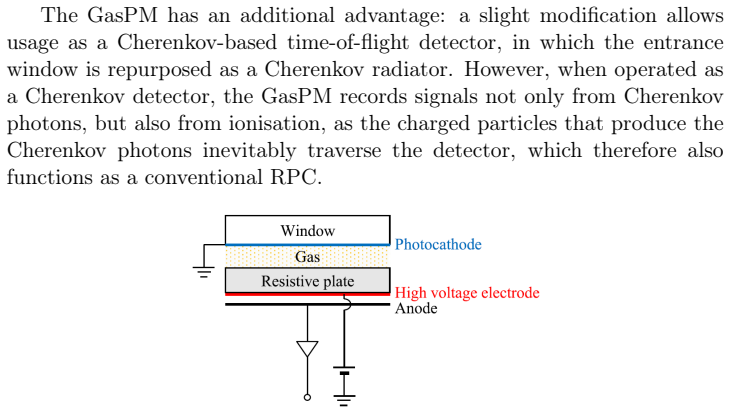
- Pairing the detector with a radiator enables precise charged-particle identification via Cherenkov radiation.
- The overall design remains scalable and cost-effective for large detector systems in particle physics.
Where Pith is reading between the lines
- The feedback suppression method could be adapted to other gaseous detectors that suffer similar secondary-signal problems.
- If the upcoming beam test succeeds, the technology may find use in timing applications at other high-energy physics facilities.
- The discrimination approach might be combined with different gas mixtures to further optimize performance.
Load-bearing premise
The main cause of earlier time resolution degradation is ultraviolet photon emission from gas excitations, and the new suppression algorithm plus discrimination method will fix it without other factors becoming limiting.
What would settle it
A beam test of the improved GasPM prototype that shows no recovery of picosecond time resolution or continued presence of secondary signals after applying the suppression algorithm would falsify the central claim.
Figures








read the original abstract
This experimental particle-physics thesis reports the latest developments on the GasPM, a novel gaseous photodetector aimed at suppressing beam-induced backgrounds in the electromagnetic calorimeter for a potential upgrade of the Belle~II experiment. The GasPM technology is based on combining a photocathode with a resistive-plate chamber offering high efficiency, excellent time resolution, and cost-effective scalability. A further advantage is that, combined with a radiator, the GasPM offers precise Cherenkov-based charged-particle identification. As part of a project launched in 2017, this work aims at addressing the degradation in time resolution observed in a previous beam test over what was achieved earlier with laser light. I focus specifically on ultraviolet-photon emission during excitation and de-excitation of the gas molecules, which leads to a secondary signal that in turn spoils time resolution (photon feedback). I design and execute an improved beam test that, along with several configuration changes, newly introduces single-vs-multiple electron discrimination and high-frequency signal readout. In addition, I probe through a cosmic-ray test the quantum efficiency of a new LaB$_6$ photocathode resistant to damage from ions drifting backwards, for use in future beam tests. The principal results are the development of an algorithm to efficiently suppress photon feedback; a preliminary calibration of a novel digitiser; the achievement of discrimination between single- and multiple-electron events; and an early qualification of a LaB$_6$ photocathode. These results are being prepared for showing at the 7th International Workshop on New Photon Detectors organized in Bologna in December 2025 and pave the way for an upcoming beam test of an improved GasPM prototype.
Editorial analysis
A structured set of objections, weighed in public.
Referee Report
Summary. The manuscript reports experimental developments on the GasPM, an RPC-based gaseous photodetector intended for background suppression and Cherenkov PID in a potential Belle II electromagnetic calorimeter upgrade. It identifies UV-photon emission from gas excitation/de-excitation as the source of photon feedback that degraded time resolution in prior beam tests, introduces an algorithm for feedback suppression together with single-versus-multiple electron discrimination and high-frequency readout, and presents a cosmic-ray qualification of a LaB6 photocathode. The principal results are described as the development of the suppression algorithm, a preliminary digitiser calibration, successful single/multiple-electron discrimination, and early LaB6 photocathode qualification, all positioned as preparation for a future improved beam test.
Significance. If the quantitative performance claims are substantiated, the work would represent incremental but useful progress toward scalable, high-time-resolution gaseous photodetectors with ion-resistant photocathodes. The combination of feedback suppression, electron-number discrimination, and LaB6 qualification addresses known practical limitations in gaseous detectors and could inform designs for future collider upgrades requiring picosecond timing and PID.
major comments (2)
- [Abstract] Abstract: the central claim that the new algorithm and configuration changes efficiently suppress photon feedback and restore time resolution rests on an unverified assumption that UV-photon feedback was the dominant cause of prior degradation. No direct isolation of the mechanism (e.g., gas-mixture variation, pressure dependence, or controlled comparison isolating photon vs. ion feedback) is described, leaving open the possibility that electronics bandwidth, photocathode non-uniformity, or other factors dominate.
- [Abstract] Abstract and results description: no quantitative before/after comparison of time resolution, suppression efficiency, or discrimination performance (with error bars or statistical significance) is provided on the improved beam-test dataset. Without these metrics it is impossible to evaluate whether the reported algorithm and discrimination method actually mitigate the identified problem or introduce new jitter sources.
minor comments (2)
- [Abstract] The abstract lists principal results without any numerical values, efficiencies, or resolution figures; including at least the achieved time resolution, suppression factor, or discrimination purity would strengthen the summary.
- Notation for the LaB6 photocathode (LaB$_6$) is clear, but the manuscript should explicitly state the cosmic-ray test conditions (rate, gas mixture, voltage) when reporting the quantum-efficiency qualification.
Simulated Author's Rebuttal
We thank the referee for the thorough review and valuable feedback on our manuscript. We address each major comment below and will make revisions to better align the abstract and results description with the preparatory nature of the current work.
read point-by-point responses
-
Referee: [Abstract] Abstract: the central claim that the new algorithm and configuration changes efficiently suppress photon feedback and restore time resolution rests on an unverified assumption that UV-photon feedback was the dominant cause of prior degradation. No direct isolation of the mechanism (e.g., gas-mixture variation, pressure dependence, or controlled comparison isolating photon vs. ion feedback) is described, leaving open the possibility that electronics bandwidth, photocathode non-uniformity, or other factors dominate.
Authors: We agree that the manuscript does not include new controlled experiments that directly isolate UV-photon feedback from other potential sources such as electronics bandwidth or photocathode effects. The focus on photon feedback is motivated by our prior beam-test observations of degraded time resolution relative to laser tests, combined with established understanding of gas excitation processes. We will revise the abstract to present the algorithm as a targeted suppression method based on that prior identification, explicitly noting that full verification through mechanism-isolation studies is planned for the upcoming beam test. revision: yes
-
Referee: [Abstract] Abstract and results description: no quantitative before/after comparison of time resolution, suppression efficiency, or discrimination performance (with error bars or statistical significance) is provided on the improved beam-test dataset. Without these metrics it is impossible to evaluate whether the reported algorithm and discrimination method actually mitigate the identified problem or introduce new jitter sources.
Authors: The current manuscript reports the design of the suppression algorithm, the single-versus-multiple electron discrimination technique, high-frequency readout implementation, digitiser calibration, and cosmic-ray qualification of the LaB6 photocathode. These constitute preparatory developments for an improved beam test that has not yet taken place. No quantitative before/after metrics from that test are available in this work. We will revise the abstract and results sections to remove any implication of completed performance restoration and to state clearly that quantitative comparisons with statistical details will be presented after the forthcoming beam test. revision: yes
Circularity Check
No significant circularity: experimental results with no derivations or self-referential reductions
full rationale
This is an experimental thesis reporting hardware development, configuration changes, an algorithm for photon-feedback suppression, single-vs-multiple electron discrimination, and LaB6 photocathode qualification via cosmic-ray and beam tests. No equations, derivations, fitted parameters, or predictions appear in the provided text. Claims rest on direct empirical observations rather than any chain that reduces by construction to its own inputs or prior self-citations. The guiding hypothesis about UV-photon feedback is stated as motivation but is not used to define or force any result; external replication of the tests can falsify or confirm the outcomes independently.
Axiom & Free-Parameter Ledger
Reference graph
Works this paper leans on
-
[1]
Steven Weinberg. A model of leptons.Phys. Rev. Lett., 19:1264, 1967
work page 1967
-
[2]
Sheldon L. Glashow. Partial-symmetries of weak interactions.Nuclear Physics, 22:579, 1961
work page 1961
-
[3]
Weak and Electromagnetic Interactions.Conf
Abdus Salam. Weak and Electromagnetic Interactions.Conf. Proc. C, 680519:367, 1968
work page 1968
-
[4]
F. Englert and R. Brout. Broken Symmetry and the Mass of Gauge Vector Mesons.Phys. Rev. Lett., 13:321, 1964
work page 1964
-
[5]
Peter W. Higgs. Broken Symmetries and the Masses of Gauge Bosons. Phys. Rev. Lett., 13:508, 1964
work page 1964
-
[6]
PhD thesis, University of Trieste, 2022.https://arts
RiccardoManfredi.Measurement of the properties ofB+ →ρ +ρ0 decays at Belle II. PhD thesis, University of Trieste, 2022.https://arts. units.it/handle/11368/3060398
work page 2022
-
[7]
Proof of the TCP Theorem.Annals of Physics, 2:1, 1957
Gerhart Lüders. Proof of the TCP Theorem.Annals of Physics, 2:1, 1957
work page 1957
-
[8]
Wolfgang Pauli. Exclusion Principle, Lorentz Group, and Reversal of Space-time and Charge.Niels Bohr and the Development of Physics, page 1, 1955
work page 1955
-
[9]
C. B. Adams et al. Axion dark matter, 2023
work page 2023
-
[10]
S. Navas et al. Review of particle physics.Phys. Rev. D, 110(3):030001, 2024
work page 2024
-
[11]
M. Gell-Mann and M. Lévy. The axial vector current in beta decay.Il Nuovo Cimento, 16:705, 1960
work page 1960
-
[12]
Unitary Symmetry and Leptonic Decays.Phys
Nicola Cabibbo. Unitary Symmetry and Leptonic Decays.Phys. Rev. Lett., 10:531, 1963
work page 1963
-
[13]
S. L. Glashow, J. Iliopoulos, and L. Maiani. Weak interactions with lepton-hadron symmetry.Phys. Rev. D, 2:1285, 1970. 68
work page 1970
-
[14]
CP-Violation in the Renor- malizableTheoryofWeakInteraction.Prog
Makoto Kobayashi and Toshihide Maskawa. CP-Violation in the Renor- malizableTheoryofWeakInteraction.Prog. Theor. Phys., 49:652, 1973
work page 1973
-
[15]
R. L. Workman and Others. Review of Particle Physics.PTEP, 2022:083C01, 2022
work page 2022
-
[16]
Parametrization of the kobayashi-maskawa matrix
Lincoln Wolfenstein. Parametrization of the kobayashi-maskawa matrix. Phys. Rev. Lett., 51:1945, 1983
work page 1945
- [17]
- [18]
-
[19]
Accelerator design at SuperKEKB.Prog
Yukiyoshi Ohnishi et al. Accelerator design at SuperKEKB.Prog. Theo. Exp. Phys., page 03A011, 2013
work page 2013
-
[20]
Yukiyoshi Ohnishi, Tetsuo Abe, Toshikazu Adachi, Kazunori Akai, Ya- sushi Arimoto, Kiyokazu Ebihara, Kazumi Egawa, John Flanagan, Hi- toshi Fukuma, Yoshihiro Funakoshi, Kazuro Furukawa, Takaaki Fu- ruya, Naoko Iida, Hiromi Iinuma, Hoitomi Ikeda, Takuya Ishibashi, Masako Iwasaki, Tatsuya Kageyama, Susumu Kamada, Takuya Kami- tani, Ken-ichi Kanazawa, Mitsuo...
work page 2013
-
[21]
P. Oddone. Detector Considerations.in D. H. Stork, proceedings of Workshop on Conceptual Design of a Test Linear Collider: Possibilities for a BB Factory, page 423, 1987
work page 1987
-
[22]
S. Eidelman, A. Nefediev, P. Pakhlov, and V. Zhukova. Superfactory of bottomed hadrons belle ii, 12 2020
work page 2020
-
[23]
Beam-beam issues for colliding schemes with large Piwinski angle and crabbed waist
Paolo Raimondi et al. Beam-beam issues for colliding schemes with large Piwinski angle and crabbed waist. 2007. 69
work page 2007
-
[24]
D. R. Douglas, J. Kewisch, and R. C. York. Betatron Function Parame- terization of Beam Optics Including Acceleration. InProceedings of the 1988 Linear Accelerator Conference, (1988)
work page 1988
-
[25]
S. Verdu-Andres. Luminosity Geometric Reduction Factor from Collid- ing Bunches with Different Lengths. BNL Report BNL-114409-2017-IR, (2017)
work page 2017
- [26]
- [27]
-
[28]
V. Aulchenko et al. Electromagnetic calorimeter for belle ii.J. Phys. Conf. Ser., 587(1):012045, 2015
work page 2015
-
[29]
I Adachi, TE Browder, P Križan, S Tanaka, Y Ushiroda, Belle II Col- laboration, et al. Detectors for extreme luminosity: Belle ii.Nuclear Instruments and Methods in Physics Research Section A: Accelerators, Spectrometers, Detectors and Associated Equipment, 907:46–59, 2018
work page 2018
-
[30]
Milesi, Marco, Tan, Justin, and Urquijo, Phillip. Lepton identification in belle ii using observables from the electromagnetic calorimeter and precision trackers.EPJ Web Conf., 245:06023, 2020
work page 2020
-
[31]
Zachary J. Liptak et al. Measurements of beam backgrounds in Su- perKEKB Phase 2.Nucl. Instrum. Meth. A, 1040:167168, 2022
work page 2022
-
[32]
Christopher Hearty. The ecl: an overview. Presentation slides, 2023. Belle II Physics Week, KEK, Japan
work page 2023
-
[33]
Charlebois, Réjean Fontaine, and Jean-Francois Pratte
Frédéric Nolet, Samuel Parent, Nicolas Roy, Marc-Olivier Mercier, Serge A. Charlebois, Réjean Fontaine, and Jean-Francois Pratte. Quenching circuit and spad integrated in cmos 65 nm with 7.8 ps fwhm single photon timing resolution.Instruments, 2(4), 2018
work page 2018
-
[34]
Kodai Matsuoka. Performance of the mcp-pmts of the top counter in the first beam operation of the belle ii experiment. InProceedings of the 5th International Workshop on New Photon-Detectors (PD18), page 011020, 2019
work page 2019
-
[35]
T. M. Conneely, M. W. U. van Dijk, C. D’Ambrosio, N. Brook, L. Castillo García, E. N. Cowie, D. Cussans, R. Forty, C. Frei, R. Gao, T. Gys, N. Harnew, J. Howorth, J. Lapington, J. Milnes, D. Piedi- grossi, and Slatter. The torch pmt: a close packing, multi-anode, long life mcp-pmt for cherenkov applications.Journal of Instrumentation, 10(05):C05003, May 2015. 70
work page 2015
-
[36]
G. N. Gol’tsman, O. Okunev, G. Chulkova, A. Lipatov, A. Semenov, K. Smirnov, B. Voronov, A. Dzardanov, C. Williams, and Roman Sobolewski. Picosecond superconducting single-photon optical detec- tor.Applied Physics Letters, 79(6):705–707, 08 2001
work page 2001
-
[37]
Boris Korzh et al. Demonstration of sub-3 ps temporal resolution with a superconducting nanowire single-photon detector.Nature Photon., 14(4):250–255, 2020
work page 2020
-
[38]
L. Sohl, S. Aune, J. Bortfeldt, F. Brunbauer, C. David, D. Desforge, G. Fanourakis, M. Gallinaro, F. García, I. Giomataris, T. Gustavs- son, C. Guyot, F.J. Iguaz, M. Kebbiri, K. Kordas, P. Legou, J. Liu, M. Lupberger, I. Manthos, H. Müller, V. Niaouris, E. Oliveri, T. Pa- paevangelou, K. Paraschou, M. Pomorski, F. Resnati, L. Ropelewski, D. Sampsonidis, T...
work page 2020
-
[39]
Shawn Shin et al. Advances in the Large Area Picosecond Photo- Detector (LAPPDTM): 8”×8” MCP-PMT with Capacitively Coupled Readout.JINST, 19(06):P06040, 2024
work page 2024
-
[40]
K. Matsuoka, R. Okubo, and Y. Adachi. Demonstration of a 25- picosecond single-photon time resolution with gaseous photomultipli- cation.Nuclear Instruments and Methods in Physics Research Section A: Accelerators, Spectrometers, Detectors and Associated Equipment, 1053:168378, 2023
work page 2023
-
[41]
R. Santonico and R. Cardarelli. Development of resistive plate counters. Nuclear Instruments and Methods in Physics Research, 187(2):377–380, May 1981
work page 1981
-
[42]
T. Francke and V. Peskov. Photosensitive gaseous detectors and their applications.Nuclear Instruments and Methods in Physics Research Section A: Accelerators, Spectrometers, Detectors and Associated Equip- ment, 525(1):1–5, 2004. Proceedings of the International Conference on Imaging Techniques in Subatomic Physics, Astrophysics, Medicine, Bi- ology and Industry
work page 2004
-
[43]
R.Okuboetal. Developmentofapicosecond-timingCherenkovdetector using gaseous photomultiplification.JINST, 20(08):C08017, 2025
work page 2025
-
[44]
Werner Riegler, Christian Lippmann, and Rob Veenhof. Detector physics and simulation of resistive plate chambers.Nuclear Instruments 71 and Methods in Physics Research Section A: Accelerators, Spectrome- ters, Detectors and Associated Equipment, 500(1):144–162, 2003. NIMA Vol 500
work page 2003
-
[45]
Research on discharges in micropattern and small gap gaseous detectors
V Peskov and P Fonte. Research on discharges in micropattern and small gap gaseous detectors.arXiv preprint arXiv:0911.0463, 2009
work page internal anchor Pith review Pith/arXiv arXiv 2009
-
[46]
Luca Macchiarulo, Isar Mostafanezhad, Gary Varner, Benjamin Rotter, Dean Uehara, Gang Liu, and Christopher Chock. Design improvements and first results for the revision 3 of aardvarc waveform sampling system on chip. In2020 IEEE Nuclear Science Symposium and Medical Imaging Conference (NSS/MIC), pages 1–2, 2020
work page 2020
-
[47]
D. A. Stricker-Shaver, S. Ritt, and B. J. Pichler. Novel Calibration Method for Switched Capacitor Arrays Enables Time Measurements with Sub-Picosecond Resolution.IEEE Trans. Nucl. Sci., 61(6):3607– 3617, 2014
work page 2014
-
[48]
81150A Pulse Function Arbitrary Noise Generator, 2018
KEYSIGHT. 81150A Pulse Function Arbitrary Noise Generator, 2018. https://shorturl.at/bHAXQ
work page 2018
-
[49]
PSPL2600C Datasheet, 2017.https://www.tek.com/en/ datasheet/pspl2600c-pulse-generator-datasheet
Tektronix. PSPL2600C Datasheet, 2017.https://www.tek.com/en/ datasheet/pspl2600c-pulse-generator-datasheet
work page 2017
-
[50]
Operational Status of Photon Factory Light Sources
Tohru Honda, Yukinori Kobayashi, Chikaori Mitsuda, Shinya Naga- hashi, Ryota Takai, and Hiroyuki Takaki. Operational Status of Photon Factory Light Sources. In12th International Particle Accelerator Con- ference, 8 2021
work page 2021
-
[51]
Easiroc, an easy & versatile readout device for sipm
Stéphane Callier, Christophe Dela Taille, Gisèle Martin-Chassard, and Ludovic Raux. Easiroc, an easy & versatile readout device for sipm. Physics Procedia, 37:1569–1576, 2012. Proceedings of the 2nd Inter- national Conference on Technology and Instrumentation in Particle Physics (TIPP 2011)
work page 2012
-
[52]
S J Mroczkowski. Electron emission characteristics of sputtered lan- thanum hexaboride.Journal of Vacuum Science and Technology, A (Vacuum, Surfaces and Films); (USA), 9:3, 05 1991. 72 Acknowledgements I acknowledge KEK and Nagoya University for hosting me during my stay in Japan, the Belle II group at INFN Trieste for its financial support and hospitalit...
work page 1991
discussion (0)
Sign in with ORCID, Apple, or X to comment. Anyone can read and Pith papers without signing in.