REVIEW 3 major objections 6 minor 115 references
Network-Level ISAC Design: State-of-the-Art, Challenges, and Opportunities
T0 review · 3 major / 6 minor · reviewed 2026-08-16 · deepseek-v4-flash
Pith's one-line read Network-level ISAC—cooperating base stations sharing signals and data—extends link-level joint sensing and communication to network scale, with gains gated by synchronization.
desk verdict A useful organizing survey of network-level ISAC; the technical core is mostly the authors' own prior results, and one unproven convexity claim in Sec. III-B should be fixed before publication. read the letter →
The pith
A machine-rendered reading of the paper's core claim, the machinery that carries it, and where it could break.
The reading
What carries the argument
The analysis is carried by three connected objects. First, the signal model (Eq. (1)) splits each node's transmit signal into communication and sensing precoded components, whose correlation structure distinguishes coordinated beamforming (uncorrelated signals across nodes) from joint-transmission CoMP (identical signals across nodes); this determines whether inter-node interference is noise or constructive gain. Second, the stochastic-geometry CRLB framework (Eqs. (13)–(18)) turns random base-station locations into expected localization bounds, producing the $\ln N$ and $\ln^2 N$ scaling laws that quantify the value of cooperation. Third, offset reciprocity (Eqs. (33)–(34)) states that the time and frequency offsets between nodes $n$ and $m$ measured at $n$ are the negatives of those measured at $m$, the identity that lets over-the-air synchronization recover the cooperative gain without external references. These objects jointly define the paper's design spectrum: cooperation level sets the synchronization and backhaul price, while the CRLB and reciprocity results set the sensing payoff.
What would settle it
Measure, in both directions, the time and frequency offsets between a pair of distributed ISAC nodes under non-line-of-sight and mobility conditions; if the measured offsets do not satisfy $\Delta t_{n,m} \approx -\Delta t_{m,n}$ and $\Delta f_{n,m} \approx -\Delta f_{m,n}$ at picosecond level, offset-reciprocity synchronization fails as described. Separately, collect base-station and target locations from a real deployment and compare the empirical localization error growth with the claimed $\ln^2 N$ and $\ln N$ curves; a systematic mismatch would show that the stochastic-geometry scaling laws do not transfer to practice.
Extended reading notes
Core claim
The paper's central claim, stated on its own terms, is that network-level ISAC significantly extends link-level ISAC through distributed cooperation, enabling coordinated sensing and communication at an unprecedented scale. The quantitative core is a set of scaling results: with base stations distributed as a Poisson point process, the Cramér-Rao lower bound for target localization falls as $\ln N$ for angle-of-arrival methods, $\ln^2 N$ for time-of-flight methods, and $a\ln^2 N + b\ln N$ for hybrid methods, and a hybrid scheme is reported to reduce localization error to 1.3% of the angle-only error and 28.8% of the time-only error at optimal deployments. The other load-bearing result is offset reciprocity: two nodes sensing the same objects see time and frequency offsets that are equal in magnitude and opposite in sign, which allows distributed ISAC nodes to synchronize without dedicated reference signals, with super-resolution estimation reported at roughly 10 ps. On communication, the paper reports that cooperative interference nulling enlarges the achievable sensing-communication spectral-efficiency region and that coherent joint transmission converts inter-node interference into constructive signal power at the price of phase-level synchronization.
Load-bearing premise
The quantitative conclusions rest on modeling assumptions—base-station and target locations follow random point processes, angle and distance measurement errors are independent, and offset reciprocity holds between real node pairs—and if any of these fail in a deployed network, the reported scaling laws and synchronization gains do not transfer.
Editorial extensions
If this is right
- If the scaling results hold, operators can choose cooperation density deliberately: adding nodes improves localization but with diminishing returns, and hybrid AOA/TOF estimation extracts the most accuracy from a given cluster.
- Per-node hardware can be simplified in networked ISAC because resolution and power combining come from spatial distribution rather than from large arrays or very high-rate converters at every node.
- Coherent joint transmission and coherent sensing are the high-gain regimes, but they require phase-level synchronization; until that is solved, non-coherent cooperation is the robust fallback.
- Backhaul capacity bounds cluster size through the constraint $R_c + eN \leq C_{\text{backhaul}}$, so cluster dimensioning becomes an explicit network design variable rather than an afterthought.
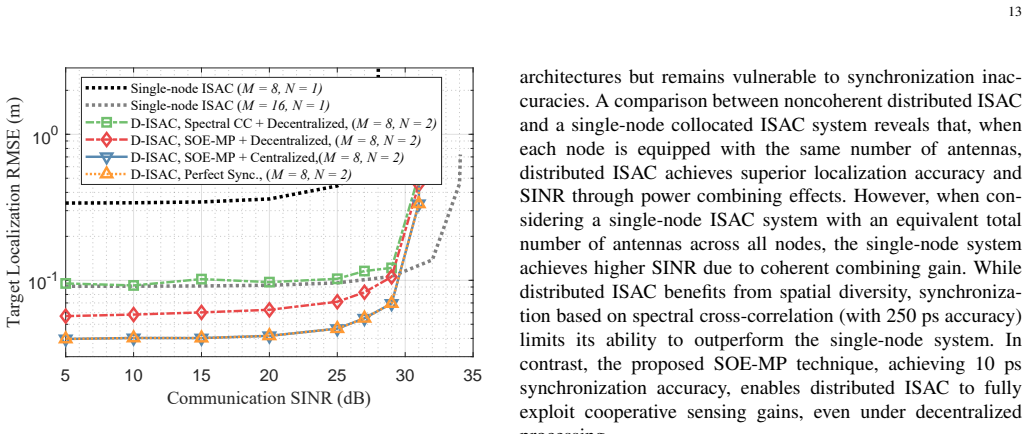
- Synchronization quality separates regimes: with coarse spectral cross-correlation (about 250 ps), distributed ISAC may not beat a single-node array with equal total antennas; with super-resolution estimation (about 10 ps), it does.
Reading between the lines
- Extension beyond the paper: offset reciprocity could serve as a calibration-free synchronization primitive embedded in any pair of ISAC nodes, with the reciprocity error itself monitored as a network health metric.
- Extension beyond the paper: the scaling-law comparison implies a deployment rule the paper does not state explicitly—under a fixed per-node power cap, AOA-based sensing favors a few concentrated sub-arrays, while TOF and hybrid sensing favor distributing antennas as thinly as possible.
- Extension beyond the paper: the sensing-communication ASE region could be turned into a dynamic scheduler that selects the cooperation level per resource block based on instantaneous backhaul load and synchronization quality, a natural extension of the convex-boundary search described in Section III-B.
Signed reviews
Editorial analysis
A structured set of objections, weighed in public.
Referee Report
Summary. The paper is a survey of network-level integrated sensing and communication (ISAC), the paradigm in which multiple base stations cooperate to provide sensing and communication services at scale. It reviews cooperation schemes and distributed architectures, presents stochastic-geometry-based performance analysis for interference management and cooperative ISAC, discusses distributed signaling designs for coherent and non-coherent operation, reviews over-the-air synchronization techniques for bi-static and distributed deployments, and lists open challenges. The paper draws substantially on the authors' own prior work for quantitative claims such as localization scaling laws and synchronization gains, and illustrates the main trade-offs with numerical examples.
Significance. If taken as a state-of-the-art overview, the paper is timely and useful. It provides a clear taxonomy of cooperation levels (Table I), a concise catalog of performance metrics (Table II), and a readable discussion of synchronization methods for distributed ISAC, an area that is often scattered across the literature. The paper also explicitly connects network-level ISAC to practical constraints such as backhaul, synchronization, and hardware. However, the survey's quantitative conclusions rest heavily on the authors' own prior results, and at least one load-bearing analytical claim (the convexity of the S-C performance boundary in Section III-B) is not supported by the text. There are also several technical inaccuracies in the mathematical presentation. The organizational value of the survey is real, but the manuscript needs revision before it can serve as a reliable reference.
major comments (3)
- [Section III-B, Eq. (19) and P1 (21)] The statement that "the S-C performance boundary is a convex region" is unsupported and, as stated, likely false. The feasible set defined by KL + J(Q-1) <= M_t with integer K, L, J, Q is discrete, and even the continuous relaxation is nonconvex because of the bilinear term KL. For example, with M_t = 4, the points (K,L,J,Q) = (4,1,1,1) and (1,4,1,1) both satisfy KL <= 4, but their convex combination (2.5,2.5,1,1) gives KL = 6.25 > 4. The mapping from allocation variables to the ASE pair is not shown to be concave, so the boundary-search method used to solve P1 and the trade-off trends in Fig. 4(a) are not justified by the given analysis. Please provide a proof under explicit assumptions, or replace the boundary-search argument with an exact or approximate method that does not rely on this convexity claim.
- [Section III-B, Eq. (19) and (21c)] The constraint J <= Jmax appears in the definition of the S-C ASE region and in the optimization problem, but the quantity Jmax is never defined anywhere in the manuscript. Without a definition, the problem formulation is incomplete and the reader cannot reproduce the optimization. Please define Jmax explicitly, or remove the constraint if it is not essential.
- [Section IV-B, Eq. (26)] The stated CRLB for non-coherent MIMO sensing, CRLB_nc = tr(F_nc^{-1}(Theta_nc)), is not the localization CRLB. Since Theta_nc includes the nuisance parameters b_R and b_I, the trace of the full inverse FIM also includes the variance of those nuisance parameters. The localization accuracy should be the trace of the appropriate sub-block of the inverse FIM, typically tr([F_nc^{-1}]_{1:2,1:2}) after ordering the position parameters first. Because this CRLB is used as the sensing objective in the signaling design problem (29), the expression should be corrected.
minor comments (6)
- [Section II-C, Eqs. (2)-(3)] There is a dimension mismatch: S_c^n is K x L, so E[S_c^n (S_c^m)^H] is K x K and cannot equal 0_{M_t x M_t} or I_{M_t x M_t}. The identity matrix in (3) should be I_K, and the text should clarify that the condition S_c^1 = ... = S_c^N is an assumption about the transmitted data, not a consequence of the covariance expression.
- [Section III-A2, Eq. (13)] The expression for F_A is garbled: the leading factor "cos^2 theta_i d_j^2 d_i^2" appears to be missing a fraction bar or other grouping, and the indices and symbols in the matrix entries are not defined carefully. Please check this equation against the cited derivation and rewrite it unambiguously.
- [Section III-B heading] The section heading "Interfernece Management" contains a typo and should read "Interference Management."
- [Section IV-B/IV-C] There are minor prose issues: "the optimal target localization necessitates a dedicated per-subcarrier signal design, ." has a stray comma before the period, and some sentences in Section IV-B are run-ons. A careful copyedit would improve readability.
- [Table III and Section III-C] The scaling laws in Table III (1/ln N, 1/ln^2 N, and hybrid) are presented without explicitly listing the modeling assumptions under which they hold, such as Poisson point process BS locations, independent AOA and TOF measurement errors, and ideal synchronization. Since these laws are used to compare localization methods and to draw conclusions about cooperative gain, the assumptions should be stated in or near the table.
- [Section V-B, Eqs. (33)-(34)] The offset reciprocity property is stated as an exact equality, but in practice it requires symmetric hardware and oscillator behavior between nodes. The manuscript should note that hardware asymmetries can break exact reciprocity, and that the cited method may need calibration in real deployments.
Circularity Check
No significant circularity: the paper is a survey that attributes quantitative results to prior work (including some by the same authors), and its new analytical content is an unsupported convexity assertion that is a correctness risk, not a circular reduction.
full rationale
Walking the derivation chain, the paper performs no new derivations; Section III presents metrics and scaling laws (Eqs. (10)-(18), Table III) as citations to prior work (e.g., [27], [28], [29], [59]), and Section V-B reviews offset reciprocity (Eqs. (33)-(34)) as a property introduced in [105]. The review does not fit any parameter and then relabel it as a prediction; each quantitative claim is either a properly attributed prior result or a qualitative synthesis. The heavy self-citation (e.g., [28], [29], [59], [105]) could raise a self-citation concern, but under the applicable rule a cited result is independent support when it is derived elsewhere under stated assumptions and is not used here to forbid alternatives; the survey does not invoke a uniqueness theorem or use the citations to suppress alternative explanations. The one genuinely problematic analytical step is Section III-B: 'It is not difficult to prove that the S-C performance boundary is a convex region, then the optimal total ASE can be obtained by searching the ASE of the boundary point' (after Eq. (21)). This is an omitted proof, and the bilinear constraint KL+J(Q-1)<=Mt makes convexity non-obvious; however, an unsupported or false lemma is a correctness risk, not circularity, because the assertion is not equivalent to the paper's input by construction. The stochastic-geometry assumptions (PPP, independent AOA/TOF errors, offset reciprocity) are assumptions imported from prior work and could fail in practice, but that is external validity risk, not an in-paper circular derivation. Overall, no load-bearing step reduces to its own input.
Assumptions & free parameters
assumptions (3)
- domain assumption Base station and target locations are modeled as Poisson point processes with assumed densities.
- domain assumption AOA and TOF measurement errors are uncorrelated and Gaussian.
- domain assumption Offset reciprocity holds for time and frequency offsets between reciprocal bi-static links in distributed ISAC.
Cite this review
Pith. "Pith review of Network-Level ISAC Design: State-of-the-Art, Challenges, and Opportunities." pith.science (2026). https://pith.science/paper/GVIGAOR2
@misc{pith2026250501295,
  author       = {Pith},
  title        = {Pith review of: Network-Level ISAC Design: State-of-the-Art, Challenges, and Opportunities},
  year         = {2026},
  howpublished = {\url{https://pith.science/paper/GVIGAOR2}},
  note         = {Machine review of arXiv:2505.01295}
}
read the original abstract
The ultimate goal of integrated sensing and communication (ISAC) deployment is to provide coordinated sensing and communication services at an unprecedented scale. This paper presents a comprehensive overview of network-level ISAC systems, an emerging paradigm that significantly extends the capabilities of link-level ISAC through distributed cooperation. We first examine recent advancements in network-level ISAC architectures, emphasizing various cooperation schemes and distributed system designs. The sensing and communication (S\&C) performance is analyzed with respect to interference management and cooperative S\&C, offering new insights into the design principles necessary for large-scale networked ISAC deployments. In addition, distributed signaling strategies across different levels of cooperation are reviewed, focusing on key performance metrics such as sensing accuracy and communication quality-of-service (QoS). Next, we explore the key challenges for practical deployment where the critical role of synchronization is also discussed, highlighting advanced over-the-air synchronization techniques specifically tailored for bi-static and distributed ISAC systems. Finally, open challenges and future research directions in network-level ISAC design are identified. The findings and discussions aim to serve as a foundational guideline for advancing scalable, high-performance, and resilient distributed ISAC systems in next-generation wireless networks.
Figures


Figures from the paper (4 more)


Reference graph
Works this paper leans on
-
[28]
Network-level integrated sensing and communication: Interference management and BS coor- dination using stochastic geometry,
K. Meng, C. Masouros, G. Chen, and F. Liu, “Network-level integrated sensing and communication: Interference management and BS coor- dination using stochastic geometry,” IEEE Trans. Wireless Commun. , vol. 23, no. 12, pp. 19 365–19 381, 2024. 15
2024
-
[1]
A survey on fundamental limits of integrated sensing and communication,
A. Liu et al. , “A survey on fundamental limits of integrated sensing and communication,” IEEE Commun. Surveys Tuts., vol. 24, no. 2, pp. 994–1034, Nov. 2022
2022
-
[2]
Sensing-assisted communica- tion in vehicular networks with intelligent surface,
K. Meng, Q. Wu, W. Chen, and D. Li, “Sensing-assisted communica- tion in vehicular networks with intelligent surface,” IEEE Trans. Veh. Technol., vol. 73, no. 1, pp. 876–893, 2023
2023
-
[3]
Integrating sensing and communi- cations for ubiquitous IoT: Applications, trends, and challenges,
Y . Cui, F. Liu, X. Jing, and J. Mu, “Integrating sensing and communi- cations for ubiquitous IoT: Applications, trends, and challenges,” IEEE Net., vol. 35, no. 5, pp. 158–167, Sep./Oct. 2021
2021
-
[4]
Performance of downlink and uplink integrated sensing and communications (ISAC) systems,
C. Ouyang, Y . Liu, and H. Yang, “Performance of downlink and uplink integrated sensing and communications (ISAC) systems,” IEEE Wireless Commun. Lett., vol. 11, no. 9, pp. 1850–1854, Sep. 2022
2022
-
[5]
3D multi-target localization via intelligent reflecting surface: Protocol and analysis,
M. Hua et al. , “3D multi-target localization via intelligent reflecting surface: Protocol and analysis,” IEEE Trans. Wireless Commun., 2024
2024
-
[6]
Integrated sensing and communications: Towards dual- functional wireless networks for 6G and beyond,
F. Liu, Y . Cui, C. Masouros, J. Xu, T. X. Han, Y . C. Eldar, and S. Buzzi, “Integrated sensing and communications: Towards dual- functional wireless networks for 6G and beyond,” IEEE J. Sel. Areas Commun., vol. 40, no. 6, pp. 1728–1767, Jun. 2022
2022
-
[7]
Cooperative ISAC Networks: Opportunities and Challenges,
K. Meng, C. Masouros, A. P. Petropulu, and L. Hanzo, “Cooperative ISAC Networks: Opportunities and Challenges,” IEEE Wireless Com- mun., pp. 1–8, 2024
2024
Show all 115 references
-
[8]
Integrated communication, localization, and sensing in 6G D-MIMO networks,
H. Guo et al., “Integrated communication, localization, and sensing in 6G D-MIMO networks,” IEEE Wireless Commun. , vol. 32, no. 2, pp. 214–221, Apr. 2025
2025
-
[9]
Multi-Node Multi-Band Cooperative Integrated Sensing and Communications: State-of-the-Art, Challenges and Opportunities,
H. Li et al., “Multi-Node Multi-Band Cooperative Integrated Sensing and Communications: State-of-the-Art, Challenges and Opportunities,” IEEE Wireless Commun., 2025
2025
-
[10]
Sensing as a service in 6G perceptive networks: A unified framework for ISAC resource allocation,
F. Dong et al. , “Sensing as a service in 6G perceptive networks: A unified framework for ISAC resource allocation,” IEEE Trans. Wireless Commun., vol. 22, no. 5, pp. 3522–3536, May. 2023
2023
-
[11]
High-resolution phased-subarray MIMO radar with grating lobe cancellation technique,
K. Han and S. Hong, “High-resolution phased-subarray MIMO radar with grating lobe cancellation technique,” IEEE Trans. Microw. Theory Techn., vol. 70, no. 5, pp. 2775–2785, May. 2022
2022
-
[12]
Hybrid beam-steering OFDM-MIMO radar: High 3-D resolution with reduced channel count,
D. A. Schneider, M. Rösch, A. Tessmann, and T. Zwick, “Hybrid beam-steering OFDM-MIMO radar: High 3-D resolution with reduced channel count,” IEEE Trans. Microw. Theory Techn. , vol. 69, no. 11, pp. 5057–5071, Nov. 2021
2021
-
[13]
OFDM radar with subcarrier aliasing—Reducing the ADC sampling frequency without losing range resolution,
O. Lang, R. Feger, C. Hofbauer, and M. Huemer, “OFDM radar with subcarrier aliasing—Reducing the ADC sampling frequency without losing range resolution,” IEEE Trans. Veh. Technol. , vol. 71, no. 10, pp. 10 241–10 253, 2022
2022
-
[14]
Sub-Nyquist sampling OFDM radar,
K. Han, S. Kang, and S. Hong, “Sub-Nyquist sampling OFDM radar,” IEEE Trans. Radar Syst. , vol. 1, pp. 669–680, 2023
2023
-
[15]
Sub-nyquist sampling OFDM radar with a time-frequency phase-coded waveform,
S. Kang, K. Han, and S. Hong, “Sub-nyquist sampling OFDM radar with a time-frequency phase-coded waveform,” IEEE Trans. Veh. Technol., 2024
2024
-
[16]
The fairy tale of simple all-digital radars: How to deal with 100 Gbit/s of a digital millimeter-wave MIMO radar on an FPGA [application notes],
B. Schweizer, A. Grathwohl, G. Rossi, P. Hinz, C. Knill, S. Stephany, H. J. Ng, and C. Waldschmidt, “The fairy tale of simple all-digital radars: How to deal with 100 Gbit/s of a digital millimeter-wave MIMO radar on an FPGA [application notes],” IEEE Microw. Mag., vol. 22, no...
2021
-
[17]
High resolution capabilities of MIMO radar,
N. H. Lehmann, A. M. Haimovich, R. S. Blum, and L. Cimini, “High resolution capabilities of MIMO radar,” in 2006 Fortieth Asilomar Conference on Signals, Systems and Computers . IEEE, 2006, pp. 25–30
2006
-
[18]
Sensing-Aided Distortion Estimation for OFDM Radar With Nonlinear Transmitter,
S. Kang, K. Han, and S. Hong, “Sensing-Aided Distortion Estimation for OFDM Radar With Nonlinear Transmitter,” IEEE Trans. Radar Syst., 2024
2024
-
[19]
Enhancing the dynamic range of OFDM radars using non-linear operation and symbol-based equalization,
R. Michev, R. N. Sridhar, J. Hasch, and C. Waldschmidt, “Enhancing the dynamic range of OFDM radars using non-linear operation and symbol-based equalization,” IEEE J. Microw., vol. 3, no. 2, pp. 614– 624, 2023
2023
-
[20]
Networking based ISAC hardware testbed and performance evaluation,
K. Ji, Q. Zhang, Z. Wei, Z. Feng, and P. Zhang, “Networking based ISAC hardware testbed and performance evaluation,” IEEE Commun. Mag., vol. 61, no. 5, pp. 76–82, 2023
2023
-
[21]
Six Integration Avenues for ISAC In 6G and Beyond: A Forward-Looking Vision,
N. González-Prelcic, D. Tagliaferri, M. F. Keskin, H. Wymeersch, and L. Song, “Six Integration Avenues for ISAC In 6G and Beyond: A Forward-Looking Vision,” IEEE Veh. Technol. Mag., 2025
2025
-
[22]
On the ground and in the sky: A tutorial on radio localization in ground-air-space networks,
H. Sallouha, S. Saleh, S. De Bast, Z. Cui, S. Pollin, and H. Wymeersch, “On the ground and in the sky: A tutorial on radio localization in ground-air-space networks,” IEEE Commun. Surveys Tuts. , 2024
2024
-
[23]
Network-Level Performance Analysis for Air- Ground Integrated Sensing and Communication,
Y . Jiang, X. Li, G. Zhu, K. Han, K. Meng, W. Yang, C. Liu, Q. Shi, and R. Zhang, “Network-Level Performance Analysis for Air- Ground Integrated Sensing and Communication,” IEEE Trans. Wireless Commun., 2025
2025
-
[24]
Wavefield networked sens- ing: Principles, algorithms and applications,
M. Manzoni, D. Tagliaferri, S. Tebaldini, M. Mizmizi, A. V . Monti- Guarnieri, C. M. Prati, and U. Spagnolini, “Wavefield networked sens- ing: Principles, algorithms and applications,” IEEE Open J. Commun. Soc., 2024
2024
-
[25]
Toward Distributed and Intelligent Integrated Sensing and Communications for 6G Networks,
E. C. Strinati et al. , “Toward Distributed and Intelligent Integrated Sensing and Communications for 6G Networks,” IEEE Wireless Com- mun., vol. 32, no. 1, pp. 60–67, 2025
2025
-
[26]
Target Han- dover in Distributed Integrated Sensing and Communication,
Y . Ge, O. Kaltiokallio, H. Chen, J. Talvitie, Y . Xia, G. Madhusudan, G. Larue, L. Svensson, M. Valkama, and H. Wymeersch, “Target Han- dover in Distributed Integrated Sensing and Communication,” arXiv preprint arXiv:2411.01871, 2024
2024 arXiv
-
[27]
Coverage and rate of joint communication and parameter estimation in wireless networks,
N. R. Olson, J. G. Andrews, and R. W. Heath, “Coverage and rate of joint communication and parameter estimation in wireless networks,” IEEE Trans. Inf. Theory , vol. 70, no. 1, pp. 206–243, 2024
2024
-
[29]
Cooperative ISAC networks: Performance analysis, scaling laws and optimization,
K. Meng, C. Masouros, A. P. Petropulu, and L. Hanzo, “Cooperative ISAC networks: Performance analysis, scaling laws and optimization,” IEEE Trans. Wireless Commun. , vol. 24, no. 2, pp. 877–892, 2025
2025
-
[30]
Target Localization in Cooperative ISAC Systems: A Scheme Based on 5G NR OFDM Signals,
Z. Zhang et al. , “Target Localization in Cooperative ISAC Systems: A Scheme Based on 5G NR OFDM Signals,” IEEE Trans. Commun. , 2024
2024
-
[31]
Integrated Sensing and Communication Enabled Coop- erative Passive Sensing Using Mobile Communication System,
Z. Wei et al., “Integrated Sensing and Communication Enabled Coop- erative Passive Sensing Using Mobile Communication System,” arXiv preprint arXiv:2405.09179, 2024
2024 arXiv
-
[32]
On hybrid radar fusion for integrated sensing and communication,
A. Chowdary, A. Bazzi, and M. Chafii, “On hybrid radar fusion for integrated sensing and communication,” IEEE Trans. Wireless Commun., 2024
2024
-
[33]
Beamforming Optimization in Distributed ISAC System with Integrated Active and Passive Sensing,
X. Lou, W. Xia, S. Jin, and H. Zhu, “Beamforming Optimization in Distributed ISAC System with Integrated Active and Passive Sensing,” IEEE Trans. Commun. , 2024
2024
-
[34]
Cooperation based joint active and passive sensing with asynchronous transceivers for perceptive mobile networks,
W. Jiang, Z. Wei, S. Yang, Z. Feng, and P. Zhang, “Cooperation based joint active and passive sensing with asynchronous transceivers for perceptive mobile networks,” IEEE Trans. Wireless Commun. , 2024
2024
-
[35]
Coordinated transmit beamforming for networked ISAC with imperfect CSI and time synchronization,
X. Yang, Z. Wei, J. Xu, Y . Fang, H. Wu, and Z. Feng, “Coordinated transmit beamforming for networked ISAC with imperfect CSI and time synchronization,” IEEE Trans. Wireless Commun. , 2024
2024
-
[36]
On Collaborative Sensing of Cellular Networks Under Mutual Signal Interference,
B. Wang et al., “On Collaborative Sensing of Cellular Networks Under Mutual Signal Interference,” IEEE Wireless Commun. Lett. , 2024
2024
-
[37]
Signaling Design for Nonco- herent Distributed Integrated Sensing and Communication Systems,
K. Han, K. Meng, and C. Masouros, “Signaling Design for Nonco- herent Distributed Integrated Sensing and Communication Systems,” arXiv preprint arXiv:2501.18264 , 2025
2025 arXiv
-
[38]
Full-duplex OFDM radar with LTE and 5G NR waveforms: Challenges, solutions, and mea- surements,
C. B. Barneto, T. Riihonen, M. Turunen, L. Anttila, M. Fleischer, K. Stadius, J. Ryynänen, and M. Valkama, “Full-duplex OFDM radar with LTE and 5G NR waveforms: Challenges, solutions, and mea- surements,” IEEE Trans. Microw. Theory Techn. , vol. 67, no. 10, pp. 4042–4054, 2019
2019
-
[39]
Toward dual-functional radar-communication systems: Optimal waveform design,
F. Liu et al. , “Toward dual-functional radar-communication systems: Optimal waveform design,” IEEE Trans. Signal Process. , vol. 66, no. 16, pp. 4264–4279, 2018
2018
-
[40]
On range side- lobe reduction for dual-functional radar-communication waveforms,
F. Liu, C. Masouros, T. Ratnarajah, and A. Petropulu, “On range side- lobe reduction for dual-functional radar-communication waveforms,” IEEE Wireless Commun. Lett. , vol. 9, no. 9, pp. 1572–1576, 2020
2020
-
[41]
Joint radar-communication: Low com- plexity algorithm and self-interference cancellation,
Y . Zeng, Y . Ma, and S. Sun, “Joint radar-communication: Low com- plexity algorithm and self-interference cancellation,” in 2018 IEEE Global Communications Conference (GLOBECOM). IEEE, 2018, pp. 1–7
2018
-
[42]
Interference management for full-duplex isac in b5g/6g networks: Architectures, challenges, and solutions,
A. Tang, X. Wang, and J. A. Zhang, “Interference management for full-duplex isac in b5g/6g networks: Architectures, challenges, and solutions,” IEEE Commun. Mag. , vol. 62, no. 9, pp. 20–26, 2024
2024
-
[43]
Full-duplex rf front ends: From antennas and circulators to leakage cancellation,
M. Biedka, Y . E. Wang, Q. M. Xu, and Y . Li, “Full-duplex rf front ends: From antennas and circulators to leakage cancellation,” IEEE Microw. Mag., vol. 20, no. 2, pp. 44–55, 2019
2019
-
[44]
Wideband self-adaptive rf cancellation circuit for full- duplex radio: Operating principle and measurements,
T. Huusari, Y .-S. Choi, P. Liikkanen, D. Korpi, S. Talwar, and M. Valkama, “Wideband self-adaptive rf cancellation circuit for full- duplex radio: Operating principle and measurements,” in 2015 IEEE 81st Vehicular Technology Conference (VTC Spring). IEEE, 2015, pp. 1–7
2015
-
[45]
Performance analysis and optimal resource allocation for large scale joint sensing and communication,
J. Xu, M. A. Kishk, J. P. Coon, and M.-S. Alouini, “Performance analysis and optimal resource allocation for large scale joint sensing and communication,” IEEE Trans. Wireless Commun., vol. 23, no. 10, pp. 14 350–14 364, 2024
2024
-
[46]
Joint coverage and detection performance metrics for integrated sensing and communication in automotive scenarios,
F. D. S. Moulin, C. Wiame, L. Vandendorpe, and C. Oestges, “Joint coverage and detection performance metrics for integrated sensing and communication in automotive scenarios,” IEEE Trans. Veh. Technol. , vol. 73, no. 11, pp. 16 758–16 773, 2024
2024
-
[47]
ISAC- enabled beam alignment for terahertz networks: Scheme design and coverage analysis,
W. Chen, L. Li, Z. Chen, Y . Liu, B. Ning, and T. Q. S. Quek, “ISAC- enabled beam alignment for terahertz networks: Scheme design and coverage analysis,” IEEE Trans. Veh. Technol. , vol. 73, no. 12, pp. 19 019–19 033, 2024
2024
-
[48]
FD-JCAS techniques for mmwave HetNets: Ginibre point process modeling and analysis,
C. Skouroumounis, C. Psomas, and I. Krikidis, “FD-JCAS techniques for mmwave HetNets: Ginibre point process modeling and analysis,” IEEE Trans. Mob., vol. 21, no. 12, pp. 4352–4366, 2022
2022
-
[49]
On the coverage of cognitive mmwave networks with directional sensing and communication,
S. Tripathi, A. K. Gupta, and S. Amuru, “On the coverage of cognitive mmwave networks with directional sensing and communication,” IEEE Trans. Wireless Commun., vol. 23, no. 10, pp. 14 215–14 231, 2024
2024
-
[50]
Beamwidth design tradeoffs in radar-aided millimeter-wave cellular networks: A stochastic geometry approach,
Y . Nabil, H. Elsawy, S. Al-Dharrab, H. Mostafa, and H. Attia, “Beamwidth design tradeoffs in radar-aided millimeter-wave cellular networks: A stochastic geometry approach,” IEEE Access, vol. 12, pp. 26 196–26 211, 2024
2024
-
[51]
Coverage and rate analysis for integrated sensing and communication networks,
X. Gan, C. Huang, Z. Yang, X. Chen, J. He, Z. Zhang, C. Yuen, Y . Liang Guan, and M. Debbah, “Coverage and rate analysis for integrated sensing and communication networks,” IEEE J. Sel. Areas Commun., vol. 42, no. 9, pp. 2213–2227, 2024
2024
-
[52]
Rethinking dense cells for integrated sensing and communications: A stochastic geometric view,
A. Salem, K. Meng, C. Masouros, F. Liu, and D. Lopez-Perez, “Rethinking dense cells for integrated sensing and communications: A stochastic geometric view,” IEEE Open J. Commun. Soc. , vol. 5, pp. 2226–2239, 2024
2024
-
[53]
The meta distribution of the SIR in joint communication and sensing networks,
K. Ma, C. Feng, G. Geraci, and H. H. Yang, “The meta distribution of the SIR in joint communication and sensing networks,” in 2024 IEEE International Conference on Communications Workshops (ICC Workshops), 2024, pp. 691–696
2024
-
[54]
FDA-MIMO radar range–angle estimation: CRLB, MSE, and resolution analysis,
J. Xiong, W.-Q. Wang, and K. Gao, “FDA-MIMO radar range–angle estimation: CRLB, MSE, and resolution analysis,” IEEE Trans. Aerosp. Electron. Syst., vol. 54, no. 1, pp. 284–294, 2017
2017
-
[55]
Cost-efficient design of an energy-neutral uav-based mobile network,
M. Virgili, N. Babu, M. Javidsharifi, I. Valiulahi, C. Masouros, A. J. Forsyth, T. Kerekes, and C. B. Papadias, “Cost-efficient design of an energy-neutral uav-based mobile network,” IEEE Trans. Commun. , vol. 70, no. 10, pp. 6890–6901, 2022
2022
-
[56]
S. N. Chiu, D. Stoyan, W. S. Kendall, and J. Mecke, Stochastic geometry and its applications . John Wiley & Sons, 2013
2013
-
[57]
Maximum likelihood angle estimation for signals with known waveforms,
J. Li and R. Compton, “Maximum likelihood angle estimation for signals with known waveforms,” IEEE Trans. Signal Process., vol. 41, no. 9, pp. 2850–2862, 1993
1993
-
[58]
Target localization geometry gain in distributed MIMO radar,
M. Sadeghi, F. Behnia, R. Amiri, and A. Farina, “Target localization geometry gain in distributed MIMO radar,” IEEE Trans. Signal Pro- cess., vol. 69, pp. 1642–1652, 2021
2021
-
[59]
Network-level ISAC: Performance analysis and optimal antenna-to-BS allocation,
K. Meng, K. Han, C. Masouros, and L. Hanzo, “Network-level ISAC: Performance analysis and optimal antenna-to-BS allocation,” arXiv preprint arXiv:2410.06365, 2024
2024 arXiv
-
[60]
Cramér-Rao bound optimization for joint radar-communication beamforming,
F. Liu, Y .-F. Liu, A. Li, C. Masouros, and Y . C. Eldar, “Cramér-Rao bound optimization for joint radar-communication beamforming,”IEEE Trans. Signal Process., vol. 70, pp. 240–253, 2021
2021
-
[61]
Joint transmit beamforming for multiuser MIMO com- munications and MIMO radar,
X. Liu et al., “Joint transmit beamforming for multiuser MIMO com- munications and MIMO radar,” IEEE Trans. Signal Process. , vol. 68, pp. 3929–3944, 2020
2020
-
[62]
Optimal transmit beamforming for integrated sensing and communication,
H. Hua, J. Xu, and T. X. Han, “Optimal transmit beamforming for integrated sensing and communication,” IEEE Trans. Veh. Technol. , vol. 72, no. 8, pp. 10 588–10 603, 2023
2023
-
[63]
Optimal coordinated transmit beamforming for networked integrated sensing and communi- cations,
G. Cheng, Y . Fang, J. Xu, and D. W. K. Ng, “Optimal coordinated transmit beamforming for networked integrated sensing and communi- cations,” IEEE Trans. Wireless Commun., vol. 23, no. 8, pp. 8200–8214, 2024
2024
-
[64]
Precoding for multi-cell ISAC: from coordinated beamforming to coordinated multipoint and bi-static sensing,
N. Babu, C. Masouros, C. B. Papadias, and Y . C. Eldar, “Precoding for multi-cell ISAC: from coordinated beamforming to coordinated multipoint and bi-static sensing,”IEEE Trans. Wireless Commun., 2024
2024
-
[65]
Networked ISAC for low- altitude economy: Coordinated transmit beamforming and UA V trajec- tory design,
G. Cheng, X. Song, Z. Lyu, and J. Xu, “Networked ISAC for low- altitude economy: Coordinated transmit beamforming and UA V trajec- tory design,” IEEE Trans. Commun. , 2025
2025
-
[66]
Federated Learning Strategies for Coordinated Beamforming in Multicell ISAC,
L. Jiang, K. Meng, M. Temiz, J. Hu, and C. Masouros, “Federated Learning Strategies for Coordinated Beamforming in Multicell ISAC,” arXiv preprint arXiv:2501.16951 , 2025
2025 arXiv
-
[67]
Integrated sensing and communication enabled multiple base stations cooperative sensing towards 6G,
Z. Wei, W. Jiang, Z. Feng, H. Wu, N. Zhang, K. Han, R. Xu, and P. Zhang, “Integrated sensing and communication enabled multiple base stations cooperative sensing towards 6G,” IEEE Netw., vol. 38, no. 4, pp. 207–215, 2023
2023
-
[68]
A tractable model for noncoherent joint-transmission base station cooperation,
R. Tanbourgi, S. Singh, J. G. Andrews, and F. K. Jondral, “A tractable model for noncoherent joint-transmission base station cooperation,” IEEE Trans. Wireless Commun. , vol. 13, no. 9, pp. 4959–4973, 2014
2014
-
[69]
Noncoherent joint transmission beamforming for dense small cell networks: Global optimality, effi- cient solution and distributed implementation,
Q.-D. Vu, L.-N. Tran, and M. Juntti, “Noncoherent joint transmission beamforming for dense small cell networks: Global optimality, effi- cient solution and distributed implementation,” IEEE Trans. Wireless Commun., vol. 19, no. 9, pp. 5891–5907, 2020
2020
-
[70]
Joint Beamforming Design and Stream Allocation for Non-Coherent Joint Transmission in Cell-Free MIMO Networks,
X. Wang, X. Zhao, J. Wang, Y . Li, and Q. Shi, “Joint Beamforming Design and Stream Allocation for Non-Coherent Joint Transmission in Cell-Free MIMO Networks,” arXiv preprint arXiv:2402.18231 , 2024
2024 arXiv
-
[71]
Coherent vs. Non-Coherent Joint Transmission in Cell-Free User-Centric Non-Terrestrial Wireless Networks,
C. D’Andrea, T. Foggi, A. Piemonese, A. Ugolini, S. Buzzi, and G. Colavolpe, “Coherent vs. Non-Coherent Joint Transmission in Cell-Free User-Centric Non-Terrestrial Wireless Networks,” in 2024 IEEE 25th International Workshop on Signal Processing Advances in Wireless Communica...
2024
-
[72]
Coordinated Multi-Point Enabled ISAC Under Asynchronous Errors: Performance Analysis and Waveform-Beamforming Optimization,
J. Zhang, S. Yan, M. Peng, and Q. Ouyang, “Coordinated Multi-Point Enabled ISAC Under Asynchronous Errors: Performance Analysis and Waveform-Beamforming Optimization,” IEEE Trans. Veh. Technol. , 2025
2025
-
[73]
Joint transmit beam- forming and receive filter design for cooperative multi-static ISAC networks,
S. Liu, M. Li, R. Liu, W. Wang, and Q. Liu, “Joint transmit beam- forming and receive filter design for cooperative multi-static ISAC networks,” IEEE Wireless Commun. Lett. , 2024. 16
2024
-
[74]
Communication-sensing region for cell-free massive MIMO ISAC systems,
W. Mao, Y . Lu, C.-Y . Chi, B. Ai, Z. Zhong, and Z. Ding, “Communication-sensing region for cell-free massive MIMO ISAC systems,” IEEE Trans. Wireless Commun. , 2024
2024
-
[75]
Cell-free ISAC MIMO systems: Joint sensing and communication beamforming,
U. Demirhan and A. Alkhateeb, “Cell-free ISAC MIMO systems: Joint sensing and communication beamforming,” IEEE Trans. Commun. , 2024
2024
-
[76]
Cooperative cell-free ISAC networks: Joint BS mode selection and beamforming design,
S. Liu, R. Liu, Z. Lu, M. Li, and Q. Liu, “Cooperative cell-free ISAC networks: Joint BS mode selection and beamforming design,” in 2024 IEEE Wireless Communications and Networking Conference (WCNC) . IEEE, 2024, pp. 1–6
2024
-
[77]
Distributed Compression Method for Channel Calibration in Cell-Free MIMO ISAC Systems,
S. Xu, H. Sun, Y . Xu, T. Guo, C. Li, and L. Yang, “Distributed Compression Method for Channel Calibration in Cell-Free MIMO ISAC Systems,” IEEE J. Sel. Areas Commun. , 2025
2025
-
[78]
Secure cell-free integrated sensing and communication in the presence of information and sensing eavesdroppers,
Z. Ren, J. Xu, L. Qiu, and D. W. K. Ng, “Secure cell-free integrated sensing and communication in the presence of information and sensing eavesdroppers,” IEEE J. Sel. Areas Commun. , 2024
2024
-
[79]
Distributed Multi-Node Cooperative Integrated Sensing and Communication Systems: Joint Beamforming and Grouping Design,
X. Li, Q. Zhu, Y . Chen, and Y . Yuan, “Distributed Multi-Node Cooperative Integrated Sensing and Communication Systems: Joint Beamforming and Grouping Design,” IEEE Internet of Things J., 2025
2025
-
[80]
Target localization accuracy gain in MIMO radar-based systems,
H. Godrich, A. M. Haimovich, and R. S. Blum, “Target localization accuracy gain in MIMO radar-based systems,” IEEE Trans. Inf. Theory, vol. 56, no. 6, pp. 2783–2803, 2010
2010
-
[81]
Phase synchronization for coherent MIMO radar: Algorithms and their analysis,
Y . Yang and R. S. Blum, “Phase synchronization for coherent MIMO radar: Algorithms and their analysis,” IEEE Trans. Signal Process. , vol. 59, no. 11, pp. 5538–5557, 2011
2011
-
[82]
Cooperative ISAC with direct localization and rate-splitting multiple access communication: A pareto optimiza- tion framework,
P. Gao, L. Lian, and J. Yu, “Cooperative ISAC with direct localization and rate-splitting multiple access communication: A pareto optimiza- tion framework,” IEEE J. Sel. Areas Commun. , vol. 41, no. 5, pp. 1496–1515, 2023
2023
-
[83]
Exploiting known interference as green signal power for downlink beamforming optimization,
C. Masouros and G. Zheng, “Exploiting known interference as green signal power for downlink beamforming optimization,” IEEE Trans. Signal Process., vol. 63, no. 14, pp. 3628–3640, 2015
2015
-
[84]
The effect of time synchronization errors on the performance of cooperative MISO sys- tems,
S. Jagannathan, H. Aghajan, and A. Goldsmith, “The effect of time synchronization errors on the performance of cooperative MISO sys- tems,” in IEEE Global Telecommunications Conference Workshops,
-
[85]
On the Sensing Performance of OFDM-based ISAC under the Influence of Oscillator Phase Noise,
L. G. de Oliveira, Y . Li, B. Geiger, L. Schmalen, T. Zwick, and B. Nuss, “On the Sensing Performance of OFDM-based ISAC under the Influence of Oscillator Phase Noise,” arXiv preprint arXiv:2410.13336, 2024
2024 arXiv
-
[86]
Network synchronization for dense small cell networks,
K. J. Zou et al. , “Network synchronization for dense small cell networks,” IEEE Wireless Commun., vol. 22, no. 2, pp. 108–117, 2015
2015
-
[87]
Synchronization of cooperative base stations,
V . Jungnickel, T. Wirth, M. Schellmann, T. Haustein, and W. Zirwas, “Synchronization of cooperative base stations,” in 2008 IEEE Interna- tional Symposium on Wireless Communication Systems . IEEE, 2008, pp. 329–334
2008
-
[88]
Picosecond Non-Line-of-Sight Wireless Time and Frequency Synchronization for Coherent Distributed Aper- ture Antenna Arrays,
J. M. Merlo and J. A. Nanzer, “Picosecond Non-Line-of-Sight Wireless Time and Frequency Synchronization for Coherent Distributed Aper- ture Antenna Arrays,” in 2023 XXXVth General Assembly and Scientific Symposium of the International Union of Radio Science (URSI GASS) . IEEE,...
2023
-
[89]
Wireless subnanosec- ond RF synchronization for distributed ultrawideband software-defined radar networks,
S. Prager, M. S. Haynes, and M. Moghaddam, “Wireless subnanosec- ond RF synchronization for distributed ultrawideband software-defined radar networks,” IEEE Trans. Microw. Theory Techn., vol. 68, no. 11, pp. 4787–4804, 2020
2020
-
[90]
Jump: Joint communication and sensing with unsynchronized transceivers made practical,
J. Pegoraro, J. O. Lacruz, T. Azzino, M. Mezzavilla, M. Rossi, J. Wid- mer, and S. Rangan, “Jump: Joint communication and sensing with unsynchronized transceivers made practical,” IEEE Trans. Wireless Commun., vol. 2, no. 10, Aug. 2024
2024
-
[91]
On the fundamental trade-offs of time-frequency resource distribution in OFDMA ISAC,
X.-Y . Wang, S. Yang, K. Meng, H.-Y . Zhai, and C. Masouros, “On the fundamental trade-offs of time-frequency resource distribution in OFDMA ISAC,” arXiv preprint arXiv:2407.12628 , 2024
2024 arXiv
-
[92]
Uplink sensing in perceptive mobile networks with asynchronous transceivers,
Z. Ni, J. A. Zhang, X. Huang, K. Yang, and J. Yuan, “Uplink sensing in perceptive mobile networks with asynchronous transceivers,” IEEE Trans. Signal Process., vol. 69, pp. 1287–1300, Feb. 2021
2021
-
[93]
Wu et al
K. Wu et al. , “Sensing in Bistatic ISAC Systems With Clock Asyn- chronism: A signal processing perspective [Special Issue on Signal Pro- cessing for the Integrated Sensing and Communications Revolution],” IEEE Signal Process. Mag. , vol. 41, no. 5, pp. 31–43, 2024
2024
-
[94]
FarSense: Pushing the range limit of WiFi-based respiration sensing with CSI ratio of two antennas,
Y . Zeng, D. Wu, J. Xiong, E. Yi, R. Gao, and D. Zhang, “FarSense: Pushing the range limit of WiFi-based respiration sensing with CSI ratio of two antennas,” Proceedings of the ACM on Interactive, Mobile, Wearable and Ubiquitous Technologies , vol. 3, no. 3, pp. 1–26, Sep. 2019
2019
-
[95]
MultiSense: Enabling multi-person respiration sensing with commodity WiFi,
Y . Zeng, D. Wu, J. Xiong, J. Liu, Z. Liu, and D. Zhang, “MultiSense: Enabling multi-person respiration sensing with commodity WiFi,” Pro- ceedings of the ACM on Interactive, Mobile, Wearable and Ubiquitous Technologies, vol. 4, no. 3, pp. 1–29, Sep. 2020
2020
-
[96]
Performance bounds and optimization for CSI-ratio-based bi-static doppler sensing in ISAC systems,
Y . Hu, K. Wu, J. A. Zhang, W. Deng, and Y . J. Guo, “Performance bounds and optimization for CSI-ratio-based bi-static doppler sensing in ISAC systems,” IEEE Trans. Wireless Commun., vol. 23, no. 11, pp. 17 461–17 477, Nov 2024
2024
-
[97]
Indotrack: Device-free indoor human tracking with commodity Wi- Fi,
X. Li, D. Zhang, Q. Lv, J. Xiong, S. Li, Y . Zhang, and H. Mei, “Indotrack: Device-free indoor human tracking with commodity Wi- Fi,” Proceedings of the ACM on Interactive, Mobile, Wearable and Ubiquitous Technologies, vol. 1, no. 3, p. 1–22, Sep. 2017
2017
-
[98]
Multiple-target Doppler frequency estimation in ISAC with clock asynchronism,
J. Zhao, Z. Lu, J. A. Zhang, S. Dong, and S. Zhou, “Multiple-target Doppler frequency estimation in ISAC with clock asynchronism,”IEEE Trans. Veh. Technol., vol. 73, no. 1, pp. 1382–1387, Jan. 2024
2024
-
[99]
SHARP: Environment and person independent activity recognition with commodity IEEE 802.11 access points,
F. Meneghello, D. Garlisi, N. D. Fabbro, I. Tinnirello, and M. Rossi, “SHARP: Environment and person independent activity recognition with commodity IEEE 802.11 access points,” IEEE Trans. Mob. , vol. 23, no. 8, pp. 9759–9775, Oct. 2023
2023
-
[100]
Bistatic OFDM-based ISAC with Over-the-Air Synchronization: System Con- cept and Performance Analysis,
D. Brunner, L. G. de Oliveira, C. Muth, S. Mandelli, M. Henninger, A. Diewald, Y . Li, M. B. Alabd, L. Schmalen, T. Zwicket al., “Bistatic OFDM-based ISAC with Over-the-Air Synchronization: System Con- cept and Performance Analysis,” arXiv preprint arXiv:2405.04962 , 2024
2024 arXiv
-
[101]
Clutter suppression, time-frequency synchronization, and sensing parameter association in asynchronous perceptive vehicular networks,
X.-Y . Wang, S. Yang, J. Zhang, C. Masouros, and P. Zhang, “Clutter suppression, time-frequency synchronization, and sensing parameter association in asynchronous perceptive vehicular networks,” IEEE J. Sel. Areas Commun. , vol. 42, no. 10, pp. 2719–2736, Oct. 2024
2024
-
[102]
Fingerprint- Spectrum-Based Synchronization in Asynchronous Perceptive Mobile Networks,
X.-Y . Wang, S. Yang, M. Chen, and C. Masouros, “Fingerprint- Spectrum-Based Synchronization in Asynchronous Perceptive Mobile Networks,” in 2024 IEEE 25th International Workshop on Signal Processing Advances in Wireless Communications (SPAWC), 2024, pp. 316–320
2024
-
[103]
Cooperation-Based Joint Active and Passive Sensing With Asynchronous Transceivers for Perceptive Mobile Networks,
W. Jiang, Z. Wei, S. Yang, Z. Feng, and P. Zhang, “Cooperation-Based Joint Active and Passive Sensing With Asynchronous Transceivers for Perceptive Mobile Networks,” IEEE Trans. Wireless Commun., vol. 23, no. 10, pp. 15 627–15 641, Oct. 2024
2024
-
[104]
Phase Synchroniza- tion Techniques for Bistatic and Multistatic Synthetic Aperture Radar: Accounting for frequency offset,
D. Liang, H. Zhang, K. Liu, D. Liu, and R. Wang, “Phase Synchroniza- tion Techniques for Bistatic and Multistatic Synthetic Aperture Radar: Accounting for frequency offset,” IEEE Geosci. Remote Sens. Mag. , vol. 10, no. 3, pp. 153–167, Sep. 2022
2022
-
[105]
Over-the-Air Time-Frequency Synchronization in Distributed ISAC Systems,
K. Han, K. Meng, and C. Masouros, “Over-the-Air Time-Frequency Synchronization in Distributed ISAC Systems,” arXiv preprint arXiv:2503.08920, 2025
2025 arXiv
-
[106]
Over-the-air synchronization for coherent digital automotive radar networks,
L. Sigg, L. G. De Oliveira, Z. Kollár, J. Schöpfel, T. T. Braun, N. Pohl, T. Zwick, and B. Nuss, “Over-the-air synchronization for coherent digital automotive radar networks,” IEEE Trans. Radar Syst. , 2024
2024
-
[107]
Uncoupled Digital Radars Creating a Coherent Sensor Network,
J. Aguilar, D. Werbunat, V . Janoudi, C. Bonfert, and C. Waldschmidt, “Uncoupled Digital Radars Creating a Coherent Sensor Network,” IEEE J. Microw., 2024
2024
-
[108]
On the feasibility of distributed beamforming in wireless networks,
R. Mudumbai, G. Barriac, and U. Madhow, “On the feasibility of distributed beamforming in wireless networks,” IEEE Trans. Wireless Commun., vol. 6, no. 5, pp. 1754–1763, 2007
2007
-
[109]
Distributed localization of target for MIMO radar with widely separated direc- tional transmitters and omnidirectional receivers,
K. Xiong, G. Cui, W. Yi, S. Wang, and L. Kong, “Distributed localization of target for MIMO radar with widely separated direc- tional transmitters and omnidirectional receivers,” IEEE Trans. Aerosp. Electron. Syst., vol. 59, no. 3, pp. 3171–3187, 2022
2022
-
[110]
Semantic-aware vision-assisted integrated sensing and communication: Architecture and resource allocation,
Y . Lu et al. , “Semantic-aware vision-assisted integrated sensing and communication: Architecture and resource allocation,” IEEE Wireless Commun., vol. 31, no. 3, pp. 302–308, 2024
2024
-
[111]
Secure radar-communication systems with malicious targets: Integrating radar, communications and jamming functionalities,
N. Su, F. Liu, and C. Masouros, “Secure radar-communication systems with malicious targets: Integrating radar, communications and jamming functionalities,” IEEE Trans. Wireless Commun., vol. 20, no. 1, pp. 83– 95, 2020
2020
-
[112]
Sensing-assisted eavesdropper estimation: An ISAC break- through in physical layer security,
——, “Sensing-assisted eavesdropper estimation: An ISAC break- through in physical layer security,” IEEE Trans. Wireless Commun. , vol. 23, no. 4, pp. 3162–3174, 2023
2023
-
[113]
Sensing for Secure Communication in ISAC: Protocol Design and Beamforming Optimization,
Y . Cao, L. Duan, and R. Zhang, “Sensing for Secure Communication in ISAC: Protocol Design and Beamforming Optimization,” IEEE Trans. Wireless Commun., 2024
2024
-
[114]
Securing the sensing functionality in ISAC networks: An artificial noise design,
J. Zou, C. Masouros, F. Liu, and S. Sun, “Securing the sensing functionality in ISAC networks: An artificial noise design,” IEEE Trans. Veh. Technol., 2024
2024
-
[2004]
IEEE, 2004, pp
GlobeCom Workshops 2004. IEEE, 2004, pp. 102–107
2004
Reviewed August 16, 2026 · model on record in the stance chip above.
Discussion (0). Continue with ORCID to comment.