REVIEW 3 major objections 6 minor 68 references
Stereoscopic Observations of an Erupting Mini-filament Driven Two-Sided-Loop Jet and the Applications for Diagnosing Filament Magnetic field
T0 review · 3 major / 6 minor · reviewed 2026-08-14 · deepseek-v4-flash
Pith's one-line read This paper reports that a two-sided-loop solar jet observed on 2013 June 2 was driven by a mini-filament eruption, and that its two arms traced the cavity magnetic field of the overlying filament, giving a 26.7-degree field-angle…
desk verdict A genuinely new stereoscopic view of a two-sided-loop jet, with a careful event analysis but a load-bearing field-line assumption that leaves the headline angle unproven. read the letter →
The pith
A machine-rendered reading of the paper's core claim, the machinery that carries it, and where it could break.
The reading
What carries the argument
The load-bearing mechanism is stereoscopic triangulation of the jet's trajectory combined with the assumption that the jet plasma flows along magnetic field lines. Paired 193 Å SDO/AIA and 195 Å STEREO-A images at 13:10:30 UT are used to reconstruct the three-dimensional curves of the two-sided-loop jet and the filament axis; projecting these curves to the disk center gives the intersection angle. The two-sided-loop jet is the tracer, meaning a pair of plasma beams ejected in opposite directions from the reconnection site. The mini-filament eruption supplies the cool plasma and drives the second reconnection stage.
What would settle it
A decisive check would be to compare the reconstructed jet trajectory with an independent magnetic field model or spectropolarimetric inversion of the same filament: if the jet arms deviate from the field lines by more than the measurement uncertainty, or if another event yields a jet-derived angle that disagrees with the direct measurement by much more than a few degrees, the tracing assumption is falsified.
Extended reading notes
Core claim
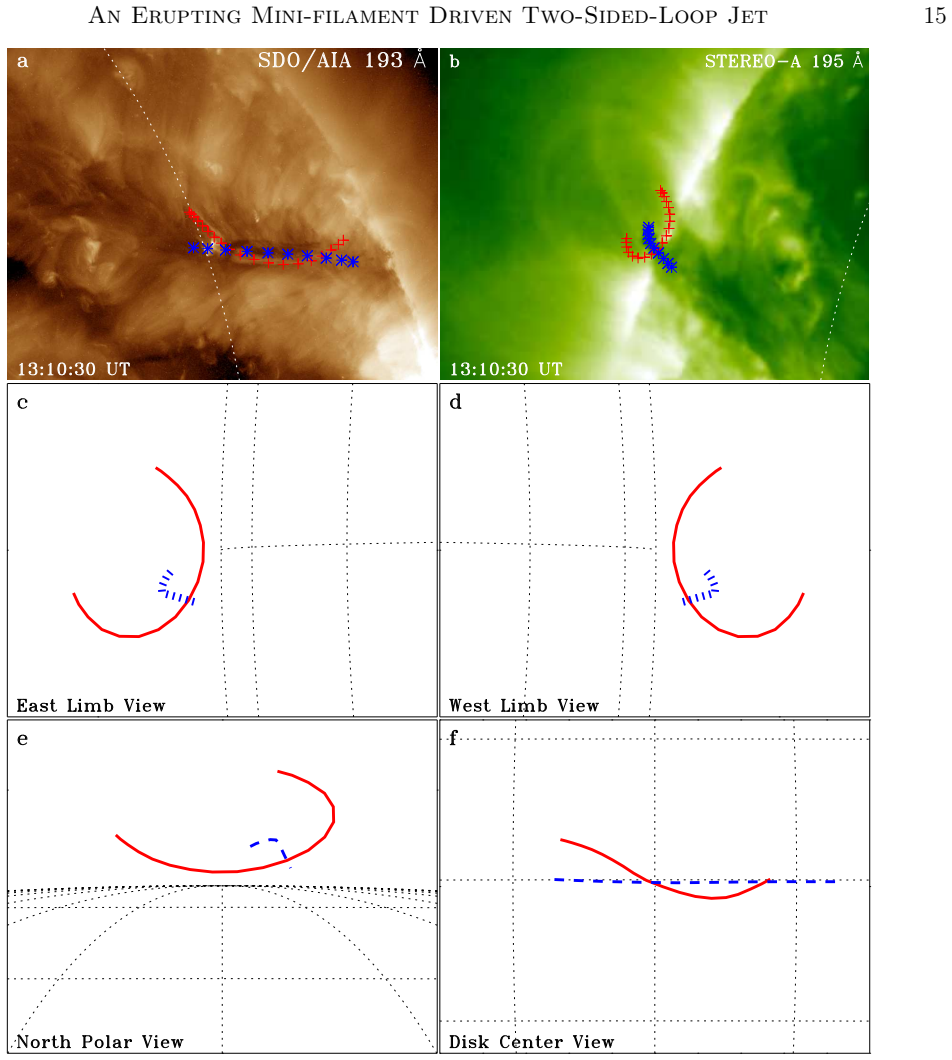
In the SDO images the jet appeared as a concave structure with projection speeds of about 80-136 km/s, while in the STEREO-A images the same eruption appeared as a spiral structure whose two arms lay along the cavity magnetic field lines hosting the large filament. Two reconnection stages are identified: the first between a rising loop and the filament's field, resembling the classical picture; the second between the rising mini-filament and the overlying field, releasing cool material into both arms. The paired images at 13:10:30 UT are reconstructed in three dimensions, and the intersection angle between the jet/cavity trajectory and the filament axis is measured to be about 26.7 degrees. The authors also find that the hot jet component appeared about three minutes before the cool mini-filament material, and they propose a schematic model in which two-sided-loop jets can be mini-filament-driven, with no coronal mass ejection expected.
Load-bearing premise
The entire field-angle measurement rests on the assumption that the two arms of the jet seen in SDO and STEREO-A are the same plasma streams and that the streams move strictly along the magnetic field lines of the large filament's cavity, so that the jet trajectory is a faithful trace of the field.
Editorial extensions
If this is right
- Two-sided-loop jets can be added to the class of jets driven by mini-filament eruptions, so the classical emerging-loop mechanism is not the only way these jets form.
- The trajectory of such a jet can be used to map the magnetic field lines of a filament's cavity, giving a diagnostic for filament magnetic structure where direct polarimetric measurements are unavailable.
- The event provides a direct observational path for cool mass to enter a filament from below, supporting the injection picture of filament mass formation.
- Two-sided-loop jets are expected not to produce coronal mass ejections, unlike collimated blowout jets, because the overlying field confines the eruption.
- Such jets may deposit more energy into the corona than collimated blowout jets because their plasma is confined and eruptive.
Reading between the lines
- If the tracing assumption holds generally, repeated mini-filament-driven two-sided-loop jets beneath different filaments could be used to build maps of prominence magnetic shear without spectropolarimetry.
- The method could be extended beyond filaments to other coronal structures: any jet whose arms lie along a pre-existing field system is a natural field-line tracer in stereoscopic data.
- A direct test would be to catch another two-sided-loop jet with simultaneous spectropolarimetric measurements of the overlying filament; the jet-derived angle should match the spectropolarimetric inclination if the method is sound.
- The proposed model predicts that the cool material in such jets should systematically lag the hot component by minutes and follow the same field lines; high-cadence multi-wavelength observations could check this.
Signed reviews
Editorial analysis
A structured set of objections, weighed in public.
Referee Report
Summary. The paper analyzes the 2013 June 2 two-sided-loop jet observed simultaneously by SDO/AIA, HMI, GONG, and STEREO-A. It reports two distinct reconnection episodes during the jet formation, associates the second episode with the eruption of a mini-filament below a large filament, and uses stereoscopic reconstruction of the jet arms at 13:10:30 UT to infer that the arms trace the cavity magnetic field lines of the overlying large filament. From the reconstructed trajectories the authors measure an intersection angle of about 26.7 degrees between the cavity field and the filament axis, which they compare to earlier spectropolarimetric results. The paper proposes that mini-filament eruptions can drive two-sided-loop jets and that such jets can serve as tracers of filament magnetic structure.
Significance. If the inference is correct, the paper provides a new formation mechanism for two-sided-loop jets, challenging the classical emerging-loop picture, and introduces a novel diagnostic for the magnetic structure of solar filaments. The observational evidence for two reconnection episodes is substantial, including time-distance plots, magnetic island signatures, conjugated flare ribbons, and the dark erupting mini-filament material. The simultaneous SDO and STEREO-A observations are an important asset. However, the central quantitative claim, the 26.7-degree intersection angle, rests on an untested field-line-tracing assumption and on a manual single-time reconstruction with no uncertainty analysis. The validation against previous measurements uses a broad range that is not probative. Therefore, while the observational case for a mini-filament-driven two-sided-loop jet is largely sound, the diagnostic application as presented is not yet fully established.
major comments (3)
- [Section 2, Figure 5] The three-dimensional reconstruction at 13:10:30 UT is based on manually selected points (red plus signs and blue asterisks) with no stated selection criteria, no number of points, and no uncertainty estimate for the reconstructed trajectories or the resulting 26.7-degree angle. Please provide a quantitative error analysis, for example by varying the input points, repeating the reconstruction at several times, or comparing with an independent triangulation method. Without such an analysis, the angle measurement is not robust and the agreement with earlier measurements cannot be assessed.
- [Section 2] The load-bearing assumption that 'the trajectory of the two-sided-loop jet represents the position of the cavity structure' is asserted rather than demonstrated. Since the entire diagnostic depends on this field-line-tracing assumption, please support it with additional evidence, such as a comparison of the reconstructed jet trajectory with a coronal magnetic field model (e.g., PFSS or NLFFF), an argument why plasma inertia and non-ideal effects are negligible, or a cross-check using another tracer of the cavity field. Without this, the measured angle may reflect the jet flow path rather than the magnetic field direction.
- [Section 2 and Section 3] The comparison with earlier direct measurements is presented as validation, but the cited range is inconsistent between the two sections (Section 2 says 20–30 degrees; Section 3 says 15–30 degrees) and is too broad to be probative. A measurement of 26.7 degrees could agree with many values in that interval. Please quantify the uncertainty in the 26.7-degree result and state explicitly which published measurements are consistent with it, rather than invoking a wide range.
minor comments (6)
- [Abstract] The projection speed is reported as '80 - 136' without units; please write '80–136 km/s'.
- [Section 1] In the sentence 'that is (a physical process that breaks and reconnects...' the parenthesis is misplaced, and 'converts to' should be 'converted to'.
- [Section 2, first paragraph] The phrase 'The SDO observations reveals' should be 'The SDO observations reveal'.
- [Section 3, final paragraph] The phrase 'well agreement' should be 'in good agreement'.
- [Section 2, Figure 4 caption] The white dotted curves marking the cavity profile and the disk limbs are described but are not clearly visible in the printed figures; please increase their contrast or add labels so that the reader can verify the correspondence.
- [Section 2, reconstruction paragraph] The paper does not describe the co-alignment procedure between SDO and STEREO-A images used for the 3D reconstruction, nor the estimated co-alignment error. Please specify how the two images were coaligned and how uncertainties in this step affect the reconstructed trajectories.
Circularity Check
No significant circularity: the 26.7-degree angle is a direct geometric reconstruction, validated against independent spectropolarimetric measurements.
full rationale
The paper's central quantitative result is a geometric measurement: paired SDO/AIA and STEREO-A images at 13:10:30 UT are used to reconstruct the three-dimensional trajectories, and the intersection angle between the reconstructed jet trajectory and the large filament axis is measured to be about 26.7 degrees (Section 2, Figure 5). No parameter is fitted to a target quantity and then renamed as a prediction; the projection speeds in the TDS plots are descriptive kinematic measurements, not predictions derived from the model. The only load-bearing inference is the physical assumption that the jet arms propagate along cavity magnetic field lines, explicitly stated as "Since the two-sided loop jet was along the magnetic field lines of the cavity structure, the trajectory of the two-sided loop jet represents the position of the cavity structure." This is an empirical premise used to interpret the observed trajectory, not a definitional equivalence that makes the conclusion true by construction; if field-line tracing fails it would be a correctness risk, not circularity. The validation against Casini et al. (2003) is an external, independent check, and the self-citations (e.g., Shen et al. 2012, 2017 for the blowout-jet context) are illustrative rather than load-bearing for the 26.7-degree measurement. No equation in the paper reduces to its own input.
Assumptions & free parameters
assumptions (4)
- domain assumption The two-sided-loop jet's trajectory follows the magnetic field lines of the cavity structure.
- domain assumption The features identified as current sheets containing magnetic islands represent actual magnetic reconnection.
- domain assumption The concave structure in SDO and the spiral structure in STEREO-A are the same physical jet.
- domain assumption The linear fits to the time-distance plots give representative speeds of the jet arms.
Cite this review
Pith. "Pith review of Stereoscopic Observations of an Erupting Mini-filament Driven Two-Sided-Loop Jet and the Applications for Diagnosing Filament Magnetic field." pith.science (2026). https://pith.science/paper/GVUBZ64H
@misc{pith2026190803660,
  author       = {Pith},
  title        = {Pith review of: Stereoscopic Observations of an Erupting Mini-filament Driven Two-Sided-Loop Jet and the Applications for Diagnosing Filament Magnetic field},
  year         = {2026},
  howpublished = {\url{https://pith.science/paper/GVUBZ64H}},
  note         = {Machine review of arXiv:1908.03660}
}
read the original abstract
The ubiquitous solar jets or jet-like activities are generally regarded as an important source of energy and mass input to the upper solar atmosphere and the solar wind. However, questions about their triggering and driving mechanisms are not completely understood. By taking advantage of high temporal and high spatial resolution stereoscopic observations taken by the Solar Dynamic Observatory (SDO) and the Solar Terrestrial Relations Observatory (STEREO), we report an intriguing two-sided-loop jet occurred on 2013 June 02, which was dynamically associated with the eruption of a mini-filament below an overlying large filament, and two distinct reconnection processes are identified during the formation stage. The SDO observations reveals that the two-sided-loop jet showed a concave shape with a projection speed of about 80 - 136. From the other view angle, the STEREO ahead observations clearly showed that the trajectory of the two arms of the two-sided-loop were along the cavity magnetic field lines hosting the large filament. Contrary to the well-accepted theoretical model, the present observation sheds new light on our understanding of the formation mechanism of two-sided-loop jets. Moreover, the eruption of the two-sided-loop jet not only supplied mass to the overlying large filament, but also provided a rare opportunity to diagnose the magnetic structure of the overlying large filament via the method of three-dimensional reconstruction.
Figures


Figures from the paper (3 more)


Reference graph
Works this paper leans on
-
[1]
Adams, M., Sterling, A. C., Moore, R. L., & Gary, G. A. 2014, ApJ, 783, 11
work page 2014
- [2]
- [3]
-
[4]
2003, A&A, 402, 769 Canfield, R
Aulanier, G., & D´ emoulin, P. 2003, A&A, 402, 769 Canfield, R. C., Reardon, K. P., Leka, K. D., et al. 1996, ApJ, 464, 1016
work page 2003
-
[5]
Lites, B. W. 2003, ApJL, 598, L67
work page 2003
-
[6]
Chae, J., Qiu, J., Wang, H., & Goode, P. R. 1999, ApJL, 513, L75
work page 1999
-
[7]
Chen, H., Yang, J., Yang, B., Ji, K., & Bi, Y. 2018, SoPh, 293, 93
work page 2018
-
[8]
2003, in Astronomical Society of the Pacific Conference Series, Vol
Ramos, A. 2003, in Astronomical Society of the Pacific Conference Series, Vol. 307, Solar Polarization, ed. J. Trujillo-Bueno & J. Sanchez Almeida, 468
work page 2003
Show all 68 references
-
[9]
2019, arXiv e-prints, arXiv:1907.07310
Duan, Y., Shen, Y., Chen, H., & Liang, H. 2019, arXiv e-prints, arXiv:1907.07310
2019 arXiv
-
[10]
1977, SoPh, 52, 37
Engvold, O., & Jensen, E. 1977, SoPh, 52, 37
1977
-
[11]
W., Hill, F., Hubbard, R
Harvey, J. W., Hill, F., Hubbard, R. P., et al. 1996, Science, 272, 1284
1996
-
[12]
2014, ApJ, 796, 73
Hong, J., Jiang, Y., Yang, J., et al. 2014, ApJ, 796, 73
2014
-
[13]
2017, ApJ, 835, 35
Hong, J., Jiang, Y., Yang, J., Li, H., & Xu, Z. 2017, ApJ, 835, 35
2017
-
[14]
2018, ApJL, 853, L26
Huang, Z., Mou, C., Fu, H., et al. 2018, ApJL, 853, L26
2018
-
[15]
2013, ApJ, 775, 132
Jiang, Y., Bi, Y., Yang, J., et al. 2013, ApJ, 775, 132
2013
-
[16]
2008, ApJ, 677, 699
Jiang, Y., Shen, Y., Yi, B., Yang, J., & Wang, J. 2008, ApJ, 677, 699
2008
-
[17]
C., Chen, H
Jiang, Y. C., Chen, H. D., Li, K. J., Shen, Y. D., & Yang, L. H. 2007, A&A, 469, 331
2007
-
[18]
L., Kucera, T
Kaiser, M. L., Kucera, T. A., Davila, J. M., et al. 2008, SSRv, 136, 5
2008
-
[19]
R., Raulin, J.-P., Nitta, N., Shibata, K., & Shimojo, M
Kundu, M. R., Raulin, J.-P., Nitta, N., Shibata, K., & Shimojo, M. 1998, SoPh, 178, 173
1998
-
[20]
R., Title, A
Lemen, J. R., Title, A. M., Akin, D. J., et al. 2012, SoPh, 275, 17
2012
-
[21]
Leroy, J. L. 1989, in Astrophysics and Space Science Library, Vol. 150, Dynamics and Structure of Quiescent Solar Prominences, ed. E. R. Priest, 77–113
1989
-
[22]
2019, ApJ, 872, 87
Li, H., & Yang, J. 2019, ApJ, 872, 87
2019
-
[23]
2017, ApJL, 842, L20
Li, H., Jiang, Y., Yang, J., et al. 2017, ApJL, 842, L20
2017
-
[24]
2015, ApJL, 814, L13
Li, X., Yang, S., Chen, H., Li, T., & Zhang, J. 2015, ApJL, 814, L13
2015
-
[25]
E., Title, A
Liu, W., Berger, T. E., Title, A. M., & Tarbell, T. D. 2009, ApJL, 707, L37
2009
-
[26]
2005, ApJL, 631, L93
Liu, Y., Kurokawa, H., & Shibata, K. 2005, ApJL, 631, L93
2005
-
[27]
2010, SSRv, 151, 333
Schmieder, B., & Aulanier, G. 2010, SSRv, 151, 333
2010
-
[28]
B., et al
Miao, Y., Liu, Y., Li, H. B., et al. 2018, ApJ, 869, 39
2018
-
[29]
D., et al
Miao, Y., Liu, Y., Shen, Y. D., et al. 2019, ApJ, 877, 61
2019
-
[30]
Falconer, D. A. 2010, ApJ, 720, 757
2010
-
[31]
2012, ApJ, 750, 50
Neugebauer, M. 2012, ApJ, 750, 50
2012
-
[32]
A., & Lin, J
Ni, L., Zhang, Q.-M., Murphy, N. A., & Lin, J. 2017, ApJ, 841, 27
2017
-
[33]
2008, ApJL, 683, L83 Nistic` o, G., Bothmer, V., Patsourakos, S., &
Nishizuka, N., Shimizu, M., Nakamura, T., et al. 2008, ApJL, 683, L83 Nistic` o, G., Bothmer, V., Patsourakos, S., &
2008
-
[34]
2009, SoPh, 259, 87
Zimbardo, G. 2009, SoPh, 259, 87
2009
-
[35]
V., Mason, G
Nitta, N. V., Mason, G. M., Wiedenbeck, M. E., et al. 2008, ApJL, 675, L125
2008
-
[36]
2001, A&A, 375, L39 10 Shen et al
Semel, M. 2001, A&A, 375, L39 10 Shen et al
2001
-
[37]
K., Sterling, A
Panesar, N. K., Sterling, A. C., & Moore, R. L. 2017, ApJ, 844, 131
2017
-
[38]
D., Thompson, B
Pesnell, W. D., Thompson, B. J., & Chamberlin, P. C. 2012, SoPh, 275, 3
2012
-
[39]
C., & Romoli, M
Pucci, S., Poletto, G., Sterling, A. C., & Romoli, M. 2013, ApJ, 776, 16 Raouafi, N. E., Patsourakos, S., Pariat, E., et al. 2016, SSRv, 201, 1
2013
-
[40]
M., & Kumar, A
Rust, D. M., & Kumar, A. 1994, SoPh, 155, 69
1994
-
[41]
Schmieder, B., Golub, L., & Antiochos, S. K. 1994, ApJ, 425, 326
1994
-
[42]
F., Liu, Y
Shen, Y., Chen, P. F., Liu, Y. D., et al. 2019, ApJ, 873, 22
2019
-
[43]
2012, ApJ, 745, 164
Shen, Y., Liu, Y., Su, J., & Deng, Y. 2012, ApJ, 745, 164
2012
-
[44]
2011, ApJL, 735, L43
Shen, Y., Liu, Y., Su, J., & Ibrahim, A. 2011, ApJL, 735, L43
2011
-
[45]
D., Su, J., Qu, Z., & Tian, Z
Shen, Y., Liu, Y. D., Su, J., Qu, Z., & Tian, Z. 2017, ApJ, 851, 67
2017
-
[46]
W., et al
Shibata, K., Ishido, Y., Acton, L. W., et al. 1992, PASJ, 44, L173
1992
-
[47]
2007, Science, 318, 1591
Shibata, K., Nakamura, T., Matsumoto, T., et al. 2007, Science, 318, 1591
2007
-
[48]
Dwivedi, B. N. 2019, SoPh, 294, 68
2019
-
[49]
Sterling, A. C. 2018, in Journal of Physics Conference Series, Vol. 1100, Journal of Physics Conference Series, 012024
2018
-
[50]
Falconer, D. A. 2019, ApJ, 871, 220
2019
-
[51]
2015, Nature, 523, 437
Adams, M. 2015, Nature, 523, 437
2015
-
[52]
C., Moore, R
Sterling, A. C., Moore, R. L., & Panesar, N. K. 2018, ApJ, 864, 68
2018
-
[53]
E., Cranmer, S
Tian, H., DeLuca, E. E., Cranmer, S. R., et al. 2014, Science, 346, 1255711
2014
-
[54]
2017, ApJ, 845, 94
Tian, Z., Liu, Y., Shen, Y., et al. 2017, ApJ, 845, 94
2017
-
[55]
2018, ApJ, 863, 180
Wang, J., Yan, X., Qu, Z., et al. 2018, ApJ, 863, 180
2018
-
[56]
1999, ApJL, 520, L71
Wang, Y.-M. 1999, ApJL, 520, L71
1999
-
[57]
Wang, Y.-M., Pick, M., & Mason, G. M. 2006, ApJ, 639, 495
2006
-
[58]
R., Socker, D
Wang, Y.-M., Sheeley, Jr., N. R., Socker, D. G., et al. 1998, ApJ, 508, 899
1998
-
[59]
F., & Keppens, R
Xia, C., Chen, P. F., & Keppens, R. 2012, ApJL, 748, L26
2012
-
[60]
F., Keppens, R., & van Marle, A
Xia, C., Chen, P. F., Keppens, R., & van Marle, A. J. 2011, ApJ, 737, 27
2011
-
[61]
2014, ApJL, 792, L38
Xia, C., Keppens, R., Antolin, P., & Porth, O. 2014, ApJL, 792, L38
2014
-
[62]
L., Priest, E
Yan, X. L., Priest, E. R., Guo, Q. L., et al. 2016, ApJ, 832, 23
2016
-
[63]
2015, ApJ, 803, 86
Yang, B., Jiang, Y., Yang, J., Hong, J., & Xu, Z. 2015, ApJ, 803, 86
2015
-
[64]
1995, Nature, 375, 42
Yokoyama, T., & Shibata, K. 1995, Nature, 375, 42
1995
-
[65]
2014, ARA&A, 52, 529
Yuan, F., & Narayan, R. 2014, ARA&A, 52, 529
2014
-
[66]
M., & Ni, L
Zhang, Q. M., & Ni, L. 2019, ApJ, 870, 113
2019
-
[67]
2017, ApJ, 834, 79
Zhang, Y., & Zhang, J. 2017, ApJ, 834, 79
2017
-
[68]
2018, ApJ, 861, 108 An Erupting Mini-filament Driven Two-Sided-Loop Jet 11 Figure 1
Zheng, R., Chen, Y., Huang, Z., et al. 2018, ApJ, 861, 108 An Erupting Mini-filament Driven Two-Sided-Loop Jet 11 Figure 1. Pre-eruption magnetic configuration. (a) HMI LOS magnetogr am in which bright (black) patches are positive (negative) polarities. (b) GONG H α image shows...
2018
Reviewed August 14, 2026 · model on record in the stance chip above.
Discussion (0). Continue with ORCID to comment.