REVIEW 3 major objections 5 minor 45 references
Predicting the impact of particle-particle collisions on turbophoresis with a reduced number of computational particles
T0 review · 3 major / 5 minor · reviewed 2026-08-14 · deepseek-v4-flash
Pith's one-line read Rescaled collision radius keeps turbophoresis at 16x lower cost
desk verdict Useful new scaling for collision radius in super-particle simulations, but the empirical hybrid parameter b_tr=32 is only validated in-sample, so the predictive claim is overstated. read the letter →
The pith
A machine-rendered reading of the paper's core claim, the machinery that carries it, and where it could break.
The reading
What carries the argument
The central object is the ‘super-particle’, a computational particle carrying statistical weight $W=N_p/N_c$, and the enhanced collision radius $d_c$ applied only to particle-particle collisions, while particle-wall collisions keep the physical diameter $d_p$. The argument rests on the scaling of the collisional source term, $\dot{f}_{\rm coll}\sim \delta v\, d^2 N_p^2$, which becomes $\dot{g}_{\rm coll}\sim \delta v_c\, d_c^2 N_p^2/W$ for super-particles; requiring invariance under $W$ gives $d_c\propto W^{1/(2+h)}$ once a Hölder-like relation $\delta v_c\sim d_c^h$ is assumed. The exponent $h$ interpolates between 1 (low Stokes number, where a perturbation solution makes particle velocity a smooth field) and 0 (high Stokes number, where collision velocity is independent of separation). The hybrid model computes $h$ per collision from the stopping-distance parameter $b=|v_{\rm rel}|\tau_p/(d_c-d_p)$, with the empirical crossover constant $b_{\rm tr}=32$, and iterates the implicit equation $h=\exp[-|v_{\rm rel}|\tau_p/(32 d_p(W^{1/(2+h)}-1))]$ to convergence.
What would settle it
Run the identical super-particle reduction in a particle-laden turbulent pipe or boundary-layer flow at $St^+=16$ and $W=16$; if the hybrid model with $b_{\rm tr}=32$ does not keep the near-wall concentration profile within the $W=1$ statistical scatter, the crossover constant is not universal and the scaling fails beyond the tested channel case.
Extended reading notes
Core claim
The paper’s central claim is that statistical invariance under particle-count reduction can be restored for collisional four-way coupling by a purely deterministic rescaling of the collision event. The collision radius is inflated according to $d_c = d_p W^{1/(2+h)}$ and the restitution coefficient is reduced according to $e_c = e_p W^{-h/(2+h)}$, with $h$ set by the local nature of the collision: $h=1$ in the low-Stokes-number (smooth, flow-following) limit, $h=0$ in the high-Stokes-number (ballistic) limit, and $h=\exp(-b/32)$ in the hybrid model, where $b=|v_{\rm rel}|\tau_p/(d_c-d_p)$ is the ratio of stopping distance to extra approach distance. Validated at $Re_*=150$ in a turbulent channel for $St^+=8$, $32$, $128$ with up to a 16-fold reduction in particle count, the method reproduces the full-particle concentration profile, collision frequency, and to a lesser extent collision-velocity statistics. The intended message is that deterministic collision models need not be abandoned when the particle count is reduced.
Load-bearing premise
Everything rests on the assumed power law $v_c\sim d_c^h$ for how collision velocity varies with collision radius, and on the empirical crossover constant 32 in $h=\exp(-b/32)$ being universal across flow geometries and Stokes numbers.
Editorial extensions
If this is right
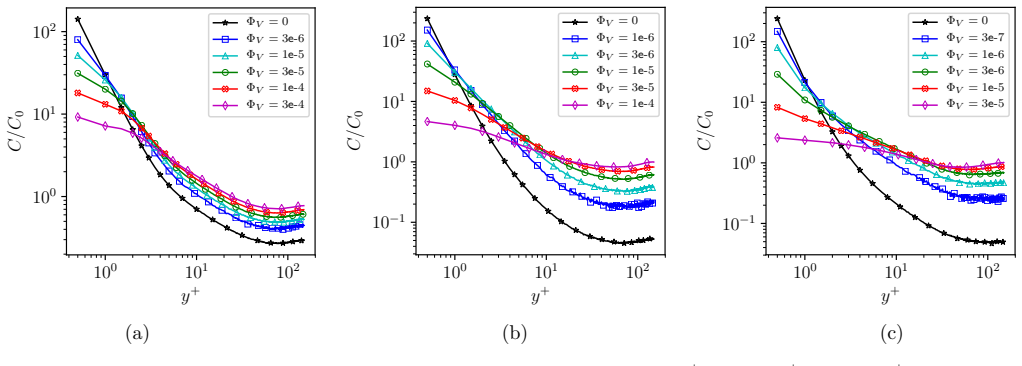
- The enhanced-radius model keeps the near-wall particle concentration profile close to the full-particle result at $St^+=8$, $32$, and $128$ for up to a 16-fold reduction in computational particle count.
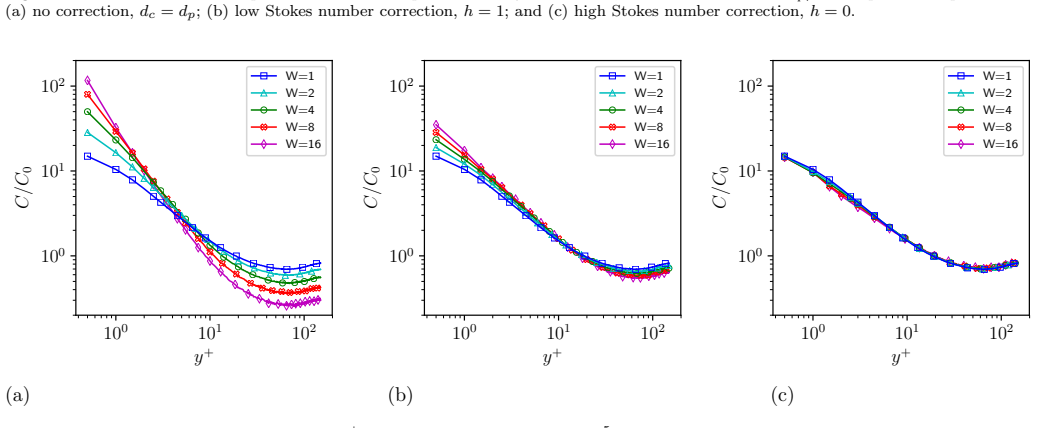
- The $h=0$ ballistic scaling $d_c=d_p\sqrt{W}$ is accurate for $St^+\ge 32$, while the $h=1$ smooth scaling $d_c=d_p\sqrt[3]{W}$ is accurate at $St^+=8$; the hybrid model bridges both limits without user input.
- Because the treatment stays deterministic, the scaling can be inserted into existing hard-sphere or soft-sphere collision algorithms by replacing $d_p$ and $e_p$ with the enhanced values.
- The modified restitution coefficient encodes the predicted collision-velocity inflation $\delta v_c/\delta v_p=W^{h/(2+h)}$, which preserves momentum transfer per collision.
- The practical limit of the reduction is set by the enhanced radius becoming comparable to near-wall flow scales, which the paper identifies as the cause of residual discrepancies for $y^+\lesssim 1$.
Reading between the lines
- If the crossover constant $b_{\rm tr}=32$ reflects a universal property of the collision process rather than of the channel geometry, the same $W^{1/(2+h)}$ rescaling should transfer to pipe and boundary-layer flows; that universality is not established in the paper.
- Because the correction is deterministic and weight-based, it could be combined with dynamically evolving statistical weights, letting $d_c$ adapt as $W$ changes during a simulation; the paper mentions this extension but does not pursue it.
- A direct measurement of collision velocity versus separation in homogeneous isotropic turbulence would isolate the assumed power law $v_c\sim d_c^h$ from the other modeling ingredients.
- The same logic could be inverted to coarsen particle counts in wall-modeled large-eddy simulations, where near-wall particle statistics are otherwise under-resolved; this is an editorial extrapolation, not a claim of the paper.
Signed reviews
Editorial analysis
A structured set of objections, weighed in public.
Referee Report
Summary. This paper proposes a correction scheme for particle-particle collisions in Eulerian-Lagrangian simulations that represent many physical particles by a smaller number of 'super-particles' with statistical weight W. The author derives that the super-particle collision rate is under-predicted by a factor W^{-1} when the physical collision diameter is used, and proposes to enlarge the collision diameter to d_c = d_p W^{1/(2+h)} and to modify the restitution coefficient to e_c = e_p W^{-h/(2+h)}, where h describes how the collision velocity scales with collision diameter (h=1 for low Stokes number, h=0 for high Stokes number). A hybrid model sets h = exp(-b/32), with b a local stopping-distance parameter, so that a different h is assigned to each collision. The method is tested in DNS of turbulent channel flow at Re*=150 for St+=8, 32, and 128, with particle counts reduced by up to a factor of 16; concentration profiles, collision frequencies, and average collision velocities are compared with the full-particle baseline.
Significance. The method addresses a real bottleneck in four-way coupled point-particle simulations and, if it holds, provides a simple, deterministic alternative to stochastic collision models. The limiting scalings in §3.3 are physically motivated, the presentation is clear, and the paper states its main limitation explicitly: at large W the enhanced collision diameter can exceed the viscous-sublayer scale. However, the quantitative evidence for the central claim is currently limited. The validation is visual rather than metric-based, the empirical constant b_tr=32 is calibrated and then tested on the same three channel-flow cases, and the power-law assumption underlying the radius scaling is not directly verified. These issues are fixable but need to be addressed before the claim of general predictive applicability is established.
major comments (3)
- [§4.2, Eq. (33)] The hybrid model's only free parameter, b_tr=32, is set empirically, and the model is then validated on the same three channel-flow cases used to select it (Re*=150, St+=8, 32, 128). Because Eqs. (28), (30), and (31) make every predicted collision diameter and restitution correction depend on h, and hence on b_tr, the collapse shown in Figs. 9-11 is an in-sample demonstration rather than a test of predictive power. I ask the author to add an out-of-sample validation (e.g., a different friction Reynolds number, a different channel geometry, or a different d_p+), a sensitivity study over b_tr, or a calibration procedure that does not rely on the target flow. Without one of these, the abstract's claim of general applicability is not supported.
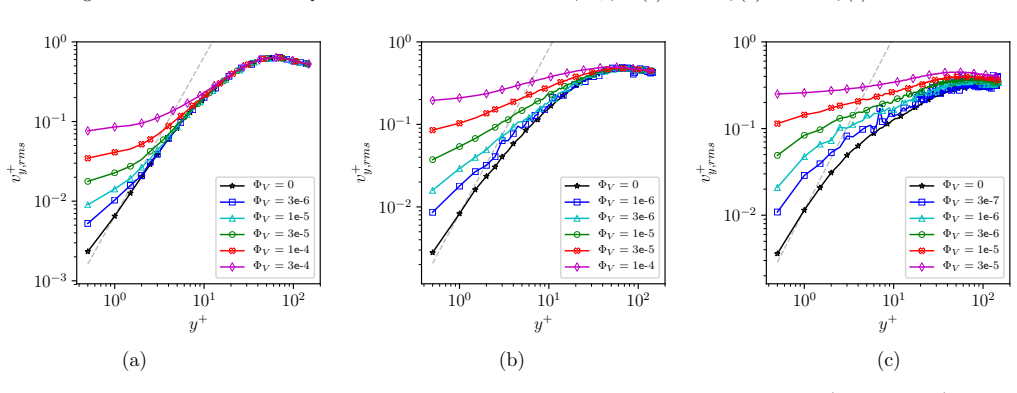
- [§4.1-4.2, Figs. 6-9] The central claim of W-invariance is supported only by visual inspection. No error bars, confidence intervals, or quantitative convergence metrics are reported for the concentration profiles, collision frequencies, or collision velocities. In particular, the statements in §4.1 that h=0 yields 'approximately collapse' at St+=32 and that h=1 is better at St+=8 are qualitative. Please add a quantitative measure, such as the relative L2 error in C/C0 between the W=1 baseline and each W>1 case, together with an estimate of sampling uncertainty, so that 'approximately invariant' has a precise meaning and the reader can judge whether the deviations grow with W.
- [§3.3, Eq. (25)] The power-law relation v_c ~ d_c^h is an assumption, not a measured or derived result. It is the foundation for Eqs. (28), (30), and (31), and it enters the definition of the hybrid parameter b in Eq. (32). The low- and high-Stokes limits are plausible, but nothing in the manuscript verifies that the exponent picture is correct in the transition regime. A direct test would be to measure the mean relative velocity of colliding pairs as a function of their separation at contact in the full simulation and compare it with the assumed d_c^h behavior. If the true relation is not a power law, the enhanced-radius formulas will not be exact even with a correctly tuned b_tr.
minor comments (5)
- [§3.3, after Eq. (25)] The sentence describing the high-Stokes limit states 'h = 1 for (25)' before the summary in Eq. (26) correctly assigns h=0 to that limit; the prose should be corrected.
- [Eq. (15)] The displayed solution for C(y) appears to be missing the division by the wall-normal velocity variance; as written, the second equality does not follow from Eq. (14). The integral solution should be C(y) proportional to exp(∫ a_y/<v_y^2> dη) divided by <v_y^2|y>.
- [§2.1 and §3.3] The symbol h is used for both the channel half-height and the collision-velocity exponent. The author acknowledges the conflict, but the dual use makes §4.2 harder to follow when b is defined in Eq. (32); a different symbol for the exponent would remove the ambiguity.
- [Fig. 11] The collision-velocity statistics at St+=8 and 32 are visibly noisy, and the paper notes that fewer samples are available at larger W. Please state the averaging time and number of samples used for the collision statistics so that the reader can assess the significance of the reported discrepancies.
- [§2.4] The estimate φv,max ~ d_p+/St+ is said to be 'roughly observed' in Fig. 2, but the observation is not quantified. Either add a supporting plot of the saturation value versus St+ or soften the claim.
Circularity Check
Partial circularity: the hybrid model's bridging constant btr=32 is set empirically and validated on the same channel-flow cases, while the limiting h=0 and h=1 scalings are independent.
-
fitted input called prediction
[Section 4.2, Eq. (33), Figures 9-11]
"A simple model containing these asymptotics is h = exp(−b/btr), where btr = 32 is set empirically. ... The results of this super-particle collision model for the channel flow at Re∗ = 150 are shown in Figure 9 for three different Stokes numbers."
The single constant btr in Eq. (33) is the only input to the hybrid closure; it fixes h for every collision and therefore, through Eqs. (28) and (31), fixes both the enhanced diameter dc and the modified restitution ec. The paper states btr = 32 is 'set empirically' and then validates the hybrid model on exactly the same Re*=150 channel-flow cases (St+=8, 32, 128) shown in Figures 9-11. No separate calibration dataset, sensitivity study, or out-of-sample geometry is reported. The claimed W-invariance in those figures is therefore in-sample: it demonstrates that a single constant can be chosen to make these specific cases collapse, rather than independently predicting the smooth-to-ballistic transition. The h=1 and h=0 limits remain independently motivated, so the circularity is partial.
full rationale
The core scaling derivation is not circular: Eqs. (28) and (31) follow from the stated invariance condition on the collision source term (Eqs. 24 and 27) together with the limiting values h=1 (low Stokes, from Maxey's perturbation solution) and h=0 (high Stokes, from a ballistic argument). These limiting scalings are independently motivated, and the direct h=0/h=1 tests in Figures 6-8 are genuine demonstrations. The paper's self-citations (Johnson 2018; Johnson et al. 2019) are used for background physics and numerical verification, not as the load-bearing justification for the new model, so they do not create circularity. The only substantive circularity is in the hybrid model: btr=32 is 'set empirically' and the model is then validated on the same Re*=150 channel at St+=8, 32, 128. Since h controls both dc and ec, the displayed W-invariance is partly a consequence of tuning this constant to those cases. Because the paper reports no independent calibration or out-of-sample test, the claim of general applicability for intermediate Stokes numbers is not fully independent. Overall score 4: partial circularity, with independent content in the limit scalings.
Assumptions & free parameters
free parameters (1)
- b_tr =
32
assumptions (5)
- domain assumption Collisions are binary; three-particle collisions are negligible.
- domain assumption Velocities of colliding particles are statistically independent in the collision source model.
- domain assumption Relative collision velocity scales as a power law with separation: v_c ~ d_c^h, with h=1 for low Stokes and h=0 for high Stokes.
- domain assumption Super-particle collision rate scales as d_c^(2+h) N_p^2 / W with no correction for radial distribution function or preferential concentration.
- ad hoc to paper The hybrid interpolation h = exp(-b/b_tr) is an adequate universal bridge.
Cite this review
Pith. "Pith review of Predicting the impact of particle-particle collisions on turbophoresis with a reduced number of computational particles." pith.science (2026). https://pith.science/paper/GW3GKBPX
@misc{pith2026190802869,
  author       = {Pith},
  title        = {Pith review of: Predicting the impact of particle-particle collisions on turbophoresis with a reduced number of computational particles},
  year         = {2026},
  howpublished = {\url{https://pith.science/paper/GW3GKBPX}},
  note         = {Machine review of arXiv:1908.02869}
}
read the original abstract
A common feature of wall-bounded turbulent particle-laden flows is enhanced particle concentrations in a thin layer near the wall due to a phenomenon known as turbophoresis. Even at relatively low bulk volume fractions, particle-particle collisions regulate turbophoresis in a critical way, making simulations sensitive to collisional effects. Lagrangian tracking of every particle in the flow can become computationally expensive when the physical number of particles in the system is large. Artificially reducing the number of particles in the simulation can mitigate the computational cost. When particle-particle collisions are an important aspect determining the simulation outcome, as in the case when turbophoresis plays an active role, simply reducing the number of particles in the simulation significantly alters the computed particle statistics. This paper introduces a computational particle treatment for particle-particle collisions which reproduces the results of a full simulation with a reduced number of particles. This is accomplished by artificially enhancing the particle collision radius based on scaling laws for the collision rates. The proposed method retains the use of deterministic collision models and is applicable for both low and high Stokes number regimes.
Figures

Figures from the paper (8 more)




Reference graph
Works this paper leans on
-
[1]
write newline
" write newline "" before.all 'output.state := FUNCTION n.dashify 't := "" t empty not t #1 #1 substring "-" = t #1 #2 substring "--" = not "--" * t #2 global.max substring 't := t #1 #1 substring "-" = "-" * t #2 global.max substring 't := while if t #1 #1 substring * t #2 global.max substring 't := if while FUNCTION word.in bbl.in ":" * " " * FUNCTION f...
-
[2]
author Ardekani, M.N. , author Costa, P. , author Breugem, W.P. , author Brandt, L. , year 2016 . title Numerical study of the sedimentation of spheroidal particles . journal International Journal of Multiphase Flow volume 87 , pages 16 -- 34 . :https://doi.org/10.1016/j.ijmultiphaseflow.2016.08.005
-
[3]
author Balachandar, S. , author Eaton, J.K. , year 2010 . title Turbulent Dispersed Multiphase Flow . journal Annual Review of Fluid Mechanics volume 42 , pages 111--133 . :10.1146/annurev.fluid.010908.165243
arXiv 2010
-
[4]
author Banko, A. , year 2018 . title Radiation Absorption by Inertial Particles in a Turbulent Square Duct Flow . Ph.D. thesis. Stanford University
work page 2018
-
[5]
author Burton, T.M. , author Eaton, J.K. , year 2005 . title Fully resolved simulations of particle-turbulence interaction . journal Journal of Fluid Mechanics volume 545 , pages 67–111 . :10.1017/S0022112005006889
-
[6]
author Capecelatro, J. , author Desjardins, O. , year 2013 . title An Euler-Lagrange strategy for simulating particle-laden flows . journal Journal of Computational Physics volume 238 , pages 1 -- 31 . :https://doi.org/10.1016/j.jcp.2012.12.015
-
[7]
author Caporaloni, M. , author Tampieri, F. , author Trombetti, F. , author Vittori, O. , year 1975 . title Transfer of particles in nonisotropic air turbulence . journal Journal of the Atmospheric Sciences , pages 565--568
work page 1975
-
[8]
author Caraman, N. , author Bor \' e e, J. , author Simonin, O. , year 2003 . title Effect of collisions on the dispersed phase fluctuation in a dilute tube flow: Experimental and theoretical analysis . journal Physics of Fluids volume 15 , pages 3602--3612 . :10.1063/1.1619136
Show all 45 references
-
[9]
, author Elghobashi, S
author Druzhinin, O.A. , author Elghobashi, S. , year 1998 . title Direct numerical simulations of bubble-laden turbulent flows using the two-fluid formulation . journal Physics of Fluids volume 10 , pages 685--697 . :10.1063/1.869594
1998 doi
-
[10]
, year 1991
author Elghobashi, S. , year 1991 . title Particle-laden turbulent flows: direct simulation and closure models . journal Applied Scientific Research volume 48 , pages 301--314 . :10.1007/BF02008202
1991 doi
-
[11]
, year 1994
author Elghobashi, S. , year 1994 . title On predicting particle-laden turbulent flows . journal Applied Scientific Research volume 52 , pages 309--329 . :10.1007/BF00936835
1994 doi
-
[12]
, author Truesdell, G.C
author Elghobashi, S. , author Truesdell, G.C. , year 1992 . title Direct simulation of particle dispersion in a decaying isotropic turbulence . journal J. Fluid Mech. volume 242 , pages 655 . :10.1017/s0022112092002532
1992 doi
-
[13]
, author Truesdell, G.C
author Elghobashi, S. , author Truesdell, G.C. , year 1993 . title On the two-way interaction between homogeneous turbulence and dispersed solid particles . I : Turbulence modification . journal Physics of Fluids A volume 5 , pages 1790--1801 . :10.1063/1.858854
1993 doi
-
[14]
, author Laurent, F
author Fox, R. , author Laurent, F. , author Massot, M. , year 2008 . title Numerical simulation of spray coalescence in an eulerian framework: Direct quadrature method of moments and multi-fluid method . journal Journal of Computational Physics volume 227 , pages 3058 -- 3088...
2008 doi
-
[15]
, year 2017
author Frankel, A. , year 2017 . title Modeling Radiation Transport in Turbulent Particle-laden Media . Ph.D. thesis. Stanford University
2017
-
[16]
, author Narayanan, C
author Garg, R. , author Narayanan, C. , author Subramaniam, S. , year 2009 . title A numerically convergent Lagrangian-Eulerian simulation method for dispersed two-phase flows . journal International Journal of Multiphase Flow volume 35 , pages 376--388 . :10.1016/j.ijmultiph...
2009 doi
-
[17]
, year 1983
author Gatignol, R. , year 1983 . title The Faxen formulas for a rigid particle in an unsteady non-uniform Stokes-flow. journal Journal de Mecanique theorique et appliquee volume 2 , pages 143--160
1983
-
[18]
, year 2008
author Guha, A. , year 2008 . title Transport and Deposition of Particles in Turbulent and Laminar Flow . journal Annual Review of Fluid Mechanics volume 40 , pages 311--341 . :10.1146/annurev.fluid.40.111406.102220
2008
-
[19]
, author Mahesh, K
author Horne, W.J. , author Mahesh, K. , year 2019 . title A massively-parallel, unstructured overset method for mesh connectivity . journal Journal of Computational Physics volume 376 , pages 585 -- 596 . :https://doi.org/10.1016/j.jcp.2018.09.053
2019 doi
-
[20]
, year 2019
author Horwitz, J. , year 2019 . title Some observations regarding two-way coupled computational point-particles . journal (in prep)
2019
-
[21]
, author Mani, A
author Horwitz, J. , author Mani, A. , year 2016 . title Accurate calculation of stokes drag for point–particle tracking in two-way coupled flows . journal Journal of Computational Physics volume 318 , pages 85 -- 109 . :https://doi.org/10.1016/j.jcp.2016.04.034
2016 doi
-
[22]
, author Mani, A
author Horwitz, J. , author Mani, A. , year 2018 . title Correction scheme for point-particle models applied to a nonlinear drag law in simulations of particle-fluid interaction . journal International Journal of Multiphase Flow volume 101 , pages 74 -- 84 . :https://doi.org/1...
2018 doi
-
[23]
, year 2018
author Johnson, P.L. , year 2018 . title Toward wall-modeled LES of particle-laden flows: Analysis of turbophoresis and inter-particle collisions in a turbulent channel flow . journal Center for Turbulence Research Annual Research Briefs , pages 111--124
2018
-
[24]
, author Bassenne, M
author Johnson, P.L. , author Bassenne, M. , author Moin, P. , year 2019 . title Turbophoresis of small inertial particles: theoretical considerations and application to wall-modeled large-eddy simulations . journal submitted to J. Fluid Mech
2019
-
[25]
, year 2016
author Kuerten, J.G. , year 2016 . title Point-Particle DNS and LES of Particle-Laden Turbulent flow - a state-of-the-art review . journal Flow, Turbulence and Combustion volume 97 , pages 689--713 . :10.1007/s10494-016-9765-y
2016 doi
-
[26]
, author Vreman, A.W
author Kuerten, J.G. , author Vreman, A.W. , year 2016 . title Collision frequency and radial distribution function in particle-laden turbulent channel flow . journal International Journal of Multiphase Flow volume 87 , pages 66--79 . :10.1016/j.ijmultiphaseflow.2016.09.005
2016 doi
-
[27]
, author Vreman, A.W
author Kuerten, J.G.M. , author Vreman, A.W. , year 2015 . title Effect of droplet interaction on droplet-laden turbulent channel flow . journal Physics of Fluids volume 27 . :10.1063/1.4921492
2015 doi
-
[28]
, author McLaughlin, J.B
author Li, Y. , author McLaughlin, J.B. , author Kontomaris, K. , author Portela, L. , year 2001 . title Numerical simulation of particle-laden turbulent channel flow . journal Physics of Fluids volume 13 , pages 2957--2967 . :10.1063/1.1396846
2001 doi
-
[29]
, author Soldati, A
author Marchioli, C. , author Soldati, A. , year 2002 . title Mechanisms for particle transfer and segregation in a turbulent boundary layer . journal Journal of Fluid Mechanics volume 468 , pages 283--315 . :10.1017/S0022112002001738
2002 doi
-
[30]
, year 1987
author Maxey, M.R. , year 1987 . title The gravitational settling of aerosol particles in homogeneous turbulence and random flow fields . journal Journal of Fluid Mechanics volume 174 , pages 441 . :10.1017/S0022112087000193
1987 doi
-
[31]
, author Riley, J.J
author Maxey, M.R. , author Riley, J.J. , year 1983 . title Equation of motion for a small rigid sphere in a nonuniform flow . journal Physics of Fluids volume 26 , pages 883--889 . :10.1063/1.864230
1983 doi
-
[32]
, author Apte, S.V
author Moin, P. , author Apte, S.V. , year 2006 . title Large-eddy simulation of realistic gas turbine combustors . journal AIAA Journal volume 44 , pages 698--708 . :10.2514/1.14606
2006 doi
-
[33]
, author Zhao, P.P
author O'Rourke, P.J. , author Zhao, P.P. , author Snider, D. , year 2009 . title A model for collisional exchange in gas/liquid/solid fluidized beds . journal Chemical Engineering Science volume 64 , pages 1784 -- 1797 . :https://doi.org/10.1016/j.ces.2008.12.014
2009 doi
-
[34]
, author Collins, L.R
author Reade, W.C. , author Collins, L.R. , year 2000 . title Effect of preferential concentration on turbulent collision rates . journal Physics of Fluids volume 12 , pages 2530--2540 . :10.1063/1.1288515
2000 doi
-
[35]
, year 1983
author Reeks, M.W. , year 1983 . title The transport of discrete particles in inhomogeneous turbulence . journal Journal of Aerosol Science volume 14 , pages 729--739 . :10.1016/0021-8502(83)90055-1
1983 doi
-
[36]
, author Naumann, A.Z
author Schiller, L. , author Naumann, A.Z. , year 1933 . title Uber die grundlegenden berechnungen bei der schwekraaftaubereitung . journal Z Ver Dtsch Ing volume 77 , pages 318--320
1933
-
[37]
, author Rutland, C
author Schmidt, D.P. , author Rutland, C. , year 2000 . title A new droplet collision algorithm . journal Journal of Computational Physics volume 164 , pages 62 -- 80 . :https://doi.org/10.1006/jcph.2000.6568
2000
-
[38]
, author Prosperetti, A
author Sierakowski, A.J. , author Prosperetti, A. , year 2016 . title Resolved-particle simulation by the physalis method: Enhancements and new capabilities . journal Journal of Computational Physics volume 309 , pages 164 -- 184 . :https://doi.org/10.1016/j.jcp.2015.12.057
2016 doi
-
[39]
, year 2014
author Sikovsky, D.P. , year 2014 . title Singularity of Inertial Particle Concentration in the Viscous Sublayer of Wall-bounded Turbulent Flows . journal Flow, Turbulence and Combustion volume 92 , pages 41--64 . :10.1007/s10494-013-9521-5
2014 doi
-
[40]
, year 2001
author Sommerfeld, M. , year 2001 . title Validation of a stochastic lagrangian modelling approach for inter-particle collisions in homogeneous isotropic turbulence . journal International Journal of Multiphase Flow volume 27 , pages 1829 -- 1858 . :https://doi.org/10.1016/S03...
2001 doi
-
[41]
, author Eaton, J.K
author Squires, K.D. , author Eaton, J.K. , year 1990 . title Particle response and turbulence modification in isotropic turbulence . journal Physics of Fluids A: Fluid Dynamics volume 2 , pages 1191--1203 . :10.1063/1.857620
1990 doi
-
[42]
, year 2013
author Subramaniam, S. , year 2013 . title Lagrangian-Eulerian methods for multiphase flows . journal Progress in Energy and Combustion Science volume 39 , pages 215--245 . :10.1016/j.pecs.2012.10.003
2013 doi
-
[43]
, author Collins, L.R
author Sundaram, S. , author Collins, L.R. , year 1997 . title Collision statistics in an isotropic particle-laden turbulent suspension. Part 1. Direct numerical simulations . journal Journal of Fluid Mechanics volume 335 , pages 75--109 . :10.1017/S0022112096004454
1997 doi
-
[44]
, author Wexler, A.S
author Wang, L.P. , author Wexler, A.S. , author Zhou, Y. , year 2000 . title Statistical mechanical description and modelling of turbulent collision of inertial particles . journal Journal of Fluid Mechanics volume 415 , pages 117--153 . :10.1017/S0022112000008661
2000 doi
-
[45]
, author Potthoff, M
author Yamamoto, Y. , author Potthoff, M. , author Tanaka, T. , author Kajishima, T. , author Tsuji, Y. , year 2001 . title Large-eddy simulation of turbulent gas-particle flow in a vertical channel: effect of considering inter-particle collisions . journal Journal of Fluid Me...
2001 doi
Reviewed August 14, 2026 · model on record in the stance chip above.
Discussion (0). Continue with ORCID to comment.