REVIEW 2 major objections 5 minor 1 cited by
Analysis of fully discrete Crank-Nicolson finite element methods for a stochastic Keller-Segel chemotaxis system with gradient-type multiplicative noise
T0 review · 2 major / 5 minor · reviewed 2026-08-06 · deepseek-v4-flash
Pith's one-line read A fully discrete Crank-Nicolson finite element method for the stochastic Keller-Segel system is proven to converge strongly at rate $O(k^{1/2}+h+k^{-1/2}h^2)$.
desk verdict The advertised inverse-k rate in Theorem 4.4 rests on an expectation miscalculation at Eq. (4.14), and Lemma 2.2 sets an Ito integral to zero pathwise; both gaps are load-bearing. read the letter →
The pith
A machine-rendered reading of the paper's core claim, the machinery that carries it, and where it could break.
The reading
What carries the argument
The argument is carried by a splitting mixed finite element formulation in which the auxiliary variable $\sigma = \nabla c$ is introduced, rewriting the elliptic equation as a mixed system and removing the need for an LBB inf-sup condition; linear finite element spaces are then chosen freely. Time discretization uses the Crank-Nicolson midpoint rule, the natural approximation for Stratonovich noise. The error analysis is organized around an error equation for the projected (finite element) components, with three load-bearing pieces: $L^2$ projections $P_u$, $P_\sigma$, $P_c$ that convert the continuous error into a finite-dimensional one with $O(h^2)$ interpolation error; a nonlinear discrete Gronwall inequality (Lemma 2.1) that controls the non-Lipschitz, sign-indefinite chemotaxis term; and a bound on the noise error term that produces the inverse-$k$ factor $h^4/k$.
What would settle it
Compute the expectation of the noise error term in equation (4.14) directly: since $\mathbb{E}|\Delta W_m|^2 = k$, the term $h^4 \|u^{m+1/2}\|^2 |\Delta W_m|^2 / k$ has expectation $h^4 \mathbb{E}\|u^{m+1/2}\|^2$, not $h^4/k$; if this is the correct bound, then the $h^4/k$ term and the $k^{-1/2}$ factor in Theorem 4.4 disappear. Alternatively, run the scheme with fixed $h$ and successively smaller $k$: if the errors do not grow as $k$ decreases, the predicted inverse-$k$ behavior is absent.
Extended reading notes
Core claim
The central result is Theorem 4.4, which bounds the fully discrete strong error by $\max_{1\le m\le M} \mathbb{E}\|u(t_m)-u_h^m\|^2_{L^2} + \mathbb{E}\big[k \sum_m \|\nabla(u(t_{m+1/2})-u_h^{m+1/2})\|^2\big] \le C(k+h^2+h^4/k)$, with analogous estimates for $\sigma = \nabla c$ and $c$. This yields the strong convergence rate $O(k^{1/2} + h + k^{-1/2}h^2)$. The distinctive $h^4/k$ contribution arises from the stochastic forcing: in the error equation, the noise term is bounded by a multiple of $h^4 \|u^{m+1/2}\|^2 |\Delta W_m|^2 / k$, and after taking expectations this is claimed to give $h^4/k$. The theorem therefore predicts that the method converges at first order when $k = h^2$, and that refining the time step beyond this balance degrades the error estimate, a prediction the paper's Test 2 explicitly seeks to confirm.
Load-bearing premise
The load-bearing premise is that the noise error term has expected size $h^4/k$ rather than $h^4$, which requires treating $|\Delta W_m|^2$ in the bound as an $O(1)$ quantity even though $\mathbb{E}|\Delta W_m|^2 = k$.
Editorial extensions
If this is right
- When $k = h^2$, the scheme achieves first-order strong convergence $O(h)$ for $u$, $\sigma$, and $c$, providing a balanced choice of temporal and spatial steps.
- For $k \ll h^2$, the error bound grows like $k^{-1/2}$, so refining time alone does not improve accuracy and can degrade it, a marked departure from deterministic chemotaxis solvers.
- The fully discrete method conserves total mass and operates without an LBB inf-sup condition, making its finite element spaces easy to construct.
- At small noise intensity, the numerical experiments recover deterministic-like accuracy: second order for $u$ and $c$ in $L^2$ and first order for $\sigma$ in $H^1$.
Reading between the lines
- If the expectation step behind the $h^4/k$ term is corrected, the true rate would likely become $O(k^{1/2}+h)$, eliminating the $k^{-1/2}$ penalty and making $k=h^2$ unnecessary; this is an inference beyond the paper's stated claim.
- The splitting-mixed Crank-Nicolson framework may transfer to other stochastic chemotaxis models or to stochastic convection-diffusion systems with gradient-type noise, since the machinery for the non-Lipschitz nonlinearity is not specific to Keller-Segel.
- The pathwise regularity lemma sets an It\^o integral to zero via the divergence theorem; if that step is not valid pathwise, the regularity assumptions would need re-establishment through martingale arguments, which would leave the numerical scheme unchanged but re-ground the analysis.
- Test 4's observation that noise accelerates blow-up is a qualitative phenomenon that could be quantified, for instance by estimating the expected blow-up time as a function of noise intensity $\delta$.
Editorial analysis
A structured set of objections, weighed in public.
Referee Report
Summary. The manuscript proposes a fully discrete Crank-Nicolson splitting mixed finite element method for a stochastic Keller-Segel system with Stratonovich gradient-type multiplicative noise. It claims P-a.s. stability for the semi- and fully discrete schemes and strong error estimates of the form E||u(t_m)-u_h^m||^2 + E[k sum ||grad(u(t_{m+1/2})-u_h^{m+1/2})||^2] <= C(k+h^2+h^4/k), with analogous bounds for the auxiliary variable sigma and the chemoattractant concentration c. The resulting convergence rate is quoted as O(k^{1/2}+h+k^{-1/2}h^2), and numerical experiments are presented for balanced, unbalanced, and small-noise regimes.
Significance. If the results are correct, this would be the first numerical analysis for this particular stochastic Keller-Segel model, and the proof strategy (splitting mixed FEM combined with Crank-Nicolson time stepping and a random projection-error term) is a useful contribution. The paper also provides pathwise stability estimates for the discrete solutions and Monte Carlo validation. Two criticisms that have been raised against the manuscript do not, on close reading, land. First, the expectation step in Eq. (4.14) is not an error: E|Delta W_m|^2 = k makes the factor |Delta W_m|^2/k have expectation 1, so the per-step contribution is O(h^4); the O(h^4/k) appearing in Eq. (4.15) is produced by summing over M = O(k^{-1}) time steps, not by replacing h^4 with h^4/k in a single step. Second, the stochastic integral discarded in Lemma 2.2(c) is genuinely zero pathwise, because for periodic functions and a constant vector b, (grad u, grad(b . grad u)) = (1/2) int_D b . grad(|grad u|^2) dx = 0; the phrase 'by the divergence theorem' is terse but the conclusion is valid.
major comments (2)
- [3.2, Eqs. (3.42)-(3.44)] The coefficient of k sum E||grad e_u^m||^2 changes from (15 nu/32 - delta^2 |b|^2/2) in the per-step inequality (3.42) to (15 nu/64 - delta^2 |b|^2) in the summed inequality (3.43) and in the final Gronwall display (3.44). These coefficients are not equal: summing (3.42) gives (15 nu/32 - delta^2 |b|^2/2) on the diagonal terms together with an additional 11 nu/64 contribution on the shifted index. Moreover, the displayed coefficient (15 nu/64 - delta^2 |b|^2) need not be positive under the theorem's assumption (3.29); it is negative whenever delta^2 |b|^2 > 15 nu/64, which (3.29) permits. Since the Gronwall argument requires a positive energy coefficient, the proof of the O(k) semi-discrete bound (3.30), which feeds directly into Theorem 4.4, is not valid as written. This is fixable by summing the coefficient correctly or by strengthening (3.29), but it is load-bearing.
- [4.2, Eq. (4.16)] In the estimate for epsilon_u^1, the term C k ||sigma_h^{1/2}||^2_{H1} ||epsilon_u^1||^2_{H1} appears on the right-hand side and is then silently replaced by C K1 (K1 + K_tilde) k in the next display. No inequality is supplied to justify this replacement: an inverse estimate would introduce h^{-2}, and absorbing the term into the left-hand side would require an unstated smallness condition on k relative to h and the stability constants. Consequently, the displayed chain does not establish the first-step bound (4.17), which is needed for the fully discrete rate in Theorem 4.3 and hence in Theorem 4.4. This is a genuine gap in the proof as written, although it appears to be fixable with a more careful first-step argument.
minor comments (5)
- [Introduction and Section 5] The statement that the error estimates are 'sharp' is not supported: no lower bound is proved, and Test 2 compares two discrete solutions that both carry the h^4/k mechanism in their error bounds, so it does not demonstrate that the error relative to the exact solution actually grows like h^4/k.
- [4.2, initial data paragraph] The sentence 'without loss of generality, we assume that u_h^0 = u^0 and sigma_h^0 = sigma^0' is not a valid reduction; the initial conditions of Algorithm 2 are projections. The subsequent proof only needs epsilon_u^0 = 0 and epsilon_sigma^0 = 0, which follow from the definitions, so the sentence should be removed or replaced by the correct statement.
- [Lemma 2.2(d)] Part (d) of Lemma 2.2 is left as an exercise for the reader, but it is used in Lemma 2.3(c) and elsewhere; a proof or a precise citation should be supplied.
- [Lemma 3.1, condition (3.4)] Condition (3.4) is described as a condition on u_0 even though it depends on k through kappa_1; it should be identified as a mesh/CFL-type condition involving both the data and the time step.
- [Throughout] There are several typographical and wording issues, including 'Prelimimaries' in the Section 2 heading, 'usefull', and 'satisifes'; in addition, the reference solution used in Test 2 is not specified, unlike in Test 1.
Circularity Check
No significant circularity: the convergence proof is self-contained a priori estimation; self-citations are only in numerical practice.
full rationale
The paper's central derivation is a sequence of a priori energy estimates for the proposed Crank-Nicolson splitting mixed finite element scheme. The constants K1, K2, K3 and the final constant C depend on the initial data, the domain, and the problem parameters; they are not fitted to computed outputs. The auxiliary variable sigma=grad c is a standard mixed-formulation change of variable, not a quantity defined in terms of the target error, and the error bound for sigma is derived from the error bound for u through the mixed form, which is a valid propagation of error rather than a circular reduction. Well-posedness and regularity premises are imported from [14,17], which are not authored by the present paper's author, so the load-bearing existence and regularity assumptions have independent external support. The author's self-citations [7,25,26] appear only in the numerical experiment section as references for the two-grid error computation convention, so they are not load-bearing for the main theorems. The inverse-k term in Theorem 4.4 arises by summing a per-step h^4 bound over M=T/k steps between Eq. (4.14) and Eq. (4.15); whether that summed estimate is sharp or overly pessimistic is a mathematical correctness question, not a circularity, because the proof does not assume the conclusion. The proof of Lemma 2.2(c) does contain the unsupported pathwise assertion that the Ito integral L2 is zero 'by the divergence theorem'; this is a proof gap or error, not a circular step, since it does not define the desired estimate in terms of itself. Overall, no prediction reduces by construction to an input, and no load-bearing result depends on a self-citation chain.
Assumptions & free parameters
assumptions (6)
- domain assumption Well-posedness and regularity of the stochastic Keller-Segel system from [14,17], including pathwise existence, uniqueness, Lp bounds, and H2 regularity.
- standard math Elliptic regularity estimate ||u||_{H2} <= C(D)||Delta u||_{L2} on the periodic domain.
- standard math Ladyzhenskaya/Gagliardo-Nirenberg inequality in R2.
- standard math Nonlinear discrete Gronwall lemma from [19].
- domain assumption Smallness condition (3.4) on initial data and smallness condition (3.29) on delta.
- domain assumption Deterministic initial data u0 in L^infty(Omega;H^2_per).
Cite this review
Pith. "Pith review of Analysis of fully discrete Crank-Nicolson finite element methods for a stochastic Keller-Segel chemotaxis system with gradient-type multiplicative noise." pith.science (2026). https://pith.science/paper/GWT5ACTE
@misc{pith2026250715103,
  author       = {Pith},
  title        = {Pith review of: Analysis of fully discrete Crank-Nicolson finite element methods for a stochastic Keller-Segel chemotaxis system with gradient-type multiplicative noise},
  year         = {2026},
  howpublished = {\url{https://pith.science/paper/GWT5ACTE}},
  note         = {Machine review of arXiv:2507.15103}
}
abstract
We develop and analyze numerical methods for a stochastic Keller-Segel system perturbed by Stratonovich noise, which models chemotactic behavior under randomly fluctuating environmental conditions. The proposed fully discrete scheme couples a Crank-Nicolson time discretization with a splitting mixed finite element method in space. We rigorously prove the stability of the numerical scheme and establish strong convergence rates of order $O(k^{1/2} + k^{-1/2}h^2)$, where $k$ and $h$ denote the time and spatial step sizes, respectively. Notably, the presence of stochastic forcing leads to an inverse dependence on $k$ in the error estimates, distinguishing the convergence behavior from that of the deterministic case. Numerical experiments are presented to validate the theoretical results and demonstrate the effectiveness and accuracy of the proposed methods.
Figures


Forward citations
Cited by 1 Pith paper
-
A splitting mixed finite element method for a stochastic Keller-Segel system with multiplicative noise
A splitting mixed finite element method for the multiplicative-noise Keller-Segel system is derived and analyzed, with localized O(ln(1/k)(k+h^2)) error estimates and convergence in probability.
Reference graph
Works this paper leans on
-
[1]
C. Amrouche and N. E. H. Seloula. Lp-theory for vector potentials and sobolev’s inequalities for vector fields: application to the Stokes equations with pressure boundary conditions. Mathematical Models and Methods in Applied Sciences , 23(01):37–92, 2013
work page 2013
-
[2]
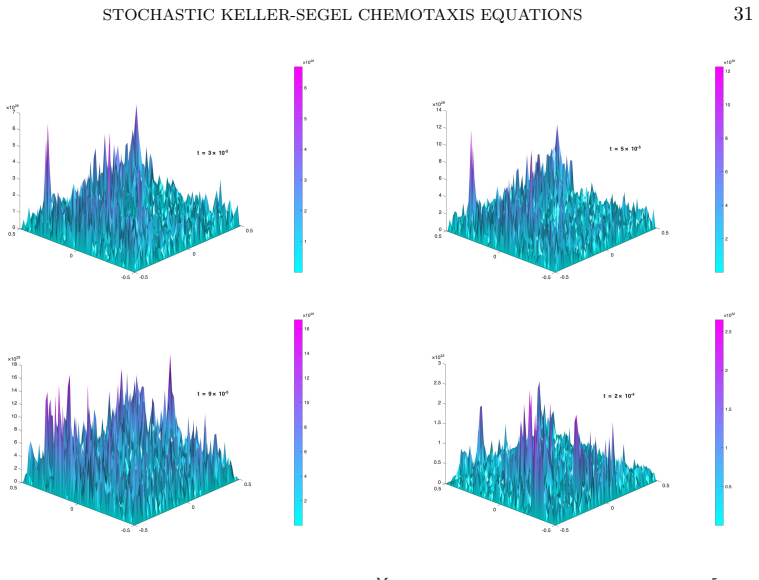
H. C. Berg and D. A. Brown. Chemotaxis in Escherichia coli analysed by three-dimensional tracking. nature, 239(5374):500–504, 1972. STOCHASTIC KELLER-SEGEL CHEMOTAXIS EQUATIONS 31 Fig. 5.4. Blowup plots of the computed solution E[uM h ] with different final times tM = 3 × 10⁻⁵, 5 × 10⁻⁵, 9 × 10⁻⁵, 2 × 10⁻⁴, and J = 400
work page 1972
-
[3]
E. Carelli and A. Prohl. Rates of convergence for discretizations of the stochastic incompressible Navier– Stokes equations. SIAM Journal on Numerical Analysis , 50(5):2467–2496, 2012
work page 2012
-
[4]
W. Chen, Q. Liu, and J. Shen. Error estimates and blow-up analysis of a finite-element approximation for the parabolic-elliptic Keller-Segel system. arXiv preprint arXiv:2212.07655 , 2022
arXiv 2022
-
[5]
A. Duarte-Rodr ´ ıguez, M.´A. Rodr ´ ıguez-Bellido, D. A. Rueda-G´ omez, and´E. J. Villamizar-Roa. Numerical analysis for a chemotaxis-Navier–Stokes system. ESAIM: Mathematical Modelling and Numerical Analysis, 55:S417–S445, 2021
work page 2021
-
[6]
X. Feng, Y. Li, and Y. Zhang. A fully discrete mixed finite element method for the stochastic Cahn–Hilliard equation with gradient-type multiplicative noise. Journal of Scientific Computing , 83(1):23, 2020
work page 2020
-
[7]
X. Feng and L. Vo. High moment and pathwise error estimates for fully discrete mixed finite element approximations of stochastic Navier–Stokes equations with additive noise. Communications in Com- putational Physics , 36(3):821–849, 2024
work page 2024
-
[8]
F. Filbet. A finite volume scheme for the Patlak–Keller–Segel chemotaxis model. Numerische Mathematik, 104(4):457–488, 2006
work page 2006
Show all 28 references
-
[9]
Friedl and D
P. Friedl and D. Gilmour. Collective cell migration in morphogenesis, regeneration and cancer. Nature reviews Molecular cell biology , 10(7):445–457, 2009
2009
-
[10]
Gilbarg, N
D. Gilbarg, N. S. Trudinger, D. Gilbarg, and N. Trudinger. Elliptic partial differential equations of second order, volume 224. Springer, 1977
1977
-
[11]
Hausenblas, D
E. Hausenblas, D. Mukherjee, and T. Tran. The one-dimensional stochastic Keller–Segel model with time-homogeneous spatial wiener processes. Journal of differential equations , 310:506–554, 2022
2022
-
[12]
Horstmann
D. Horstmann. From 1970 until present: the Keller-Segel model in chemotaxis and its consequences. 2003
1970
-
[13]
Hu and X
J. Hu and X. Zhang. Positivity-preserving and energy-dissipative finite difference schemes for the Fokker– Planck and Keller–Segel equations. IMA Journal of Numerical Analysis , 43(3):1450–1484, 2023
2023
-
[14]
Huang and J
H. Huang and J. Qiu. The microscopic derivation and well-posedness of the stochastic Keller–Segel equa- tion. Journal of nonlinear science , 31(1):6, 2021
2021
-
[15]
E. F. Keller and L. A. Segel. Initiation of slime mold aggregation viewed as an instability. Journal of Theoretical Biology, 26(3):399–415, 1970
1970
-
[16]
Mayorcas and M
A. Mayorcas and M. Tomaˇ sevi´ c. Blow-up for a stochastic model of chemotaxis driven by conservative noise on R2. Journal of Evolution Equations , 23(3):57, 2023
2023
-
[17]
Misiats, O
O. Misiats, O. Stanzhytskyi, and I. Topaloglu. On global existence and blowup of solutions of stochastic Keller–Segel type equation. Nonlinear Differential Equations and Applications NoDEA, 29(1):3, 2022
2022
-
[18]
T. Nagai. Behavior of solutions to a parabolic-elliptic system modelling chemotaxis. Journal of the Korean 32 LIET VO Mathematical Society, 37(5):721–733, 2000
2000
-
[19]
B. G. Pachpatte. Inequalities for finite difference equations . CRC Press, 2001
2001
-
[20]
Perthame
B. Perthame. Transport equations in biology. Springer, 2007
2007
-
[21]
E. T. Roussos, J. S. Condeelis, and A. Patsialou. Chemotaxis in cancer. Nature Reviews Cancer, 11(8):573– 587, 2011
2011
-
[22]
N. Saito. Error analysis of a conservative finite-element approximation for the Keller-Segel system of chemotaxis. Commun. Pure Appl. Anal , 11(1):339–364, 2012
2012
-
[23]
Shi and C
D. Shi and C. Li. A linearized decoupled Crank–Nicolson FEM for Keller–Segel chemotactic model with nonlinear secretion. Communications in Nonlinear Science and Numerical Simulation , 118:107063, 2023
2023
-
[24]
P. J. Van Haastert and P. N. Devreotes. Chemotaxis: signalling the way forward. Nature reviews Molecular cell biology, 5(8):626–634, 2004
2004
-
[25]
L. Vo. Higher order time discretization method for the stochastic Stokes equations with multiplicative noise. Journal of Scientific Computing , 97(3):59, 2023
2023
-
[26]
L. Vo. High moment and pathwise error estimates for fully discrete mixed finite element approximations of the stochastic Stokes equations with multiplicative noise. ESAIM: Mathematical Modelling and Numerical Analysis, 59(3):1301–1331, 2025
2025
-
[27]
Zhang, J
J. Zhang, J. Zhu, and R. Zhang. Characteristic splitting mixed finite element analysis of Keller–Segel chemotaxis models. Applied Mathematics and Computation , 278:33–44, 2016
2016
-
[28]
Zhou and N
G. Zhou and N. Saito. Finite volume methods for a Keller–Segel system: discrete energy, error estimates and numerical blow-up analysis. Numerische Mathematik , 135(1):265–311, 2017
2017
Reviewed August 6, 2026 · model on record in the stance chip above.
Discussion (0). Continue with ORCID to comment.