REVIEW 5 major objections 7 minor 50 references
Observations of the X-ray Millihertz Quasiperiodic Oscillations in Hercules X-1
T0 review · 5 major / 7 minor · reviewed 2026-08-10 · deepseek-v4-flash
Pith's one-line read Her X-1's X-ray variability splits into two millihertz QPO families with different luminosity dependencies.
desk verdict Solid 10 mHz QPO confirmation from HXMT, but the new 5-9 mHz population and its luminosity correlation rest on sub-threshold detections and need a formal statistical test before the two-family claim is secure. read the letter →
The pith
A machine-rendered reading of the paper's core claim, the machinery that carries it, and where it could break.
The reading
What carries the argument
The analysis hinges on the continuous wavelet transform with a Morlet mother wavelet, which resolves transient oscillations in both time and frequency and can catch QPOs that a stationary Fourier power spectrum would blur out. Detected peaks are characterized by their global wavelet power relative to a 95% confidence red-noise spectrum (the R factor) and by a quality factor Q; the paper keeps peaks with R > 0.9 and good time intervals longer than 800 seconds. For interpretation, the paper uses the beat-frequency model, which predicts a QPO at the difference between the spin frequency and the Keplerian frequency at the Alfvén radius, and the magnetic disk precession model, whose predicted precession timescale depends on X-ray luminosity and viscosity.
What would settle it
Re-analyze the same light curves with the detection threshold set to R ≥ 1 (peak power at or above the 95% confidence level); if no 5–9 mHz peak survives and the frequency–luminosity correlation disappears, the central claim is refuted.
Extended reading notes
Core claim
The paper's central claim is that Her X-1 shows two distinct types of X-ray mHz QPOs: a previously hinted ~10 mHz oscillation and a newly identified ~5–9 mHz oscillation that coexists with it. Using wavelet analysis on individual good time intervals, the authors find that the lower-frequency QPO's centroid frequency increases from about 5 mHz to about 9 mHz as the 2–110 keV luminosity grows from roughly 2×$10^{37}$ to 4×$10^{37}$ erg/s, whereas the 10 mHz QPO frequency is independent of luminosity. They further find that the 10 mHz X-ray QPO matches the frequency, rms amplitude, and quality factor of the UV QPOs reported for this source, supporting a common reprocessing origin, while the behavior of the 5–9 mHz QPO points to a separate mechanism, most plausibly precession of the magnetically warped inner disk.
Load-bearing premise
The new 5–9 mHz QPO family is selected with a wavelet-power threshold of R > 0.9, which is below the 95% confidence level, so some of the reported detections may be noise fluctuations rather than real oscillations.
Editorial extensions
If this is right
- If the 10 mHz X-ray and UV QPOs share a beat-frequency origin, the magnetospheric boundary condition of Alfvén radius close to corotation must persist during the observed main-on states.
- If the 5–9 mHz QPO is magnetic disk precession, its frequency should respond to luminosity and viscosity changes in other strongly magnetized pulsars, providing a probe of inner-disk conditions.
- The luminosity–frequency relation of the 5–9 mHz QPO gives a new observable for tracking accretion changes over the 35-day superorbital cycle.
- A common origin for the 10 mHz X-ray and UV oscillations would allow simultaneous multiwavelength observations to map the reprocessing geometry of the disk and companion star.
Reading between the lines
- If confirmed with a stricter detection threshold, the 5–9 mHz frequency–luminosity relation could be calibrated as a luminosity indicator for Her X-1 and applied to other disk-fed pulsars with similar magnetic fields.
- A direct testable extension would be to search for a 5–9 mHz component in simultaneous UV or optical light curves; if reprocessing dominates, the lower-frequency QPO should appear there only weakly or not at all.
- One could also check whether the 5–9 mHz QPO appears in archival observations at other 35-day phases; the magnetic precession model predicts it should be strongest when the inner disk is most strongly warped.
Signed reviews
Editorial analysis
A structured set of objections, weighed in public.
Referee Report
Summary. Using Insight-HXMT observations of Her X-1 from 2017 to 2019, the paper reports a ~10 mHz QPO in the power density and wavelet spectra and identifies a new family of ~5-9 mHz QPOs coexisting with the 10 mHz feature. It claims a positive correlation between the 5-9 mHz centroid frequency and the 2-110 keV X-ray luminosity, while the 10 mHz frequency remains constant, and interprets the 10 mHz QPOs as beat-frequency oscillations and the 5 mHz QPOs as magnetic disk precession. The 10 mHz detection is supported by a PDS fitting improvement, but the 5-9 mHz family and the luminosity correlation rest on wavelet peaks selected with R>0.9 and on a visual trend without a statistical test.
Significance. If the two-family interpretation survives scrutiny, this would be a valuable addition to the sparse phenomenology of mHz QPOs in HMXB pulsars: Her X-1 would become a rare case with two coexisting mHz QPO families showing different luminosity dependencies, providing new constraints on beat-frequency and disk-precession models. The paper's strengths are the systematic use of a large public HXMT dataset, the explicit PDS detection statistic for the 10 mHz QPO (chi-square change from 84 to 112), and the wavelet time-frequency maps that display transient frequency evolution. At present the 5-9 mHz identification is not yet secure because the adopted R>0.9 threshold is below the 95% confidence level (R=1 by Eq. 8), and the luminosity relation is asserted without a regression or error propagation. The theoretical interpretation is illustrative rather than testable because key model parameters (alpha for Her X-1 and the allowed Alfven radius range) are taken from other sources or allowed to vary over a wide range.
major comments (5)
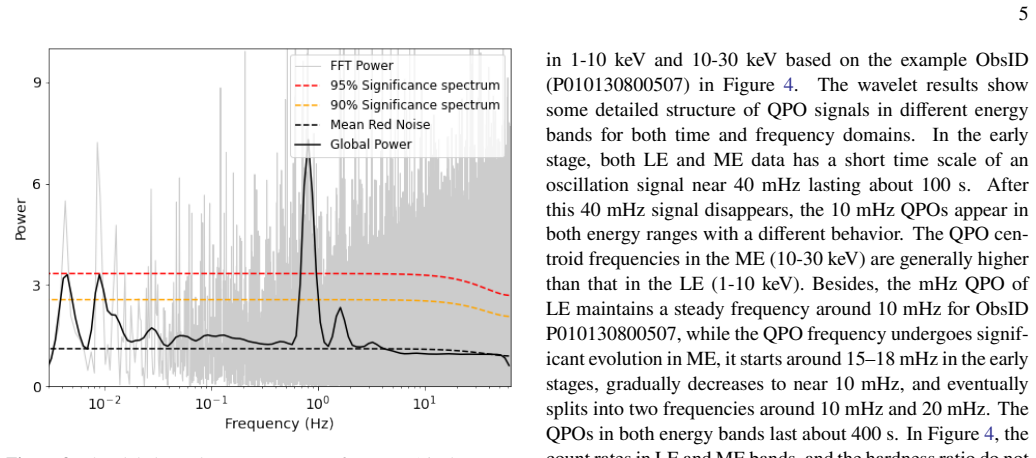
- [Section 3.2 / Eq. (8) / Table 2] The detection threshold is inconsistent with the stated significance criterion. The R factor is defined as the global wavelet peak divided by the global 95% confidence spectrum, so R<1 means the peak is below the 95% confidence level. The paper nevertheless selects peaks with R>0.9, and Table 2 lists 5 mHz peaks with R=0.97±0.07 (ObsID 0207) and R=0.92±0.11 (ObsID 0402). These are not significant detections by the paper's own definition, yet they enter the 5-9 mHz sample and the luminosity plot. The Figure 3 caption, which says the 5 and 10 mHz detections reach the 95% significance levels, is also in tension with R=0.95-0.97 for the same observation. Please re-run the analysis with R≥1 or provide a separate, justified threshold, and show the luminosity relation without the sub-threshold points.
- [Section 3.2 / Figure 5] The claimed positive correlation is not supported by a statistical test. Figure 5 shows no error bars, no fitted line, and no correlation coefficient; Table 2 does provide uncertainties on frequency and luminosity, so a weighted regression (or at least a Spearman rank test) should be reported. With only six 5 mHz points, two of which are below the 95% confidence threshold, the visual trend may be driven by a small number of points. Please report the correlation coefficient with its p-value, both with and without the R<1 detections, and include error bars in the figure.
- [Section 4 / Table 2] The 5 and 10 mHz features in ObsIDs 0207 and 0801 have frequencies in a 2:1 ratio (0.0046/0.0095 and 0.0055/0.0106). The paper dismisses a harmonic relation because the two features have approximately equal global wavelet power and different luminosity behavior, but a subharmonic can have comparable power and the luminosity argument is exactly what is under test. A quantitative test (e.g., phase coherence between the two features, or amplitude ratios in individual time segments) is needed before claiming two independent physical mechanisms.
- [Section 3.2 / Section 4 / Figure 5] The constancy of the 10 mHz frequency depends on excluding ObsID 0507 from the correlation. That observation's ME QPO evolves from ~15-18 mHz to ~10 mHz and has an unusually large FWHM (4.5 mHz), so there is a physical rationale for treating it separately, but the manuscript does not state an a-priori criterion. Because the conclusion that the 10 mHz frequency is luminosity-independent is based on the remaining points, the paper should show the result with and without ObsID 0507 and discuss whether its frequency evolution reflects a different accretion state rather than a luminosity dependence.
- [Section 4 / Eq. (9)] The magnetic disk precession prediction is not a clean test. Eq. (9) is evaluated with α=0.023 taken from Roy et al. (2019) for 4U 0115+63, without propagating the uncertainty in α or demonstrating that this value applies to Her X-1. The beat-frequency discussion likewise allows the Alfven radius to vary from 3.5×10^7 to 4.1×10^8 cm while merely requiring it to be close to the corotation radius. With these choices the predicted 5-9 mHz range is essentially flexible, so the agreement with the observed frequencies provides weak model discrimination. Please constrain α from the Her X-1 disk (or show the sensitivity) and specify a quantitative corotation proximity condition.
minor comments (7)
- [Section 3.1] The text refers to 'P01030800701' and 'P01030801504' while Table 2 uses the last four digits (e.g., 0207, 1504); please make the observation naming consistent.
- [Section 3.1 / Eq. (1)] Please clarify whether S and B are count rates in the same energy band and whether the light curves used for the rms calculation are background-subtracted; the formula includes B in the numerator although background subtraction is described earlier.
- [Section 3.2 / Eq. (3)] The Morlet wavelet central frequency ω0 is not stated; the scale-to-frequency conversion and the frequency resolution depend on this choice (usually ω0=6), so please report it.
- [Section 3.2 / Figure 3] The red-noise parameter α=0.054 is quoted in the caption but the estimation of the AR(1) parameter is not described; please state how α is obtained for each light curve.
- [Section 4 / Eq. (9)] The left-hand side is denoted t_prec but the text calls it the QPO precessional frequency; please clarify that it is the period and that ν_qpo = 1/t_prec.
- [Table 2] Empty cells for non-detections would be clearer as em dashes or 'not detected'.
- [Acknowledgments] The acknowledgments contain 'the the NSFC'; please remove the duplicated article.
Circularity Check
No significant circularity: the empirical detections are data-driven and the theoretical interpretations use external models and parameters.
full rationale
The central empirical claims—detection of ~10 mHz and ~5–9 mHz QPOs, the luminosity dependence of the 5–9 mHz centroid frequency, and the constancy of the 10 mHz frequency—are derived directly from Insight-HXMT light curves via standard power-density-spectrum fitting and continuous wavelet analysis against an AR(1) red-noise background (Torrence & Compo 1998). The 5–9 mHz population is not constructed from the luminosity values; both quantities are measured from the same observations, but the correlation is an empirical relationship, not a fitted parameter. The theoretical section applies the beat-frequency model to the 10 mHz QPO as a consistency check: the radius required by the BFM is compared with the Alfvén radius estimated from the known cyclotron magnetic field, and the precession model for the 5 mHz QPO uses equation (27) of Shirakawa & Lai (2002) with α = 0.023 taken from Roy et al. (2019), an external source, rather than being fitted to the Her X-1 data. The only self-citations (Wang et al. 2021; Zhu & Wang 2024; Chen et al. 2022) concern data-reduction procedures and wavelet application, and are not load-bearing for the physical conclusions. The R > 0.9 selection threshold and the use of an external viscosity parameter are statistical and modeling caveats, but they are not cases where a prediction reduces by construction to its inputs.
Assumptions & free parameters
free parameters (4)
- Viscosity parameter alpha for Her X-1 disk =
0.023 (adopted from Roy et al. 2019 model fits to 4U 0115+63)
- QPO selection threshold R > 0.9 =
0.9
- AR(1) red-noise parameter for wavelet significance =
e.g., 0.054 for ObsID 0207
- X-ray spectral fit parameters (TBabs * cutoffpl) =
not tabulated in the paper
assumptions (6)
- domain assumption Her X-1 is at a distance of 6.6 kpc
- domain assumption Neutron star mass is 1.4 solar masses and radius is 1e6 cm
- domain assumption Magnetic field strength is about 2.9e12 G
- ad hoc to paper The Alfven radius must be close to the corotation radius for the 10 mHz beat-frequency interpretation
- standard math Wavelet significance is calibrated against an AR(1) red-noise model with a chi-square distribution
- domain assumption The 10 mHz X-ray and UV QPOs share a common origin through reprocessing
Cite this review
Pith. "Pith review of Observations of the X-ray Millihertz Quasiperiodic Oscillations in Hercules X-1." pith.science (2026). https://pith.science/paper/GWUOL5IS
@misc{pith2026250115366,
  author       = {Pith},
  title        = {Pith review of: Observations of the X-ray Millihertz Quasiperiodic Oscillations in Hercules X-1},
  year         = {2026},
  howpublished = {\url{https://pith.science/paper/GWUOL5IS}},
  note         = {Machine review of arXiv:2501.15366}
}
abstract
With a systematic timing investigation of the persistent X-ray binary pulsar Her X-1 based on a large number of Insight-HXMT observations between 2017 to 2019, we confirm the presence of X-ray millihertz quasi-periodic oscillations (mHz QPOs) at $\sim 0.01$ Hz. By applying wavelet analysis in our data analysis procedures, we firstly identified $\sim 0.005-0.009$ Hz QPOs coexisting with the $\sim 0.01$ Hz QPOs. Wavelet analysis suggests that these QPO features show transient behaviors, frequencies of mHz QPOs evolved in short time scales. There exists a positive relation between QPO centroid frequency (from $\sim 0.005-0.009$ Hz) and the X-ray luminosity, while the 10 mHz QPO frequencies keep nearly constant for different luminosities, which suggests different physical mechanisms for two types of mHz QPOs. The 10 mHz QPOs in both X-ray and UV bands would have the same origin related to the beat frequency where the Alfv$\acute{e}$n radius is close to the corotation radius, and the 5 mHz QPOs may originate from magnetic disk precession.
Figures


Figures from the paper (2 more)


Reference graph
Works this paper leans on
-
[1]
Addison, P. S. 2017, The illustrated wavelet transform handbook: introductory theory and applications in science, engineering, medicine and finance (CRC press)
work page 2017
- [2]
-
[3]
1989, Astrophysical Journal, Part 1 (ISSN 0004-637X), vol
Angelini, L., Stella, L., & Parmar, A. 1989, Astrophysical Journal, Part 1 (ISSN 0004-637X), vol. 346, Nov. 15, 1989, p. 906-911., 346, 906 Boroson,B.,O’Brien,K.,Horne,K.,etal.2000,TheAstrophysical Journal, 545, 399
work page 1989
-
[4]
Brumback, M. C., Hickox, R. C., Fürst, F. S., et al. 2021, The Astrophysical Journal, 909, 186
work page 2021
-
[5]
2015, The Astrophysical Journal, 799, 2
Bu, Q.-c., Chen, L., Li, Z.-s., et al. 2015, The Astrophysical Journal, 799, 2
work page 2015
- [6]
-
[7]
1998, The Astrophysical Journal, 492, 342
Chakrabarty, D. 1998, The Astrophysical Journal, 492, 342
work page 1998
-
[8]
2022, Monthly Notices of the Royal Astronomical Society, 513, 4875
Chen, X., Wang, W., You, B., et al. 2022, Monthly Notices of the Royal Astronomical Society, 513, 4875
work page 2022
Show all 50 references
-
[9]
2020, Science China Physics, Mechanics & Astronomy, 63, 1
Chen, Y., Cui, W., Li, W., et al. 2020, Science China Physics, Mechanics & Astronomy, 63, 1
2020
-
[10]
2011, Monthly Notices of the Royal Astronomical Society, 414, 1023
Devasia, J., James, M., Paul, B., & Indulekha, K. 2011, Monthly Notices of the Royal Astronomical Society, 414, 1023
2011
-
[11]
2021, Monthly Notices of the Royal Astronomical Society, 503, 6045
Ding, Y., Wang, W., Zhang, P., et al. 2021, Monthly Notices of the Royal Astronomical Society, 503, 6045
2021
-
[12]
1996, Astrophysical Journal v
Finger, M., Wilson, R., & Harmon, B. 1996, Astrophysical Journal v. 459, p. 288, 459, 288
1996
-
[13]
2023, Monthly Notices of the Royal Astronomical Society, 524, 1478
Ghosh, A., Gallo, L., & Gonzalez, A. 2023, Monthly Notices of the Royal Astronomical Society, 524, 1478
2023
-
[14]
1979, Astrophysical Journal, Part 1, vol
Ghosh, P., & Lamb, F. 1979, Astrophysical Journal, Part 1, vol. 234, Nov. 15, 1979, p. 296-316., 234, 296
1979
-
[15]
2024, Nature Astronomy, 1
Heyl, J., Doroshenko, V., González-Caniulef, D., et al. 2024, Nature Astronomy, 1
2024
-
[16]
2004, The Astrophysical Journal, 616, 463
Inam, S., Baykal, A., Swank, J., & Stark, M. 2004, The Astrophysical Journal, 616, 463
2004
-
[17]
2010, Monthly Notices of the Royal Astronomical Society, 407, 285
James, M., Paul, B., Devasia, J., & Indulekha, K. 2010, Monthly Notices of the Royal Astronomical Society, 407, 285
2010
- [18]
-
[19]
2007, The Astrophysical Journal, 660, 1409
Kaur, R., Paul, B., Raichur, H., & Sagar, R. 2007, The Astrophysical Journal, 660, 1409
2007
-
[20]
1999, The Astrophysical Journal, 524, 1030
Lai, D. 1999, The Astrophysical Journal, 524, 1030
1999
-
[21]
2003, Monthly Notices of the Royal Astronomical Society, 342, 446
Leahy, D. 2003, Monthly Notices of the Royal Astronomical Society, 342, 446
2003
-
[22]
2011, The Astrophysical Journal, 736, 74
Leahy, D., & Igna, C. 2011, The Astrophysical Journal, 736, 74
2011
-
[23]
2020, The Astrophysical Journal, 889, 131
Leahy, D., Postma, J., & Chen, Y. 2020, The Astrophysical Journal, 889, 131
2020
-
[24]
2020, The Astrophysical Journal, 902, 146
Leahy, D., & Wang, Y. 2020, The Astrophysical Journal, 902, 146
2020
-
[25]
2020, SCIENCE CHINA Physics, Mechanics & Astronomy, 63, 1
Liu, C., Zhang, Y., Li, X., et al. 2020, SCIENCE CHINA Physics, Mechanics & Astronomy, 63, 1
2020
-
[26]
2022, Monthly Notices of the Royal Astronomical Society, 516, 5579
Liu, Q., Wang, W., Chen, X., et al. 2022, Monthly Notices of the Royal Astronomical Society, 516, 5579
2022
-
[27]
2015, Monthly Notices of the Royal Astronomical Society, 454, 541
Lyu, M., Méndez, M., Zhang, G., & Keek, L. 2015, Monthly Notices of the Royal Astronomical Society, 454, 541
2015
-
[28]
2024, Monthly Notices of the Royal Astronomical Society, 531, 530
Manikantan, H., Paul, B., Sharma, R., Pradhan, P., & Rana, V. 2024, Monthly Notices of the Royal Astronomical Society, 531, 530
2024
-
[29]
1981, Astrophysical Journal, 244, 1001
Middleditch, J., Mason, K., Nelson, J., & White, N. 1981, Astrophysical Journal, 244, 1001
1981
-
[30]
Moon, D.-S., & Eikenberry, S. S. 2001, The Astrophysical Journal, 552, L135 O’Brien, K., Horne, K., Boroson, B., et al. 2001, Monthly Notices of the Royal Astronomical Society, 326, 1067
2001
-
[31]
2011, arXiv preprint arXiv:1110.4446
Paul, B., & Naik, S. 2011, arXiv preprint arXiv:1110.4446
2011 arXiv
-
[32]
1998, arXiv preprint astro-ph/9805366
Paul, B., & Rao, A. 1998, arXiv preprint astro-ph/9805366
1998 arXiv
-
[33]
Petterson, J. A. 1975, Astrophysical Journal, vol. 201, Oct. 15, 1975, pt. 2, p. L61-L64., 201, L61
1975
- [34]
-
[35]
2021, Monthly Notices of the Royal Astronomical Society, 508, 5578
Raman, G., Paul, B., & Bhattacharya, D. 2021, Monthly Notices of the Royal Astronomical Society, 508, 5578
2021
-
[36]
1997, Monthly Notices of the Royal Astronomical Society, 288, 43
Reynolds, A., Quaintrell, H., Still, M., et al. 1997, Monthly Notices of the Royal Astronomical Society, 288, 43
1997
-
[37]
2019, The Astrophysical Journal, 872, 33
Roy, J., Agrawal, P., Iyer, N., et al. 2019, The Astrophysical Journal, 872, 33
2019
-
[38]
1999, The Astrophysical Journal, 510, 974
Scott, D., & Leahy, D. 1999, The Astrophysical Journal, 510, 974
1999
-
[39]
2002, The Astrophysical Journal, 565, 1134
Shirakawa, A., & Lai, D. 2002, The Astrophysical Journal, 565, 1134
2002
-
[40]
1983, Astronomy and Astrophysics, vol
Staubert, R., Bezler, M., & Kendziorra, E. 1983, Astronomy and Astrophysics, vol. 117, no. 2, Jan. 1983, p. 215-219., 117, 215
1983
-
[41]
2009, arXiv preprint arXiv:0904.2307
Staubert, R., Klochkov, D., & Wilms, J. 2009, arXiv preprint arXiv:0904.2307
2009 arXiv
-
[42]
1994, Astrophysical Journal, Part 1 (ISSN 0004-637X), vol
Takeshima, T., Dotani, T., Mitsuda, K., & Nagase, F. 1994, Astrophysical Journal, Part 1 (ISSN 0004-637X), vol. 436, no. 2, p. 871-874, 436, 871
1994
-
[43]
a., Gursky, H., Kellogg, E., et al
Tananbaum, H. a., Gursky, H., Kellogg, E., et al. 1972, Astrophysical Journal, vol. 174, p. L143, 174, L143
1972
-
[44]
Torrence, C., & Compo, G. P. 1998, Bulletin of the American Meteorological society, 79, 61 Trümper, J., Pietsch, W., Reppin, C., et al. 1978, Astrophysical
1998
-
[45]
219, Feb
Journal, Part 2-Letters to the Editor, vol. 219, Feb. 1, 1978, p. L105-L110. Deutsche Forschungsgemeinschaft, 219, L105 Van der Klis, M., Stella, L., White, N., Jansen, F., & Parmar, A. 1987, Astrophysical Journal, Part 1 (ISSN 0004-637X), vol. 316, May 1, 1987, p. 411-426., 316, 411
1978
-
[46]
2001, The Astrophysical Journal, 549, 522
Vrtilek, S., Quaintrell, H., Boroson, B., et al. 2001, The Astrophysical Journal, 549, 522
2001
-
[47]
2021, Journal of High Energy Astrophysics, 30, 1, doi: https://doi.org/10.1016/j.jheap.2021.01.002
Wang, W., Tang, Y., Tuo, Y., et al. 2021, Journal of High Energy Astrophysics, 30, 1, doi: https://doi.org/10.1016/j.jheap.2021.01.002
2021 doi
-
[48]
2019, Journal of High Energy Astrophysics, 23, 29
Xiao, G., Ji, L., Staubert, R., et al. 2019, Journal of High Energy Astrophysics, 23, 29
2019
-
[49]
2014, in Space Telescopes and Instrumentation 2014: Ultraviolet to Gamma Ray, Vol
Zhang, S., Lu, F., Zhang, S., & Li, T. 2014, in Space Telescopes and Instrumentation 2014: Ultraviolet to Gamma Ray, Vol. 9144, SPIE, 588–595 10
2014
-
[50]
2024, The Astrophysical Journal, 968, 106
Zhu, H., & Wang, W. 2024, The Astrophysical Journal, 968, 106
2024
Reviewed August 10, 2026 · model on record in the stance chip above.
Discussion (0). Continue with ORCID to comment.