REVIEW 3 major objections 4 minor 30 references
Magnetic and electric behaviors of DyMn$_2$O$_5$: effect of hole doping
T0 review · 3 major / 4 minor · reviewed 2026-08-14 · deepseek-v4-flash
Pith's one-line read Replacing dysprosium with strontium in DyMn2O5 raises the Mn4+ fraction, shortens Mn4+-Mn4+ bonds by about 9%, and strengthens ferromagnetic correlations.
desk verdict Solid systematic data on Sr-doped DyMn2O5, but the enhanced-FM mechanism claim is overinterpreted and needs revision. read the letter →
The pith
A machine-rendered reading of the paper's core claim, the machinery that carries it, and where it could break.
The reading
What carries the argument
The load-bearing mechanism is the ferromagnetic part of the Mn$^{4+}$--Mn$^{4+}$ exchange running through edge-sharing Mn$^{4+}$O$_6$ octahedra that form ribbons along the c axis. Divalent Sr at the Dy site raises the Mn$^{4+}$ fraction through charge compensation; with more Mn$^{4+}$ pairs and a shorter Mn$^{4+}$--Mn$^{4+}$ bond (about 9% contraction), direct exchange strengthens the ferromagnetic alignment that already has a c-axis component in the parent magnetic structure. The paper uses this mechanism to explain the larger 43 K anomaly and higher 3 K coercivity, while the accompanying dilution of the Dy sublattice explains the weaker 9 K transition and the reduced magnetocaloric response.
What would settle it
Measure the ordered magnetic moment of Dy$_{0.8}$Sr$_{0.2}$Mn$_2$O$_5$ by neutron diffraction and determine the manganese valence by Mn K-edge X-ray absorption: if the Mn$^{4+}$ fraction has not increased or the ordered moment on the Mn$^{4+}$ sublattice is not larger than in the parent compound, the central ferromagnetic-enhancement explanation is wrong.
Extended reading notes
Core claim
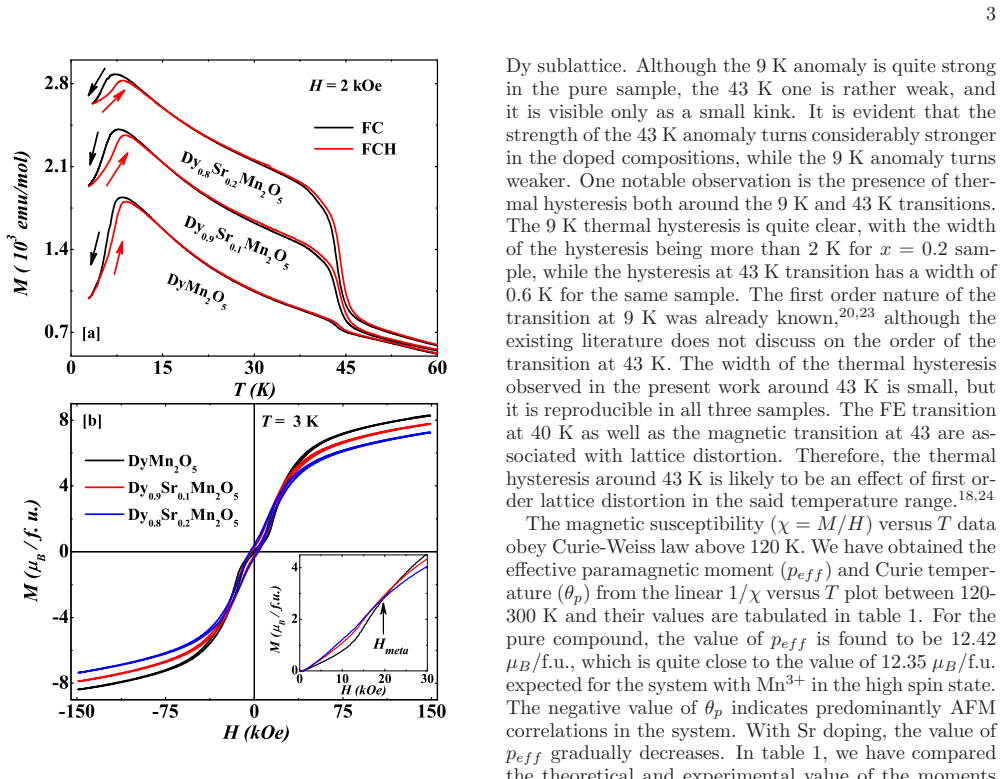
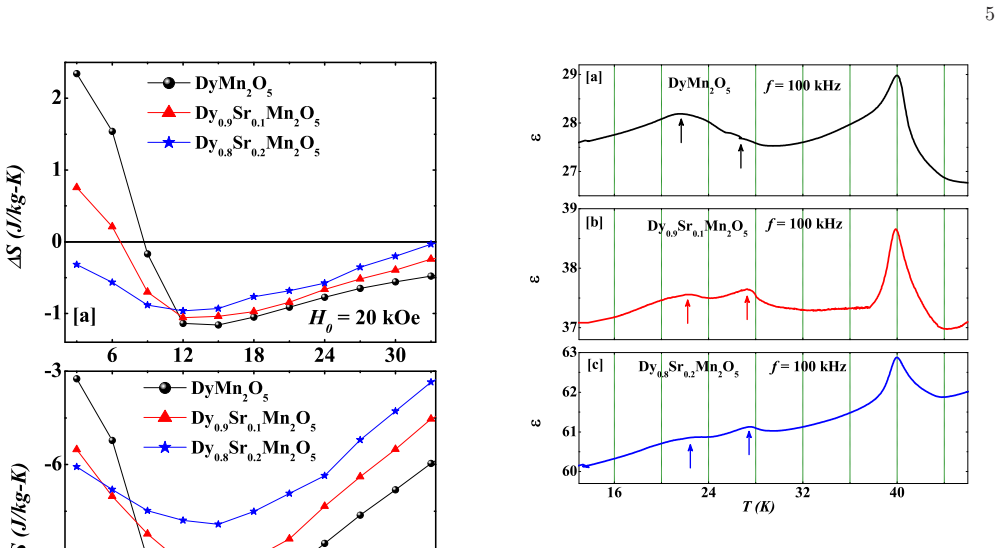
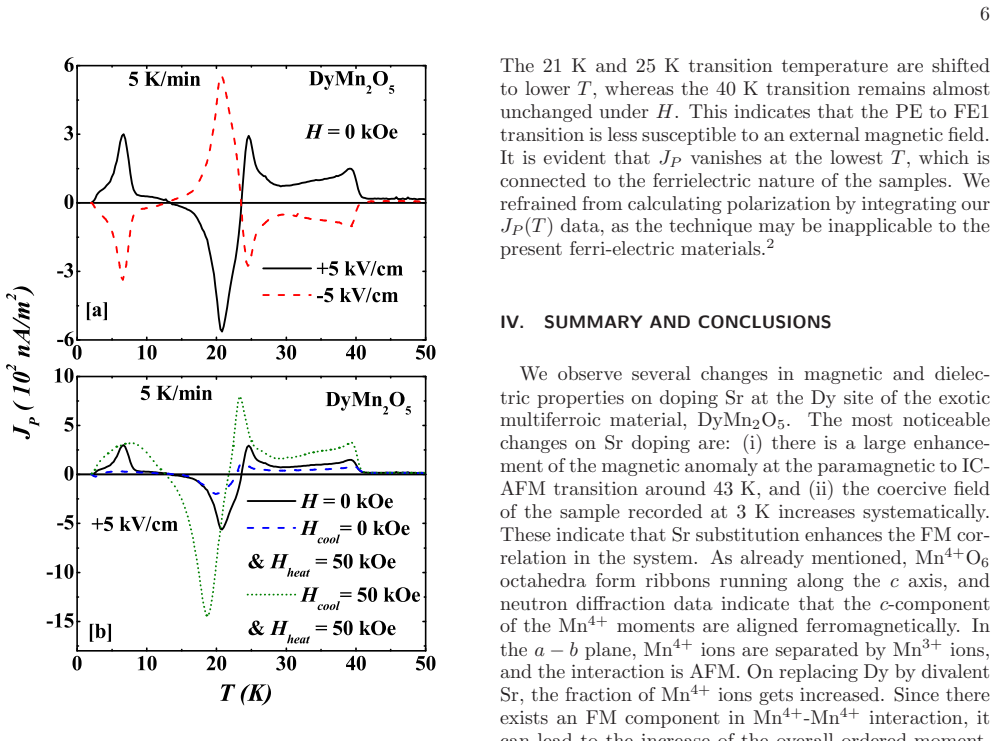
On the paper's own terms, the central claim is that Sr doping of DyMn$_2$O$_5$ works through two linked effects: charge compensation increases the Mn$^{4+}$ fraction, and the extra Mn$^{4+}$ strengthens the ferromagnetic component of the exchange between neighboring Mn$^{4+}$ ions, whose octahedra form ribbons along the c axis. The signatures are a much larger magnetic anomaly at the 43 K transition, a coercive field at 3 K that grows from 1.49 to 3.55 kOe with Sr content, and a roughly 9% shorter Mn$^{4+}$--Mn$^{4+}$ bond. On the electric side, the dielectric anomaly near 28 K tied to the transition from the first to the second ferroelectric state (FE1 to FE2) becomes strongly enhanced, while the feature near 21 K weakens, suggesting that Mn$^{4+}$ favors the FE2 phase. The parent compound shows a conventional magnetocaloric peak at 12 K, with $\Delta S = 11.2~\mathrm{J\,kg^{-1}\,K^{-1}}$ at 75 kOe and $\mathrm{RCP} \approx 316~\mathrm{J/kg}$, which declines with Sr doping because the Dy sublattice is diluted. The field sensitivity of the pyroelectric peaks near 21--25 K is read as supporting the earlier proposal that multiple ferroelectric transitions accompany changes in the magnetic structure.
Load-bearing premise
The argument assumes that the larger 43 K magnetic anomaly, the higher 3 K coercivity, and the shorter Mn--Mn bond all reflect genuinely stronger ferromagnetic exchange between Mn$^{4+}$ ions, rather than side effects of adding strontium such as lattice strain, local disorder, phase segregation, or altered magnetic anisotropy.
Editorial extensions
If this is right
- The 43 K magnetic anomaly should grow monotonically with Sr content as long as the Mn4+ fraction rises, making the anomaly size a proxy for hole doping.
- Coercive field at 3 K should continue to rise with Sr concentration, reflecting the stronger ferromagnetic correlations, until solubility limits or frustration intervene.
- The parent compound's magnetocaloric peak, 11.2 J kg$^{-1}$ K$^{-1}$ at 12 K with a 75 kOe field change and a relative cooling power of 316 J/kg, places DyMn2O5 among the viable low-temperature magnetic refrigerants, and Sr doping systematically weakens the response.
- The 28 K dielectric anomaly is enhanced while the 21 K feature weakens, indicating that Mn4+ content favors the FE2 ferroelectric phase over FE3.
- Pyroelectric peaks near 21-25 K shift and intensify under a 50 kOe field, while the 7 K peak is destroyed, showing that magnetic field can switch or suppress specific electric-order states.
Reading between the lines
- Beyond the paper's data, neutron diffraction on the doped samples should show a larger ordered moment on the Mn4+ sublattice along the c axis; if it does not, the ferromagnetic-correlation explanation would need revision.
- Extending the Sr series past x = 0.2 would test whether the 43 K anomaly and coercivity saturate, indicating a solubility or frustration limit to the charge-doping effect.
- The paper infers the Mn4+ increase from charge balance alone; X-ray absorption or bond-valence analysis on the doped samples would provide a direct, independent check.
- Comparing Sr doping with an isovalent rare-earth substitution would separate the hole-doping contribution from the effects of simple dilution and lattice change.
Signed reviews
Editorial analysis
A structured set of objections, weighed in public.
Referee Report
Summary. The paper reports a systematic study of Sr substitution at the Dy site in DyMn2O5 (x = 0, 0.1, 0.2) using powder X-ray diffraction, dc magnetization, dielectric permittivity, and pyroelectric current measurements. The authors find that Sr doping enhances the magnetic anomaly near 43 K, increases the low-temperature coercive field, weakens the 9 K Dy-ordering transition, and strengthens the dielectric anomaly near 28 K. They attribute these changes to an increased Mn4+ fraction that shortens the Mn4+-Mn4+ bond along the c axis and strengthens ferromagnetic correlations. The parent compound exhibits a large magnetocaloric effect (ΔS = 11.2 J kg−1 K−1 at 12 K for ΔH = 75 kOe, RCP = 316 J/kg), which decreases with Sr doping. The paper concludes that the observed effects arise from Dy dilution and enhanced Mn4+-Mn4+ ferromagnetic exchange.
Significance. If the central interpretation is correct, the paper demonstrates a simple chemical route to tune the magnetic and multiferroic properties of RMn2O5 manganites, and it identifies a promising magnetocaloric material in the parent compound, with a peak entropy change competitive with other transition-metal oxides. The reported measurements are internally consistent and the doping trends are systematic. The MCE values come from the standard Maxwell relation applied to measured isotherms, and the coercivity and lattice-parameter trends are independent observables, so the work is not circular. However, the key claim—that Sr doping enhances ferromagnetic Mn4+-Mn4+ correlations—is inferred rather than directly demonstrated, and the supporting evidence is circumstantial. The manuscript would be significantly strengthened by direct measurements of the Mn3+/Mn4+ ratio and of the magnetic structure, or by a more cautious framing of the interpretation.
major comments (3)
- [Section IV (Summary and Conclusions), paragraph 1; also Abstract] The central conclusion that the larger 43 K anomaly and the higher 3 K coercive field 'indicate that Sr substitution enhances the FM correlation in the system' is not uniquely supported by the data. Dy3+ carries a large magnetic moment and dominates the low-field susceptibility; replacing Dy3+ by nonmagnetic Sr2+ dilutes the Dy sublattice and weakens the 9 K ordering, so the 43 K Mn feature can appear more pronounced without any increase in Mn exchange strength. The same dilution, together with Sr-induced disorder or strain, can also raise coercivity and broaden transitions. The abstract's own hedge ('which we believe to be related') signals this gap. A background-subtracted analysis of the 43 K anomaly or a direct measurement of the ordered Mn moment (e.g., neutron diffraction) would be needed to distinguish enhanced FM correlations from dilution effects.
- [Section II and Section III (synthesis and Fig. 2)] The assumed increase in the Mn4+:Mn3+ ratio with Sr doping is never directly verified. The charge-balance argument presumes that Sr2+ substitution introduces hole doping without significant oxygen-vacancy formation, but no XANES, XPS, or oxygen-content analysis is presented. If oxygen vacancies compensate the charge deficit, the Mn4+ fraction may not increase as assumed, and the entire mechanism—including the bond-length change and the enhanced FM correlation—would be called into question. This is a load-bearing assumption for the paper's central claim.
- [Section III, Fig. 2 and Section IV] The reported ~9% decrease in the Mn4+-Mn4+ bond length with only 20% Sr substitution is presented without any uncertainties from the Rietveld refinement, and it appears in tension with the reported increase in the lattice parameter c. No R-factors, goodness-of-fit values, or error bars are provided, so the reader cannot assess whether the bond-length change is statistically significant or an artifact of the refinement. This is particularly important because the bond-length change is used as direct support for stronger direct exchange, and the 9% magnitude seems large for the modest doping levels studied.
minor comments (4)
- [Abstract] There is a typo: 'ferromagnetic corelations' should be 'ferromagnetic correlations'.
- [Section III, Table I] The table lists ΔS as '-11.2/-6.7' etc., but the text states a peak magnitude of 11.2 J kg−1 K−1 at 75 kOe. The sign convention should be defined explicitly in the table caption or text (conventional MCE corresponds to ΔS < 0).
- [Section III (MCE calculation)] The isothermal M(H) data used for the Maxwell-relation calculation are said to be 'not shown in here'; this makes it impossible for the reader to check the numerical integration or the field-spacing effects. Showing at least the representative isotherms or providing them as supplementary material would improve reproducibility.
- [Section III, Fig. 4] The captions could more clearly specify the temperature at which panels (a) and (b) were measured; currently the temperatures (42 K and 6 K) are only given in the text, not in the figure caption.
Circularity Check
No circularity: the paper's claims rest on direct measurements, standard Maxwell-relation MCE analysis, and external literature, not on fitted inputs or self-citation chains.
full rationale
The derivation chain is self-contained and non-circular. The Sr-doping effect is introduced as an aliovalent-substitution expectation, not as a fitted input: the paper states that doping divalent Sr at the Dy site is expected to enhance the Mn4+:Mn3+ ratio, but the central observations are directly measured quantities (magnetization anomalies, coercive field, bond length from PXRD refinement, dielectric anomalies, and pyroelectric current). The magnetocaloric entropy change is calculated from measured isothermal magnetization data using the standard Maxwell relation, so no parameter is fitted and then renamed as a prediction. The interpretation that the larger 43 K anomaly and increased coercivity indicate enhanced ferromagnetic correlations is an inference, not an equation-level reduction, and the abstract itself hedges with 'which we believe to be related'. Citations to Ratcliff, Zhao, and Higashiyama are external prior work and are not used to justify the paper's own central claim in a load-bearing way. The main weakness is underdetermination: the Mn4+ fraction is not directly measured and the enhanced-FM attribution is one possible mechanism, but that is a correctness and assumption risk, not circularity. Therefore the paper warrants a score of 0.
Assumptions & free parameters
free parameters (2)
- Mn4+-Mn4+ bond length along c-axis =
Decreases by about 9% for x=0.2, exact values not quoted
- Lattice parameters a, b, c and unit cell volume =
Reported as functions of x in Fig. 2, numeric values not tabulated
assumptions (4)
- domain assumption Sr2+ substitutes at the Dy3+ site and each Sr2+ converts one Mn3+ to Mn4+, increasing the Mn4+:Mn3+ ratio with x.
- domain assumption The anomaly near 43 K marks the paramagnetic to incommensurate antiferromagnetic transition, and its enhancement with doping reflects increased ferromagnetic correlations.
- standard math The Maxwell relation ΔS = ∫(∂M/∂T)_H dH applies to the measured magnetization isotherms.
- domain assumption The samples are single-phase and adopt the orthorhombic Pbam structure described by the Rietveld model.
Cite this review
Pith. "Pith review of Magnetic and electric behaviors of DyMn$_2$O$_5$: effect of hole doping." pith.science (2026). https://pith.science/paper/GX2DTY6W
@misc{pith2026190804609,
  author       = {Pith},
  title        = {Pith review of: Magnetic and electric behaviors of DyMn$_2$O$_5$: effect of hole doping},
  year         = {2026},
  howpublished = {\url{https://pith.science/paper/GX2DTY6W}},
  note         = {Machine review of arXiv:1908.04609}
}
abstract
DyMn$_2$O$_5$ is an intriguing multiferroic material showing multiple magnetic, electric and structural transitions. We present here the systematic study on the effect of Sr doping at the Dy site of DyMn$_2$O$_5$ through magnetic and dielectric measurements. Doping of divalent Sr at the Dy site is expected to enhance the Mn$^{4+}$:Mn$^{3+}$ ratio and it will also dilute the Dy site. Our study indicates large enhancement in the magnetic anomaly observed close to 43 K, which we believe to be related to the increased ferromagnetic correlations on Sr doping. Gradual increase in coercive field at 3 K with the Sr doping and decrease in bond length of adjacent Mn$^{4+}$ ions further support the enhancement of ferromagnetic corelations in the system. The parent sample shows a large magnetocaloric effect around 12 K, the magnitude of which found to decrease with increasing Sr concentration. The doping also enhances the anomaly at around 28 K observed in the dielectric permittivity versus temperature data, and this anomaly was earlier claimed to be associated with the spin reorientation as well as a simultaneous transition from one ferroelectric state to other. The electric orderings observed below 25 K are found to be susceptible to the applied magnetic field, and supports the view of Ratcliff II {\it et al.}(Phys. Rev. B {\bf 72}, 060407(R)(2005)) of concomitant changes in the magnetic structure associated with the multiple electric transitions.
Figures


Figures from the paper (4 more)


Reference graph
Works this paper leans on
-
[1]
author author S. C. \ Abrahams \ and\ author J. L. \ Bernstein ,\ @noop journal journal J. Chem. Phys. \ volume 46 ,\ pages 3776 ( year 1967 ) NoStop
work page 1967
-
[2]
author author D. Higashiyama , author S. Miyasaka , author N. Kida , author T. Arima , \ and\ author Y. Tokura ,\ @noop journal journal Phys. Rev. B \ volume 70 ,\ pages 174405 ( year 2004 ) NoStop
work page 2004
-
[3]
author author N. Hur , author S. Park , author P. A. \ Sharma , author S. Guha , \ and\ author S.-W. \ Cheong ,\ @noop journal journal Phys. Rev. Lett. \ volume 93 ,\ pages 107207 ( year 2004 a ) NoStop
work page 2004
-
[4]
author author C. R. d. \ Cruz , author F. Yen , author B. Lorenz , author M. M. \ Gospodinov , author C. W. \ Chu , author W. Ratcliff , author J. W. \ Lynn , author S. Park , \ and\ author S.-W. \ Cheong ,\ @noop journal journal Phys. Rev. B \ volume 73 ,\ pages 100406(R) ( year 2006 a ) NoStop
work page 2006
-
[5]
author author N. Hur , author S. Park , author P. A. \ Sharma , author J. S. \ Ahn , author S. Guha , \ and\ author S.-W. \ Cheong ,\ @noop journal journal Nature \ volume 429 ,\ pages 392 ( year 2004 b ) NoStop
work page 2004
-
[6]
author author A. Inomata \ and\ author K. Kohn ,\ @noop journal journal J. Phys.: Condens. Matter \ volume 8 ,\ pages 2673 ( year 1996 ) NoStop
work page 1996
-
[7]
author author N. Nakamura \ and\ author K. Kohn ,\ @noop journal journal Ferroelectrics \ volume 204 ,\ pages 107 ( year 1997 ) NoStop
work page 1997
-
[8]
author author S. Chattopadhyay , author V. Bal´edent , author F. Damay , author A. Gukasov , author E. Moshopoulou , author P. Auban-Senzier , author C. Pasquier , author G. Andr´e , author F. Porcher , author E. Elkaim , author C. Doubrovsky , author M. Greenblatt , \ and\ author P. Foury-Leylekian ,\ @noop journal journal Phys. Rev. B \ volume 93 ,\ pag...
work page 2016
Show all 30 references
-
[9]
Yang , author X
author author L. Yang , author X. Li , author M. F. \ Liu , author P. L. \ Li , author Z. B. \ Yan , author M. Zeng , author M. H. \ Qin , author X. S. \ Gao , \ and\ author J.-M. \ Liu ,\ @noop journal journal Sci. Rep. \ volume 6 ,\ pages 34767 ( year 2016 ) NoStop
2016
-
[10]
author author V. A. \ Sanina , author E. I. \ Golovenchits , author V. G. \ Zalesskii , \ and\ author M. P. \ Scheglov ,\ @noop journal journal J. Phys.: Condens. Matter \ volume 23 ,\ pages 456003 ( year 2011 ) NoStop
2011
-
[11]
Kagomiya , author K
author author I. Kagomiya , author K. Kohn , \ and\ author T. Uchiyama ,\ @noop journal journal Ferroelectrics \ volume 280 ,\ pages 131 ( year 2002 ) NoStop
2002
-
[12]
Cheong , S
author author M. Cheong , S. W.and Mostovoy ,\ @noop journal journal Nat. Mater. \ volume 6 ,\ pages 13 ( year 2007 ) NoStop
2007
-
[13]
author author J. v. d. \ Brink \ and\ author D. I. \ Khomskii ,\ @noop journal journal J. Phys.: Condens. Matter \ volume 20 ,\ pages 434217 ( year 2008 ) NoStop
2008
-
[14]
Balédent , author S
author author V. Balédent , author S. Chattopadhyay , author P. Fertey , author M. B. \ Lepetit , author M. Greenblatt , author B. Wanklyn , author F. O. \ Saouma , author J. I. \ Jang , \ and\ author P. Foury-Leylekian ,\ @noop journal journal Phys. Rev. Lett. \ volume 114 ,\...
2015
-
[15]
Noda , author H
author author Y. Noda , author H. Kimura , author M. Fukunaga , author S. Kobayashi , author I. Kagomiya , \ and\ author K. Kohn ,\ @noop journal journal J. Phys.: Condens. Matter \ volume 20 ,\ pages 434206 ( year 2008 ) NoStop
2008
-
[16]
author author P. G. \ Radaelli \ and\ author L. C. \ Chapon ,\ @noop journal journal J. Phys.: Condens. Matter \ volume 20 ,\ pages 434213 ( year 2008 ) NoStop
2008
-
[17]
Chattopadhyay , author S
author author S. Chattopadhyay , author S. Petit , author E. Ressouche , author S. Raymond , author V. Balédent , author G. Yahia , author W. Peng , author J. Robert , author M.-B. \ Lepetit , author M. Greenblatt , \ and\ author P. Foury-Leylekian ,\ @noop journal journal Sci...
2017
-
[18]
author author G. R. \ Blake , author L. C. \ Chapon , author P. G. \ Radaelli , author S. Park , author N. Hur , author S.-W. \ Cheong , \ and\ author J. Rodríguez-Carvajal ,\ @noop journal journal Phys. Rev. B \ volume 71 ,\ pages 214402 ( year 2005 ) NoStop
2005
-
[19]
author author Z. Y. \ Zhao , author M. F. \ Liu , author X. Li , author L. Lin , author Z. B. \ Yan , author S. Dong , \ and\ author J. M. \ Liu ,\ @noop journal journal Sci. Rep. \ volume 4 ,\ pages 3984 ( year 2014 a ) NoStop
2014
-
[20]
Ratcliff II , author V
author author W. Ratcliff II , author V. Kiryukhin , author M. Kenzelmann , author S.-H. \ Lee , author R. Erwin , author J. Schefer , author N. Hur , author S. Park , \ and\ author S.-W. \ Cheong ,\ @noop journal journal Phys. Rev. B \ volume 72 ,\ pages 060407(R) ( year 2005...
2005
-
[21]
author author A. B. \ Sushkov , author C. Kant , author M. Schiebl , author A. M. \ Shuvaev , author A. Pimenov , author A. Pimenov , author B. Lorenz , author S. Park , author S.-W. \ Cheong , author M. Mostovoy , \ and\ author H. D. \ Drew ,\ @noop journal journal Phys. Rev....
2014
-
[22]
Lutterotti , author S
author author L. Lutterotti , author S. Matthies , author H.-R. \ Wenk , author A. S. \ Schultz , \ and\ author J. W. \ Richardson ,\ @noop journal journal J. Appl. Phys. \ volume 81 ,\ pages 594 ( year 1997 ) NoStop
1997
-
[23]
Mihailova , author M
author author B. Mihailova , author M. M. \ Gospodinov , author B. Güttler , author F. Yen , author A. P. \ Litvinchuk , \ and\ author M. N. \ Iliev ,\ @noop journal journal Phys. Rev. B \ volume 71 ,\ pages 172301 ( year 2005 ) NoStop
2005
-
[24]
author author C. R. d. \ Cruz , author F. Yen , author B. Lorenz , author S. Park , author S.-W. \ Cheong , author M. M. \ Gospodinov , author W. Ratcliff , author J. W. \ Lynn , \ and\ author C. W. \ Chu ,\ @noop journal journal J. Appl. Phys. \ volume 99 ,\ pages 08R103 ( ye...
2006
-
[25]
author author V. K. \ Pecharsky \ and\ author K. A. \ Gschneidner Jr ,\ @noop journal journal J. Mag. Mag Mater. \ volume 200 ,\ pages 44 ( year 1999 ) NoStop
1999
-
[26]
author author A. K. \ Pathak , author I. Dubenko , author H. E. \ Karaca , author S. Stadler , \ and\ author N. Ali ,\ @noop journal journal Appl. Phys. Lett. \ volume 97 ,\ pages 062505 ( year 2010 ) NoStop
2010
-
[27]
Hernando , author J
author author B. Hernando , author J. L. \ Sánchez Llamazares , author V. M. \ Prida , author D. Baldomir , author D. Serantes , author M. Ilyn , \ and\ author J. González ,\ @noop journal journal Appl. Phys. Lett. \ volume 94 ,\ pages 222502 ( year 2009 ) NoStop
2009
-
[28]
\ Phan \ and\ author S.-C
author author M.-H. \ Phan \ and\ author S.-C. \ Yu ,\ @noop journal journal J. Mag. Mag Mater. \ volume 308 ,\ pages 325 ( year 2007 ) NoStop
2007
-
[29]
author author Z. Y. \ Zhao , author M. F. \ Liu , author X. Li , author J. X. \ Wang , author Z. B. \ Yan , author K. F. \ Wang , \ and\ author J. M. \ Liu ,\ @noop journal journal J. Appl. Phys. \ volume 116 ,\ pages 054104 ( year 2014 b ) NoStop
2014
-
[30]
author author Z. Y. \ Zhao , author Y. L. \ Wang , author L. Lin , author M. F. \ Liu , author X. Li , author Z. B. \ Yan , \ and\ author J. M. \ Liu ,\ @noop journal journal J. Appl. Phys. \ volume 118 ,\ pages 174105 ( year 2015 ) NoStop
2015
Reviewed August 14, 2026 · model on record in the stance chip above.
Discussion (0). Continue with ORCID to comment.