REVIEW 4 major objections 5 minor 124 references
Linear spectropolarimetry of 35 Type Ia Supernovae with VLT/FORS: An analysis of the Si II line polarization
T0 review · 4 major / 5 minor · reviewed 2026-08-14 · deepseek-v4-flash
Pith's one-line read The paper claims a linear relation between Si II line polarization and ejecta velocity in Type Ia supernovae.
desk verdict Largest uniform SN Ia spectropolarimetric sample to date, with a new but not airtight velocity–polarization relation; worth serious peer review. read the letter →
The pith
A machine-rendered reading of the paper's core claim, the machinery that carries it, and where it could break.
The reading
What carries the argument
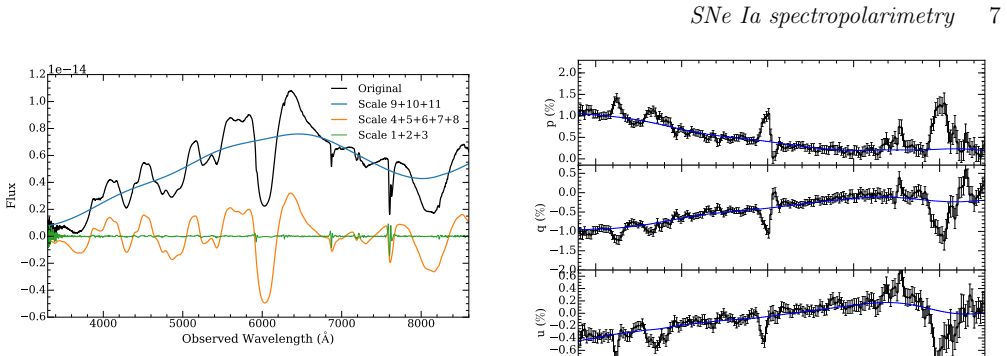
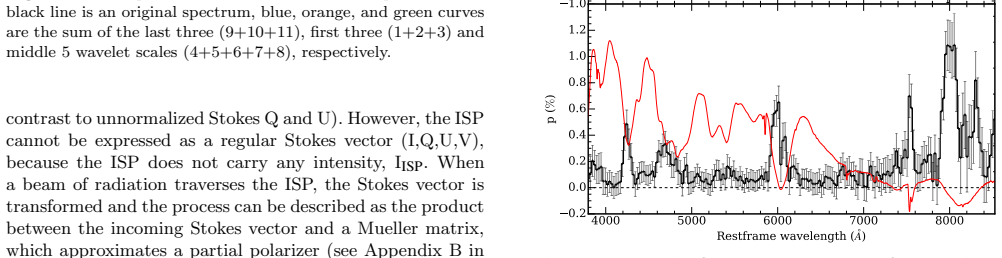
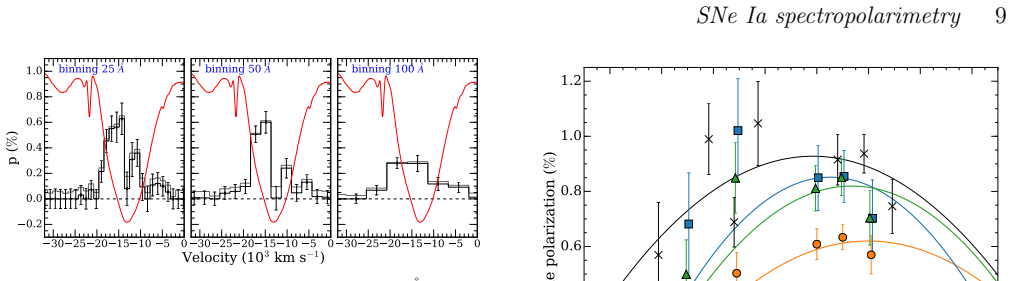
The central object is the peak polarization of the Si II $\lambda 6355$ absorption line measured on continuum-subtracted Stokes $q$ and $u$ spectra. Continuum polarization is removed by an \`a trous wavelet decomposition of the ordinary and extraordinary beams into continuum and line scales, followed by vector subtraction; peak values are read after bias correction from spectra binned at 100 \AA, with 25 and 50 \AA bins used for line-complex and $q$--$u$ analyses. Velocities are measured from the absorption minimum of Si II $\lambda 6355$ and interpolated to $-5$ days with a polynomial fit. The relation itself is the load-bearing element: it is tested across multiple epoch windows, holds only before maximum ($\rho \approx 0.8$ pre-peak, $\rho \approx 0.4$ post-peak), and is compared with synthetic polarization from delayed-detonation, double-detonation, and violent-merger simulations.
What would settle it
Re-measure the relation with a homogeneous data set where every supernova is observed at the same epochs relative to B-max, for example daily from $-10$ to $+1$ days, and take the polarization at a fixed epoch such as $-5$ days. If the slope against $v_{\mathrm{Si\,II},-5}$ vanishes or the Pearson coefficient drops well below 0.8, the reported relation is an artifact of sparse and uneven sampling rather than a physical connection.
Extended reading notes
Core claim
On the paper's own terms, the peak linear polarization of the Si II $\lambda 6355$ line, measured with 100 \AA binning and corrected for polarization bias, peaks a few days before B-band maximum at levels from about 0.1 to 1.7 per cent. Across the 23 objects with at least one epoch in $-11$ to $+1$ days, the maximum polarization is linearly related to the Si II blueshift velocity at $-5$ days with slope $(6.40\times10^{-5} \pm 1.28\times10^{-5})$ per cent per km s$^{-1}$, intercept $-0.484 \pm 0.147$ per cent, and $\rho = 0.80$; two outliers, SN 2004dt and SN 2003eh, are excluded. The interpretation is that an off-center delayed detonation naturally produces both higher silicon velocities and stronger line polarization, because the detonation front's offset controls how much silicon-rich material sits aspherically above the photosphere. Comparisons in the $\Delta m_{15}$--$v_{\mathrm{Si\,II}}$ plane split the sample into a low-polarization Chandrasekhar-like cluster and higher-polarization candidates above the sub-Chandrasekhar double-detonation predictions, tentatively supporting two explosion channels.
Load-bearing premise
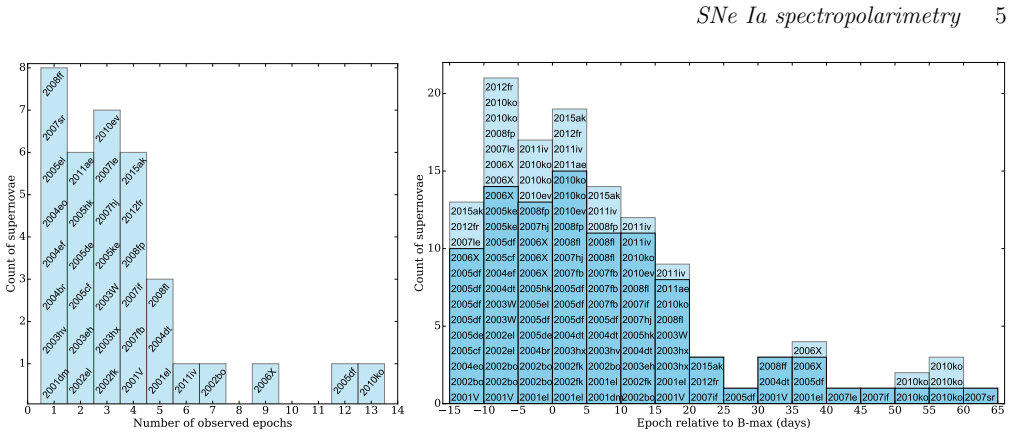
The load-bearing premise is that the maximum Si II polarization measured anywhere in the $-11$ to $+1$ day window is a comparable quantity across the 23 supernovae, even though observing cadence ranges from a single epoch to twelve, and no correction to a common epoch is applied.
Editorial extensions
If this is right
- If the velocity--polarization relation is real, a single pre-maximum spectropolarimetric epoch gives a proxy for the ejecta's global asymmetry, not just its line-of-sight velocity.
- The relation and the $\Delta m_{15}$--$p_{\mathrm{Si\,II}}$ relation together point to off-center delayed-detonation geometry, where the detonation offset sets both silicon speed and chemical clumpiness.
- The polarization dichotomy between objects above and below the sub-Chandrasekhar double-detonation prediction supports two distinct explosion mechanisms, with average polarizations of $0.15 \pm 0.08$ per cent versus $0.41 \pm 0.16$ per cent.
- Evolving $q$--$u$ loops imply the silicon distribution is not simply layered; it becomes clumpier with depth, a constraint that total-flux spectroscopy cannot provide.
- Observed polarization levels match delayed-detonation and double-detonation model predictions, while only SN 2004dt matches the violent-merger predictions.
Reading between the lines
- A dense, homogeneous high-cadence campaign that measures polarization at a common epoch such as $-5$ days for every object could decide whether the reported slope is a physical relation or a sampling-cadence artifact.
- If the relation holds with a common epoch, the scatter around the fitted line may carry viewing-angle information, since polarization is orientation-dependent while velocity is roughly not.
- The loop-area evolution could be turned into a quantitative test: three-dimensional explosion models that predict silicon plume structure as a function of depth can be compared with the measured loop areas and their time evolution.
- The apparent polarization dichotomy in the $\Delta m_{15}$--$v_{\mathrm{Si\,II}}$ plane suggests that future large samples should stratify SN Ia analyses by both brightness decline and velocity, rather than by light-curve shape alone.
Signed reviews
Editorial analysis
A structured set of objections, weighed in public.
Referee Report
Summary. This paper compiles archival VLT/FORS spectropolarimetry for 35 Type Ia supernovae at 127 epochs, measures the Si II λ6355 line polarization after wavelet-based continuum subtraction, and analyzes its time evolution, its relation to Si II velocity and Δm15, q–u loop behavior, and comparisons with DDT, double-detonation, and violent-merger model predictions. The central new claim is Eq. (11): a linear relation between the maximum Si II polarization in a −11 to +1 day window and the Si II velocity at −5 days, with slope (6.40 ± 1.28)×10⁻⁵ %/(km/s), intercept −0.484 ± 0.147, and Pearson ρ = 0.80. The paper also reports that subluminous and transitional objects lie below the Δm15–pSiII relation, finds a polarization dichotomy between objects above and below the Polin et al. double-detonation line in the Δm15–vSiII plane, documents q–u loop evolution in several well-sampled objects, and derives an upper limit on the intrinsic continuum polarization.
Significance. If Eq. (11) is robust, it is a new and interesting observational constraint connecting ejecta kinematics to the geometry of the Si II line-forming region, and it sharpens the comparison among SN Ia explosion models. The paper's strengths include the largest systematically reduced sample of SN Ia spectropolarimetry to date, explicit treatment of polarization bias correction and binning choices, a reproduction of the Δm15–pSiII relation with an independent and larger sample, new quantitative q–u loop area measurements, and quantitative model comparisons. The main weakness is that the headline v–p relation uses a maximum-within-window polarization without correcting for heterogeneous observing cadence, and the paper itself states that no common time-evolution pattern exists; this is load-bearing for the central claim. The two-population polarization dichotomy in Fig. 15b is also partly a corollary of Eq. (11), so it is not independent evidence for two explosion channels as currently presented.
major comments (4)
- [Section 5.3, Eq. (11), Fig. 13, and Table 3] The central claim uses p_max, the maximum Si II polarization in a −11 to +1 day window, as a comparable quantity across objects whose cadence varies from one epoch to twelve. As the authors state in Sect. 5.2 that no common time-evolution pattern exists and therefore no correction to a common epoch is applied, p_max is not a comparable observable: a single-epoch object gives a lower limit on its true peak, while a twelve-epoch object is likely observed near its peak. If cadence density or epoch placement correlates with vSiII,−5, the fitted slope and ρ = 0.80 in Eq. (11) could be partly a sampling artifact. The sub-window tests in Table 3 use the same maximum-within-window definition and therefore do not remove this bias. I request a quantitative test: either fitting per-object p(t) curves (e.g., the nested-sampling fits introduced in Sect. 4.5) and using the fitted peak, restricting to objects with at least three pre-maximum epochs, or injecting synthetic p(t) curves at the actual observed cadences to estimate the bias in the slope and correlation coefficient.
- [Section 5.3.2, Fig. 15b] The claimed polarization dichotomy between 'Chandrasekhar-like' and 'sub-Chandrasekhar' groups is not independent evidence for two explosion channels, because the group assignment is made in the Δm15–vSiII plane and pSiII is strongly correlated with vSiII via Eq. (11). Objects above the Polin et al. line have systematically higher velocities, and Eq. (11) therefore predicts that they have higher polarization; Fig. 15b is largely a corollary of Eq. (11). To support the two-population claim, the polarization distributions should be compared after removing the Eq. (11) trend, or on a sample matched in vSiII. Without such a test, the dichotomy does not add independent support for the two-explosion-mechanism interpretation.
- [Section 4.4 and Eq. (11)] The velocity vSiII,−5 is derived from low-order polynomial fits to heterogeneous flux spectra, often extrapolated to −5 days when no spectrum is available near that epoch, but the reported Pearson p-values and the linear least-squares fit in Table 3 treat the velocity as error-free. The x-uncertainties are not propagated into the slope, intercept, or correlation coefficient. Please propagate the velocity fit uncertainties, for example by bootstrap resampling of the velocity fits or by using an orthogonal regression, and show that the slope and ρ in Eq. (11) remain statistically significant.
- [Section 5.2, Fig. 12] The Δm15–pSiII reproduction uses the maximum polarization in a −10 to 0 day window with no epoch correction, for the same reason stated in Sect. 5.2. Because the observed maximum in this window is a lower limit for sparsely sampled objects, the reported ρ = 0.63 (p = 0.005) should be presented as a qualitative confirmation of the Wang et al. relation rather than a quantitative reproduction. Please state this limitation explicitly in the text near Fig. 12 and in the conclusions, and consider a robustness test restricted to objects with at least two epochs in the window.
minor comments (5)
- [Table 3 header] The header says the slope α is 'in %/mag', but the independent variable vSiII is in km/s; the correct unit is %/(km/s) or % per km/s.
- [Section 5.6] The text refers to 'SN 20011iv' in the sentence listing the six low-reddening objects; this should be SN 2011iv.
- [Section 3.1] The text says the GG435 filter has a cut-off at ∼435 µm; this should be ∼435 nm.
- [Section 4.5] The criterion for manually choosing the lower and upper wavelength edges of the Si II line is not described quantitatively; please state how the edges were selected and whether the choice was checked for sensitivity to bin size.
- [Figure 15 caption] The caption would benefit from a sentence stating exactly how the orange and green diamond groups were assigned (i.e., by eye relative to the dashed Polin et al. line), since the group assignment is used in the quantitative polarization comparison in panel (b).
Circularity Check
No significant circularity; the v–p relation is measured from independent observables and the model comparisons use external simulations.
full rationale
The paper's central new result, Eq. 11, is an empirical regression between the maximum Si II 6355 line polarization in a fixed −11 to +1 day window and the Si II velocity at −5 days. These are independently measured quantities: polarization is derived from continuum-subtracted VLT/FORS spectropolarimetry (Sect. 4.5), while velocities come from absorption minima of flux spectra (Sect. 4.4). Neither quantity is defined in terms of the other, and no model parameter is fitted and then renamed as a prediction. The comparisons to Bulla et al. (2016a,b) and Polin et al. (2019) use external simulations with stated assumptions. Self-citations (e.g., Wang et al. 2007 for the Δm15–p relation and the pre-maximum epoch choice; Höflich et al. 2006 for the delayed-detonation interpretation) motivate choices and interpretations but are not load-bearing for the v–p fit. The statistical caveat that p_max is taken over a heterogeneous cadence window with no common-epoch correction (Sect. 5.2) is a validity threat, not a circular reduction: it concerns whether p_max is a comparable observable, not whether the derivation assumes its conclusion. The Fig. 15b polarization dichotomy is presented as tentative and depends on the external Polin grouping; while it is consistent with Eq. 11, the paper does not use the dichotomy to derive Eq. 11, so no by-construction circularity is exhibited.
Assumptions & free parameters
free parameters (3)
- pSiII-vSiII slope alpha =
6.40e-5 +/- 1.28e-5 (% per km/s)
- pSiII-vSiII intercept beta =
-0.484 +/- 0.147 (%)
- Priors in nested-sampling p(t) fit =
a in [-1,0], pmax in [0,5]%, tmax in [-10,0] d
assumptions (5)
- domain assumption Measured line polarization after wavelet continuum subtraction represents intrinsic SN line polarization (ISP is additive in Stokes q,u for weak incoming polarization)
- domain assumption Electron scattering in an aspherical photosphere is the dominant source of intrinsic continuum and line polarization
- domain assumption The Polin et al. (2019) Delta m15-vSiII relation for sub-Chandrasekhar double-detonations with a thin He shell is the correct separator of two SN Ia populations
- domain assumption Wavelet decomposition scales 9+10+11 approximate the continuum and scales 4-8 contain line features
- domain assumption Type Ia supernovae are standardizable candles and Delta m15 traces 56Ni production
Cite this review
Pith. "Pith review of Linear spectropolarimetry of 35 Type Ia Supernovae with VLT/FORS: An analysis of the Si II line polarization." pith.science (2026). https://pith.science/paper/GXLGPSAU
@misc{pith2026190807526,
  author       = {Pith},
  title        = {Pith review of: Linear spectropolarimetry of 35 Type Ia Supernovae with VLT/FORS: An analysis of the Si II line polarization},
  year         = {2026},
  howpublished = {\url{https://pith.science/paper/GXLGPSAU}},
  note         = {Machine review of arXiv:1908.07526}
}
abstract
Spectropolarimetry enables us to measure the geometry and chemical structure of the ejecta in supernova explosions, which is fundamental for the understanding of their explosion mechanism(s) and progenitor systems. We collected archival data of 35 Type Ia Supernovae (SNe Ia), observed with FORS on the Very Large Telescope at 127 epochs in total. We examined the polarization of the Si II $\lambda$6355 $\AA$ line (p$_{\rm Si II}$) as a function of time which is seen to peak at a range of various polarization degrees and epochs relative to maximum brightness. We reproduced the $\Delta$m$_{15}$-p$_{\rm Si II}$ relationship identified in a previous study, and show that subluminous and transitional objects display polarization values below the $\Delta$m$_{15}$-p$_{\rm Si II}$ relationship for normal SNe Ia. We found a statistically significant linear relationship between the polarization of the Si II $\lambda$6355 $\AA$ line before maximum brightness and the Si II line velocity and suggest that this, along with the $\Delta$m$_{15}$-p$_{\rm Si II}$ relationship, may be explained in the context of a delayed-detonation model. In contrast, we compared our observations to numerical predictions in the $\Delta$m$_{15}$-v$_{\rm Si II}$ plane and found a dichotomy in the polarization properties between Chandrasekhar and sub-Chandrasekhar mass explosions, which supports the possibility of two distinct explosion mechanisms. A subsample of SNe display evolution of loops in the $q$-$u$ plane that suggests a more complex Si structure with depth. This insight, which could not be gleaned from total flux spectra, presents a new constraint on explosion models. Finally, we compared our statistical sample of the Si II polarization to quantitative predictions of the polarization levels for the double-detonation, delayed-detonation, and violent-merger models.
Figures

Figures from the paper (17 more)



Reference graph
Works this paper leans on
-
[1]
Altavilla G., et al., 2007, @doi [ ] 10.1051/0004-6361:20077487 , http://adsabs.harvard.edu/abs/2007A
-
[2]
Amanullah R., et al., 2010, @doi [ ] 10.1088/0004-637X/716/1/712 , http://adsabs.harvard.edu/abs/2010ApJ...716..712A 716, 712
-
[3]
Andersson B.-G., et al., 2013, @doi [ ] 10.1088/0004-637X/775/2/84 , http://adsabs.harvard.edu/abs/2013ApJ...775...84A 775, 84
-
[4]
Appenzeller I., et al., 1998, The Messenger, http://esoads.eso.org/abs/1998Msngr..94....1A 94, 1
1998
-
[5]
Ashall C., et al., 2018, @doi [ ] 10.1093/mnras/sty632 , http://adsabs.harvard.edu/abs/2018MNRAS.tmp..611A
-
[6]
B., Dobkin D
Barber C. B., Dobkin D. P., Huhdanpaa H., 1996, ACM TRANSACTIONS ON MATHEMATICAL SOFTWARE, 22, 469
1996
-
[7]
Benz W., Bowers R. L., Cameron A. G. W., Press W. H. ., 1990, @doi [ ] 10.1086/168273 , http://adsabs.harvard.edu/abs/1990ApJ...348..647B 348, 647
doi:10.1086/168273 1990
-
[8]
L., 2007, @doi [ ] 10.1086/520494 , http://adsabs.harvard.edu/abs/2007ApJ...666.1024B 666, 1024
Blondin S., Tonry J. L., 2007, @doi [ ] 10.1086/520494 , http://adsabs.harvard.edu/abs/2007ApJ...666.1024B 666, 1024
doi:10.1086/520494 2007
Show all 124 references
-
[9]
Blondin S., Kirshner R., Challis P., Calkins M., 2007, Central Bureau Electronic Telegrams, http://adsabs.harvard.edu/abs/2007CBET.1048....2B 1048
2007
-
[10]
Blondin S., et al., 2012, @doi [ ] 10.1088/0004-6256/143/5/126 , http://adsabs.harvard.edu/abs/2012AJ....143..126B 143, 126
2012 doi
-
[11]
Braden B., 1986, The College Mathematics Journal, 17, 326
1986
-
[12]
C., 2017, Supernova Explosions , @doi 10.1007/978-3-662-55054-0
Branch D., Wheeler J. C., 2017, Supernova Explosions , @doi 10.1007/978-3-662-55054-0
2017 doi
-
[13]
Branch D., Baron E., Hall N., Melakayil M., Parrent J., 2005, @doi [ ] 10.1086/430135 , http://adsabs.harvard.edu/abs/2005PASP..117..545B 117, 545
2005 doi
-
[14]
Buil C., 2012, Central Bureau Electronic Telegrams, http://adsabs.harvard.edu/abs/2012CBET.3277....3B 3277, 3
2012
-
[15]
Bulla M., 2017, PhD thesis, Astrophysics Research Centre, School of Mathematics and Physics, Queen's University Belfast, Belfast BT7 1NN, UK, @doi 10.5281/zenodo.321286
2017 doi
-
[16]
A., Kromer M., 2015, @doi [ ] 10.1093/mnras/stv657 , http://adsabs.harvard.edu/abs/2015MNRAS.450..967B 450, 967
Bulla M., Sim S. A., Kromer M., 2015, @doi [ ] 10.1093/mnras/stv657 , http://adsabs.harvard.edu/abs/2015MNRAS.450..967B 450, 967
2015 doi
-
[17]
A., Pakmor R., Kromer M., Taubenberger S., R \"o pke F
Bulla M., Sim S. A., Pakmor R., Kromer M., Taubenberger S., R \"o pke F. K., Hillebrandt W., Seitenzahl I. R., 2016a, @doi [ ] 10.1093/mnras/stv2402 , http://adsabs.harvard.edu/abs/2016MNRAS.455.1060B 455, 1060
-
[18]
Bulla M., et al., 2016b, @doi [ ] 10.1093/mnras/stw1733 , http://adsabs.harvard.edu/abs/2016MNRAS.462.1039B 462, 1039
-
[19]
R., et al., 2011, @doi [ ] 10.1088/0004-6256/141/1/19 , http://adsabs.harvard.edu/abs/2011AJ....141...19B 141, 19
Burns C. R., et al., 2011, @doi [ ] 10.1088/0004-6256/141/1/19 , http://adsabs.harvard.edu/abs/2011AJ....141...19B 141, 19
2011 doi
-
[20]
R., et al., 2015, SNooPy: TypeIa supernovae analysis tools , Astrophysics Source Code Library ( @eprint ascl 1505.023 )
Burns C. R., et al., 2015, SNooPy: TypeIa supernovae analysis tools , Astrophysics Source Code Library ( @eprint ascl 1505.023 )
2015
-
[21]
Chandrasekhar S., 1960, Radiative transfer
1960
-
[22]
Chomiuk L., et al., 2016, @doi [ ] 10.3847/0004-637X/821/2/119 , http://adsabs.harvard.edu/abs/2016ApJ...821..119C 821, 119
2016 doi
-
[23]
V., 2008, @doi [ ] 10.1088/0004-6256/136/6/2227 , http://adsabs.harvard.edu/abs/2008AJ....136.2227C 136, 2227
Chornock R., Filippenko A. V., 2008, @doi [ ] 10.1088/0004-6256/136/6/2227 , http://adsabs.harvard.edu/abs/2008AJ....136.2227C 136, 2227
2008 doi
-
[24]
Cikota A., Patat F., Cikota S., Faran T., 2017a, @doi [ ] 10.1093/mnras/stw2545 , http://adsabs.harvard.edu/abs/2017MNRAS.464.4146C 464, 4146
-
[25]
Cikota A., Patat F., Cikota S., Spyromilio J., Rau G., 2017b, @doi [ ] 10.1093/mnras/stx1734 , http://adsabs.harvard.edu/abs/2017MNRAS.471.2111C 471, 2111
-
[26]
Cikota A., et al., 2018, @doi [ ] 10.1051/0004-6361/201731395 , http://adsabs.harvard.edu/abs/2018A
2018 doi
-
[27]
Dhawan S., Leibundgut B., Spyromilio J., Maguire K., 2015, @doi [ ] 10.1093/mnras/stu2716 , http://adsabs.harvard.edu/abs/2015MNRAS.448.1345D 448, 1345
2015 doi
-
[28]
European Southern Observatory
ESO 2015, FORS2 User Manual, issue 96.0, VLT-MAN-ESO-13100-1543. European Southern Observatory
2015
-
[29]
A., 2004, Morphology of supernova remnants
Fesen R. A., 2004, Morphology of supernova remnants. Cambridge University Press, p. 64–73, @doi 10.1017/CBO9780511536236.007
2004 doi
-
[30]
K., Hillebrandt W., Seitenzahl I
Fink M., R \"o pke F. K., Hillebrandt W., Seitenzahl I. R., Sim S. A., Kromer M., 2010, @doi [ ] 10.1051/0004-6361/200913892 , http://adsabs.harvard.edu/abs/2010A
2010 doi
-
[31]
Folatelli G., et al., 2013, @doi [ ] 10.1088/0004-637X/773/1/53 , http://adsabs.harvard.edu/abs/2013ApJ...773...53F 773, 53
2013 doi
-
[32]
364, The Future of Photometric, Spectrophotometric and Polarimetric Standardization
Fossati L., Bagnulo S., Mason E., Landi Degl'Innocenti E., 2007, in Sterken C., ed., Astronomical Society of the Pacific Conference Series Vol. 364, The Future of Photometric, Spectrophotometric and Polarimetric Standardization. p. 503
2007
-
[33]
S., et al., 2015, @doi [ ] 10.1088/0067-0049/220/1/9 , http://adsabs.harvard.edu/abs/2015ApJS..220....9F 220, 9
Friedman A. S., et al., 2015, @doi [ ] 10.1088/0067-0049/220/1/9 , http://adsabs.harvard.edu/abs/2015ApJS..220....9F 220, 9
2015 doi
-
[34]
Gall C., et al., 2018, @doi [ ] 10.1051/0004-6361/201730886 , http://adsabs.harvard.edu/abs/2018A
2018 doi
-
[35]
Ganeshalingam M., et al., 2010, @doi [ ] 10.1088/0067-0049/190/2/418 , http://adsabs.harvard.edu/abs/2010ApJS..190..418G 190, 418
2010 doi
-
[36]
V., 2013, @doi [ ] 10.1093/mnras/stt893 , http://adsabs.harvard.edu/abs/2013MNRAS.433.2240G 433, 2240
Ganeshalingam M., Li W., Filippenko A. V., 2013, @doi [ ] 10.1093/mnras/stt893 , http://adsabs.harvard.edu/abs/2013MNRAS.433.2240G 433, 2240
2013 doi
-
[37]
A., Kasen D., 2018, @doi [ ] 10.3847/2041-8213/aaa409 , http://adsabs.harvard.edu/abs/2018ApJ...852L..33G 852, L33
Goldstein D. A., Kasen D., 2018, @doi [ ] 10.3847/2041-8213/aaa409 , http://adsabs.harvard.edu/abs/2018ApJ...852L..33G 852, L33
2018 doi
-
[38]
Z., Margutti R., 2017, @doi [ ] 10.3847/1538-4357/835/1/64 , http://adsabs.harvard.edu/abs/2017ApJ...835...64G 835, 64
Guillochon J., Parrent J., Kelley L. Z., Margutti R., 2017, @doi [ ] 10.3847/1538-4357/835/1/64 , http://adsabs.harvard.edu/abs/2017ApJ...835...64G 835, 64
2017 doi
-
[39]
P., et al., 2016, @doi [ ] 10.1051/0004-6361/201527228 , http://adsabs.harvard.edu/abs/2016A
Guti \'e rrez C. P., et al., 2016, @doi [ ] 10.1051/0004-6361/201527228 , http://adsabs.harvard.edu/abs/2016A
2016 doi
-
[40]
Hicken M., et al., 2009, @doi [ ] 10.1088/0004-637X/700/1/331 , http://adsabs.harvard.edu/abs/2009ApJ...700..331H 700, 331
2009 doi
-
[41]
Hoang T., 2017, @doi [ ] 10.3847/1538-4357/836/1/13 , http://adsabs.harvard.edu/abs/2017ApJ...836...13H 836, 13
2017 doi
-
[42]
N., Lee H., Ahn S.-H., 2019, @doi [Nature Astronomy] 10.1038/s41550-019-0763-6 , https://ui.adsabs.harvard.edu/abs/2019NatAs.tmp..319H p
Hoang T., Tram L. N., Lee H., Ahn S.-H., 2019, @doi [Nature Astronomy] 10.1038/s41550-019-0763-6 , https://ui.adsabs.harvard.edu/abs/2019NatAs.tmp..319H p. 319
2019 doi
-
[43]
H \"o flich P., 1991, , http://adsabs.harvard.edu/abs/1991A
1991
-
[44]
L., Fesen R
H \"o flich P., Gerardy C. L., Fesen R. A., Sakai S., 2002, @doi [ ] 10.1086/339063 , http://adsabs.harvard.edu/abs/2002ApJ...568..791H 568, 791
2002 doi
-
[45]
L., Marion H., Quimby R., 2006, @doi [ ] 10.1016/j.newar.2006.06.074 , http://adsabs.harvard.edu/abs/2006NewAR..50..470H 50, 470
H \"o flich P., Gerardy C. L., Marion H., Quimby R., 2006, @doi [ ] 10.1016/j.newar.2006.06.074 , http://adsabs.harvard.edu/abs/2006NewAR..50..470H 50, 470
2006 doi
-
[46]
Time-Frequency Methods and Phase Space
Holschneider M., Kronland-Martinet R., Morlet J., Tchamitchian P., 1989, in Combes J.-M., Grossmann A., Tchamitchian P., eds, Wavelets. Time-Frequency Methods and Phase Space. p. 286
1989
-
[47]
M., 2013, @doi [Philosophical Transactions of the Royal Society of London Series A] 10.1098/rsta.2012.0282 , http://adsabs.harvard.edu/abs/2013RSPTA.37120282H 371, 20120282
Hook I. M., 2013, @doi [Philosophical Transactions of the Royal Society of London Series A] 10.1098/rsta.2012.0282 , http://adsabs.harvard.edu/abs/2013RSPTA.37120282H 371, 20120282
2013
-
[48]
A., H \"o flich P., Wang L., Wheeler J
Howell D. A., H \"o flich P., Wang L., Wheeler J. C., 2001, @doi [ ] 10.1086/321584 , http://adsabs.harvard.edu/abs/2001ApJ...556..302H 556, 302
2001 doi
-
[49]
Kasen D., et al., 2003, @doi [ ] 10.1086/376601 , http://adsabs.harvard.edu/abs/2003ApJ...593..788K 593, 788
2003 doi
-
[50]
Kashi A., Soker N., 2011, @doi [ ] 10.1111/j.1365-2966.2011.19361.x , http://adsabs.harvard.edu/abs/2011MNRAS.417.1466K 417, 1466
2011
-
[51]
M., 1991, , http://adsabs.harvard.edu/abs/1991A
Khokhlov A. M., 1991, , http://adsabs.harvard.edu/abs/1991A
1991
-
[52]
Krisciunas K., Suntzeff N. B., Espinoza J., Gonzalez D., Miranda A., Sanhueza P., 2017a, @doi [Research Notes of the American Astronomical Society] 10.3847/2515-5172/aa9f18 , http://adsabs.harvard.edu/abs/2017RNAAS...1...36K 1, 36
-
[53]
Krisciunas K., et al., 2017b, @doi [ ] 10.3847/1538-3881/aa8df0 , http://adsabs.harvard.edu/abs/2017AJ....154..211K 154, 211
-
[54]
arXiv:0912.0201
LSST Science Collaboration et al., 2009, arXiv e-prints, https://ui.adsabs.harvard.edu/\#abs/2009arXiv0912.0201L p. arXiv:0912.0201
2009 arXiv
-
[55]
C., Filippenko A
Leonard D. C., Filippenko A. V., Chornock R., Li W., 2002, @doi [ ] 10.1086/343772 , http://adsabs.harvard.edu/abs/2002AJ....124.2506L 124, 2506
2002 doi
-
[56]
Leonini S., Brimacombe J., 2010, Central Bureau Electronic Telegrams, http://adsabs.harvard.edu/abs/2010CBET.2569....1L 2569, 1
2010
-
[57]
Livio M., Mazzali P., 2018, @doi [ ] 10.1016/j.physrep.2018.02.002 , https://ui.adsabs.harvard.edu/abs/2018PhR...736....1L 736, 1
2018 doi
-
[58]
A., Ramirez-Ruiz E., Badenes C., Huppenkothen D., Jeltema T
Lopez L. A., Ramirez-Ruiz E., Badenes C., Huppenkothen D., Jeltema T. E., Pooley D. A., 2009, @doi [ ] 10.1088/0004-637X/706/1/L106 , http://adsabs.harvard.edu/abs/2009ApJ...706L.106L 706, L106
2009 doi
-
[59]
S., Narayan G., Kirshner R
Mandel K. S., Narayan G., Kirshner R. P., 2011, @doi [ ] 10.1088/0004-637X/731/2/120 , http://adsabs.harvard.edu/abs/2011ApJ...731..120M 731, 120
2011 doi
-
[60]
G., 1974, @doi [ ] 10.1086/152655 , http://adsabs.harvard.edu/abs/1974ApJ...187..461M 187, 461
Martin P. G., 1974, @doi [ ] 10.1086/152655 , http://adsabs.harvard.edu/abs/1974ApJ...187..461M 187, 461
1974 doi
-
[61]
Matheson T., Challis P., Kirshner R., Calkins M., 2003, , http://adsabs.harvard.edu/abs/2003IAUC.8134....2M 8134
2003
-
[62]
R., Wheeler J
Maund J. R., Wheeler J. C., Baade D., Patat F., H \"o flich P., Wang L., Clocchiatti A., 2009, @doi [ ] 10.1088/0004-637X/705/2/1139 , https://ui.adsabs.harvard.edu/abs/2009ApJ...705.1139M 705, 1139
2009 doi
-
[63]
R., et al., 2010a, @doi [ ] 10.1088/0004-637X/722/2/1162 , http://adsabs.harvard.edu/abs/2010ApJ...722.1162M 722, 1162
Maund J. R., et al., 2010a, @doi [ ] 10.1088/0004-637X/722/2/1162 , http://adsabs.harvard.edu/abs/2010ApJ...722.1162M 722, 1162
-
[64]
R., et al., 2010b, @doi [ ] 10.1088/2041-8205/725/2/L167 , http://adsabs.harvard.edu/abs/2010ApJ...725L.167M 725, L167
Maund J. R., et al., 2010b, @doi [ ] 10.1088/2041-8205/725/2/L167 , http://adsabs.harvard.edu/abs/2010ApJ...725L.167M 725, L167
-
[65]
A., et al., 2005, @doi [ ] 10.1086/429874 , http://adsabs.harvard.edu/abs/2005ApJ...623L..37M 623, L37
Mazzali P. A., et al., 2005, @doi [ ] 10.1086/429874 , http://adsabs.harvard.edu/abs/2005ApJ...623L..37M 623, L37
2005 doi
-
[66]
A., Ashall C., Pian E., Stritzinger M
Mazzali P. A., Ashall C., Pian E., Stritzinger M. D., Gall C., Phillips M. M., H \"o flich P., Hsiao E., 2018, @doi [ ] 10.1093/mnras/sty434 , http://adsabs.harvard.edu/abs/2018MNRAS.476.2905M 476, 2905
2018 doi
-
[67]
K., Anupama G
Misra K., Sahu D. K., Anupama G. C., Pandey K., 2008, @doi [ ] 10.1111/j.1365-2966.2008.13398.x , http://adsabs.harvard.edu/abs/2008MNRAS.389..706M 389, 706
2008
-
[68]
Nagao T., Maeda K., Tanaka M., 2018, @doi [ ] 10.3847/1538-4357/aac94e , http://adsabs.harvard.edu/abs/2018ApJ...861....1N 861, 1
2018 doi
-
[69]
A., R \"o pke F
Pakmor R., Kromer M., Taubenberger S., Sim S. A., R \"o pke F. K., Hillebrandt W., 2012, @doi [ ] 10.1088/2041-8205/747/1/L10 , http://adsabs.harvard.edu/abs/2012ApJ...747L..10P 747, L10
2012 doi
-
[70]
Pastorello A., et al., 2007, @doi [Monthly Notices of the Royal Astronomical Society] 10.1111/j.1365-2966.2007.11700.x , 377, 1531
2007
-
[71]
Patat F., Romaniello M., 2006, @doi [ ] 10.1086/497581 , http://adsabs.harvard.edu/abs/2006PASP..118..146P 118, 146
2006 doi
-
[72]
R., Wang L., Wheeler J
Patat F., Baade D., H \"o flich P., Maund J. R., Wang L., Wheeler J. C., 2009, @doi [ ] 10.1051/0004-6361/200810651 , http://adsabs.harvard.edu/abs/2009A
2009 doi
-
[73]
R., Benetti S., Botticella M
Patat F., Maund J. R., Benetti S., Botticella M. T., Cappellaro E., Harutyunyan A., Turatto M., 2010, @doi [ ] 10.1051/0004-6361/200913083 , http://adsabs.harvard.edu/abs/2010A
2010 doi
-
[74]
R., Wang L., Wheeler J
Patat F., H \"o flich P., Baade D., Maund J. R., Wang L., Wheeler J. C., 2012, @doi [ ] 10.1051/0004-6361/201219146 , http://adsabs.harvard.edu/abs/2012A
2012 doi
-
[75]
Patat F., et al., 2015, @doi [ ] 10.1051/0004-6361/201424507 , http://adsabs.harvard.edu/abs/2015A
2015 doi
-
[76]
Perlmutter S., et al., 1999, @doi [ ] 10.1086/307221 , http://adsabs.harvard.edu/abs/1999ApJ...517..565P 517, 565
1999 doi
-
[77]
M., 1993, @doi [ ] 10.1086/186970 , http://adsabs.harvard.edu/abs/1993ApJ...413L.105P 413, L105
Phillips M. M., 1993, @doi [ ] 10.1086/186970 , http://adsabs.harvard.edu/abs/1993ApJ...413L.105P 413, L105
1993 doi
-
[78]
Pignata G., et al., 2008, Central Bureau Electronic Telegrams, http://adsabs.harvard.edu/abs/2008CBET.1498....1P 1498
2008
-
[79]
A., Eastman R
Pinto P. A., Eastman R. G., 2000, @doi [ ] 10.1086/308380 , http://adsabs.harvard.edu/abs/2000ApJ...530..757P 530, 757
2000 doi
-
[80]
Planck Collaboration et al., 2016, @doi [ ] 10.1051/0004-6361/201525830 , http://adsabs.harvard.edu/abs/2016A
2016 doi
-
[81]
Polin A., Nugent P., Kasen D., 2019, @doi [ ] 10.3847/1538-4357/aafb6a , https://ui.adsabs.harvard.edu/abs/2019ApJ...873...84P 873, 84
2019 doi
-
[82]
L., et al., 2016, @doi [ ] 10.3847/0004-637X/828/1/24 , http://adsabs.harvard.edu/abs/2016ApJ...828...24P 828, 24
Porter A. L., et al., 2016, @doi [ ] 10.3847/0004-637X/828/1/24 , http://adsabs.harvard.edu/abs/2016ApJ...828...24P 828, 24
2016 doi
-
[83]
L., Rest A., Suntzeff N
Prieto J. L., Rest A., Suntzeff N. B., 2006, @doi [ ] 10.1086/504307 , http://adsabs.harvard.edu/abs/2006ApJ...647..501P 647, 501
2006 doi
-
[84]
L., Stanek K
Prieto J. L., Stanek K. Z., Beacom J. F., 2008, @doi [ ] 10.1086/524654 , http://adsabs.harvard.edu/abs/2008ApJ...673..999P 673, 999
2008 doi
-
[85]
P., 1977, , http://adsabs.harvard.edu/abs/1977AZh....54.1188P 54, 1188
Pskovskii I. P., 1977, , http://adsabs.harvard.edu/abs/1977AZh....54.1188P 54, 1188
1977
-
[86]
G., Livio M., 2006, @doi [ ] 10.1086/504791 , http://adsabs.harvard.edu/abs/2006ApJ...648..884R 648, 884
Riess A. G., Livio M., 2006, @doi [ ] 10.1086/504791 , http://adsabs.harvard.edu/abs/2006ApJ...648..884R 648, 884
2006 doi
-
[87]
G., et al., 1998, @doi [ ] 10.1086/300499 , http://adsabs.harvard.edu/abs/1998AJ....116.1009R 116, 1009
Riess A. G., et al., 1998, @doi [ ] 10.1086/300499 , http://adsabs.harvard.edu/abs/1998AJ....116.1009R 116, 1009
1998 doi
-
[88]
Rosswog S., Kasen D., Guillochon J., Ramirez-Ruiz E., 2009, @doi [ ] 10.1088/0004-637X/705/2/L128 , http://adsabs.harvard.edu/abs/2009ApJ...705L.128R 705, L128
2009 doi
-
[89]
F., Finkbeiner D
Schlafly E. F., Finkbeiner D. P., 2011, @doi [ ] 10.1088/0004-637X/737/2/103 , http://adsabs.harvard.edu/abs/2011ApJ...737..103S 737, 103
2011 doi
-
[90]
R., et al., 2013, @doi [ ] 10.1093/mnras/sts402 , http://adsabs.harvard.edu/abs/2013MNRAS.429.1156S 429, 1156
Seitenzahl I. R., et al., 2013, @doi [ ] 10.1093/mnras/sts402 , http://adsabs.harvard.edu/abs/2013MNRAS.429.1156S 429, 1156
2013 doi
-
[91]
S., Ford V
Serkowski K., Mathewson D. S., Ford V. L., 1975, @doi [ ] 10.1086/153410 , http://adsabs.harvard.edu/abs/1975ApJ...196..261S 196, 261
1975 doi
-
[92]
R., 1975, @doi [ ] 10.1086/153868 , http://adsabs.harvard.edu/abs/1975ApJ...201..151S 201, 151
Shapiro P. R., 1975, @doi [ ] 10.1086/153868 , http://adsabs.harvard.edu/abs/1975ApJ...201..151S 201, 151
1975 doi
-
[93]
R., Sutherland P
Shapiro P. R., Sutherland P. G., 1982, @doi [ ] 10.1086/160559 , http://adsabs.harvard.edu/abs/1982ApJ...263..902S 263, 902
1982 doi
-
[94]
M., et al., 2012, @doi [ ] 10.1111/j.1365-2966.2012.21270.x , http://adsabs.harvard.edu/abs/2012MNRAS.425.1789S 425, 1789
Silverman J. M., et al., 2012, @doi [ ] 10.1111/j.1365-2966.2012.21270.x , http://adsabs.harvard.edu/abs/2012MNRAS.425.1789S 425, 1789
2012
-
[95]
M., Vink \'o J., Marion G
Silverman J. M., Vink \'o J., Marion G. H., Wheeler J. C., Barna B., Szalai T., Mulligan B. W., Filippenko A. V., 2015, @doi [ ] 10.1093/mnras/stv1011 , http://adsabs.harvard.edu/abs/2015MNRAS.451.1973S 451, 1973
2015 doi
-
[96]
V., eds, American Institute of Physics Conference Series Vol
Skilling J., 2004, in Fischer R., Preuss R., Toussaint U. V., eds, American Institute of Physics Conference Series Vol. 735, American Institute of Physics Conference Series. pp 395--405, @doi 10.1063/1.1835238
2004 doi
-
[97]
arXiv:1503.03757
Spergel D., et al., 2015, arXiv e-prints, https://ui.adsabs.harvard.edu/\#abs/2015arXiv150303757S p. arXiv:1503.03757
2015 arXiv
-
[98]
Spyromilio J., Bailey J., 1993, @doi [Proceedings of the Astronomical Society of Australia] 10.1017/S1323358000025819 , http://adsabs.harvard.edu/abs/1993PASAu..10..263S 10, 263
1993 doi
-
[99]
G., 2008, Central Bureau Electronic Telegrams, http://adsabs.harvard.edu/abs/2008CBET.1488....1T 1488
Tan T. G., 2008, Central Bureau Electronic Telegrams, http://adsabs.harvard.edu/abs/2008CBET.1488....1T 1488
2008
-
[100]
A., Kawabata K
Tanaka M., Maeda K., Mazzali P. A., Kawabata K. S., Nomoto K., 2017, @doi [ ] 10.3847/1538-4357/aa6035 , http://adsabs.harvard.edu/abs/2017ApJ...837..105T 837, 105
2017 doi
-
[101]
Taubenberger S., 2017, The Extremes of Thermonuclear Supernovae . p. 317, @doi 10.1007/978-3-319-21846-5_37
2017 doi
-
[102]
L., ed., Vol
Tody D., 1986, in Crawford D. L., ed., Vol. 627, Instrumentation in astronomy VI. p. 733, @doi 10.1117/12.968154
1986 doi
-
[103]
R., Hines D
Trammell S. R., Hines D. C., Wheeler J. C., 1993, @doi [ ] 10.1086/186986 , http://adsabs.harvard.edu/abs/1993ApJ...414L..21T 414, L21
1993 doi
-
[104]
Wagers A., Wang L., Asztalos S., 2010, @doi [ ] 10.1088/0004-637X/711/2/711 , http://adsabs.harvard.edu/abs/2010ApJ...711..711W 711, 711
2010 doi
-
[105]
C., 1996, @doi [ ] 10.1086/310026 , http://adsabs.harvard.edu/abs/1996ApJ...462L..27W 462, L27
Wang L., Wheeler J. C., 1996, @doi [ ] 10.1086/310026 , http://adsabs.harvard.edu/abs/1996ApJ...462L..27W 462, L27
1996 doi
-
[106]
C., 2008, @doi [ ] 10.1146/annurev.astro.46.060407.145139 , http://adsabs.harvard.edu/abs/2008ARA
Wang L., Wheeler J. C., 2008, @doi [ ] 10.1146/annurev.astro.46.060407.145139 , http://adsabs.harvard.edu/abs/2008ARA
2008
-
[107]
C., Li Z., Clocchiatti A., 1996, @doi [ ] 10.1086/177617 , http://adsabs.harvard.edu/abs/1996ApJ...467..435W 467, 435
Wang L., Wheeler J. C., Li Z., Clocchiatti A., 1996, @doi [ ] 10.1086/177617 , http://adsabs.harvard.edu/abs/1996ApJ...467..435W 467, 435
1996 doi
-
[108]
C., H \"o flich P., 1997, @doi [ ] 10.1086/310495 , http://adsabs.harvard.edu/abs/1997ApJ...476L..27W 476, L27
Wang L., Wheeler J. C., H \"o flich P., 1997, @doi [ ] 10.1086/310495 , http://adsabs.harvard.edu/abs/1997ApJ...476L..27W 476, L27
1997 doi
-
[109]
A., H \"o flich P., Wheeler J
Wang L., Howell D. A., H \"o flich P., Wheeler J. C., 2001, @doi [ ] 10.1086/319822 , http://adsabs.harvard.edu/abs/2001ApJ...550.1030W 550, 1030
2001 doi
-
[110]
Wang L., et al., 2003, @doi [ ] 10.1086/375444 , http://adsabs.harvard.edu/abs/2003ApJ...591.1110W 591, 1110
2003 doi
-
[111]
C., Kawabata K., Khokhlov A., Nomoto K., Patat F., 2006, @doi [ ] 10.1086/508250 , http://adsabs.harvard.edu/abs/2006ApJ...653..490W 653, 490
Wang L., Baade D., H \"o flich P., Wheeler J. C., Kawabata K., Khokhlov A., Nomoto K., Patat F., 2006, @doi [ ] 10.1086/508250 , http://adsabs.harvard.edu/abs/2006ApJ...653..490W 653, 490
2006 doi
-
[112]
Wang L., Baade D., Patat F., 2007, @doi [Science] 10.1126/science.1121656 , http://adsabs.harvard.edu/abs/2007Sci...315..212W 315, 212
2007 doi
-
[113]
Wang X., et al., 2009, @doi [ ] 10.1088/0004-637X/699/2/L139 , https://ui.adsabs.harvard.edu/\#abs/2009ApJ...699L.139W 699, L139
2009 doi
-
[114]
arXiv:1710.07005
Wang L., et al., 2017, arXiv e-prints, https://ui.adsabs.harvard.edu/abs/2017arXiv171007005W p. arXiv:1710.07005
2017 arXiv
-
[115]
L., 1979a, @doi [ ] 10.1086/157029 , http://adsabs.harvard.edu/abs/1979ApJ...229..954W 229, 954
White R. L., 1979a, @doi [ ] 10.1086/157029 , http://adsabs.harvard.edu/abs/1979ApJ...229..954W 229, 954
-
[116]
L., 1979b, @doi [ ] 10.1086/157067 , http://adsabs.harvard.edu/abs/1979ApJ...230..116W 230, 116
White R. L., 1979b, @doi [ ] 10.1086/157067 , http://adsabs.harvard.edu/abs/1979ApJ...230..116W 230, 116
-
[117]
Whittet D. C. B., Martin P. G., Hough J. H., Rouse M. F., Bailey J. A., Axon D. J., 1992, @doi [ ] 10.1086/171039 , http://adsabs.harvard.edu/abs/1992ApJ...386..562W 386, 562
1992 doi
-
[118]
A., Lebofsky M
Wilking B. A., Lebofsky M. J., Martin P. G., Rieke G. H., Kemp J. C., 1980, @doi [ ] 10.1086/157694 , http://adsabs.harvard.edu/abs/1980ApJ...235..905W 235, 905
1980 doi
-
[119]
A., Lebofsky M
Wilking B. A., Lebofsky M. J., Rieke G. H., 1982, @doi [ ] 10.1086/113147 , http://adsabs.harvard.edu/abs/1982AJ.....87..695W 87, 695
1982 doi
-
[120]
Yaron O., Gal-Yam A., 2012, @doi [ ] 10.1086/666656 , http://adsabs.harvard.edu/abs/2012PASP..124..668Y 124, 668
2012 doi
-
[121]
Zelaya P., et al., 2017, @doi [ ] 10.3847/1538-4357/836/1/88 , http://adsabs.harvard.edu/abs/2017ApJ...836...88Z 836, 88
2017 doi
-
[122]
L., Filippenko A
Zheng W., Kelly P. L., Filippenko A. V., 2018, @doi [ ] 10.3847/1538-4357/aabaeb , http://adsabs.harvard.edu/abs/2018ApJ...858..104Z 858, 104
2018 doi
-
[123]
G., 2001, @doi [ ] 10.1086/323894 , https://ui.adsabs.harvard.edu/abs/2001PASP..113.1420V 113, 1420
van Dokkum P. G., 2001, @doi [ ] 10.1086/323894 , https://ui.adsabs.harvard.edu/abs/2001PASP..113.1420V 113, 1420
2001 doi
-
[124]
C., 1957, Light Scattering by Small Particles
van de Hulst H. C., 1957, Light Scattering by Small Particles
1957
Reviewed August 14, 2026 · model on record in the stance chip above.
Discussion (0). Continue with ORCID to comment.