From Answer Generators to Reasoning Facilitators: Designing AI Tutors for Mathematical Reasoning in High-Stakes Environments
Pith reviewed 2026-07-03 07:08 UTC · model grok-4.3
The pith
AI math tutors can reduce the cost of fixing flawed reasoning by replacing Socratic dialogue with layered worked examples, step-linked visuals, and metacognitive scaffolding.
A machine-rendered reading of the paper's core claim, the machinery that carries it, and where it could break.
Core claim
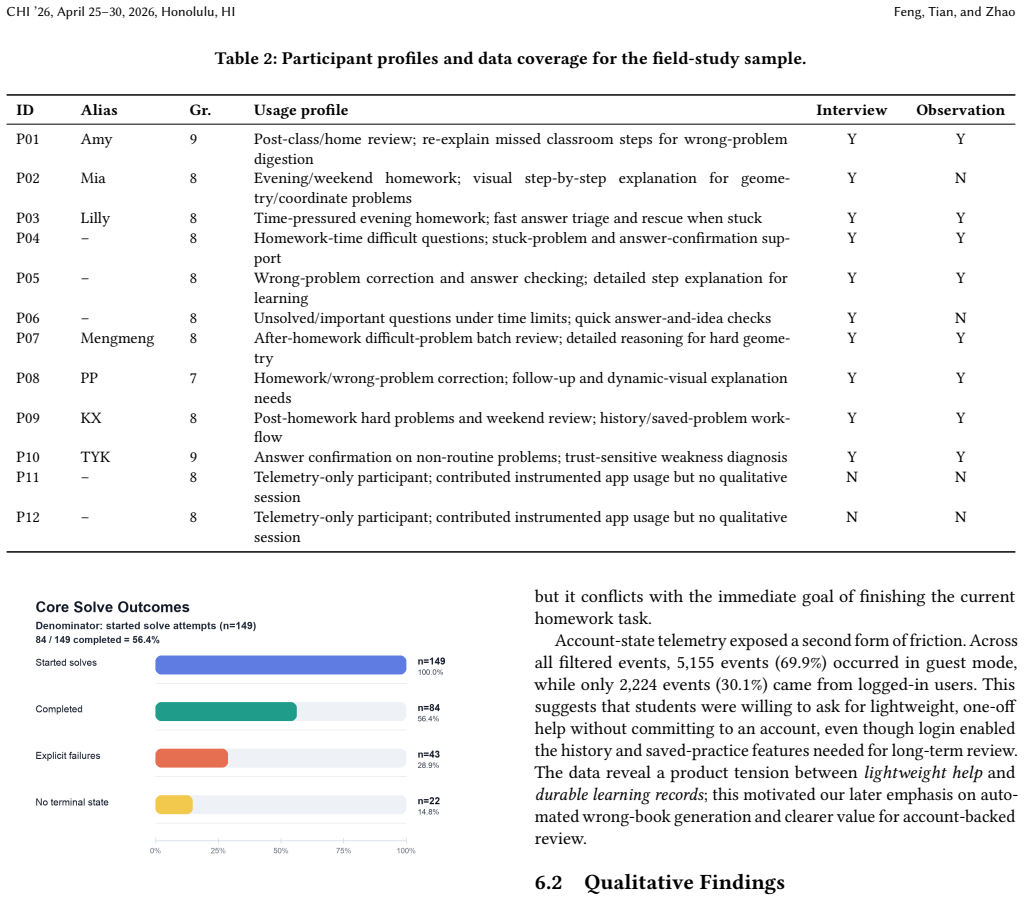
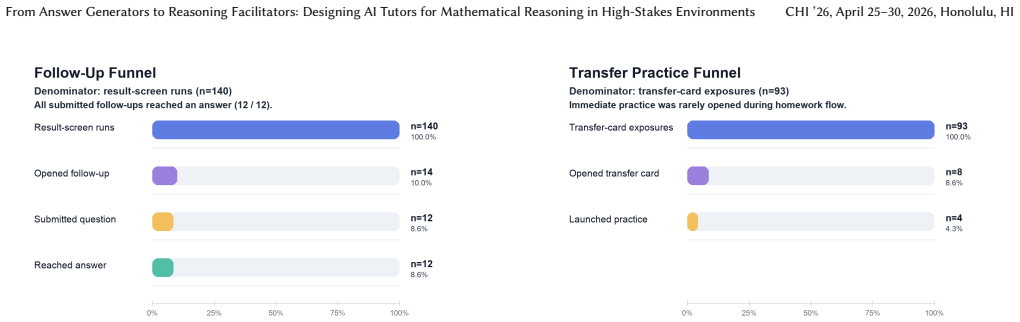
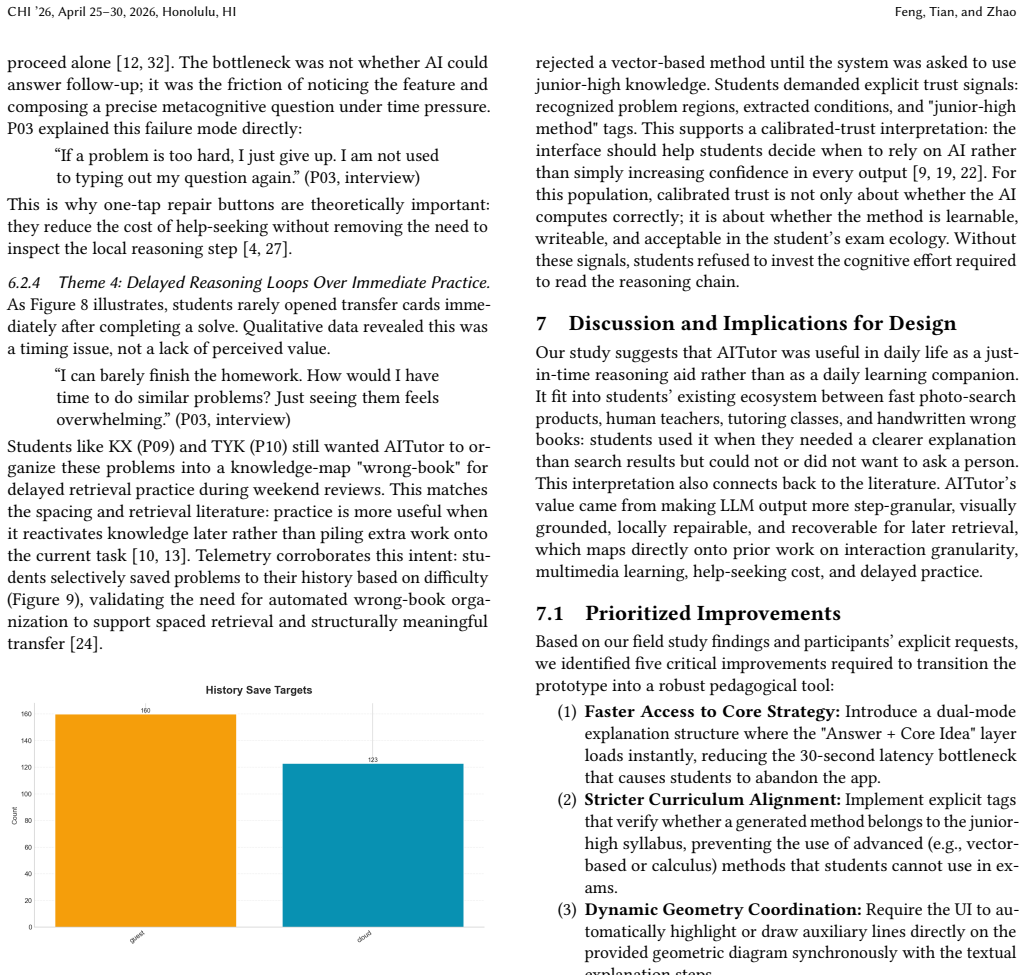
The central claim is that an interactive system called AITutor, built by mapping pedagogical mechanisms to specific user interface elements such as layered worked examples, step-linked visual grounding, and metacognitive scaffolding, lowers the interaction cost of reasoning repair. Data from 7,379 telemetry events, 8 observations, and 10 interviews with 12 students preparing for Zhongkao exams show that students actively resist Socratic dialogue under time pressure and repurpose answer-first shortcuts as diagnostic checkpoints. The study therefore proposes a Reasoning-Centered Product Loop that structurally supports inspection, local repair, curriculum verification, and delayed retrieval of
What carries the argument
The Reasoning-Centered Product Loop, a design structure that organizes AI tutoring around inspection, local repair, curriculum verification, and delayed retrieval of reasoning steps instead of answer generation.
If this is right
- Students repurpose answer-generation requests as diagnostic checkpoints rather than endpoints under time pressure.
- Layered worked examples enable step-by-step inspection without raising interaction cost.
- Step-linked visual grounding supports local repair of specific reasoning errors.
- Metacognitive scaffolding aids curriculum verification and delayed retrieval of reasoning.
- The overall loop shifts the role of AI from answer generator to reasoning facilitator in high-stakes settings.
Where Pith is reading between the lines
- The same interface patterns could be tested in other timed, high-stakes domains such as science problem solving or language exams.
- Systems built on this loop might integrate automated curriculum mapping to make verification steps more reliable.
- Designers could explore hybrid modes that allow students to toggle between answer shortcuts and full repair scaffolding.
- Longitudinal data would be needed to check whether lowered repair cost leads to measurable gains in independent problem solving.
Load-bearing premise
The assumption that results from twelve participants, telemetry events, observations, and interviews are sufficient to generalize student resistance to Socratic dialogue and the benefits of the listed interface features to broader populations under real exam pressure.
What would settle it
A larger field study in which students show no measurable reduction in reasoning-repair effort or continue to prefer pure Socratic questioning when using the same interface features would falsify the central claim.
Figures

read the original abstract
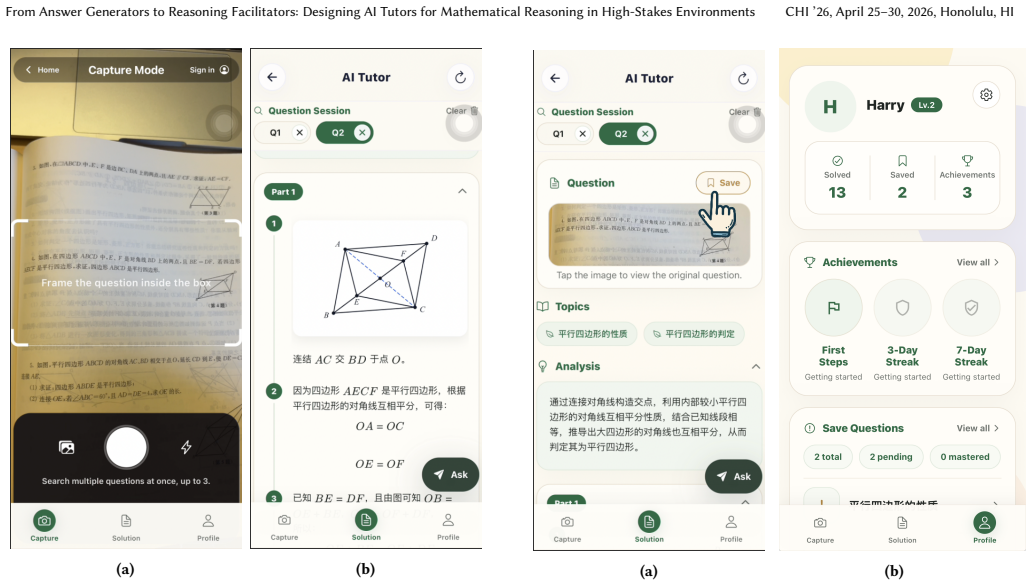
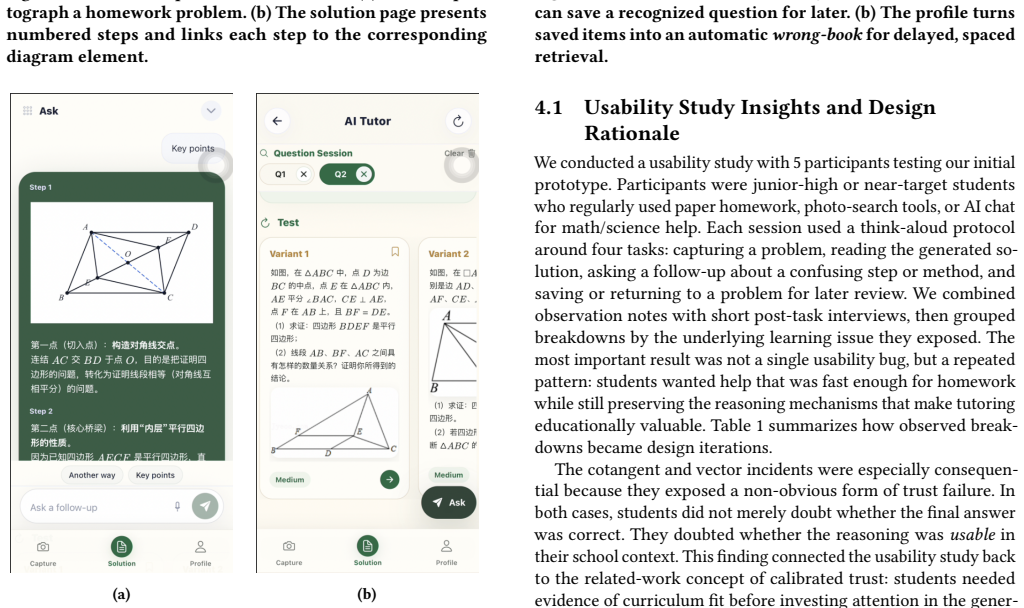
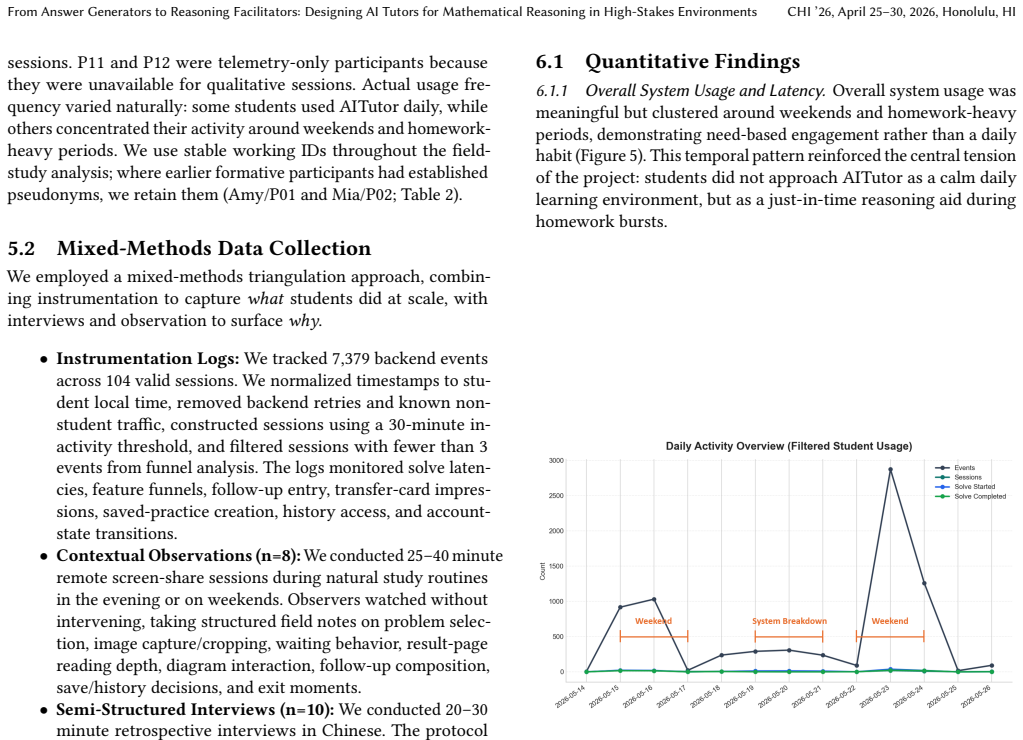
The rapid integration of Large Language Models (LLMs) into educational technology threatens to reduce mathematical learning to mere answer generation. This paper presents a generative study, usability study, and 12-participant field deployment of AITutor, an interactive system that translates theoretical pedagogical mechanisms into concrete user interface features. We explore how junior-high students preparing for high-stakes exams (Zhongkao) interact with AI tutoring. Through mixed-methods triangulation (7,379 telemetry events, 8 contextual observations, 10 interviews), we reveal that students actively resist traditional Socratic dialogue under time pressure, repurposing "answer-first" shortcuts as vital diagnostic checkpoints. We demonstrate how features like layered worked examples, step-linked visual grounding, and metacognitive scaffolding lower the interaction cost of reasoning repair. We contribute a "Reasoning-Centered Product Loop," offering actionable implications for designing AI that structurally supports the inspection, local repair, curriculum verification, and delayed retrieval of mathematical reasoning in the wild.
Editorial analysis
A structured set of objections, weighed in public.
Referee Report
Summary. The paper presents AITutor, an interactive AI tutoring system for junior-high students preparing for high-stakes Zhongkao math exams. Through a generative study, usability study, and 12-participant field deployment analyzed via mixed-methods triangulation (7,379 telemetry events, 8 contextual observations, 10 interviews), it claims that students resist traditional Socratic dialogue under time pressure and repurpose answer-first shortcuts as diagnostic tools. It demonstrates that UI features including layered worked examples, step-linked visual grounding, and metacognitive scaffolding lower the interaction cost of reasoning repair, and contributes a 'Reasoning-Centered Product Loop' with design implications for AI tutors that support inspection, local repair, curriculum verification, and delayed retrieval of mathematical reasoning.
Significance. If the empirical observations hold, the work provides concrete, actionable design guidance for educational AI that prioritizes reasoning processes over answer generation in time-constrained, high-stakes settings. The real-world field deployment and mixed-methods approach add ecological validity to HCI and edtech research on LLM-based tutors, highlighting student agency in repurposing system features.
major comments (2)
- [Field Deployment] Field Deployment section: The central claim that layered worked examples, step-linked visual grounding, and metacognitive scaffolding lower interaction cost of reasoning repair is supported only by triangulation from 12 participants (with 7,379 telemetry events, 8 observations, 10 interviews) and lacks a control condition or explicit handling of per-user variance; this weakens causal linkage between the listed UI mechanisms and the observed reductions in repair cost versus alternative explanations such as exam context or self-selection.
- [Methods] Methods: No details are provided on analysis methods for telemetry, exclusion criteria for the 12 participants, inter-rater reliability for observations/interviews, or assessment of selection bias; these omissions are load-bearing for evaluating the robustness of the mixed-methods evidence used to support resistance to Socratic dialogue and feature effectiveness.
minor comments (1)
- [Abstract] The abstract introduces a 'generative study' without elaboration; the full methods section should define its scope and relation to the usability study and field deployment for clarity.
Simulated Author's Rebuttal
We thank the referee for their constructive feedback, which highlights important areas for strengthening the presentation of our empirical work. We address each major comment in turn.
read point-by-point responses
-
Referee: [Field Deployment] Field Deployment section: The central claim that layered worked examples, step-linked visual grounding, and metacognitive scaffolding lower interaction cost of reasoning repair is supported only by triangulation from 12 participants (with 7,379 telemetry events, 8 observations, 10 interviews) and lacks a control condition or explicit handling of per-user variance; this weakens causal linkage between the listed UI mechanisms and the observed reductions in repair cost versus alternative explanations such as exam context or self-selection.
Authors: We agree that our study design is observational and does not include a control condition, as it was a field deployment in authentic high-stakes exam preparation settings where random assignment would be impractical and potentially unethical. The 12-participant sample reflects the challenges of recruiting in this context. We used mixed-methods triangulation to mitigate threats to validity, and the telemetry data does allow for some per-user analysis. However, we recognize that stronger causal language should be avoided. In the revision, we will revise the abstract and discussion to frame the findings as observational insights supported by triangulation rather than direct demonstrations of causal effects, and we will add a limitations subsection discussing alternative explanations and the absence of controls. revision: partial
-
Referee: [Methods] Methods: No details are provided on analysis methods for telemetry, exclusion criteria for the 12 participants, inter-rater reliability for observations/interviews, or assessment of selection bias; these omissions are load-bearing for evaluating the robustness of the mixed-methods evidence used to support resistance to Socratic dialogue and feature effectiveness.
Authors: We appreciate this feedback and acknowledge that the Methods section requires expansion for transparency. We will add subsections detailing: (1) telemetry analysis methods, including how the 7,379 events were logged, filtered, and analyzed for patterns in interaction costs; (2) participant recruitment and exclusion criteria (all 12 met the criteria of being junior-high students preparing for Zhongkao with no exclusions beyond consent); (3) qualitative analysis procedures, including inter-rater reliability metrics (e.g., percentage agreement or kappa for coding interviews and observations); and (4) an assessment of selection bias, noting that participants were from partner schools and may not represent all students. These additions will be included in the revised manuscript. revision: yes
Circularity Check
Empirical HCI study with no derivations or self-referential claims
full rationale
This is a mixed-methods empirical study reporting observations from a 12-participant field deployment, telemetry events, observations, and interviews. No equations, parameters, predictions, or first-principles derivations are present that could reduce to inputs by construction. The contributed 'Reasoning-Centered Product Loop' is presented as a design implication from data rather than a renamed or fitted result. No self-citation chains or uniqueness theorems are invoked as load-bearing for any central claim. The paper is self-contained against external benchmarks as an observational HCI report.
Axiom & Free-Parameter Ledger
Reference graph
Works this paper leans on
-
[1]
Shaaron Ainsworth. 1999. The functions of multiple representations.Computers & Education33, 2–3 (1999), 131–152
work page 1999
-
[2]
Shaaron Ainsworth. 2006. DeFT: A conceptual framework for considering learn- ing with multiple representations.Learning and instruction16, 3 (2006), 183–198
work page 2006
-
[3]
Vincent Aleven and Kenneth R Koedinger. 2002. An effective metacognitive strategy: Learning by doing and explaining with a computer-based Cognitive Tutor.Cognitive Science26, 2 (2002), 147–179
work page 2002
-
[4]
Vincent Aleven, Elmar Stahl, Silke Schworm, Frank Fischer, and Raven Wallace
-
[5]
Help seeking and help design in interactive learning environments.Review of educational research73, 3 (2003), 277–320
work page 2003
-
[6]
John R Anderson, Albert T Corbett, Kenneth R Koedinger, and Ray Pelletier. 1995. Cognitive tutors: Lessons learned.The journal of the learning sciences4, 2 (1995), 167–207
work page 1995
-
[7]
Robert K Atkinson, Sharon J Derry, Alexander Renkl, and Donald Wortham. 2000. Learning from examples: Instructional principles from the worked examples research.Review of Educational Research70, 2 (2000), 181–214
work page 2000
-
[8]
Ryan S. Baker, Albert T. Corbett, Kenneth R. Koedinger, and Angela Z. Wagner
-
[9]
InProceedings of the SIGCHI Conference on Human Factors in Computing Systems
Off-task behavior in the cognitive tutor classroom: When students game the system. InProceedings of the SIGCHI Conference on Human Factors in Computing Systems. ACM, New York, NY, USA, 383–390. doi:10.1145/985692.985741
-
[10]
Kiran Bisra, Qian Liu, John C Nesbit, Farimah Salimi, and Philip H Winne. 2018. Inducing self-explanation: A meta-analysis.Educational Psychology Review30, 3 (2018), 703–725
work page 2018
-
[11]
Zana Buçinca, Maja Barbara Malaya, and Krzysztof Z Gajos. 2021. To trust or to think: cognitive forcing functions can reduce overreliance on AI in AI-assisted decision-making.Proceedings of the ACM on Human-Computer Interaction5, CSCW1 (2021), 1–21
work page 2021
-
[12]
Nicholas J Cepeda, Harold Pashler, Edward Vul, John T Wixted, and Doug Rohrer
-
[13]
Distributed practice in verbal recall tasks: A review and quantitative synthesis.Psychological Bulletin132, 3 (2006), 354–380
work page 2006
-
[14]
Michelene TH Chi, Miriam Bassok, Matthew W Lewis, Peter Reimann, and Robert Glaser. 1989. Self-explanations: How students study and use examples in learning to solve problems.Cognitive science13, 2 (1989), 145–182
work page 1989
-
[15]
Allan Collins, John Seely Brown, and Susan E Newman. 1989. Cognitive appren- ticeship: Teaching the crafts of reading, writing, and mathematics. InKnowing, Learning, and Instruction: Essays in Honor of Robert Glaser, Lauren B Resnick (Ed.). Lawrence Erlbaum Associates, Hillsdale, NJ, USA, 453–494
work page 1989
-
[16]
John Dunlosky et al. 2013. Improving students’ learning with effective learning techniques.Psychological Science in the Public Interest14, 1 (2013), 4–58
work page 2013
-
[17]
Arthur C Graesser, Patrick Chipman, Brian C Haynes, and Andrew Olney. 2005. AutoTutor: An intelligent tutoring system with mixed-initiative dialogue.IEEE Transactions on Education48, 4 (2005), 612–618
work page 2005
-
[18]
John Hattie and Helen Timperley. 2007. The power of feedback.Review of Educational Research77, 1 (2007), 81–112
work page 2007
-
[19]
Manu Kapur. 2008. Productive failure.Cognition and instruction26, 3 (2008), 379–424
work page 2008
-
[20]
Jeffrey D Karpicke and Henry L Roediger III. 2008. The critical importance of retrieval for learning.Science319, 5865 (2008), 966–968
work page 2008
-
[21]
Enkelejda Kasneci et al. 2023. ChatGPT for good? On opportunities and challenges of large language models for education.Learning and individual differences103 (2023), 102274
work page 2023
-
[22]
René F Kizilcec. 2016. How much information? Effects of transparency on trust in an algorithmic interface. InProceedings of the 2016 CHI Conference on Human Factors in Computing Systems. ACM, New York, NY, USA, 2390–2395
work page 2016
-
[23]
Kenneth R Koedinger and Vincent Aleven. 2007. Exploring the assistance dilemma in experiments with cognitive tutors.Educational psychology review19 (2007), 239–264
work page 2007
-
[24]
Jill H Larkin and Herbert A Simon. 1987. Why a diagram is (sometimes) worth ten thousand words.Cognitive science11, 1 (1987), 65–100
work page 1987
-
[25]
John D Lee and Katrina A See. 2004. Trust in automation: Designing for appro- priate reliance.Human factors46, 1 (2004), 50–80
work page 2004
-
[26]
Richard E Mayer and Roxana Moreno. 2003. Nine ways to reduce cognitive load in multimedia learning.Educational psychologist38, 1 (2003), 43–52
work page 2003
-
[27]
Steven C Pan and Timothy C Rickard. 2018. Transfer of test-enhanced learning: Meta-analytic review and synthesis.Psychological Bulletin144, 7 (2018), 710–756
work page 2018
-
[28]
Alexander Renkl. 2002. Worked-out examples: Instructional explanations support learning by self-explanations.Learning and instruction12, 5 (2002), 529–556
work page 2002
-
[29]
Henry L Roediger III and Jeffrey D Karpicke. 2006. Test-enhanced learning: Taking memory tests improves long-term retention.Psychological science17, 3 (2006), 249–255
work page 2006
-
[30]
Ido Roll, Vincent Aleven, Bruce M McLaren, and Kenneth R Koedinger. 2011. Improving students’ help-seeking skills using metacognitive feedback in an intelligent tutoring system.Learning and instruction21, 2 (2011), 267–280
work page 2011
-
[31]
Wolfgang Schnotz and Maria Bannert. 2003. Construction and interference in learning from multiple representation.Learning and Instruction13, 2 (2003), 141–156
work page 2003
-
[32]
Valerie J Shute. 2008. Focus on formative feedback.Review of Educational Research 78, 1 (2008), 153–189
work page 2008
-
[33]
Jan van der Meij and Ton de Jong. 2006. Supporting students’ learning with multiple representations in a dynamic simulation-based learning environment. Learning and Instruction16, 3 (2006), 199–212
work page 2006
-
[34]
Kurt VanLehn. 2011. The relative effectiveness of human tutoring, intelligent tutoring systems, and other tutoring systems.Educational psychologist46, 4 (2011), 197–221
work page 2011
-
[35]
David Wood, Jerome S Bruner, and Gail Ross. 1976. The role of tutoring in problem solving.Journal of Child Psychology and Psychiatry17, 2 (1976), 89–100
work page 1976
discussion (0)
Sign in with ORCID, Apple, or X to comment. Anyone can read and Pith papers without signing in.