REVIEW 4 major objections 5 minor 124 references
Time lag in transient galactic and extragalactic accreting sources
T0 review · 4 major / 5 minor · reviewed 2026-08-14 · deepseek-v4-flash
Pith's one-line read The paper claims that one viscous-disk formula reproduces the observed optical-to-X-ray delays in four galactic accreting sources, and that in AGNs the same delay measures the free-fall time of tidally disrupted stellar debris from the…
desk verdict A conference-proceedings narrative that honestly summarizes prior work; as a research preprint it lacks derivations, and the four-source 'excellent agreement' is not independently supported because input parameters are not given. read the letter →
The pith
A machine-rendered reading of the paper's core claim, the machinery that carries it, and where it could break.
The reading
What carries the argument
The load-bearing objects are two analytic formulas. Eq. 6.1, $\tau = 6.9\, m^{2/3} \dot{m}^{1/15} \alpha^{-4/5} (T_4)^{28/15}$, is the viscous propagation time of a mass-flow surge through a standard $\alpha$ disk; it encodes the compact-object mass $m$, accretion rate $\dot{m}$, viscosity parameter $\alpha$, and disk optical temperature $T_4$, and it is what converts an observed delay into a physical quantity. Eq. 6.3, $r_{\mathrm{opt}} = 1.65 \times 10^{12} \tau_{\mathrm{obs}} m^{1/3}$ cm, comes from integrating the free-fall velocity and converts an AGN delay into the radius where the optical flash originates, identified with the tidal radius. The argument rides on these two identities: measured delays are plugged into them to recover viscosity or disrupted-star radius.
What would settle it
Measure the delay in a transient whose disk mass, temperature, and viscosity are independently constrained, and compare with Eq. 6.1; a discrepancy of more than a factor of two would falsify the formula's universal form. For an AGN tidal disruption event with a well-measured black hole mass, check whether the delay implies a disrupted-star radius in the giant range; a radius far outside the giant branch, or a light curve showing a slow viscous disk-rise, would refute the free-fall identification.
Extended reading notes
Core claim
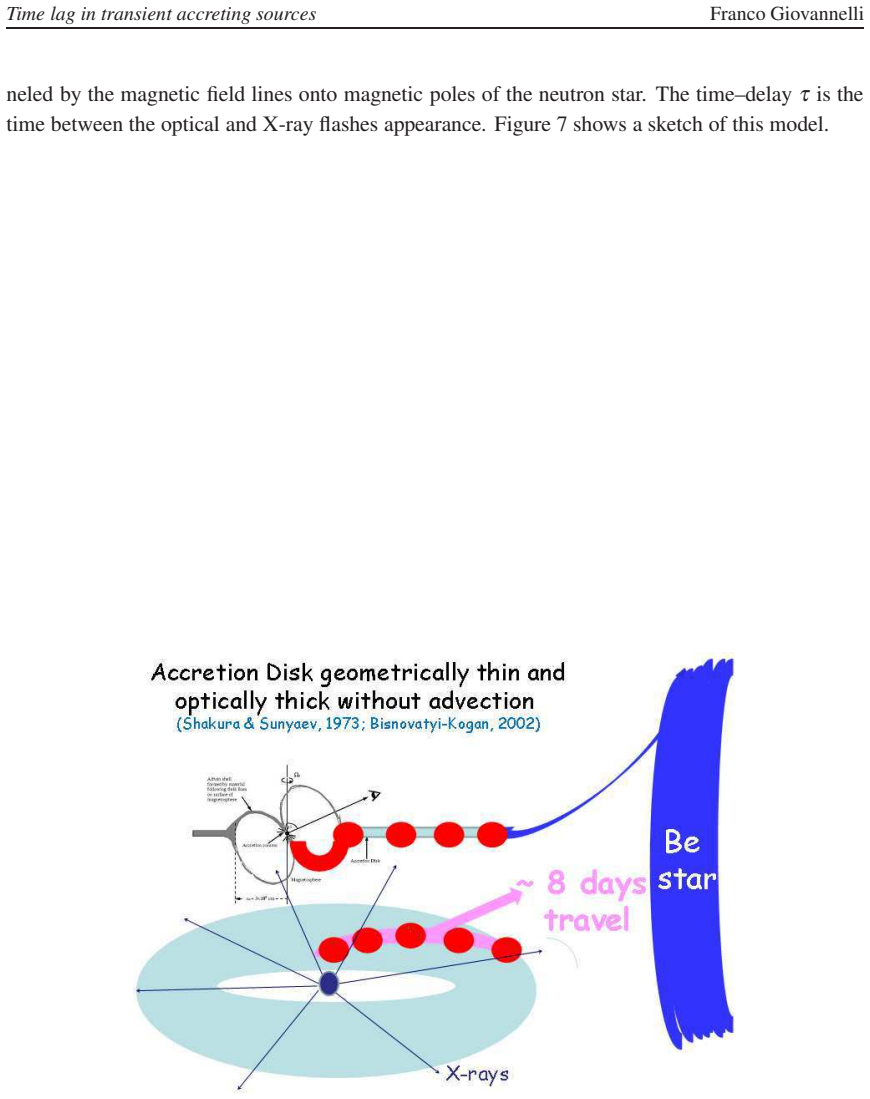
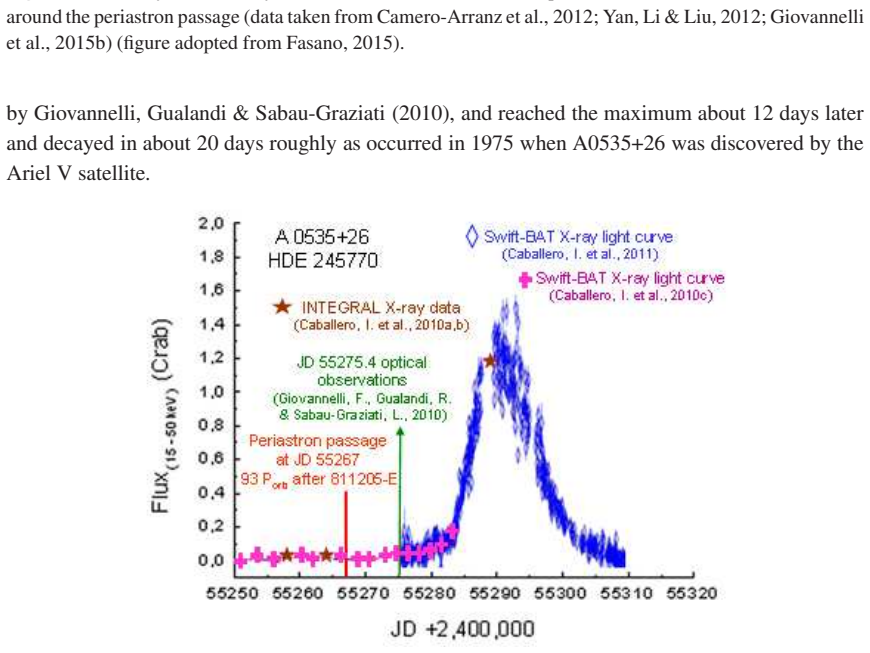
The central claim is that in disk-accreting close binaries an outburst begins at the disk periphery, seen as an optical brightening, and the increased mass flow then propagates inward under turbulent viscosity, producing the X-ray flash only after a delay $\tau$. The paper states that Eq. 6.1, $\tau = 6.9\, m^{2/3} \dot{m}^{1/15} \alpha^{-4/5} (T_4)^{28/15}$ days, gives excellent agreement with four measured delays: about 8 days for A0535+26, 0.9\textendash 1.4 days for SS Cygni, about 3 days for Aql X-1, and about 6 days for GRO J1655-40. For AGNs the paper claims that the debris from a star disrupted at the tidal radius falls almost radially at free-fall speed, so the observed optical-to-X-ray delay equals the free-fall time; inverting that gives the radius of the optical flash, which for the six listed AGNs implies disrupted stars with radii of tens to hundreds of solar radii, characteristic of giants. The paper also expects that debris with larger angular momentum will later form a disk and produce long-lived multiwavelength variability.
Load-bearing premise
For the AGN part, the load-bearing premise is that the shredded star's debris falls almost straight inward with very little angular momentum, so the observed optical-to-X-ray delay equals the free-fall time from the tidal radius; if angular momentum is substantial, a disk forms and the inflow is viscous and much slower.
Editorial extensions
If this is right
- If the formula holds, a measured optical-to-X-ray delay in a transient with known companion mass and accretion rate yields the disk viscosity parameter $\alpha$, which is otherwise very hard to measure.
- The scaling $\tau \propto (T_4)^{28/15} \alpha^{-4/5} \dot{m}^{1/15} m^{2/3}$ predicts that the delay is almost insensitive to accretion rate but very sensitive to the disk's optical temperature, a directly testable trend across a sample of transients.
- In AGNs, measuring a delay and knowing the black hole mass gives the radius of the disrupted star; the values recovered in this paper indicate giant-branch stars, linking optical-X-ray delays to stellar evolution.
- After an AGN tidal-disruption flash, matter with appreciable angular momentum should form an accretion disk and produce long-duration, irregular variability across the electromagnetic spectrum.
- The periodic ephemeris approach for A0535+26 lets observers predict the arrival of X-ray outbursts from observed optical brightenings around periastron.
Reading between the lines
- Inference beyond the paper: if Eq. 6.1 is robust, the delay can be used as an independent estimator of disk temperature, since the delay depends so steeply on $T_4$; multi-band optical monitoring timed against X-ray flares would test this.
- Inference beyond the paper: the galactic and AGN models predict opposite scalings with angular momentum, so a tidal disruption event with a slow, viscous rise should show a much longer delay than the free-fall value; distinguishing the two regimes is an observational handle on the debris angular-momentum distribution.
- Inference beyond the paper: the reported roughly 5-day lag between the H-beta and H-alpha equivalent-width jumps, if real, may trace the radial propagation of the same viscosity wave through different line-forming disk zones; simultaneous time-resolved spectroscopy of future outbursts could map that propagation directly.
Signed reviews
Editorial analysis
A structured set of objections, weighed in public.
Referee Report
Summary. This paper reviews the evidence for optical–X-ray time delays in transient accreting sources and summarizes a model for the delay in galactic X-ray binaries, cataclysmic variables, and AGNs. For galactic sources, the delay is attributed to viscous propagation of an accretion wave through a disk, and the paper quotes Eq. (6.1), which is said to reproduce the observed delays of four systems to within about ten percent. For AGNs, the delay is interpreted as the free-fall time from the tidal radius of a disrupted star, leading to Eq. (6.3), and a table of six sources is presented. The paper also contains a historical account of the A0535+26/HDE245770 system and its multifrequency behaviour.
Significance. If the quantitative claims were fully supported, the paper would offer a simple unified formula connecting the optical–X-ray delay to stellar mass, accretion rate, disk viscosity, and disk temperature for galactic sources, and to the SMBH mass and stellar radius for TDE-like AGN flares. The empirical synthesis of A0535+26 observations and the proposed extension to AGNs are suggestive. However, the central equations are not derived in this manuscript, the input parameters are not given, and the AGN comparison is constructed from the observed delays. As it stands, the paper is better read as a conference summary of earlier work (GBK13, BKG17) than as a self-contained validation of the delay model.
major comments (4)
- [Section 6, Eq. (6.1)] The central quantitative claim of the paper — that Eq. (6.1) reproduces the observed optical–X-ray delays in A0535+26, SS Cygni, Aql X-1, and GRO J1655-40 — is not testable from the manuscript because no derivation of Eq. (6.1) is given and the input parameters (m, \dot{m}, T0, and especially α) for each of the four systems are not reported. The text immediately after the list states that Eq. (6.1) can be used to determine α from the experimental delay; if α is adjusted to match τ_exp, the claimed “excellent agreement” is by construction rather than a validation. Please provide either the derivation or a table of independently constrained input parameters and the resulting α for each source.
- [Section 6, Eq. (6.1)] The printed formula has τ ∝ α^{4/5}, i.e., a positive power of α. For a delay produced by outward transport of a viscosity wave, one expects the viscous time to decrease with increasing α, since larger α means faster angular momentum transport. As written, the formula implies that higher viscosity produces longer delays, which is opposite to the physical mechanism described in the text and sketched in Fig. 7. This sign (or exponent) needs to be corrected or physically justified.
- [Section 7, Eq. (6.3) and Table 2] The AGN test is circular. Eq. (6.3) is obtained by setting τ_ff = τ_obs and solving for r_opt, and Table 2 then lists r_opt = r_t and computes the implied stellar radius R_s = ... × m_s^{1/3} R_⊙. Since r_opt is constructed from τ_obs, the agreement between r_opt and r_t is a consequence of the construction, not an independent confirmation of the model. A genuine test would require computing τ_ff from independently measured stellar and SMBH parameters and comparing it with τ_obs.
- [Section 7 and Section 8] The model's applicability to the AGN sources in Table 2 rests on the assumption that the debris from the disrupted star falls quasi-spherically at near free-fall velocity with low angular momentum. This assumption is not justified for any of the listed sources. Standard TDE scenarios from Rees (1988) and later work generally involve debris with significant angular momentum that forms an accretion disk, in which the inflow time is the much longer viscous time; the paper itself acknowledges in Section 8 that higher-angular-momentum matter forms a disk. Please provide a quantitative argument or observational evidence that the debris in these specific objects has low angular momentum.
minor comments (5)
- [Abstract] The text cites “Rees (1998)”, but the body and reference list give Rees (1988); the year should be corrected.
- [Section 6, Eq. (6.1)] The equation is not clearly typeset: multiplication symbols between m, \dot{m}, α, and T4 are missing, and it is unclear whether the exponent of T4 is positive or negative; please check the original expression and reproduce it unambiguously.
- [Table 2] The entry for 3C 120 lists “3.9-6.2? (10)”, which is ambiguous and should be clarified with a reference or an explanation of the uncertainty.
- [Section 4, Table 1] The phrase “The mass are expressed in unit of SMC” should be “The masses are expressed in units of the SMC mass.”
- [Section 1] The philosophical preamble and the explanation that the talk was not originally scheduled are unusual in a research paper; consider condensing this material into a footnote or deleting it.
Circularity Check
The claimed four-source agreement can reduce to fitting alpha, and the AGN 'radius' is obtained by inverting the measured delay.
-
fitted input called prediction
[Section 6, Eq. (6.1) and the following source list]
"By using this formula it is possible to obtain an excellent agreement between the experimental and theoretical delays found in: [list of four sources] ... In this general formula the α-viscosity parameter plays an important role, and usually it is hard to be determined. However, if the other parameters are known, because experimentally determined, the formula (6.1) can be used for determining α, taking into account the experimental delay measured in a certain source."
The claimed validation of Eq. (6.1) is the agreement between τ_th and τ_exp for A0535+26, SS Cygni, Aql X-1, and GRO J1655-40. But the paper immediately states that Eq. (6.1) can be inverted to determine α from the measured delay, and it gives no independent values of α, m, dot-m, or T0 for these sources. Thus the listed τ_th values are not shown to be independent predictions: if α is inferred from τ_exp, the equality τ_th ≃ τ_exp is forced by construction rather than being a test of the formula.
-
self definitional
[Section 7, Eq. (6.3) and Table 2]
"Taking τff = τobs, BKG17 obtained a radius of the optical flash ropt as: ropt = 1.65 × 10^12 τobs m^{1/3} cm (6.3) ... However, with the formula (6.3) BKG17 justify the experimental time delay between optical and X-ray flashes observed in AGNs."
Equation (6.3) does not predict the AGN delay; it is obtained by setting τff equal to the observed τobs and solving for ropt. The table then labels this inverted radius as 'ropt = rt', identifying it with the tidal radius. Consequently, the 'agreement' in Table 2 is a consistency check on the assumed stellar and black-hole parameters, not an independent derivation of τobs from first principles. The observed delay is an input to Eq. (6.3), so using Eq. (6.3) to 'justify' the delay is circular by construction.
full rationale
The paper's two central quantitative relations are imported from the authors' earlier BKG17 paper and are not rederived here. For the galactic sources, Eq. (6.1) is presented as if it reproduces four measured delays, but the text states that the free α parameter can be determined from the experimental delay itself. With no per-source parameter values given, the reported τ_th ≃ τ_exp values are consistent with inversion rather than with independent prediction. For the AGN case, Eq. (6.3) is literally the inverse of the observed delay under an assumed free-fall model: setting τff = τobs and solving for ropt, then calling that radius rt, makes the 'predicted' radius an algebraic rearrangement of the input delay. The paper also leans heavily on self-citations (GBK13, BKG17), but that alone would not be circular; the circularity is the inversion of the measured quantity into the claimed output. Because the central four-source 'agreement' and the AGN radius both reduce at least partially to construction or fitting, a score of 6 is appropriate: some independent content may exist in BKG17, but the present paper does not exhibit an independent prediction.
Assumptions & free parameters
free parameters (1)
- alpha (Shakura-Sunyaev viscosity parameter)
assumptions (4)
- domain assumption Turbulent viscosity in a Shakura-Sunyaev thin disk transports an enhanced mass flux inward and produces the optical-to-X-ray delay.
- domain assumption For AGN tidal disruption, debris with low angular momentum falls quasi-spherically at nearly free-fall speed.
- domain assumption The observed optical-X-ray delay in AGNs is the free-fall time from the tidal radius to the inner hot region.
- domain assumption The disrupted star is a moderate-mass giant with radius of tens to hundreds of solar radii.
Cite this review
Pith. "Pith review of Time lag in transient galactic and extragalactic accreting sources." pith.science (2026). https://pith.science/paper/GYGDIWJW
@misc{pith2026190809667,
  author       = {Pith},
  title        = {Pith review of: Time lag in transient galactic and extragalactic accreting sources},
  year         = {2026},
  howpublished = {\url{https://pith.science/paper/GYGDIWJW}},
  note         = {Machine review of arXiv:1908.09667}
}
abstract
X-ray binaries are cauldrons of fundamental physical processes which appear along practically the whole electromagnetic spectrum. The sub-class of X-ray transient sources show multifrequency behaviour which deserve particular attention in order to understand the causing physics. These binary systems consist of a compact star and an optical star, therefore there is a mutual influence between these two stars that drive the low energy (LE) (i.e. radio, IR, optical) and high energy (HE) (i.e. UV, X-ray, $\gamma$-ray) processes. The LE processes are produced mostly on the optical star and the HE processes mostly on the compact star, typically a neutron star. Thus it appears evident that through the study of LE processes it is possible to understand also the HE processes and vice versa. In this paper we will discuss this problem starting from the experimental evidence of a delay between LE and HE processes detected for the first time in the X-ray/Be system A0535+26/HDE245770 (e.g. Giovannelli \& Sabau-Graziati, 2011; Giovannelli, Bisnovatyi-Kogan \& Klepnev, 2013 (here after GBK13); Giovannelli et al., 2015b). This delay is common in cataclysmic variables (CVs) and other binary systems with either a neutron star or a black hole. Since a delay between LE processes and HE processes has been experimentally observed in several active galactic nuclei (AGNs), we will discuss also the tidal disruption of stars by massive BHs, following the original idea of Rees (1998): stars in galactic nuclei can be captured or tidally disrupted by a central black hole. Some debris would be ejected at high speed, the remainder would be swallowed by the hole, causing a bright flare lasting at most a few years.
Figures

Figures from the paper (10 more)






Reference graph
Works this paper leans on
-
[1]
in Re lativity 16, Issue 1, article id
Abramowicz, M.A., Fragile, P .C.: 2013, Living Rev. in Re lativity 16, Issue 1, article id. 1, 88 pp
2013
-
[2]
Baade, W ., Zwicky, F.: 1934, Phys. Rev. 45, 138
1934
-
[3]
Bartolini, C., Guarnieri, A., Piccioni, A., Giangrande , A., Giovannelli, F.: 1978, IAU Circ. No. 3167
1978
-
[4]
Bartolini, C., Bianco, G., Guarnieri, A., Piccioni, A., Giovannelli, F.: 1983, Hvar Obs. Bull. 7(1), 159
1983
-
[5]
Belczynski, K., Ziółkowski, J.: 2009, ApJ 707, 870
2009
-
[6]
Belczynski, K., Dominik, M., Bulik, T., O’Shaughnessy, R., Fryer, C., Holz, D.E.: 2010, ApJL 715, L138
2010
-
[7]
Bisnovatyi-Kogan, G.S.: 2011, Stellar Physics 2: Stellar Evolution and Stability , Berlin-Heidelberg: Springer-V erlag
2011
-
[8]
Bisnovatyi-Kogan, G.S., Komberg, B.V .: 1974, Sov. Astr on. 18, 217
1974
Show all 124 references
-
[9]
Bisnovatyi-Kogan, G.S., Giovannelli, G.: 2017, A&A 599 , A55, 7 pp. (BKG17)
2017
-
[10]
Blaes, O.: 2014, SSRv 183, 21-41
2014
-
[11]
Blumenthal, G.R., Tucker, W .H.: 1974, Ann. Rev. A&A 12, 23-46. 24 Time lag in transient accreting sources Franco Giovannelli
1974
-
[12]
The Golden Age of Cataclysmic V ariables and Related Objects - III
Buckley, D., 2015, talk at the Palermo Workshop on " The Golden Age of Cataclysmic V ariables and Related Objects - III "
2015
-
[13]
Burbidge, E.Margaret, Burbidge, G.R., Fowler, W .A., H oyle, F.: 1957, Rev. Mod. Phys. 29, 547-655
1957
-
[14]
et al.: 1996, in Multifrequency Behaviour of High Energy Cosmic Sources , F
Burger, M., van Dessel, E.L., Giovannelli, F., Sabau-G raziati, L., Bartolini, C. et al.: 1996, in Multifrequency Behaviour of High Energy Cosmic Sources , F. Giovannelli & L. Sabau-Graziati (eds.), Mem. SAIt. 67, 365
1996
-
[15]
Caballero, I., Lebrun, F., Rodriguez, J., Soldi, S., Ma ttana, F., et al.: 2010a, A Tel. 2496
-
[16]
Caballero, I., Santangelo, A., Pottschmidt, K., Kloch kov, D., Rodriguez, J., et al.: 2010b, A Tel. 2541
-
[17]
Caballero, I., Pottschmidt, K., Barragán, L., Ferrign o, C., Klochkov, D., et al.: 2010c, Talk at CRSF Meeting, Tübingen 2010
2010
-
[18]
Caballero, I., Kretschmar, P ., Pottschmidt, K., Santa ngelo, A., Wilms, J., et al.: 2010d, AIPC 1248, 147
-
[19]
Caballero, I., Pottschmidt, K., Santangelo, A., Barra gán, L., Klochkov, D., et al.: 2011, arXiv:1107.3417
2011 arXiv
-
[20]
Cameron, A.G.W .: 1958, Ann. Rev. Nucl. Part. Sci. 8, 299 -326
1958
-
[21]
Camero-Arranz, A., Finger, M.H., Wilson-Hodge, C.A., Jenke, P ., Steele, I., et al.: 2012, ApJ 754, 20
2012
-
[22]
Casares, J., Jonker, P .G.: 2014, SSRv 183, 223-252
2014
-
[23]
et al.: 2014, Nature 505, Issue 7483, 378-381
Casares, J., Negueruela, I., Ribó, M., Ribas, I., Pared es, J.M. et al.: 2014, Nature 505, Issue 7483, 378-381
2014
-
[24]
Chartres, M., Li, F.: 1977, IAU Circ. No. 3154
1977
-
[25]
Nederlandsche Akad
Clay, J.: 1927, Proc. Nederlandsche Akad. v. Wet. 30, 11 15
1927
-
[26]
J., Carpenter, G.F., Engel, A.R., Quenby, J.J.: 1975, Nature 256, 630
Coe, M. J., Carpenter, G.F., Engel, A.R., Quenby, J.J.: 1975, Nature 256, 630
1975
-
[27]
Coe, M.J., Reig, P ., McBride, V .A., Galache, J.L., Fabr egat, J.: 2006, MNRAS 368, 447
2006
-
[28]
Coleiro, A., Chaty, S.: 2013, ApJ 764, 185
2013
-
[29]
Corbet, R.H.D.: 1984, A&A 141, 91
1984
-
[30]
Corbet, R.H.D.: 1986, MNRAS 220, 1047
1986
-
[31]
et al.: 2015, ApJ 8 06, 129
Edelson, R., Gelbord, J.M., Horne, K. et al.: 2015, ApJ 8 06, 129
2015
-
[32]
Fasano, A.: 2015, Comportamento spettrofotometrico della transiente X A053 5+26/HDE245770, Bachelor’s degree thesis, Sapienza University, Roma, Ital y
2015
-
[33]
et al.: 2016 , ApJ 821, 56
Fausnaugh, M.M., Denney, K.D., Barth, A.J. et al.: 2016 , ApJ 821, 56
2016
-
[34]
Ferrario, L., de Martino, D., Gänsicke, B.T.: 2015, SSR v 191, 111-169
2015
-
[35]
1994 IAU Circ
Finger, M.H., Wilson, R.B., Hagedon, K.S. 1994 IAU Circ . No. 5931
1994
-
[36]
Finger, M.H., Wilson, R.B., Harmon, B.A.: 1996, ApJ 459 , 288
1996
-
[37]
Finger, M.H., Camero-Arranz, A., Kretschmar, P ., Wils on, C., and Patel, S.: 2006, BAAS 38, 359
2006
-
[38]
25 Time lag in transient accreting sources Franco Giovannelli
Frank, J., King, A.R., Raine, D.J.: 1985, Accretion power in astrophysics, Cambridge and New Y ork, Cambridge University Press, 283 pp. 25 Time lag in transient accreting sources Franco Giovannelli
1985
-
[39]
Fryer, C.L., Belczynski, K., Wiktorowicz, G., Dominik , M., Kalogera, V ., Holz, D.E.: 2012, ApJ 749, 91
2012
-
[40]
Holt & C.S
Ghosh, P .: 1994, in The Evolution of X-Ray Binaries , S.S. Holt & C.S. Day (Eds.), AIP Conf. Proc. 308, 439
1994
-
[41]
Giacconi, R., Gursky, H., Paolini, F.R., Rossi, B.: 196 2, Phys. Rev. Lett. 9, 439
-
[42]
Giacconi, R., Gursky, H., Kellog, E., Schreier, E., Tan anbaum, H.: 1971, Astrophys. J. Lett. 167, L67
1971
-
[43]
230, 540
Giacconi, R., Branduardi, G., Briel, U., Epstein, A., F abricant, D.: 1979, ApJ. 230, 540
1979
-
[44]
Giangrande, A., Giovannelli, F., Bartolini, C., Guarn ieri, A., Piccioni, A.: 1980, A&A Suppl. Ser. 40, 289
1980
-
[45]
Matteucci & F
Giovannelli, F.: 2000, in The Evolution of The Milky W ay, F. Matteucci & F. Giovannelli (Eds.), Kluwer Academic Publishers, pp. 619-620
2000
-
[46]
Giovannelli, F.: 2005, The Impact of Multifrequency Observations in High Energy As trophysics, Ph. D. Thesis, University of Barcelona, Spain
2005
-
[47]
Giovannelli, F.: 2015, talk at the Frascati Workshop 20 15 on Multifrequency Behaviour of High Energy Cosmic Sources - XI , 29th May
2015
-
[48]
of the 4th Ann
Giovannelli, F.: 2016, in Proc. of the 4th Ann. Conf. on High Energy Astrophysics in Sou thern Africa (HEASA 2016). Online at http://pos.sissa.it/cgi-bin/reader/conf.cg i?confid=275, id.31
2016
-
[49]
& Wolfendale, A.W
Giovannelli, F., Karakuła, S., Tkaczyk, W .: 1981, in Origin of Cosmic Rays , Setti, G., Spada, G. & Wolfendale, A.W . (Eds.), IAU Symp. 94, p. 335
1981
-
[50]
Giovannelli, F., Karakuła, S., Tkaczyk, W .: 1982, Acta Astron. 32, 121
1982
-
[51]
1982 in Proc
Giovannelli, F., de Loore, C., Bartolini, C., Burger, M ., Ferrari-Toniolo, M., et al. 1982 in Proc. of the Third European IUE Conference, ESA SP-176, 233
1982
-
[52]
Giovannelli (ed.), Edizioni Scientifiche SIDEREA, Roma, p
Giovannelli, F., Ferrari-Toniolo, M., Persi, P ., Goly nskaya, I.M., Kurt, V .G., et al.: 1985 in Multifrequency Behaviour of Galactic Accreting Sources , F. Giovannelli (ed.), Edizioni Scientifiche SIDEREA, Roma, p. 284
1985
-
[53]
Giovannelli, F., Ziółkowski, J.: 1990, AcA 40, 95-103
1990
-
[54]
Giovannelli, F., Sabau-Graziati, L.: 1992, SSRv 59, 1- 81
1992
-
[55]
Giovannelli, F., Sabau-Graziati, L.: 2001, Ap&SS, 276 , 67-80
2001
-
[56]
Giovannelli, F., Bernabei, S., Rossi, C., Sabau-Grazi ati, L.: 2007, A&A, 475, 651
2007
-
[57]
Giovannelli, F., Gualandi, R., Sabau-Graziati, L.: 20 10, A Tel. 2497
-
[58]
Giovannelli, F., Sabau-Graziati, L.: 2011, Acta Polyt echnica V ol. 51, No. 2., p. 21
2011
-
[59]
S.: 2013, A&A 560, id.A1, 11 pp (GBK13)
Giovannelli, F., Bisnovatyi-Kogan, G.S., Klepnev, A. S.: 2013, A&A 560, id.A1, 11 pp (GBK13)
2013
-
[60]
Giovannelli, F., Bisnovatyi-Kogan, G.S., Bruni, I., C orfini, G., Martinelli, F., Rossi, C.: 2015a, AcA 65, 107-116
-
[61]
of the XI Multifrequency Behaviour of High Energy Cosmic Sources Workshop (MULTIF15)
Giovannelli, F., Rossi, C., Bisnovatyi-Kogan, G., Bru ni, I., Fasano, A., Salas Procas, J.: 2015b, Proc. of the XI Multifrequency Behaviour of High Energy Cosmic Sources Workshop (MULTIF15). Online at http://pos.sissa.it/cgi-bin/reader/conf.cgi?confid =246, id.39
-
[62]
Giovannelli, F., Sabau-Graziati, L.: 2016, in Frontier Research in Astrophysics II, Online at https://pos.sissa.it/cgi-bin/reader/conf.cgi?confid= 269, id. 1. 26 Time lag in transient accreting sources Franco Giovannelli
2016
-
[63]
Grimm, H.-J.: 2003, PhD Thesis, Ludwig-Maximilians-U niversitat, München, Germany
2003
-
[64]
Grudzinska, M., Belczynski, K., Casares, J., de Mink, S .E., Ziolkowski, J.: 2015, MNRAS, 452, 2773-2787
2015
-
[65]
Giovannelli (ed.), Frascati: CNR, Istituto di Astrofisi ca, Edizioni Scientifiche SIDEREA, Roma, p
Guarnieri, A., Bartolini, C., Piccioni, A., Giovannel li, F.: 1985b, in Multifrequency Behaviour of Galactic Accreting Sources, F. Giovannelli (ed.), Frascati: CNR, Istituto di Astrofisi ca, Edizioni Scientifiche SIDEREA, Roma, p. 310
-
[66]
Hutchings, J.B.: 1984, P ASP 96, 312
1984
-
[67]
Hayakawa, S.: 1952, Prog. Theor. Phys. 8, 571
1952
-
[68]
13, 1084
Hess, V .F.: 1912, Physik Zh. 13, 1084
1912
-
[69]
Slettebak & T.P
van den Heuvel, E.P .J., Rappaport, S.: 1987, in Physics of Be Stars , A. Slettebak & T.P . Snow (eds.), Cambridge and New Y ork, Cambridge University Press, Proc. of the IAU Coll. N. 92, p. 291
1987
-
[70]
Janot-Pacheco, E., Motch, C., Mouchet, M.: 1987, A&A 17 7, 91
1987
-
[71]
R.: 2004, http://www.johnstonsarchiv e.net/relativity/bhctable.html
Johnstone, Wm. R.: 2004, http://www.johnstonsarchiv e.net/relativity/bhctable.html
2004
-
[72]
Joss, P .C., Rappaport, S.A.: 1984, Ann. Rev. Astron. As trophys. 22, 537
1984
-
[73]
Serlemitso s, P .J.: 1975, Nature 256, 633
Kaluzienski, L.J., Holt, S.S., Boldt, E.A. Serlemitso s, P .J.: 1975, Nature 256, 633
1975
-
[74]
: 1995, A&A 303, 497
van Kerkwijk, M.H., van Paradijs, J., Zuiderwijk, E.J. : 1995, A&A 303, 497
1995
-
[75]
Kormendy, J., Gebhardt, K.: 2001, arXiv:astro-ph/010 5230v1
2001
-
[76]
Kormendy, J., Ho, L.C.: 2013, Ann. Rev. A&A 51, 511-653
2013
-
[77]
Lasota, J.-P .: 2001, New Astron. Rev. 45, 449
2001
-
[78]
ISBN 978-3-662-52857-0
Lasota, J.-P .: 2016, in Astrophysics of Black Holes, Cosimo Bambi (Ed.), Astrophysics and Space Science Library, V olume 440. ISBN 978-3-662-52857-0. Springer-V erlag Berlin Heidelberg, p. 1
2016
-
[79]
Lipunov, V .M.: 1987, Ap&SS 132, no. 1, 1-51
1987
-
[80]
1, 1- 45
Lipunov, V .M., Postnov, K.A.: 1988, Ap&SS 145, no. 1, 1- 45
1988
-
[81]
Liu, Q.Z., van Paradijs, J., van den Heuvel, E.P .J.: 200 6, A&A 455, 1165
-
[82]
Liu, Q.Z., van Paradijs, J., van den Heuvel, E.P .J.: 200 7, A&A 469, 807
-
[83]
de Loore, C., Giovannelli, F., van Dessel, E.L., Bartol ini, C., Burger, M., et al.: 1984 A&A 141, 279
1984
-
[84]
Magorrian, J., Tremaine, S.: 1999, MNRAS 309, 447-460
1999
-
[85]
McClintock, J.E., Narayan, R., Rybicki, G.B.: 2004, Ap J 615, 402-415
2004
-
[86]
Margon, B., Nelson, J., Chanan, G., Bowyer, S., Thorste nsen, J.R.: 1977, ApJ 216, 811
1977
-
[87]
Frascati: CNR, Istituto di Astrofisica, Ed
de Martino, D., Vittone, A., Giovannelli, F., Ciatti, F ., Margoni, R., et al.: 1985, in Multifrequency Behaviour of Galactic Accreting Sources , Proceedings of the 1984 Frascati Workshop, Franco Giovannelli (ed.). Frascati: CNR, Istituto di Astrofisica, Ed. Scientifiche SIDEREA...
1985
-
[88]
de Martino, D., Waters, L.B.F.M., Giovannelli, F., Per si, P .: 1989, in The 23rd ESLAB Symposium on Two T opics in X Ray Astronomy, V olume 1X-Ray Binaries, ESA SP 296, 519-520
1989
-
[89]
Motch, C., Stella, L., Janot-Pacheco, E., Mouchet, M.: 1991, ApJ 369, 490
1991
-
[90]
Nagase, F.: 1989, P ASJ 41, no. 1, 1-79. 27 Time lag in transient accreting sources Franco Giovannelli
1989
-
[91]
Nagase, F., Hayakawa, S., Kunieda, H., Makino, F., Masa i, K., et al.: 1982, ApJ 263, 814
1982
-
[92]
Orosz, J.A.: 2002, arXiv:astro-ph/0209041v1
2002 arXiv
-
[93]
Orosz, J.A., Remillard, R.A., Bailyn, C.D., McClintoc k, J.E.: 1997, ApJL 478, L83
1997
-
[94]
Peterson, L., Winckler, J.R.: 1958, Phys. Rev. Lett. 1, Issue 6, 205-206
1958
-
[95]
Giovannelli & G
Piccioni, A., Bartolini, C., Bernabei, S., Guarnieri, A., Tarozzi, F., V alentini, G.: 1999, in Frontier Objects in Astrophysics and Particle Physics , F. Giovannelli & G. Mannocchi (Eds.), SIF, Bologna, Italy, 65, 195
1999
-
[96]
Priedhorsky, W .C., Terrell, J.: 1983, Nature 303, 681
1983
-
[97]
Pringle, J.E.: 1981, Ann. Rev. A&A 19, 137-162
1981
-
[98]
Raguzova, N.V ., Lipunov, V .M.: 1999, A&A 349, 505
1999
-
[99]
Giacconi (ed.), D
Rappaport, S., Joss, P .C.: 1981, in X-Ray Astronomy with the Einstein Satellite , R. Giacconi (ed.), D. Reidel Publ. Co., Dordrecht, Holland, p. 123
1981
-
[100]
Rees, M.J.: 1988, Nature, 333, 523-528
1988
-
[101]
Ricketts, M.J., Turner, M.J.L., Page, C.G., Pounds, K .A.: 1975, 256, 631-633
1975
-
[102]
Ritter, H., Kolb, U.: 2003, A&A 404, 301
2003
-
[103]
Rosenberg, F.D., Eyles, C.J., Skinner, G.K., Willmor e, A.P .: 1975, Nature 256, 628
1975
-
[104]
Shahbaz, T., Bandyopadhyay, R.M., Charles, P .A., Wag ner, R.M., Muhli, P ., et al.: 1998, MNRAS 300, 1035
1998
-
[105]
Shakura, N.I., Sunyaev, R.A.: 1973, A&A 24, 337
1973
-
[106]
, Weisskopf, M.C., Grindlay, J.: 1982, Nature, 297, 568-570
Skinner, G.K.„ Bedford, D.K., Elsner, R.F., Leahy, D. , Weisskopf, M.C., Grindlay, J.: 1982, Nature, 297, 568-570
1982
-
[107]
Smak, J.: 1984, P ASP 96, 5
1984
-
[108]
Strong, A.W ., Wolfendale, A.W ., Worral, D.M.: 1976, MNRAS 175, 23
1976
-
[109]
Bleeker, J
Tanaka, Y .: 2001, in The Century of Space Science , J.A. Bleeker, J. Geiss & M. Huber (Eds.), Kluwer Academic Publishers, pp. 839-856
2001
-
[110]
Thorsett, S.E., Arzoumanian, Z., McKinnon, M.M., Tay lor, J.H.: 1993, ApJ 405, L29
1993
-
[111]
et al.: 2002, ApJ 574, 740-753
Tremaine, S., Gebhardt, K., Bender, R., Bower, G., Dre ssler, A. et al.: 2002, ApJ 574, 740-753
2002
-
[112]
Ulrich, M.-H., Maraschi, L., Urry, C.M.: 1997, ARA&A, 35, 445
1997
-
[113]
245, 163
V aiana, G.S., Cassinelli, J.P ., Fabbiano, G., Giacconi, R., Golub, R.: 1981, ApJ. 245, 163
1981
-
[114]
Villard, P .: 1900, Compt. Rend. Acad. Sci. Paris 130, 1 010
1900
-
[115]
Wheatley, P .J., Mauche, C.W ., Mattei, J.A.: 2003, MNRAS 345, 49
2003
-
[116]
Wiktorowicz,G., Belczynski, K, Maccarone, T.J.: 201 4, in Binary Systems, their Evolution and Environments, arXiv:1312.5924v2
-
[117]
Cambridge Phil
Wilson, C.T.R.: 1900, Proc. Cambridge Phil. Soc. 11, 3 2
1900
-
[118]
W ., Menutt, D.P .: 1984, Astrophys
Wood, K.S., Meekins, J.F., Y entis, D.J., Smathers, H. W ., Menutt, D.P .: 1984, Astrophys. J. Suppl. Ser. 56, 507. 28 Time lag in transient accreting sources Franco Giovannelli
1984
-
[119]
Y an, J., Li, H., Liu, Q.: 2012, ApJ 744, 1
2012
-
[120]
Bambi (Ed.), ApSSLibrary 440, 152-168
Y uan, F.: 2016, in Astrophysics of Black Holes, C. Bambi (Ed.), ApSSLibrary 440, 152-168
2016
-
[121]
Zel’dovich, Y a.B., Guseinov, O.Kh.: 1965, Sov. Phys. Doklady 10, 524
1965
-
[122]
Ziółkowski, J.: 2003, arXiv:astro-ph/0307307v1
2003 arXiv
-
[123]
Ziółkowski, J.: 2013, Acta Polytechnica V ol 53, Suppl ., 665
2013
-
[124]
delay model
Zwicky, F.: 1939, Phys. Rev. 55, 726. DISCUSSION DMITRY BISIKALO: What is the physical reason of mass-transfer changing in you r "delay model"? FRANCO GIOV ANNELLI:The physical reason for X-ray/Be is connected with eccentri c orbit of NS or BH in the binary system, where the a...
1939
Reviewed August 14, 2026 · model on record in the stance chip above.
Discussion (0). Continue with ORCID to comment.