REVIEW 2 major objections 5 minor 71 references
Spin amplitude wave due to dipole-quadrupole hybridization in spin-1 pyrochlore magnets
T0 review · 2 major / 5 minor · reviewed 2026-08-12 · deepseek-v4-flash
Pith's one-line read Spin-1 pyrochlore magnets can order into dipole-quadrupole amplitude waves.
desk verdict Genuinely new amplitude-wave phases in a microscopically derived spin-1 pyrochlore model, but their survival beyond the SU(3) ansatz and the material parameters are both open questions. read the letter →
The pith
A machine-rendered reading of the paper's core claim, the machinery that carries it, and where it could break.
The reading
What carries the argument
The central object is the pseudospin-1 pyrochlore Hamiltonian, Eq. (1), with bond-dependent exchange couplings $\{J_{zz}, J_\pm, J_{\pm\pm}, J_{z\pm}\}$ and a single-ion term $D_z (S^z)^2$; all analysis runs through its per-tetrahedron form, Eq. (5), whose classical solutions organize by the irreducible representations of $T_d$. The variational tool that opens the amplitude sector is the SU(3) coherent state, Eq. (7), whose parameters allow the dipole magnitude $M$ to shrink below 1 while keeping full account of the five quadrupole operators, something the SU(2) states of fixed $M=1$ cannot do. Material placement rests on the microscopic derivation in the appendices: a point-charge estimate $\Delta_{\rm tri}\simeq 19$ meV fixes $D_z$, and the hopping calculation at direct-hopping fraction $x=1$ gives $J_{z\pm}$ as the dominant exchange.
What would settle it
Compute the ground state of Eq. (1) on a single tetrahedron or small cluster by exact diagonalization or a tensor-network method at, for example, $J_{z\pm}=1.5$ and $D_z$ inside the AW window: if the 2:2 or 1:3 moment split disappears, the SU(3) mean-field conclusion fails. Independently, measure the trigonal splitting of GeFe$_2$O$_4$ by optical or X-ray absorption; a value near 118 meV rather than about 19 meV would move the material out of the AW regime.
Extended reading notes
Core claim
Within the SU(3) coherent-state mean-field treatment of Eq. (1), the claim is that for finite easy-plane anisotropy $D_z$ and sufficiently large $J_{z\pm}$, the ground state is not the uniform splayed ferromagnet or a quantum paramagnet but an amplitude wave: the tetrahedron lowers its symmetry and fragments into sublattices with large dipole moments and sublattices with suppressed dipole moments, with the quadrupole expectation values following the same 2:2 or 1:3 pattern. The energy accounting shows that the large-moment sites pay the $D_z$ cost while earning the $J_{z\pm}$ exchange gain, and the small-moment sites do the opposite, so the competition is resolved by spatial fragmentation rather than by uniformly reducing all moments. The AW-I and AW-II orders mix different irreducible representations of the tetrahedral point group, and the paper shows that they disappear when the SU(3) variational space is restricted to SU(2) states, which is the sense in which quadrupoles are essential to the phase.
Load-bearing premise
The load-bearing assumption is that the SU(3) product states span the true ground state when dipole amplitudes are reduced, together with the point-charge value $\Delta_{\rm tri}\simeq 19$ meV that places the real materials in the $J_{z\pm}$-dominant regime.
Editorial extensions
If this is right
- Amplitude-modulated spin-density waves would be available to Mott insulators without any metallic Fermi surface or nesting condition, since the modulation here is a product of anisotropic exchange and single-ion anisotropy.
- The experimentally observed spin-density waves in GeFe$_2$O$_4$ and $\gamma$-SiFe$_2$O$_4$ could be identified with the AW phases, providing a concrete microscopic model for the reported frustration-wave order.
- The quadrupolar degrees of freedom would be physically decisive rather than passive: the AW phases vanish when the variational manifold is restricted to SU(2) states of full moment.
- Direct Fe--Fe hopping, not oxygen-mediated superexchange, is the parameter regime that favors the AW state, and it makes the global-frame couplings $J$, $K$, and $\Gamma$ comparable in size.
- The AW-to-quantum-paramagnet transitions are discontinuous, so signatures such as specific-heat jumps or hysteretic field sweeps should appear where the phase boundary is crossed.
Reading between the lines
- A test beyond the paper's own methods would be exact diagonalization or tensor-network calculations on finite clusters of Eq. (1); the paper does not provide this check, so the survival of the AW phases away from product states is an open question.
- The material placement inherits the paper's disputed value of the trigonal splitting; a spectroscopic measurement near 19 meV versus 118 meV would determine whether GeFe$_2$O$_4$ actually sits in the AW window.
- The model suggests a tuning strategy: varying the trigonal distortion or the A-site chemistry of a spinel should move a material between AW-I, AW-II, and the quantum paramagnet, making the 2:2 to 1:3 switch a tunable feature.
Editorial analysis
A structured set of objections, weighed in public.
Referee Report
Summary. The paper studies a pseudospin-1 pyrochlore model for Fe2+-based spinel oxides such as GeFe2O4 and gamma-SiFe2O4. Starting from the d6 atomic multiplet and including Coulomb interaction, cubic and trigonal crystal fields, spin-orbit coupling, and hopping, the authors derive an effective Hamiltonian consisting of anisotropic exchange terms and an easy-plane single-ion anisotropy. Using an SU(3) coherent-state variational ansatz, they obtain a mean-field phase diagram containing, in addition to the previously known AIAO, Gamma5, PC, SFM, and quantum paramagnetic phases, two amplitude-wave phases AW-I and AW-II in which dipolar and quadrupolar moments are distributed among sublattices in 2:2 and 1:3 patterns. They argue that the Jz±-dominated parameter regime evaluated for the two spinels, especially with direct hopping alone, places these compounds in the AW regime and thus provides a concrete microscopic account of the observed spin-density waves.
Significance. If the central claim holds, the paper identifies a genuinely new mechanism: in insulating spin-1 magnets, anisotropic exchange and easy-plane single-ion anisotropy can produce spatially modulated hybrids of dipolar and quadrupolar moments, without requiring metallic nesting or lattice distortion. The microscopic derivation in Appendix A is unusually complete: the multiplet structure, Kugel-Khomskii exchange, projection onto the Jeff=1 subspace, and the bookkeeping of the small quadrupolar terms are all displayed. The paper also gives analytic critical fields for the Gamma5-QP and PC-QP transitions, and the material parameters are estimated rather than fitted to the target experimental phases, so the prediction is not a disguised fit. These strengths make the work potentially important for the frustrated-magnetism and spin-orbital physics communities. The main open question is whether the AW phases survive beyond the product-state variational manifold.
major comments (2)
- [Sec. III.B-D, Eq. (7)] The AW-I and AW-II phases are established only within the SU(3) product-state ansatz of Eq. (7), and the paper explicitly notes that they disappear in the SU(2)-restricted treatment (Fig. 2(a)). This is not circular, but it makes the central existence claim depend on a variational manifold whose completeness in the M<1 amplitude sector is not demonstrated. No exact-diagonalization, DMRG, iPEPS, or linear flavor-wave stability analysis is provided, so it is possible that the 2:2 and 1:3 large/small moment patterns are artifacts of the product-state restriction. I would ask for at least a linear flavor-wave calculation around the AW states or a small-cluster ED check of Eq. (1) in the parameter region of Fig. 2 to show that the new phases survive inter-site quantum fluctuations.
- [Appendix B3 and Table I] The material-specific identification of GeFe2O4 and gamma-SiFe2O4 as AW candidates depends on the trigonal splitting Delta_tri ~ 19 meV obtained from a point-charge model with Delta_tri/Delta_cub = 0.015. This conflicts with the susceptibility-based estimate Delta_tri = 118 meV of Ref. [58]. The paper argues that the larger value is unlikely because it would give Delta_tri/Delta_cub ~ 0.09, comparable to Eu2Ir2O7, but this is a plausibility argument rather than a direct experimental determination. Since this value controls both the single-ion anisotropy Dz and the Jz±-dominant exchange hierarchy in Table I that places the compounds in the AW regime, the material claim needs either an independent determination of Delta_tri or a sensitivity analysis showing that the AW regime is robust across the 19-118 meV range.
minor comments (5)
- [Table I caption] The caption contains the typo 'Exchange paraneters'; it should read 'Exchange parameters'.
- [Sec. III.C and Fig. 2(b,c)] The notation for the order parameters in Fig. 2(b,c) is introduced only later in Sec. III.D and Appendix C; a sentence pointing to Table III when the figure is first referenced would improve readability.
- [Eq. (5)] The dot product in the term m_T1^(1) . m_T1^(2) is not explicitly defined; clarifying that it is a contraction over the three components of the T1 vectors would help.
- [Appendix B3] The text contains the typo 'absorbtion' in 'optical absorbtion measurement'; it should be 'absorption'.
- [Appendix D2] The reduction of the four-parameter state to three parameters via eta = phi is justified only because quadrupole exchange is discarded and the single-ion anisotropy has U(1) symmetry about the local z axis. This assumption should be stated explicitly in the main text, since it is load-bearing for the variational parametrization.
Circularity Check
No significant circularity: the AW phases are variational outputs of Eq. (1) and the material parameters are independently estimated, not fitted to the claimed SDW phases.
full rationale
The paper's derivation chain is self-contained rather than circular. The effective pseudospin-1 Hamiltonian Eq. (1) is derived in Appendix A from the atomic multiplet 5T2g via a Kugel-Khomskii exchange Hamiltonian and a projection onto the Jeff = 1 manifold, with stated inputs (Coulomb interaction, cubic and trigonal CEF, SOC, hopping amplitudes). The amplitude-wave phases are outputs of a SU(3) coherent-state variational minimization of Eq. (1), and the paper shows explicitly that they disappear in the SU(2)-restricted treatment (Fig. 2(a)). This is a variational restriction and a possible correctness risk, but it is not circular: the 2:2 and 1:3 sublattice fragmentations are not programmed into the SU(3) ansatz, which only allows the dipole amplitude M to vary on each site. Material parameters in Table I are computed from Slater-Koster integrals and a point-charge estimate of the trigonal distortion, and the paper argues against a previously published larger Delta_tri value on physical grounds; this is an assumption/selection, not a fit of a parameter to the target AW phases or to the experimental SDW modulation. The explanation of the AW origin in Section IV uses the mean-field energy decomposition after the phases were found, so it does not define the phases into existence. No load-bearing result is justified by a self-citation chain: the cited prior work [29,38,51] supplies methods and generic model frameworks, while the AW phases themselves are new outputs of the present variational calculation. Thus no step reduces by construction to its inputs; the residual concerns are about variational completeness and parameter uncertainty, which belong to correctness risk rather than circularity.
Assumptions & free parameters
free parameters (8)
- UC (Kanamori interorbital interaction U'K) =
approx 3 eV (assumed)
- JC and Delta_JC (Coury parameters) =
JC=1.0 eV, Delta_JC=0.1 eV
- Spin-orbit coupling lambda =
0.020 eV
- Cubic CEF Delta_cub =
1.0 eV (calculation), 1.26 eV (Delta_tri estimate)
- Hopping amplitudes to, td =
to=0.40 eV, td=-0.40 eV
- Direct-hopping fraction x =
x=1 (direct hopping only) for the AW-favorable material row
- Phase-diagram plane (Jzz, J±, J±±) =
(-1, 0.4, 0.2)
- Trigonal distortion eta =
0.012 (GeFe2O4), 0.036 (gamma-SiFe2O4)
assumptions (5)
- domain assumption Energy-scale hierarchy: HCoulomb, Hcub_CEF (~1 eV) >> Hkin (~100 meV) >> HSOC ~ Htri_CEF (~10 meV) (Eq. 3)
- domain assumption The SU(3) product-state ansatz (Eq. 7) spans the ground-state manifold, including M<1 amplitude states
- domain assumption Point-charge model for the trigonal CEF gives Delta_tri/Delta_cub=0.015 (GeFe2O4) and 0.035 (gamma-SiFe2O4)
- domain assumption Quadrupole-exchange and single-ion quadrupolar terms from SOC are negligible in the Jeff=1 subspace
- standard math Second-order Kugel-Khomskii perturbation theory with Slater-Koster hoppings
Cite this review
Pith. "Pith review of Spin amplitude wave due to dipole-quadrupole hybridization in spin-1 pyrochlore magnets." pith.science (2026). https://pith.science/paper/GYL65BPM
@misc{pith2026241115969,
  author       = {Pith},
  title        = {Pith review of: Spin amplitude wave due to dipole-quadrupole hybridization in spin-1 pyrochlore magnets},
  year         = {2026},
  howpublished = {\url{https://pith.science/paper/GYL65BPM}},
  note         = {Machine review of arXiv:2411.15969}
}
abstract
We explore the quantum pseudospin-1 pyrochlore magnet featuring Fe$^{2+}$-based spinel oxides that addresses the formation of amplitude-modulated spin-density waves. We propose that the relatively small spin-orbit coupling and the small extra crystal field splitting in these materials create anisotropic exchange interactions and strong single-ion anisotropy, respectively, whose interplay becomes the source of quadrupolar moments selectively appearing on certain sublattices, leading to a spatially modulated hybrid of dipolar and quadrupolar moments. This mechanism represents the possibility of insulating magnets to form an exotic phase with coexisting liquid-solid properties.
Figures


Figures from the paper (3 more)


Reference graph
Works this paper leans on
-
[58]
A. Legros, S.-S. Zhang, X. Bai, H. Zhang, Z. Dun, W. A. Phelan, C. D. Batista, M. Mourigal, and N. P. Armitage, Observation of 4- and 6-Magnon Bound States in the Spin-Anisotropic Frustrated Antiferromagnet FeI2, Phys. Rev. Lett. 127, 267201 (2021)
work page 2021
-
[1]
Single-ion parameters We first outline the material parameters for on-site atomic Hamiltonian (2). The Coulomb interaction pa- rameters (A2) are determined as follows: Part of the Slater-Condon parameters for the Fe 2+ ion are known, F 2 = 9 .7 eV and F 4 = 6 .1 eV [57], and the corre- sponding Coury parameters are, JC = 0 .935 eV and 14 GeFe 2O4 <latexit...
-
[2]
Kugel-Khomskii Hamiltonian The exchange interactions between the above 5T2g multiplet are described by the Kugel-Khomskii model HKK. Here we derive this model by considering Hkin as a perturbative term for HCoulomb + Hcub CEF and show its bond- dependent nature by virtue of spatial anisotropy of orbitals. To represent the model, the following orbital oper...
-
[3]
Spin-orbit coupling and trigonal crystalline electric field We now consider the SOC and trigonal CEF, which are the third and the fourth terms atomic Hamiltonian (2), respectively, both having the energy scale of order 10 meV. We first include the SOC term, which is expressed within the 5T2g manifold as HSOC = −λLeff · S, λ < 0. (A17) The effective angula...
-
[4]
+ B∥Lz 1Lz 4 + B′(Lx 1 Ly 4 + Ly 1Lx 4 ) + B′′(Lx 1 Lz 4 − Lz 1Lx 4 + Ly 1Lz 4 − Lz 1Ly 4) + C1Q3z2−r2 1 Q3z2−r2 4 + C2Qx2−y2 1 Qx2−y2 4 + C3(Qyz 1 Qyz 4 + Qzx 1 Qzx 4 ) + C4Qxy 1 Qxy 4 + D1(Q3z2−r2 1 Qxy 4 + Qxy 1 Q3z2−r2 4 ) + D2(Qyz 1 Qzx 4 + Qzx 1 Qyz 4 ) + E1(Q3z2−r2 1 Qyz 4 − Qyz 1 Q3z2−r2 4 + Q3z2−r2 1 Qzx 4 − Qzx 1 Q3z2−r2 4 ) + E2(Qx2−y2 1 Qyz 4 ...
-
[5]
Low-energy effective Hamiltonian for pseudospin-1 states Our final goal is to derive the low-energy effective Hamiltonian of the Jeff = 1 subspace. This Hamiltonian is obtained by projecting the Kugel-Khomskii Hamiltonian (A10) onto the Jeff = 1 manifold, Heff = PJeff =1HKKPJeff =1. Let us first consider the case without the trigonal crystal field in the ...
-
[6]
J.-R. Li, J. Lee, W. Huang, S. Burchesky, B. Shteynas, F. C ¸ . Top, A. O. Jamison, and W. Ketterle, A stripe phase with supersolid properties in spin–orbit-coupled Bose–Einstein condensates, Nature 543, 91–94 (2017)
work page 2017
-
[7]
Inter-atomic parameters For Hkin in Eq.(A12), there are two kinds of hop- pings; the oxygen-mediated hopping and direct hopping between the magnetic ions. They are expressed by Slater- Koster parameters ( tpdσ, tpdπ, tddσ, tddπ, tddδ) [59] and the charge transfer energy ∆ pd between p orbitals of lig- and ions and d orbitals of magnetic ions. We set the h...
Show all 71 references
-
[8]
The effect of this distortion is included in Htri CEF and Hoxy kin
T rigonal distortion effect We now illustrate how the trigonal distortion of the lig- and octahedron is treated and reflected in the parameters when taking a projection. The effect of this distortion is included in Htri CEF and Hoxy kin . When the magnetic ion is positioned at...
-
[9]
Results Let us present the model parameters obtained as func- tions of these material parameters. Figure 6(c) shows the exchange parameters for the three cases; oxygen- mediated hoppings only (x = 0), oxygen-mediated/direct hoppings being equivalent ( x = 0.5), and direct hopp...
-
[10]
Figure 5(b) shows these parameters as a function of ∆ tri/|λ|
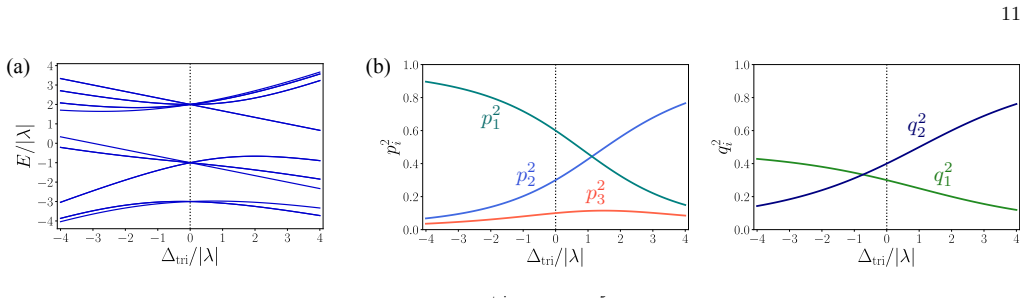
When we take the fictitiously large limit of the trigonal crystal field, ∆tri → +∞, we find p2 = q2 = 1, and in the opposite limit, ∆tri → −∞, p1 = q1 = 1. Figure 5(b) shows these parameters as a function of ∆ tri/|λ|. Since the octahedral compression favors Lz eff = 0, p2 2 a...
-
[11]
SU(3) coherent state In this section, we consider a single S = 1 state. The general spin-1 state is expressed by an SU(3) coherent state with four parameters, {ξ1, ξ2, ξ3, ξ4}: |ψ⟩ = eiξ3 cos ξ2 sin ξ1 |+1⟩ + cos ξ1 |0⟩ + eiξ4 sin ξ2 sin ξ1 |−1⟩ , (D1) where |±1⟩ and |0⟩ are e...
-
[12]
(D7) 17 TABLE III
Representation of SU(3) coherent state with uniaxial symmetry Now, since we are working on a case where the ampli- tude of the dipolar moment can vary between 0 and 1, it is convenient to parametrize the expectation value of the spin operators as ⟨S⟩ = M sin θ cos φ sin θ...
-
[13]
A. F. Andreev and I. M. Lifshitz, Quantum Theory of Defects in Crystals, Sov. Phys. JETP 29, 1107 (1969)
1969
-
[14]
A. J. Leggett, Can a Solid Be ”Superfluid”?, Phys. Rev. Lett. 25, 1543–1546 (1970)
1970
-
[15]
Kim and M
E. Kim and M. H. W. Chan, Probable observation of a supersolid helium phase, Nature 427, 225–227 (2004)
2004
-
[16]
D. Y. Kim and M. H. W. Chan, Absence of Supersolidity in Solid Helium in Porous Vycor Glass, Phys. Rev. Lett. 109, 155301 (2012)
2012
-
[17]
Leonard, A
J. Leonard, A. Morales, P. Zupancic, T. Esslinger, and T. Donner, Supersolid formation in a quantum gas break- ing a continuous translational symmetry, Nature 543, 87–90 (2017)
2017
-
[18]
Tanzi, S
L. Tanzi, S. Roccuzzo, E. Lucioni, F. Fam` a, A. Fioretti, C. Gabbanini, G. Modugno, A. Recati, and S. Stringari, Supersolid symmetry breaking from compressional oscil- lations in a dipolar quantum gas, Nature 574, 382–385 (2019)
2019
-
[19]
M. A. Norcia, C. Politi, L. Klaus, E. Poli, M. Sohmen, M. J. Mark, R. N. Bisset, L. Santos, and F. Ferlaino, Two-dimensional supersolidity in a dipolar quantum gas, Nature 596, 357–361 (2021)
2021
-
[20]
Matsuda and T
H. Matsuda and T. Tsuneto, Off-Diagonal Long-Range Order in Solids, Prog. Theor. Phys. Suppl. 46, 411–436 (1970)
1970
-
[21]
Liu and M
K.-S. Liu and M. E. Fisher, Quantum lattice gas and the existence of a supersolid, J. Low Temp. Phys. 10, 655– 683 (1973)
1973
-
[22]
Wessel and M
S. Wessel and M. Troyer, Supersolid Hard-Core Bosons on the Triangular Lattice, Phys. Rev. Lett. 95, 127205 (2005)
2005
-
[23]
Heidarian and K
D. Heidarian and K. Damle, Persistent Supersolid Phase of Hard-Core Bosons on the Triangular Lattice, Phys. Rev. Lett. 95, 127206 (2005)
2005
-
[24]
R. G. Melko, A. Paramekanti, A. A. Burkov, A. Vish- wanath, D. N. Sheng, and L. Balents, Supersolid Order from Disorder: Hard-Core Bosons on the Triangular Lat- tice, Phys. Rev. Lett. 95, 127207 (2005)
2005
-
[25]
Boninsegni and N
M. Boninsegni and N. Prokof’ev, Supersolid Phase of Hard-Core Bosons on a Triangular Lattice, Phys. Rev. Lett. 95, 237204 (2005)
2005
-
[26]
Hotta and N
C. Hotta and N. Furukawa, Strong coupling theory of the spinless charges on triangular lattices: Possible for- mation of a gapless charge-ordered liquid, Phys. Rev. B 74, 193107 (2006)
2006
-
[27]
Heidarian and A
D. Heidarian and A. Paramekanti, Supersolidity in the Triangular Lattice Spin-1/2 XXZ Model: A Variational Perspective, Phys. Rev. Lett. 104, 015301 (2010)
2010
-
[28]
Yamamoto, G
D. Yamamoto, G. Marmorini, and I. Danshita, Quantum Phase Diagram of the Triangular-Lattice XXZ Model in a Magnetic Field, Phys. Rev. Lett. 112, 127203 (2014)
2014
-
[29]
Yamamoto, G
D. Yamamoto, G. Marmorini, and I. Danshita, Micro- scopic Model Calculations for the Magnetization Process of Layered Triangular-Lattice Quantum Antiferromag- nets, Phys. Rev. Lett. 114, 027201 (2015)
2015
-
[30]
Sellmann, X.-F
D. Sellmann, X.-F. Zhang, and S. Eggert, Phase diagram of the antiferromagnetic XXZ model on the triangular lattice, Phys. Rev. B 91, 081104 (2015)
2015
-
[31]
Xiang, C
J. Xiang, C. Zhang, Y. Gao, W. Schmidt, K. Schmalzl, C.-W. Wang, B. Li, N. Xi, X.-Y. Liu, H. Jin, G. Li, J. Shen, Z. Chen, Y. Qi, Y. Wan, W. Jin, W. Li, P. Sun, and G. Su, Giant magnetocaloric effect in spin supersolid candidate Na2BaCo(PO4)2, Nature 625, 270–275 (2024)
2024
-
[32]
M. E. Brooks-Bartlett, S. T. Banks, L. D. C. Jaubert, A. Harman-Clarke, and P. C. W. Holdsworth, Magnetic- Moment Fragmentation and Monopole Crystallization, Phys. Rev. X 4, 011007 (2014)
2014
-
[33]
Petit, E
S. Petit, E. Lhotel, B. Canals, M. Ciomaga Hatnean, J. Ollivier, H. Mutka, E. Ressouche, A. Wildes, M. R. Lees, and G. Balakrishnan, Observation of magnetic frag- mentation in spin ice, Nat. Phys. 12, 746–750 (2016)
2016
-
[34]
J. A. M. Paddison, H. S. Ong, J. O. Hamp, P. Mukher- jee, X. Bai, M. G. Tucker, N. P. Butch, C. Castelnovo, 19 M. Mourigal, and S. E. Dutton, Emergent order in the kagome Ising magnet Dy 3Mg2Sb3O14, Nat. Commun. 7, 13842 (2016)
2016
-
[35]
Lefran ˜A§ois, V
E. Lefran ˜A§ois, V. Cathelin, E. Lhotel, J. Robert, P. Le- jay, C. V. Colin, B. Canals, F. Damay, J. Ollivier, B. F ˜A¥k, L. C. Chapon, R. Ballou, and V. Simonet, Fragmentation in spin ice from magnetic charge injec- tion, Nat. Commun. 8, 209 (2017)
2017
-
[36]
Z. Dun, X. Bai, J. A. M. Paddison, E. Hollingworth, N. P. Butch, C. D. Cruz, M. B. Stone, T. Hong, F. Demmel, M. Mourigal, and H. Zhou, Quantum Ver- sus Classical Spin Fragmentation in Dipolar Kagome Ice Ho3Mg2Sb3O14, Phys. Rev. X 10, 031069 (2020)
2020
-
[37]
In that respect, such a quadrupolar state is not a symmetry-breaking long-range order and it is commonly referred to as the quantum paramagnet
In the present case, the quadrupolar moment is induced by the on-site term, Dz in Eq.(1), which works as a conjugate field to a quadrupole. In that respect, such a quadrupolar state is not a symmetry-breaking long-range order and it is commonly referred to as the quantum param...
-
[38]
Perversi, A
G. Perversi, A. M. Arevalo-Lopez, C. Ritter, and J. P. Attfield, Frustration wave order in iron(II) oxide spinels, Commun. Phys. 1, 69 (2018)
2018
-
[39]
P. T. Barton, M. C. Kemei, M. W. Gaultois, S. L. Moffitt, L. E. Darago, R. Seshadri, M. R. Suchomel, and B. C. Melot, Structural distortion below the N´ eel temperature in spinel GeCo 2O4, Phys. Rev. B 90, 064105 (2014)
2014
-
[40]
Li and G
F.-Y. Li and G. Chen, Competing phases and topological excitations of spin-1 pyrochlore antiferromagnets, Phys. Rev. B 98, 045109 (2018)
2018
-
[41]
Penc and A
K. Penc and A. M. L¨ auchli, Spin Nematic Phases in Quantum Spin Systems, in Introduction to Frustrated Magnetism: Materials, Experiments, Theory, edited by C. Lacroix, P. Mendels, and F. Mila (Springer Berlin Hei- delberg, Berlin, Heidelberg, 2011) pp. 331–362”
2011
-
[42]
Amari, Y
Y. Amari, Y. Akagi, S. B. Gudnason, M. Nitta, and Y. Shnir, CP 2 skyrmion crystals in an SU(3) magnet with a generalized Dzyaloshinskii-Moriya interaction, Phys. Rev. B 106, L100406 (2022)
2022
-
[43]
Zhang, Z
H. Zhang, Z. Wang, D. Dahlbom, K. Barros, and C. D. Batista, CP2 skyrmions and skyrmion crystals in realistic quantum magnets, Nat. Commun. 14, 3626 (2023)
2023
-
[44]
Chen and L
G. Chen and L. Balents, Spin-orbit effects in Na 4Ir3O8: A hyper-kagome lattice antiferromagnet, Phys. Rev. B 78, 094403 (2008)
2008
-
[45]
Jackeli and G
G. Jackeli and G. Khaliullin, Mott Insulators in the Strong Spin-Orbit Coupling Limit: From Heisenberg to a Quantum Compass and Kitaev Models, Phys. Rev. Lett. 102, 017205 (2009)
2009
-
[46]
Khaliullin, Excitonic Magnetism in Van Vleck–type d4 Mott Insulators, Phys
G. Khaliullin, Excitonic Magnetism in Van Vleck–type d4 Mott Insulators, Phys. Rev. Lett. 111, 197201 (2013)
2013
-
[47]
Liu and G
H. Liu and G. Khaliullin, Pseudospin exchange interac- tions in d7 cobalt compounds: Possible realization of the Kitaev model, Phys. Rev. B 97, 014407 (2018)
2018
-
[48]
Khaliullin, D
G. Khaliullin, D. Churchill, P. P. Stavropoulos, and H.- Y. Kee, Exchange interactions, Jahn-Teller coupling, and multipole orders in pseudospin one-half 5 d2 Mott insula- tors, Phys. Rev. Res. 3, 033163 (2021)
2021
-
[49]
Chen, Quadrupole moments and their interactions in the triangular lattice antiferromagnet FeI 2, Phys
G. Chen, Quadrupole moments and their interactions in the triangular lattice antiferromagnet FeI 2, Phys. Rev. Res. 5, L032042 (2023)
2023
-
[50]
K. A. Ross, L. Savary, B. D. Gaulin, and L. Balents, Quantum Excitations in Quantum Spin Ice, Phys. Rev. X 1, 021002 (2011)
2011
-
[51]
J. G. Rau and M. J. Gingras, Frustrated Quantum Rare- Earth Pyrochlores, Annu. Rev. Condens. Matter Phys. 10, 357–386 (2019)
2019
-
[52]
Y. Li, G. Chen, W. Tong, L. Pi, J. Liu, Z. Yang, X. Wang, and Q. Zhang, Rare-Earth Triangular Lattice Spin Liq- uid: A Single-Crystal Study of YbMgGaO 4, Phys. Rev. Lett. 115, 167203 (2015)
2015
-
[53]
P. A. Maksimov, Z. Zhu, S. R. White, and A. L. Cherny- shev, Anisotropic-Exchange Magnets on a Triangular Lattice: Spin Waves, Accidental Degeneracies, and Dual Spin Liquids, Phys. Rev. X 9, 021017 (2019)
2019
-
[54]
Songvilay, J
M. Songvilay, J. Robert, S. Petit, J. A. Rodriguez-Rivera, W. D. Ratcliff, F. Damay, V. Bal´ edent, M. Jim´ enez-Ruiz, P. Lejay, E. Pachoud, A. Hadj-Azzem, V. Simonet, and C. Stock, Kitaev interactions in the Co honeycomb anti- ferromagnets Na3Co2SbO6 and Na2Co2TeO6, Phys. Rev...
2020
-
[55]
C. Kim, J. Jeong, G. Lin, P. Park, T. Masuda, S. Asai, S. Itoh, H.-S. Kim, H. Zhou, J. Ma, and J.-G. Park, An- tiferromagnetic Kitaev interaction in Jeff = 1/2 cobalt honeycomb materials Na 3Co2SbO6 and Na2Co2TeO6, J. Phys.: Condens. Matter 34, 045802 (2022)
2022
-
[56]
Halloran, F
T. Halloran, F. Desrochers, E. Z. Zhang, T. Chen, L. E. Chern, Z. Xu, B. Winn, M. Graves-Brook, M. B. Stone, A. I. Kolesnikov, Y. Qiu, R. Zhong, R. Cava, Y. B. Kim, and C. Broholm, Geometrical frustration versus Kitaev interactions in BaCo 2(AsO4)2, Proc. Natl. Acad. Sci. 120,...
2023
-
[57]
Bai, S.-S
X. Bai, S.-S. Zhang, Z. Dun, H. Zhang, Q. Huang, H. Zhou, M. B. Stone, A. I. Kolesnikov, F. Ye, C. D. Batista, and M. Mourigal, Hybridized quadrupolar ex- citations in the spin-anisotropic frustrated magnet FeI 2, Nature Physics 17, 467–472 (2021)
2021
-
[59]
D. I. Khomskii, K. I. Kugel, A. O. Sboychakov, and S. V. Streltsov, Role of local geometry in the spin and orbital structure of transition metal compounds, J. Exp. Theor. Phys. 122, 484–498 (2016)
2016
-
[60]
T. M. Dunn, Spin-orbit coupling in the first and second transition series, Trans. Faraday Soc. 57, 1441 (1961)
1961
-
[61]
A. J. Walisinghe and N. F. Chilton, Assessment of min- imal active space CASSCF-SO methods for calculation of atomic Slater-Condon and spin-orbit coupling param- eters in d- and f-block ions, Dalton Trans. 50, 14130– 14138 (2021)
2021
-
[62]
H. Yan, O. Benton, L. Jaubert, and N. Shannon, The- ory of multiple-phase competition in pyrochlore magnets with anisotropic exchange with application to Yb2Ti2O7, Er2Ti2O7, and Er 2Sn2O7, Phys. Rev. B 95, 094422 (2017)
2017
-
[63]
D. M. Gitman and A. L. Shelepin, Coherent states of SU(N) groups, J. Phys. A: Math. Gen. 26, 313–327 (1993)
1993
-
[64]
Nemoto, Generalized coherent states for SU (n) sys- tems, J
K. Nemoto, Generalized coherent states for SU (n) sys- tems, J. Phys. A: Math. Gen. 33, 3493–3506 (2000). 20
2000
-
[65]
S. M. Winter, Y. Li, H. O. Jeschke, and R. Valent ´ ı, Chal- lenges in design of Kitaev materials: Magnetic interac- tions from competing energy scales, Phys. Rev. B 93, 214431 (2016)
2016
-
[66]
J. G. Rau and M. J. P. Gingras, Frustration and anisotropic exchange in ytterbium magnets with edge- shared octahedra, Phys. Rev. B 98, 054408 (2018)
2018
-
[67]
M. E. A. Coury, S. L. Dudarev, W. M. C. Foulkes, A. P. Horsfield, P.-W. Ma, and J. S. Spencer, Hubbard-like Hamiltonians for interacting electrons in s, p, and d or- bitals, Phys. Rev. B 93, 075101 (2016)
2016
-
[68]
Tondello, G
E. Tondello, G. De Michelis, L. Oleari, and L. Di Sipio, Slater-condon parameters for atoms and ions of the first transition period, Coord. Chem. Rev. 2, 53–63 (1967)
1967
-
[69]
Strobel, F
P. Strobel, F. P. Koffyberg, and A. Wold, Electrical and optical properties of high-purity p-type single crystals of GeFe2O4, J. Solid State Chem. 31, 209–216 (1980)
1980
-
[70]
J. C. Slater and G. F. Koster, Simplified LCAO Method for the Periodic Potential Problem, Phys. Rev. 94, 1498– 1524 (1954)
1954
-
[71]
Uematsu, H
D. Uematsu, H. Sagayama, T.-h. Arima, J. J. Ishikawa, S. Nakatsuji, H. Takagi, M. Yoshida, J. Mizuki, and K. Ishii, Large trigonal-field effect on spin-orbit coupled states in a pyrochlore iridate, Phys. Rev. B 92, 094405 (2015)
2015
Reviewed August 12, 2026 · model on record in the stance chip above.
Discussion (0). Continue with ORCID to comment.