REVIEW 2 major objections 5 minor 47 references
Systematic interpolatory ansatz for one-dimensional polaron systems
T0 review · 2 major / 5 minor · reviewed 2026-08-14 · deepseek-v4-flash
Pith's one-line read A truncated basis built from the zero- and infinite-repulsion limits of a trapped one-dimensional Fermi polaron reproduces the exact energies and densities at all repulsion strengths when the Hamiltonian is diagonalized in that basis.
desk verdict A genuinely useful generalization of the two-state interpolatory ansatz with solid benchmarks; the main gap is that the g=∞ basis coefficients are underspecified for N>1 and the double well. read the letter →
The pith
A machine-rendered reading of the paper's core claim, the machinery that carries it, and where it could break.
The reading
What carries the argument
The central object is the Gram–Schmidt-orthonormalized set $\{|\varphi_i\rangle,\,|\chi_\mu\rangle\}$ built from zero-coupling states $|\varphi_i\rangle$ and infinite-coupling eigenstates $|\psi_\mu\rangle$, whose coordinate form is given by Eq. (8) with coefficients $a_\mu$ satisfying the orthogonality conditions of Eq. (7). The overlaps between the two families are evaluated through determinant identities (Appendix A) that convert integrals over ordered spatial regions into derivatives of determinants, which lets the matrix elements of the non-interacting Hamiltonian and the contact interaction be computed recursively. The machinery's job is to feed exact endpoint information into the finite-coupling regime with one basis construction, after which a single numerical diagonalization produces the spectrum and all observables.
What would settle it
Independently compute the double-well $g=1$ and $g=10$ ground-state energies and densities with a method that does not use the paper's infinite-coupling states—for example, a lattice or tensor-network simulation with extrapolation—and compare; deviations larger than the matrix-product-state discrepancies shown in the paper would falsify the claimed accuracy for that geometry. A more direct check is to solve the strong-coupling eigenstate conditions (Eq. (7)) for the double-well trap numerically and compare the resulting coefficients $a_\mu$ with the ones implicit in the paper's basis: a mismatch would show the reported results rest on an unverified input.
Extended reading notes
Core claim
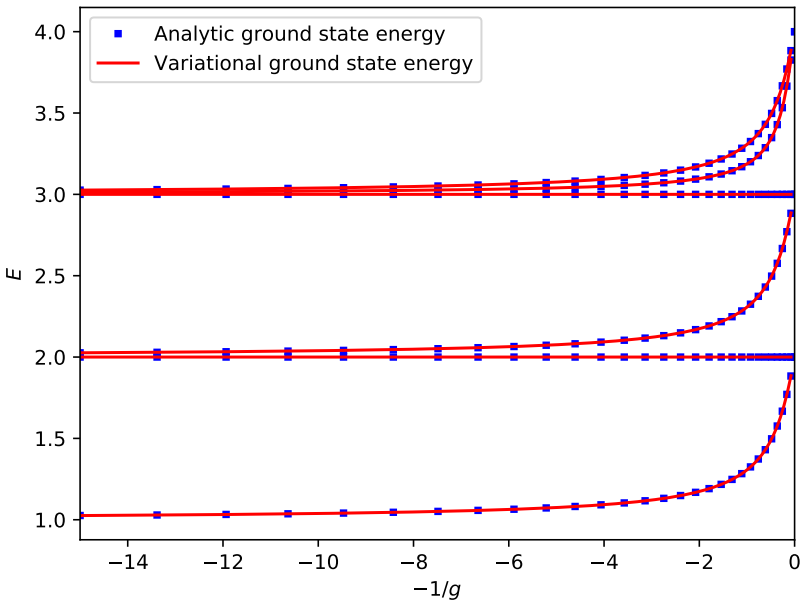
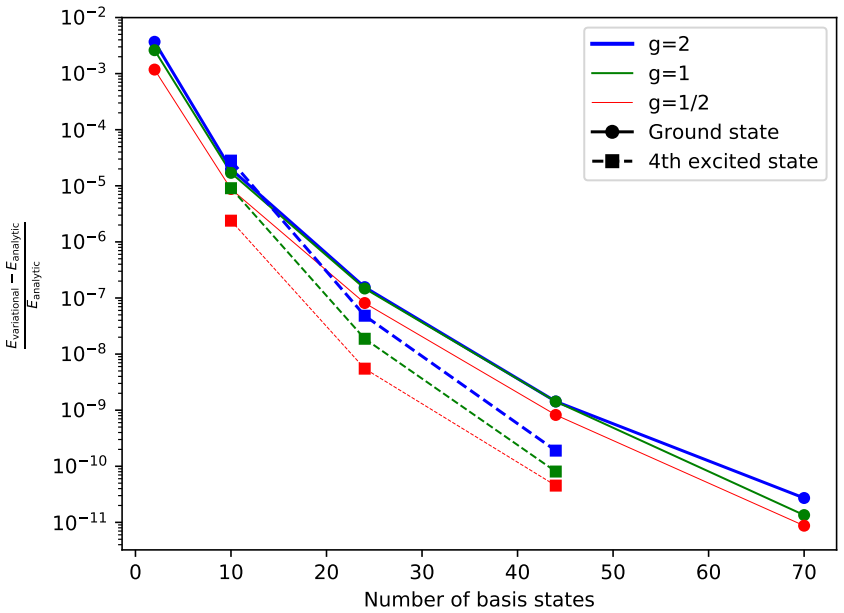
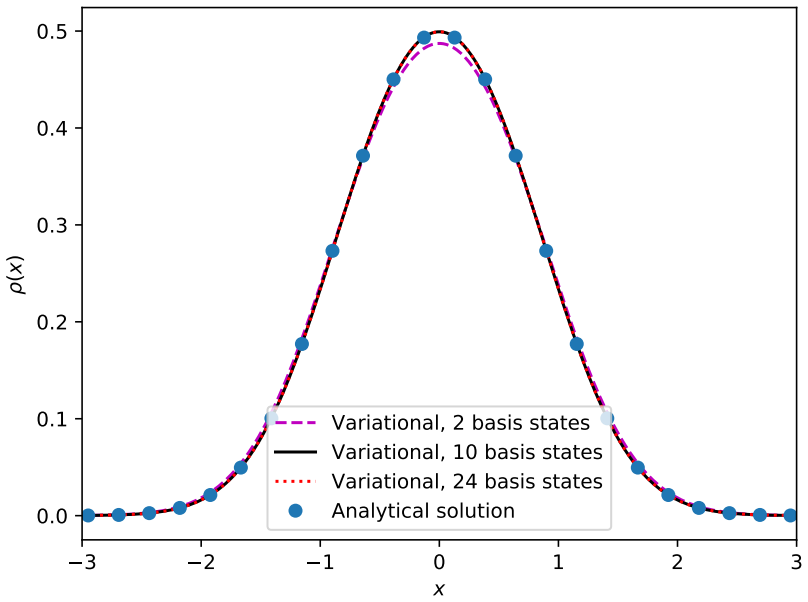
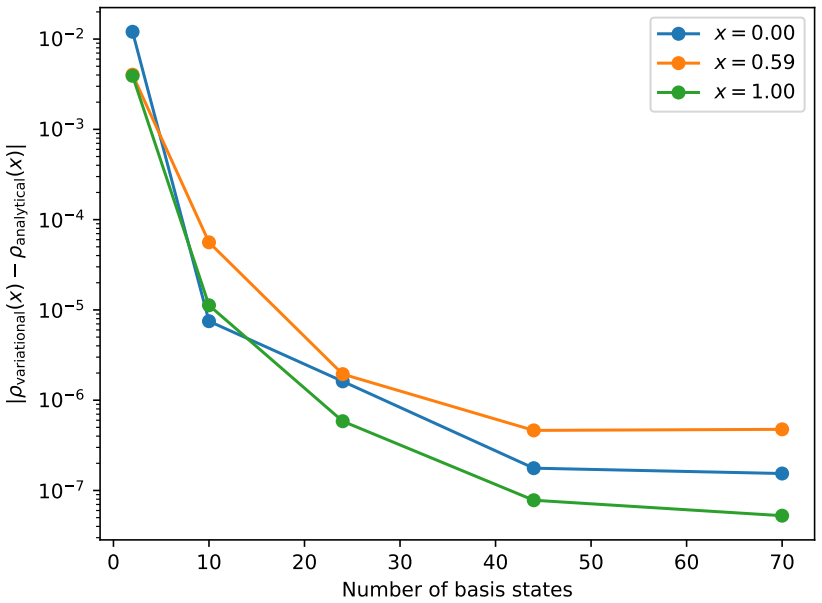
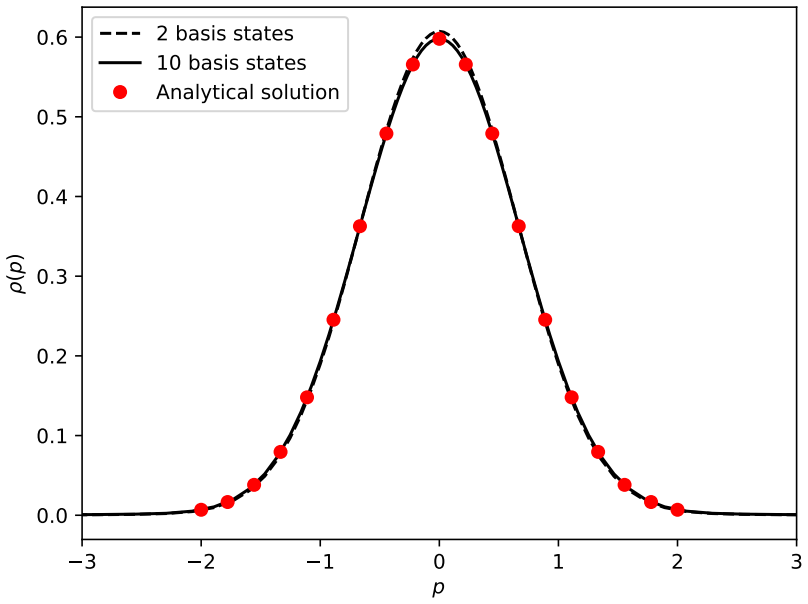
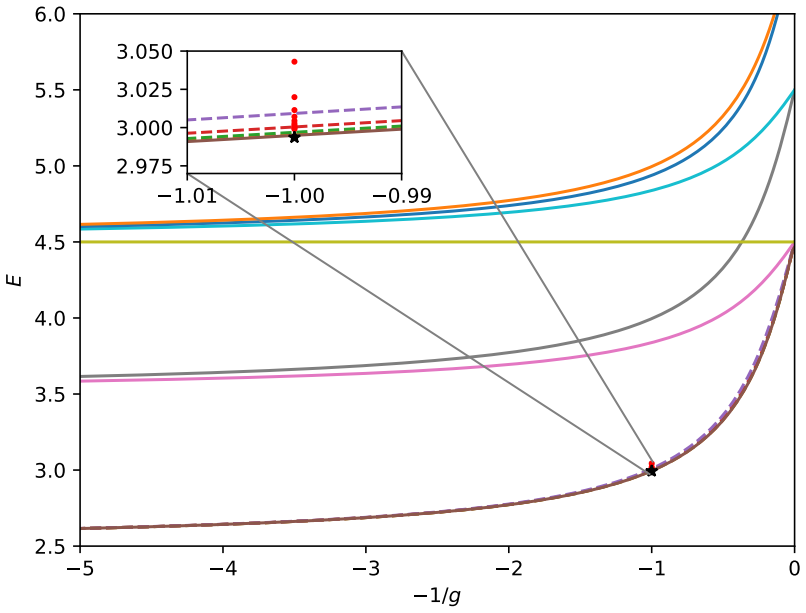
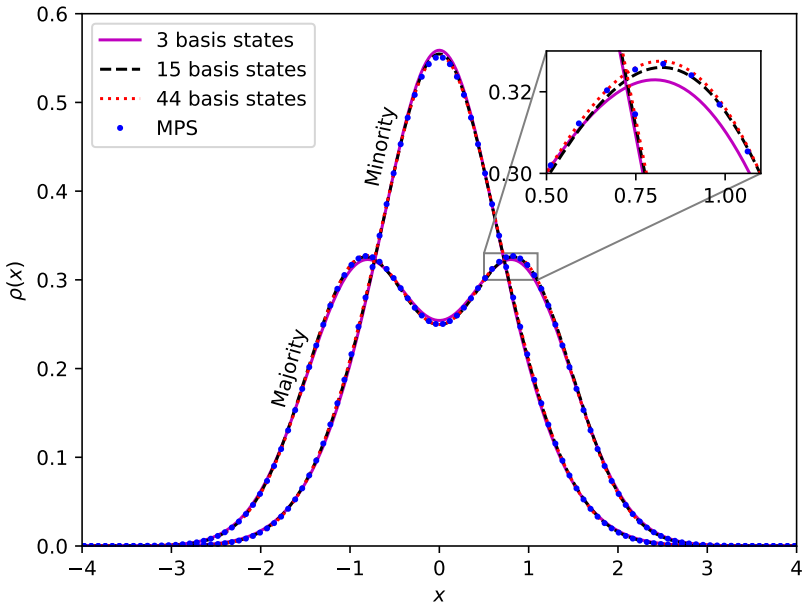
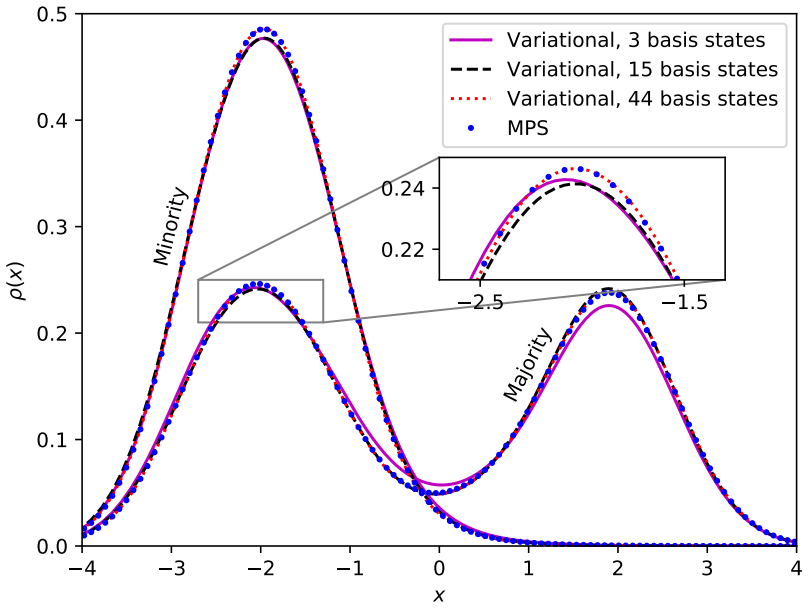
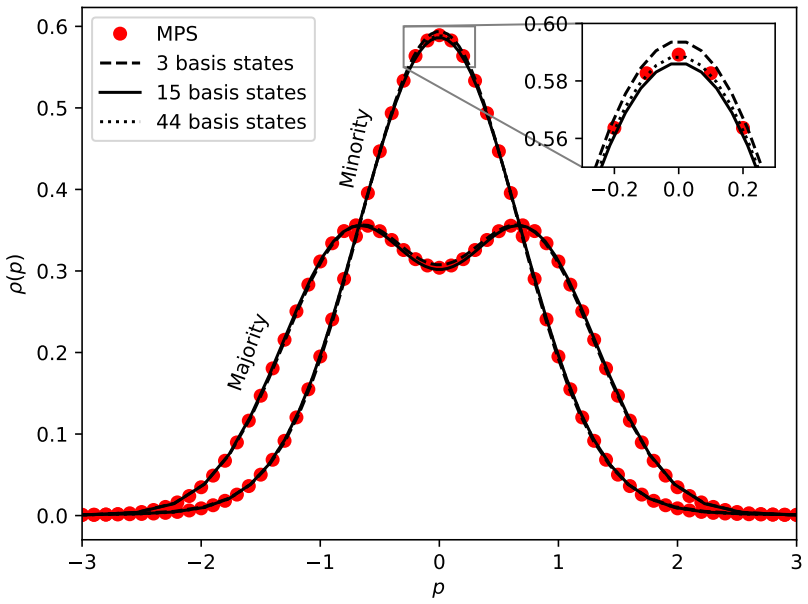
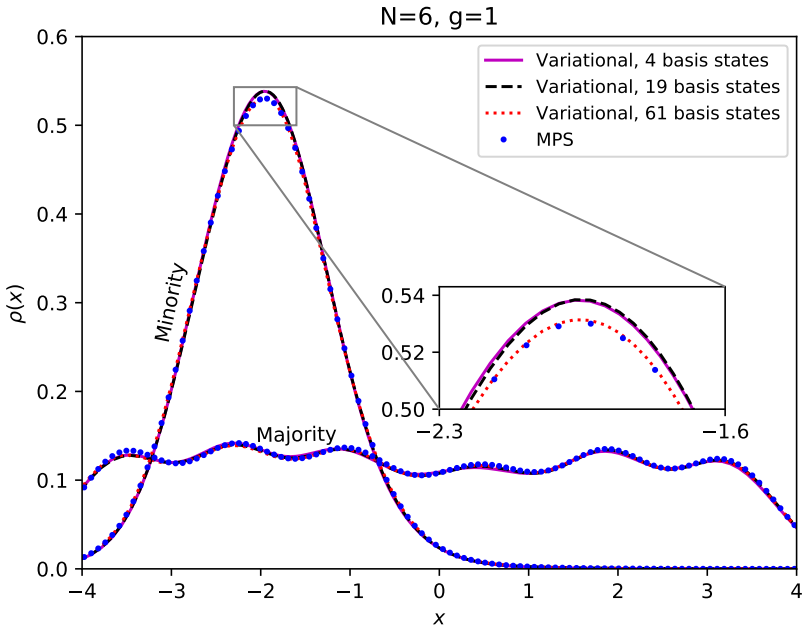
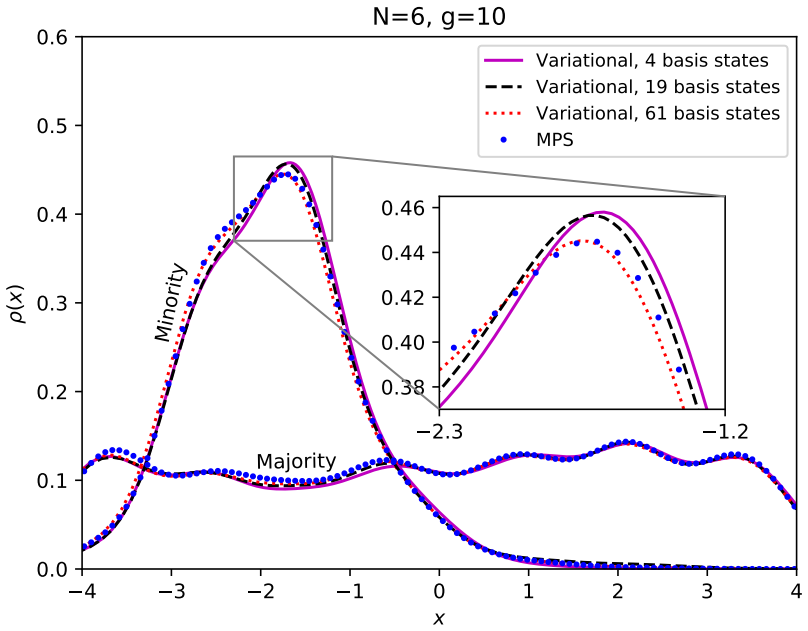
On its own terms, the paper establishes that the static properties of the trapped one-dimensional Fermi polaron—energies, spatial and momentum densities, and the minority–majority correlation function—can be recovered by diagonalizing the Hamiltonian in a finite basis obtained by Gram–Schmidt orthonormalizing the union of low-energy zero-interaction states and low-energy infinite-interaction eigenstates. The construction is exact at $g\to 0$ and $g\to+\infty$ by design, and the paper shows numerically that it remains accurate at intermediate repulsion: relative energy errors near $10^{-10}$ for one majority fermion plus impurity in a harmonic trap, close agreement with matrix-product-state results for two majority fermions in both harmonic and double-well traps, and clearly larger but still reasonable agreement for six majority fermions.
Load-bearing premise
The method assumes that correct infinite-coupling eigenstates—specifically the coefficients $a_\mu$—are known for the trap being treated; for the double-well calculations the paper does not state how these coefficients were obtained, so those results inherit an unspecified external computation.
Editorial extensions
If this is right
- Energies, spatial and momentum densities, and correlation functions at any repulsion $g$ follow from one basis construction and one diagonalization, so the cost of scanning interaction strengths is negligible once the basis exists.
- The approach is exact at $g\to 0$ and $g\to+\infty$, so the strong-coupling regime—the hardest for perturbative and many numerical methods—is where the interpolation is most reliable.
- The same machinery applies to different trap geometries, demonstrated here for a harmonic well and a smooth double well, as long as the infinite-coupling states for that geometry are available.
- Convergence is very fast for small particle numbers and improves with basis size, but it slows as the number of majority fermions grows, as seen in the 6+1 case.
Reading between the lines
- If the infinite-coupling coefficients for an arbitrary trap could be supplied by a separate numerical solver, this construction would become a general few-body variational solver whose accuracy is set entirely by the endpoint inputs; the paper leaves that automation implicit.
- The same interpolation logic should transfer to attractive contact interactions, provided suitable strong-coupling endpoint states are used, so a testable extension is to check the convergence of the method for negative $g$ across the crossover.
- Because the basis is built once, entire observables such as momentum distributions can be produced pointwise across the crossover at almost no extra cost, which suggests the method could serve as a fast engine for checking sum rules or polaron crossover curves.
- The worse agreement at 6+1 indicates the selection of which endpoint states to include matters as the particle number grows; an error estimate based on the truncation energy, rather than basis count, would be a concrete way to test and improve that choice.
Signed reviews
Editorial analysis
A structured set of objections, weighed in public.
Referee Report
Summary. The paper proposes a variational method for a single impurity interacting through a contact potential with N identical fermions in a one-dimensional trap. The variational basis is constructed from low-energy eigenstates of the noninteracting Hamiltonian and low-energy exact eigenstates at infinite repulsion; the two sets are Gram-Schmidt orthonormalized, and energies, density matrices, momentum distributions, and correlation functions are obtained by diagonalizing the Hamiltonian in this basis. The method is benchmarked against the exact two-particle solution in a harmonic trap and against matrix-product-state calculations for 2+1 and 6+1 systems in both harmonic and double-well geometries. The central claim is that this truncated interpolatory basis accurately describes the system at arbitrary finite repulsion while being exact at the zero- and infinite-coupling limits.
Significance. If the central claim holds, the method is a valuable and computationally cheap tool for trapped one-dimensional Fermi polarons: it requires a single construction of the basis for all interaction strengths, and it is exact at both limits. The paper's strengths are the detailed derivations of overlaps and density-matrix elements in Section 3.3 and Appendices A and E, the excellent 1+1 benchmark with relative energy errors near 10^-10 at roughly 70 basis states, and the independent MPS comparisons for 2+1 and 6+1. The main weakness is that the infinite-coupling input states are not fully specified for N>1 and for the double-well geometry, which undermines the reproducibility of the strong-coupling results and the claimed exactness at g=∞. With the missing coefficients supplied, the method would constitute a useful contribution to few-body quantum-gas techniques.
major comments (2)
- [§3.2 and §5.2–5.3] The infinite-interaction basis states ψ_μ of Eq. (8) are under-specified for N>1. The coefficient vectors a_μ are constrained only by the orthonormality conditions in Eq. (7), but for the basis to contain the exact strong-coupling eigenstates these vectors must be eigenstates of the trap-dependent spin-chain Hamiltonian. The paper never states how the a_μ are obtained for the harmonic 2+1 and 6+1 calculations, and in particular for the double-well potential of Appendix C. For N=1 the coefficients are given explicitly ([1,−1] in §5.1.1), but for N=2 and N=6 the basis sizes reported in §5.2.1 and §5.3 presuppose definite a_μ that are neither tabulated nor described. The energy cutoff for the infinite-interaction states is also not defined for N>1, since it is not stated whether the spin-chain energy is included. Because every reported energy, density, and correlation function for the 2+1 and 6+1 systems inherits any error in this unspecified input, the central claim of exactness at the infinite-coupling limit is not verifiable for those systems. The authors should provide the a_μ, or a complete algorithm for computing them, for each geometry and particle number, and specify exactly how the basis cutoff is applied.
- [§5.1.2 and §5.3] The abstract claims the method describes the system accurately at arbitrary finite repulsion, but for N>1 the independent MPS comparisons are limited to g=1 for the 2+1 system and to g=1 and g=10 for the 6+1 system (Figures 7–13). No independent check is provided at weak coupling or at intermediate coupling where the interpolation error is typically largest, and the 6+1 agreement is visibly worse without a quantified discrepancy. At minimum, the paper should add one or two additional coupling points for the 2+1 or 6+1 system, or explicitly qualify the 'arbitrary finite repulsion' claim as an expectation from the variational construction rather than a demonstrated benchmark.
minor comments (5)
- [§1] There is a typo: 'Gram-Schmidth ortonormalization' should be 'Gram-Schmidt orthonormalization'.
- [§5.2.1] The text says the extrapolated MPS value is represented by a black cross, while the caption of Figure 7 says a black star; the figure and caption should be made consistent.
- [§5.2.3] The word 'discrepeancy' should be 'discrepancy'.
- [Appendix A.1] The sentence containing 'he factor 1/k' contains a typo: 'he' should be 'the'.
- [§5.1.1] The notation for the energy cutoff, e.g., 'an energy not greater than 2 (above the lowest energy state)', should be defined once in the main text rather than only in the 1+1 example, because the cutoff is the single convergence parameter of the method.
Circularity Check
No significant circularity: the variational energies and densities are genuine finite-g predictions built from independently established g=0 and g=∞ inputs and benchmarked against external analytic and MPS results.
full rationale
The central derivation is not circular. The basis is assembled from the noninteracting eigenstates |φi⟩ and the exact strong-coupling eigenstates |ψμ⟩ of Refs [37,38]; Ref [37] is independent of the present authors, and the input from Ref [38] is a parameter-free published solution whose assumptions do not include the target finite-g results. No parameter is fitted to the energies, densities, momentum distributions, or correlation functions that are later reported as predictions; the only inputs are the single-particle orbitals, the strong-coupling coefficients a_μ, and the interaction strength g, and the outputs are obtained by a fixed Gram-Schmidt construction followed by numerical diagonalization of H0+gV. The finite-g accuracy claim is therefore not true by construction, except at the two endpoints, which the paper states explicitly. The validation is external: the 1+1 harmonic case is compared to the independent Busch et al. analytical two-body solution (Figures 2-6; Eq. (68)), and the 2+1 and 6+1 cases are compared to independent MPS simulations using the OSMPS library (Figures 7-13). Self-citations to Refs [38,45] are present, but Ref [45] is only named as the two-state predecessor of the present multi-state method, and the strong-coupling input is also supported by Ref [37], so the self-citation is not load-bearing. One genuine weakness, flagged as a completeness gap rather than circularity, is that for N>1 and the double-well geometry the coefficients a_μ that define the |ψμ⟩ are never explicitly given (Section 3.2 only imposes Eq. (7)), so the double-well results depend on an unspecified external construction; this affects reproducibility and could affect correctness if the imported coefficients were wrong, but it is not an instance of the paper's predictions reducing to its inputs by definition or by fitting.
Assumptions & free parameters
free parameters (1)
- Basis energy cutoff E =
0, 2, 4, 6, 8 in the examples
assumptions (4)
- domain assumption The g=∞ eigenstates ψµ of Eq. (8) with coefficients aµ satisfying Eq. (7) are exact solutions of the Hamiltonian at infinite repulsion for the harmonic and double-well traps.
- standard math Single-particle eigenstates of the trap potential form a complete basis and energy-cutoff truncation is convergent.
- domain assumption The Hubbard-model discretization of Appendix D (L=256 sites, U=g/a) plus the fit f(L)=A+B/L+C/L^2 approximates the continuum polaron to the quoted accuracy.
- standard math Gram-Schmidt orthonormalization plus exact diagonalization in the truncated space yields variational approximations (upper bounds for the ground state) of the low-lying spectrum.
Cite this review
Pith. "Pith review of Systematic interpolatory ansatz for one-dimensional polaron systems." pith.science (2026). https://pith.science/paper/GYMBFSMC
@misc{pith2026190802849,
  author       = {Pith},
  title        = {Pith review of: Systematic interpolatory ansatz for one-dimensional polaron systems},
  year         = {2026},
  howpublished = {\url{https://pith.science/paper/GYMBFSMC}},
  note         = {Machine review of arXiv:1908.02849}
}
read the original abstract
We explore a new variational principle for studying one-dimensional quantum systems in a trapping potential. We focus on the Fermi polaron problem, where a single distinguishable impurity interacts through a contact potential with a background of identical fermions. We can accurately describe this system at arbitrary finite repulsion by constructing a truncated basis containing states at both the limits of zero and infinite repulsion. We show how to construct this basis and how to obtain energies, density matrices and correlation functions, and provide results both for a harmonic well and a double well for various particle numbers. The results are compared both with matrix product states methods and with the analytical result for two particles in a harmonic well.
Figures

Figures from the paper (10 more)

Reference graph
Works this paper leans on
-
[45]
An interpolatory ansatz captures the physics of one- dimensional confined fermi systems,
M. E. S. Andersen, A. S. Dehkharghani, A. G. Volosniev, E. J. Lindgren, and N. T. Zinner, “An interpolatory ansatz captures the physics of one- dimensional confined fermi systems,” Scientific Reports, vol. 6, no. 1, p. 28362, 2016
work page 2016
-
[1]
Quantum simulations with ultracold quantum gases,
I. Bloch, J. Dalibard, and S. Nascimb` ene, “Quantum simulations with ultracold quantum gases,” Nature Physics , vol. 8, pp. 267 EP –, Apr
-
[2]
Quan- tum phase transition from a superfluid to a mott insulator in a gas of ultracold atoms,
M. Greiner, O. Mandel, T. Esslinger, T. W. H¨ansch, and I. Bloch,“Quan- tum phase transition from a superfluid to a mott insulator in a gas of ultracold atoms,” Nature, vol. 415, pp. 39 EP –, Jan 2002. Article
work page 2002
-
[3]
Transition from a strongly interacting 1D superfluid to a Mott insulator,
T. St ¨oferle, H. Moritz, C. Schori, M. K¨ohl, and T. Esslinger, “Transition from a strongly interacting 1D superfluid to a Mott insulator,” Phys. Rev. Lett., vol. 92, p. 130403, Mar 2004
work page 2004
-
[4]
Two fermions in a double well: Exploring a fundamen- tal building block of the hubbard model,
S. Murmann, A. Bergschneider, V. M. Klinkhamer, G. Z ¨urn, T. Lompe, and S. Jochim, “Two fermions in a double well: Exploring a fundamen- tal building block of the hubbard model,” Phys. Rev. Lett. , vol. 114, p. 080402, Feb 2015
work page 2015
-
[5]
Tonks-Girardeau gas of ul- tracold atoms in an optical lattice,
B. Paredes, A. Widera, V. Murg, O. Mandel, S. Folling, I. Cirac, G. V. Shlyapnikov, T. W. Hansch, and I. Bloch, “Tonks-Girardeau gas of ul- tracold atoms in an optical lattice,” Nature, vol. 429, pp. 277–281, May 2004
work page 2004
-
[6]
Observation of a one- dimensional Tonks-Girardeau gas,
T. Kinoshita, T. Wenger, and D. S. Weiss, “Observation of a one- dimensional Tonks-Girardeau gas,”Science, vol. 305, no. 5687, pp. 1125– 1128, 2004
work page 2004
-
[7]
T. Kinoshita, T. Wenger, and D. S. Weiss,“A quantum Newton’s cradle,” Nature, vol. 440, pp. 900–903, Apr 2006
work page 2006
Show all 47 references
-
[8]
Feshbach resonances in ultracold gases,
C. Chin, R. Grimm, P. Julienne, and E. Tiesinga, “Feshbach resonances in ultracold gases,” Rev. Mod. Phys., vol. 82, pp. 1225–1286, Apr 2010
2010
-
[9]
Atomic scattering in the presence of an external con- finement and a gas of impenetrable bosons,
M. Olshanii, “Atomic scattering in the presence of an external con- finement and a gas of impenetrable bosons,” Phys. Rev. Lett. , vol. 81, pp. 938–941, Aug 1998
1998
-
[10]
Confinement-induced resonances in low-dimensional quantum systems,
E. Haller, M. J. Mark, R. Hart, J. G. Danzl, L. Reichs¨ollner, V. Melezhik, P. Schmelcher, and H.-C. N ¨agerl, “Confinement-induced resonances in low-dimensional quantum systems,”Phys. Rev. Lett., vol. 104, p. 153203, Apr 2010
2010
-
[11]
Fermionization of two distinguishable fermions,
G. Z ¨urn, F. Serwane, T. Lompe, A. N. Wenz, M. G. Ries, J. E. Bohn, and S. Jochim, “Fermionization of two distinguishable fermions,” Phys. Rev. Lett., vol. 108, p. 075303, Feb 2012
2012
-
[12]
Quantum simulations with ultracold atoms in optical lattices,
C. Gross and I. Bloch, “Quantum simulations with ultracold atoms in optical lattices,” Science, vol. 357, no. 6355, pp. 995–1001, 2017. 43
2017
-
[13]
A one- dimensional liquid of fermions with tunable spin,
G. Pagano, M. Mancini, G. Cappellini, P. Lombardi, F. Sch ¨afer, H. Hu, X.-J. Liu, J. Catani, C. Sias, M. Inguscio, and L. Fallani, “A one- dimensional liquid of fermions with tunable spin,” Nature Physics , vol. 10, pp. 198–201, 3 2014
2014
-
[14]
Visualizing edge states with an atomic bose gas in the quantum hall regime,
B. K. Stuhl, H.-I. Lu, L. M. Aycock, D. Genkina, and I. B. Spielman, “Visualizing edge states with an atomic bose gas in the quantum hall regime,” Science, vol. 349, no. 6255, pp. 1514–1518, 2015
2015
-
[15]
Observa- tion of chiral edge states with neutral fermions in synthetic Hall ribbons,
M. Mancini, G. Pagano, G. Cappellini, L. Livi, M. Rider, J. Catani, C. Sias, P. Zoller, M. Inguscio, M. Dalmonte, and L. Fallani, “Observa- tion of chiral edge states with neutral fermions in synthetic Hall ribbons,” Science, vol. 349, no. 6255, pp. 1510–1513, 2015
2015
-
[16]
Resistance Minimum in Dilute Magnetic Alloys,
J. Kondo, “Resistance Minimum in Dilute Magnetic Alloys,” Progress of Theoretical Physics, vol. 32, pp. 37–49, 07 1964
1964
-
[17]
Infrared catastrophe in fermi gases with local scatter- ing potentials,
P. W. Anderson, “Infrared catastrophe in fermi gases with local scatter- ing potentials,” Phys. Rev. Lett., vol. 18, pp. 1049–1051, Jun 1967
1967
-
[18]
Quantum dynamics of impurities in a one-dimensional bose gas,
J. Catani, G. Lamporesi, D. Naik, M. Gring, M. Inguscio, F. Minardi, A. Kantian, and T. Giamarchi, “Quantum dynamics of impurities in a one-dimensional bose gas,” Phys. Rev. A , vol. 85, p. 023623, Feb 2012
2012
-
[19]
Motional coherence of fermions immersed in a bose gas,
R. Scelle, T. Rentrop, A. Trautmann, T. Schuster, and M. K. Oberthaler, “Motional coherence of fermions immersed in a bose gas,” Phys. Rev. Lett., vol. 111, p. 070401, Aug 2013
2013
-
[20]
Neutral impurities in a bose-einstein con- densate for simulation of the fr ¨ohlich-polaron,
M. Hohmann, F. Kindermann, B. G ¨anger, T. Lausch, D. Mayer, F. Schmidt, and A. Widera, “Neutral impurities in a bose-einstein con- densate for simulation of the fr ¨ohlich-polaron,” EPJ Quantum Technol- ogy, vol. 2, p. 23, Nov 2015
2015
-
[21]
Bose polarons in the strongly interacting regime,
M.-G. Hu, M. J. Van de Graaff, D. Kedar, J. P. Corson, E. A. Cornell, and D. S. Jin, “Bose polarons in the strongly interacting regime,” Phys. Rev. Lett., vol. 117, p. 055301, Jul 2016
2016
-
[22]
Observation of attractive and repulsive polarons in a bose-einstein condensate,
N. B. Jørgensen, L. Wacker, K. T. Skalmstang, M. M. Parish, J. Levin- sen, R. S. Christensen, G. M. Bruun, and J. J. Arlt, “Observation of attractive and repulsive polarons in a bose-einstein condensate,” Phys. Rev. Lett., vol. 117, p. 055302, Jul 2016
2016
-
[23]
Tun- able polarons in bose-einstein condensates,
E. Compagno, G. De Chiara, D. G. Angelakis, and G. M. Palma, “Tun- able polarons in bose-einstein condensates,” Scientific Reports, vol. 7, no. 1, p. 2355, 2017. 44
2017
-
[24]
Bose polarons in ul- tracold atoms in one dimension: beyond the fr ¨ohlich paradigm,
F. Grusdt, G. E. Astrakharchik, and E. Demler, “Bose polarons in ul- tracold atoms in one dimension: beyond the fr ¨ohlich paradigm,” New Journal of Physics , vol. 19, p. 103035, oct 2017
2017
-
[25]
Universality of an impurity in a bose-einstein condensate,
S. M. Yoshida, S. Endo, J. Levinsen, and M. M. Parish, “Universality of an impurity in a bose-einstein condensate,” Phys. Rev. X , vol. 8, p. 011024, Feb 2018
2018
-
[26]
Bipolarons in a bose-einstein condensate,
A. Camacho-Guardian, L. A. Pe˜ na Ardila, T. Pohl, and G. M. Bruun, “Bipolarons in a bose-einstein condensate,” Phys. Rev. Lett. , vol. 121, p. 013401, Jul 2018
2018
-
[27]
Coalescence of two impurities in a trapped one-dimensional bose gas,
A. S. Dehkharghani, A. G. Volosniev, and N. T. Zinner, “Coalescence of two impurities in a trapped one-dimensional bose gas,” Phys. Rev. Lett., vol. 121, p. 080405, Aug 2018
2018
-
[28]
Ul- trafast many-body interferometry of impurities coupled to a fermi sea,
M. Cetina, M. Jag, R. S. Lous, I. Fritsche, J. T. M. Walraven, R. Grimm, J. Levinsen, M. M. Parish, R. Schmidt, M. Knap, and E. Demler, “Ul- trafast many-body interferometry of impurities coupled to a fermi sea,” Science, vol. 354, no. 6308, pp. 96–99, 2016
2016
-
[29]
Fermi polaron-polaritons in charge- tunable atomically thin semiconductors,
M. Sidler, P. Back, O. Cotlet, A. Srivastava, T. Fink, M. Kroner, E. Demler, and A. Imamoglu, “Fermi polaron-polaritons in charge- tunable atomically thin semiconductors,” Nature Physics , vol. 13, pp. 255 EP –, Oct 2016
2016
-
[30]
Repulsive fermi polarons in a resonant mixture of ultracold 6Li atoms,
F. Scazza, G. Valtolina, P. Massignan, A. Recati, A. Amico, A. Burchi- anti, C. Fort, M. Inguscio, M. Zaccanti, and G. Roati, “Repulsive fermi polarons in a resonant mixture of ultracold 6Li atoms,” Phys. Rev. Lett., vol. 118, p. 083602, Feb 2017
2017
-
[31]
Coherent oscillations in small Fermi-polaron systems,
M. Tylutki, G. E. Astrakharchik, and A. Recati, “Coherent oscillations in small Fermi-polaron systems,” Phys. Rev. A , vol. 96, p. 063603, Dec 2017
2017
-
[32]
Interacting fermions in one dimension. i. repulsive po- tential,
J. B. McGuire, “Interacting fermions in one dimension. i. repulsive po- tential,” Journal of Mathematical Physics , vol. 6, no. 3, pp. 432–439, 1965
1965
-
[33]
Interacting fermions in one dimension. ii. attractive potential,
J. B. McGuire, “Interacting fermions in one dimension. ii. attractive potential,” Journal of Mathematical Physics , vol. 7, no. 1, pp. 123–132, 1966. 45
1966
-
[34]
Zur theorie der metalle,
H. Bethe, “Zur theorie der metalle,” Zeitschrift f ¨ur Physik , vol. 71, pp. 205–226, Mar 1931
1931
-
[35]
Two interacting fermions in a one-dimensional harmonic trap: Matching the bethe ansatz and varia- tional approaches,
D. Rubeni, A. Foerster, and I. Roditi, “Two interacting fermions in a one-dimensional harmonic trap: Matching the bethe ansatz and varia- tional approaches,” Phys. Rev. A , vol. 86, p. 043619, Oct 2012
2012
-
[36]
Few interacting fermions in a one-dimensional harmonic trap,
T. Sowi´ nski, T. Grass, O. Dutta, and M. Lewenstein, “Few interacting fermions in a one-dimensional harmonic trap,” Phys. Rev. A , vol. 88, p. 033607, Sep 2013
2013
-
[37]
Quantum magnetism without lattices in strongly interacting one- dimensional spinor gases,
F. Deuretzbacher, D. Becker, J. Bjerlin, S. M. Reimann, and L. San- tos, “Quantum magnetism without lattices in strongly interacting one- dimensional spinor gases,” Phys. Rev. A , vol. 90, p. 013611, Jul 2014
2014
-
[38]
Strongly interacting confined quantum systems in one dimension,
A. G. Volosniev, D. V. Fedorov, A. S. Jensen, M. Valiente, and N. T. Zin- ner, “Strongly interacting confined quantum systems in one dimension,” Nature Communications, vol. 5, pp. 5300 EP –, Nov 2014. Article
2014
-
[39]
Many interacting fermions in a one-dimensional harmonic trap: a quantum-chemical treatment,
T. Grining, M. Tomza, M. Lesiuk, M. Przybytek, M. Musia l, P. Massig- nan, M. Lewenstein, and R. Moszynski, “Many interacting fermions in a one-dimensional harmonic trap: a quantum-chemical treatment,” New Journal of Physics , vol. 17, p. 115001, oct 2015
2015
-
[40]
Two-flavour mixture of a few fermions of different mass in a one-dimensional harmonic trap,
D. P¸ ecak, M. Gajda, and T. Sowi´ nski, “Two-flavour mixture of a few fermions of different mass in a one-dimensional harmonic trap,” New Journal of Physics , vol. 18, no. 1, p. 013030, 2016
2016
-
[41]
Su( n) fermions in a one-dimensional harmonic trap,
E. K. Laird, Z.-Y. Shi, M. M. Parish, and J. Levinsen, “Su( n) fermions in a one-dimensional harmonic trap,” Phys. Rev. A , vol. 96, p. 032701, Sep 2017
2017
-
[42]
Bloch oscillations in the absence of a lattice,
F. Meinert, M. Knap, E. Kirilov, K. Jag-Lauber, M. B. Zvonarev, E. Demler, and H.-C. N ¨agerl, “Bloch oscillations in the absence of a lattice,” Science, vol. 356, no. 6341, pp. 945–948, 2017
2017
-
[43]
Quantum flutter of supersonic particles in one-dimensional quantum liquids,
C. J. M. Mathy, M. B. Zvonarev, and E. Demler, “Quantum flutter of supersonic particles in one-dimensional quantum liquids,” Nat Phys, vol. 8, pp. 881–886, Dec 2012
2012
-
[44]
Quantum flutter: Signatures and robustness,
M. Knap, C. J. M. Mathy, M. Ganahl, M. B. Zvonarev, and E. Demler, “Quantum flutter: Signatures and robustness,”Phys. Rev. Lett., vol. 112, p. 015302, Jan 2014. 46
2014
-
[46]
Two cold atoms in a harmonic trap,
T. Busch, B.-G. Englert, K. Rza˙ zewski, and M. Wilkens, “Two cold atoms in a harmonic trap,” Foundations of Physics , vol. 28, pp. 549– 559, Apr 1998
1998
-
[47]
Out-of-equilibrium dynamics with matrix product states,
M. L. Wall and L. D. Carr, “Out-of-equilibrium dynamics with matrix product states,” New Journal of Physics, vol. 14, no. 12, p. 125015, 2012. 47
2012
Reviewed August 14, 2026 · model on record in the stance chip above.
Discussion (0). Continue with ORCID to comment.