REVIEW 3 major objections 5 minor 30 references
Universal Graph Learning for Power System Reconfigurations: Transfer Across Topology Variations
T0 review · 3 major / 5 minor · reviewed 2026-08-04 · deepseek-v4-flash
Pith's one-line read The paper claims that a single UGCN, trained on augmented reconfigurations of known grids, transfers zero-shot to unseen topologies and grid sizes without retraining, and demonstrates this on state forecasting and false-data-injection detec
desk verdict A sensible architecture for within-family reconfiguration transfer, wrapped in an 'any reconfiguration' claim the experiments don't support. read the letter →
The pith
A machine-rendered reading of the paper's core claim, the machinery that carries it, and where it could break.
The reading
What carries the argument
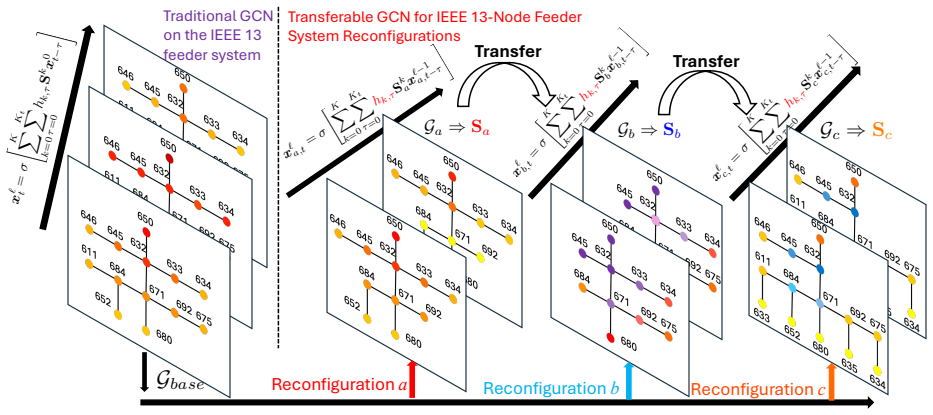
The core object is the shared spatio-temporal graph filter: scalar coefficients h_{k,τ} (equivalently weight matrices H) applied to powers of the graph shift operator S_q, so the same convolution parameters work for any graph size. Around this core sit the adaptive pooling matrix A_q, which maps an arbitrary N_q-node feature matrix to N_p pooled nodes, and the parallel transformer output, which uses continuous position encodings to produce N_q outputs for any configuration. Together they remove the fixed input dimension and fixed output dimension assumptions that break ordinary neural networks on reconfigured grids.
What would settle it
Train UGCN on IEEE 33-bus augmentations, then test it on a reconfiguration generated outside the augmentation grammar—for example, a two-island microgrid operation where a feeder is intentionally islanded and resynchronized with a different phase sequence—and check whether forecasting MSE and FDI accuracy fall back to baseline levels. A second check: train on augmentations with node counts 22–38 and test on a reconfiguration with 60 nodes; if transfer degrades sharply, the 'any reconfiguration' claim fails.
Extended reading notes
Core claim
The central claim is that topology reconfiguration is not a new domain but a point along a 'topology dimension,' so a model trained on a set of augmented configurations can generalize zero-shot to any reconfiguration of the same family. The UGCN does this by sharing scalar-weight complex GCN filters across all configurations, using application-oriented adaptive pooling (average and max, or learned assignment) to collapse variable node counts to a fixed hidden size, and using a parallel transformer with position embeddings to generate outputs with configuration-specific semantics and dimensionality. The paper shows this on two tasks: state forecasting (including H=0 state estimation) and FDI
Load-bearing premise
The load-bearing premise is that the five augmentation operations—feeder disconnection, new feeder connection, parameter changes, line breaks, and subtree merging—cover every reconfiguration the model will face, so training on samples from that generator transfers to 'any' reconfiguration; the paper does not prove coverage, and its test set is drawn from the same generator.
Editorial extensions
If this is right
- A single trained UGCN can be deployed across distribution feeder reconfigurations, such as the IEEE 33-bus system varying between 22 and 38 nodes, without retraining.
- One model can be trained jointly on multiple heterogeneous transmission systems and still transfer to new reconfigurations of each, avoiding a separate model per grid.
- The zero-shot transfer covers both state estimation and forecasting over horizons of 1 to 5 hours, not just single-step prediction.
- FDI localization retains high accuracy across attack magnitudes and across multi-grid hybrid training, while baseline methods degrade toward trivial all-ones or all-zeros predictions.
- If correct, the framework removes the need for labeled data from every new topology, making real-time redeployment after grid changes practical.
Reading between the lines
- The paper's 'any reconfiguration' claim is stronger than what the experiments directly show: the test set is drawn from the same stochastic augmentation generator as the training set, so a reconfiguration type outside that generator (for example, deliberate islanding sequences or phase-balancing operations) remains the untested frontier.
- The same architecture could be transferred to other variable-dimension, variable-semantics power-system tasks, such as dynamic line rating under changing topology or attack localization when the sensor set changes, because the parallel transformer already decouples output semantics per configuration.
- The scalar-shared filter view suggests that cross-system transfer between grids of very different sizes may be achievable by graph decomposition, which the paper explicitly defers; if combined with adaptive pooling, the model could learn regional physics from subgraphs and compose them for whole-grid inference.
- A practical deployment test would compare UGCN's zero-shot predictions against a utility's actual sequence of reconfigurations and its retrained models; the paper's benchmarks do not include such a naturally occurring distribution shift.
Editorial analysis
A structured set of objections, weighed in public.
Referee Report
Summary. The paper proposes a Universal Graph Convolutional Network (UGCN) for power system state forecasting and false data injection detection, with the aim of transferring a single trained model across reconfigurations of a given grid without retraining. The method combines physics-aware spatio-temporal graph convolutions with shared scalar filter coefficients, adaptive grid pooling to handle variable input sizes, and a parallel transformer output layer with position-based embeddings to handle variable output dimensions. Training uses graph augmentations (feeder disconnection, new feeder connection, parameter changes, line breaks, subtree merging) to generate many reconfigurations from a base grid. Experiments on IEEE 33/69-bus distribution systems and IEEE 30/39/57-bus transmission systems report large improvements over baselines in voltage forecasting and FDI localization, including multi-system hybrid training.
Significance. If the central claim of universal zero-shot transfer to any reconfiguration were established, the work would be a useful practical contribution: a single model that avoids retraining for each topology variant would address a real deployment bottleneck in power system ML. The paper's architecture is a sensible combination of existing ideas — shared spatio-temporal GCN coefficients, adaptive pooling, and a parallel transformer output — and the two application domains (state forecasting and FDI localization) are relevant and clearly formulated. The reported within-family transfer results are promising, and the paper is honest in some internal remarks (Remark 1, the conclusion) about the limits of cross-system generality. However, the 'any reconfiguration' claim in the abstract is not supported by the experimental design, and the lack of uncertainty quantification and the fragile position-encoding assumption weaken the evidence. The manuscript is likely salvageable as a within-family transfer method with substantially softened claims.
major comments (3)
- [Abstract; §V-A; Remark 1; §VI] The central claim of transfer to 'any reconfiguration' is not supported by the evidence. Test reconfigurations are generated by the same augmentation operations described in §III-A on the same base systems (IEEE 33/69 distribution; IEEE 30/39/57 transmission). Section V-A states 1000 training and 200 testing reconfigurations but provides no evidence that the test distribution is structurally different from the training distribution. Remark 1 explicitly defers cross-regional transfer between grids of vastly different dimensions, and the conclusion defers transfer to 'totally new grids' to future work. The experiments therefore demonstrate interpolation within an augmentation manifold, not universal extrapolation. The authors should either weaken the abstract and conclusion to 'within-family reconfiguration transfer' or add a genuinely disjoint test setting, e.g., an unseen reconfiguration
- [§V-D, §V-E] All reported MSE and accuracy values are point estimates with no error bars, confidence intervals, multiple seeds, or statistical significance tests. Given the very large claimed improvements (191x–271x in MSE, 27+ percentage points in accuracy), the reader cannot determine whether these gaps are robust or an artifact of a single reconfiguration draw or poorly tuned baselines. Please report mean ± standard deviation over at least five seeds and clarify whether the baselines received the same hyperparameter tuning budget and the same augmentation exposure as UGCN.
- [§III-D, Eq. (17)] The position encoding p_Nq = [0, ..., N_q-1]/max(N_q-1, 1) assumes that bus indices are semantically comparable across grids of different sizes. In IEEE 30/39/57-bus systems, bus numbers are conventional labels, not physical coordinates; a linear scale to [0,1] does not establish cross-grid alignment. The transformer's cross-system transfer claim depends on this assumption. Please test sensitivity to random bus permutations/renumbering to show that the reported transfer accuracy is not an artifact of bus-index alignment.
minor comments (5)
- [§V-D2 and Figure 7 caption] The text in §V-D2 says Figure 7 illustrates results on 'IEEE 33-bus system reconfigurations', but the figure caption reads 'unseen IEEE 69-bus system reconfiguration'. One of these is wrong; please correct.
- [Conclusion] There is a typo: 'beyound reconfiguration' should be 'beyond reconfiguration'. The final paragraph also repeats the same future-work sentence twice; please condense.
- [Remark 2] The text says 'IEEE 30, 57, and 57 bus systems' — the second '57' is likely a typo for '39'. Please fix.
- [Algorithm 1, line 14 vs Eq. (16)] Algorithm 1 uses mean(X_pool_q) in the encoder, while Eq. (16) uses vec(X_pool_q). These are different operations and the discrepancy should be resolved.
- [General] No code or data availability statement is provided. Given the complexity of the augmentation pipeline, releasing code would substantially aid reproducibility.
Circularity Check
No significant circularity: the central result is a held-out generalization test, not a fit renamed as a prediction; overclaiming in the abstract is a scope-of-claim issue, not a circularity issue.
full rationale
The paper's derivation chain is not circular by the standards of Eq. X = Eq. Y or fitted-parameter-renamed-as-prediction. The shared parameters H are trained on labeled source configurations via min_H L(H) = (1/Q) sum_q ell(H; S_q, X_q, y_q) (Eq. 8), and the reported transfer numbers (e.g., MSE 9.621e-5 in Section V-D-2, FDI accuracies in Section V-E) are evaluated on held-out labels for unseen reconfigurations; nothing in those numbers is the training objective or a fitted parameter substituted for a test target. The augmentation operations of Section III-A define the training family, and the test reconfigurations in Section V-A are drawn from the same family: '1000 distribution system reconfigurations for training and 200 for testing.' That is a standard held-out evaluation within one distribution family and is not circular. The paper's own statements limit the strongest 'any reconfiguration' claim: Remark 1 defers 'cross-regional transferability between grids with vastly different dimensions,' and the conclusion says 'Future work will extend beyond reconfigurations to achieve transfer to entirely new grids.' These are scope limitations/overclaims, which are correctness risks, not circular reductions. The self-citations [5], [21] support the GCN/GSO background but do not function as an unverified uniqueness theorem or as the sole justification for the transfer claim; the comparative experiments provide independent evidence. Therefore no circular step is present.
Assumptions & free parameters
free parameters (5)
- N_p (number of pooled nodes) =
Not reported
- Graph filter order K and temporal order Kt =
Not reported
- Hidden dimensions and architecture widths =
256 neurons in two fully connected layers
- Cluster assignment for adaptive average pooling =
Unspecified, 'e.g., based on electrical distance or topological ordering'
- Attack level scaling ω and detection threshold =
ω in [0,1], threshold 0.5
assumptions (4)
- ad hoc to paper The reconfiguration types in Section III-A (feeder disconnection, new feeder, parameter changes, line breaks, subtree merging) span all reconfigurations encountered at test time, including the 'any reconfiguration' claim.
- domain assumption The admittance matrix Y acts as a low-pass graph filter and Y^{-1} relates voltages to currents, justifying the GSO design.
- domain assumption Scalar (size-invariant) GCN weights transfer across graphs because graph convolutions are local with shared weights.
- ad hoc to paper The position encoding p_Nq = [0,...,N_q-1]/max(N_q-1,1) provides semantically consistent bus positions across grids of different sizes.
Cite this review
Pith. "Pith review of Universal Graph Learning for Power System Reconfigurations: Transfer Across Topology Variations." pith.science (2026). https://pith.science/paper/GYZ6EKAZ
@misc{pith2026250908672,
  author       = {Pith},
  title        = {Pith review of: Universal Graph Learning for Power System Reconfigurations: Transfer Across Topology Variations},
  year         = {2026},
  howpublished = {\url{https://pith.science/paper/GYZ6EKAZ}},
  note         = {Machine review of arXiv:2509.08672}
}
read the original abstract
This work addresses a fundamental challenge in applying deep learning to power systems: developing neural network models that transfer across significant system changes, including networks with entirely different topologies and dimensionalities, without requiring training data from unseen reconfigurations. Despite extensive research, most ML-based approaches remain system-specific, limiting real-world deployment. This limitation stems from a dual barrier. First, topology changes shift feature distributions and alter input dimensions due to power flow physics. Second, reconfigurations redefine output semantics and dimensionality, requiring models to handle configuration-specific outputs while maintaining transferable feature extraction. To overcome this challenge, we introduce a Universal Graph Convolutional Network (UGCN) that achieves transferability to any reconfiguration or variation of existing power systems without any prior knowledge of new grid topologies or retraining during implementation. Our approach applies to both transmission and distribution networks and demonstrates generalization capability to completely unseen system reconfigurations, such as network restructuring and major grid expansions. Experimental results across power system applications, including false data injection detection and state forecasting, show that UGCN significantly outperforms state-of-the-art methods in cross-system zero-shot transferability of new reconfigurations.
Figures


Figures from the paper (5 more)


Reference graph
Works this paper leans on
-
[1]
Zhu,Optimization of power system operation
J. Zhu,Optimization of power system operation. John Wiley & Sons, 2015
2015
-
[2]
Constrained reinforcement learn- ing for predictive control in real-time stochastic dynamic optimal power flow,
T. Wu, A. Scaglione, and D. Arnold, “Constrained reinforcement learn- ing for predictive control in real-time stochastic dynamic optimal power flow,”IEEE Trans. Power Syst., vol. 39, no. 3, pp. 5077–5090, 2023
2023
-
[3]
Modernizing the grid: Challenges and opportunities for a sustainable future,
J. R. Aguero, E. Takayesu, D. Novosel, and R. Masiello, “Modernizing the grid: Challenges and opportunities for a sustainable future,”IEEE Power Energy Mag., vol. 15, no. 3, pp. 74–83, 2017
2017
-
[4]
A review of safe reinforcement learning methods for modern power systems,
T. Su, T. Wu, J. Zhao, A. Scaglione, and L. Xie, “A review of safe reinforcement learning methods for modern power systems,”arXiv preprint arXiv:2407.00304, 2024
arXiv 2024
-
[5]
Complex-value spatio-temporal graph convolutional neural networks and its applications to electric power systems ai,
T. Wu, A. Scaglione, and D. Arnold, “Complex-value spatio-temporal graph convolutional neural networks and its applications to electric power systems ai,”IEEE Trans. Smart Grid, 2023
2023
-
[6]
A transfer learning framework for power system event identification,
H. Li, Z. Ma, and Y . Weng, “A transfer learning framework for power system event identification,”IEEE Trans. Power Syst., vol. 37, no. 6, pp. 4424–4435, 2022
2022
-
[7]
Transferable learning of gcn sampling graph data clusters from different power systems,
T. Wu, A. Scaglione, D. Arnold, and T. Chen, “Transferable learning of gcn sampling graph data clusters from different power systems,” in 2024 60th Annual Allerton Conference on Communication, Control, and Computing. IEEE, 2024, pp. 1–7
2024
-
[8]
Deep learning in power systems research: A review,
M. Khodayar, G. Liu, J. Wang, and M. E. Khodayar, “Deep learning in power systems research: A review,”CSEE J. Power Energy Syst., vol. 7, no. 2, pp. 209–220, 2020
2020
Show all 30 references
-
[9]
Transfer learning for transient stability predictions in modern power systems under enduring topolog- ical changes,
M. Hijazi, P. Dehghanian, and S. Wang, “Transfer learning for transient stability predictions in modern power systems under enduring topolog- ical changes,”IEEE Trans. Autom. Sci. Eng., 2023
2023
-
[10]
A decade survey of transfer learning (2010–2020),
S. Niu, Y . Liu, J. Wang, and H. Song, “A decade survey of transfer learning (2010–2020),”IEEE Trans. Artif. Intell., vol. 1, no. 2, pp. 151– 166, 2021
2010
-
[11]
V oltage stability monitoring based on disagreement-based deep learning in a time-varying environment,
T. Wu, Y .-J. A. Zhang, and H. Wen, “V oltage stability monitoring based on disagreement-based deep learning in a time-varying environment,” IEEE Trans. Power Syst., vol. 36, no. 1, pp. 28–38, 2020
2020
-
[12]
Power system event identification with transfer learning using large-scale real-world synchrophasor data in the united states,
J. Shi, K. Yamashita, and N. Yu, “Power system event identification with transfer learning using large-scale real-world synchrophasor data in the united states,” in2022 IEEE Power & Energy Society Innovative Smart Grid Technologies Conference (ISGT). IEEE, 2022, pp. 1–5
2022
-
[13]
Adaptive assessment of power system transient stability based on active transfer learning with deep belief network,
B. Li and J. Wu, “Adaptive assessment of power system transient stability based on active transfer learning with deep belief network,” IEEE Trans. Autom. Sci. Eng., vol. 20, no. 2, pp. 1047–1058, 2022
2022
-
[14]
An integrated transfer learning method for power system dynamic security assessment of unlearned faults with missing data,
C. Ren, Y . Xu, B. Dai, and R. Zhang, “An integrated transfer learning method for power system dynamic security assessment of unlearned faults with missing data,”IEEE Trans. Power Syst., vol. 36, no. 5, pp. 4856–4859, 2021
2021
-
[15]
Meta-transfer learning-based method for multi-fault analysis and assessment in power system,
L. Zheng, Y . Zhu, and Y . Zhou, “Meta-transfer learning-based method for multi-fault analysis and assessment in power system,”Appl. Intell., vol. 54, no. 23, pp. 12 112–12 127, 2024
2024
-
[16]
Meta-transfer learning for few-shot learning,
Q. Sun, Y . Liu, T.-S. Chua, and B. Schiele, “Meta-transfer learning for few-shot learning,” inProceedings of the IEEE/CVF conference on computer vision and pattern recognition, 2019, pp. 403–412
2019
-
[17]
An efficient and explainable transformer-based few-shot learning for modeling electricity consumption profiles across thousands of domains,
W. Xia, G. Peng, C. Wang, P. Palensky, E. Pauwels, and P. P. Vergara, “An efficient and explainable transformer-based few-shot learning for modeling electricity consumption profiles across thousands of domains,” arXiv preprint arXiv:2408.08399, 2024
2024 arXiv
-
[18]
Transient stability assessment using deep transfer learning,
J. Kim, H. Lee, S. Kim, S.-H. Chung, and J. H. Park, “Transient stability assessment using deep transfer learning,”IEEE Access, vol. 11, pp. 116 622–116 637, 2023
2023
-
[19]
Bidirectional active transfer learning for adaptive power system stability assessment and dominant instability mode identification,
Z. Shi, W. Yao, Y . Tang, X. Ai, J. Wen, and S. Cheng, “Bidirectional active transfer learning for adaptive power system stability assessment and dominant instability mode identification,”IEEE Trans. Power Syst., vol. 38, no. 6, pp. 5128–5142, 2022
2022
-
[20]
A unified deep neural network for solving ac opf in expanding and multiple networks,
H. Liang, C. Zhao, and M. Chen, “A unified deep neural network for solving ac opf in expanding and multiple networks,” in2024 IEEE International Conference on Communications, Control, and Computing Technologies for Smart Grids (SmartGridComm). IEEE, 2024, pp. 575–580
2024
-
[21]
Spatio-temporal graph convolutional neural networks for physics-aware grid learning algorithms,
T. Wu, I. L. Carre ˜no, A. Scaglione, and D. Arnold, “Spatio-temporal graph convolutional neural networks for physics-aware grid learning algorithms,”IEEE Trans. Smart Grid, 2023
2023
-
[22]
Manifold learning: What, how, and why,
M. Meil ˘a and H. Zhang, “Manifold learning: What, how, and why,” Annual Review of Statistics and Its Application, vol. 11, no. 1, pp. 393– 417, 2024
2024
-
[23]
On the challenges of learning with inference networks on sparse, high-dimensional data,
R. Krishnan, D. Liang, and M. Hoffman, “On the challenges of learning with inference networks on sparse, high-dimensional data,” inInterna- tional conference on artificial intelligence and statistics. PMLR, 2018, pp. 143–151
2018
-
[24]
Semi-supervised classification with graph convolutional networks,
T. N. Kipf and M. Welling, “Semi-supervised classification with graph convolutional networks,” inICLR, 2017
2017
-
[25]
Attention is all you need,
A. Vaswani, N. Shazeer, N. Parmar, J. Uszkoreit, L. Jones, A. N. Gomez, Ł. Kaiser, and I. Polosukhin, “Attention is all you need,”Adv. Neural Inf. Process. Syst., vol. 30, 2017
2017
-
[26]
Graph attention networks,
P. Velickovic, G. Cucurull, A. Casanova, A. Romero, P. Lio, Y . Bengio et al., “Graph attention networks,”stat, vol. 1050, no. 20, pp. 10–48 550, 2017
2017
-
[27]
Recipe for a General, Powerful, Scalable Graph Trans- former,
L. Ramp ´aˇsek, M. Galkin, V . P. Dwivedi, A. T. Luu, G. Wolf, and D. Beaini, “Recipe for a General, Powerful, Scalable Graph Trans- former,”Adv. Neural Inf. Process. Syst., vol. 35, 2022
2022
-
[28]
Power system state forecast- ing via deep recurrent neural networks,
L. Zhang, G. Wang, and G. B. Giannakis, “Power system state forecast- ing via deep recurrent neural networks,” inIEEE ICASSP, 2019
2019
-
[29]
Locational detection of the false data injection attack in a smart grid: A multilabel classification approach,
S. Wang, S. Bi, and Y .-J. A. Zhang, “Locational detection of the false data injection attack in a smart grid: A multilabel classification approach,”IEEE Internet Things J., vol. 7, no. 9, pp. 8218–8227, 2020
2020
-
[30]
Kfrnn: an effective false data injection attack detection in smart grid based on kalman filter and recurrent neural network,
Y . Wang, Z. Zhang, J. Ma, and Q. Jin, “Kfrnn: an effective false data injection attack detection in smart grid based on kalman filter and recurrent neural network,”IEEE Internet Things J., vol. 9, 2021
2021
Reviewed August 4, 2026 · model on record in the stance chip above.
Discussion (0). Sign in to comment.