REVIEW 2 major objections 4 minor 57 references
Uniform Sampling of Surfaces by Casting Rays
T0 review · 2 major / 4 minor · reviewed 2026-08-07 · deepseek-v4-flash
Pith's one-line read Uniformly sampling rays through a bounding box and keeping every intersection with an implicit surface yields uniform white-noise surface samples.
desk verdict Solid, useful paper: the uniformity theorem is classical, but the practical ray-casting package for implicit surfaces is well-engineered, with the caveat that the guarantee is conditional on a valid Lipschitz bound. read the letter →
The pith
A machine-rendered reading of the paper's core claim, the machinery that carries it, and where it could break.
The reading
What carries the argument
The carrying mechanism is the line-integral identity behind the Cauchy-Crofton formula: an integral of a function over a surface can be written as a constant times an integral over all oriented lines of the sum of the function's values at that line's intersections with the surface. Sampling the compact set of lines meeting the bounding box and returning every intersection lets each surface point be weighted by the number of sampled lines through it, and since each point lies on exactly one line per direction, a $k$-equidistributed line sequence produces a $k$-equidistributed point sequence. The practical tracer is a modified sphere march: with a known Lipschitz bound $\lambda$, step by $|f(p)|/\lambda$, record each zero crossing, then keep marching instead of stopping at the first hit.
What would settle it
Take an analytic torus inside $[-1,1]^3$, cast $M$ uniformly sampled rays using the exact continuous ray-torus intersection solver, bin the collected samples on a toroidal grid, and compare the per-bin proportions with the analytically known area distribution by total variation distance; if the distance does not converge to zero as $M\to\infty$, the claimed uniformity is false. The same test with an artificially underestimated Lipschitz bound in the sphere-tracing version should visibly miss thin features and inflate the total variation score.
Extended reading notes
Core claim
The central claim is that a surface sampler can be built directly from a ray-intersection subroutine: if oriented lines are sampled uniformly from the set of lines meeting a bounding box around the surface, and every intersection of each line with the surface is collected, then the resulting point sequence is $k$-equidistributed, hence uniform white noise on the surface. The paper proves this from the Cauchy-Crofton relation and shows that it holds for any surface representation with a ray tracer, including neural implicit functions when a modified sphere tracer marches with steps of size $|f(p)|/\lambda$. No mesh extraction and no projection step is needed, and sampled points lie exactly on the zero level set. The same framework yields surface area, volume, and centroid estimators from intersection and chord-length statistics, and the paper verifies uniformity on 114 mesh-based implicit surfaces against baselines of rejection sampling, Hamiltonian Monte Carlo, and marching-cubes extraction.
Load-bearing premise
The method needs a global Lipschitz bound for the implicit function that is a true upper bound everywhere in the box; when the supplied bound is too small, the tracing step can jump past a zero crossing and the sample distribution silently stops being uniform.
Editorial extensions
If this is right
- Any surface representation with a ray-intersection subroutine—implicit signed distance functions, unsigned distance fields, neural fields, and even Gaussian particle scenes—can be uniformly sampled without meshing or projection.
- On neural implicit surfaces the sampler is orders of magnitude cheaper than rejection sampling or marching-cubes extraction, with comparable or better measured uniformity.
- Because samples lie exactly on the surface and are area-proportional, the same ray-casting pass yields unbiased Monte Carlo estimates of surface area, enclosed volume, shell centroid, and volumetric centroid.
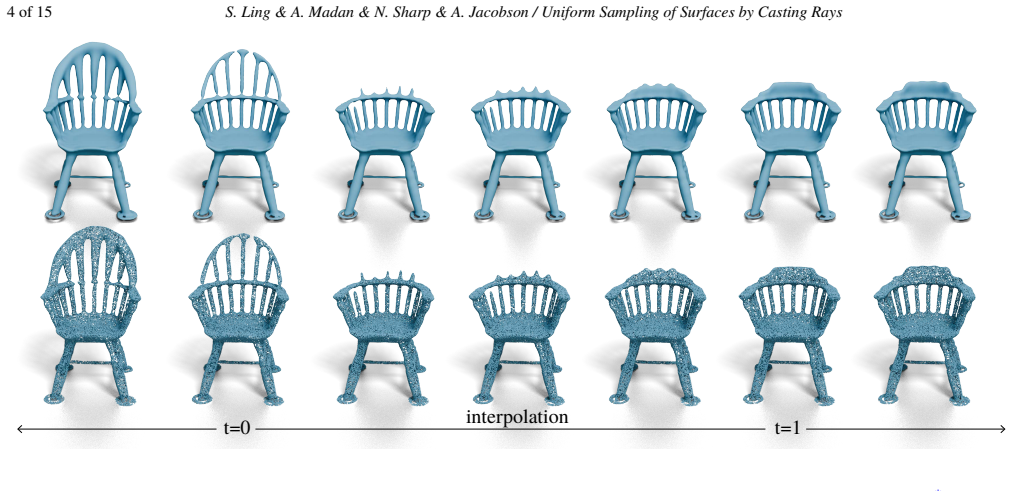
- Subsampling the white-noise output produces blue noise, sparse voxel partitioning gives stratified low-variance sampling, and the same machinery handles offset surfaces, open boundaries, and non-manifold geometry.
- The 2D restriction of the algorithm uniformly samples planar implicit outlines, which the paper connects to vector-graphics and font-generation tasks.
Reading between the lines
- Because the theorem requires only $k$-equidistributed rays rather than statistically independent ones, deterministic low-discrepancy ray sets should inherit the uniformity guarantee, and the paper's convergence experiments already hint that such sets improve moment-estimation rates.
- The intersection and chord statistics that feed the uniform samples also give an unbiased area and volume estimator whose cost scales with surface area, suggesting an unexplored use as a differentiable surrogate loss for shape optimization or reconstruction where ray generation is independent of surface parameters.
- For neural fields whose global Lipschitz constant is only estimated, uniformity in practice depends on the supplied bound being a true upper bound; coupling sphere tracing with conservative interval bounds or rigorous Lipschitz estimation would make the numeric sampler match the theoretical guarantee.
- The same line-intersection idea should extend to planar intersections of a surface to sample curves, or to higher-dimensional varieties, though average chord-length formulas imply efficiency falls as dimension increases.
Editorial analysis
A structured set of objections, weighed in public.
Referee Report
Summary. The paper proposes a method for uniformly sampling points on implicit surfaces by sampling random rays through a bounding box and collecting every intersection of each ray with the zero level set. The authors justify uniformity via Cauchy-Crofton integral geometry, present a sphere-tracing modification to find all intersections under a Lipschitz bound, and validate the method against meshes, rejection sampling, Hamiltonian Monte Carlo, and marching-cubes-based sampling. They further demonstrate extensions to blue noise, stratified sampling via sparse voxels, moment estimation, curvature-based resampling, and neural implicit deformation.
Significance. The core observation is correct and useful: if the ray-intersection subroutine is exact and the ray distribution is the standard isotropic one, the collected points are uniform in the sense of equidistribution, following established Cauchy-Crofton theory. The paper contributes a self-contained proof of the 1-equidistribution of the resampling view in Appendix A, a practical sphere-marching variant to collect all intersections, and a broad set of applications. The experimental comparison on 114 meshes against a ground-truth uniform sampler is solid both in uniformity (total variation score) and in cost (number of implicit function evaluations). The main weaknesses are in the specification of the algorithm and the unqualified guarantee for neural implicits whose Lipschitz bounds are only estimated.
major comments (2)
- [Section 4.1-4.2, Algorithm 1 and Algorithm 2] The pseudocode does not implement the full-line intersection process required by the theory. In Algorithm 1, origins o_i are sampled in the plane through the origin normal to d_i; in Algorithm 2, tracing starts at t=0 at o_i and only advances t upward until t<length(ℓ_i). For a line whose intersection with the bounding box straddles that plane, only the forward half of the line is traced, so intersections on the backward half are never recorded. Moreover, the update p ← o_i + t d_i/λ together with t ← t + s makes the termination test dimensionally inconsistent with the parameterization of ℓ_i in Algorithm 1. Please specify the bounding-box chord interval [t_min, t_max] explicitly and trace the entire interval, or move the ray origins to a plane outside the bounding box; in either case, reconcile the step-size parameterization with the ray parameter used in the termination test.
- [Abstract, Section 4.2-4.3] The uniformity guarantee is stated without qualification, but Algorithm 2's sphere tracing is safe only if λ is a true upper Lipschitz bound of f. As the paper itself notes in Section 4.3, neural implicits such as SIREN and NeuS 'encourage SDF-ness but do not guarantee it and may have large global Lipschitz bounds.' For those headline examples λ is estimated rather than certified, and an underestimate can cause missed zero crossings and biased samples. Please scope the guarantee to exact ray intersection or to a certified Lipschitz bound, or provide empirical evidence on neural fields with known mesh ground truth that the estimated λ is sufficient in the tested regimes.
minor comments (4)
- [Section 6.4] The sentence 'subsample our uniform a samples as blue noise' appears to contain a typo; it should read 'subsample our uniform samples as blue noise.'
- [Appendix A] The proof relies on the limit ∑ k_i/M from [PPK16], yet the footnote states that the proof in [PPK16] has an error and omits a factor of 2/|L|. Since the corrected proof is said to follow the same argument, it would be helpful to include that corrected derivation explicitly rather than leaving the reader to reconstruct it.
- [Figure 12 and Section 5] The neural field examples in Figure 12 are qualitative; the quantitative TV evaluations in Section 5 are all on mesh-derived signed distance functions, where λ is known. A quantitative uniformity measurement on at least one neural implicit with an estimated Lipschitz bound would make the practical claim more convincing.
- [Algorithm 1] The text describes a '2√3-sided square'; this is the side length of the square, not its diagonal. The wording could be clarified to avoid ambiguity about the sampling domain.
Circularity Check
No significant circularity: the uniformity guarantee is derived from an external integral-geometry theorem and is not equivalent to the method's inputs.
full rationale
The derivation chain is not circular. The central uniformity claim (Sections 3.2 and Appendix A, Theorem 1) reduces, via the Cauchy-Crofton formula, to an external integral-geometry identity: an integral over the surface equals an integral over the line process summing over all intersections. The paper states this pedigree explicitly ('This relationship is well-known in mathematics', citing [PPK16] and [San76]) and supplies a self-contained proof in Appendix A using resampled importance sampling, with the requirement that all ray intersections are found. The cited [PPK16] is not authored by the present authors, so there is no load-bearing self-citation; indeed Appendix A corrects an error in [PPK16]'s proof, so the paper is not merely importing the result. No parameter is fitted to data and then renamed a prediction: lambda is a user-supplied Lipschitz bound, a precondition of sphere tracing, and uniformity is proven for the exact-intersection subroutine regardless of lambda. The practical caveat that neural fields only 'encourage SDF-ness but do not guarantee it and may have large global Lipschitz bounds' concerns whether sphere tracing actually recovers all intersections for that representation; it does not make the mathematical statement equivalent to its inputs. The empirical TV evaluations use a mesh-based ground-truth sampler independent of the method, providing external validation rather than circular confirmation.
Assumptions & free parameters
free parameters (1)
- intersection tolerance epsilon =
1e-4
assumptions (5)
- standard math Cauchy-Crofton / integral geometry: the integral of a function over a surface S equals (1/(2 pi)) times the integral over all lines of the sum of the function over all intersections of each line with S
- domain assumption Algorithm 1 samples from the uniform measure on the set of oriented lines intersecting the bounding box
- domain assumption A valid global Lipschitz bound lambda of f is known
- domain assumption The surface is contained in the user-provided bounding box
- standard math The surface is a sufficiently regular codimension-one set for the Cauchy-Crofton formula to apply
Cite this review
Pith. "Pith review of Uniform Sampling of Surfaces by Casting Rays." pith.science (2026). https://pith.science/paper/GZT5JGFC
@misc{pith2026250605268,
  author       = {Pith},
  title        = {Pith review of: Uniform Sampling of Surfaces by Casting Rays},
  year         = {2026},
  howpublished = {\url{https://pith.science/paper/GZT5JGFC}},
  note         = {Machine review of arXiv:2506.05268}
}
read the original abstract
Randomly sampling points on surfaces is an essential operation in geometry processing. This sampling is computationally straightforward on explicit meshes, but it is much more difficult on other shape representations, such as widely-used implicit surfaces. This work studies a simple and general scheme for sampling points on a surface, which is derived from a connection to the intersections of random rays with the surface. Concretely, given a subroutine to cast a ray against a surface and find all intersections, we can use that subroutine to uniformly sample white noise points on the surface. This approach is particularly effective in the context of implicit signed distance functions, where sphere marching allows us to efficiently cast rays and sample points, without needing to extract an intermediate mesh. We analyze the basic method to show that it guarantees uniformity, and find experimentally that it is significantly more efficient than alternative strategies on a variety of representations. Furthermore, we show extensions to blue noise sampling and stratified sampling, and applications to deform neural implicit surfaces as well as moment estimation.
Figures


Figures from the paper (13 more)


Reference graph
Works this paper leans on
-
[1]
write newline
" write newline "" before.all 'output.state := FUNCTION fin.entry add.period write newline FUNCTION new.block output.state before.all = 'skip after.block 'output.state := if FUNCTION new.sentence output.state after.block = 'skip output.state before.all = 'skip after.sentence 'output.state := if if FUNCTION not #0 #1 if FUNCTION and 'skip pop #0 if FUNCTIO...
-
[2]
write newline
" write newline "" before.all 'output.state := FUNCTION fin.entry.original add.period write newline FUNCTION new.block output.state before.all = 'skip after.block 'output.state := if FUNCTION new.sentence output.state after.block = 'skip output.state before.all = 'skip after.sentence 'output.state := if if FUNCTION not #0 #1 if FUNCTION and 'skip pop #0 i...
-
[3]
: Controlling neural level sets
Atzmon M., Haim N., Yariv L., Israelov O., Maron H., Lipman Y. : Controlling neural level sets. Advances in Neural Information Processing Systems 32 (2019)
work page 2019
-
[4]
: Random points on an algebraic manifold
Breiding P., Marigliano O. : Random points on an algebraic manifold. SIAM Journal on Mathematics of Data Science 2, 3 (2020), 683--704
work page 2020
-
[5]
: Fast poisson disk sampling in arbitrary dimensions
Bridson R. : Fast poisson disk sampling in arbitrary dimensions. SIGGRAPH sketches 10, 1 (2007), 1
work page 2007
-
[6]
: Uniform Sampling over Level Sets
Chiu E. : Uniform Sampling over Level Sets. Master's thesis, Massachusetts Institute of Technology, 2022
work page 2022
-
[7]
: Learning gradient fields for shape generation
Cai R., Yang G., Averbuch-Elor H., Hao Z., Belongie S., Snavely N., Hariharan B. : Learning gradient fields for shape generation. In Computer Vision--ECCV 2020: 16th European Conference, Glasgow, UK, August 23--28, 2020, Proceedings, Part III 16 (2020), Springer, pp. 364--381
work page 2020
-
[8]
: Improving neural implicit surfaces geometry with patch warping
Darmon F., Bascle B., Devaux J.-C., Monasse P., Aubry M. : Improving neural implicit surfaces geometry with patch warping. In Proceedings of the IEEE/CVF Conference on Computer Vision and Pattern Recognition (2022), pp. 6260--6269
work page 2022
Show all 57 references
-
[9]
A., Henning R., Johnson R
Detwiler J. A., Henning R., Johnson R. A., Marino M. G. : A generic surface sampler for monte carlo simulations. IEEE Transactions on Nuclear Science 55, 4 (Aug. 2008), 2329–2333. URL: http://dx.doi.org/10.1109/TNS.2008.2001063, https://doi.org/10.1109/tns.2008.2001063 doi:10....
2008
-
[10]
V., Laurynėnas A., Ivanauskas F
Daugmaudis J. V., Laurynėnas A., Ivanauskas F. : The influence of bounding surface on the precision of the cauchy–crofton method. Lietuvos matematikos rinkinys 51, proc. LMS (Dec. 2010), 250–255. URL: https://www.journals.vu.lt/LMR/article/view/17823, https://doi.org/10.15388/...
2010 doi
-
[11]
Franklin J. N. : Deterministic simulation of random processes. Mathematics of Computation 17, 81 (1963), 28--59
1963
-
[12]
: Segment tracing using local lipschitz bounds
Galin E., Gu \'e rin E., Paris A., Peytavie A. : Segment tracing using local lipschitz bounds. In Computer Graphics Forum (2020), vol. 39, Wiley Online Library, pp. 545--554
2020
-
[13]
: Ray tracing harmonic functions
Gillespie M., Yang D., Botsch M., Crane K. : Ray tracing harmonic functions. ACM Trans. Graph 43, 4 (2024)
2024
-
[14]
Hart J. C. : Sphere tracing: A geometric method for the antialiased ray tracing of implicit surfaces. The Visual Computer 12, 10 (1996), 527--545
1996
-
[15]
L., Huang H
Huang S.-S., Chen G., Heng C. L., Huang H. : Neuralindicator: implicit surface reconstruction from neural indicator priors. In Forty-first International Conference on Machine Learning (2024)
2024
-
[16]
: Diffcd: A symmetric differentiable chamfer distance for neural implicit surface fitting
H \"a renstam-Nielsen L., Sang L., Saroha A., Araslanov N., Cremers D. : Diffcd: A symmetric differentiable chamfer distance for neural implicit surface fitting. In European Conference on Computer Vision (2024), Springer, pp. 432--447
2024
-
[17]
Khosravifard A., Hematiyan M. R. : A new method for meshless integration in 2d and 3d galerkin meshfree methods. Engineering Analysis with Boundary Elements 34, 1 (2010), 30--40
2010
-
[18]
: Bssrdf importance sampling
King A., Kulla C., Conty A., Fajardo M. : Bssrdf importance sampling. In ACM SIGGRAPH 2013 Talks. 2013, pp. 1--1
2013
-
[19]
: 3d gaussian splatting for real-time radiance field rendering
Kerbl B., Kopanas G., Leimk \"u hler T., Drettakis G. : 3d gaussian splatting for real-time radiance field rendering. ACM Trans. Graph. 42, 4 (2023), 139--1
2023
-
[20]
Knuth D. E. : The METAFONT book, vol. C of Computers and Typesetting. Addison-Wesley, Reading, Massachusetts, 1986
1986
-
[21]
E., Cline H
Lorensen W. E., Cline H. E. : Marching cubes: A high resolution 3d surface construction algorithm. In Seminal graphics: pioneering efforts that shaped the field. 1998, pp. 347--353
1998
-
[22]
: Sampling with mollified interaction energy descent
Li L., Liu Q., Korba A., Yurochkin M., Solomon J. : Sampling with mollified interaction energy descent. arXiv preprint arXiv:2210.13400 (2022)
2022 arXiv
-
[23]
D., Williams F., Jacobson A., Fidler S., Litany O
Liu H.-T. D., Williams F., Jacobson A., Fidler S., Litany O. : Learning smooth neural functions via lipschitz regularization. In ACM SIGGRAPH 2022 Conference Proceedings (2022), pp. 1--13
2022
-
[24]
R., Bowyer A
Li X., Wang W., Martin R. R., Bowyer A. : Using low-discrepancy sequences and the crofton formula to compute surface areas of geometric models. Computer-Aided Design 35, 9 (2003), 771--782
2003
-
[25]
: A quasi-monte carlo method for computing areas of point-sampled surfaces
Liu Y.-S., Yong J.-H., Zhang H., Yan D.-M., Sun J.-G. : A quasi-monte carlo method for computing areas of point-sampled surfaces. Computer-Aided Design 38, 1 (2006), 55--68
2006
-
[26]
: Surface area estimation of digitized 3d objects using quasi-monte carlo methods
Liu Y.-S., Yi J., Zhang H., Zheng G.-Q., Paul J.-C. : Surface area estimation of digitized 3d objects using quasi-monte carlo methods. Pattern Recognition 43, 11 (2010), 3900--3909
2010
-
[27]
: On the generalization of the average chord length
Mazzolo A. : On the generalization of the average chord length. Annals of Nuclear Energy 35, 3 (2008), 503--506. URL: https://www.sciencedirect.com/science/article/pii/S0306454907001843, https://doi.org/https://doi.org/10.1016/j.anucene.2007.06.026 doi:https://doi.org/10.1016/...
2008 doi
-
[28]
: Instant neural graphics primitives with a multiresolution hash encoding
M \"u ller T., Evans A., Schied C., Keller A. : Instant neural graphics primitives with a multiresolution hash encoding. ACM transactions on graphics (TOG) 41, 4 (2022), 1--15
2022
-
[29]
: 3d gaussian ray tracing: Fast tracing of particle scenes
Moenne-Loccoz N., Mirzaei A., Perel O., de Lutio R., Martinez Esturo J., State G., Fidler S., Sharp N., Gojcic Z. : 3d gaussian ray tracing: Fast tracing of particle scenes. ACM Transactions on Graphics (TOG) 43, 6 (2024), 1--19
2024
-
[30]
: Robust field-aligned global parametrization
Myles A., Pietroni N., Zorin D. : Robust field-aligned global parametrization. ACM Trans. Graph. 33, 4 (2014), 135--1
2014
-
[31]
C., Alexa M., Gross M
\"O ztireli A. C., Alexa M., Gross M. : Spectral sampling of manifolds. ACM Transactions on Graphics (TOG) 29, 6 (2010), 1--8
2010
-
[32]
J., Florence P., Straub J., Newcombe R., Lovegrove S
Park J. J., Florence P., Straub J., Newcombe R., Lovegrove S. : Deepsdf: Learning continuous signed distance functions for shape representation. In Proceedings of the IEEE/CVF conference on computer vision and pattern recognition (2019), pp. 165--174
2019
-
[33]
: Pointclouds: Distributing points uniformly on a surface
Palais R., Palais B., Karcher H. : Pointclouds: Distributing points uniformly on a surface. arXiv preprint arXiv:1611.04690 (2016)
2016 arXiv
-
[34]
Quinn J. A. : Low-discrepancy point sampling of 2D manifolds for visual computing. Cardiff University (United Kingdom), 2009
2009
-
[35]
Rubin D. B. : The calculation of posterior distributions by data augmentation: Comment: A noniterative sampling/importance resampling alternative to the data augmentation algorithm for creating a few imputations when fractions of missing information are modest: The sir algorit...
1987
-
[36]
: Point sampling with uniformly distributed lines
Rovira J., Wonka P., Castro F., Sbert M. : Point sampling with uniformly distributed lines. In Proceedings Eurographics/IEEE VGTC Symposium Point-Based Graphics, 2005. (2005), IEEE, pp. 109--118
2005
-
[37]
Reddy P., Zhang Z., Wang Z., Fisher M., Jin H., Mitra N. J. : A multi-implicit neural representation for fonts. In Advances in Neural Information Processing Systems 34: Annual Conference on Neural Information Processing Systems 2021, NeurIPS 2021, December 6-14, 2021, virtual ...
2021
-
[38]
Santal \'o L. A. : Integral geometry and geometric probability. 1976
1976
-
[39]
: Accurate spectral analysis of two-dimensional point sets
Schl \" o mer T., Deussen O. : Accurate spectral analysis of two-dimensional point sets. J. Graphics, GPU, & Game Tools 15 , 3 (2011), 152--160. URL: https://doi.org/10.1080/2151237X.2011.609773, https://doi.org/10.1080/2151237X.2011.609773 doi:10.1080/2151237X.2011.609773
2011
-
[40]
Stol J., De Figueiredo L. H. : Self-validated numerical methods and applications. In Monograph for 21st Brazilian Mathematics Colloquium, IMPA, Rio de Janeiro. Citeseer (1997), vol. 5, Citeseer, p. 122
1997
-
[41]
Schaufler G., Jensen H. W. : Ray tracing point sampled geometry. In Rendering Techniques 2000: Proceedings of the Eurographics Workshop in Brno, Czech Republic, June 26--28, 2000 11 (2000), Springer, pp. 319--328
2000
-
[42]
: Stochastic poisson surface reconstruction
Sell \' a n S., Jacobson A. : Stochastic poisson surface reconstruction. ACM Trans. Graph. 41 , 6 (2022), 227:1--227:12. URL: https://doi.org/10.1145/3550454.3555441, https://doi.org/10.1145/3550454.3555441 doi:10.1145/3550454.3555441
2022
-
[43]
: Implicit neural representations with periodic activation functions
Sitzmann V., Martel J., Bergman A., Lindell D., Wetzstein G. : Implicit neural representations with periodic activation functions. Advances in neural information processing systems 33 (2020), 7462--7473
2020
-
[44]
Sullivan J. M. : Pleasing shapes for topological objects. In Mathematics and Modern Art: Proceedings of the First ESMA Conference, held in Paris, July 19-22, 2010 (2012), Springer, pp. 153--165
2012
-
[45]
Talbot J. F. : Importance resampling for global illumination. Brigham Young University, 2005
2005
-
[46]
Trusty T., Chen H., Levin D. I. : The shape matching element method: Direct animation of curved surface models. ACM Transactions on Graphics (TOG) 40, 4 (2021), 1--14
2021
-
[47]
: Vecfusion: Vector font generation with diffusion
Thamizharasan V., Liu D., Agarwal S., Fisher M., Gharbi M., Wang O., Jacobson A., Kalogerakis E. : Vecfusion: Vector font generation with diffusion. In IEEE/CVF Conference on Computer Vision and Pattern Recognition, CVPR 2024, Seattle, WA, USA, June 16-22, 2024 (2024), IEEE , ...
2024
-
[48]
: Computation of intersection volume using discrete quadrature algorithm
Tong J., Li Q., Peng W., Fang Y., Wu Y. : Computation of intersection volume using discrete quadrature algorithm. Optik 158 (2018), 725--736
2018
-
[49]
: Neus: Learning neural implicit surfaces by volume rendering for multi-view reconstruction
Wang P., Liu L., Liu Y., Theobalt C., Komura T., Wang W. : Neus: Learning neural implicit surfaces by volume rendering for multi-view reconstruction. arXiv preprint arXiv:2106.10689 (2021)
2021 arXiv
-
[50]
: Neural fields in visual computing and beyond
Xie Y., Takikawa T., Saito S., Litany O., Yan S., Khan N., Tombari F., Tompkin J., Sitzmann V., Sridhar S. : Neural fields in visual computing and beyond. CoRR abs/2111.11426 (2021). URL: https://arxiv.org/abs/2111.11426, http://arxiv.org/abs/2111.11426 arXiv:2111.11426
2021 arXiv
-
[51]
: Geometry processing with neural fields
Yang G., Belongie S., Hariharan B., Koltun V. : Geometry processing with neural fields. Advances in Neural Information Processing Systems 34 (2021), 22483--22497
2021
-
[52]
: Omnisvg: A unified scalable vector graphics generation model, 2025
Yang Y., Cheng W., Chen S., Zeng X., Zhang J., Wang L., Yu G., Ma X., Jiang Y.-G. : Omnisvg: A unified scalable vector graphics generation model, 2025. URL: https://arxiv.org/abs/2504.06263, http://arxiv.org/abs/2504.06263 arXiv:2504.06263
2025
-
[53]
C., Denny J., Lindsey A., Thomas S., Amato N
Yeh H.-Y. C., Denny J., Lindsey A., Thomas S., Amato N. M. : Umaprm: Uniformly sampling the medial axis. In 2014 IEEE International Conference on Robotics and Automation (ICRA) (2014), IEEE, pp. 5798--5803
2014
-
[54]
: Volume rendering of neural implicit surfaces
Yariv L., Gu J., Kasten Y., Lipman Y. : Volume rendering of neural implicit surfaces. Advances in Neural Information Processing Systems 34 (2021), 4805--4815
2021
-
[55]
: Sample elimination for generating poisson disk sample sets
Yuksel C. : Sample elimination for generating poisson disk sample sets. In Computer Graphics Forum (2015), vol. 34, Wiley Online Library, pp. 25--32
2015
-
[56]
: Iso-points: Optimizing neural implicit surfaces with hybrid representations
Yifan W., Wu S., Oztireli C., Sorkine-Hornung O. : Iso-points: Optimizing neural implicit surfaces with hybrid representations. In Proceedings of the IEEE/CVF Conference on Computer Vision and Pattern Recognition (2021), pp. 374--383
2021
-
[57]
: Unbiased sampling and meshing of isosurfaces
Yan D.-M., Wallner J., Wonka P. : Unbiased sampling and meshing of isosurfaces. IEEE transactions on visualization and computer graphics 20, 11 (2014), 1579--1589
2014
Reviewed August 7, 2026 · model on record in the stance chip above.
Discussion (0). Sign in to comment.