REVIEW 4 major objections 3 minor 4 references
Multi Messenger Study of GRB 221009A with VHE Gamma-ray and Neutrino Afterglow from a Gaussian Structured Jet
T0 review · 4 major / 3 minor · reviewed 2026-08-03 · deepseek-v4-flash
Pith's one-line read This paper argues that a Gaussian structured jet viewed mildly off-axis explains the extreme TeV afterglow of GRB 221009A without the enormous energy a uniform top-hat jet would require, and that the same jet produces a PeV–EeV neutrino flu
desk verdict The Gaussian structured-jet fit to GRB 221009A's GeV–TeV afterglow is serious and the sub-threshold neutrino conclusion is probably right, but the paper overstates its case with an imprecise 'off-axis' framing and a post-hoc time-dependent εB that weakens the parameter inference. read the letter →
The pith
A machine-rendered reading of the paper's core claim, the machinery that carries it, and where it could break.
The reading
What carries the argument
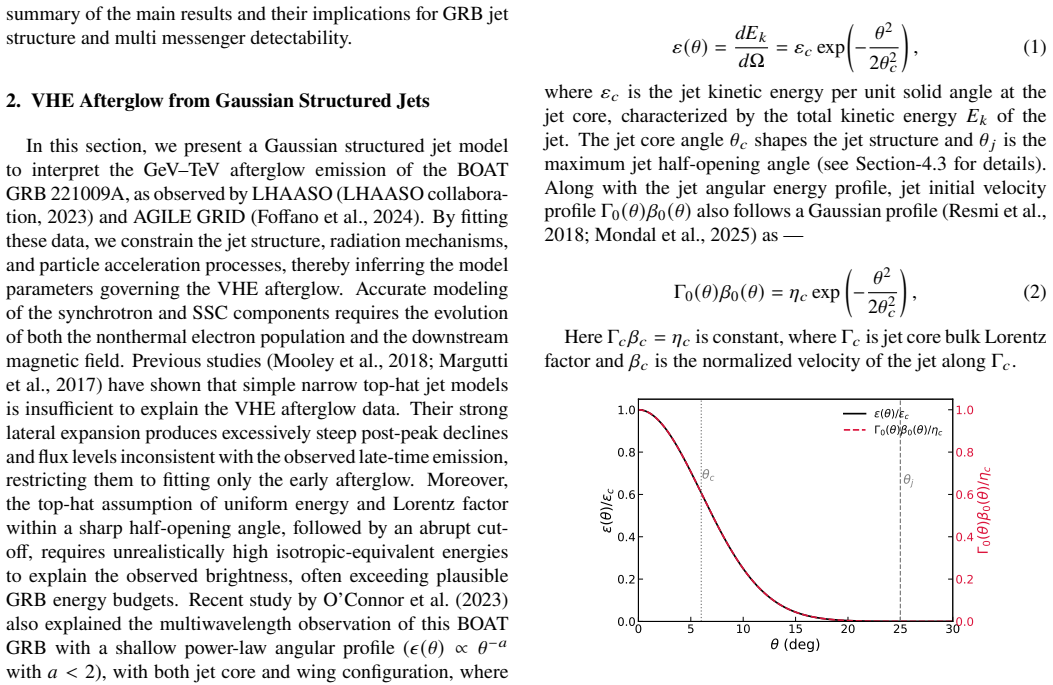
The central object is the Gaussian structured jet, defined by an energy profile ε(θ) = ε_c exp(−θ²/2θ_c²) and a matching Gaussian profile for the initial bulk Lorentz factor. The jet is divided into angular segments; each segment contributes to the observed synchrotron and synchrotron-self-Compton flux through Doppler factors, segment solid angles, adiabatic blast-wave evolution in a uniform interstellar medium, and corrections for Klein–Nishina scattering, internal γγ pair production, and extragalactic background light. The same photon field serves as the target for neutrino production: protons accelerated with an E^-2 spectrum interact with synchrotron photons via the pγ channel, and the c
What would settle it
Take a future nearby bright GRB whose TeV afterglow is fit by the same pure-leptonic Gaussian structured jet model; if IceCube Gen2 or GRAND200k records even one coincident PeV–EeV neutrino above the paper's predicted flux, the neutrino prediction fails. Independently, an afterglow fit that includes X-ray, optical, and radio data and requires a wind-like medium or a power-law jet profile would directly test the uniform-ISM Gaussian assumption.
Extended reading notes
Core claim
The paper's central claim is that the multi-TeV afterglow of GRB 221009A does not require an ultra-energetic uniform jet. A Gaussian structured jet—whose energy per solid angle falls off smoothly with angle—viewed at a mild off-axis angle of θ_v ≈ 2.5°, relative to a core angle θ_c ≈ 4.4°, reproduces the GeV–TeV spectral energy distributions and light curves observed by AGILE and LHAASO with a total kinetic energy of only about 3.6×10^52 erg and an ambient density near 1 cm^-3. Using the same parameters, the predicted neutrino flux from proton–photon interactions in the PeV–EeV range falls below the 90% upper-limit sensitivity curves derived for IceCube Gen2 and GRAND200k; an optimized corre
Load-bearing premise
The load-bearing premise is that the TeV afterglow is entirely leptonic synchrotron and synchrotron-self-Compton emission from a Gaussian structured jet expanding into a uniform interstellar medium, so if hadronic processes contribute non-negligibly to the GeV–TeV photons, or the jet profile or external medium differs, the fitted parameters and the predicted neutrino flux would change.
Editorial extensions
If this is right
- The very-high-energy afterglow of GRB 221009A is consistent with a mildly off-axis Gaussian structured jet, so the event does not demand the extreme isotropic-equivalent energies required by top-hat jet models.
- The predicted PeV–EeV neutrino flux lies below the sensitivities of IceCube Gen2 and GRAND200k, making the observed neutrino non-detection consistent with this model.
- The viewing geometry matters: switching from on-axis to off-axis viewing changes the predicted neutrino flux by roughly an order of magnitude.
- Only particularly energetic, nearby, and efficiently baryon-loaded bursts are likely to produce detectable neutrino and cosmic-ray signals; future Cherenkov Telescope Array observations could constrain jet geometry and radiation mechanisms.
- An optimized correlation search for GRAND200k still yields only about 0.1 expected neutrino events for this burst, implying that single-burst neutrino detections from ordinary GRB afterglows will be rare.
Reading between the lines
- Editorial extension: the paper does not follow secondary cascades from the pγ channel, so including those cascades could raise the predicted photon and neutrino yields; a natural next step is to compute the cascade contribution.
- Editorial extension: the need to allow a time-varying ε_B to fit all three spectral time bins suggests the model's parameter constraints are less tight than the central fit alone implies; adding X-ray, optical, and radio data would test whether the Gaussian jet profile and the uniform-ISM assumption hold.
- Editorial extension: if the afterglow environment is wind-like rather than uniform, or if the jet profile follows a power law rather than a Gaussian, the target photon density and pγ optical depth change; comparing these scenarios in joint VHE–neutrino fits would isolate the geometry.
- Editorial extension: the on-axis/off-axis order-of-magnitude difference in neutrino flux suggests stacking searches that classify bursts by viewing-angle indicators could improve the collective sensitivity of next-generation neutrino telescopes.
Editorial analysis
A structured set of objections, weighed in public.
Referee Report
Summary. The paper models the VHE afterglow of GRB 221009A using an external forward shock from a Gaussian structured jet in a uniform ISM, including synchrotron and SSC emission with Klein–Nishina, internal γγ attenuation, and EBL corrections. The authors perform an MCMC fit to the AGILE-GRID and LHAASO GeV–TeV SED and light-curve data, obtaining best-fit parameters (Ek ~ 3.6×10^52 erg, θv = 2.46°, θc = 4.41°, εe ≫ εB), and then compute the pγ neutrino flux in the PeV–EeV range, compare it with IceCube-Gen2 and GRAND200k sensitivities, and conclude that the predicted neutrino flux lies below detection limits, with expected events of order ~0.1 even in an optimistic parameter regime.
Significance. If the results hold, the paper would provide a concrete demonstration that a Gaussian structured jet can reproduce the exceptional TeV afterglow of GRB 221009A without the extreme energy requirements of a top-hat jet, and would strengthen the conclusion that this burst is not a detectable neutrino source for next-generation detectors. The work combines a real MCMC fit to actual AGILE/LHAASO data with a detailed treatment of KN, γγ, and EBL corrections, and the neutrino non-detection conclusion appears robust to the explored parameter variations. The correlation analysis for GRAND200k is a useful step for identifying favorable parameter regimes, though it is partly disconnected from the fitted afterglow parameters.
major comments (4)
- [§3.1, Table 1, Figure 3] The MCMC is performed only on the T2 = T*+[100,674] s SED; for the other two SED intervals and the light curve, εB is allowed to evolve 'as a function of observer time' while all other parameters are kept within their ±1σ credible intervals. This is a per-bin adjustment, not a parameter constrained by the data. Since the pγ neutrino flux is directly proportional to the target photon density, which depends on εB(t), the calculated neutrino flux is not uniquely determined by the fitted model. The statement that the neutrino flux is computed 'using parameters inferred from the multi-wavelength SED' is therefore overstated. Please report the εB(t) values, propagate their uncertainties into the neutrino flux, and clarify how the time-dependent εB is constrained by the data rather than chosen post hoc.
- [Abstract, §2.4, §3.2, Table 1] The abstract and summary repeatedly state that the VHE afterglow is reproduced 'at an off-axis angle', and §3.2 describes the geometry as 'mildly off-axis'. However, the best-fit parameters give θv = 2.46° and θc = 4.41°, so θv < θc. By the paper's own definition in §2.4, θv < θc is the on-axis case (scenario i). This internal inconsistency affects the interpretation of the Doppler-boosting argument that is used to explain the high SSC flux. Please correct the framing: either the geometry is on-axis/mildly off-axis in a different sense, or a genuinely off-axis fit (θv > θc) should be presented and compared.
- [§4.2, §5.1, Figures 8–10] The correlation study in Section 5.1 uses a simulated GRB with parameters sampled from broad ranges (Ek,iso ∈ [10^53,10^56] erg, εp ∈ [10^-2,1], n0 ∈ [0.3,30] cm^-3) and a fixed Γ0 = 460, rather than the posterior distribution of Table 1. Consequently, the statement that 'the expected number of events from this GRB is of order ~0.1' is not a prediction of the fitted Gaussian structured-jet model; it is the result of a separate optimistic scan. The paper should distinguish more carefully between model-predicted neutrino flux (Section 4.4, Figure 7) and the parameter-space exploration (Section 5), and should state that the latter does not use the GRB 221009A posterior parameters.
- [§4.3, Eq. (9)] The neutrino calculation uses Ek,iso(θv) = 4π εc exp(-θv^2/(2θc^2)), i.e., the line-of-sight isotropic-equivalent energy, to normalize the proton and photon populations. For a structured jet, however, target photons and cosmic-ray protons from regions outside the narrow beaming cone can contribute to pγ interactions. The paper does not justify why only the line-of-sight cone matters for the neutrino optical depth, especially at late times when the beaming angle widens. Please provide an explicit calculation or a quantitative justification that the neglected angular contributions do not change the neutrino flux by more than the claimed order-of-magnitude separation.
minor comments (3)
- [Throughout] There are several typos and inconsistencies: 'LHASSO' appears in multiple places; the reference 'Ren et al. 2024a' and 'Ren et al. 2024b' are the same paper; Figure 7 caption says 'shaded purple band' but the figure appears to have curves rather than a band; the 'mildly off-axis' terminology is used inconsistently with the formal θv < θc definition.
- [§4.4, Eq. (11)] The event-rate formula integrates over time and energy, but the text does not specify the energy integration range used for the reported event counts. Please state the energy window in each figure and check whether the IceCube-Gen2 and GRAND200k effective areas are flavor-specific or averaged.
- [§3.1] The MCMC section says 'we keep θj, k fixed to 25° and 2.5 respectively' but the prior ranges and the likelihood function are not fully specified. In particular, it is unclear whether the corner plot in Figure 2 shows the posterior or the sample chains, and whether convergence was assessed beyond the number of iterations.
Circularity Check
No significant circularity; the neutrino flux is a forward prediction from gamma-ray-fitted parameters, not a fitted input, with only minor non-load-bearing self-citations.
full rationale
The central neutrino prediction is not circular: the afterglow parameters are obtained by MCMC fitting to AGILE/LHAASO GeV–TeV data (Section 3.1), and the neutrino flux is then computed from those parameters via a standard pγ formalism (Razzaque 2013). The neutrino flux is not fitted to IceCube/KM3NeT/GRAND200k data, so there is no fitted-input-called-prediction loop. The comparison to detector sensitivities is equivalent to computing expected muon-neutrino events (Eq. 11) and checking against the N90=3.89 Poisson bound; the plotted UL curves are rescaled model spectra, so the 'below UL' statement is a restatement of the event-count calculation rather than a separate fitted result. The Gaussian structured-jet framework is adopted from the authors' prior work (Mondal et al. 2025), but the angular profile is originally attributed to external works (Lamb & Kobayashi 2017; Resmi et al. 2018), and the present MCMC fit independently tests the model against the data. The pγ formalism of Razzaque (2013) is a published, externally checkable method, not a uniqueness theorem imported from the authors. The paper's time-dependent ε_B—adjusted per SED interval after fitting only the T2 bin—is ad hoc and weakens the robustness of the parameter inference, but it is a modeling limitation, not a circular reduction. Similarly, the 'mildly off-axis' label conflicts with the paper's own definition (θv=2.46° < θc=4.41° is on-axis by Section 2.4), an internal inconsistency rather than a tautology. These issues affect correctness but do not make the derivation equivalent to its inputs. Score 2 reflects only minor self-citations that are not load-bearing.
Assumptions & free parameters
free parameters (10)
- log10 E_k (erg) =
52.56 (+0.24/-0.25)
- log10 n0 (cm^-3) =
0.016 (+0.209/-0.063)
- eta_c = Gamma_c * beta_c =
459.6 (+0.4/-0.34)
- log10 epsilon_e =
-0.78 (+0.04/-0.12)
- log10 epsilon_B =
-3.71 (+0.07/-0.06) (first epoch)
- theta_v (deg) =
2.46 (+0.92/-1.37)
- theta_c (deg) =
4.41 (+1.49/-1.14)
- theta_j (deg) =
25 (fixed)
- k (electron power-law index) =
2.5 (fixed)
- epsilon_p (proton energy fraction) =
1.0 (optimistic scenario)
assumptions (7)
- domain assumption Synchrotron/SSC emission model with electron power-law distribution (Sari et al. 1998; Sari & Esin 2001)
- domain assumption Blandford-McKee self-similar adiabatic evolution for relativistic blast wave
- domain assumption Uniform ISM with constant proton density n0
- ad hoc to paper Gaussian angular profiles for jet energy and initial Lorentz factor (Eqs. 1-2)
- domain assumption pγ interaction formalism of Razzaque (2013)
- domain assumption Proton spectrum ∝ E_p^{-2} with no high-energy cutoff
- standard math Neutrino oscillations produce 1:1:1 flavor ratio at Earth
Cite this review
Pith. "Pith review of Multi Messenger Study of GRB 221009A with VHE Gamma-ray and Neutrino Afterglow from a Gaussian Structured Jet." pith.science (2026). https://pith.science/paper/GZYQORAX
@misc{pith2026251113633,
  author       = {Pith},
  title        = {Pith review of: Multi Messenger Study of GRB 221009A with VHE Gamma-ray and Neutrino Afterglow from a Gaussian Structured Jet},
  year         = {2026},
  howpublished = {\url{https://pith.science/paper/GZYQORAX}},
  note         = {Machine review of arXiv:2511.13633}
}
abstract
Recent detections of very-high-energy (VHE; $\gtrsim 100~{\rm GeV}$) emission from GRB afterglows, most notably the unprecedented brightness of GRB~221009A observed by LHAASO, reveal components beyond the standard electron synchrotron model. The multi-TeV photons motivate synchrotron self-Compton and possible hadronic contributions, while the non-detection of coincident neutrinos by IceCube/KM3NeT/GRAND200k constrains the microphysical parameters, jet kinetic energy, and ambient-medium density. We model the VHE afterglow of GRB~221009A with an external forward shock from a Gaussian structured jet in a uniform-density medium. This angular structure reproduces the extreme TeV output at an off-axis angle but without demanding large energies as in a top-hat jet. We compute the corresponding $p\gamma$ neutrino flux in the PeV-EeV range and derive a time-integrated upper limit using the effective areas of IceCube-Gen2 and GRAND200k. This provides insight into the contribution of individual GRBs to neutrino events. The predicted neutrino flux for GRB~221009A, using parameters inferred from the multi-wavelength spectral energy distribution, lies below the sensitivities of these detectors. Even our correlation analysis, optimized for neutrino searches with the upcoming GRAND200k, indicates that the expected number of events from this GRB is of order $\sim 0.1$ under a highly optimistic microphysical parameter regime. We also compare neutrino-flux variations from on-axis and off-axis viewing geometries and find an approximately order of magnitude difference in the signal. Thus, our study concludes that a brighter burst closer than GRB~221009A would be crucial for neutrino detection by upcoming telescopes. Future GRB detections by the Cherenkov Telescope Array will provide important constraints on their geometry, radiation mechanisms, and possible associated neutrino signals.
Figures


Figures from the paper (7 more)


Reference graph
Works this paper leans on
-
[115]
URL:https://dx.doi.org/10.3847/1538-4357/ ad1bcd, doi:10.3847/1538-4357/ad1bcd. Resmi, L., Schulze, S., Ishwara-Chandra, C., Misra, K., Buch- ner, J., De Pasquale, M., Sánchez-Ramírez, R., Klose, S., Kim, S., Tanvir, N., et al., 2018. Low-frequency view of gw170817/grb 170817a with the giant metrewave radio tele- scope. The Astrophysical Journal 867, 57. ...
arXiv 2018
-
[2013]
Publications of the Astro- nomical Society of the Pacific 125, 306
emcee: the mcmc hammer. Publications of the Astro- nomical Society of the Pacific 125, 306. Fraija, N., Duran, R.B., Dichiara, S., Beniamini, P., 2019. Syn- chrotron self-compton as a likely mechanism of photons be- yondthesynchrotronlimitingrb190114c. TheAstrophysical Journal 883, 162. Frail, D.A., Kulkarni, S.R., Nicastro, L., Feroci, M., Taylor, G.B., ...
doi:10.1038/38451 2019
-
[2018]
Physical Review Letters 120, 241103
Late time afterglow observations reveal a collimated relativistic jet in the ejecta of the binary neutron star merger gw170817. Physical Review Letters 120, 241103. Lesage, S., Veres, P., Briggs, M., Goldstein, A., Kocevski, D., Burns, E., Wilson-Hodge, C., Bhat, P., Huppenkothen, D., Fryer, C., etal., 2023. Fermi-gbmdiscoveryofgrb221009a: An extraordinar...
2023
-
[2023]
A tera–electron volt afterglow from a narrow jet in an extremelybrightgamma-rayburst. Science380,1390–1396. Lloyd, N.M., Petrosian, V., 2000. Synchrotron Radia- tion as the Source of Gamma-Ray Burst Spectra. As- trophysical Journal 543, 722–732. doi:10.1086/317125, arXiv:astro-ph/0007061. MAGIC Collaboration, 2019. Observation of inverse compton emissionf...
Reviewed August 3, 2026 · model on record in the stance chip above.
Discussion (0). Continue with ORCID to comment.