REVIEW 2 major objections 4 minor 2 cited by
DDSketch: A fast and fully-mergeable quantile sketch with relative-error guarantees
T0 review · 2 major / 4 minor · reviewed 2026-08-14 · deepseek-v4-flash
Pith's one-line read DDSketch is a fully-mergeable quantile sketch that returns every queried quantile within a fixed relative error $\alpha$, and proves logarithmic memory for heavy-tailed data.
desk verdict DDSketch is a simple, fully mergeable relative-error quantile sketch whose central formal claim holds up; it deserves a serious referee, but two text-level errors (the missing EX shift in Corollary 8 and the Pareto size arithmetic) need fixing before one cites the details. read the letter →
The pith
A machine-rendered reading of the paper's core claim, the machinery that carries it, and where it could break.
The reading
What carries the argument
The central object is a fixed logarithmic binning of the positive line: buckets $B_i=(\gamma^{i-1},\gamma^i]$ indexed by $i=\lceil\log_\gamma x\rceil$, with $\gamma=(1+\alpha)/(1-\alpha)$ chosen so that any value in a bucket is within $\alpha$ relative error of the bucket's midpoint representative $2\gamma^i/(\gamma+1)$. This binning carries the whole argument: it turns a relative-error requirement into the purely combinatorial task of locating the bucket containing the $q$-th order statistic, it makes merging trivial because boundaries do not depend on the data, and it makes the bounded-space tradeoff legible through the condition $x_1\le x_q\gamma^{m-1}$, which says the highest bucket must not be more than $m-1$ steps above the queried quantile's bucket. The proof machinery around the binning consists of a Chernoff/Hoeffding tail bound on sample quantiles and a subexponential concentration bound on the sample maximum, whose combination produces the logarithmic sketch-size bound.
What would settle it
Take i.i.d. samples from a Pareto distribution with shape $a=1$, $n=10^6$, $\alpha=0.01$, and failure probabilities $\delta_1=\delta_2=e^{-10}$; Theorem 9 predicts that, with probability at least $1-2e^{-10}$, a DDSketch with $\gamma\approx1.02$ answers all quantiles $q\ge1/2$ within 1% relative error using at most 3380 buckets. Running that configuration repeatedly and finding either a relative error above 1% or a bucket count above 3380 with frequency exceeding $2e^{-10}$ would refute the paper's stated size guarantee. A complementary check of Proposition 4 is the paper's own adversarial set $\{\gamma,\gamma^2,\ldots,\gamma^{2m}\}$, where the condition $x_1\le x_q\gamma^{m-1}$ fails and low-quantile accuracy should degrade.
Extended reading notes
Core claim
The paper's central claim is that DDSketch is the first fully-mergeable quantile sketch with formal relative-error guarantees. It partitions $\mathbb R_{>0}$ into fixed buckets $(\gamma^{i-1},\gamma^i]$ with $\gamma=(1+\alpha)/(1-\alpha)$, increments the bucket containing a newly inserted value, and answers a quantile query by adding bucket counts until it reaches rank $q(n-1)$, returning the representative $2\gamma^i/(\gamma+1)$. Lemma 2 shows that representative is within $\alpha$ relative error of any value in its bucket, and Proposition 3 shows the cumulative-count walk therefore returns an $\alpha$-accurate quantile. Because the boundaries are fixed in advance, merging two sketches is exactly a bucketwise addition of counters; the bounded-memory variant collapses the lowest-index buckets when more than $m$ buckets are occupied, and Proposition 4 pins down when this is safe: quantile $q$ remains $\alpha$-accurate as long as $x_1 \le x_q \gamma^{m-1}$. Theorem 9 then turns this condition into a size bound of $$O\left(\frac{b\log(n/\delta)}{\log\gamma}\right)$$ buckets for i.i.d. samples from a distribution whose log is subexponential, with failure probability at most $\delta_1+\delta_2$.
Load-bearing premise
The bounded-size guarantee assumes the empirical tail is no fatter than a Pareto tail, so that the largest value stays within a factor $\gamma^{m-1}$ of the target quantile; against adversarial data the sketch can need one bucket per value.
Editorial extensions
If this is right
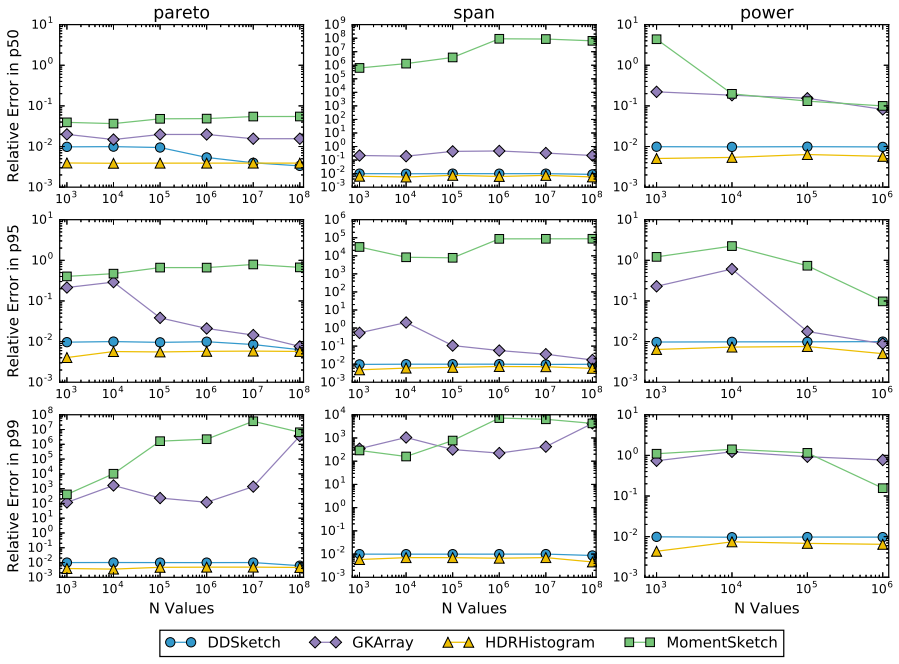
- On heavy-tailed data, tail quantiles such as p99 are reported within a fixed multiple $1\pm\alpha$ of the true value; the experiments show this can be orders of magnitude more accurate than rank-error sketches on the same streams.
- Sketches built on different hosts can be combined in any order and any number of times by summing bucket counters, and the result remains as accurate as a single sketch over the union of the data, up to the bounded-bucket collapse.
- For Pareto and exponential tails the required number of buckets grows only logarithmically (or double-logarithmically) in the number of values, so a few thousand buckets keep p50 through p99 accurate over millions to astronomically many samples.
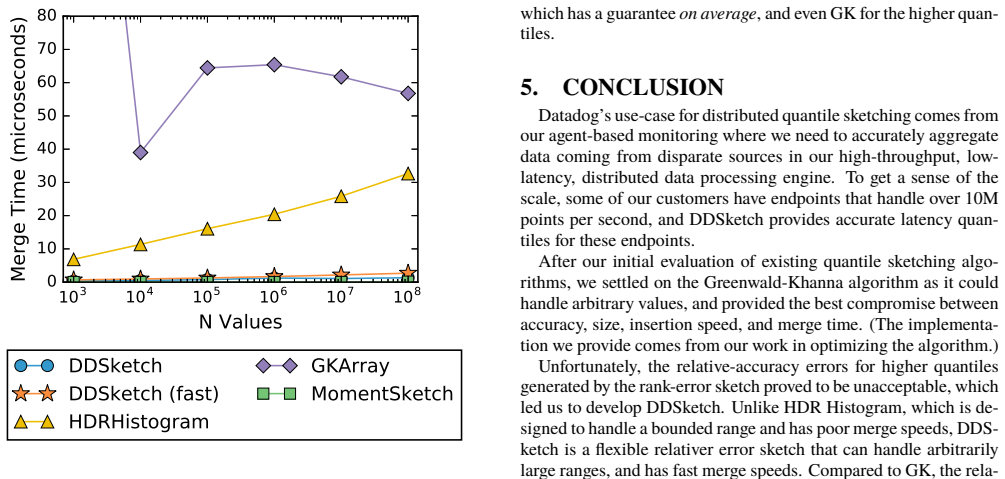
- Merging two DDSketches costs roughly 10 microseconds for sketches of up to fifty million values in the reported Java implementation, making distributed aggregation practical at high ingest rates.
- The bounded variant intentionally sacrifices the lowest quantiles when memory is tight, which is acceptable for monitoring upper-tail metrics like p99 but not for applications that need the smallest non-zero values.
Reading between the lines
- The paper's proof of Proposition 4 suggests a directly implementable monitoring rule that the authors do not state: track the current ratio $\log x_1 - \log x_q$ per sketch, and grow $m$ or flag the sketch when that ratio approaches $(m-1)\log\gamma$, telling operators when low quantiles are no longer guaranteed.
- Because bucket boundaries are fixed, the same collapsing logic could be applied symmetrically to the highest buckets, yielding bounded-space sketches that protect a middle quantile range rather than only the upper tail; the paper mentions collapse direction for negatives only in passing.
- A natural extension is variable accuracy per region: choose a smaller $\gamma$ for quantiles near the median and a larger $\gamma$ for extreme tails, preserving mergeability while spending buckets where they matter most; the paper does not explore this.
- The subexponential-log assumption is sufficient rather than necessary; any distribution with a known bound on the log-tail's moment generating function can be plugged into Theorem 9's template to produce concrete sketch-size constants for Weibull, log-normal, or other heavy-tailed models.
Signed reviews
Editorial analysis
A structured set of objections, weighed in public.
Referee Report
Summary. The paper proposes DDSketch, a fully mergeable quantile sketch with relative-error guarantees. Values are assigned to logarithmic buckets with boundaries gamma^{i-1} < x <= gamma^i for gamma = (1+alpha)/(1-alpha), and a quantile query returns the representative value 2 gamma^i / (gamma+1) of the bucket containing the target order statistic. The sketch is mergeable by summing bucket counts, and a bounded-memory variant collapses low-index buckets when the number of buckets exceeds a limit m. The main formal claim is that for i.i.d. data from a distribution whose logarithm is subexponential, with probability at least 1-delta1-delta2, DDSketch is an alpha-accurate (q,1)-sketch with size O((b log(n/delta)) / log gamma), provided q = Omega(1/sqrt(n)). A separate calculation is given for Pareto tails. The paper also reports extensive experiments on synthetic and real data, comparing DDSketch with GKArray, HDR Histogram, and the Moments sketch.
Significance. If the formal results are correct, DDSketch is a genuinely useful contribution: it is the first relative-error quantile sketch with formal guarantees that is fully mergeable, and the bucket design is simple enough to be fast in practice. The core accuracy argument in Lemma 2 and Proposition 3 is clean and does not rely on fitted constants or hidden assumptions. The distribution-dependent size analysis is a reasonable way to make the bounded-space claim precise, and the paper correctly acknowledges that distribution-free results are impossible. The experimental evaluation covers multiple implementations and real workloads, and the authors have released code. The main weaknesses are localized formal errors in Section 3: a false statement of the sample-maximum bound and an inconsistent Pareto size calculation. These do not invalidate the algorithmic idea or the corrected version of Theorem 9, but they must be fixed before the paper can be cited as providing a fully verified guarantee.
major comments (2)
- [Section 3.2, Corollary 8] The statement of Corollary 8 is false as written. Theorem 7 bounds the tail of X - EX, so the proof establishes only Pr[X(n) - EX > t] <= delta2, i.e., X(n) < EX + 2b log(n/delta2), not X(n) < 2b log(n/delta2). For nonnegative subexponential data, EX > 0 and the difference can be arbitrarily large. Theorem 9 silently uses the corrected bound with the EX term, so the main theorem survives, but the published corollary cannot be cited as a black box and must be restated and proved correctly.
- [Section 3.3, Pareto example] The claimed sketch size of 3380 for Pareto data is inconsistent with the displayed bounds. With delta1 = delta2 = e^{-10}, a = 1, and n = 10^6, the displayed bound gives log(X(n)) < 4 log(n/delta2) + 1 = 4 log n + 41 and log(X(n/2)) > -log(1/2 + sqrt(log(1/delta1)/(2n))) ~ 0.689, so the size bound is about 51(4 log n + 41) + 1, which is roughly 4900, not 3380. The expression 51a^{-1}(4 log n + 11) appears to have lost the +30 contribution from log(n/delta2) = log n + 10. This numerical example should be corrected and rechecked.
minor comments (4)
- [Section 4.3] The sentence 'as we saw in Section 6' refers to the tradeoff between insertion speed and sketch size, but Section 6 is the acknowledgment; the intended reference is presumably Section 4.2 or the implementation discussion in Section 2.2.
- [Section 6] The acknowledgment credits the Minor Planet Center, but none of the three datasets described in Section 4.1 appears to use Minor Planet Center data; please clarify or remove this leftover acknowledgment.
- [Section 5] There is a typo in the conclusion: 'a flexible relativer error sketch' should read 'a flexible relative-error sketch.'
- [Section 3.3] The phrase 'The double logarithm in our size bound from Theorem 9' is misleading in the Pareto discussion, because the final Pareto bound grows as O(log n), not as a double logarithm; please rephrase to avoid confusion about the asymptotic order.
Circularity Check
No significant circularity: the algorithmic guarantees follow directly from the bucket definition and standard concentration arguments, with no fitted values or self-citation load-bearing steps.
full rationale
The paper's derivation chain is self-contained. It defines gamma=(1+alpha)/(1-alpha) buckets and proves in Lemma 2 that the bucket midpoint is an alpha-accurate relative-error estimator for every value in the bucket; this is a direct property of the bucket geometry, not an assumed conclusion. Proposition 3 shows the quantile query returns the bucket containing x_q, again by the definition of ranks and bucket boundaries. Proposition 4 derives the sufficient condition x1 <= xq gamma^{m-1} for the bounded version from the collapse rule, so the bounded-sketch guarantee is not circular. Section 3 then supplies distribution-dependent size bounds: Lemma 5 uses a Hoeffding-style argument to lower-bound the q-th sample quantile, Theorem 7 is a standard subexponential concentration inequality, and Theorem 9 combines these with the bucket-span inequality to bound sketch size. The inputs are explicit distribution parameters (sigma, b for subexponential; a for Pareto) and sample size n; no fitted constant is later renamed as a prediction. Mergeability is established by the fact that bucket counts are added and the same collapse rule is applied, which is the algorithm's definition rather than a circular invocation. Experimental comparisons use independent implementations of GKArray, HDR Histogram, and Moments sketch, plus Datadog and UCI datasets; the authors' own code repositories are implementation artifacts, not evidence for the theorems. The paper's explicit caveats that distribution-free results are impossible and that practical use relies on empirical tails no fatter than Pareto are assumptions, not smuggled outputs. The printed proof of Corollary 8 omits the EX shift in its statement and the Section 3.3 Pareto arithmetic does not reproduce the stated 3380; these are correctness and reproducibility defects, not circularity, because Theorem 9's use of the bound includes the shift and the central derivation does not reduce to its own inputs. No circular step can be exhibited from the paper's equations.
Assumptions & free parameters
assumptions (4)
- standard math Hoeffding/Chvatal binomial tail bound used in Lemma 5 to bound lower sample quantiles.
- standard math Subexponential concentration inequality (Theorem 7) cited to Buldygin and Kozachenko.
- domain assumption Data is i.i.d. from a subexponential or Pareto distribution for the bounded-size guarantee.
- domain assumption For the bounded version, the sufficient condition x1 <= xq * gamma^(m-1) is used to ensure the q-quantile bucket is not collapsed.
Cite this review
Pith. "Pith review of DDSketch: A fast and fully-mergeable quantile sketch with relative-error guarantees." pith.science (2026). https://pith.science/paper/H2BP6FY5
@misc{pith2026190810693,
  author       = {Pith},
  title        = {Pith review of: DDSketch: A fast and fully-mergeable quantile sketch with relative-error guarantees},
  year         = {2026},
  howpublished = {\url{https://pith.science/paper/H2BP6FY5}},
  note         = {Machine review of arXiv:1908.10693}
}
read the original abstract
Summary statistics such as the mean and variance are easily maintained for large, distributed data streams, but order statistics (i.e., sample quantiles) can only be approximately summarized. There is extensive literature on maintaining quantile sketches where the emphasis has been on bounding the rank error of the sketch while using little memory. Unfortunately, rank error guarantees do not preclude arbitrarily large relative errors, and this often occurs in practice when the data is heavily skewed. Given the distributed nature of contemporary large-scale systems, another crucial property for quantile sketches is mergeablility, i.e., several combined sketches must be as accurate as a single sketch of the same data. We present the first fully-mergeable, relative-error quantile sketching algorithm with formal guarantees. The sketch is extremely fast and accurate, and is currently being used by Datadog at a wide-scale.
Figures


Figures from the paper (8 more)




Forward citations
Cited by 2 Pith papers
-
Enabling Multi-Dimensional Distributed Trace Comparison with Contrast
A mergeable trace-summary representation (TPO) lets operators dynamically compare arbitrary groups of traces across structural, timing, critical-path, and semantic dimensions, powering a visual and an LLM-based compar...
-
Approximation-First Timeseries Monitoring Query At Scale
PromSketch caches Exponential-Histogram sketch summaries in memory so overlapping window-aggregation rule queries can be answered approximately without rescanning raw time series.
Reference graph
Works this paper leans on
-
[1]
INTRODUCTION Computing has increasingly moved to a distributed, container- ized, micro-service model. Some organizations run thousands of hosts, across several data centers, with each host running a dozen containers each, and these containers might only live for a couple hours [11, 10]. Effectively being able to administer and operational- ize such a large...
-
[2]
It is straightforward to insert items into this sketch as well as delete items and merge sketches
DDSKETCH We will first describe the most basic version of our algorithm that will be able to giveα-accurateq-quantiles for any0≤q≤ 1. It is straightforward to insert items into this sketch as well as delete items and merge sketches. Then we will show how to modify the sketch so that it givesα-accurateq-quantiles forq0≤ q≤ 1 with bounded size. Section 2.2 w...
-
[3]
DISTRIBUTION BOUNDS For most practical applications, e.g., tracking the latency of web requests to a particular endpoint, one cares about constant quantiles such as those around the median such as 0.25, 0.5, 0.75, or those towards the edge such as 0.9, 0.95, 0.99, 0.999. Thus by Proposi- tion 4, we will focus on the necessary conditions forx1≤xqγm−1 or: l...
-
[4]
EV ALUA TION We provide implementations of DDSketch in Java [12], Go [13] and Python [14]. Our Java implementation provides multiple ver- sions of DDSketch: buckets can be stored in a contiguous way (for fast addition) or in a sparse way (for smaller memory footprint). The number of buckets can grow indefinitely or be bounded with a fixed maximum of m bucke...
-
[5]
CONCLUSION Datadog’s use-case for distributed quantile sketching comes from our agent-based monitoring where we need to accurately aggregate data coming from disparate sources in our high-throughput, low- latency, distributed data processing engine. To get a sense of the scale, some of our customers have endpoints that handle over 10M points per second, a...
-
[6]
ACKNOWLEDGMENT This research has made use of data provided by the International Astronomical Union’s Minor Planet Center
-
[7]
G. Cormode, F. Korn, S. Muthukrishnan, and D. Srivastava. Effective computation of biased quantiles over data streams. In 21st International Conference on Data Engineering , ICDE’05, pages 20–31, New York, NY, USA, 2005. IEEE Computer Society Press. 103 104 105 106 107 10810-3 10-2 10-1 100 101 Relative Error in p50 pareto 103 104 105 106 107 10810-3 10-2 ...
work page 2005
-
[8]
G. Cormode, F. Korn, S. Muthukrishnan, and D. Srivastava. Space- and time-efficient deterministic algorithms for biased quantiles over data streams. InProceedings of the 25th ACM SIGMOD-SIGACT-SIGART Symposium on Principles of Database Systems, PODS ’06, pages 263–272, New York, NY, USA, 2006. ACM
work page 2006
Show all 42 references
-
[9]
Cranor, T
C. Cranor, T. Johnson, O. Spataschek, and V. Shkapenyuk. Gigascope: a stream database for network applications. In Proceedings of the 2003 ACM SIGMOD International Conference on Management of Data, pages 647–651. ACM, 2003
2003
-
[10]
Abraham, J
L. Abraham, J. Allen, O. Barykin, V. Borkar, B. Chopra, C. Gerea, D. Merl, J. Metzler, D. Reiss, S. Subramanian, J. L. Wiener, and O. Zed. Scuba: Diving into data at facebook. PVLDB, 6(11):1057–1067, 2013
2013
-
[11]
P. K. Agarwal, G. Cormode, Z. Huang, J. Phillips, Z. Wei, and K. Yi. Mergeable summaries. InProceedings of the 31st ACM SIGMOD-SIGACT-SIGAI Symposium on Principles of Database Systems, PODS ’12, pages 23–34, New York, NY, USA, 2012. ACM
2012
-
[12]
Beyer, C
B. Beyer, C. Jones, J. Petoff, and N. R. Murphy.Site Reliability Engineering: How Google Runs Production Systems. ” O’Reilly Media, Inc.”, 2016
2016
-
[13]
V. V. Buldygin and U. V. Kozachenko.Metric Characterization of Random Variables and Random Processes. American Mathematical Society, Rhode Island, USA, 2000
2000
-
[14]
Chv ´atal
V. Chv ´atal. The tail of the hypergeometric distribution. Discrete Mathematics, 25:285–287, 1979
1979
-
[15]
Cormode, M
G. Cormode, M. Garofalakis, P. J. Haas, and C. Jermaine. Synopses for massive data: Samples, histograms, wavelets, sketches. Foundations and Trends R© in Databases, 4(1-3):1–294, 2011
2011
-
[16]
Dean and L
J. Dean and L. A. Barroso. The tail at scale. Communications of the ACM, 56(2):74–80, 2013
2013
-
[17]
Dunning and O
T. Dunning and O. Ertl. Computing extremely accurate quantiles using t-digests. arXiv preprint arXiv:1902.04023, 2019
1902 arXiv
-
[18]
Elasticsearch reference: Percentiles aggregation
Elasticsearch. Elasticsearch reference: Percentiles aggregation. https://www.elastic.co/guide/en/ elasticsearch/reference/current/ search-aggregations-metrics-percentile-aggregation. html, 2015. Accessed: 2018-09-14
2015
-
[19]
8 emerging trends in container orchestration
Datadog. 8 emerging trends in container orchestration. https: //www.datadoghq.com/container-orchestration,
-
[20]
M. B. Greenwald and S. Khanna. Space-efficient online computation of quantile summaries. In Proceedings of the 2001 ACM SIGMOD International Conference on Management of Data, SIGMOD ’01, pages 58–66, New York, NY, USA, 2001. ACM
2001
-
[21]
8 surprising facts about real docker adoption
Datadog. 8 surprising facts about real docker adoption. https://www.datadoghq.com/docker-adoption/,
-
[22]
Accessed: 2018-12-12
2018
-
[23]
https://github.com/DataDog/sketches-java, 2019
Datadog. https://github.com/DataDog/sketches-java, 2019
2019
-
[24]
https://github.com/DataDog/sketches-go, 2019
Datadog. https://github.com/DataDog/sketches-go, 2019
2019
-
[25]
https://github.com/DataDog/sketches-py, 2019
Datadog. https://github.com/DataDog/sketches-py, 2019
2019
-
[26]
S. DAWN. Moments sketch. https: //github.com/stanford-futuredata/momentsketch,
-
[27]
Unfortunately, for data sets with heavy tails, rank-error guaran- tees can return values with large relative errors
and [21] for excellent surveys on much of this work as well as additional motivation for sketching quantiles). Unfortunately, for data sets with heavy tails, rank-error guaran- tees can return values with large relative errors. Consider again the histogram of 2M request respon...
-
[28]
Accessed: 2019-05-29
2019
-
[29]
The best known rank-error quantile sketch is that of Greenwald and Khanna [20] whose deterministic sketch (GK) providesϵ rank accuracy usingO((1/ϵ) log(nϵ)) space
demonstrated the first quantile sketching algorithm with for- mal guarantees. The best known rank-error quantile sketch is that of Greenwald and Khanna [20] whose deterministic sketch (GK) providesϵ rank accuracy usingO((1/ϵ) log(nϵ)) space. In addition to accuracy and size, a ...
-
[30]
R. R. Sambasivan, R. Fonseca, I. Shafer, and G. R. Ganger. So, you want to trace your distributed system? key design insights from years of practical experience. Technical Report CMU-PDL-14-102, Carnegie Mellon University, 2014
2014
-
[31]
E. Gan, J. Ding, K. S. Tai, V. Sharan, and P. Bailis. Moment-based quantile sketches for efficient high cardinality aggregation queries. PVLDB, 11(11):1647–1660, 2018
2018
-
[33]
M. B. Greenwald and S. Khanna. Quantiles and equidepth histograms over streams. In M. Garofalakis, J. Gehrke, and R. Rastogi, editors, Data Stream Management, pages 45–86. Springer, New York, NY, USA, 2016
2016
-
[34]
S. Guha, N. Koudas, and K. Shim. Approximation and streaming algorithms for histogram construction problems. ACM Transactions on Database Systems (TODS), 31(1):396–438, 2006. 103 104 105 106 107 10810-5 10-4 10-3 10-2 10-1 100 Rank Error in p50 pareto 103 104 105 106 107 10810...
2006
-
[35]
S. Guha, K. Shim, and J. Woo. Rehist: Relative error histogram construction algorithms. In Proceedings of the 30th International Conference on Very Large Data Bases , VLDB ’04, pages 300–311. VLDB Endowment, 2004
2004
-
[36]
H. V. Jagadish, N. Koudas, S. Muthukrishnan, V. Poosala, K. C. Sevcik, and T. Suel. Optimal histograms with quality guarantees. In Proceedings of the 24rd International Conference on Very Large Data Bases, VLDB ’98, pages 275–286, 1998
1998
-
[37]
Karnin, K
Z. Karnin, K. Lang, and E. Liberty. Optimal quantile approximation in streams. In Proceedings of the 57th IEEE Symposium on Foundations of Computer Science (FOCS) , FOCS ’16, pages 71–78, New York, NY, USA, 2016. IEEE Computer Society Press
2016
-
[38]
M. Lichman. Uci machine learning repository. https: //archive.ics.uci.edu/ml/datasets/individual+ household+electric+power+consumption, 2013
2013
-
[39]
G. Luo, L. Wang, K. Yi, and G. Cormode. Quantiles over data streams: experimental comparisons, new analyses, and further improvements. PVLDB, 25(4):449–472, 2016
2016
-
[40]
Madden, M
S. Madden, M. J. Franklin, J. M. Hellerstein, and W. Hong. The design of an acquisitional query processor for sensor networks. In Proceedings of the 2003 ACM SIGMOD International Conference on Management of Data , pages 491–502. ACM, 2003
2003
-
[41]
J. I. Munro and M. S. Paterson. Selection and sorting with limited storage. Theoretical Computer Science, 12(3):315–323, 1980
1980
-
[43]
G. Tene. Hdrhistogram: A high dynamic range (hdr) histogram. http://hdrhistogram.org/, 2012. Accessed: 2018-09-15
2012
-
[2048]
It is also worth noting that the actual sketch size required for the Pareto distribution is much smaller than the upper bounds we calculated in Section 3.3. 103 104 105 106 107 108 N Values 0 20 40 60 160 180 200 220 DDSketch DDSketch (fast) HDRHistogram GKArray MomentSketch T...
Reviewed August 14, 2026 · model on record in the stance chip above.
Discussion (0). Continue with ORCID to comment.