REVIEW 3 major objections 5 minor 32 references
Analysis of collision shift assessments in ion-based clocks
T0 review · 3 major / 5 minor · reviewed 2026-08-03 · deepseek-v4-flash
Pith's one-line read The paper claims that the worst-case collision shift in any single-ion optical clock is set by the classical Langevin collision rate ΓL reduced by a simple recoil-decoupling factor, giving δfc/fc = κ ΓL v̄c/(2πfc).
desk verdict A genuinely useful analytic reduction of ion-clock collision shifts, with a real but addressable gap between the word "bound" and the inequality actually proven. read the letter →
The pith
A machine-rendered reading of the paper's core claim, the machinery that carries it, and where it could break.
The reading
What carries the argument
The Ramsey suppression factor (RSF) is the central object: for a given recoil velocity it is the angular average of the product of Bessel functions that determines how much the velocity kick reduces the coupling of the clock laser in the second Ramsey pulse. The paper shows that this factor can be replaced, for bounding purposes, by a step function that cuts off at the recoil speed where the RSF has fallen to 50%, giving v̄c≈0.034 for the standard trap geometry. The other half of the machinery is the recoil-velocity distribution for Langevin scattering, which is derived classically and shown to be approximately constant near zero, so that the only remaining parameter is κ≈1. Together they co
What would settle it
Measure the fractional clock shift of a single ion as a function of background H2 pressure over a range spanning, say, 1–50 nPa while independently calibrating the pressure. If the slope of shift versus ΓL exceeds κ v̄c/(2πfc) with κ≈1 by more than a factor of two, or if the shift does not scale linearly with pressure, the bound as stated is falsified. A complementary calculation would be to include the full anisotropic H2 quadrupole and tensor-polarizability terms in the recoil-velocity distribution; a value of κ that departs substantially from 1 would also break the simple formula.
Extended reading notes
Core claim
On the paper's own terms, the central discovery is that a collision shift bound is determined by the classical Langevin collision rate reduced by a factor that quantifies how the ion's recoil motion decouples the clock laser during a Ramsey interrogation. The authors derive a Ramsey suppression factor from the Bessel-function average over recoil directions, show that the recoil-velocity distribution for Langevin scattering is nearly flat near zero (so a single number κ≈1 captures it), and approximate the suppression by a step function whose cutoff is v̄c≈0.034. Combining these pieces gives Eq. (60). They further demonstrate, using hard-sphere, Lennard-Jones, and fully quantum treatments of t
Load-bearing premise
The load-bearing premise is that the effect of the recoil velocity on the Ramsey signal is well represented by a step-function cutoff at the speed where the suppression factor has dropped to 50%, together with a recoil-velocity distribution that is roughly flat near zero (κ≈1); if the true distribution vanished linearly at zero, the suppression would scale as v̄c^2 and be about 30 times smaller, so the numerical bound would change.
Editorial extensions
If this is right
- A single-ion clock's collision-shift bound can be computed from the pressure (via ΓL) and a geometry-dependent v̄c, with no Monte-Carlo simulation and no molecular potential curves.
- Earlier Monte-Carlo and quantum-potential estimates that differed by roughly √2 are reconciled once the recoil-decoupling suppression is included.
- The relevant collision rate can be measured by shelving the ion and observing whether it fails to reshelve; the resulting rate slightly overestimates ΓL but is still usable for a bound.
- For 176Lu+ with a 300 K H2 background, the bound is ≈6.2×10⁻²¹ per nPa, and it is insensitive to interrogation time over practical ranges.
Reading between the lines
- Beyond the paper: the same formula could be used to choose a more favorable trap geometry—orienting the clock laser and choosing trap frequencies so that the Ramsey suppression factor falls at smaller recoil speeds would tighten the bound without new physics.
- Beyond the paper: because the bound is linear in ΓL, a two-pressure differential measurement of the clock frequency would serve as a clean test of both the rate dependence and the assumed κ≈1.
- Beyond the paper: applying this to ion crystals requires the 'crystal recoils as a whole' approximation, which the paper offers only as a rough estimate; an experiment with a two-ion crystal could verify or correct that extrapolation.
Signed reviews
Editorial analysis
A structured set of objections, weighed in public.
Referee Report
Summary. The paper analyzes background-gas collision shifts in single-ion optical clocks. It develops a classical Langevin-scattering model and a quantum scattering treatment with an r^-4 plus hard-sphere potential and with Lennard-Jones potentials, and argues that the worst-case clock shift is approximately the classical Langevin rate multiplied by a velocity-averaged 'Ramsey suppression factor' that accounts for decoupling of the clock laser after the ion recoils. The central formula, Eq. (60), gives δf_c/f_c ≈ κ Γ_L \bar{v}_c/(2π f_c) with κ≈1 and \bar{v}_c≈0.034 for a representative geometry. The authors claim this obviates Monte-Carlo simulations and molecular potential energy curves, and they propose a method to measure the relevant collision rate. The paper contains both analytic classical results and a quantum treatment with WKB cross-checks, and it applies the result to a Lu+ clock and to the two-ion crystal system of Hankin et al.
Significance. If Eq. (60) were established as a rigorous worst-case bound, this would be a substantial practical simplification: a collision-shift estimate for any single-ion clock would reduce to a known Langevin rate and a simple geometric factor. The paper's strengths are its cross-checking of classical and quantum treatments, the explicit WKB solution of the r^-4 problem (Fig. 8), and the numerical tests against Lennard-Jones potentials (Fig. 11). The proposed shelving-based scheme for measuring the collision rate is also constructive and useful. However, the central claim is not actually proven as a bound: Section II replaces the angularly averaged Ramsey suppression factor by a step function at its 50% point, and Section V adopts κ≈1 on the basis of a specific class of potentials. The result is a well-motivated and plausible order-of-magnitude estimate, but the word 'bound' is used more strongly than the derivation supports.
major comments (3)
- [Section V, Eq. (60); Section II, Eqs. (10)-(11b)] The central claim that Eq. (60) is a 'bound' is not established. The derivation replaces the angularly averaged Ramsey suppression factor R(v) by a step function whose cutoff is defined by R(\bar{v}_c)=0.5 (Section V text). This is not a conservative replacement: R decays gradually, and the tail v > \bar{v}_c contributes to the velocity average ⟨R⟩. The assertion between Eqs. (11a) and (11b) that 'Averaging over a recoil velocity distribution will always result in an expression given in Eqs. 11' is not an inequality and is not proven. For the Langevin distribution of Eq. (29), which is finite at v=0 and decays as exp(-v^2), the tail contribution is not obviously negligible; the hard-sphere (κ=4) and Lennard-Jones tests do not bound all possible potentials. To retain the word 'bound', the authors need either a conservative tail estimate or a rigorous monotonicity argument; otherwise the c
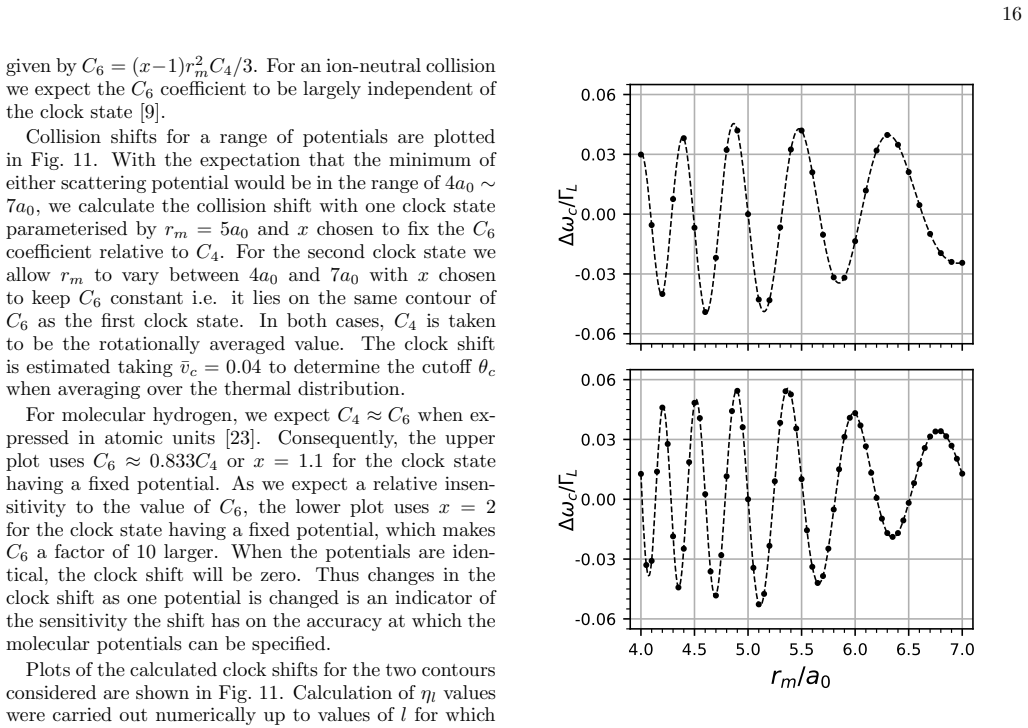
- [Section IV-D, Fig. 11 and surrounding discussion] The universality implied by Eq. (60) is supported only by a narrow family of Lennard-Jones potentials: one clock state fixed at r_m=5 a0, the second varying over r_m ∈ [4,7] a0 on a contour of fixed C_6, with C_6 either ≈0.83 C_4 or ≈8.33 C_4. The statement that 'we would expect the underlying recoil velocity distribution to have the same qualitative features as shown in Sect. III, specifically that the PDF in the neighbourhood of zero is κ≈1' (end of Section IV-D) is a plausibility argument, not a proof. A potential with a strong forward-scattering peak or a different short-range behaviour could concentrate more weight near \bar{v}_c and increase the average. The paper should either broaden the test (e.g., vary the C_4 exponent, add barriers or orientation-dependent terms, or attempt an explicit variational argument) or clearly state that Eq. (60) is an empirical estimate rather than a
- [Section III-A, III-B, and Eq. (29)] The claim that 'the exact values of p_0 and p_1 are inconsequential' (Section III-A) is weakened by the fact that the constant part of Eq. (29), 8 p_1/√π exp(-\bar{v}^2), is precisely the term that makes the PDF nonzero at \bar{v}=0 and leads to κ≈0.855 in Section III-B. The p_0, p_1 are fitted to an approximate interpolation of the differential cross-section, so the derivation is not fully parameter-free. The authors should show that κ remains near unity over the range of plausible (p_0,p_1) values consistent with their fit, or compute the velocity distribution directly from the quantum/WKB scattering amplitudes, to make the κ≈1 result robust.
minor comments (5)
- [Section IV-A, after Eq. (46)] The citation 'Case [?]' is unresolved and should be replaced with the appropriate reference.
- [Section III-C; Section IV-E] Typos: 'power low' should be 'power law' (Section III-C) and 'approachs' should be 'approaches' (Section IV-E).
- [Section II, Eq. (4) and Section V] The value \bar{v}_c≈0.034 is given for one specific geometry (laser at 45° to principal axes, ω_x=ω_y=2π×500 kHz, λ=848 nm). The text says the factor is 'readily calculated', but the angular averaging of Eq. (4) is not displayed. A compact expression or a plot of \bar{v}_c as a function of trap parameters would make the recipe in Eq. (60) directly usable.
- [Section II, Eq. (11a)] The derivation of κ=4 for the hard-sphere velocity distribution of Eq. (16) is not shown. One sentence explaining how κ enters the expansion would help the reader reproduce the numbers.
- [Section II, text after Fig. 2] The sentence 'The value of \bar{v}_c is slightly less than the point at which R≈0.5, which occurs at \bar{v}_c≈0.039' uses the same symbol \bar{v}_c for both the 'effective cutoff' and the 50%-threshold point, which is confusing. Please distinguish these two definitions.
Circularity Check
No circularity found: Eq. (60) is an independently derived bound, not a refit of the quantity it predicts.
full rationale
The central result, Eq. (60), expresses the collision-shift bound as delta f_c/f_c = kappa Gamma_L vbar_c/(2 pi f_c), with kappa ~ 1 and vbar_c ~ 0.034. None of the ingredients is fitted to the collision shift being predicted. Gamma_L is the classical Langevin rate defined through the polarizability, ion charge, and background-gas density (Sec. II.A and Eqs. 24-26), so it is external to the clock-shift calculation. The suppression factor vbar_c is defined from the Ramsey suppression factor R, which is itself computed from the atom-laser coupling in Eq. (4) and the geometry/trap parameters, not from any measurement of clock shifts. The classical Langevin recoil-velocity distribution is derived analytically (Eqs. 28-29), with p0 and p1 fitted only to an intermediate scattering-angle approximation and explicitly not load-bearing. The quantum treatment in Sec. IV provides an independent check, and the Lennard-Jones results in Fig. 11 are a consistency test rather than an input to Eq. (60). The paper's step-function replacement of R(v) by a cutoff at vbar_c is a bound-quality concern, not circularity: it is an algebraic approximation, not an equation whose output is identical to its input. The only self-citations (e.g., [5]) are contextual references to a Lu+ clock comparison and do not support the derivation of Eq. (60). Thus, while the claimed bound may be questioned on rigor grounds, the derivation chain is self-contained and does not reduce to a fit or to a self-citation.
Assumptions & free parameters
free parameters (4)
- p0 =
1/(3π) ≈ 0.106
- p1 =
1/12 ≈ 0.0833
- κ =
≈ 1 (range 0.855–1.12)
- v̄c =
≈ 0.034 for the example geometry
assumptions (5)
- domain assumption A collision can be modeled as an instantaneous velocity kick, and the ion's subsequent motion is a coherent state in a harmonic trap.
- domain assumption At most one collision per interrogation (ΓT ≪ 1) and collisions are independent.
- domain assumption The ion-neutral interaction is dominated by the state-independent C4/r^4 polarization potential; C6, tensor, and quadrupole terms are negligible for the bound.
- domain assumption The randomized-phase approximation and the WKB phase shifts with a hard-sphere boundary accurately represent the quantum scattering for collision energies of interest.
- standard math Standard results from quantum scattering theory (partial-wave expansion, Cauchy-Schwarz bound, Mathieu-function connection formulas, WKB) are accepted.
Cite this review
Pith. "Pith review of Analysis of collision shift assessments in ion-based clocks." pith.science (2026). https://pith.science/paper/H2C3MYVA
@misc{pith2026251205474,
  author       = {Pith},
  title        = {Pith review of: Analysis of collision shift assessments in ion-based clocks},
  year         = {2026},
  howpublished = {\url{https://pith.science/paper/H2C3MYVA}},
  note         = {Machine review of arXiv:2512.05474}
}
read the original abstract
We consider back-ground gas collision shifts in ion-based clocks. We give both a classical and quantum description of a collision between an ion and a polarizable particle with a simple hard-sphere repulsion. Both descriptions give consistent results, which shows that a collision shift bound is determined by the classical Langevin collision rate reduced by a readily calculated factor describing the decoupling of the clock laser from the ion due to the recoil motion. We also show that the result holds when using a more general Lennard-Jones potential to describe the interaction between the ion and its collision partner. This leads to a simple bound for the collision shift applicable to any single ion clock without resorting to large-scale Monte-Carlo simulations or determination of molecular potential energy curves describing the collision. It also provides a relatively straightforward means to measure the relevant collision rate.
Figures


Figures from the paper (7 more)


Reference graph
Works this paper leans on
-
[6]
Systematic uncertainty due to background-gas collisions in trapped-ion optical clocks
Aaron M Hankin, ER Clements, Y Huang, Samuel M Brewer, J-S Chen, CW Chou, DB Hume, and DR Leibrandt. Systematic uncertainty due to background-gas collisions in trapped-ion optical clocks. Physical Review A, 100(3):033419, 2019. 21
2019
-
[7]
Col- lisional frequency shift of a trapped-ion optical clock
Amar C Vutha, Tom Kirchner, and Pierre Dub´ e. Col- lisional frequency shift of a trapped-ion optical clock. Physical Review A, 96(2):022704, 2017
2017
-
[8]
176Lu+ clock comparison at the 10−18 level via correlation spectroscopy.Science Ad- vances, 9(18):eadg1971, 2023
Zhang Zhiqiang, Kyle J Arnold, Rattakorn Kaewuam, and Murray D Barrett. 176Lu+ clock comparison at the 10−18 level via correlation spectroscopy.Science Ad- vances, 9(18):eadg1971, 2023
2023
-
[1]
A liquid-nitrogen-cooled Ca + ion optical clock with a systematic uncertainty of 4.6×10⁻¹⁹
Baolin Zhang, Zixiao Ma, Yao Huang, Huili Han, Ruming Hu, Yuzhuo Wang, Huaqing Zhang, Liyan Tang, Tingyun Shi, Hua Guan, et al. A liquid-nitrogen-cooled Ca + ion optical clock with a systematic uncertainty of 4.6×10⁻¹⁹. arXiv preprint arXiv:2506.17423, 2025
arXiv 2025
-
[2]
This leads to the limiting value of √ 2 cosx K cos2 x 2 = ¯b √ 2K 1+¯b2 2 (23) foru→ ∞i.e. ¯r→0. In Fig. 4, we illustrate the orbits that arise for different impact factors for a fixed energy. Impact parameters for bothb > bc andb < bc were chosen to give deflections of π/2, π,3π/2,and 2πto illustrate the onset of spiralling behaviour. Forb < b c, the orb...
-
[3]
115In+-172Yb+ coulomb crystal clock with 2.5× 10⁻¹⁸ systematic uncertainty.Physical Review Letters, 134(2):023201, 2025
HN Hausser, J Keller, T Nordmann, NM Bhatt, J Kiethe, H Liu, IM Richter, M Von Boehn, J Rahm, S Weyers, et al. 115In+-172Yb+ coulomb crystal clock with 2.5× 10⁻¹⁸ systematic uncertainty.Physical Review Letters, 134(2):023201, 2025
2025
-
[4]
High-stability single-ion clock with 5.5×10 −19 systematic uncertainty
Mason C Marshall, Daniel A Rodriguez Castillo, Willa J Arthur-Dworschack, Alexander Aeppli, Kyung- tae Kim, Dahyeon Lee, William Warfield, Joost Hinrichs, Nicholas V Nardelli, Tara M Fortier, et al. High-stability single-ion clock with 5.5×10 −19 systematic uncertainty. Physical Review Letters, 135(3):033201, 2025
2025
-
[5]
27Al+ quantum-logic clock with a systematic uncertainty below 10 −18.Physi- cal review letters, 123(3):033201, 2019
Samuel M Brewer, J-S Chen, Aaron M Hankin, Ethan R Clements, Chin-wen Chou, David J Wineland, David B Hume, and David R Leibrandt. 27Al+ quantum-logic clock with a systematic uncertainty below 10 −18.Physi- cal review letters, 123(3):033201, 2019
2019
Show all 32 references
-
[9]
Ultracold atom-ion collisions
R Cˆ ot´ e and A Dalgarno. Ultracold atom-ion collisions. Physical Review A, 62(1):012709, 2000
2000
-
[10]
Kinetics of a single trapped ion in an ul- tracold buffer gas.New Journal of Physics, 13(5):053020, 2011
Christoph Zipkes, Lothar Ratschbacher, Carlo Sias, and Michael K¨ ohl. Kinetics of a single trapped ion in an ul- tracold buffer gas.New Journal of Physics, 13(5):053020, 2011
2011
-
[11]
Improved estimate of the collisional frequency shift in Al + optical clocks.Physical Review Research, 1(3):033137, 2019
Jack Davis, Pierre Dub´ e, and Amar C Vutha. Improved estimate of the collisional frequency shift in Al + optical clocks.Physical Review Research, 1(3):033137, 2019
2019
-
[12]
Frequency ratio of Al + and Hg + single-ion optical clocks; metrology at the 17th decimal place.Science, 319(5871):1808–1812, 2008
Till Rosenband, DB Hume, PO Schmidt, Chin-Wen Chou, Anders Brusch, Luca Lorini, WH Oskay, Robert E Drullinger, Tara M Fortier, Jason E Stalnaker, et al. Frequency ratio of Al + and Hg + single-ion optical clocks; metrology at the 17th decimal place.Science, 319(5871):1808–1812, 2008
2008
-
[13]
Cold atom–ion experiments in hybrid traps.Contemporary Physics, 55(1):33–45, 2014
Arne H¨ arter and Johannes Hecker Denschlag. Cold atom–ion experiments in hybrid traps.Contemporary Physics, 55(1):33–45, 2014
2014
-
[14]
Collisional frequency shifts in Sr+ optical clocks.Physical Review A, 112(4):043110, 2025
Iosif Leibin, Inna S Kalinina, Amar C Vutha, and Alexei A Buchachenko. Collisional frequency shifts in Sr+ optical clocks.Physical Review A, 112(4):043110, 2025
2025
-
[15]
Quantum-diffractive background gas col- lisions in atom-trap heating and loss.Physical Review A, 60(1):R29, 1999
S Bali, KM O’Hara, ME Gehm, SR Granade, and JE Thomas. Quantum-diffractive background gas col- lisions in atom-trap heating and loss.Physical Review A, 60(1):R29, 1999
1999
-
[16]
Physics of atoms and molecules
Brian Harold Bransden and Charles Jean Joachain. Physics of atoms and molecules. Pearson Education In- dia, 2003
2003
-
[17]
Scattering of cold-atom coherences by hot atoms: Frequency shifts from background-gas collisions
Kurt Gibble. Scattering of cold-atom coherences by hot atoms: Frequency shifts from background-gas collisions. Physical review letters, 110(18):180802, 2013
2013
-
[18]
Modification of effective-range theory in the pres- ence of a long-range (r −4) potential.Journal of Mathe- matical Physics, 2(4):491–498, 1961
Thomas F O’Malley, Larry Spruch, and Leonard Rosen- berg. Modification of effective-range theory in the pres- ence of a long-range (r −4) potential.Journal of Mathe- matical Physics, 2(4):491–498, 1961
1961
-
[19]
Multichannel quantum-defect the- ory for ultracold atom–ion collisions.New Journal of Physics, 13(8):083005, 2011
Zbigniew Idziaszek, Andrea Simoni, Tommaso Calarco, and Paul S Julienne. Multichannel quantum-defect the- ory for ultracold atom–ion collisions.New Journal of Physics, 13(8):083005, 2011
2011
-
[20]
Since the integrand will asymptote to∼1/r 2 asr→0, it must diverge asu 0 increases
asymptotes to a finite value asu 0 increases, whereas our expression increases askb cu0/2 =kb 2 c/(2R) =L/R. Since the integrand will asymptote to∼1/r 2 asr→0, it must diverge asu 0 increases. In addition our expression agrees with numerical evaluation of the integral. Hence w...
-
[21]
Colli- sion kernels and laser spectroscopy.Physical Review A, 25(5):2550, 1982
PR Berman, TW Mossberg, and SR Hartmann. Colli- sion kernels and laser spectroscopy.Physical Review A, 25(5):2550, 1982
1982
-
[22]
On the characteristic exponents of flo- quet solutions to the mathieu equation.arXiv preprint math-ph/0510076, 2005
Jan Eric Str¨ ang. On the characteristic exponents of flo- quet solutions to the mathieu equation.arXiv preprint math-ph/0510076, 2005
2005 arXiv
-
[23]
The mobilities of ions in unlike gases
Alexander Dalgarno, MR C McDowell, and Alan Williams. The mobilities of ions in unlike gases. Philosophical Transactions of the Royal Society of Lon- don. Series A, Mathematical and Physical Sciences, 250(982):411–425, 1958
1958
-
[24]
Specification of polarizability can be given in atomic units, cgs units (cm 3), or SI units
accounting for convention choices inQ. Specification of polarizability can be given in atomic units, cgs units (cm 3), or SI units. For the readers con- venience, conversion factors from atomic units to cgs or SI area 3 0 or 4πϵ 0a3 0 respectively, wherea 0 is the Bohr radius....
-
[25]
Math- ieusche funktionen und sph¨ aroidfunktionen.Die Grundlehren der Mathematischen Wissenschaften, 1954
Josef Meixner and Friedrich Wilhelm Sch¨ afke. Math- ieusche funktionen und sph¨ aroidfunktionen.Die Grundlehren der Mathematischen Wissenschaften, 1954
1954
-
[26]
Evangelos Miliordos and Katharine LC Hunt. Depen- dence of the multipole moments, static polarizabilities, and static hyperpolarizabilities of the hydrogen molecule on the H–H separation in the ground singlet state.The Journal of Chemical Physics, 149(23), 2018
2018
-
[27]
Valentina Zhelyazkova, Fernanda BV Martins, Matija ˇZeˇ sko, and Fr´ ed´ eric Merkt. Multipole-moment effects in ion–molecule reactions at low temperatures: part ii–charge–quadrupole-interaction-induced suppression of the He++ N2 reaction at collision energies belowk b·10 k. P...
2022
-
[28]
Polarizabilities of hydrogen molecules calculated without using the born-oppenheimer approximation.Physical Re- view A, 103(6):062813, 2021
D Sun, YP Zhang, XJ Wei, LM Wang, and Z-C Yan. Polarizabilities of hydrogen molecules calculated without using the born-oppenheimer approximation.Physical Re- view A, 103(6):062813, 2021
2021
-
[29]
Cryogenic trapped-ion system for large scale quantum simulation
Guido Pagano, PW Hess, HB Kaplan, WL Tan, Phil Richerme, Patrick Becker, Antonis Kyprianidis, Jiehang Zhang, Eric Birckelbaw, MR Hernandez, et al. Cryogenic trapped-ion system for large scale quantum simulation. Quantum Science and Technology, 4(1):014004, 2018
2018
-
[30]
Exact solution of the Schr¨ odinger equation with a Lennard–Jones potential.Journal of Mathemati- cal Chemistry, 51(7):1881–1896, 2013
J Sesma. Exact solution of the Schr¨ odinger equation with a Lennard–Jones potential.Journal of Mathemati- cal Chemistry, 51(7):1881–1896, 2013
2013
-
[31]
Torques on quadrupoles.Revista mexicana de f ´ ısica, 52(6):501– 506, 2006
GF Torres del Castillo and A M´ endez Garrido. Torques on quadrupoles.Revista mexicana de f ´ ısica, 52(6):501– 506, 2006
2006
-
[32]
Polariz- ability of molecular hydrogen and gas metrology.Physical Review A, 111(1):012801, 2025
Zhong-Liang Nie, Jin Wang, Chang-Le Hu, Yu R Sun, Cun-Feng Cheng, Yan Tan, and Shui-Ming Hu. Polariz- ability of molecular hydrogen and gas metrology.Physical Review A, 111(1):012801, 2025
2025
Reviewed August 3, 2026 · model on record in the stance chip above.
Discussion (0). Continue with ORCID to comment.