REVIEW 3 major objections 4 minor 35 references
The selection problem for some first-order stationary mean-field games
T0 review · 3 major / 4 minor · reviewed 2026-08-14 · deepseek-v4-flash
Pith's one-line read The paper proves that, as the discount rate vanishes, the limit of a first-order stationary mean-field game is the regular weak solution minimizing the weighted action functional $\int\langle u\rangle m\,dx$ among all regular weak…
desk verdict The weak-solution selection theorem is a genuine advance and looks right, but the classical existence results are stated more broadly than the proofs support: Proposition 3.4 needs β+1>0, which Assumption 2 does not guarantee. read the letter →
The pith
A machine-rendered reading of the paper's core claim, the machinery that carries it, and where it could break.
The reading
What carries the argument
The central object is a phase-space probability measure attached to each solution, the discounted holonomy measure $$\mu_\epsilon(dx,dv)=m_\epsilon(x)\,dx\otimes\delta_{-Du_\epsilon(x)}(dv).$$ It encodes the transport equation through the discounted holonomy condition $$\int(-\epsilon\phi+v\cdot D\phi)\,d\mu_\epsilon=-\epsilon\int\phi\,dx,$$ and its Lagrangian action equals $\epsilon\int u_\epsilon\,dx$. Passing $\epsilon\to0$ yields a holonomy measure $\mu$ satisfying $\int v\cdot D\phi\,d\mu=0$. Comparing the two measures through the Legendre transform of the quadratic Hamiltonian produces the monotone inequality whose $\epsilon\to0$ limit is (1.12), and hence the selection inequality (1.13). This is the mechanism that converts compactness of the discounted solutions into a variational selection principle.
What would settle it
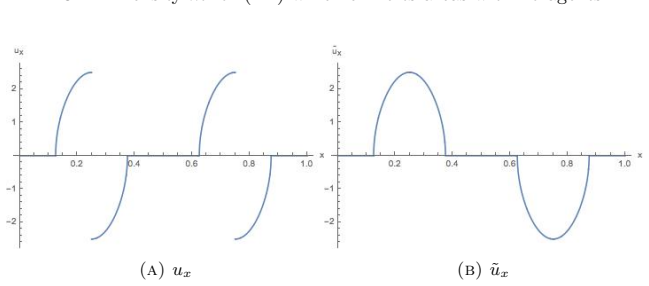
Solve the explicit example $g(m)=m$, $V(x)=\pi\cos(2\pi x)$ numerically for a sequence $\epsilon\to0$ and test whether $u_\epsilon-\int u_\epsilon$ converges weakly in $H^1(\mathbb T)$ to the minimizer $\tilde u$ of $\int\langle u\rangle m\,dx$; convergence to the other regular weak solution $\hat u$ would disprove Theorem 1.9.
Extended reading notes
Core claim
The central discovery is a selection criterion for the vanishing-discount limit of first-order stationary mean-field games. If $(u_\epsilon,m_\epsilon)$ is a regular weak solution of the discounted problem and, after normalization, $u_\epsilon$ converges weakly in $H^1$ to $\bar u$ while $m_\epsilon$ converges weakly in $L^1$ to $\bar m$, then for any regular weak solution $(u,m)$ of the limit problem the difference term $\int(g(m_\epsilon)-g(m))(m_\epsilon-m)\,dx$ tends to zero. Since $g$ is strictly increasing, this forces $\bar m=m$. The same argument yields the variational inequality $\int\langle\bar u\rangle m\,dx\le\int\langle u\rangle m\,dx$ for every regular weak solution of the limit problem, so the vanishing-discount limit is the regular weak solution that minimizes the functional $u\mapsto\int\langle u\rangle m\,dx$. The paper also proves that when a uniform lower bound on the density and polynomial growth of $g$ hold, the discounted problem has a unique classical solution and the limit is classical and unique, with the refined rate $\|u_\epsilon-\bar H/\epsilon-u-\lambda\|_\infty+\|m_\epsilon-m\|_\infty\to 0$.
Load-bearing premise
The selection mechanism relies on the discounted densities $m_\epsilon$ converging strongly in some $L^p$ space (not merely weakly) as $\epsilon\to0$; if only weak convergence is available, the monotonicity argument cannot force the vanishing-discount density to coincide with the density of the limit solution.
Editorial extensions
If this is right
- If the selection inequality holds, the vanishing-discount limit is singled out by a variational principle: among all regular weak solutions of the stationary problem, it minimizes $u\mapsto\int\langle u\rangle m\,dx$.
- In the classical regime, the limit is unique up to constants and smooth, with the refined expansion $u_\epsilon=\bar H/\epsilon+u+\lambda+o(1)$ and $m_\epsilon=m+o(1)$.
- The monotone term $\int(g(m_\epsilon)-g(m))(m_\epsilon-m)\,dx\to0$ forces the limiting density to match the density of any regular weak solution, so $\bar m$ is unique.
- The explicit one-dimensional example shows that non-uniqueness arises where the limiting density vanishes, and the selection criterion identifies the minimizer among the possible solutions.
Reading between the lines
- This selection rule could be used as an a posteriori numerical check: compute any regular weak solution of the limit problem, evaluate $u\mapsto\int\langle u\rangle m\,dx$, and the vanishing-discount limit must be the minimizer.
- The same holonomy-measure comparison may apply to other singular perturbations—small viscosity, finite horizon, or stochastic noise—provided a discounted holonomy condition with a similar limit exists; the paper does not prove those cases.
- If the minimizing solution is not unique, the first-order correction $\lambda$ in the refined expansion would be the natural tie-breaker; the paper leaves that question open.
- The explicit example suggests that non-uniqueness is tied to regions where the limiting density vanishes, so the selection criterion can be interpreted as choosing the solution whose active positive-density region realizes the lowest weighted action.
Signed reviews
Editorial analysis
A structured set of objections, weighed in public.
Referee Report
Summary. The paper studies the vanishing-discount limit of a first-order stationary mean-field game with quadratic Hamiltonian. Under Assumptions 1 and 2 it claims existence and uniqueness of classical solutions of the discounted problem and convergence to a unique classical solution of the ergodic problem (Theorem 1.1, Corollary 1.2), together with refined asymptotics via a linearized problem (Theorem 1.4). Under a different growth range, Assumption 3, it develops a weak-solution framework, constructs discounted and limit Mather measures, and proves a selection criterion (Theorem 1.9): any weak limit of regular weak discounted solutions is the regular weak solution of the limit problem that minimizes the Mather-type functional ∫⟨u⟩m. An explicit one-dimensional example with non-unique weak solutions is used to illustrate the selection rule.
Significance. If the selection theorem is correct, it is a genuinely interesting application of Aubry-Mather ideas to mean-field games and gives a sharp variational selection principle for the vanishing-discount limit. The paper also provides a welcome explicit example of non-uniqueness and a workable notion of regular weak solutions. The classical existence and refined-asymptotics part is also potentially valuable, and the Mather-measure construction in Section 7 is clearly the strongest and most original part of the paper. However, the classical part contains a real gap in the stated parameter range, and one load-bearing uniqueness assertion is not proved; these issues need to be addressed before the paper can be accepted.
major comments (3)
- [§3, Proposition 3.4, inequality (3.8)] The proof of the uniform L∞ bound for m uses the chain ∫m^{p+β}|Dm|² ≤ C∫m^{p+1} ≤ C∫m^{p+β+2}, with the last step justified by p+β+2>p+1. This ordering only holds when β+1>0, whereas Assumption 2 explicitly permits every β∈R. For β≤−1 the exponent ordering is reversed; the lower bound m≥m0 from Proposition 3.2 does not repair the estimate because m^{p+1}/m^{p+β+2}=m^{−β−1} is unbounded above when β<−1. In addition, the Moser iteration is initialized at r0=β+1, which is not a norm controlled by Lemma 3.3 when β+1≤0. Consequently Theorem 1.1 and Corollary 1.2 are not proved in the full stated range of Assumption 2. This does not affect the Section 7 selection argument, which is run under Assumption 3, but it is a genuine gap in the classical part of the paper.
- [§6, Proposition 6.5] The proof of Proposition 6.5 asserts 'Because the solution to (1.5) is unique' and uses that assertion to pass from subsequential convergence of (vϵ,θϵ) to full convergence. No proof or reference for uniqueness of Problem 3 is given. Uniqueness for the linear first-order system (1.5), including uniqueness of the constant λ under the normalization of u, is not evident and is load-bearing for Theorem 1.4; without it the refined asymptotics are only subsequential. The authors should either prove the uniqueness statement or replace it with a direct argument that does not require it.
- [§7, proof of Theorem 1.9, inequality (7.8)] The derivation of (7.8) is summarized as 'proceeding in a similar manner,' but the symmetric argument is not identical to the one leading to (7.7). It requires an estimate on εuε+1/2|D(ηδ*uε)|²+Wε integrated against the arbitrary regular weak solution m, whereas (1.6) is stated only in the sense of distributions. The mollification step introduces ηδ*m in place of m, so an additional argument is needed, for instance using the pointwise identity forced by (1.6)–(1.7) together with uniform integrability, or a different mollification procedure. Since the selection inequality (1.13) rests on (7.8), this step should be spelled out.
minor comments (4)
- [§7, equation (7.5)] The display on the left-hand side of (7.5) reads ∫ v·D(ηδ*u)−Lϵ+W−Wϵ dμϵ, but the left-hand side of (7.4) has −v·D(ηδ*u)−Lϵ+W−Wϵ; the minus sign is missing in the display, even though the subsequent computation appears to use it.
- [Assumption 2] The second condition in Assumption 2 is printed as g(z)≤C2+zg(z); the way this condition is used in Lemma 3.3 and later suggests that the intended inequality is g(z)≤C2+zg'(z) or a similar growth condition. Please correct or clarify the statement.
- [§6, Proposition 6.3] In the integration-by-parts step after equation (6.5) the displayed formula contains the fragment '−hzxi' with an undefined h; it should involve the function ψ_i defined in (6.5).
- [§7.4, Proposition 7.9] The proof states strict inequalities comparing ˜u and u on the two halves of the interval, but the preceding bounds (7.12)–(7.13) appear to justify only ≥/≤, with possible equality on parts of the support of m; the strict inequalities should be relaxed or justified.
Circularity Check
No significant circularity: the selection inequality is derived from Mather-measure comparison, not from its conclusion.
full rationale
The core selection claim (Theorem 1.9) is self-contained: it starts from the defining identities (1.6)-(1.8) for the discounted problem and (1.9)-(1.11) for the limit problem, constructs the phase-space measures μϵ and μ via μϵ = mϵ ⊗ δ_{−Duϵ} in Propositions 7.4 and 7.6, derives the holonomy and action identities (7.2)-(7.3), and then obtains inequalities (7.7) and (7.8) from the Fenchel inequality and Jensen's inequality. Adding them gives (7.9), which yields the monotone-convergence identity (1.12) and the selection inequality (1.13). No parameter is fitted, and no subsequential limit is chosen by fiat; the minimizing property (1.13) is a consequence of the comparison of the two Mather measures, not an assumed input. The cited works [16] and [19] supply, respectively, existence of regular weak solutions for the discounted problem and the Aubry-Mather viewpoint; neither contains the MFG selection statement, and neither is used to replace the derivation of (1.12)-(1.13). The flagged weakness in Proposition 3.4 concerning β ≤ −1 is a possible correctness gap in the classical-solution regularity range, not a circularity, and the weak-solution selection proof in Section 7 is independent of that Moser iteration. Therefore no significant circularity is present.
Assumptions & free parameters
assumptions (8)
- domain assumption V ∈ C1,α(Td), g ∈ C1,α((0,∞)), g strictly increasing
- domain assumption Assumption 1: g^{-1}(g(1) - osc V) > 0
- domain assumption Assumption 2: g'(z) ≥ C1 z^β and g(z) ≤ C2 + z g(z)
- domain assumption Assumption 3: c1 m^{α-1} ≤ g'(m) ≤ c2 m^{α-1} with the stated range on α
- domain assumption Existence and uniform estimates for weak solutions of Problems 1 and 2 from Ferreira-Gomes [16]
- domain assumption Mather measure framework and discounted holonomy condition from Gomes [19]
- ad hoc to paper Uniqueness of solutions to Problem 3, Eq. (1.5)
- ad hoc to paper Implicit condition β+1>0 in Proposition 3.4
Cite this review
Pith. "Pith review of The selection problem for some first-order stationary mean-field games." pith.science (2026). https://pith.science/paper/H2FX2YUF
@misc{pith2026190806485,
  author       = {Pith},
  title        = {Pith review of: The selection problem for some first-order stationary mean-field games},
  year         = {2026},
  howpublished = {\url{https://pith.science/paper/H2FX2YUF}},
  note         = {Machine review of arXiv:1908.06485}
}
read the original abstract
Here, we study the existence and the convergence of solutions for the vanishing discount MFG problem with a quadratic Hamiltonian. We give conditions under which the discounted problem has a unique classical solution and prove convergence of the vanishing-discount limit to a unique solution up to constants. Then, we establish refined asymptotics for the limit. When those conditions do not hold, the limit problem may not have a unique solution and its solutions may not be smooth, as we illustrate in an elementary example. Finally, we investigate the stability of regular weak solutions and address the selection problem. Using ideas from Aubry-Mather theory, we establish a selection criterion for the limit.
Figures

Reference graph
Works this paper leans on
-
[19]
D. Gomes. Generalized Mather problem and selection principles for viscosity solutions and Mather measures. Adv. Calc. Var., 1(3):291–307, 2008
work page 2008
-
[16]
R. Ferreira and D. Gomes. Existence of weak solutions to stationary mean-field games through varia- tional inequalities. SIAM J. Math. Anal. , 50(6):5969–6006, 2018
work page 2018
-
[1]
E. Al-Aidarous, E. Alzahrani, H. Ishii, and A. Younas. A convergence result for the ergodic problem for Hamilton-Jacobi equations with Neumann-type boundary conditions. Proc. Roy. Soc. Edinburgh Sect. A, 146(2):225–242, 2016
work page 2016
-
[2]
F. Camilli, I. Capuzzo-Dolcetta, and D. Gomes. Error estimates for the approximation of the effective Hamiltonian. Appl. Math. Optim. , 57(1):30–57, 2008
work page 2008
-
[3]
P. Cardaliaguet and P. J. Graber. Mean field games systems of first order. ESAIM Control Optim. Calc. Var., 21(3):690–722, 2015
work page 2015
-
[4]
P. Cardaliaguet and A. Porretta. Long time behavior of the master equation in mean field game theory. Anal. PDE, 12(6):1397–1453, 2019
work page 2019
- [5]
-
[6]
Dieudonn´ e.Foundations of modern analysis
J. Dieudonn´ e.Foundations of modern analysis. Academic Press, New York-London, 1969. Enlarged and corrected printing, Pure and Applied Mathematics, Vol. 10-I
work page 1969
Show all 35 references
-
[7]
Evangelista, R
D. Evangelista, R. Ferreira, D. Gomes, L. Nurbekyan, and V. Voskanyan. First-order, stationary mean- field games with congestion. Nonlinear Analysis, 173:37–74, 2018
2018
-
[8]
Evangelista and D
D. Evangelista and D. Gomes. On the existence of solutions for stationary mean-field games with congestion. Journal of Dynamics and Differential Equations , pages 1–24, 2016
2016
-
[9]
L. C. Evans. Some new PDE methods for weak KAM theory. Calculus of Variations and Partial Differential Equations, 17(2):159–177, 2003
2003
-
[10]
L. C. Evans and D. Gomes. Effective Hamiltonians and averaging for Hamiltonian dynamics. I. Arch. Ration. Mech. Anal., 157(1):1–33, 2001
2001
-
[11]
L. C. Evans and D. Gomes. Effective Hamiltonians and averaging for Hamiltonian dynamics II. Archive for rational mechanics and analysis , 161(4):271–305, 2002. SELECTION FOR MFGS 25
2002
-
[12]
A. Fathi. Solutions KAM faibles conjugu´ ees et barri` eres de Peierls.C. R. Acad. Sci. Paris S´ er. I Math., 325(6):649–652, 1997
1997
-
[13]
A. Fathi. Th´ eor` eme KAM faible et th´ eorie de Mather sur les syst` emes lagrangiens.C. R. Acad. Sci. Paris S´ er. I Math., 324(9):1043–1046, 1997
1997
-
[14]
A. Fathi. Orbite h´ et´ eroclines et ensemble de Peierls.C. R. Acad. Sci. Paris S´ er. I Math., 326:1213–1216, 1998
1998
-
[15]
A. Fathi. Sur la convergence du semi-groupe de Lax-Oleinik. C. R. Acad. Sci. Paris S´ er. I Math. , 327:267–270, 1998
1998
-
[17]
Ferreira, D
R. Ferreira, D. Gomes, and T. Tada. Existence of weak solutions to first-order stationary mean-field games with Dirichlet conditions. To appear in Proc. Amer. Math. Society , April 2018
2018
-
[18]
Gilbarg and N
D. Gilbarg and N. S. Trudinger. Elliptic partial differential equations of second order. Classics in Math- ematics. Springer-Verlag, Berlin, 2001. Reprint of the 1998 edition
2001
-
[20]
Gomes and H
D. Gomes and H. Mitake. Existence for stationary mean-field games with congestion and quadratic Hamiltonians. NoDEA Nonlinear Differential Equations Appl. , 22(6):1897–1910, 2015
1910
-
[21]
Gomes, H
D. Gomes, H. Mitake, and H. Tran. The selection problem for discounted Hamilton-Jacobi equations: some non-convex cases. J. Math. Soc. Japan , 70(1):345–364, 2018
2018
-
[22]
Gomes, L
D. Gomes, L. Nurbekyan, and M. Prazeres. Explicit solutions of one-dimensional, first-order, stationary mean-field games with congestion. 2016 IEEE 55th Conference on Decision and Control, CDC 2016 , pages 4534–4539, 2016
2016
-
[23]
Gomes, L
D. Gomes, L. Nurbekyan, and M. Prazeres. One-dimensional stationary mean-field games with local coupling. Dyn. Games and Applications , 2017
2017
-
[24]
Gomes, S
D. Gomes, S. Patrizi, and V. Voskanyan. On the existence of classical solutions for stationary extended mean field games. Nonlinear Anal., 99:49–79, 2014
2014
-
[25]
Gomes and H
D. Gomes and H. S´ anchez Morgado. A stochastic Evans-Aronsson problem. Trans. Amer. Math. Soc., 366(2):903–929, 2014
2014
-
[26]
Ishii, H
H. Ishii, H. Mitake, and H. V. Tran. The vanishing discount problem and viscosity Mather measures. Part 1: The problem on a torus. J. Math. Pures Appl. (9) , 108(2):125–149, 2017
2017
-
[27]
Ishii, H
H. Ishii, H. Mitake, and H. V. Tran. The vanishing discount problem and viscosity Mather measures. Part 2: Boundary value problems. J. Math. Pures Appl. (9) , 108(3):261–305, 2017
2017
-
[28]
Lasry and P.-L
J.-M. Lasry and P.-L. Lions. Jeux ` a champ moyen. I. Le cas stationnaire.C. R. Math. Acad. Sci. Paris , 343(9):619–625, 2006
2006
-
[29]
Lasry and P.-L
J.-M. Lasry and P.-L. Lions. Mean field games. Jpn. J. Math. , 2(1):229–260, 2007
2007
-
[30]
P. L. Lions. Coll` ege de France course on mean-field games. 2007-2011
2007
-
[31]
P. L. Lions, G. Papanicolao, and S. R. S. Varadhan. Homogeneization of Hamilton-Jacobi equations. Preliminary Version, 1988
1988
-
[32]
Ma˜ n´ e
R. Ma˜ n´ e. On the minimizing measures of Lagrangian dynamical systems.Nonlinearity, 5(3):623–638, 1992
1992
-
[33]
J. Mather. Action minimizing invariant measure for positive definite Lagrangian systems. Math. Z , 207:169–207, 1991
1991
-
[34]
Mitake and H
H. Mitake and H. Tran. Selection problems for a discount degenerate viscous Hamilton-Jacobi equation. Adv. Math., 306:684–703, 2017
2017
-
[35]
Pimentel and V
E. Pimentel and V. Voskanyan. Regularity for second-order stationary mean-field games. Indiana Univ. Math. J., 66(1):1–22, 2017. (D. A. Gomes) King Abdullah University of Science and Technology (KAUST), CEMSE Divi- sion, Thuwal 23955-6900. Saudi Arabia, and KAUST SRI, Center fo...
2017
Reviewed August 14, 2026 · model on record in the stance chip above.
Discussion (0). Continue with ORCID to comment.