Energy Gap in Weakly Disordered Fractional Quantum Hall Liquids: Quantitative Comparison to GaAs Quantum Well Experiments at ν= 1/3
Pith reviewed 2026-06-30 02:31 UTC · model grok-4.3
The pith
Incorporating finite layer thickness and experimental disorder reproduces the activation energy gap at ν=1/3 in narrow GaAs quantum wells.
A machine-rendered reading of the paper's core claim, the machinery that carries it, and where it could break.
Core claim
Both the charge gap and the mobility gap at ν=1/3 in the weakly disordered lowest Landau level, computed with finite layer thickness from device-specific wave functions and experimental disorder energy, show good quantitative agreement with the experimentally measured activation gap in narrow quantum wells.
What carries the argument
The charge gap and mobility gap estimated in the weakly disordered lowest Landau level using perpendicular electron wave functions from Poisson-Schrödinger solutions and experimental disorder energy.
If this is right
- Finite layer thickness must be included via device-specific wave functions to obtain accurate theoretical gaps at ν=1/3.
- Weak disorder, when input from experiment, allows direct comparison between theoretical charge/mobility gaps and measured activation gaps.
- The quantitative match holds for narrow quantum wells but indicates that higher subbands become necessary in wide wells.
Where Pith is reading between the lines
- The same inputs could be tested at other fractions such as 2/5 to check if agreement persists across the hierarchy.
- Varying well width while holding disorder fixed might isolate the thickness contribution more cleanly in future measurements.
Load-bearing premise
The disorder energy extracted from the experiment is an independent input that does not itself depend on the activation gap being compared.
What would settle it
If calculations using different thickness models or without the experimental disorder energy fail to match the measured activation gaps in narrow wells, the claimed quantitative agreement would be falsified.
Figures


read the original abstract
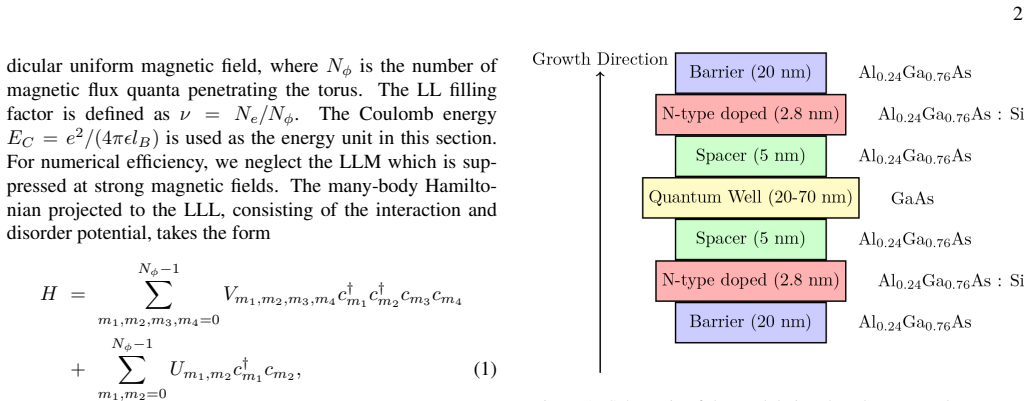
Based on a recent experiment in high-quality GaAs quantum wells [Phys. Rev. Lett. 127, 056801 (2021)], we present a microscopic study of the energy gap in two-dimensional electron gases at filling factor $\nu=1/3$, explicitly incorporating both finite layer thickness and disorder effects. The finite layer thickness is modeled by solving the Poisson-Schr\"odinger equations for the experimental devices, yielding the electron wave functions in the perpendicular direction. Using these and the disorder energy extracted from the experiment, we estimate the charge gap and the mobility gap at $\nu=1/3$ in the weakly disordered lowest Landau level. Remarkably, both gaps show good quantitative agreement with the activation gap measured from the experiment in narrow quantum wells. Our results also indicate the potential need of incorporating higher subbands to make accurate theoretical predictions of the energy gap in wide quantum wells.
Editorial analysis
A structured set of objections, weighed in public.
Referee Report
Summary. The manuscript presents a microscopic calculation of the charge and mobility gaps at filling factor ν=1/3 in GaAs quantum wells, incorporating finite layer thickness via solution of the Poisson-Schrödinger equations for experimental device parameters and disorder energy extracted from the same experiments. It reports that both computed gaps show good quantitative agreement with the measured activation gap in narrow quantum wells, while suggesting that higher subbands may be needed for wide wells.
Significance. If the disorder energy extraction is shown to be independent of the activation gap data, the work offers a valuable quantitative benchmark for microscopic theories of the FQH gap that include realistic disorder and finite-thickness effects. The agreement in narrow wells would strengthen the case for the model's applicability in the weakly disordered regime; the wide-well caveat highlights a concrete direction for refinement.
major comments (2)
- [Abstract / disorder extraction description] Abstract and the paragraph describing the disorder input: the central quantitative agreement claim rests on using 'disorder energy extracted from the experiment' as input while comparing to the 'activation gap measured from the experiment' in the same devices. The manuscript must explicitly detail the extraction procedure (e.g., via which transport observable, temperature range, or fitting method) and demonstrate that this observable is independent of the low-T activated transport data used for the gap comparison; without this, the agreement risks circularity as noted in the stress-test concern.
- [Gap computation section] Section on gap computation (likely the part following the Poisson-Schrödinger solution): the charge and mobility gaps are computed in the 'weakly disordered lowest Landau level' using the extracted disorder energy; the manuscript should clarify how the disorder strength is incorporated into the gap formulas (e.g., via specific broadening or scattering terms) and whether the resulting gaps remain independent of the input disorder value by construction or through additional assumptions.
minor comments (1)
- [Abstract] The abstract mentions 'narrow quantum wells' for the agreement but does not quantify the well widths or cite the specific experimental reference beyond the 2021 PRL; adding a table or explicit comparison of well widths would improve clarity.
Simulated Author's Rebuttal
We thank the referee for the careful reading and constructive comments on our manuscript. We address the two major comments below and will revise the text accordingly to improve clarity on the disorder extraction and its use in the gap calculations.
read point-by-point responses
-
Referee: [Abstract / disorder extraction description] Abstract and the paragraph describing the disorder input: the central quantitative agreement claim rests on using 'disorder energy extracted from the experiment' as input while comparing to the 'activation gap measured from the experiment' in the same devices. The manuscript must explicitly detail the extraction procedure (e.g., via which transport observable, temperature range, or fitting method) and demonstrate that this observable is independent of the low-T activated transport data used for the gap comparison; without this, the agreement risks circularity as noted in the stress-test concern.
Authors: We agree that the extraction procedure requires explicit description to rule out any appearance of circularity. The disorder energy in the manuscript is obtained from the temperature dependence of the longitudinal resistivity at temperatures well above the activation regime (typically 1-10 K) and from zero-field mobility data, both of which are independent of the low-temperature activated transport used to extract the gap. In the revised manuscript we will add a dedicated paragraph (or subsection) detailing the observable, temperature window, and fitting method, together with a brief argument for independence. revision: yes
-
Referee: [Gap computation section] Section on gap computation (likely the part following the Poisson-Schrödinger solution): the charge and mobility gaps are computed in the 'weakly disordered lowest Landau level' using the extracted disorder energy; the manuscript should clarify how the disorder strength is incorporated into the gap formulas (e.g., via specific broadening or scattering terms) and whether the resulting gaps remain independent of the input disorder value by construction or through additional assumptions.
Authors: We will expand the gap-computation section to specify the incorporation of disorder. The extracted disorder energy enters as a Gaussian broadening of the Landau-level density of states (with width set by the experimental disorder strength) that is then used to evaluate both the charge gap (difference between the chemical potentials at adjacent fillings) and the mobility gap (energy required for delocalized states to percolate). These quantities are not independent of the input disorder by construction; they are computed from it together with the finite-thickness wave functions. The revised text will state the broadening ansatz, the percolation criterion, and the underlying assumptions explicitly. revision: yes
Circularity Check
No significant circularity; derivation uses external experimental input independently
full rationale
The paper extracts a disorder energy parameter from the cited experiment and feeds it into a microscopic model (Poisson-Schrödinger wavefunctions plus disorder) to compute charge and mobility gaps at ν=1/3, then compares the computed gaps to the separately measured activation gap in the same devices. This is a standard one-parameter fit from one observable to predict a second observable; the provided text does not exhibit any equation or procedure in which the disorder extraction itself is performed using the activation-gap data, nor any self-citation that bears the central claim. No self-definitional, fitted-input-renamed-as-prediction, or uniqueness-imported steps are present. The result remains falsifiable against the external benchmark.
Axiom & Free-Parameter Ledger
free parameters (1)
- disorder energy
axioms (1)
- domain assumption Poisson-Schrödinger equations accurately capture the perpendicular confinement for the given quantum-well structure.
Reference graph
Works this paper leans on
-
[1]
D. C. Tsui, H. L. Stormer, and A. C. Gossard, Two-dimensional magnetotransport in the extreme quantum limit, Phys. Rev. Lett. 48, 1559 (1982)
1982
-
[2]
Nayak, S
C. Nayak, S. H. Simon, A. Stern, M. Freedman, and S. Das Sarma, Non-abelian anyons and topological quantum computation, Rev. Mod. Phys.80, 1083 (2008)
2008
-
[3]
F. D. M. Haldane and E. H. Rezayi, Finite-size studies of the incompressible state of the fractionally quantized hall effect and its excitations, Phys. Rev. Lett.54, 237 (1985)
1985
-
[4]
S. M. Girvin, A. H. MacDonald, and P. M. Platzman, Collective-excitation gap in the fractional quantum hall effect, Phys. Rev. Lett.54, 581 (1985). 6
1985
-
[5]
G. S. Boebinger, A. M. Chang, H. L. Stormer, and D. C. Tsui, Magnetic field dependence of activation energies in the frac- tional quantum hall effect, Phys. Rev. Lett.55, 1606 (1985)
1985
-
[6]
R. L. Willett, H. L. Stormer, D. C. Tsui, A. C. Gossard, and J. H. English, Quantitative experimental test for the theoretical gap energies in the fractional quantum hall effect, Phys. Rev. B 37, 8476 (1988)
1988
-
[7]
R. R. Du, H. L. Stormer, D. C. Tsui, L. N. Pfeiffer, and K. W. West, Experimental evidence for new particles in the fractional quantum hall effect, Phys. Rev. Lett.70, 2944 (1993)
1993
-
[8]
Melik-Alaverdian and N
V . Melik-Alaverdian and N. E. Bonesteel, Composite fermions and landau-level mixing in the fractional quantum hall effect, Phys. Rev. B52, R17032 (1995)
1995
-
[9]
K. Park, N. Meskini, and J. K. Jain, Activation gaps for the fractional quantum hall effect: realistic treatment of transverse thickness, Journal of Physics: Condensed Matter11, 7283 (1999)
1999
-
[10]
R. H. Morf, N. d’Ambrumenil, and S. Das Sarma, Excitation gaps in fractional quantum hall states: An exact diagonalization study, Phys. Rev. B66, 075408 (2002)
2002
-
[11]
X. Wan, D. N. Sheng, E. H. Rezayi, K. Yang, R. N. Bhatt, and F. D. M. Haldane, Mobility gap in fractional quantum hall liq- uids: Effects of disorder and layer thickness, Phys. Rev. B72, 075325 (2005)
2005
-
[12]
W. Pan, W. Kang, M. P. Lilly, J. L. Reno, K. W. Baldwin, K. W. West, L. N. Pfeiffer, and D. C. Tsui, Particle-hole symmetry and the fractional quantum hall effect in the lowest landau level, Phys. Rev. Lett.124, 156801 (2020)
2020
-
[13]
K. A. Villegas Rosales, P. T. Madathil, Y . J. Chung, L. N. Pfeif- fer, K. W. West, K. W. Baldwin, and M. Shayegan, Fractional quantum hall effect energy gaps: Role of electron layer thick- ness, Phys. Rev. Lett.127, 056801 (2021)
2021
-
[14]
F. C. Zhang and S. Das Sarma, Excitation gap in the fractional quantum hall effect: Finite layer thickness corrections, Phys. Rev. B33, 2903 (1986)
1986
-
[15]
T. Zhao, K. Kudo, W. N. Faugno, A. C. Balram, and J. K. Jain, Revisiting excitation gaps in the fractional quantum hall effect, Phys. Rev. B105, 205147 (2022)
2022
-
[16]
Yoshioka, Effect of the landau level mixing on the ground state of two-dimensional electrons, J
D. Yoshioka, Effect of the landau level mixing on the ground state of two-dimensional electrons, J. Phys. Soc. Jpn.53, 3740 (1984)
1984
-
[17]
Jpn.55, 885 (1986)
D.Yoshioka, J.Phys.Soc. Jpn.55, 885 (1986)
1986
-
[18]
F. F. Fang and W. E. Howard, Negative field-effect mobility on (100) si surfaces, Phys. Rev. Lett.16, 797 (1966)
1966
-
[19]
Mooney, A theory of large elastic deformation, Journal of Applied Physics11, 582 (1940)
M. Mooney, A theory of large elastic deformation, Journal of Applied Physics11, 582 (1940)
1940
-
[20]
von Roos, Position-dependent effective masses in semicon- ductor theory, Phys
O. von Roos, Position-dependent effective masses in semicon- ductor theory, Phys. Rev. B27, 7547 (1983)
1983
-
[21]
Sebawe Abdalla and H
M. Sebawe Abdalla and H. Eleuch, Exact solutions of the position-dependent-effective mass schrödinger equation, AIP Advances6, 055011 (2016)
2016
-
[22]
D. N. Sheng, X. Wan, E. H. Rezayi, K. Yang, R. N. Bhatt, and F. D. M. Haldane, Disorder-driven collapse of the mobility gap and transition to an insulator in the fractional quantum hall ef- fect, Phys. Rev. Lett.90, 256802 (2003)
2003
-
[23]
Yoshioka, Ground state of the two-dimensional charged par- ticles in a strong magnetic field and the fractional quantum hall effect, Phys
D. Yoshioka, Ground state of the two-dimensional charged par- ticles in a strong magnetic field and the fractional quantum hall effect, Phys. Rev. B29, 6833 (1984)
1984
-
[24]
Y . J. Chung, K. A. V . Rosales, K. W. Baldwin, K. W. West, M. Shayegan, and L. N. Pfeiffer, Working principles of doping- well structures for high-mobility two-dimensional electron sys- tems, Phys. Rev. Mater.4, 044003 (2020)
2020
-
[25]
I. Tan, G. L. Snider, L. D. Chang, and E. L. Hu, A self- consistent solution of schrödinger–poisson equations using a nonuniform mesh, Journal of Applied Physics68, 4071 (1990)
1990
-
[26]
L. R. Ram-Mohan, K. H. Yoo, and J. Moussa, The schrödinger–poisson self-consistency in layered quantum semi- conductor structures, Journal of Applied Physics95, 3081 (2004)
2004
-
[27]
D. J. BenDaniel and C. B. Duke, Space-charge effects on elec- tron tunneling, Phys. Rev.152, 683 (1966)
1966
-
[28]
Stern and S
F. Stern and S. Das Sarma, Electron energy levels in gaas- ga1−xalxAsheterojunctions, Phys. Rev. B30, 840 (1984)
1984
-
[29]
M. W. Ortalano, S. He, and S. Das Sarma, Realistic calcu- lations of correlated incompressible electronic states in gaas- alxga1−xas heterostructures and quantum wells, Phys. Rev. B 55, 7702 (1997)
1997
-
[30]
J. K. Jain,Composite Fermions(Cambridge University Press, 2007)
2007
-
[31]
Hebal, Z
H. Hebal, Z. Koziol, S. Lisesivdin, and R. Steed, General- purpose open-source 1d self-consistent schrödinger-poisson solver: Aestimo 1d, Computational Materials Science186, 110015 (2021)
2021
-
[32]
Harrison and A
P. Harrison and A. Valavanis, Negative field-effect mobility on (100) si surfaces, John Wiley & Sons (2016)
2016
-
[33]
Bonsall and A
L. Bonsall and A. A. Maradudin, Some static and dynamical properties of a two-dimensional wigner crystal, Phys. Rev. B 15, 1959 (1977)
1959
-
[34]
N. M. Fujiki and D. J. W. Geldart, Influence of the envelope function on the ground-state energy of quasi-two-dimensional wigner solids, Phys. Rev. B46, 9634 (1992)
1992
-
[35]
Q. Niu, D. J. Thouless, and Y .-S. Wu, Quantized hall conduc- tance as a topological invariant, Phys. Rev. B31, 3372 (1985)
1985
-
[36]
T. Fukui, Y . Hatsugai, and H. Suzuki, Chern numbers in dis- cretized brillouin zone: Efficient method of computing (spin) hall conductances, Journal of the Physical Society of Japan74, 1674 (2005), https://doi.org/10.1143/JPSJ.74.1674
-
[37]
B. I. Halperin, P. A. Lee, and N. Read, Theory of the half-filled landau level, Phys. Rev. B47, 7312 (1993)
1993
-
[38]
P. P. Ewald, Zur begründung der kristalloptik, Ann. Phys.359, 519 (1917). Appendix A. Disorder strength The disorder effect manifests itself in the reduced energy gap compared to that in the absence of disorder. Such a reduction can be understood using the composite fermion (CF) picture, where an electron is converted to a CF via attachment of2pmagnetic f...
1917
discussion (0)
Sign in with ORCID, Apple, or X to comment. Anyone can read and Pith papers without signing in.