REVIEW 2 major objections 5 minor 15 references
The fundamental theorem for singular surfaces with limiting tangent planes
T0 review · 2 major / 5 minor · reviewed 2026-08-14 · deepseek-v4-flash
Pith's one-line read For any proper frontal, compatible first and second fundamental forms are realized by a unique singular surface up to rigid motion.
desk verdict Genuine generalization to proper frontals with a sound strategy, but eq. (75) has a sign/layout error that breaks the proof as written—fixable, but mandatory. read the letter →
The pith
A machine-rendered reading of the paper's core claim, the machinery that carries it, and where it could break.
The reading
What carries the argument
The argument runs on the decomposition $Dx = \Omega\Lambda^T$, where $\Omega$ is a moving base (two linearly independent vector fields spanning the limiting tangent plane) and $\Lambda$ is a $2\times 2$ coefficient matrix. The fundamental forms factor as $I=\Lambda I_\Omega\Lambda^T$ and $II=\Lambda II_\Omega$, which lets the classical Christoffel symbols and Weingarten matrix be extended across the singular set: conditions (22a) and (22b) guarantee that the combinations $\Lambda^{-1}(\Gamma_i\Lambda - \Lambda_{u/v})$ extend smoothly, defining $T_1$ and $T_2$. The proof then reduces the Gauss and Mainardi-Codazzi equations, via a lemma, to integrability conditions for a moving-frame system and solves them with the Frobenius theorem; the compatibility of the system for $x$ itself is exactly the singular compatibility equations (44). Density of the regular set supplies extension of all identities to the singular set.
What would settle it
Take a smooth data set $E,F,G,e,f,g$ with a decomposition as in Theorem 5.1 that satisfies the compatibility conditions on $U$ minus the singular set, then perturb the compatibility conditions slightly on a tiny interval inside the singular set while keeping them on the regular set; if the theorem's conclusions still hold, the density assumption would be violated. More directly, construct a non-proper frontal such as a map that is constant on a small open disk, and check that the construction of $T_1,T_2$ or the limiting relative curvatures breaks down, as the paper's remark indicates.
Extended reading notes
Core claim
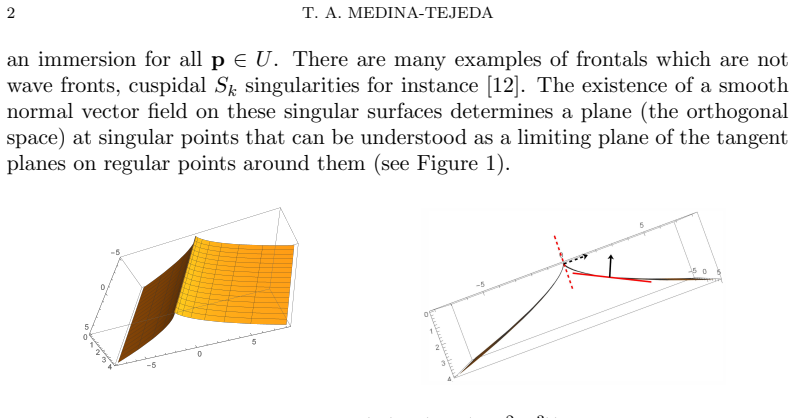
The central claim is Theorem 5.1: given smooth functions $E,F,G,e,f,g$ with $E\geq 0$, $G\geq 0$, $EG-F^2\geq 0$ that admit a decomposition through a moving base $\Omega$ with $I_\Omega$ positive definite and $\lambda_\Omega^{-1}(0)$ having empty interior, and that satisfy the Gauss and Mainardi-Codazzi equations on the regular set, there exists a frontal $x$ with a tangent moving base $\Omega$ such that $Dx=\Omega\Lambda^T$, $I_\Omega$ and $II_\Omega$ match the given data, and $x$ has $E,F,G,e,f,g$ as its first and second fundamental forms. Moreover, the realization is unique up to a translation and a proper orthogonal transformation. The theorem is an extension, not just a formal analog: the singular set may be nonempty, and the proof shows that the wave-front case is detected by the relative curvatures $(K_\Omega,H_\Omega)$ failing to vanish together on the singular set.
Load-bearing premise
The singular set where the coefficient matrix $\Lambda$ has determinant zero must have empty interior, because the proof extends identities from the dense regular set to the whole domain by limits.
Editorial extensions
If this is right
- Any proper frontal in $\mathbb{R}^3$ is determined, up to rigid motion, by its fundamental forms plus the extra structure of a moving-base decomposition, so the invariant content of singular surfaces matches the regular case once the right decomposition is chosen.
- Wave fronts are exactly the frontals whose relative curvature pair $(K_\Omega,H_\Omega)$ does not vanish at singular points, giving a computable criterion from the fundamental data alone.
- The theorem turns the local existence question into an algebraic one: checking the compatibility conditions (39), (38g), and (38h) replaces solving PDEs with arbitrary initial data.
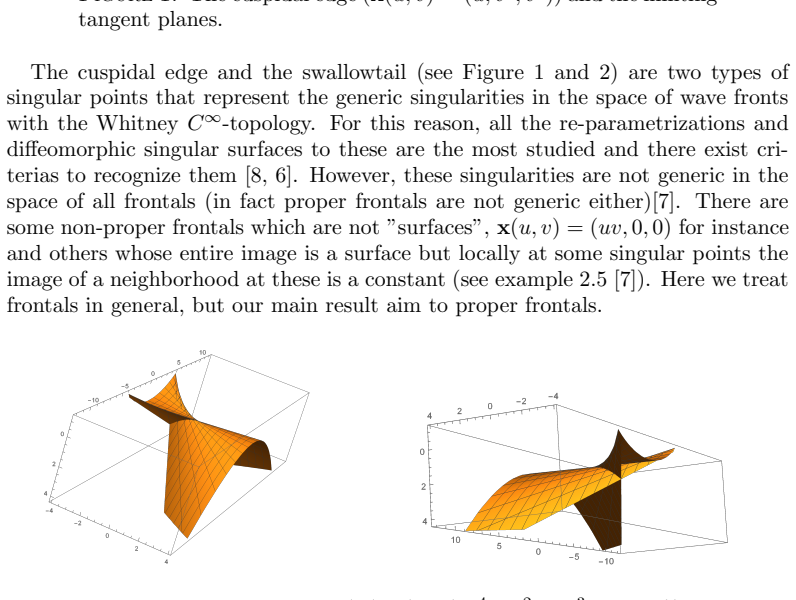
- The relative curvatures $K_\Omega$ and $H_\Omega$ are independent of the choice of compatible moving base up to zero locus and sign, so features like cuspidal edges and swallowtails can be read from the fundamental forms.
- The uniqueness clause extends to the singular setting: two realizations with the same data differ by a translation and a proper orthogonal transformation, even across singularities.
Reading between the lines
- The moving-base decomposition suggests viewing frontals as 'ladder surfaces': the pair $(\Omega,\Lambda)$ functions like a moving frame with a singular part, and the compatibility conditions are exactly the Maurer-Cartan equations for that ladder; this may generalize to higher-dimensional frontals with the same density argument.
- Because the theorem only needs Gauss-Mainardi-Codazzi on the regular set plus the decomposition conditions, it might be possible to relax the 'empty interior' hypothesis to 'nowhere dense' or to allow $\Lambda$ to vanish on regions where the image is a curve, though the density argument would need a replacement.
- The relative curvatures satisfy $K_\Omega = \lambda_\Omega K$ and $H_\Omega = \lambda_\Omega H$ on the regular set; a natural test is to compute them for known examples and verify that they match the paper's characterization of wave fronts.
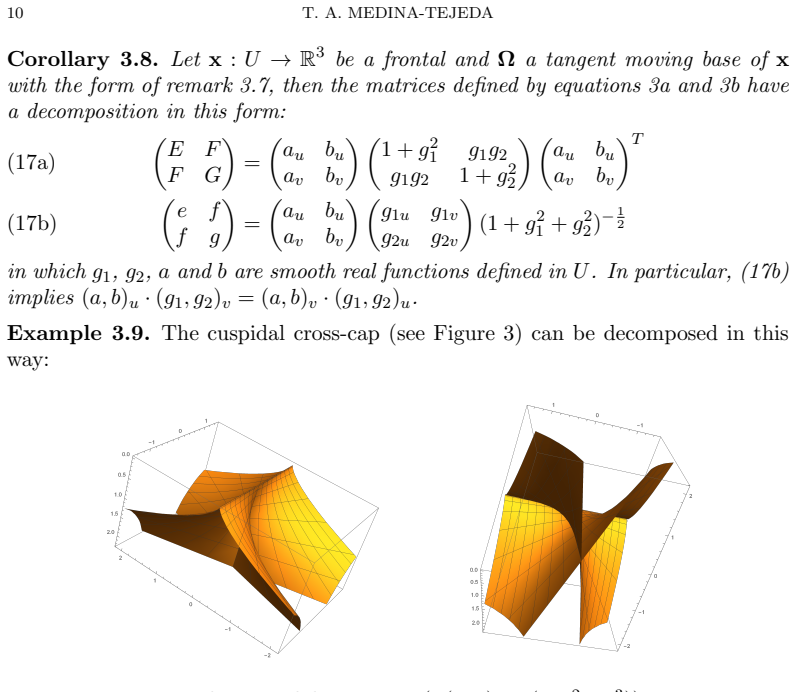
- The decomposition conditions (22a) and (22b) are not implied by the factorization $I=\Lambda I_\Omega\Lambda^T$ alone, as the paper's Whitney cross-cap example shows; understanding which extra conditions the moving base must satisfy could yield a cleaner algebraic characterization.
Signed reviews
Editorial analysis
A structured set of objections, weighed in public.
Referee Report
Summary. The paper extends the classical fundamental theorem of surfaces in Euclidean 3-space to the class of proper frontals, i.e., smooth maps with a unit normal field whose singular set has empty interior. The main result, Theorem 5.1, states that given smooth functions E,F,G,e,f,g with E≥0, G≥0, EG−F^2≥0, admitting a decomposition through a moving base Ω with positive definite IΩ and with det(Λ)^{-1}(0) having empty interior, and satisfying the formal Gauss and Mainardi–Codazzi equations on the regular set, there exists a frontal realizing these data as its first and second fundamental forms, unique up to translation and a proper orthogonal transformation. The paper also introduces relative curvatures KΩ and HΩ that characterize wave fronts, derives singular compatibility equations, and proves the theorem by constructing a frame via Frobenius' theorem and then integrating the surface.
Significance. The claimed result is a substantial contribution to the differential geometry of singular surfaces: it provides a fundamental theorem for the entire class of proper frontals, going substantially beyond the classical regular case and previous restricted results for wave fronts. The method is coherent and mostly self-contained, with a clean use of a moving-base decomposition Dx=ΩΛ^T, density arguments for extending identities across the singular set, and explicit compatibility equations. The paper also gives a useful characterization of wave fronts via relative curvatures, and it honestly acknowledges overlap with the framed-surfaces work of Fukunaga and Takahashi. If the local proof gaps identified below are repaired, the theorem is likely correct and valuable.
major comments (2)
- [Section 5, Eq. (75)] The displayed definition of \barΓ2 is inconsistent with the relation (63b) that the proof uses immediately afterward. Since \barT2 is defined as the matrix Q in (36), the relation \barΓ2\barΛ−\barΛ_v = \barΛ\barT2 forces \barΓ2 e3 = (f,g,0)^T. The displayed matrix in (75) instead has \barΓ2 e3 = (α21,α22,0)^T (in the first equality) or (−f,−g,0)^T (in the second equality), so the proof's assertion that (72a)–(72b) imply (63a)–(63b) is false for the displayed \barΓ2. Consequently the subsequent application of Lemmas 5.2 and 5.3 to transfer the Gauss and Mainardi–Codazzi compatibility from \barΓ1,\barΓ2 to \barT1,\barT2 is not justified as written. The correct \barΓ2 is \barΓ2 = (\barΛ\barT2 + \barΛ_v)\barΛ^{-1} on the regular set, whose third column is (f,g,0)^T and whose third row is (α21,α22,0)^T; with this matrix the identity \barI\barΓ2^T+\barΓ2\barI=\barI_v holds and the proof goes through. This error is local and repairable, but it is load-bearing for the existence part of Theorem 5.1.
- [Section 5, rigidity statement and proof] The rigidity proof chooses ρ∈SO(3) with ρΩ(u0,v0)=¯Ω(u0,v0). If the second tangent moving base ¯Ω induces the opposite orientation of the normal at (u0,v0), no proper orthogonal transformation exists with this property, and the hypotheses of Theorem 5.1 as stated do not explicitly require the moving bases to be compatibly oriented. This issue can arise even for trivial data, for instance a planar frontal with IIΩ=0. The statement should either assume that Ω and ¯Ω are compatible (in the sense of Definition 3.4) or allow ρ to be an orthogonal transformation and adjust the rigidity argument accordingly.
minor comments (5)
- [Theorem 3.22 proof] The proof twice refers to 'proposition 3.22'; the intended reference is Proposition 3.21, which gives the 2×2 minor criterion for a front.
- [Section 5] The proof headings read 'Teorema 5.1'; these should be 'Theorem 5.1'.
- [Theorem 5.1, rigidity paragraph] In the statement, '¯Ω : U→R^3' should be '¯Ω : U→M_{3×2}(R)', since ¯Ω is a moving base with two columns.
- [Remark 3.7] The symbol 'I2' is used for the 2×2 identity matrix but is not defined at that point; this should be clarified.
- [General presentation] The paper contains a number of small typos, such as 'restringing' for 'restricting' and inconsistent notation for the second fundamental-form coefficients (f1Ω and f2Ω appear where the reader might expect a symmetric matrix). A careful editorial pass is recommended.
Circularity Check
No significant circularity: Theorem 5.1 is a constructive existence proof whose output is derived from the stated PDE and decomposition hypotheses, not assumed from them.
full rationale
The paper's central result, Theorem 5.1, is a constructive Frobenius-type argument. Given the decomposition (61a)-(61b) and conditions (62a)-(62b), Proposition 3.14 defines T1 and T2 from the Christoffel symbols; Lemma 5.2 transfers the formal Gauss and Mainardi-Codazzi equations on the dense regular set into the compatibility condition T1v - T2u + [T1,T2] = 0; the frame W is then constructed from system (77), Y = W^T W is identified with the given IOmega via system (79) and Lemma 5.3, and finally x is obtained by integrating Dx = Omega Lambda^T. Each step uses the hypotheses as inputs, and the conclusion is not a renamed fit or a parameter fitted to a subset of the data. The only acknowledged overlap with prior work, Corollary 3.23 versus [4], is proved internally in the text and is not load-bearing for Theorem 5.1. No self-citation chain, imported uniqueness theorem, or ansatz-by-citation supports the main claim. A possible sign inconsistency in equation (75) would be a correctness issue, not a circularity issue.
Assumptions & free parameters
assumptions (4)
- standard math Frobenius theorem (Theorem 2.3) guarantees existence and uniqueness of solutions to first-order PDE systems under compatibility conditions.
- domain assumption The regular set U - λ_Ω^{-1}(0) is dense in U when the singular set has empty interior.
- standard math The Gauss and Mainardi-Codazzi equations are equivalent to the structure equation Γ1_v - Γ2_u + [Γ1,Γ2] = 0 for the extended Christoffel matrices.
- standard math Smooth dependence and uniqueness for linear ODE/PDE systems (standard Picard-Lindelöf/Frobenius theory).
Cite this review
Pith. "Pith review of The fundamental theorem for singular surfaces with limiting tangent planes." pith.science (2026). https://pith.science/paper/H37VHB3G
@misc{pith2026190804821,
  author       = {Pith},
  title        = {Pith review of: The fundamental theorem for singular surfaces with limiting tangent planes},
  year         = {2026},
  howpublished = {\url{https://pith.science/paper/H37VHB3G}},
  note         = {Machine review of arXiv:1908.04821}
}
read the original abstract
In this paper, we prove a similar result to the fundamental theorem of regular surfaces in classical differential geometry, which extends the classical theorem to the entire class of singular surfaces in Euclidean 3-space known as frontals. Also, we characterize in a simple way these singular surfaces and its fundamental forms with local properties in the differential of its parametrization and decompositions in the matrices associated to the fundamental forms. In particular we introduce new types of curvatures which can be used to characterize wave fronts. The only restriction on the parametrizations that is assumed in several occasions is that the singular set has empty interior.
Figures
Figures from the paper (2 more)
Reference graph
Works this paper leans on
-
[1]
V. I. Arnol ′d, Singularities of caustics and wave fronts , volume 62 of Mathematics and its Applications (Soviet Series) . Kluwer Academic Publishers Group, Dordrecht, 1990
work page 1990
-
[2]
M. P. Do Carmo, Differential Geometry of Curves and Surfaces , Prentice Hall, Inc, 1976
work page 1976
-
[3]
S. Fujimori, K. Saji, M. Umehara and K. Yamada, Singularities of maximal surfaces, Math. Z., 259(2008), no. 4, 827–848
work page 2008
-
[4]
T. Fukunaga, M. Takahashi, Framed surfaces in the Euclidean space. Bull. Braz. Math. Soc. (N.S.) 50 (2019), no. 1, 37–65
work page 2019
-
[5]
M. Hasegawa, A. Honda, K. Naokawa, K. Saji, M. Umehara and K. Yamada, Intrinsic prop- erties of surfaces with singularities , Internat. J. Math. 26 (2015), no. 4, 1540008, 34 pp
work page 2015
-
[6]
Recognition Problem of Frontal Singularities
G. Ishikawa, Recognition Problem of Frontal Singularities, arXiv:1808.09594
-
[7]
Ishikawa, Singularities of frontals, Adv
G. Ishikawa, Singularities of frontals, Adv. Stud. Pure Math., 78, 55–106, Math. Soc. Japan, Tokyo, 2018
2018
- [8]
Show all 15 references
-
[9]
Kossowski, Realizing a singular first fundamental form as a nonimmersed surface in Eu- clidean 3-space, J
M. Kossowski, Realizing a singular first fundamental form as a nonimmersed surface in Eu- clidean 3-space, J. Geom. 81 (2004), no. 1-2, 101–113
2004
-
[10]
Martins, K
L.F. Martins, K. Saji, K. Teramoto, Singularities of a surface given by Kenmotsu-type formula in Euclidean three-space, arXiv:1804.01671. THE FUNDAMENTAL THEOREM FOR SINGULAR SURFACES 29
-
[11]
L. F. Martins, K. Saji, M. Umehara and K. Yamada, Behavior of Gaussian curvature and mean curvature near non-degenerate singular points on wave fronts , Geometry and Topology of Manifold, Springer Proc. Math. & Statistics, 2016, 247–282
2016
-
[12]
Saji, Criteria for cuspidal Sk singularities and their applications
K. Saji, Criteria for cuspidal Sk singularities and their applications. J. Gokova Geom. Topol. GGT 4, 67-81 (2010)
2010
-
[13]
K. Saji, M. Umehara, and K. Yamada, The geometry of fronts , Ann. of Math. 169 (2009), 491–529
2009
-
[14]
J. J. Stoker, Differential Geometry, Wiley-Interscience, New York, 1969
1969
-
[15]
C. L. Terng, Lecture notes on Curves and Surfaces Part I , 2005, www.math.uci.edu/ cterng/. Instituto de Ciˆencias Matem´aticas e de Computac ¸˜ao - Universidade de S ˜ao Paulo, Av. Trabalhador s ˜ao-carlense, 400 - Centro, CEP: 13566-590 - S ˜ao Carlos - SP, Brazil E-mail add...
2005
Reviewed August 14, 2026 · model on record in the stance chip above.
Discussion (0). Continue with ORCID to comment.