REVIEW 3 major objections 4 minor 58 references
Exotic Mazur manifolds and knot trace invariants
T0 review · 3 major / 4 minor · reviewed 2026-08-14 · deepseek-v4-flash
Pith's one-line read This paper proves that infinitely many Mazur manifolds—the simplest contractible 4-manifolds after the 4-ball—come in homeomorphic but non-diffeomorphic pairs, and that the knot Floer invariant ν detects them.
desk verdict First exotic Mazur manifolds, with a new ν-based trace invariant; the central argument is sound, and the main weaknesses are heavy reliance on computational checks and an unpublished theorem, both explicitly flagged by the authors. read the letter →
The pith
A machine-rendered reading of the paper's core claim, the machinery that carries it, and where it could break.
The reading
What carries the argument
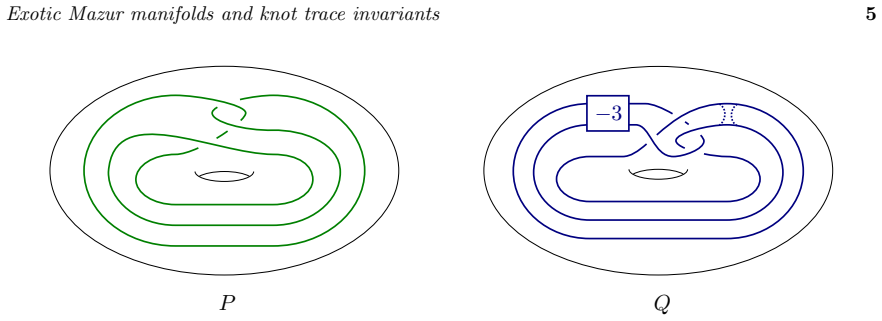
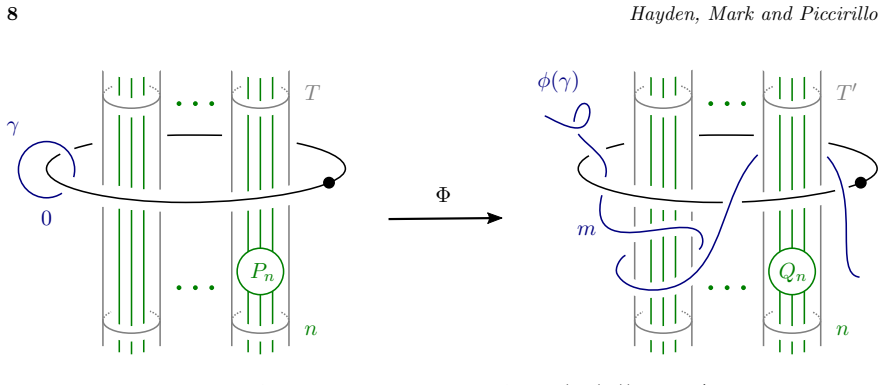
The load-bearing object is the knot trace $X_n(K)=B^4$ with an $n$-framed 2-handle attached along $K$, together with the knot Floer invariant $\nu(K)$. The technical engine is the mapping cone formula for Heegaard Floer homology of integer surgeries: for each spin$^c$ structure $\mathfrak{s}$ on the surgery cobordism, the induced map $F_{\mathfrak{s}}$ is shown to be zero or nonzero according to whether $|\langle c_1(\mathfrak{s}),\sigma\rangle|$ is above or below $2\nu(K)-n$, with the borderline case governed by $\epsilon(K)$. This converts the diffeomorphism type of a trace into the pattern of which cobordism maps are nonzero, and hence into the value of $\nu$. The second piece is the satellite pair $P_n$ and $Q_n$: the patterns are concordant in the solid torus, so $Q_n(K)$ stays concordant to $K$ while $P_n(K)$ raises $\nu$, and the two handle attachments are homeomorphic through a cork twist. The bridge from Mazur manifolds to traces is Theorem 2.7, which uses the JSJ decomposition and a hyperbolicity/volume check to show that any diffeomorphism of the Mazur pair induces a diffeomorphism of the associated traces.
What would settle it
Run the paper's computer pipeline on the exterior of $K_m$ in $S^3_0(C)$ for each $m$ and inspect the JSJ torus decomposition: if some $m$ yields the solid torus or a component homeomorphic to $V_0(P)$, the bridge from Mazur diffeomorphisms to trace diffeomorphisms breaks for that $m$. Alternatively, find knots $K$ and $K'$ with diffeomorphic $n$-traces for some $n<0$ and $\{\nu(K),\nu(K')\}=\{0,1\}$; that would realize the one exceptional case allowed by Theorem 1.4 and show $\nu$ is not a trace invariant for all framings.
Extended reading notes
Core claim
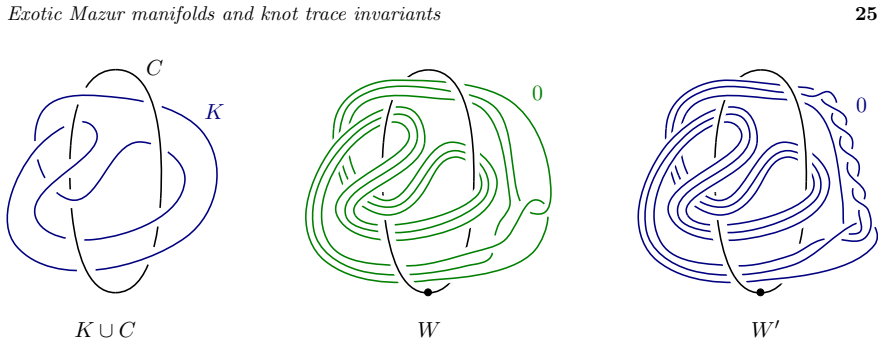
The central claim is that homeomorphism does not determine diffeomorphism type among Mazur manifolds, and that the difference is visible to knot Floer homology. For each link in an infinite family $L_m=K_m\cup C$, the paper constructs two Mazur manifolds $W_{L_m,n}$ and $W'_{L_m,n}$ by attaching an n-framed 2-handle along the satellite knots $P_n(K_m)$ and $Q_n(K_m)$; the two are homeomorphic because the two attachment patterns differ by a cork twist, which preserves homeomorphism type. The diffeomorphism obstruction is Theorem 1.4: if the oriented knot traces $X_n(K)$ and $X_n(K')$ are diffeomorphic, then $\nu(K)=\nu(K')$, except possibly when $n<0$ and $\{\nu(K),\nu(K')\}=\{0,1\}$. Since $\nu(P_n(K_m))=\nu(K_m)+1$ while $\nu(Q_n(K_m))=\nu(K_m)$, the traces are not diffeomorphic whenever $\nu(K_m)=\tau(K_m)>0$, and Theorem 2.7 converts this into non-diffeomorphism of the Mazur manifolds. The passage from Mazur diffeomorphisms to trace diffeomorphisms uses 3-manifold topology—JSJ decompositions and hyperbolicity—to guarantee that a boundary diffeomorphism preserves the decomposition into the exterior of $K$ and the surgery solid torus.
Load-bearing premise
For the construction to work, infinitely many of the links $L_m$ must have the property that the exterior of $K_m$ in the zero-surgery on $C$ is neither a solid torus nor composed of the specific solid-torus piece coming from the Mazur pattern; the paper establishes this by computer hyperbolicity checks and volume estimates, not by a proof that covers all $m$.
Editorial extensions
If this is right
- Infinitely many Mazur manifolds come in exotic pairs; earlier examples of exotic contractible 4-manifolds required more complicated handle structures.
- The invariant $\nu$ is a smooth invariant of oriented knot traces for $n\ge 0$, and for $n<0$ except possibly when $\{\nu(K),\nu(K')\}=\{0,1\}$, giving a computable way to distinguish homeomorphic traces.
- There are infinitely many irreducible integer homology spheres, each containing two distinct knots whose zero-surgeries are $S^1\times S^2$, resolving the $S^1\times S^2$ analogue of the Property R question.
- The concordance invariants $\tau$ and $\epsilon$ are not zero-trace invariants, assuming the forthcoming identification of the bordered invariants with the usual ones.
- For framings in the range $n=0$ or $2-2\nu(K)<n\le 2\nu(K)-2$, $\nu$ bounds the $n$-shake genus from below, giving an adjunction-type inequality that extends the known shake-slice bound for Legendrian knots.
Reading between the lines
- Because $\nu$ is computable in practice, the same trace-invariance criterion should be usable to search for exotic pairs among other satellite patterns and framings, not just the $P_n/Q_n$ family.
- If the exceptional case $n<0$ with $\{\nu(K),\nu(K')\}=\{0,1\}$ is ever realized, it would produce the first counterexamples to full trace invariance of $\nu$; no such examples are currently known.
- The strategy of detecting exotic 4-manifolds by first passing to knot traces and then to a concordance invariant suggests that other mapping-cone-defined concordance invariants may also be trace invariants, yielding further computable obstructions.
- The only non-theorem step in producing the infinite family is the computer-assisted hyperbolicity and volume verification; a closed-form proof for all $m$ would remove the computational dependence.
Signed reviews
Editorial analysis
A structured set of objections, weighed in public.
Referee Report
Summary. The paper constructs pairs of Mazur manifolds, proves they are homeomorphic but not diffeomorphic (Theorem 1.1), and introduces a new smooth invariant of knot traces derived from the Heegaard Floer concordance invariant ν (Theorem 1.4). It also shows, conditional on forthcoming work of Ozsváth and Szabó [40], that τ and ε are not zero-trace invariants (Theorem 1.5), and derives shake genus bounds from ν (Theorem 1.6). The main technical engine is a careful mapping-cone argument in §4 that establishes trace invariance of ν, combined with a handle-theoretic bridge (Theorem 2.7) that converts Mazur diffeomorphisms into trace diffeomorphisms for links with certain JSJ hypotheses.
Significance. If Theorem 1.1 holds, it provides the first examples of exotic smooth structures on Mazur manifolds, a central question in 4-manifold topology, and it yields the first counterexamples to the uniqueness conjecture for S^1×S^2 surgeries on integer homology spheres (Corollary 1.3). The trace invariance of ν is a genuinely new and computable tool for studying knot traces, and the paper offers reproducible computational data in the repository [18]. The mapping-cone proof of Theorem 1.4 is a serious, self-contained derivation from established Heegaard Floer theory, and the paper is careful to flag the dependence of Theorem 1.5 on the unpublished [40]. These are significant strengths. However, the proof of the infinite family in Theorem 1.1 relies on a volume-monotonicity claim that is not fully certified, which prevents the main theorem from being accepted at face value.
major comments (3)
- [§2.3, Proof of Theorem 1.1] The verification that the infinite family L_m satisfies the hypotheses preceding Theorem 2.7 depends on the assertion that -1/(m-1)-surgery on α produces a hyperbolic manifold whose volume increases monotonically with m for m>N, citing Thurston's hyperbolic Dehn surgery theorem and [38, Theorem 1A]. No explicit N is given, and the monotonicity is not checked against the specific cusp basis used in the SnapPy/Sage computations. If the monotonicity fails for some large m, the conclusion that S^3_0(C)\K_m is not diffeomorphic to V0(P) is not established, and the JSJ uniqueness step in Theorem 2.7 would not apply. The authors should supply a rigorous proof of the monotonicity claim or provide an explicit N together with certified computations for all m>N.
- [§4.3, Theorem 1.5] Theorem 1.5, stating that τ and ε are not zero-trace invariants, depends crucially on the unpublished equivalence in [40] between the bordered invariants τ, ε, ν and their standard counterparts. Although the abstract and the proof mention this dependence, the theorem is stated unconditionally in §4.3. The authors should either state the theorem as conditional on [40], or, if the result is considered established, provide a verifiable reference. This is a load-bearing issue for Theorem 1.5, though not for Theorem 1.1.
- [§2.3, Corollary 2.9] The formula ν(P(K)) = ν(K)+1 if ν(K)=τ(K)>0 and ν(P(K))=ν(K) otherwise is stated with the proof left to the reader. This result is used directly in the proof of Theorem 2.11, which is a key step in establishing Theorem 1.1. Since the central theorem depends on this calculation, a complete proof or a detailed derivation from Theorem 2.8 and the properties of ν should be included.
minor comments (4)
- [References] Reference [13] is misattributed: the citation 'A Donald, Embedding Seifert manifolds in S4' is not the source of Donaldson's theorem on intersection forms used in §4.2. The correct reference is S.K. Donaldson, 'An application of gauge theory to four-dimensional topology', J. Differential Geom. 18 (1983) 279-315.
- [§4.1, Proposition 4.2 proof] In the proof of Proposition 4.2, the phrase 'unless s = ν(K) = 0' should read 'unless s = ε(K) = 0' to match Lemma 4.1; the intended meaning is clear because ε(K)=0 implies ν(K)=0, but the notation is inconsistent as written.
- [§2.1, SnapPy/Sage computations] The paper reports hyperbolicity and volume computations from SnapPy and Sage only as approximate values (vol ≈ 9, vol ≈ 11) and refers to the external repository [18] for documentation. Including the exact link diagrams and the specific commands or scripts in the text would improve reproducibility and allow the reader to verify the JSJ hypotheses without accessing the repository.
- [§2.2, Figure 3] The handle calculus in Figure 3 is used repeatedly in the proof of Proposition 2.2, but the individual moves are not annotated. Adding step-by-step explanations or labels for each move would make the argument significantly easier to follow.
Circularity Check
No circularity found: the derivation of exotic Mazur manifolds relies on independent Floer-theoretic invariants, standard 3-manifold theorems, and external computational checks.
full rationale
The main claim (Theorem 1.1) is derived as follows: Proposition 2.2 gives homeomorphic Mazur manifolds via handle calculus and cork twisting; Theorem 2.7 converts a Mazur diffeomorphism into a knot-trace diffeomorphism under JSJ hypotheses, which are verified for the infinite family by SnapPy/Sage hyperbolic volume computations and Thurston's hyperbolic Dehn surgery theorem together with Neumann–Zagier; and Theorem 1.4, proved directly from the Ozsváth–Szabó mapping cone formula, shows that the invariant ν distinguishes the associated traces. Nothing here is defined in terms of the target conclusion: ν is a pre-existing knot Floer concordance invariant, not fitted to the examples, and its values are computed from concordance invariance, Levine's satellite formula, and an independently proved twist inequality. The author-overlap citations ([35], [37], [47]) support auxiliary technical lemmas—for example, a Heegaard Floer naturality statement and dualizable-pattern facts—whose assumptions do not include knot-trace invariance or the existence of exotic Mazur manifolds, so they are not load-bearing in a circular way. The computational data in [18] are documentation, and the unpublished [40] is used only for the secondary Theorem 1.5 and is explicitly flagged as forthcoming. I can exhibit no reduction of any prediction to its own input by construction, so the honest finding is no significant circularity.
Assumptions & free parameters
assumptions (9)
- domain assumption Freedman's theorem: cutting out and regluing a Mazur cork preserves homeomorphism type.
- domain assumption Ozsváth-Szabó mapping cone formula for integer surgery and the identification of cone inclusions B_s with surgery cobordism maps.
- domain assumption Ozsváth-Szabó adjunction inequality: 2τ(K)+|[Σ]|+[Σ]·[Σ]≤2g for surfaces in a smooth 4-manifold with b_2^+=0.
- domain assumption Donaldson's theorem: the intersection form of a smooth definite 4-manifold is diagonalizable.
- domain assumption Thurston's hyperbolic Dehn surgery theorem, Neumann-Zagier volume formulas, and the JSJ decomposition theorem.
- domain assumption Laudenbach-Poénaru: every self-diffeomorphism of S^1×S^2 extends over S^1×B^3.
- domain assumption Gluck's theorem: up to isotopy, every self-homeomorphism of S^1×S^2 preserves S^1×{pt}.
- ad hoc to paper Forthcoming equivalence of Ozsváth and Szabó [40] identifying the bordered invariants with the standard τ, ε, and ν.
- domain assumption SnapPy/Sage computations: V0(P)≅V0(Q) is hyperbolic; S^3_0(C)\K1 is hyperbolic with volume ≈9; Y\α is hyperbolic with no nontrivial self-diffeomorphisms.
Cite this review
Pith. "Pith review of Exotic Mazur manifolds and knot trace invariants." pith.science (2026). https://pith.science/paper/H3D2AAVG
@misc{pith2026190805269,
  author       = {Pith},
  title        = {Pith review of: Exotic Mazur manifolds and knot trace invariants},
  year         = {2026},
  howpublished = {\url{https://pith.science/paper/H3D2AAVG}},
  note         = {Machine review of arXiv:1908.05269}
}
abstract
From a handlebody-theoretic perspective, the simplest compact, contractible 4-manifolds, other than the 4-ball, are Mazur manifolds. We produce the first pairs of Mazur manifolds that are homeomorphic but not diffeomorphic. Our diffeomorphism obstruction comes from our proof that the knot Floer homology concordance invariant $\nu$ is an invariant of the smooth 4-manifold associated to a knot in the 3-sphere by attaching an n-framed 2-handle to the 4-ball along the knot. In contrast, we also show (modulo forthcoming work of Ozsv\'ath and Szab\'o) that the concordance invariants $\tau$ and $\epsilon$ are not invariants of such 4-manifolds. As a corollary to the existence of exotic Mazur manifolds, we produce integer homology 3-spheres admitting two distinct $S^1 \times S^2$ surgeries, resolving a question from Problem 1.16 in Kirby's list.
Figures


Figures from the paper (5 more)



Reference graph
Works this paper leans on
-
[40]
P S Ozsv´ ath, Z Szab´ o, Algebras with matchings and knot Floer homology , In preparation
-
[18]
K Hayden , T E Mark, L Piccirillo , Data and code to accompany this paper, https: //doi.org/10.7910/DVN/XFY7DL
-
[1]
Conference on 4-manifolds and knot concordance, Max Planck Institute for Mathematics
Problem list , from “Conference on 4-manifolds and knot concordance, Max Planck Institute for Mathematics”, Available at http://people.brandeis.edu/~aruray/ 4manifoldsconference/problem_session.pdf (October 2016)
work page 2016
-
[2]
Mathematical Pro- ceedings of the Cambridge Philosophical Society
S Akbulut , On 2-dimensional homology classes of 4-manifolds , from “Mathematical Pro- ceedings of the Cambridge Philosophical Society”, volume 82, Cambridge University Press (1977) 99–106
work page 1977
-
[3]
S Akbulut, An exotic 4-manifold, J. Differential Geom. 33 (1991) 357–361
work page 1991
-
[4]
S Akbulut, A fake compact contractible 4-manifold, J. Differential Geom. 33 (1991) 335–356
work page 1991
-
[5]
S Akbulut, R Matveyev, Exotic structures and adjunction inequality , Turkish J. Math. 21 (1997) 47–53
work page 1997
-
[6]
S Akbulut, D Ruberman, Absolutely exotic compact 4-manifolds , Comment. Math. Helv. 91 (2016) 1–19
work page 2016
Show all 58 references
-
[7]
S Akbulut, E Z Yildiz, Knot concordances inS1×S2 and exotic smooth 4-manifolds, arXiv preprint arXiv:1901.00806 (January 2019)
1901 arXiv
-
[8]
K L Baker, D Buck , A G Lecuona, Some knots in S1×S2 with lens space surgeries , Communications in Analysis and Geometry 24 (2016) 431–470
2016
-
[9]
D Celoria , M Golla , Heegaard Floer homology and concordance bounds on the Thurston norm, arXiv preprint arXiv:1806.10562 (2018)
2018 arXiv
-
[10]
T D Cochran, A Ray, Shake slice and shake concordant knots, Journal of Topology 9 (2016) 861–888
2016
-
[11]
J Conway , B Tosun , Mazur-type manifolds with L-space boundaries , arXiv preprint arXiv:1807.08880 (2018)
2018 arXiv
-
[12]
M Culler , N M Dunfield, M Goerner , J R Weeks, SnapPy, a computer program for studying the geometry and topology of 3-manifolds, Available at http://snappy.computop. org
-
[13]
A Donald, Embedding Seifert manifolds in S4, Trans. Amer. Math. Soc. 367 (2015) 559–595
2015
-
[14]
N M Dunfield, N R Hoffman, J E Licata, Asymmetric hyperbolic L-spaces, Heegaard genus, and Dehn filling , Math. Res. Lett. 22 (2015) 1679–1698 Exotic Mazur manifolds and knot trace invariants 29
2015
-
[15]
Differential Geom
M H Freedman, The topology of four-dimensional manifolds , J. Differential Geom. 17 (1982) 357–453
1982
-
[16]
Differential Geom
D Gabai, Foliations and the topology of 3-manifolds, J. Differential Geom. 18 (1983) 445–503
1983
-
[17]
H Gluck, The embedding of two-spheres in the four-sphere , Bull. Amer. Math. Soc. 67 (11
-
[19]
M Hedden, A S Levine, Splicing knot complements and bordered Floer homology , Journal f¨ ur die reine und angewandte Mathematik (Crelles Journal) 2016 (2016) 129–154
2016
-
[20]
M Hedden, K Raoux, In preparation
-
[21]
J Hom, Bordered Heegaard Floer homology and the tau-invariant of cable knots , J. Topol. 7 (2014) 287–326
2014
-
[22]
Knot Theory Ramifications 26 (2017) 1740015, 24
J Hom, A survey on Heegaard Floer homology and concordance, J. Knot Theory Ramifications 26 (2017) 1740015, 24
2017
-
[23]
Symplectic Geom
J Hom, Z Wu, Four-ball genus bounds and a refinement of the Ozv´ ath-Szab´ o tau invariant, J. Symplectic Geom. 14 (2016) 305–323
2016
-
[24]
Algebraic and geometric topology (Proc. Sympos. Pure Math., Stanford Univ., Stanford, Calif., 1976), Part 2
W Jaco , P B Shalen, A new decomposition theorem for irreducible sufficiently-large 3- manifolds, from “Algebraic and geometric topology (Proc. Sympos. Pure Math., Stanford Univ., Stanford, Calif., 1976), Part 2”, Proc. Sympos. Pure Math., XXXII, Amer. Math. Soc., Providence, R....
1978
-
[25]
K Johannson, Homotopy equivalences of 3-manifolds with boundaries, volume 761 of Lecture Notes in Mathematics , Springer, Berlin (1979)
1979
-
[26]
B Kalm´ ar, A I Stipsicz, Singular maps on exotic 4-manifold pairs , Algebr. Geom. Topol. 13 (2013) 1709–1731
2013
-
[27]
M H Kim, J Park, Homology spheres and property R, arXiv preprint arxiv:1906.11234 (June 2019)
1906 arXiv
-
[28]
Geometric topology (Athens, GA, 1993)
R Kirby , Problems in low-dimensional topology , from “Geometric topology (Athens, GA, 1993)” (W H Kazez, editor), AMS/IP Stud. Adv. Math. 2, Amer. Math. Soc., Providence, RI (1997) 35–473
1997
-
[29]
R Kirby, P Melvin, Slice knots and property R, Invent. Math. 45 (1978) 57–59
1978
-
[30]
F Laudenbach, V Po´ enaru, A note on 4-dimensional handlebodies, Bull. Soc. Math. France 100 (1972) 337–344
1972
-
[31]
Sigma 4 (2016) e34, 47
A S Levine, Nonsurjective satellite operators and piecewise-linear concordance, Forum Math. Sigma 4 (2016) e34, 47
2016
-
[32]
Topology of low-dimensional manifolds (Proc. Second Sussex Conf., Chelwood Gate, 1977)
W B R Lickorish, Shake-slice knots , from “Topology of low-dimensional manifolds (Proc. Second Sussex Conf., Chelwood Gate, 1977)”, Lecture Notes in Math. 722, Springer, Berlin (1979) 67–70
1979
-
[33]
88 (1998) 55–66
P Lisca, G Mati´ c, Stein 4-manifolds with boundary and contact structures , Topology Appl. 88 (1998) 55–66
1998
-
[34]
Topology of low-dimensional man- ifolds
R A Litherland, Signatures of iterated torus knots, from “Topology of low-dimensional man- ifolds”, Springer (1979) 71–84
1979
-
[35]
Differential Geom
T E Mark, B Tosun, Naturality of Heegaard Floer invariants under positive rational contact surgery, J. Differential Geom. 110 (2018) 281–344 30 Hayden, Mark and Piccirillo
2018
-
[36]
B Mazur, A note on some contractible 4-manifolds, Ann. of Math. (2) 73 (1961) 221–228
1961
-
[37]
A N Miller, L Piccirillo, Knot traces and concordance, J. Topol. 11 (2018) 201–220
2018
-
[38]
W D Neumann, D Zagier, Volumes of hyperbolic three-manifolds, Topology 24 (1985) 307– 332
1985
-
[39]
Y Ni, F Vafaee, Null surgery on knots in L-spaces , To appear in Trans. Amer. Math. Soc. (2016)
2016
-
[41]
P Ozsv´ ath, Z Szab´ o, Knot Floer homology and the four-ball genus , Geom. Topol. 7 (2003) 615–639
2003
-
[42]
P Ozsv´ ath, Z Szab´ o, Holomorphic disks and knot invariants , Adv. Math. 186 (2004) 58–116
2004
-
[43]
P S Ozsv´ ath, Z Szab´ o, Knot Floer homology and integer surgeries , Algebr. Geom. Topol. 8 (2008) 101–153
2008
-
[44]
P S Ozsv´ ath, Z Szab´ o, Knot Floer homology and rational surgeries , Algebr. Geom. Topol. 11 (2011) 1–68
2011
-
[45]
P S Ozsv´ ath, Z Szab´ o, Bordered knot algebras with matchings , arXiv preprint arXiv:1707.00597 (July 2017)
2017 arXiv
-
[46]
L Piccirillo, The Conway knot is not slice , arXiv preprint arXiv:1808.02923 (August 2018)
2018 arXiv
-
[47]
L Piccirillo, Shake genus and slice genus , To appear in Geom. Topol. (March 2018)
2018
-
[48]
O Plamenevskaya, Bounds for the Thurston-Bennequin number from Floer homology , Al- gebr. Geom. Topol. 4 (2004) 399–406
2004
-
[49]
K Raoux , τ -invariants for knots in rational homology spheres , arXiv preprint arXiv:1611.09415 (2016)
2016 arXiv
-
[50]
J A Rasmussen, Floer homology and knot complements , PhD thesis, Harvard University, arXiv preprint math/0306378 (2003)
2003 arXiv
-
[51]
D Sch¨ utz, SKnotJob, Available at http://www.maths.dur.ac.uk/~dma0ds/knotjob.html (2018)
2018
-
[52]
Y Shinohara, On the signature of knots and links , Transactions of the American Mathemat- ical Society 156 (1971) 273–285
1971
-
[53]
F Swenton , Kirby calculator , Available at https://community.middlebury.edu/ ~mathanimations/klo/ (2019)
2019
-
[54]
Z Szab´ o, Knot Floer homology calculator, Available at https://web.math.princeton.edu/ ~szabo/HFKcalc.html (2019)
2019
-
[55]
The Sage Developers , SageMath, the Sage mathematics software system , Available at https://www.sagemath.org (2019)
2019
-
[56]
org/publications/books/gt3m/ (1978)
W P Thurston, The geometry and topology of three-manifolds , Available at http://msri. org/publications/books/gt3m/ (1978)
1978
-
[57]
Mathematical Proceedings of the Cambridge Philosophical Society
A G Tristram, Some cobordism invariants for links , from “Mathematical Proceedings of the Cambridge Philosophical Society”, volume 66, Cambridge University Press (1969) 251–264
1969
-
[58]
K Yasui, Corks, exotic 4-manifolds and knot concordance , arXiv preprint arXiv:1505.02551 (May 2015) Columbia University, New York, NY 10027 University of Virginia, Charlottesville, VA 22904 Brandeis University, Waltham, MA 02453 hayden@math.columbia.edu, tmark@virginia.edu, l...
2015 arXiv
Reviewed August 14, 2026 · model on record in the stance chip above.
Discussion (0). Continue with ORCID to comment.