REVIEW 3 major objections 4 minor 50 references
Examples of complete Calabi--Yau metrics on affine smoothings of irregular toric Calabi--Yau cones
T0 review · 3 major / 4 minor · reviewed 2026-08-07 · deepseek-v4-flash
Pith's one-line read Every toric Calabi–Yau cone in the $P_{r,s}$ family admits an $r$-parameter affine smoothing carrying asymptotically conical Calabi–Yau metrics, and for $r=1$ the tangent cone is irregular; adding suitable lattice segments to $Y^{p,q}$…
desk verdict Solid new smoothing examples and a useful Minkowski-decomposition pipeline, but the proof that the r=1 Cho-Futaki-Ono cones are irregular has a load-bearing sign error. read the letter →
The pith
A machine-rendered reading of the paper's core claim, the machinery that carries it, and where it could break.
The reading
What carries the argument
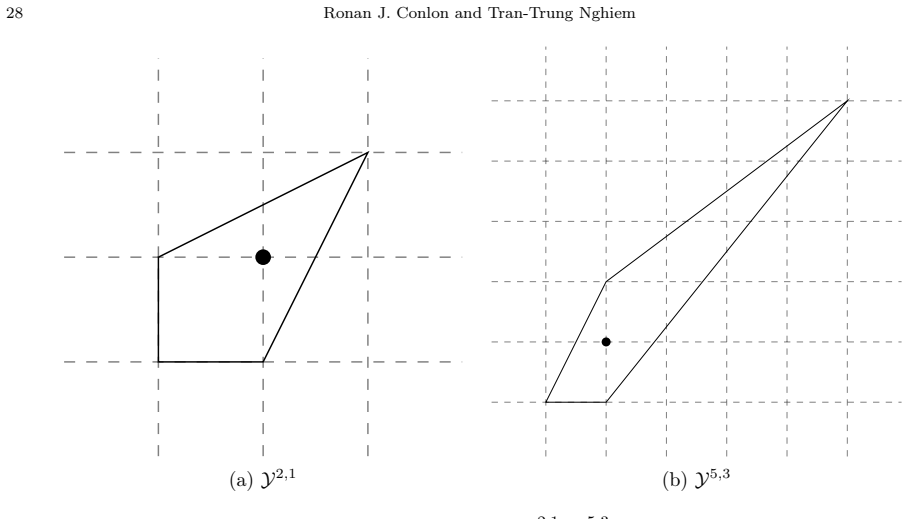
The machinery has three main parts. First, a toric diagram is a convex lattice polygon with no interior lattice points on its edges, encoding a three-dimensional toric Gorenstein (hence Calabi–Yau) cone. Second, deformation theory identifies the versal base of the cone with the Minkowski scheme built from the polygon's lattice maximal Minkowski decompositions: decompositions $P=P_0+\cdots+P_m$ into lattice segments and triangles correspond to $m$-parameter smoothings over $\mathbb{C}^m$. Third, the Calabi–Yau Reeb field is the unique minimizer of the normalized volume function, computed from the index character via Hilbert series, and the cone is irregular exactly when a coordinate of this minimizer is irrational. The paper's contribution is to wire these three parts into an algorithm and to execute it on the $P_{r,s}$ and $Y^{p,q}+L$ families.
What would settle it
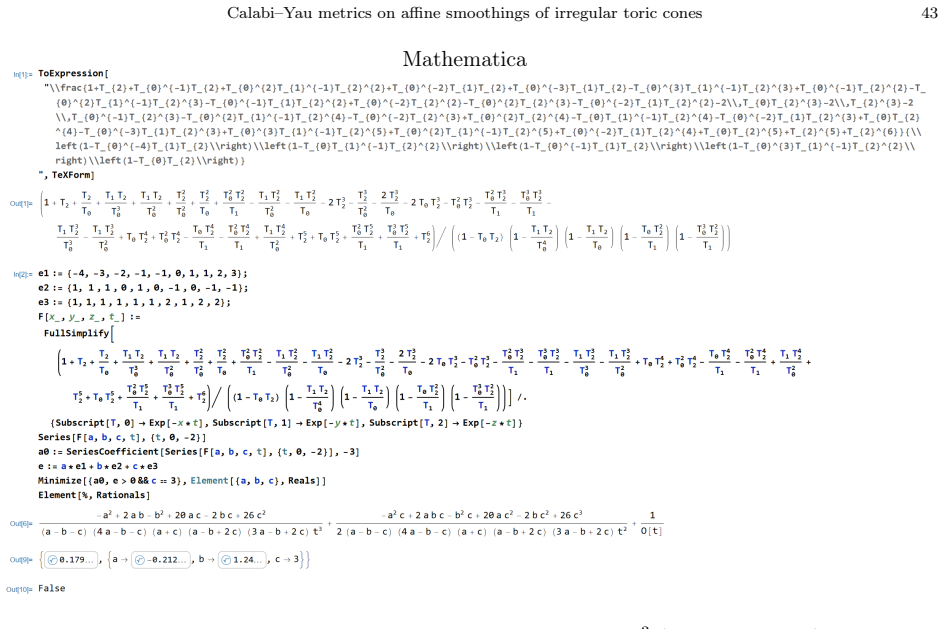
Take $s=2$ and $a=0$, and compute the cubic $b^3+9b^2+b(27-18s^3)+27(s^4-2s^3+1)$ at values of $b$ in the allowed interval $(-3,3(s-1))$, comparing with the claimed bound $27s^3(1-s)$; if the cubic is not always negative, the exclusion of $a=0$ fails and the irregularity proof needs repair. One can also test directly whether $a=0$ solves the volume-minimizer equations, or check whether the degree-8 polynomial $P(a)$ has a rational root in $(-3,3)$.
Extended reading notes
Core claim
The central claim is that irregularity of the tangent cone is not an obstruction to affine smoothing: each toric Calabi–Yau cone $C_{r,s}$ in the $P_{r,s}$ family is the tangent cone at infinity of an asymptotically conical Calabi–Yau manifold obtained by an $r$-parameter affine smoothing, and for $r=1$ the Calabi–Yau Reeb field has an irrational coordinate, making the cone irregular. The proof identifies the versal deformation base with the reduced Minkowski scheme $\mathbb{C}^r$ via the unique lattice maximal Minkowski decomposition $P_{r,s}=L_1+\cdots+L_r+\Delta_s$, applies a general existence theorem for AC Calabi–Yau metrics on smooth fibers of such deformations, and computes the Reeb field as the unique minimizer of the normalized volume. For the quadrilateral family $Y^{p,q}$, the paper proves that $Y^{p,q}+L$ has a lattice maximal Minkowski decomposition exactly for the two listed choices of segment $L$, and that the resulting cone is the tangent cone of an AC Calabi–Yau metric on a one-parameter smoothing. A conjecture is formulated: $Y^{p,q}+L$ is irregular exactly when $Y^{p,q}$ is.
Load-bearing premise
The paper's irregularity conclusion for the $r=1$ cones rests on the computer-assisted claim that the volume-minimizing Reeb field has an irrational coordinate, together with an inequality in Proposition 5.5 that is stated incorrectly as written; if the minimization or the exclusion of the rational candidate $a=0$ fails, the irregularity assertion would need revision, although the existence of Calabi–Yau metrics on the smoothings would survive.
Editorial extensions
If this is right
- Every cone $C_{r,s}$ admits an $r$-parameter affine smoothing, and every smooth fiber carries a complete Calabi–Yau metric with Euclidean volume growth and quadratic curvature decay asymptotic to the cone.
- For $r=1$ these smoothings provide infinitely many new affine Calabi–Yau manifolds with irregular tangent cone, answering a question left open by the classification of asymptotically conical Calabi–Yau manifolds.
- For the two allowed segments $L$, the cones obtained from $Y^{p,q}+L$ are one-parameter smoothable and appear as tangent cones of AC Calabi–Yau metrics on the smoothing.
- Combined with known crepant resolutions, the smoothings give geometric transitions from the resolved to the deformed Calabi–Yau metrics through the cone.
- The supplied code computes the Reeb field and all Minkowski decompositions from the toric diagram alone, making the irregularity test and the deformation-theoretic smoothability check algorithmically accessible.
Reading between the lines
- If the paper's conjecture holds, then the two segment choices produce irregular cones for every irregular $Y^{p,q}$, so the construction would yield an infinite family of irregular tangent cones with smoothings beyond the $r=1$ subfamily.
- The same pipeline could be run on any lattice polygon with a maximal Minkowski decomposition, giving an explicit though case-by-case method to decide smoothability and irregularity; the main limitation is computational rather than conceptual.
- Because the existence of AC Calabi–Yau metrics on the smoothings does not use the irregularity assertion, the smoothing results in Theorems A and B are independent of the correctness of the inequality in Proposition 5.5; only the 'irregular' label depends on that step.
- An exact-arithmetic re-run of the minimization for small $s$ could decide the $a=0$ exclusion directly, and would either repair or refute the claimed irrationality of the Reeb field in Proposition 5.5.
Editorial analysis
A structured set of objections, weighed in public.
Referee Report
Summary. The paper constructs new complete asymptotically conical (AC) Calabi–Yau metrics on affine smoothings of irregular toric Calabi–Yau cones. Theorem A treats the Cho–Futaki–Ono family: each cone is shown to admit an r-parameter affine smoothing over an irreducible versal base, with AC Calabi–Yau metrics on the smooth fibers, and the r=1 members are claimed to be irregular. Theorem B treats Minkowski sums of Gauntlett–Martelli–Sparks–Waldram polygons with a lattice segment, giving two families of one-parameter smoothings with AC Calabi–Yau metrics. The paper also provides Macaulay2 and Mathematica code for computing Hilbert series, Minkowski decompositions, and Reeb minimizers, and it benchmarks these computations against the known del Pezzo cone examples.
Significance. If the main claims are correct, this gives the first infinite families of affine Calabi–Yau manifolds with irregular tangent cones after the original example of Conlon–Hein, thereby answering a question from [21]. The paper's computational toolkit is a genuine strength: the code is included, the algorithms are explicit, and the known del Pezzo cone values are reproduced. The deformation-theoretic framework via Altmann's versal-base theorem is well matched to the problem. However, the irregularity assertion for the r=1 subfamily rests on a specific inequality in Proposition 5.5 that is false as written, so the strongest advertised conclusion is not currently established.
major comments (3)
- [Section 5.2, Proposition 5.5] The proof of irregularity for P_s contains an invalid inequality that is load-bearing for the r=1 case of Theorem A. After substituting a=0 into the equation ∂_b a_0=0, the paper obtains the cubic f(b)=b^3+9b^2+b(27-18s^3)+27(s^4-2s^3+1) and asserts that b<3(s-1) implies f(b)<27s^3(1-s)<0. This is backwards: f'(b)=3(b+3)^2-18s^3 is negative on the relevant interval for s≥2, so f is decreasing and b<3(s-1) implies f(b)>f(3(s-1))=27s^3(1-s). Moreover, for s=3 the cubic has a root in the admissible interval (-3,6), since f(0)=756>0 and f(6)=-1458<0. Thus the rational candidate a=0 is not excluded by the argument given, and the conclusion that the minimizer's first coordinate must be a root of the irreducible degree-8 polynomial P is not justified. The smoothing and metric-existence parts of Theorem A survive, but the irregularity claim for the Cho–Futaki–Ono r=1 cones is not proven as written.
- [Section 5.1 and Example 5.7] The displayed maximal Minkowski decomposition in Theorem 5.1 is inconsistent with the printed examples. For s=3, P_3 is defined as Conv((-1,-2),(0,-1),(1,3),(0,2),(-1,-1)), which after translating by (1,2) has vertices (0,0),(1,1),(2,5),(1,4),(0,3). But with L_1=Conv((0,0),(1,1)) and Δ_3=Conv((0,0),(0,1),(1,4)) as stated, the Minkowski sum L_1+Δ_3 has convex hull (0,0),(1,1),(1,2),(2,5),(1,4),(0,1), a hexagon rather than P_3. Consequently the theorem's statement of Δ_s (or the vertex list of P_s) needs correction before Theorem 5.1 can be used to justify the smoothing construction for all r,s.
- [Lemma 5.2] The proof of generic smoothness is incomplete as written. The argument invokes Hartshorne III, Lemma 10.5 after establishing that π_0 is dominant, but that lemma normally requires a nonsingular source (or a separate argument that the singular locus does not dominate the base) and it yields an open subset of the base over which the map is smooth, not an open subset of X_0 as stated in the lemma. Since the existence of at least one smooth fiber is needed for the application of [21, Theorem 4.3] in Corollary 5.3 and in the proof of Theorem B(b), this step should be justified directly, for example by a Jacobian computation on the explicit toric total space or by a precise citation from Altmann's theory.
minor comments (4)
- [Example 3.9] The sentence "Then Y_3 is the intersection of the following 20 quadrics in C^10" appears to contain a typo: the displayed weight matrix W has nine columns, so the ambient space should be C^9.
- [Example 3.8] The displayed list of quadrics for the ideal I contains an isolated double comma in the line "z_4 z_6 - z_1 z_9, z_5^2 - z_1 z_9, , z_4 z_5 - z_1 z_8"; this is a harmless typo but should be cleaned up.
- [Appendix A.3] The code relies on Mathematica's Minimize and IrreduciblePolynomialQ as black boxes. A short note on the exactness of these calls, or a certificate such as a minimal polynomial and a root-isolation interval, would make the irregularity verification reproducible without trusting undocumented internals.
- [Notation] The notation Q_{p,q} for the Minkowski sums in Theorem B conflicts with the earlier notation Q_i for del Pezzo toric diagrams; this is manageable but occasionally confusing.
Circularity Check
No circularity found; the derivation is self-contained, with the Proposition 5.5 inequality issue being a correctness concern rather than a circular one.
full rationale
The paper's derivation chain is self-contained with respect to the quantities it claims to predict. The Reeb field is not fitted to any subset of data: the volume function is a fixed algebraic expression derived from the toric diagram via the localization formula (Proposition 5.4), and the minimizer is computed by Gröbner elimination and Mathematica's Minimize, then cross-checked against known del Pezzo cone values (Examples 3.8-3.10). The smoothing and AC Calabi-Yau metric conclusions rest on Altmann's versal-base theorem (Theorem 4.22) for the deformation side and on [21, Theorem 4.3] for metric existence; the latter is a cited theorem of the first author and Hein, but it is a published independent result with stated assumptions that do not presume the present examples, so under the review rules it is real evidence and does not raise the circularity score. The Minkowski decomposition computations (Theorems 5.1 and B) are explicit lattice-geometric decompositions verified with the supplied Macaulay2 code, not renamings of known results. The only significant weakness identified by the skeptic, namely the sign of the inequality in Proposition 5.5 used to exclude the rational candidate a = 0, is a mathematical correctness concern rather than a circularity: even if that exclusion fails, the volume minimizer is not defined in terms of the desired irregularity conclusion. No step reduces by construction to its inputs, so no circularity is present.
Assumptions & free parameters
assumptions (5)
- domain assumption The Reeb field of the Calabi-Yau cone metric is the unique minimizer of the volume function a0 (Futaki-Ono-Wang, Theorem 3.5).
- standard math Altmann's theorem identifies the versal deformation base of a toric Gorenstein singularity with the Minkowski scheme, and non-trivial deformations correspond to maximal Minkowski decompositions (Theorems 4.21, 4.22).
- standard math Conlon-Hein Theorem 4.3 gives AC Calabi-Yau metrics on smooth fibers of a generally smooth deformation of a Calabi-Yau cone, in every Kähler class.
- domain assumption Mathematica's Minimize and IrreduciblePolynomialQ return correct global minimum and irreducibility results.
- standard math The localization formula for the volume function (MSY equation 7.26) is valid for these toric cones.
Cite this review
Pith. "Pith review of Examples of complete Calabi--Yau metrics on affine smoothings of irregular toric Calabi--Yau cones." pith.science (2026). https://pith.science/paper/H6KE36UP
@misc{pith2026250614118,
  author       = {Pith},
  title        = {Pith review of: Examples of complete Calabi--Yau metrics on affine smoothings of irregular toric Calabi--Yau cones},
  year         = {2026},
  howpublished = {\url{https://pith.science/paper/H6KE36UP}},
  note         = {Machine review of arXiv:2506.14118}
}
read the original abstract
We present new examples of affine Calabi--Yau manifolds of Euclidean volume growth and quadratic curvature decay, whose tangent cones at infinity are irregular and have smooth links. In the process, we demonstrate (and provide the relevant computer code) how to explicitly compute the Reeb field and all Minkowski decompositions of a given toric Calabi--Yau cone with smooth link from the data of its toric polytope. Minkowski decompositions of this polytope into lattice segments and/or triangles give rise to smoothings of the given cone. Furthermore, we propose an effective strategy to generate smoothable Calabi--Yau cones from a given non-smoothable one by taking Minkowski sums of certain toric diagrams, and provide an example to illustrate the method.
Figures


Figures from the paper (6 more)


Reference graph
Works this paper leans on
-
[21]
,Classification of asymptotically conical Calabi-Yau manifolds, Duke Math. J.173(2024), no. 5, 947–1015 (English)
work page 2024
-
[1]
Toric Q-Gorenstein Singularities
K. Altmann,ToricQ-Gorenstein singularities, arXiv:alg-geom/9403003 (1994)
work page Pith review arXiv 1994
-
[2]
,The versal deformation of an isolated toric Gorenstein singularity, Invent. Math.128(1997), no. 3, 443–479. MR 1452429
work page 1997
-
[3]
,One parameter families containing three-dimensional toric-Gorenstein singularities, Explicit birational geometry of 3-folds, London Math. Soc. Lecture Note Ser., vol. 281, Cambridge Univ. Press, Cambridge, 2000, pp. 21–50. MR 1798979
work page 2000
-
[4]
J. Arndt,Verselle deformationen zyklischer quotientensingularitäten., Dissertation, Universität Hamburg (1988)
work page 1988
-
[5]
M. Artin,Lectures on deformations of singularities, Lecture Notes, Tata Institute of Fundamental Research (1976)
work page 1976
-
[6]
V. Batyrev and L. Borisov,Dual cones and mirror symmetry for generalized Calabi-Yau manifolds, Mirror sym- metry, II, AMS/IP Stud. Adv. Math., vol. 1, Amer. Math. Soc., Providence, RI, 1997, pp. 71–86. MR 1416334
work page 1997
-
[7]
Berman,Conical Calabi-Yau metrics on toric affine varieties and convex cones, J
R. Berman,Conical Calabi-Yau metrics on toric affine varieties and convex cones, J. Differential Geom.125 (2023), no. 2, 345–377. MR 4649389
work page 2023
Show all 50 references
-
[8]
Biquard and T
O. Biquard and T. Delcroix,Ricci flat Kähler metrics on rank two complex symmetric spaces, J. Éc. polytech. Math.6(2019), 163–201. MR 3932737
2019
-
[9]
Boyer and K
C. Boyer and K. Galicki,Sasakian geometry, Oxford Mathematical Monographs, Oxford University Press, Oxford,
-
[10]
Candelas and X
P. Candelas and X. de la Ossa,Comments on conifolds, Nuclear Phys. B342(1990), no. 1, 246–268. MR 1068113 (91m:32018)
1990
-
[11]
J.Cheeger,Degeneration of Riemannian metrics under Ricci curvature bounds, LezioniFermiane.[FermiLectures], Scuola Normale Superiore, Pisa, 2001
2001
-
[12]
Cheeger and T
J. Cheeger and T. Colding,Lower bounds on Ricci curvature and the almost rigidity of warped products, Ann. of Math. (2)144(1996), no. 1, 189–237
1996
-
[13]
Cheeger and G
J. Cheeger and G. Tian,On the cone structure at infinity of Ricci flat manifolds with Euclidean volume growth and quadratic curvature decay, Invent. Math.118(1994), no. 3, 493–571
1994
-
[14]
K. Cho, A. Futaki, and H. Ono,Uniqueness and examples of compact toric Sasaki-Einstein metrics, Commun. Math. Phys.277(2008), no. 2, 439–458 (English)
2008
-
[15]
J. Christophersen,On the components and discriminant of the versal base space of cyclic quotient singularities, Singularity theory and its applications, Part I (Coventry, 1988/1989), Lecture Notes in Math., vol. 1462, Springer, Berlin, 1991, pp. 81–92. MR 1129026
1988
-
[16]
Cifarelli, R
C. Cifarelli, R. Conlon, and A. Deruelle,An Aubin continuity path for shrinking gradient Kähler–Ricci solitons, Journal für die reine und angewandte Mathematik (Crelles Journal)2024(2024), no. 815, 229–307. 44 Ronan J. Conlon and Tran-Trung Nghiem
2024
-
[17]
Colding and W
T. Colding and W. Minicozzi,On uniqueness of tangent cones for Einstein manifolds, Invent. Math.196(2014), 515–588
2014
-
[18]
Collins and G
T. Collins and G. Székelyhidi,K-semistability for irregular Sasakian manifolds, J. Differential Geom.109(2018), no. 1, 81–109. MR 3798716
2018
-
[19]
Conlon,On the smoothability of certain Kähler cones, arXiv:1407.4887 (2014)
R. Conlon,On the smoothability of certain Kähler cones, arXiv:1407.4887 (2014)
2014 arXiv
-
[20]
Conlon and H.-J
R. Conlon and H.-J. Hein,Asymptotically conical Calabi–Yau metrics on quasi-projective varieties, Geom. Funct. Anal.25(2015), no. 2, 517–552. MR 3334234
2015
-
[22]
D. Cox, J. Little, and D. O’Shea,Ideals, varieties, and algorithms, third ed., Undergraduate Texts in Mathemat- ics, Springer, New York, 2007, An introduction to computational algebraic geometry and commutative algebra. MR 2290010
2007
-
[23]
D. Cox, J. Little, and H. Schenck,Toric varieties, Grad. Stud. Math., vol. 124, Providence, RI: American Math- ematical Society (AMS), 2011 (English)
2011
-
[24]
Elkik,Solutions d’équations à coefficients dans un anneau hensélien, Ann
R. Elkik,Solutions d’équations à coefficients dans un anneau hensélien, Ann. Sci. École Norm. Sup. (4)6(1973), 553–603. MR 345966
1973
-
[25]
Esparza,Uniqueness of asymptotically conical shrinking gradient Kähler-Ricci solitons, arXiv:2502.13521 (2025)
C. Esparza,Uniqueness of asymptotically conical shrinking gradient Kähler-Ricci solitons, arXiv:2502.13521 (2025)
2025 arXiv
-
[26]
Flenner and M
H. Flenner and M. Zaidenberg,Log-canonical forms and log canonical singularities, Math. Nachr.254/255(2003), 107–125. MR 1983959 (2004m:14028)
2003
-
[27]
Futaki, H
A. Futaki, H. Ono, and G. Wang,Transverse Kähler geometry of Sasaki manifolds and toric Sasaki-Einstein manifolds, J. Differential Geom.83(2009), no. 3, 585–635. MR 2581358
2009
-
[28]
Gauntlett, D
J. Gauntlett, D. Martelli, J. Sparks, and D. Waldram,Sasaki-Einstein metrics onS2 ×S 3, Adv. Theor. Math. Phys.8(2004), no. 4, 711–734 (English)
2004
-
[29]
Goto,Calabi-Yau structures and Einstein-Sasakian structures on crepant resolutions of isolated singularities, J
R. Goto,Calabi-Yau structures and Einstein-Sasakian structures on crepant resolutions of isolated singularities, J. Math. Soc. Japan64(2012), no. 3, 1005–1052. MR 2965437
2012
-
[30]
Gross,Examples of special Lagrangian fibrations, Symplectic geometry and mirror symmetry (Seoul, 2000), World Sci
M. Gross,Examples of special Lagrangian fibrations, Symplectic geometry and mirror symmetry (Seoul, 2000), World Sci. Publ., River Edge, NJ, 2001, pp. 81–109. MR 1882328
2000
-
[31]
Guillemin,Kaehler structures on toric varieties, J
V. Guillemin,Kaehler structures on toric varieties, J. Differential Geom.40(1994), no. 2, 285–309. MR 1293656
1994
-
[32]
Hartshorne,Algebraic geometry, Graduate Texts in Mathematics, No
R. Hartshorne,Algebraic geometry, Graduate Texts in Mathematics, No. 52, Springer-Verlag, New York- Heidelberg, 1977. MR 0463157
1977
-
[33]
Hein and S
H.-J. Hein and S. Sun,Calabi-Yau manifolds with isolated conical singularities, Publ. Math. Inst. Hautes Études Sci.126(2017), 73–130. MR 3735865
2017
-
[34]
Ishii,Introduction to singularities, Springer, Tokyo, 2014
S. Ishii,Introduction to singularities, Springer, Tokyo, 2014. MR 3288750
2014
-
[35]
Kollár and N
J. Kollár and N. Shepherd-Barron,Threefolds and deformations of surface singularities, Invent. Math.91(1988), no. 2, 299–338. MR 922803
1988
-
[36]
Kronheimer,The construction of ALE spaces as hyper-Kähler quotients, J
P. Kronheimer,The construction of ALE spaces as hyper-Kähler quotients, J. Differential Geom.29(1989), no. 3, 665–683. MR 992334
1989
-
[37]
Differential Geom.29(1989), no
,A Torelli-type theorem for gravitational instantons, J. Differential Geom.29(1989), no. 3, 685–697. MR 992335
1989
-
[38]
Lenstra, H
A. Lenstra, H. Lenstra, Jr., and L. Lovász,Factoring polynomials with rational coefficients, Math. Ann.261 (1982), no. 4, 515–534. MR 682664
1982
-
[39]
Lerman,Contact toric manifolds, J
E. Lerman,Contact toric manifolds, J. Symplectic Geom.1(2003), no. 4, 785–828. MR 2039164
2003
-
[40]
Martelli and J
D. Martelli and J. Sparks,Toric geometry, Sasaki-Einstein manifolds and a new infinite class of AdS/CFT duals, Comm. Math. Phys.262(2006), no. 1, 51–89. MR 2200882
2006
-
[41]
Martelli, J
D. Martelli, J. Sparks, and S.-T. Yau,The geometric dual ofa-maximisation for toric Sasaki-Einstein manifolds, Comm. Math. Phys.268(2006), no. 1, 39–65. MR 2249795
2006
-
[42]
,Sasaki-Einstein manifolds and volume minimisation, Comm. Math. Phys.280(2008), no. 3, 611–673. MR 2399609
2008
-
[43]
Nghiem,Calabi-Yau metrics on rank two symmetric spaces with horospherical tangent cone at infinity, arXiv:2401.05122 (2024)
T.-T. Nghiem,Calabi-Yau metrics on rank two symmetric spaces with horospherical tangent cone at infinity, arXiv:2401.05122 (2024)
2024 arXiv
-
[44]
Pinansky,Quantum deformations from toric geometry, J
S. Pinansky,Quantum deformations from toric geometry, J. High Energy Phys. (2006), 055, 26 pp. (electronic)
2006
-
[45]
Riemenschneider,Deformationen von Quotientensingularitäten (nach zyklischen Gruppen), Math
O. Riemenschneider,Deformationen von Quotientensingularitäten (nach zyklischen Gruppen), Math. Ann.209 (1974), 211–248. MR 367276
1974
-
[46]
Rossi,Geometric transitions, J
M. Rossi,Geometric transitions, J. Geom. Phys.56(2006), no. 9, 1940–1983. MR 2240431 (2007e:14061)
2006
-
[47]
Stevens,On the versal deformation of cyclic quotient singularities, Singularity theory and its applications, Part I (Coventry, 1988/1989), Lecture Notes in Math., vol
J. Stevens,On the versal deformation of cyclic quotient singularities, Singularity theory and its applications, Part I (Coventry, 1988/1989), Lecture Notes in Math., vol. 1462, Springer, Berlin, 1991, pp. 302–319. MR 1129040 Calabi–Yau metrics on affine smoothings of irregular...
1988
-
[48]
Sun and J
S. Sun and J. Zhang,No semistability at infinity for Calabi-Yau metrics asymptotic to cones, Invent. Math.233 (2023), no. 1, 461–494. MR 4602001
2023
-
[49]
van Coevering,Ricci-flat Kähler metrics on crepant resolutions of Kähler cones, Math
C. van Coevering,Ricci-flat Kähler metrics on crepant resolutions of Kähler cones, Math. Ann.347(2010), no. 3, 581–611. MR 2640044
2010
-
[50]
Z.267(2011), no
,Examples of asymptotically conical Ricci-flat Kähler manifolds, Math. Z.267(2011), no. 1-2, 465–496. MR 2772262 Department of Mathematical Sciences, The University of Texas at Dallas, Richardson, TX 75080, USA Email address:ronan.conlon@utdallas.edu Institut Camille Jordan, U...
2011
Reviewed August 7, 2026 · model on record in the stance chip above.
Discussion (0). Continue with ORCID to comment.