REVIEW 2 major objections 5 minor 43 references
The agreement distance of unrooted phylogenetic networks
T0 review · 2 major / 5 minor · reviewed 2026-08-14 · deepseek-v4-flash
Pith's one-line read The paper proves that the agreement distance between two unrooted phylogenetic networks is within a factor of two of their TBR distance and within a factor of four of their prune-and-regraft distance.
desk verdict A solid unrooted-network extension of agreement forests with useful constant-factor bounds on TBR and PR distances; mostly right, but the endpoint ordered-embedding proof is a genuine gap. read the letter →
The pith
A machine-rendered reading of the paper's core claim, the machinery that carries it, and where it could break.
The reading
What carries the argument
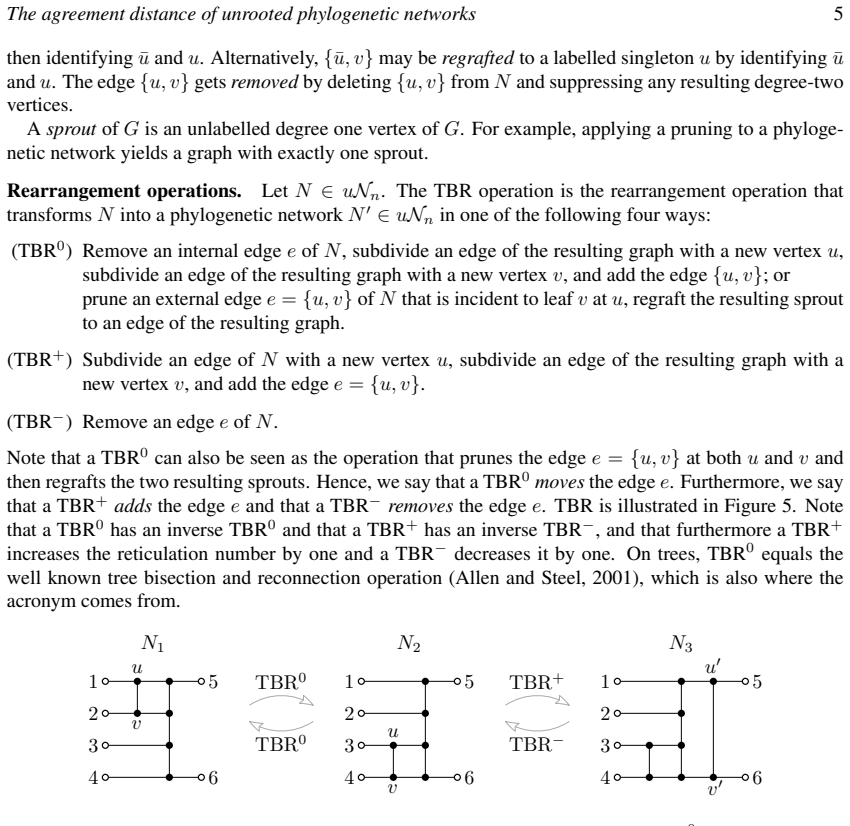
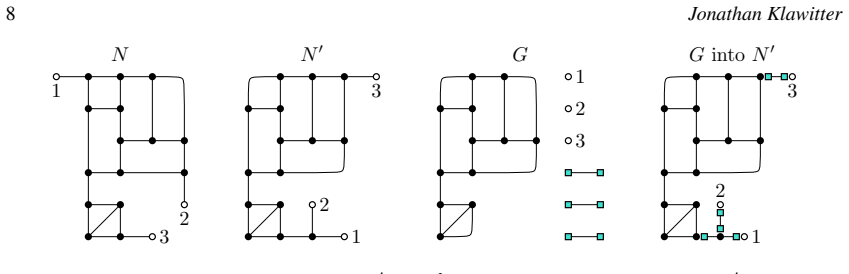
The maximum agreement graph (MAG): a graph whose connected components split into agreement subgraphs—parts that embed identically into both networks—and disagreement edges, single edges on unlabelled vertices that account for edges moved or added when passing from one network to the other. A MAG is an agreement graph with the fewest disagreement edges, and the count of those edges defines $d_{\mathrm{AD}}$. For endpoint agreement, a maximum endpoint agreement graph is the same idea but with one-ended sprouts that model prune-and-regraft moves; the endpoint agreement distance counts sprouts on agreement subgraphs plus disagreement edges. The argument that these counts are metrics and that they sandwich the rearrangement distances runs through ordered agreement embeddings, which fix a systematic ordering of disagreement edges, and through explicit constructions that turn a rearrangement sequence into an agreement graph and vice versa.
What would settle it
Run a brute-force check over small proper binary networks, testing whether every maximum endpoint agreement graph admits an ordered agreement embedding; a single failure would supply a counterexample to the proof of the upper bound $d_{\mathrm{PR}} \le 3\,d_{\mathrm{EAD}}$ as written.
Extended reading notes
Core claim
The central claim is Theorem 5.7: for any two proper unrooted binary phylogenetic networks on the same taxa, $d_{\mathrm{AD}}(N,N') \le d_{\mathrm{TBR}}(N,N') \le 2\,d_{\mathrm{AD}}(N,N')$. The agreement distance is therefore not just a lower bound; it is a constant-factor approximation of the TBR distance, and through the known two-sided comparison between PR and TBR it also satisfies $d_{\mathrm{AD}}(N,N') \le d_{\mathrm{PR}}(N,N') \le 4\,d_{\mathrm{AD}}(N,N')$. The paper also proves that the endpoint agreement distance is a metric and satisfies $d_{\mathrm{EAD}}(N,N') \le d_{\mathrm{PR}}(N,N') \le 3\,d_{\mathrm{EAD}}(N,N')$. For trees, and whenever one network is displayed by the other, the agreement distance coincides with the TBR distance; the gap between the distances is a genuinely network phenomenon, exhibited by a pair of tier-seven networks with agreement distance $2$ and TBR distance $3$.
Load-bearing premise
The metric property of the endpoint agreement distance and the factor-three PR bound both depend on the claim that every maximum endpoint agreement graph admits an ordered agreement embedding; that existence is asserted by analogy to an earlier result rather than proven in this paper.
Editorial extensions
If this is right
- Because $d_{\mathrm{AD}}(N,N') \le d_{\mathrm{TBR}}(N,N') \le 2\,d_{\mathrm{AD}}(N,N')$, any algorithm that computes $d_{\mathrm{AD}}$ gives a 2-approximation of the TBR distance and, through Corollary 5.8, a 4-approximation of the PR distance.
- The agreement distance equals the TBR distance on trees and on tree-network pairs, so in those settings there is no approximation loss at all.
- Both $d_{\mathrm{AD}}$ and $d_{\mathrm{EAD}}$ are metrics, so they give network comparison scores that obey the triangle inequality, a property useful for clustering or outlier detection among inferred networks.
- Computing the agreement distance is NP-hard, so the new constant-factor bounds are structural certificates rather than immediate practical algorithms.
Reading between the lines
- A practical reading of Theorem 5.7 is that an exact or approximate solver for maximum agreement graphs would immediately yield approximation algorithms for TBR and PR distances; the paper stops short of proposing such an algorithm.
- The gap between $d_{\mathrm{AD}}$ and $d_{\mathrm{TBR}}$ is not known to be tight, since the only exhibited separation is $2$ versus $3$; tightening the factor-two bound would likely require understanding when ordered agreement embeddings force extra rearrangement moves.
- For search heuristics, the endpoint agreement distance looks more natural than the ordinary agreement distance for prune-and-regraft moves because its sprouts model one-ended pruning; that analogical advantage is not tested in this paper.
- The tier-seven separating example leaves open whether agreement distance and TBR distance coincide on low-tier networks; checking tiers one through six directly would be a small computational experiment.
Signed reviews
Editorial analysis
A structured set of objections, weighed in public.
Referee Report
Summary. The paper introduces maximum agreement graphs (MAGs) and maximum endpoint agreement graphs (MEAGs) for unrooted, binary, proper phylogenetic networks, generalizing maximum agreement forests from trees. It defines the agreement distance dAD and the endpoint agreement distance dEAD, proves that both are metrics, and studies their relations to the TBR and PR distances. The main results are dAD(N,N') ≤ dTBR(N,N') ≤ 2 dAD(N,N') (Theorem 5.7), the resulting bound dAD ≤ dPR ≤ 4 dAD (Corollary 5.8), and dEAD ≤ dPR ≤ 3 dEAD (Theorem 5.10), together with dAD ≤ dEAD ≤ 2 dAD (Proposition 5.9). The paper also shows that dAD coincides with the TBR-distance on unrooted trees and on tree/network pairs, and gives an example where the two distances differ for networks. The overall contribution is a constant-factor approximation framework for rearrangement distances on unrooted phylogenetic networks.
Significance. If the results hold, this is a meaningful step: it provides the first constant-factor bounds relating agreement-type distances to TBR and PR distances on unrooted networks, and the chain dAD ≤ dPR ≤ 4 dAD gives a single proxy for two rearrangement metrics. The constructions in Lemma 5.5 and Lemma 5.6 are detailed and nontrivial, and the paper is generally careful in building on published results rather than re-deriving them. However, the endpoint version of ordered agreement embeddings is only asserted by analogy with prior work and a short outline, and this lemma is load-bearing both for the metric property of dEAD and for the upper bound in Theorem 5.10. The main ideas are credible, but the manuscript is not fully vetted until that gap is closed.
major comments (2)
- [Section 4, ordered agreement embedding; used in Proposition 4.1 and Theorem 5.10] The existence of ordered agreement embeddings for endpoint agreement graphs is asserted without a complete proof. The text says the proof works analogously to Theorem 3.1 and Lemma 3.2 of Klawitter (2019) and gives a two-sentence outline. This existence is load-bearing: Corollary 4.2 obtains the metric property of dEAD from Proposition 4.1, whose reverse inequality fixes ordered embeddings of a MEAG into N and N′, and Theorem 5.10 fixes such embeddings and uses the ordering of disagreement edges when adding edges by PR+. The outlined argument does not show that the two conditions—no sprout of an agreement subgraph attached to a disagreement edge, and the ordering condition Ej may be attached to Ei only for i ≤ j—can be enforced simultaneously in the unrooted endpoint setting, where agreement subgraphs may themselves carry sprouts. An embedding change that detaches a sprout from a disagreement edge can alter which disagreement edges are attached to which, and the interaction with the ordering condition is not addressed. I request a full proof of the existence of ordered agreement embeddings for endpoint agreement graphs, or an explicit reduction to the rooted lemma that accounts for sprouts in agreement subgraphs.
- [Section 5, Lemma 5.3] The converse direction of Lemma 5.3 contains the displayed inequality dAD(T,N) ≥ dAD(T,T′) + dAD(T,N) = dTBR(T,N). The middle term dAD(T,N) makes the inequality self-referential and cannot be correct; the intended second summand is presumably dAD(T′,N), which equals r when T′ is displayed by N. As printed, the proof of the lower bound dAD(T,N) ≥ dTBR(T,N) is invalid, although the surrounding argument suggests a straightforward repair by replacing the erroneous term and justifying why the ordered embedding of G into N yields an agreement graph of T and T′ with k−r disagreement edges. Please correct the equation and expand this step.
minor comments (5)
- [Throughout] Several cross-references use the wrong kind of label: 'Theorem 3.1' should be Lemma 3.1, 'Theorem 2.1' should be Observation 2.1, 'Theorem 3.3' should be Proposition 3.3, 'Theorem 5.2' should be Lemma 5.2, and 'Theorem 4.1' should be Proposition 4.1. Please harmonize the references.
- [Section 4, proof sketch after the definition of ordered agreement embedding] The outline begins 'Starting with an agreement embedding of G into N′', but the object being embedded is the endpoint agreement graph, which has been called H; the symbol G is not defined in this paragraph.
- [Concluding remarks] The text says 'maximum endpoint agreement graphs (MAEGs)', whereas the body of the paper consistently uses the abbreviation MEAG. Please make the abbreviation uniform.
- [Section 5, proof of Proposition 5.9] The sentence 'Since ¯v is either a degree vertex or a labelled leaf' should state the degree explicitly, presumably 'degree-three vertex'; as written it is ambiguous.
- [Abstract] The phrase 'maximum agreement graphs as a generalisations' should be 'as a generalization' or 'as generalizations'.
Circularity Check
dAD/dTBR bounds are self-contained, but the EAD metric and dPR≤3·dEAD depend on ordered endpoint agreement embeddings whose existence is deferred by analogy to the author's own prior work.
-
self citation load bearing
[Section 4, definition of ordered agreement embedding for endpoint agreement graphs]
"A proof that ordered agreement embeddings exists works analogously to the proof of Theorem 3.1 and the proof of Lemma 3.2 (Klawitter, 2019), yet we outline the proof idea here."
The existence of ordered agreement embeddings for endpoint agreement graphs is asserted by analogy to the author's own prior rooted-network proof and not proved in this paper. This assertion is load-bearing: Proposition 4.1 uses fixed ordered embeddings for the inequality dEAD ≥ dR, Corollary 4.2 (dEAD is a metric) inherits this, and Theorem 5.10 fixes ordered endpoint embeddings to construct the PR-sequence for dPR ≤ 3 dEAD. Unlike the rooted case, endpoint agreement subgraphs may themselves contain sprouts, so the cited analogy does real work. The EAD metric and the PR upper bound therefore rest on a self-citation rather than on a self-contained derivation.
full rationale
The main agreement-distance chain is not circular. dAD is defined from MAGs and compared to dTBR via explicit construction: Lemma 5.5 turns any TBR-sequence into an agreement graph, and Lemma 5.6 turns a MAG into a TBR-sequence using Lemma 3.1, whose ordered-embedding existence is proved in this paper. Proposition 3.3 and Lemma 5.2 use Allen–Steel and Janssen–Klawitter as ordinary published, parameter-free results; Corollary 5.8 is a straightforward composition. No fitted quantity is renamed as a prediction. The endpoint side is less self-contained: Section 4 states rather than proves the existence of ordered agreement embeddings for MEAGs, saying the proof works analogously to the author's rooted-network paper and giving a two-sentence outline. Corollary 4.2 and Theorem 5.10 fix such embeddings, so if the analogy fails—endpoint agreement subgraphs may carry sprouts—dEAD could fail to be a metric and the dPR ≤ 3 dEAD construction would lack support. This is a load-bearing reliance on a self-citation, although not a definitional or fitted circularity. One line in Lemma 5.3, 'dAD(T,N) ≥ dAD(T,T′) + dAD(T,N)', is evidently a typo; the intended dAD(T′,N) term makes the displayed inequality correct. Net: no reduction of the AD results to their inputs, but one central EAD claim rests on an unproved self-cited analogy, so the score is moderate rather than zero.
Assumptions & free parameters
assumptions (4)
- domain assumption The TBR and PR rearrangement operations and their induced distances on unrooted proper binary phylogenetic networks are well-defined metrics, as established by Janssen and Klawitter (2019, Corollary 4.4).
- domain assumption For a tree T and a network N, the tree T' displayed by N that minimises dTBR(T,N) = dTBR(T,T') + dTBR(T',N) exists (Janssen and Klawitter 2019, Theorem 4.13).
- domain assumption The network space is restricted to binary, proper networks; parallel edges are allowed, but networks are always proper unless otherwise stated.
- standard math Standard graph-theoretic operations: vertex suppression, edge subdivision, cyclomatic number, and the existence of DFS-based path searches in connected graphs.
Cite this review
Pith. "Pith review of The agreement distance of unrooted phylogenetic networks." pith.science (2026). https://pith.science/paper/H6MUVJTF
@misc{pith2026190808183,
  author       = {Pith},
  title        = {Pith review of: The agreement distance of unrooted phylogenetic networks},
  year         = {2026},
  howpublished = {\url{https://pith.science/paper/H6MUVJTF}},
  note         = {Machine review of arXiv:1908.08183}
}
abstract
A rearrangement operation makes a small graph-theoretical change to a phylogenetic network to transform it into another one. For unrooted phylogenetic trees and networks, popular rearrangement operations are tree bisection and reconnection (TBR) and prune and regraft (PR) (called subtree prune and regraft (SPR) on trees). Each of these operations induces a metric on the sets of phylogenetic trees and networks. The TBR-distance between two unrooted phylogenetic trees $T$ and $T'$ can be characterised by a maximum agreement forest, that is, a forest with a minimum number of components that covers both $T$ and $T'$ in a certain way. This characterisation has facilitated the development of fixed-parameter tractable algorithms and approximation algorithms. Here, we introduce maximum agreement graphs as a generalisations of maximum agreement forests for phylogenetic networks. While the agreement distance -- the metric induced by maximum agreement graphs -- does not characterise the TBR-distance of two networks, we show that it still provides constant-factor bounds on the TBR-distance. We find similar results for PR in terms of maximum endpoint agreement graphs.
Figures


Figures from the paper (11 more)







Reference graph
Works this paper leans on
-
[1]
B. L. Allen and M. Steel. Subtree Transfer Operations and Their Induced Metrics on Evolutionary Trees . Annals of Combinatorics, 5 0 (1): 0 1--15, 2001. doi:10.1007/s00026-001-8006-8
-
[2]
M. L. Bonet and K. St. John. Efficiently Calculating Evolutionary Tree Measures Using SAT . In O. Kullmann, editor, Theory and Applications of Satisfiability Testing - SAT 2009, pages 4--17, 2009. ISBN 978-3-642-02777-2. doi:10.1007/978-3-642-02777-2\_3
-
[3]
M. Bordewich and C. Semple. On the Computational Complexity of the Rooted Subtree Prune and Regraft Distance . Annals of Combinatorics, 8 0 (4): 0 409--423, 2005. doi:10.1007/s00026-004-0229-z
-
[4]
M. Bordewich and C. Semple. A universal tree-based network with the minimum number of reticulations. Discrete Applied Mathematics, 250: 0 357--362, 2018. doi:10.1016/j.dam.2018.05.010
-
[5]
M. Bordewich, C. McCartin, and C. Semple. A 3-approximation algorithm for the subtree distance between phylogenies. Journal of Discrete Algorithms, 6 0 (3): 0 458--471, 2008. doi:10.1016/j.jda.2007.10.002
-
[6]
M. Bordewich, S. Linz, and C. Semple. Lost in space? G eneralising subtree prune and regraft to spaces of phylogenetic networks. Journal of Theoretical Biology, 423: 0 1--12, 2017 a . doi:10.1016/j.jtbi.2017.03.032
-
[7]
M. Bordewich, C. Scornavacca, N. Tokac, and M. Weller. On the fixed parameter tractability of agreement-based phylogenetic distances. Journal of Mathematical Biology, 74 0 (1): 0 239--257, 2017 b . doi:10.1007/s00285-016-1023-3
-
[8]
R. Bouckaert, J. Heled, D. Kühnert, T. Vaughan, C.-H. Wu, D. Xie, M. A. Suchard, A. Rambaut, and A. J. Drummond. BEAST 2: A Software Platform for Bayesian Evolutionary Analysis . PLOS Computational Biology, 10 0 (4): 0 1--6, 2014. doi:10.1371/journal.pcbi.1003537
Show all 43 references
-
[9]
Chen, J.-H
J. Chen, J.-H. Fan, and S.-H. Sze. Parameterized and approximation algorithms for maximum agreement forest in multifurcating trees. Theoretical Computer Science, 562: 0 496--512, 2015. doi:10.1016/j.tcs.2014.10.031
2015 doi
-
[10]
R. Diestel. Graph Theory. Springer-Verlag Berlin Heidelberg, 5 edition, 2017. ISBN 978-3-662-53622-3. doi:10.1007/978-3-662-53622-3
2017 doi
-
[11]
M. Dunn. Language phylogenies. In C. Bowern and B. Evans, editors, The Routledge Handbook of Historical Linguistics, chapter 7. Routledge, 2014. doi:10.4324/9781315794013.ch7
2014 doi
-
[12]
Felsenstein
J. Felsenstein. Inferring phylogenies, volume 2. Sinauer Associates, 2004
2004
-
[13]
Francis, K
A. Francis, K. T. Huber, and V. Moulton. Tree-Based Unrooted Phylogenetic Networks . Bulletin of Mathematical Biology, 80 0 (2): 0 404--416, 2018 a . doi:10.1007/s11538-017-0381-3
2018 doi
-
[14]
Francis, K
A. Francis, K. T. Huber, V. Moulton, and T. Wu. Bounds for phylogenetic network space metrics. Journal of Mathematical Biology, 76 0 (5): 0 1229--1248, 2018 b . doi:10.1007/s00285-017-1171-0
2018 doi
-
[15]
Gambette, L
P. Gambette, L. van Iersel, M. Jones, M. Lafond, F. Pardi, and C. Scornavacca. Rearrangement moves on rooted phylogenetic networks. PLOS Computational Biology, 13 0 (8): 0 1--21, 2017. doi:10.1371/journal.pcbi.1005611
2017 doi
-
[16]
Guindon, J.-F
S. Guindon, J.-F. Dufayard, V. Lefort, M. Anisimova, W. Hordijk, and O. Gascuel. New Algorithms and Methods to Estimate Maximum-Likelihood Phylogenies: Assessing the Performance of PhyML 3.0 . Systematic Biology, 59 0 (3): 0 307--321, 2010. doi:10.1093/sysbio/syq010
2010 doi
-
[17]
Gusfield
D. Gusfield. ReCombinatorics: the algorithmics of ancestral recombination graphs and explicit phylogenetic networks. MIT Press, 2014
2014
-
[18]
Hallett and C
M. Hallett and C. McCartin. A Faster FPT Algorithm for the Maximum Agreement Forest Problem . Theory of Computing Systems, 41 0 (3): 0 539--550, 2007. doi:10.1007/s00224-007-1329-z
2007 doi
-
[19]
Hickey, F
G. Hickey, F. Dehne, A. Rau-Chaplin, and C. Blouin. SPR Distance Computation for Unrooted Trees . Evolutionary Bioinformatics, 4: 0 EBO.S419, 2008. doi:10.4137/EBO.S419
2008 doi
-
[20]
K. T. Huber, L. van Iersel, R. Janssen, M. Jones, V. Moulton, Y. Murakami, and C. Semple. Rooting for phylogenetic networks . arXiv preprint arXiv:1906.07430, 2019
1906 arXiv
-
[21]
D. H. Huson, R. Rupp, and C. Scornavacca. Phylogenetic networks: concepts, algorithms and applications. Cambridge University Press, 2010. doi:10.1093/sysbio/syr055
2010 doi
-
[22]
Janssen and J
R. Janssen and J. Klawitter. Rearrangement operations on unrooted phylogenetic networks . Theory and Applications of Graphs, 6 0 (2), 2019. doi:10.20429/tag.2019.060206
2019
-
[23]
Janssen, M
R. Janssen, M. Jones, P. L. Erd o s, L. van Iersel, and C. Scornavacca. Exploring the tiers of rooted phylogenetic network space using tail moves. Bulletin of Mathematical Biology, 80 0 (8): 0 2177--2208, 2018. doi:10.1007/s11538-018-0452-0
2018 doi
-
[24]
Klawitter
J. Klawitter. The agreement distance of rooted phylogenetic networks. Discrete Mathematics & Theoretical Computer Science, 21 0 (3), 2019. doi:10.23638/DMTCS-21-3-19
2019 doi
-
[25]
Klawitter and S
J. Klawitter and S. Linz. On the S ubnet P rune and R egraft D istance. Electronic Journal of Combinatorics, 26 0 (2): 0 329--355, 2019. doi:10.37236/7860
2019 doi
-
[26]
J. I. Meier, D. A. Marques, S. Mwaiko, C. E. Wagner, L. Excoffier, and O. Seehausen. Ancient hybridization fuels rapid cichlid fish adaptive radiations. Nature Communications, 8: 0 14363, 2017. doi:10.1038/ncomms14363
2017 doi
-
[27]
R. D. M. Page. On Islands of Trees and the Efficacy of Different Methods of Branch Swapping in Finding Most-Parsimonious Trees . Systematic Biology, 42 0 (2): 0 200--210, 1993. doi:10.2307/2992542
1993 doi
-
[28]
L. H. Rieseberg and J. H. Willis. Plant Speciation . Science, 317 0 (5840): 0 910--914, 2007. doi:10.1126/science.1137729
2007 doi
-
[29]
E. M. Rodrigues, M.-F. Sagot, and Y. Wakabayashi. The maximum agreement forest problem: Approximation algorithms and computational experiments. Theoretical Computer Science, 374 0 (1): 0 91--110, 2007. doi:10.1016/j.tcs.2006.12.011
2007 doi
-
[30]
Ronquist and J
F. Ronquist and J. P. Huelsenbeck. MrBayes 3: Bayesian phylogenetic inference under mixed models . Bioinformatics, 19 0 (12): 0 1572--1574, 2003. doi:10.1093/bioinformatics/btg180
2003 doi
-
[31]
Semple and M
C. Semple and M. A. Steel. Phylogenetics, volume 24. Oxford University Press on Demand, 2003
2003
-
[32]
K. St. John. Review Paper: The Shape of Phylogenetic Treespace . Systematic Biology, 66 0 (1): 0 e83--e94, 2017. doi:10.1093/sysbio/syw025
2017 doi
-
[33]
M. Steel. Phylogeny: discrete and random processes in evolution. Society for Industrial and Applied Mathematics, 2016. ISBN 978-1-611974-47-8
2016
-
[34]
D. L. Swofford, G. J. Olsen, and P. J. Waddell. Phylogenetic Inference . In D. M. Hillis, C. Moritz, and B. K. Mable, editors, Molecular Systematics, chapter 11, pages 407--514. Sinauer Associates, 1996
1996
-
[35]
C. M. Thomas and K. M. Nielsen. Mechanisms of, and Barriers to, Horizontal Gene Transfer between Bacteria . Nature Reviews Microbiology, 3 0 (9): 0 711--721, 2005. doi:10.1038/nrmicro1234
2005 doi
-
[36]
Wagner, R
A. Wagner, R. J. Whitaker, D. J. Krause, J.-H. Heilers, M. van Wolferen, C. van der Does, and S.-V. Albers. Mechanisms of gene flow in archaea. Nature Reviews Microbiology, 15 0 (8): 0 492--502, 2017. doi:10.1038/nrmicro.2017.41
2017 doi
-
[37]
Whidden and F
C. Whidden and F. A. Matsen. Quantifying MCMC Exploration of Phylogenetic Tree Space . Systematic Biology, 64 0 (3): 0 472--491, 2015. doi:10.1093/sysbio/syv006
2015 doi
-
[38]
Whidden and F
C. Whidden and F. A. Matsen. Calculating the Unrooted Subtree Prune-and-Regraft Distance . IEEE/ACM Transactions on Computational Biology and Bioinformatics, 16 0 (3): 0 898--911, 2019. doi:10.1109/TCBB.2018.2802911
2019
-
[39]
Whidden and N
C. Whidden and N. Zeh. A Unifying View on Approximation and FPT of Agreement Forests . In S. L. Salzberg and T. Warnow, editors, Algorithms in Bioinformatics, pages 390--402, 2009. doi:10.1007/978-3-642-04241-6\_32
2009 doi
-
[40]
Whidden, R
C. Whidden, R. G. Beiko, and N. Zeh. Fixed-Parameter Algorithms for Maximum Agreement Forests . SIAM Journal on Computing, 42 0 (4): 0 1431--1466, 2013. doi:10.1137/110845045
2013 doi
-
[41]
Y. Wu. A practical method for exact computation of subtree prune and regraft distance. Bioinformatics, 25 0 (2): 0 190--196, 2009. doi:10.1093/bioinformatics/btn606
2009 doi
-
[42]
Y. Yu, R. M. Barnett, and L. Nakhleh. Parsimonious Inference of Hybridization in the Presence of Incomplete Lineage Sorting . Systematic Biology, 62 0 (5): 0 738--751, 2013. doi:10.1093/sysbio/syt037
2013 doi
-
[43]
Y. Yu, J. Dong, K. J. Liu, and L. Nakhleh. Maximum likelihood inference of reticulate evolutionary histories. Proceedings of the National Academy of Sciences, 111 0 (46): 0 16448--16453, 2014. doi:10.1073/pnas.1407950111
2014 doi
Reviewed August 14, 2026 · model on record in the stance chip above.
Discussion (0). Continue with ORCID to comment.