From Coverage to Sensing: ISAC meets FR3
Pith reviewed 2026-05-20 00:55 UTC · model grok-4.3
The pith
6G networks can coordinate existing FR2 radars as a service to enable native sensing in FR3 spectrum through time multiplexing and hierarchical beam alignment.
A machine-rendered reading of the paper's core claim, the machinery that carries it, and where it could break.
Core claim
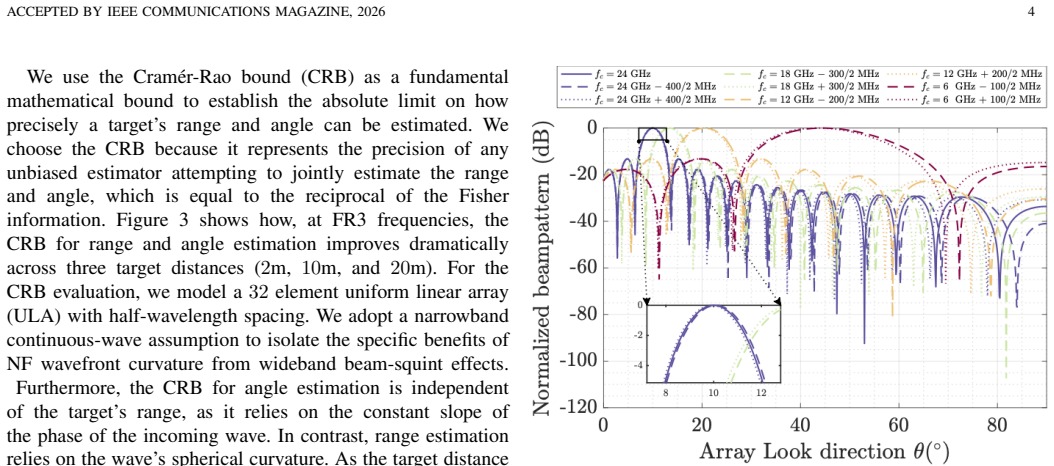
Existing FR2 radars can be time-multiplexed and coordinated under a 6G medium access control as radar-as-a-service, forming a bridge between legacy sensing and network-managed integrated sensing and communications. A hierarchical FR3 beam-alignment strategy performs coarse access at lower frequencies and refinement at upper FR3, with the resulting sensing and communication capabilities quantified via range-angle Cramér-Rao bounds in the near field. Intra- and inter-beam squint phenomena specific to wideband FR3 arrays are identified, and design approaches to mitigate them are discussed, while substantial sensing information can be extracted from payload resource elements.
What carries the argument
Hierarchical FR3 beam-alignment strategy that separates coarse lower-frequency access from upper-FR3 refinement, together with near-field range-angle Cramér-Rao bounds that quantify joint sensing and communication performance.
If this is right
- Legacy FR2 radars become a transitional sensing layer that can be scheduled and coordinated by the 6G network.
- Hierarchical frequency usage reduces beam-alignment overhead while improving range and angle estimation accuracy in the near field.
- Sensing services gain access to data-carrying resource elements, increasing the effective sensing bandwidth without extra pilot overhead.
- Beam squint in wideband FR3 arrays can be controlled through array design so that the Cramér-Rao bounds remain valid performance limits.
- Dense or distributed FR3 massive-MIMO deployments naturally operate as large reconfigurable sensor arrays for wireless digital twins.
Where Pith is reading between the lines
- FR3 infrastructure could support real-time environmental mapping integrated directly into the communication network.
- Calibrated FR3 channel simulators become central for training ISAC algorithms before hardware deployment.
- Network-managed coordination of sensing might eventually reduce the need for standalone radar hardware in many scenarios.
- The same FR3 arrays used for communications could enable new applications such as dynamic situational awareness for autonomous systems.
Load-bearing premise
That FR3 sensing can extract substantial information from payload resource elements rather than relying solely on pilot resources, and that intra- and inter-beam squint phenomena can be effectively mitigated through design approaches without invalidating the near-field CRB quantifications.
What would settle it
Measurements from an FR3 prototype showing that payload resource elements contribute far less usable sensing information than predicted or that residual beam squint causes estimation errors to exceed the derived near-field Cramér-Rao bounds.
Figures



read the original abstract
Future 6G systems are expected to exploit upper midband spectrum in frequency range 3 (FR3) not only for high throughput communications, but also for sensing services such as localization, detection, and situational awareness. The following paper develops a concrete path from today's coverage-oriented deployments to FR3 networks that treat sensing as a native function. We first show how existing FR2 radars can be time-multiplexed and coordinated under a $6$G medium access control as radar-as-a-service, forming a bridge between legacy sensing and network-managed integrated sensing and communications (ISAC). We then propose a hierarchical FR3 beam-alignment strategy in which coarse access occurs at lower frequencies and refinement occurs at upper FR3, and quantify the resulting sensing and communication capabilities via range-angle Cram{\'{e}}r-Rao bounds in the near field. We identify intra- and inter-beam squint phenomena specific to wideband FR3 arrays, and discuss design approaches to mitigate them. On the signal-processing side, we argue that FR3 sensing cannot rely solely on pilot resources and discuss how much sensing information can be extracted from payload resource elements. We further highlight the role of calibrated FR3 channel simulators and real-time models as the core of wireless digital twins for training and evaluating ISAC algorithms, and discuss how massive MIMO and dense or distributed deployments at FR3 naturally act as large reconfigurable sensor arrays.
Editorial analysis
A structured set of objections, weighed in public.
Referee Report
Summary. The manuscript proposes transitioning from coverage-oriented deployments to FR3-based 6G ISAC networks. It first demonstrates time-multiplexed coordination of existing FR2 radars under a 6G MAC as radar-as-a-service to bridge legacy sensing and network-managed ISAC. It then introduces a hierarchical FR3 beam-alignment strategy (coarse access at lower frequencies, refinement at upper FR3), quantifies resulting sensing and communication performance via near-field range-angle Cramér-Rao bounds, identifies intra- and inter-beam squint phenomena with mitigation approaches, argues for extracting sensing information from payload resource elements rather than pilots alone, and discusses calibrated FR3 channel simulators, real-time models, and massive MIMO/distributed deployments as large reconfigurable sensor arrays.
Significance. If the central claims hold, the work offers a practical roadmap for incorporating native sensing into FR3 spectrum, which is expected to be central to 6G. The radar-as-a-service coordination and hierarchical alignment ideas provide concrete bridges between legacy systems and future ISAC; the emphasis on payload-based sensing and digital twins supplies actionable system-level guidance. These elements could inform standardization and deployment if the performance quantifications are robust.
major comments (2)
- [§4] §4 (near-field CRB analysis): The range-angle CRB derivations rely on an idealized array response that does not explicitly incorporate frequency-dependent steering-vector deviations arising from intra- and inter-beam squint across the wide FR3 bandwidth. Because the manuscript later identifies these as FR3-specific phenomena requiring mitigation, the reported bounds risk being optimistic unless the mitigation fully restores the assumed manifold; this directly affects the headline sensing-capability claims.
- [§3.2] §3.2 (hierarchical beam-alignment): The performance quantification via CRBs for the coarse-to-refinement strategy lacks an explicit baseline comparison against non-hierarchical wideband FR3 alignment; without this, it is difficult to isolate the contribution of the proposed hierarchy to the claimed sensing and communication gains.
minor comments (2)
- [Abstract] The abstract states that FR3 sensing extracts information from payload REs but provides no quantitative comparison (e.g., fraction of information or CRB degradation) relative to pilot-only operation; a brief numerical illustration would strengthen the claim.
- [Notation] Notation for frequency sub-bands within FR3 and for beam-squint parameters should be introduced once and used consistently to avoid reader confusion in the mitigation discussion.
Simulated Author's Rebuttal
We thank the referee for the constructive and detailed review. The comments highlight important points regarding clarity and completeness of our performance analysis. We address each major comment below and indicate the planned revisions.
read point-by-point responses
-
Referee: [§4] §4 (near-field CRB analysis): The range-angle CRB derivations rely on an idealized array response that does not explicitly incorporate frequency-dependent steering-vector deviations arising from intra- and inter-beam squint across the wide FR3 bandwidth. Because the manuscript later identifies these as FR3-specific phenomena requiring mitigation, the reported bounds risk being optimistic unless the mitigation fully restores the assumed manifold; this directly affects the headline sensing-capability claims.
Authors: We agree that the CRB analysis in §4 is performed with an idealized array response. The manuscript identifies beam squint as an FR3-specific issue and proposes mitigation strategies in subsequent sections. To resolve the concern, we will revise §4 to explicitly state that the bounds assume the array manifold is restored via the proposed mitigations, and we will add a short cross-reference explaining how those techniques recover the ideal response. This will ensure the reported sensing capabilities are not presented as optimistic. revision: yes
-
Referee: [§3.2] §3.2 (hierarchical beam-alignment): The performance quantification via CRBs for the coarse-to-refinement strategy lacks an explicit baseline comparison against non-hierarchical wideband FR3 alignment; without this, it is difficult to isolate the contribution of the proposed hierarchy to the claimed sensing and communication gains.
Authors: We concur that a direct baseline comparison would better isolate the contribution of the hierarchical approach. In the revised manuscript we will add CRB results for a non-hierarchical wideband FR3 alignment strategy under identical system parameters, allowing quantitative comparison of sensing and communication performance against the proposed coarse-to-refinement method. This addition will strengthen the evidence for the hierarchy's benefits. revision: yes
Circularity Check
No significant circularity; derivation chain is self-contained
full rationale
The paper proposes a hierarchical FR3 beam-alignment strategy and quantifies sensing/communication performance via standard range-angle Cramér-Rao bounds applied to the new setup. These bounds follow from conventional array signal processing applied to the described near-field model rather than being fitted to data or defined in terms of the target outputs. Discussions of intra-/inter-beam squint mitigation, payload resource element sensing, and radar-as-a-service coordination are design arguments and forward-looking proposals with independent content; no equations or claims reduce by construction to prior fitted parameters, self-citations, or ansatzes imported from the authors' own prior work. The central results therefore retain external mathematical grounding and are not equivalent to their inputs.
Axiom & Free-Parameter Ledger
Reference graph
Works this paper leans on
-
[1]
Upper Mid-Band Spectrum for 6G: Vision, Opportunity and Challenges,
A. Bazziet al., “Upper Mid-Band Spectrum for 6G: Vision, Opportunity and Challenges,”IEEE Communications Magazine, vol. 64, no. 1, pp. 206–212, 2026
work page 2026
-
[2]
AI-Enhanced Integrated Sensing and Communications: Advancements, Challenges, and Prospects,
N. Wuet al., “AI-Enhanced Integrated Sensing and Communications: Advancements, Challenges, and Prospects,”IEEE Communications Magazine, vol. 62, no. 9, pp. 144–150, 2024
work page 2024
-
[3]
Rethinking Integrated Sensing and Communication: When Near Field Meets Wideband,
Z. Wanget al., “Rethinking Integrated Sensing and Communication: When Near Field Meets Wideband,”IEEE Communications Magazine, vol. 62, no. 9, pp. 44–50, 2024
work page 2024
-
[4]
A Survey on Integrated Sensing, Communication, and Computation,
D. Wenet al., “A Survey on Integrated Sensing, Communication, and Computation,”IEEE Communications Surveys & Tutorials, vol. 27, no. 5, pp. 3058–3098, 2025
work page 2025
-
[5]
A. Magboolet al., “Multi-Functional RIS for a Multi-Functional System: Integrating Sensing, Communication, and Wireless Power Transfer,” IEEE Network, vol. 39, no. 1, pp. 71–79, 2025
work page 2025
-
[6]
The Bridge Toward 6G: 5G-Advanced Evolution in 3GPP Release I9,
X. Lin, “The Bridge Toward 6G: 5G-Advanced Evolution in 3GPP Release I9,”IEEE Communications Standards Magazine, vol. 9, no. 1, pp. 28–35, 2025
work page 2025
-
[7]
Cellular Wireless Networks in the Upper Mid-Band,
S. Kanget al., “Cellular Wireless Networks in the Upper Mid-Band,” IEEE Open Journal of the Communications Society, vol. 5, pp. 2058– 2075, 2024
work page 2058
-
[8]
Sharing Spectrum and Services in the 7–24 GHz Upper Midband,
P. Testolinaet al., “Sharing Spectrum and Services in the 7–24 GHz Upper Midband,”IEEE Communications Magazine, vol. 62, no. 8, pp. 170–177, 2024
work page 2024
-
[9]
An Ultra-Wideband Study of Vegetation Impact on Upper Midband / FR3 Communication,
N. A. Abbasiet al., “An Ultra-Wideband Study of Vegetation Impact on Upper Midband / FR3 Communication,”IEEE Wireless Communications Letters, vol. 14, no. 8, pp. 2302–2305, 2025
work page 2025
-
[10]
G. P. Fettweis, “Pragmatic 6G,”Wireless World Research and Trends Magazine, pp. v–viii, 2025
work page 2025
-
[11]
G. Fettweis and F. Gast, “Radio Sensing Device Control,” European European Patent Pending P110 669-GB (I001 222) / P270 594EP00, 2025
work page 2025
-
[12]
Leveraging the potential of 5G millimeter wave,
Ericsson, “Leveraging the potential of 5G millimeter wave,” Ericsson, Technical Report, 2021, accessed: 2025-09-22. [Online]. Available: https://www.ericsson.com/490025/assets/local/reports-papers/ further-insights/doc/leveraging-the-potential-of-5g-millimeter-wave.pdf [13]NR; User Equipment (UE) radio transmission and reception; Part 2: Range 2 Standalon...
work page 2021
-
[13]
S. Suyamaet al., “Evaluation of 30 Gbps super high bit rate mobile communications using channel data in 11 GHz band 24×24 MIMO ex- periment,” in2014 IEEE International Conference on Communications (ICC), 2014, pp. 5203–5208
work page 2014
discussion (0)
Sign in with ORCID, Apple, or X to comment. Anyone can read and Pith papers without signing in.