REVIEW 4 major objections 4 minor 1 cited by
Matrix representations of the twisted virtual braid group and its extensions
T0 review · 4 major / 4 minor · reviewed 2026-08-07 · deepseek-v4-flash
Pith's one-line read The paper classifies every complex local representation of the twisted virtual braid group TVB2 into GL3(C) as one of eight explicit families, all unfaithful and reducible to 2x2, then extends the list to seven homogeneous families for…
desk verdict New classification lists for twisted virtual braid group representations, but the reducibility theorems are demonstrably false and the n≥3 proofs are omitted; needs serious revision before it can be trusted. read the letter →
The pith
A machine-rendered reading of the paper's core claim, the machinery that carries it, and where it could break.
The reading
What carries the argument
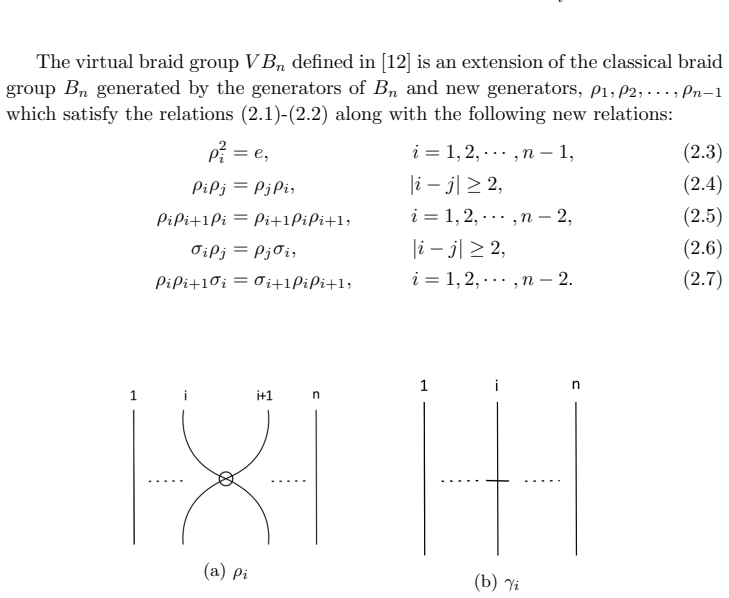
The engine of the classification is the local representation ansatz itself: each generator is represented by a block-diagonal matrix carrying one small block, a $2 \times 2$ matrix for $TVB_2 \to \mathrm{GL}_3(\mathbb{C})$, and identity blocks elsewhere, with the twist generators $\gamma_j$ forming a family of length $n$. Plugging this ansatz into the defining relations of $TVB_n$, the involutions $\rho_i^2=1$, $\gamma_j^2=1$, the commutation rules, and the key mixed relation $\rho_1\sigma_1\rho_1=\gamma_2\gamma_1\sigma_1\gamma_1\gamma_2$, turns the representation problem into an explicit polynomial system; for $n=2$ it is a system of 31 equations in the 12 entries of the four $2 \times 2$ blocks, whose solution and subsequent change-of-basis normalization produce the eight normal forms. For $n \geq 3$ the same computation is run with all blocks constant, the homogeneous case, and for $STVB_2$ the additional singular relations $\sigma_1\tau_1=\tau_1\sigma_1$ and $\rho_1\tau_1\rho_1=\gamma_2\gamma_1\tau_1\gamma_1\gamma_2$ are imposed. The non-further-reducibility of the $n$-dimensional restrictions is controlled by restricting to the braid subgroup $B_n$ and invoking the lemma that irreducibility on a subgroup forces irreducibility of the ambient representation. The paper then separately promotes the classical $\Phi$-type extension formula $\Phi_{t,u,v}(\tau_1)=t\,\zeta(\sigma_1)+u\,\zeta(\sigma_1^{-1})+vI_3$ to the twisted setting and compares it with the local extension.
What would settle it
A direct computer-algebra check would settle the classification: generate the full solution set of the defining relations for $TVB_2$ with arbitrary invertible complex $2 \times 2$ blocks for $\gamma_1,\gamma_2$, and compare the equivalence classes with the eight families of Theorem 3.1; any class not equivalent to a $\zeta_i$ refutes completeness. For the reducibility statements, take $\zeta_3$ or $\zeta_4$ with the $2 \times 2$ block of $\gamma_1=\gamma_2$ equal to $-I_2$ and a nonzero off-diagonal $\sigma_1$ block, then test whether the $\sigma_1$-block eigenvectors are common to all matrices; if such a common eigenvector exists outside the stated conditions, the 'only if' part of Theorem 3.3(iii) fails.
Extended reading notes
Core claim
The paper's central claim is that the local ansatz is rigid for $TVB_2$: if $\zeta \colon TVB_2 \to \mathrm{GL}_3(\mathbb{C})$ is any complex local representation, then after a change of basis its values are one of the eight families $\zeta_1,\dots,\zeta_8$ displayed in Theorem 3.1, with parameters constrained by inequalities such as $b^2-d^2x^2 \neq 0$ and $x \neq 0$. In all eight families the twist generators $\gamma_1,\gamma_2$ act in only two ways, either both are the identity or they are $\mathrm{diag}(-1,1,1)$ and $\mathrm{diag}(1,-1,1)$, so the classification reduces the representation theory of this local type to a short list of $2 \times 2$ blocks. Each family is unfaithful, and each contains the invariant line spanned by the third standard basis vector, hence each is reducible to a $2 \times 2$ subrepresentation; Theorem 3.3 then states which families reduce further to degree 1. For $n \geq 3$, Theorem 3.4 gives the analogous seven homogeneous local families in $\mathrm{GL}_{n+1}(\mathbb{C})$, and Theorem 4.1 gives thirteen families for $STVB_2$ into $\mathrm{M}_3(\mathbb{C})$. Finally, Theorem 5.1 and Corollary 5.2 show that the local extension $\eta_1$ of $\zeta_1$ agrees with a $\Phi$-type extension only for a specific parameter formula, so not every local representation of $TVB_2$ extends to $STVB_2$ by the $\Phi$-type prescription.
Load-bearing premise
The load-bearing step is an omitted calculation: for $n=2$ the paper states the solution of a 31-equation system in 12 unknowns without showing the full derivation, and for $n \geq 3$ and for $STVB_2$ it asserts 'a similar proof' with no equations displayed, so the completeness of the seven- and thirteen-family lists rests entirely on those hidden computations. The reducibility claims additionally assume that any common eigenvector of the $2 \times 2$ blocks must be a standard coordinate vector, which is not generally true when a block is $\pm I_2$.
Editorial extensions
If this is right
- Every complex local representation of $TVB_2$ in $\mathrm{GL}_3(\mathbb{C})$ is accounted for by eight parameterized families; no such representation is faithful, so the twisted virtual braid group does not admit a faithful $3 \times 3$ local representation.
- All eight families reduce to a $2 \times 2$ subrepresentation; types $\zeta_3$ through $\zeta_8$ sometimes reduce further to degree 1, with explicit conditions such as $b=0$ and $a \neq d$ for $\zeta_3$ and $\zeta_4$.
- For $n \geq 3$, homogeneous local representations of $TVB_n$ into $\mathrm{GL}_{n+1}(\mathbb{C})$ are exhausted by seven families; for $\zeta'_1$ through $\zeta'_4$ the $n$-dimensional reduction stays irreducible when $bc \neq 1$.
- The singular twisted virtual braid monoid $STVB_2$ has thirteen local $\mathrm{M}_3(\mathbb{C})$ families, all unfaithful and reducible to $2 \times 2$; when $\eta(\tau_1)$ is invertible these extend to $STVG_2$.
- Local extension and $\Phi$-type extension are different mechanisms: for $\zeta_1$ they agree only when $t,u,v$ satisfy the three formulas in Corollary 5.2, so there are local extensions that are not $\Phi$-type.
Reading between the lines
- Because every classified local representation is unfaithful, any faithful complex representation of $TVB_n$ must abandon the local block form or use a dimension larger than those covered here; the smallest faithful degree of $TVB_n$ is an immediate open problem.
- The equation-solving method is portable: repeating the classification over a finite field would turn parameter inequalities such as $b^2-d^2x^2 \neq 0$ into congruences and could produce new normal forms when those expressions vanish.
- The $\Phi$-type comparison for $\zeta_1$ likely represents a pattern: for each $\zeta_i$, the locus of parameters where a local extension agrees with a $\Phi$-type extension should be a proper algebraic subvariety, with Corollary 5.2 as the first explicit example.
- A testable repair of the reducibility analysis is to compute joint eigenvectors of the $2 \times 2$ blocks without assuming they are coordinate vectors; cases where the $\gamma$-block is $-I_2$ admit extra candidate common eigenvectors and would shift the reducibility-to-1 criteria.
Signed reviews
Editorial analysis
A structured set of objections, weighed in public.
Referee Report
Summary. The paper classifies complex local representations of the twisted virtual braid group TVB2 into GL3(C), obtaining eight normal forms ζ1,...,ζ8; homogeneous local representations of TVBn into GL_{n+1}(C) for n≥3, obtaining seven normal forms; and local representations of the singular twisted virtual braid group STVB2 into M3(C), obtaining thirteen normal forms. It analyzes faithfulness and irreducibility of these representations and compares local extensions with Φ-type extensions of the first family ζ1 to STVB2.
Significance. If the classification theorems are correct, the paper provides complete parameter lists for local representations in these settings, which would be a useful first step toward linearity and extension problems for twisted virtual braid groups. The families are given explicitly and are concrete enough to check. However, the irreducibility analysis contains demonstrable errors and the classification proofs omit essential computations, so the paper's advertised results are not established in the submitted form.
major comments (4)
- [§3, Theorem 3.3(i)] The claim that type ζ2 is never further reducible to degree 1 is false. Take b=0, d=2, w=0, x=1; these parameters satisfy the stated conditions (d≠0, x≠0). Then the 2×2 block of ζ2(σ1) is 2I2 and the 2×2 block of ζ2(ρ1) is the swap matrix [[0,1],[1,0]], while γ1 and γ2 are the identity. The vector (1,1,0) is a common eigenvector of all three matrices, so the representation is reducible to degree 1. The same conclusion follows with b=1, d=0, w=0, x=1, which also satisfies the stated conditions. The proof in §3 incorrectly restricts the search for common eigenvectors to the coordinate vectors (0,1) and (1,0).
- [§3, Theorem 3.3(ii)] The criterion 'reducible to degree 1 if and only if b=0 and a≠d' for types ζ3 and ζ4 is wrong. In ζ3 the 2×2 block of ρ1 is −I2 and in ζ4 it is I2; in both cases the γ blocks are I2, so every vector is an eigenvector of these blocks. Hence any eigenvector of the 2×2 block of σ1 gives a common invariant line, and such an eigenvector always exists over C. For example, ζ4 with a=1, b=1, c=0, d=1 has σ1-block [[1,1],[0,1]], whose eigenvector (1,0) is also an eigenvector of I2 and of the γ blocks; thus the invariant line is C(1,0,0). The stated condition is therefore neither necessary nor sufficient.
- [§4, Theorem 4.3] Theorem 4.3 is proved by 'a similar proof as the proof of Theorem 3.3' and inherits the same defective eigenvector analysis. A concrete counterexample to part (i) is the family η2 with x=1, z=0, a=2, b=1, f=1, g=1. These parameters satisfy the condition a^2x^2+2abxz−b^2+b^2z^2=3≠0 and x≠0. The 2×2 blocks of σ1, ρ1, τ1 are respectively [[2,1],[1,2]], [[0,1],[1,0]], and [[1,1],[1,1]], all of which fix the vector (1,1) up to scale; γ1 and γ2 are the identity. Thus span{(1,1,0)} is invariant and the representation is further reducible to degree 1, contradicting the assertion that η1,...,η4 are not further reducible.
- [§3.1, §3.3, §4.1] The completeness of the classifications is not verifiable from the submitted text. In the proof of Theorem 3.1, the reduction to q=r=0, s=1 is asserted after 'Solving this system gives directly' without presenting the 31-equation system or its solution, and the subsequent case analysis relies on this unreported step. The proofs of Theorem 3.4 and Theorem 4.1 say only 'a similar proof as the proof of Theorem 3.1 gives the required result' and provide no equations at all. Since the main contribution is a complete classification of all local representations in each setting, these omitted computations are load-bearing; the reader cannot rule out missing families or extra parameter restrictions.
minor comments (4)
- [§3, Theorem 3.1] The condition for ζ2, '(d ≠ 0 or dx ≠ ±b − bw)', is ambiguous; it should clarify that the disjunction is over d≠0 and dx ≠ ±(b−bw), and the parenthesization should be fixed.
- [§3, Theorem 3.3 proof] In Case 3 of the proof, the text refers to 'a > d' and 'd > a' for complex numbers a,d; complex numbers are not ordered. The intended condition is a≠d, and the inequalities should be removed.
- [§3, Theorem 3.4] In part (6), the parameter list says 'where b ∈ C∗' but the displayed matrices use the parameter x; this is a typo and should read x∈C∗. Also, the 2×2 blocks in parts (1)–(4) use expressions such as √b/√c and √c/√b, which require a choice of square-root branches for b,c∈C∗; the notation should be clarified or the families should be parameterized without roots.
- [§5, Corollary 5.2] The formulas for t, u, v have denominators involving b^3−b(d−1)^2x^2; the parameter conditions under which these denominators are nonzero are not stated.
Circularity Check
No significant circularity: the classifications are direct solutions of the defining relations, and the one external irreducibility criterion is cited from non-overlapping prior work.
full rationale
The paper's central results are self-contained algebra: Theorem 3.1 sets up a 31-equation system in 12 unknowns from the defining relations of TVB2 and solves it; Theorems 3.4 and 4.1 are asserted by 'a similar proof' (an omitted-computation completeness issue, not circularity). No fitted parameters are renamed as predictions; the eight families for TVB2, seven for TVBn, and thirteen for STVB2 are not derived from an ansatz equivalent to the conclusion. Theorem 3.7 uses Lemma 3.6, a standard restriction-irreducibility fact cited to the authors' own [22], and Theorem 3.3 of [9] for irreducibility of local braid-group representations. The latter is external to this paper and does not assume the target statements; the lemma is elementary and parameter-free. Self-citations in the introduction ([19], [20], [21], [25]) are contextual and not load-bearing. The paper's reducibility claims in Theorem 3.3 and Theorem 4.3 may contain genuine mathematical errors, and the equation-solving is not fully displayed, but these are correctness and completeness concerns, not circular reasoning. No step in the derivation reduces by definition to its own input.
Assumptions & free parameters
assumptions (2)
- domain assumption The group presentations of TVBn (relations (2.1)-(2.13)) and STVBn (relations (2.1)-(2.22)) are correct.
- domain assumption Theorem 3.3 of [9]: a homogeneous local representation of Bn with 2x2 block [[0,b],[c,0]] is irreducible if and only if bc != 1.
Cite this review
Pith. "Pith review of Matrix representations of the twisted virtual braid group and its extensions." pith.science (2026). https://pith.science/paper/H72LK2ZN
@misc{pith2026250603806,
  author       = {Pith},
  title        = {Pith review of: Matrix representations of the twisted virtual braid group and its extensions},
  year         = {2026},
  howpublished = {\url{https://pith.science/paper/H72LK2ZN}},
  note         = {Machine review of arXiv:2506.03806}
}
abstract
This paper classifies complex local representations of the twisted virtual braid group, $TVB_2$, into $\mathrm{GL}_3(\mathbb{C})$. It shows that such representations fall into eight types, all of which are unfaithful and reducible to a two-dimensional representation. Further reducibility to a one-dimensional representation is analyzed for specific types. The paper also examines complex homogeneous local representations of $TVB_n$ into $\mathrm{GL}_{n+1}(\mathbb{C})$ for $n \geq 3$, identifying seven unfaithful types. Additionally, complex local representations of the singular twisted virtual braid group, $STVB_2$, into $\mathrm{M}_3(\mathbb{C})$ are classified into thirteen unfaithful types. Finally, the paper demonstrates that not all complex local extensions of $TVB_2$ representations to $STVB_2$ conform to a $\Phi$-type extension.
Figures


Forward citations
Cited by 1 Pith paper
-
On the classification and irreducibility of $2$-local representations of the twin group $T_n$
A 2-local representation of the twin group reduces to an (n-1)-dimensional one, and this reduced representation is irreducible exactly when a avoids 1, -1 and roots of an explicit polynomial.
Reference graph
Works this paper leans on
-
[9]
M. Chreif and M. Dally, On the Irreducibility of Local Representations of the Braid Group Bn, Arab. J. Math. , 13 (2024) 263–273
work page 2024
-
[1]
Artin, Theorie der z¨ opfe, Abhandlungen Hamburg, 4, (1925), 47-72
E. Artin, Theorie der z¨ opfe, Abhandlungen Hamburg, 4, (1925), 47-72
work page 1925
-
[2]
Baez, Link Invariant of Finite Type and Pertubation Theory, Lett
J. Baez, Link Invariant of Finite Type and Pertubation Theory, Lett. Math. Phys. , 26 (1992) 43–51
work page 1992
-
[3]
V. Bardakov, N. Chbili, and T. Kozlovskaya, Extensions of Braid Group Represen- tations to the Monoid of Singular Braids, Mediterr. J. Math. , 21 (2024) 180
work page 2024
-
[4]
Bigelow, The Burau Representation is Not Faithful For n = 5, Geometry & Topology, 3 (1999) 397-–404
S. Bigelow, The Burau Representation is Not Faithful For n = 5, Geometry & Topology, 3 (1999) 397-–404
work page 1999
-
[5]
Bigelow, Braid groups are linear, J
S. Bigelow, Braid groups are linear, J. Amer. Math. Soc. , 14 (2000) 471–486
work page 2000
-
[6]
J. Birman, Braids, Links and Mapping Class Groups, Annals of Mathematical stud- ies, Princeton University Press, 82 (1974)
work page 1974
-
[7]
Birman, New Point of View in Knot Theory, Bull
J. Birman, New Point of View in Knot Theory, Bull. Amer. Math. Soc. , 28 (1993) 253-287
work page 1993
Show all 26 references
-
[8]
Burau, Braids, Uber Zopfgruppen and Gleichsinnig Verdrillte Verkettungen, Abh
W. Burau, Braids, Uber Zopfgruppen and Gleichsinnig Verdrillte Verkettungen, Abh. Math. Semin. Hamburg Univ. , 11 (1936) 179–186
1936
-
[10]
R. Fenn, E. Keyman, and C. Rourke, The Singular Braid Monoid Embeds in a Group, J. Knot Theory & Ramifications , 7 (1998) 881–892
1998
-
[11]
Formanek, Braid Group Representations of Low Degree, Proc
E. Formanek, Braid Group Representations of Low Degree, Proc. London Math. Soc., 73 (1996) 279—322
1996
-
[12]
Kauffman and S
L. Kauffman and S. Lambropoulou, Virtual Braids, Fund. Math., 184 (2004) 159– 186
2004
-
[13]
Krammer, Braid Groups are Linear, Annals Math., 155 (2002) 131–156
D. Krammer, Braid Groups are Linear, Annals Math., 155 (2002) 131–156
2002
-
[14]
Lawrence, Homological Representations of the Hecke Algebra, Comm
R. Lawrence, Homological Representations of the Hecke Algebra, Comm. Math. Phys., 135 (1990) 141—191
1990
-
[15]
Levaillant and D
C. Levaillant and D. Wales, Parameters For Which the Lawrence–Krammer Repre- sentation is Reducible, Journal of Algebra , 323 (2010) 1966–1982
2010
-
[16]
Long and M
D. Long and M. Paton, The Burau Representation of the Braid Group Bn is Not Faithful For n ≥ 6, Topology, 32 (1992) 439–447
1992
-
[17]
Mikhalchishina, Local Representations of Braid Groups, Sib
Y. Mikhalchishina, Local Representations of Braid Groups, Sib. Math. J. , 54 (2013) 666–678
2013
-
[18]
Moody, The Burau Representation of the Braid Group Bn is Not Faithful For Large n, Bull
J. Moody, The Burau Representation of the Braid Group Bn is Not Faithful For Large n, Bull. Amer. Math. Soc. , 25 (1991) 379–384. August 23, 2025 4:28 M˙Nasser 24
1991
-
[19]
Mayassi, M
T. Mayassi, M. Nasser, Classification of Homogeneous Local Representations of the Singular Braid Monoid, arXiv:2501.13404v1
-
[20]
Nasser, On the Faithfulness of a Family of Representations of the Singular Braid Monoid SMn, arXiv:2405.04888v2
M. Nasser, On the Faithfulness of a Family of Representations of the Singular Braid Monoid SMn, arXiv:2405.04888v2
-
[21]
Nasser, Local Extensions and Φ-Type Extensions of Some Local Representations of the Braid Group Bn to the Singular Braid Monoid SMn, Vietnam Journal of Mathematics, (2024) 1–12
M. Nasser, Local Extensions and Φ-Type Extensions of Some Local Representations of the Braid Group Bn to the Singular Braid Monoid SMn, Vietnam Journal of Mathematics, (2024) 1–12
2024
-
[22]
Nasser, On Extensions of the Standard Representation of the Braid Group to the Singular Braid Group, arXiv:2504.09256v1
M. Nasser, On Extensions of the Standard Representation of the Braid Group to the Singular Braid Group, arXiv:2504.09256v1
-
[23]
K. Negi, M. Prabhakar, and S. Kamada, Twisted Virtual Braids and Twisted Links, arXiv:2302.13244v2
-
[24]
Paris, The Proof of Birman’s Conjecture on Singular Braid Monoids, Geometry and Topology, 8 (2004) 1281–1300
L. Paris, The Proof of Birman’s Conjecture on Singular Braid Monoids, Geometry and Topology, 8 (2004) 1281–1300
2004
-
[25]
Prabhakar, K
M. Prabhakar, K. Negi, The Monoid Structure of Singular Twisted Virtual Braids, arXiv:2502.08965v1
-
[26]
Vinberg, Linear Representations of Groups, Translated from the Russian by A
E. Vinberg, Linear Representations of Groups, Translated from the Russian by A. Iacob (Birkh¨ auser, 1989)
1989
Reviewed August 7, 2026 · model on record in the stance chip above.
Discussion (0). Continue with ORCID to comment.