REVIEW 4 major objections 5 minor 3 cited by
The HST Legacy Archival Uniform Reduction of Local Group Imaging (LAURELIN). I. Photometry and Star Formation Histories for 36 Ultra-faint Dwarf Galaxies
T0 review · 4 major / 5 minor · reviewed 2026-08-07 · deepseek-v4-flash
Pith's one-line read By uniformly reducing deep space-based imaging of 36 ultra-faint dwarf galaxies, this paper finds they stopped forming stars about 12.5 billion years ago, near the end of reionization, with a hint that LMC and first-infall satellites…
desk verdict Solid, useful data-release paper for UFD SFHs; the body's 5σ environmental delay is not robust and should be downgraded to the abstract's 2σ upper limit. read the letter →
The pith
A machine-rendered reading of the paper's core claim, the machinery that carries it, and where it could break.
The reading
What carries the argument
The object that carries the argument is the ancient main-sequence turnoff (MSTO) region of each galaxy's color-magnitude diagram: the count and color spread of stars around the turnoff encode the age distribution of the oldest stellar populations. The pipeline is uniform resolved-star photometry in two filters, followed by maximum-likelihood fitting of synthetic Hess diagrams with stellar models that cover the extremely low metallicities of ultra-faint dwarfs, including simple-stellar-population fits to fix distance and foreground dust per galaxy and additive models for foreground stars and background galaxies. Quenching times are read off the cumulative star formation histories: $\tau_{80}$ is the lookback time at which the cumulative stellar mass fraction reaches 0.8, and uncertainties come from Hamiltonian Monte Carlo sampling of the fit.
What would settle it
Recompute the inverse-variance-weighted group averages after removing the single most ancient, highest-weight long-term Milky Way galaxy (Boo I): if the $5\sigma$ delay drops to roughly $2\sigma$ or below, the environmental signal rests on one object. Alternatively, measure $\tau_{80}$ for a sample of isolated field ultra-faint dwarfs beyond the Local Group with $M_{V,\mathrm{eff}} \leq -2.5$; if they quench as late as the LMC and first-infall groups, the modern kinematic grouping does not trace the reionization-era environment and the delay is not a patchy-reionization signature.
Extended reading notes
Core claim
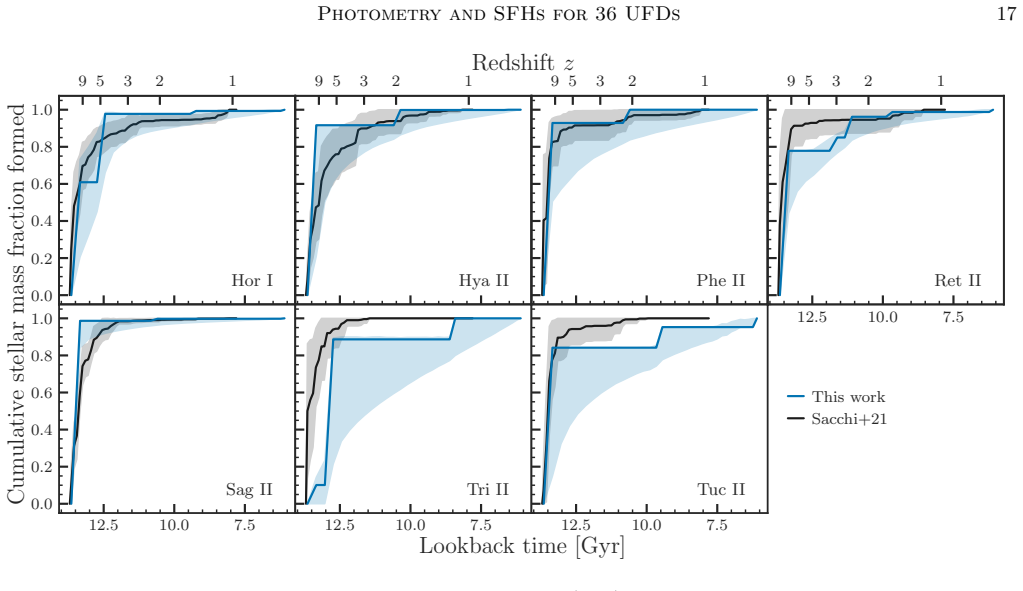
On the paper's own terms, the central result is an ensemble quenching epoch: defining quenching as the lookback time by which 80% of the stellar mass formed ($\tau_{80}$), the 36 galaxies quench at an average $12.48 \pm 0.18$ Gyr ago, or $z = 4.6^{+0.6}_{-0.5}$ in $\Lambda$CDM, which the authors identify as consistent with reionization-driven suppression of star formation. The secondary result is environmental: ultra-faint dwarfs classified as LMC satellites or first-infall objects show a quenching delay of about 800 Myr or less relative to long-term Milky Way satellites at $2\sigma$ significance in the fiducial analysis, with inverse-variance-weighted averages producing larger differences (up to $5\sigma$) that depend strongly on one ancient, high-weight galaxy. The paper also establishes a practical limit: below $M_{V,\mathrm{eff}} \approx -2.5$, corresponding to roughly 100 main-sequence-turnoff stars, the stochastic sparsity of the stellar population dominates and per-object star formation histories lose the precision needed to test patchy reionization.
Load-bearing premise
The interpretation of the 800 Myr delay as evidence of patchy reionization assumes that a galaxy's current kinematic classification (long-term Milky Way satellite, first infall, or LMC satellite) reflects the density of its environment at the time of reionization, an assumption the paper itself says is not well constrained.
Editorial extensions
If this is right
- If the average quenching time is correct, the ultra-faint dwarfs as a population are direct fossils of reionization: their star formation ended just as the intergalactic ultraviolet background finished reionizing the Local Group volume.
- The roughly 800 Myr upper limit on the quenching delay sets the scale of the patchy-reionization signal that future samples must either confirm as real or rule out as a small-sample artifact.
- The $M_{V,\mathrm{eff}} \leq -2.5$ threshold gives survey designers a selection rule: fainter systems cannot deliver per-object star formation histories precise enough for quenching-time differences, so future programs should target the roughly 100-turnoff-star regime.
- Because precision saturates at a signal-to-noise ratio near 100 at the turnoff, investing in wider footprints rather than deeper integrations is the higher-yield strategy for the faintest galaxies.
- The public photometry catalogs, with distances and extinctions measured on the same system, allow any group to reproduce the ensemble averages and test alternative grouping schemes.
Reading between the lines
- The delay signal's physical interpretation stands or falls with the assumption, which the paper explicitly flags, that today's kinematic classes trace reionization-era environments; if they do not, the 800 Myr difference measures something about orbital histories rather than patchy reionization.
- A natural extension the paper leaves implicit is to apply the same uniform pipeline to isolated field ultra-faint dwarfs outside the Local Group; if isolated systems quench as late as the LMC and first-infall groups, the environmental interpretation would need revision.
- The gap between the $2\sigma$ unweighted result and the $5\sigma$ weighted result implies that the true significance of the delay depends on how much weight one gives to the oldest, most precisely measured long-term Milky Way satellites; re-deriving the averages with a jackknife over those galaxies would be a cheap, decisive robustness test.
- Future wide-field space telescopes with the same filters could enlarge the LMC and first-infall samples from three to five objects to tens, which is the direct way to beat the stochastic noise that currently caps the precision.
Signed reviews
Editorial analysis
A structured set of objections, weighed in public.
Referee Report
Summary. The paper presents a homogeneous reduction of HST ACS/WFC F606W/F814W imaging for 36 ultra-faint dwarf galaxies, producing public photometric catalogs, artificial-star-based completeness, SSP distance and extinction measurements, and MATCH-based star formation histories. The main scientific results are an ensemble mean quenching time of 12.48 ± 0.18 Gyr ago (defined as the lookback time by which 80% of stellar mass formed), a comparison of quenching times among kinematic groups (long-term Milky Way satellites, first-infall systems, and LMC satellites), and a recommended threshold of M_V,eff ≤ −2.5 (about 100 MSTO stars) for robust MSTO-based SFH measurement. The paper also validates its distances against RR Lyrae distances for 18 galaxies and compares its SFHs with previous literature measurements.
Significance. If the results hold, this paper provides a valuable homogeneous legacy dataset for Local Group science: uniformly reduced photometry and SFHs for 36 UFDs, a practical design threshold for future MSTO-based SFH programs, and an independent empirical anchor for reionization-quenching scenarios. The distance validation against RR Lyrae stars is a particular strength, as is the public data release and the explicit discussion of which galaxies yield reliable SFHs. The central astrophysical claims are, however, more modest than the 5σ language in parts of the paper: the robustly supported result is an approximately 2σ, ≲800 Myr delay, which the abstract and conclusions state correctly. The paper's significance therefore rests on the uniformity and legacy value of the data products, and on the ensemble quenching time, more than on the environmental delay claim.
major comments (4)
- [§4.3, Table 4] The claim of a quenching delay 'at up to 5σ significance' is not robust as presented. Table 4 gives a weighted long-term MW τ80 of 13.38 ± 0.05 Gyr, and this value is dominated by Boötes I, whose Table 3 τ80 is 13.40+0.00−0.06, with the zero upper uncertainty reflecting truncation at the 13.8 Gyr grid boundary. Because §3.3 states that only random MCMC uncertainties are used and no systematic floor is applied, the inverse-variance weighting over-credits boundary-pinned ancient systems. Adding a conservative 0.3–0.5 Gyr systematic floor to each galaxy's σ(τ80) would substantially reduce Boo I's weight and move the weighted mean toward the unweighted value, dropping the reported significances to roughly 2σ. I request that the authors either remove or explicitly qualify the 5σ statement, or recompute the weighted averages with a systematic floor and report the resulting significances.
- [§3.3, Figure 9, Table 3] The absolute quenching time of 12.48 ± 0.18 Gyr is quoted with statistical errors only, while Table 3 shows many τ80 uncertainties with +0.00 upper errors (e.g., Boo I, Sag II, ComBer), indicating fits pinned to the oldest grid edge. In addition, Figure 6 reports no formal uncertainties for the SSP-based distances, and those distance uncertainties are not propagated into the SFHs. Because the fits also assume a fixed 10–13.8 Gyr age range, BaSTI models, a Kroupa IMF, a 0.35 binary fraction, and a monotonic age–metallicity relation, the absence of systematic uncertainties makes the precision of the ensemble mean potentially misleading. I ask the authors to quantify the sensitivity of τ80 to these choices for at least a subset of galaxies, or to re-label the 12.48 ± 0.18 Gyr value explicitly as a model-dependent estimate whose systematic error is not yet evaluated.
- [Abstract and §5 vs. §4.3 and Table 4] The abstract and conclusions state a delay of '≲800 Myr at 2σ', but §4.3 reports culled weighted differences of Δτ80 = 1.65 ± 0.31 Gyr for long-term MW versus LMC and 1.33 ± 0.41 Gyr for long-term MW versus first-infall. These statements are mutually inconsistent as written: a measured 1.65 Gyr delay cannot simultaneously be an upper limit of 800 Myr. Please clarify which estimator (unweighted vs. weighted, culled vs. full sample) underlies the headline 800 Myr bound, and state explicitly whether this is an upper limit on the true physical delay or on the detectable signal after accounting for the systematic and grouping caveats acknowledged in §4.3.
- [§4.3] The interpretation of the quenching delay as an environmental signal depends on the premise that today's kinematic groups (long-term MW, first infall, LMC) trace different large-scale density environments at the epoch of reionization. The paper explicitly acknowledges in §4.3 that 'the orbital histories are not well-constrained back to the reionization-era' and that some simulations place all present-day UFDs in comparably low-density regions. Since this premise is not independently tested in the paper, the delay should be presented as conditional on that assumption. If the authors wish to retain the stronger environmental interpretation, they should add a robustness test using alternative group assignments, or show explicitly how the inferred delay changes under plausible reionization-era orbit scenarios.
minor comments (5)
- [§2.1] The phrase 'of of' appears in the sentence 'spanning an absolute V magnitude range of of −7.1 ≤ M_V ≤ +0.0'; please correct the typo.
- [§4.3] The word 'unceratinties' in the discussion of unweighted averages is a typo for 'uncertainties'; please correct it.
- [Table 3] Many τ80 entries have +0.00 upper uncertainties, which readers will immediately recognize as grid-boundary truncation; a table note explicitly stating that +0.00 upper errors indicate the 13.8 Gyr fitting boundary would improve clarity and prevent misinterpretation of these as genuinely zero upper uncertainty.
- [Figure 6 and §3.3] The caption of Figure 6 correctly states that no formal uncertainties are calculated for the SSP distances, but the text in §3.3 does not explain how distance or extinction uncertainties enter the SFH uncertainties; a sentence on whether these are propagated, marginalized, or ignored would help the reader interpret the reported 68% intervals.
- [§4.2] The comparison with Brown+14 notes different adopted oldest-age limits (14.1 vs. 13.7 Gyr) but does not state whether this could bias the τ80 comparison for the six galaxies in common; a brief comment on the expected size of this effect would be useful.
Circularity Check
No significant circularity: quenching times are CMD-fit outputs benchmarked against independent RR Lyrae distances and literature SFHs.
full rationale
The paper's central quantities (distances, extinctions, SFHs, tau80 values, ensemble averages, and quenching delays) are all outputs of a uniform CMD-fitting pipeline (DOLPHOT/MATCH/BaSTI), not inputs. The distance and extinction fits in Section 3.1 assume ancient SSP ages, but they are validated against independent RR Lyrae distances for 18 of 36 galaxies, with |Delta mu| <= 0.02 mag on average (Section 3.1 and Figure 6), and the SFH fits themselves allow ages from 6 to 13.8 Gyr (Section 3.3), so the resulting quenching times are not forced by the distance prior. The ensemble quenching time of 12.48 +/- 0.18 Gyr and the kinematic-group delays are compared against, and found consistent with, independent external measurements (Brown et al. 2014; Sacchi et al. 2021; Simon et al. 2021, 2023; Gallart et al. 2021), rather than being derived from those papers. Kinematic group assignments come from Gaia-proper-motion orbital studies (Kallivayalil et al. 2018; Patel et al. 2020; Pace et al. 2022) and are external to the SFH fits; the paper explicitly acknowledges that mapping present-day orbits to reionization-era environments is an assumption and uncertain (Section 4.3). The self-citations are to standard methodology (MATCH, Savino et al. 2023, 2025) and prior comparison samples; none functions as an unverified uniqueness theorem or a fitted input renamed as a prediction. The paper explicitly flags missing systematic uncertainties ('We do not compute systematic uncertainties', Section 3.3) and the kinematic-to-environment caveat ('the orbital histories are not well-constrained back to the reionization-era', Section 4.3); these are honest limitations that affect robustness, not circular steps. The body transparently reports the weighted/unweighted discrepancy and settles on a 2-sigma upper limit (about 800 Myr) in the abstract and conclusions, so the 5-sigma weighted value is presented as method-dependent rather than a separate predicted quantity. No load-bearing step reduces by construction to its own inputs.
Assumptions & free parameters
free parameters (5)
- Distance modulus per galaxy (μ) =
16.58 to 22.65 mag (Table 2)
- Foreground extinction per galaxy (AV) =
0.01 to 0.50 mag (Table 2)
- SSP age and metallicity per galaxy =
log t 10.08-10.13, [Fe/H] -3.1 to -1.5 (Table 2)
- Foreground/background scaling factors =
Free in CMD fit
- SFH age-bin mass fractions =
36 galaxies x ~36 age bins
assumptions (6)
- domain assumption BaSTI stellar models accurately represent ancient, extremely metal-poor ([Fe/H] < -2) populations with [α/Fe]=0.4
- domain assumption The MATCH maximum-likelihood CMD fitting, with Poisson statistics and the -zinc monotonic age-metallicity constraint, produces unbiased SFHs
- domain assumption IMFs and binary parameters: Kroupa IMF (0.08-120 M⊙), binary fraction 0.35, metallicity dispersion 0.2 dex
- domain assumption The kinematic groups (long-term MW, first infall, LMC) inferred from Gaia proper motions trace distinct reionization-era environments
- domain assumption The age grid upper limit of 13.8 Gyr and the F606W-F814W filter pair allow the true star formation history of UFDs to be recovered
- domain assumption The RR Lyrae distance comparison validates the SSP distances
Cite this review
Pith. "Pith review of The HST Legacy Archival Uniform Reduction of Local Group Imaging (LAURELIN). I. Photometry and Star Formation Histories for 36 Ultra-faint Dwarf Galaxies." pith.science (2026). https://pith.science/paper/H75DPMTX
@misc{pith2026250518252,
  author       = {Pith},
  title        = {Pith review of: The HST Legacy Archival Uniform Reduction of Local Group Imaging (LAURELIN). I. Photometry and Star Formation Histories for 36 Ultra-faint Dwarf Galaxies},
  year         = {2026},
  howpublished = {\url{https://pith.science/paper/H75DPMTX}},
  note         = {Machine review of arXiv:2505.18252}
}
abstract
We present uniformly measured resolved stellar photometry and star formation histories (SFHs) for 36 nearby ($\lesssim$ 400 kpc) ultra-faint dwarf galaxies (UFDs; $-7.1 \le M_V \le +0.0$) from new and archival HST imaging. We measure homogeneous distances to all systems via isochrone fitting and find good agreement ($\le$ 2%) for the 18 UFDs that have literature RR Lyrae distances. From the ensemble of SFHs, we find: (i) an average quenching time (here defined as the lookback time by which 80% of the stellar mass formed, $\tau_{80}$) of 12.48 $\pm$ 0.18 Gyr ago ($z = 4.6_{-0.5}^{+0.6}$), which is compatible with reionization-based quenching scenarios; and (ii) modest evidence of a delay ($\lesssim$ 800 Myr) in quenching times of UFDs thought to be satellites of the LMC or on their first infall, relative to long-term Galactic satellites, which is consistent with previous findings. We show that robust SFH measurement via the ancient main sequence turnoff (MSTO) requires a minimum effective luminosity (i.e., luminosity within the observed field of view) of $M_V \leq -2.5$, which corresponds to $\sim$100 stars around the MSTO. We also find that increasing the S/N above $\sim$100 at the MSTO does not improve SFH precision, which remains dominated by stochastic effects associated with the number of available stars. A main challenge driving the precision of UFD SFHs is limitations in the accuracy of foreground dust maps. We make all photometry catalogs public as the first data release of a larger HST archival program targeting all dwarf galaxies within $\sim$1.3 Mpc.
Figures


Figures from the paper (10 more)



Forward citations
Cited by 3 Pith papers
-
Chemodynamics of Bo\"otesI with $S^{5}$: Revised Velocity Gradient, Dark Matter Density, and Galactic Chemical Evolution Constraints
Boötes I shows a shallow 4σ intrinsic velocity gradient aligned with its orbit, a negative metallicity gradient, and a dark matter profile that weakly favors a cusp over a core.
-
A Unified Framework Connecting Chemical Enrichment to Resolved Star Formation Histories with Applications to Local Group Dwarf Irregulars
Modeling metallicity as a power law of cumulative stellar mass fits four dwarf CMDs; WLM's enrichment history favors FIREbox over TNG50 and Galacticus.
-
Spectroscopic Analysis of Pictor II: a very low metallicity ultra-faint dwarf galaxy bound to the Large Magellanic Cloud
Pictor II is spectroscopically confirmed as an extremely metal-poor, dark matter-dominated ultra-faint dwarf galaxy that is very likely bound to the Large Magellanic Cloud.
Reference graph
Works this paper leans on
-
[1]
2022,, Instrument Science Report WFC3 2022-5, 55 pages
Anderson, J. 2022,, Instrument Science Report WFC3 2022-5, 55 pages
2022
-
[2]
Anderson, J., & King, I. R. 2000, PASP, 112, 1360, doi: 10.1086/316632
doi:10.1086/316632 2000
-
[3]
Anderson, J., & King, I. R. 2006,, Instrument Science Report ACS 2006-01 21 http://americano.dolphinsim.com/dolphot/dolphot.pdf Astropy Collaboration, Robitaille, T. P., Tollerud, E. J., et al. 2013, A&A, 558, A33, doi: 10.1051/0004-6361/201322068 Astropy Collaboration, Price-Whelan, A. M., Sip˝ ocz, B. M., et al. 2018, AJ, 156, 123, doi: 10.3847/1538-388...
-
[4]
2018, ApJL, 856, L22, doi: 10.3847/2041-8213/aab14d 22 Durbin et al
Aubert, D., Deparis, N., Ocvirk, P., et al. 2018, ApJL, 856, L22, doi: 10.3847/2041-8213/aab14d 22 Durbin et al. T able 5.Description of columns in the DOLPHOT photometric catalogs. Column Type Unit Description ID str Unique source identifier within the field RA float32 deg Right Ascension (ICRS) DEC float32 deg Declination (ICRS) X float32 pix X position...
-
[5]
Avila, R. J., Hack, W., Cara, M., et al. 2015, in Astronomical Society of the Pacific Conference Series, Vol. 495, Astronomical Data Analysis Software an Systems XXIV (ADASS XXIV), ed. A. R. Taylor & E. Rosolowsky, 281, doi: 10.48550/arXiv.1411.5605
-
[6]
2017,, Instrument Science Report WFC3 2017-19, 4 pages
Bajaj, V. 2017,, Instrument Science Report WFC3 2017-19, 4 pages
2017
-
[7]
2020, in American Astronomical Society Meeting Abstracts, Vol
Bajaj, V., & Anderson, J. 2020, in American Astronomical Society Meeting Abstracts, Vol. 235, American Astronomical Society Meeting Abstracts #235, 109.07
2020
-
[8]
Battaglia, G., Taibi, S., Thomas, G. F., & Fritz, T. K. 2022, A&A, 657, A54, doi: 10.1051/0004-6361/202141528
Show all 155 references
-
[9]
2015, ApJ, 807, 50, doi: 10.1088/0004-637X/807/1/50
Bechtol, K., Drlica-Wagner, A., Balbinot, E., et al. 2015, ApJ, 807, 50, doi: 10.1088/0004-637X/807/1/50
2015 doi
-
[10]
D., Bolton, J
Becker, G. D., Bolton, J. S., Madau, P., et al. 2015, MNRAS, 447, 3402, doi: 10.1093/mnras/stu2646
2015 doi
-
[11]
Lacey, C. G. 2003, MNRAS, 343, 679, doi: 10.1046/j.1365-8711.2003.06709.x
2003
-
[13]
2007, ApJ, 668, 949, doi: 10.1086/521385 Photometry and SFHs for 36 UFDs 23
Besla, G., Kallivayalil, N., Hernquist, L., et al. 2007, ApJ, 668, 949, doi: 10.1086/521385 Photometry and SFHs for 36 UFDs 23
2007 doi
-
[14]
2015, ApJ, 807, 154, doi: 10.1088/0004-637X/807/2/154
Bland-Hawthorn, J., Sutherland, R., & Webster, D. 2015, ApJ, 807, 154, doi: 10.1088/0004-637X/807/2/154
2015 doi
-
[15]
S., & Ricotti, M
Bovill, M. S., & Ricotti, M. 2009, ApJ, 693, 1859, doi: 10.1088/0004-637X/693/2/1859
2009 doi
-
[16]
Boylan-Kolchin, M., & Weisz, D. R. 2021, MNRAS, 505, 2764, doi: 10.1093/mnras/stab1521
2021 doi
-
[17]
R., Bullock, J
Boylan-Kolchin, M., Weisz, D. R., Bullock, J. S., & Cooper, M. C. 2016, MNRAS, 462, L51, doi: 10.1093/mnrasl/slw121
2016 doi
-
[18]
A., & Veljanoski, J
Breddels, M. A., & Veljanoski, J. 2018b, A&A, 618, A13, doi: 10.1051/0004-6361/201732493
-
[19]
M., Tumlinson, J., Geha, M., et al
Brown, T. M., Tumlinson, J., Geha, M., et al. 2014, ApJ, 796, 91, doi: 10.1088/0004-637X/796/2/91
2014 doi
-
[20]
2019, MNRAS, 483, 1314, doi: 10.1093/mnras/sty2913
Frings, J. 2019, MNRAS, 483, 1314, doi: 10.1093/mnras/sty2913
2019 doi
-
[21]
S., Kravtsov, A
Bullock, J. S., Kravtsov, A. V., & Weinberg, D. H. 2000, ApJ, 539, 517, doi: 10.1086/309279
2000 doi
-
[22]
Strigari, L. E. 2010, ApJ, 710, 408, doi: 10.1088/0004-637X/710/1/408
2010 doi
-
[23]
L., Sand, D
Carlin, J. L., Sand, D. J., Mu˜ noz, R. R., et al. 2017, AJ, 154, 267, doi: 10.3847/1538-3881/aa94d0
2017 doi
- [24]
-
[25]
P., et al
Cignoni, M., Sabbi, E., van der Marel, R. P., et al. 2015, ApJ, 811, 76, doi: 10.1088/0004-637X/811/2/76
2015 doi
-
[26]
J., Fouesneau, M., Hogg, D
Dalcanton, J. J., Fouesneau, M., Hogg, D. W., et al. 2015, ApJ, 814, 3, doi: 10.1088/0004-637X/814/1/3 D’Aloisio, A., McQuinn, M., & Trac, H. 2015, ApJL, 813, L38, doi: 10.1088/2041-8205/813/2/L38
2015 doi
-
[27]
R., Ocvirk, P., et al
Dawoodbhoy, T., Shapiro, P. R., Ocvirk, P., et al. 2018, MNRAS, 480, 1740, doi: 10.1093/mnras/sty1945 de Jong, J. T. A., Rix, H. W., Martin, N. F., et al. 2008, AJ, 135, 1361, doi: 10.1088/0004-6256/135/4/1361 de Jong, J. T. A., Yanny, B., Rix, H.-W., et al. 2010, ApJ, 714, 66...
2018 doi
-
[28]
Delchambre, L., Bailer-Jones, C. A. L., Bellas-Velidis, I., et al. 2023, A&A, 674, A31, doi: 10.1051/0004-6361/202243423
2023 doi
-
[29]
2016,, Astrophysics Source Code Library, record ascl:1608.013 http://ascl.net/1608.013
Dolphin, A. 2016,, Astrophysics Source Code Library, record ascl:1608.013 http://ascl.net/1608.013
2016
-
[30]
Dolphin, A. E. 2000, PASP, 112, 1383, doi: 10.1086/316630
2000 doi
-
[31]
Dolphin, A. E. 2002, MNRAS, 332, 91, doi: 10.1046/j.1365-8711.2002.05271.x
2002
-
[32]
Dolphin, A. E. 2012, ApJ, 751, 60, doi: 10.1088/0004-637X/751/1/60
2012 doi
-
[33]
Dolphin, A. E. 2013, ApJ, 775, 76, doi: 10.1088/0004-637X/775/1/76
2013 doi
-
[34]
2016, ApJS, 222, 8, doi: 10.3847/0067-0049/222/1/8
Dotter, A. 2016, ApJS, 222, 8, doi: 10.3847/0067-0049/222/1/8
2016 doi
-
[35]
S., et al
Drlica-Wagner, A., Bechtol, K., Rykoff, E. S., et al. 2015, ApJ, 813, 109, doi: 10.1088/0004-637X/813/2/109
2015 doi
-
[36]
D., Pendleton, B
Duane, S., Kennedy, A. D., Pendleton, B. J., & Roweth, D. 1987, Physics Letters B, 195, 216, doi: 10.1016/0370-2693(87)91197-X
1987 doi
-
[37]
1992, MNRAS, 256, 43P, doi: 10.1093/mnras/256.1.43P
Efstathiou, G. 1992, MNRAS, 256, 43P, doi: 10.1093/mnras/256.1.43P
1992 doi
-
[38]
P., Charlot, S., et al
Endsley, R., Stark, D. P., Charlot, S., et al. 2021, MNRAS, 502, 6044, doi: 10.1093/mnras/stab432
2021 doi
-
[39]
2021, MNRAS, 507, 4211, doi: 10.1093/mnras/stab2437
Engler, C., Pillepich, A., Pasquali, A., et al. 2021, MNRAS, 507, 4211, doi: 10.1093/mnras/stab2437
2021 doi
-
[40]
N., et al
Escala, I., Wetzel, A., Kirby, E. N., et al. 2018, MNRAS, 474, 2194, doi: 10.1093/mnras/stx2858
2018 doi
-
[41]
Ferraro, S., & Smith, K. M. 2018, PhRvD, 98, 123519, doi: 10.1103/PhysRevD.98.123519
2018 doi
- [42]
-
[43]
A., Magnier, E
Flewelling, H. A., Magnier, E. A., Chambers, K. C., et al. 2020, ApJS, 251, 7, doi: 10.3847/1538-4365/abb82d
2020 doi
-
[44]
S., McCarthy, I
Font, A. S., McCarthy, I. G., & Belokurov, V. 2021, MNRAS, 505, 783, doi: 10.1093/mnras/stab1332
2021 doi
-
[45]
K., Battaglia, G., Pawlowski, M
Fritz, T. K., Battaglia, G., Pawlowski, M. S., et al. 2018, A&A, 619, A103, doi: 10.1051/0004-6361/201833343
2018 doi
- [46]
-
[47]
W., Weisz, D
Fu, S. W., Weisz, D. R., Starkenburg, E., et al. 2023, ApJ, 958, 167, doi: 10.3847/1538-4357/ad0030
2023 doi
-
[48]
R., Oh, S
Furlanetto, S. R., Oh, S. P., & Briggs, F. H. 2006, PhR, 433, 181, doi: 10.1016/j.physrep.2006.08.002
2006 doi
-
[49]
R., Zaldarriaga, M., & Hernquist, L
Furlanetto, S. R., Zaldarriaga, M., & Hernquist, L. 2004, ApJ, 613, 1, doi: 10.1086/423025
2004 doi
-
[50]
2007, in IAU Symposium, Vol
Gallart, C., & LCID Team. 2007, in IAU Symposium, Vol. 241, Stellar Populations as Building Blocks of Galaxies, ed. A. Vazdekis & R. Peletier, 290–294, doi: 10.1017/S1743921307008186
2007 doi
-
[51]
2021, ApJ, 909, 192, doi: 10.3847/1538-4357/abddbe
Gallart, C., Monelli, M., Ruiz-Lara, T., et al. 2021, ApJ, 909, 192, doi: 10.3847/1538-4357/abddbe
2021 doi
- [52]
-
[53]
F., et al
Garrison-Kimmel, S., Wetzel, A., Hopkins, P. F., et al. 2019, MNRAS, 489, 4574, doi: 10.1093/mnras/stz2507 24 Durbin et al
2019 doi
-
[54]
E., Monaco, L., et al
Gilmore, G., Norris, J. E., Monaco, L., et al. 2013, ApJ, 763, 61, doi: 10.1088/0004-637X/763/1/61
2013 doi
-
[55]
2017, http://ascl.net/1708.004
Ginsburg, A., Parikh, M., Woillez, J., et al. 2017, http://ascl.net/1708.004
2017
-
[56]
M., Brasseur, C
Ginsburg, A., Sip˝ ocz, B. M., Brasseur, C. E., et al. 2019, AJ, 157, 98, doi: 10.3847/1538-3881/aafc33
2019 doi
-
[57]
2021,, v0.4.5, Zenodo Zenodo, doi: 10.5281/zenodo.591669
Ginsburg, A., Sip˝ ocz, B., Parikh, M., et al. 2021,, v0.4.5, Zenodo Zenodo, doi: 10.5281/zenodo.591669
2021 doi
-
[58]
2012, The DrizzlePac Handbook (Baltimore: STScI)
Gonzaga, S., Hack, W., Fruchter, A., & Mack, J. 2012, The DrizzlePac Handbook (Baltimore: STScI)
2012
-
[59]
2019, ApJ, 887, 93, doi: 10.3847/1538-4357/ab5362
Finkbeiner, D. 2019, ApJ, 887, 93, doi: 10.3847/1538-4357/ab5362
2019 doi
-
[60]
J., Dencheva, N., & Fruchter, A
Hack, W. J., Dencheva, N., & Fruchter, A. S. 2013, in Astronomical Society of the Pacific Conference Series, Vol. 475, Astronomical Data Analysis Software and Systems XXII, ed. D. N. Friedel, 49
2013
-
[61]
R., Millman, K
Harris, C. R., Millman, K. J., van der Walt, S. J., et al. 2020, Nature, 585, 357, doi: 10.1038/s41586-020-2649-2
2020 doi
-
[62]
L., Pietrinferni, A., Cassisi, S., et al
Hidalgo, S. L., Pietrinferni, A., Cassisi, S., et al. 2018, ApJ, 856, 125, doi: 10.3847/1538-4357/aab158
2018 doi
-
[63]
L., Mack, J., Avila, R., et al
Hoffmann, S. L., Mack, J., Avila, R., et al. 2021, in American Astronomical Society Meeting Abstracts, Vol. 53, American Astronomical Society Meeting Abstracts, 216.02
2021
-
[64]
2016, ApJ, 832, 21, doi: 10.3847/0004-637X/832/1/21
Homma, D., Chiba, M., Okamoto, S., et al. 2016, ApJ, 832, 21, doi: 10.3847/0004-637X/832/1/21
2016 doi
-
[65]
Hunter, J. D. 2007, Computing in Science and Engineering, 9, 90, doi: 10.1109/MCSE.2007.55
2007 doi
-
[66]
2017, ApJ, 848, 85, doi: 10.3847/1538-4357/aa8c80
Jeon, M., Besla, G., & Bromm, V. 2017, ApJ, 848, 85, doi: 10.3847/1538-4357/aa8c80
2017 doi
-
[67]
P., Simon, J
Ji, A. P., Simon, J. D., Frebel, A., Venn, K. A., & Hansen, T. T. 2019, ApJ, 870, 83, doi: 10.3847/1538-4357/aaf3bb
2019 doi
-
[68]
2024, ApJ, 976, 93, doi: 10.3847/1538-4357/ad82de
Jin, X., Yang, J., Fan, X., et al. 2024, ApJ, 976, 93, doi: 10.3847/1538-4357/ad82de
2024 doi
-
[69]
P., Besla, G., Anderson, J., & Alcock, C
Kallivayalil, N., van der Marel, R. P., Besla, G., Anderson, J., & Alcock, C. 2013, ApJ, 764, 161, doi: 10.1088/0004-637X/764/2/161
2013 doi
-
[70]
V., Zivick, P., et al
Kallivayalil, N., Sales, L. V., Zivick, P., et al. 2018, ApJ, 867, 19, doi: 10.3847/1538-4357/aadfee
2018 doi
-
[71]
2020, MNRAS, 494, 2200, doi: 10.1093/mnras/staa639
Katz, H., Ramsoy, M., Rosdahl, J., et al. 2020, MNRAS, 494, 2200, doi: 10.1093/mnras/staa639
2020 doi
-
[72]
2023, ApJ, 959, 31, doi: 10.3847/1538-4357/acfe08
Kim, J., Jeon, M., Choi, Y., et al. 2023, ApJ, 959, 31, doi: 10.3847/1538-4357/acfe08
2023 doi
-
[73]
N., Lanfranchi, G
Kirby, E. N., Lanfranchi, G. A., Simon, J. D., Cohen, J. G., & Guhathakurta, P. 2011, ApJ, 727, 78, doi: 10.1088/0004-637X/727/2/78
2011 doi
-
[74]
E., Walker, M
Koposov, S. E., Walker, M. G., Belokurov, V., et al. 2018, MNRAS, 479, 5343, doi: 10.1093/mnras/sty1772
2018 doi
-
[75]
2001, MNRAS, 322, 231, doi: 10.1046/j.1365-8711.2001.04022.x
Kroupa, P. 2001, MNRAS, 322, 231, doi: 10.1046/j.1365-8711.2001.04022.x
2001
-
[76]
Laevens, B. P. M., Martin, N. F., Bernard, E. J., et al. 2015, ApJ, 813, 44, doi: 10.1088/0004-637X/813/1/44
2015 doi
-
[77]
L., Babusiaux, C., & Cox, N
Lallement, R., Vergely, J. L., Babusiaux, C., & Cox, N. L. J. 2022, A&A, 661, A147, doi: 10.1051/0004-6361/202142846
2022 doi
-
[78]
R., Dolphin, A
Lewis, A. R., Dolphin, A. E., Dalcanton, J. J., et al. 2015, ApJ, 805, 183, doi: 10.1088/0004-637X/805/2/183
2015 doi
-
[79]
Y., Alvarez, M
Li, T. Y., Alvarez, M. A., Wechsler, R. H., & Abel, T. 2014, ApJ, 785, 134, doi: 10.1088/0004-637X/785/2/134
2014 doi
-
[80]
A., et al
Longeard, N., Martin, N., Ibata, R. A., et al. 2021, MNRAS, 503, 2754, doi: 10.1093/mnras/stab604
2021 doi
-
[81]
2012, ApJ, 746, 109, doi: 10.1088/0004-637X/746/1/109
Lunnan, R., Vogelsberger, M., Frebel, A., et al. 2012, ApJ, 746, 109, doi: 10.1088/0004-637X/746/1/109
2012 doi
-
[82]
2022,, Instrument Science Report ACS 2022-03, 37 pages Mart ´ ınez-V´ azquez, C
Mack, J., Hack, W., Burger, M., et al. 2022,, Instrument Science Report ACS 2022-03, 37 pages Mart ´ ınez-V´ azquez, C. E., Vivas, A. K., Gurevich, M., et al. 2019, MNRAS, 490, 2183, doi: 10.1093/mnras/stz2609
2022 doi
-
[83]
2010, in Proceedings of the 9th Python in Science Conference, ed
McKinney, W. 2010, in Proceedings of the 9th Python in Science Conference, ed. S. van der Walt & Millman,
2010
-
[84]
Jarrod, Proceedings of the Python in Science Conference (SciPy), 56–61, doi: 10.25080/Majora-92bf1922-00a
-
[85]
McQuinn, K. B. W., Mao, Y.-Y., Buckley, M. R., et al. 2023, ApJ, 944, 14, doi: 10.3847/1538-4357/acaec9
2023 doi
-
[86]
McQuinn, K. B. W., Mao, Y.-Y., Tollerud, E. J., et al. 2024, ApJ, 967, 161, doi: 10.3847/1538-4357/ad429b
2024 doi
-
[87]
McQuinn, K. B. W., Skillman, E. D., Cannon, J. M., et al. 2010, ApJ, 721, 297, doi: 10.1088/0004-637X/721/1/297
2010 doi
-
[88]
McQuinn, K. B. W., Skillman, E. D., Dolphin, A., et al. 2015, ApJ, 812, 158, doi: 10.1088/0004-637X/812/2/158
2015 doi
-
[89]
2007, MNRAS, 377, 1043, doi: 10.1111/j.1365-2966.2007.11489.x
McQuinn, M., Lidz, A., Zahn, O., et al. 2007, MNRAS, 377, 1043, doi: 10.1111/j.1365-2966.2007.11489.x
2007
-
[90]
L., et al
Monelli, M., Gallart, C., Hidalgo, S. L., et al. 2010, ApJ, 722, 1864, doi: 10.1088/0004-637X/722/2/1864 Mu˜ noz, J. A., Madau, P., Loeb, A., & Diemand, J. 2009, MNRAS, 400, 1593, doi: 10.1111/j.1365-2966.2009.15562.x Mu˜ noz, R. R., Cˆ ot´ e, P., Santana, F. A., et al. 2018, ...
2010
-
[91]
J., Carlin, J
Mutlu-Pakdil, B., Sand, D. J., Carlin, J. L., et al. 2018, ApJ, 863, 25, doi: 10.3847/1538-4357/aacd0e
2018 doi
-
[92]
R., & El-Badry, K
Nagarajan, P., Weisz, D. R., & El-Badry, K. 2022, ApJ, 932, 19, doi: 10.3847/1538-4357/ac69e6
2022 doi
-
[93]
L., Dey, A., Olsen, K., et al
Nidever, D. L., Dey, A., Olsen, K., et al. 2018, AJ, 156, 131, doi: 10.3847/1538-3881/aad68f
2018 doi
-
[94]
L., Dey, A., Fasbender, K., et al
Nidever, D. L., Dey, A., Fasbender, K., et al. 2021, AJ, 161, 192, doi: 10.3847/1538-3881/abd6e1
2021 doi
-
[95]
2000, A&AS, 143, 23, doi: 10.1051/aas:2000169 Photometry and SFHs for 36 UFDs 25
Ochsenbein, F., Bauer, P., & Marcout, J. 2000, A&AS, 143, 23, doi: 10.1051/aas:2000169 Photometry and SFHs for 36 UFDs 25
2000 doi
-
[96]
G., et al
Ocvirk, P., Aubert, D., Sorce, J. G., et al. 2020, MNRAS, 496, 4087, doi: 10.1093/mnras/staa1266
2020 doi
-
[97]
2012, ApJ, 744, 96, doi: 10.1088/0004-637X/744/2/96
Okamoto, S., Arimoto, N., Yamada, Y., & Onodera, M. 2012, ApJ, 744, 96, doi: 10.1088/0004-637X/744/2/96
2012 doi
-
[98]
Pace, A. B. 2024, arXiv e-prints, arXiv:2411.07424, doi: 10.48550/arXiv.2411.07424
2024 doi
-
[99]
B., Erkal, D., & Li, T
Pace, A. B., Erkal, D., & Li, T. S. 2022, ApJ, 940, 136, doi: 10.3847/1538-4357/ac997b
2022 doi
-
[100]
2020, ApJ, 893, 121, doi: 10.3847/1538-4357/ab7b75
Patel, E., Kallivayalil, N., Garavito-Camargo, N., et al. 2020, ApJ, 893, 121, doi: 10.3847/1538-4357/ab7b75
2020 doi
-
[101]
2014, ApJ, 793, 113, doi: 10.1088/0004-637X/793/2/113
Pentericci, L., Vanzella, E., Fontana, A., et al. 2014, ApJ, 793, 113, doi: 10.1088/0004-637X/793/2/113
2014 doi
-
[102]
2004, ApJ, 612, 168, doi: 10.1086/422498
Pietrinferni, A., Cassisi, S., Salaris, M., & Castelli, F. 2004, ApJ, 612, 168, doi: 10.1086/422498
2004 doi
-
[103]
2021, ApJ, 908, 102, doi: 10.3847/1538-4357/abd4d5 Planck Collaboration, Aghanim, N., Akrami, Y., et al
Pietrinferni, A., Hidalgo, S., Cassisi, S., et al. 2021, ApJ, 908, 102, doi: 10.3847/1538-4357/abd4d5 Planck Collaboration, Aghanim, N., Akrami, Y., et al. 2020, A&A, 641, A6, doi: 10.1051/0004-6361/201833910
2021 doi
-
[104]
2022, ApJ, 933, 217, doi: 10.3847/1538-4357/ac7226
Richstein, H., Patel, E., Kallivayalil, N., et al. 2022, ApJ, 933, 217, doi: 10.3847/1538-4357/ac7226
2022 doi
-
[105]
Ricotti, M., & Gnedin, N. Y. 2005, ApJ, 629, 259, doi: 10.1086/431415
2005 doi
-
[106]
E., Ellis, R
Robertson, B. E., Ellis, R. S., Dunlop, J. S., McLure, R. J., & Stark, D. P. 2010, Nature, 468, 49, doi: 10.1038/nature09527 Rodriguez Wimberly, M. K., Cooper, M. C., Fillingham, S. P., et al. 2019, MNRAS, 483, 4031, doi: 10.1093/mnras/sty3357
2010 doi
-
[107]
2021, ApJL, 920, L19, doi: 10.3847/2041-8213/ac2aa3
Sacchi, E., Richstein, H., Kallivayalil, N., et al. 2021, ApJL, 920, L19, doi: 10.3847/2041-8213/ac2aa3
2021 doi
-
[108]
V., Navarro, J
Sales, L. V., Navarro, J. F., Kallivayalil, N., & Frenk, C. S. 2017, MNRAS, 465, 1879, doi: 10.1093/mnras/stw2816
2017 doi
-
[109]
2009, MNRAS, 395, L6, doi: 10.1111/j.1745-3933.2009.00627.x
Salvadori, S., & Ferrara, A. 2009, MNRAS, 395, L6, doi: 10.1111/j.1745-3933.2009.00627.x
2009
-
[110]
B., Wetzel, A., Tollerud, E., Sanderson, R
Santistevan, I. B., Wetzel, A., Tollerud, E., Sanderson, R. E., & Samuel, J. 2023, MNRAS, 518, 1427, doi: 10.1093/mnras/stac3100
2023 doi
-
[111]
R., Skillman, E
Savino, A., Weisz, D. R., Skillman, E. D., et al. 2023, ApJ, 956, 86, doi: 10.3847/1538-4357/acf46f
2023 doi
-
[112]
R., Dolphin, A
Savino, A., Weisz, D. R., Dolphin, A. E., et al. 2025, ApJ, 979, 205, doi: 10.3847/1538-4357/ada24f
2025 doi
-
[113]
S., Fattahi, A., et al
Sawala, T., Frenk, C. S., Fattahi, A., et al. 2016, MNRAS, 456, 85, doi: 10.1093/mnras/stv2597
2016 doi
-
[114]
F., & Finkbeiner, D
Schlafly, E. F., & Finkbeiner, D. P. 2011, ApJ, 737, 103, doi: 10.1088/0004-637X/737/2/103
2011 doi
-
[115]
J., Finkbeiner, D
Schlegel, D. J., Finkbeiner, D. P., & Davis, M. 1998, ApJ, 500, 525, doi: 10.1086/305772
1998 doi
-
[116]
Simon, J. D. 2019, ARA&A, 57, 375, doi: 10.1146/annurev-astro-091918-104453
2019 doi
-
[117]
Thompson, I. B. 2010, ApJ, 716, 446, doi: 10.1088/0004-637X/716/1/446
2010 doi
-
[118]
D., Li, T
Simon, J. D., Li, T. S., Erkal, D., et al. 2020, ApJ, 892, 137, doi: 10.3847/1538-4357/ab7ccb
2020 doi
-
[119]
D., Brown, T
Simon, J. D., Brown, T. M., Drlica-Wagner, A., et al. 2021, ApJ, 908, 18, doi: 10.3847/1538-4357/abd31b
2021 doi
-
[120]
D., Brown, T
Simon, J. D., Brown, T. M., Mutlu-Pakdil, B., et al. 2023, ApJ, 944, 43, doi: 10.3847/1538-4357/aca9d1
2023 doi
-
[121]
D., Li, T
Simon, J. D., Li, T. S., Ji, A. P., et al. 2024, ApJ, 976, 256, doi: 10.3847/1538-4357/ad85dd
2024 doi
-
[122]
M., Bryan, G
Simpson, C. M., Bryan, G. L., Johnston, K. V., et al. 2013, MNRAS, 432, 1989, doi: 10.1093/mnras/stt474
2013 doi
-
[123]
M., Grand, R
Simpson, C. M., Grand, R. J. J., G´ omez, F. A., et al. 2018, MNRAS, 478, 548, doi: 10.1093/mnras/sty774
2018 doi
-
[124]
D., Tolstoy, E., Cole, A
Skillman, E. D., Tolstoy, E., Cole, A. A., et al. 2003, ApJ, 596, 253, doi: 10.1086/377635
2003 doi
-
[125]
D., Monelli, M., Weisz, D
Skillman, E. D., Monelli, M., Weisz, D. R., et al. 2017, ApJ, 837, 102, doi: 10.3847/1538-4357/aa60c5
2017 doi
-
[126]
M., & Ferraro, S
Smith, K. M., & Ferraro, S. 2017, PhRvL, 119, 021301, doi: 10.1103/PhysRevLett.119.021301
2017 doi
-
[127]
2013, MNRAS, 432, L51, doi: 10.1093/mnrasl/slt035
Sobacchi, E., & Mesinger, A. 2013, MNRAS, 432, L51, doi: 10.1093/mnrasl/slt035
2013 doi
-
[128]
Somerville, R. S. 2002, ApJL, 572, L23, doi: 10.1086/341444
2002 doi
-
[129]
G., Ocvirk, P., Aubert, D., et al
Sorce, J. G., Ocvirk, P., Aubert, D., et al. 2022, MNRAS, 515, 2970, doi: 10.1093/mnras/stac2007 STSCI Development Team. 2012,, Astrophysics Source Code Library, record ascl:1212.011 http://ascl.net/1212.011 The Matplotlib Development Team. 2023,, v3.8.1, Zenodo Zenodo, doi: 1...
2022 doi
-
[130]
2010, ApJ, 708, 1398, doi: 10.1088/0004-637X/708/2/1398 van der Walt, S., Colbert, S
Tumlinson, J. 2010, ApJ, 708, 1398, doi: 10.1088/0004-637X/708/2/1398 van der Walt, S., Colbert, S. C., & Varoquaux, G. 2011, Computing in Science and Engineering, 13, 22, doi: 10.1109/MCSE.2011.37
2010 doi
-
[131]
2014b, ApJ, 794, 72, doi: 10.1088/0004-637X/794/1/72
Edvardsson, B. 2014b, ApJ, 794, 72, doi: 10.1088/0004-637X/794/1/72
-
[132]
C., Geha, M., Kirby, E
Vargas, L. C., Geha, M., Kirby, E. N., & Simon, J. D. 2013, ApJ, 767, 134, doi: 10.1088/0004-637X/767/2/134
2013 doi
-
[133]
E., et al
Virtanen, P., Gommers, R., Oliphant, T. E., et al. 2020, Nature Methods, 17, 261, doi: 10.1038/s41592-019-0686-2
2020 doi
-
[134]
K., Mart ´ ınez-V´ azquez, C., & Walker, A
Vivas, A. K., Mart ´ ınez-V´ azquez, C., & Walker, A. R. 2020, ApJS, 247, 35, doi: 10.3847/1538-4365/ab67c0 26 Durbin et al
2020 doi
-
[135]
2021, The Journal of Open Source Software, 6, 3021, doi: 10.21105/joss.03021
Waskom, M. 2021, The Journal of Open Source Software, 6, 3021, doi: 10.21105/joss.03021
2021 doi
-
[136]
2020,, Astrophysics Source Code Library, record ascl:2012.015 http://ascl.net/2012.015
Waskom, M., Botvinnik, O., Gelbart, M., et al. 2020,, Astrophysics Source Code Library, record ascl:2012.015 http://ascl.net/2012.015
2020
-
[137]
2023,, v0.13.0, Zenodo Zenodo, doi: 10.5281/zenodo.592845
Waskom, M., Gelbart, M., Botvinnik, O., et al. 2023,, v0.13.0, Zenodo Zenodo, doi: 10.5281/zenodo.592845
2023 doi
-
[138]
2015, ApJL, 799, L21, doi: 10.1088/2041-8205/799/2/L21
Webster, D., Bland-Hawthorn, J., & Sutherland, R. 2015, ApJL, 799, L21, doi: 10.1088/2041-8205/799/2/L21
2015 doi
-
[139]
R., Dolphin, A
Weisz, D. R., Dolphin, A. E., Skillman, E. D., et al. 2014a, ApJ, 789, 148, doi: 10.1088/0004-637X/789/2/148
-
[140]
R., Dolphin, A
Weisz, D. R., Dolphin, A. E., Skillman, E. D., et al. 2014b, ApJ, 789, 147, doi: 10.1088/0004-637X/789/2/147
-
[141]
R., Dolphin, A
Weisz, D. R., Dolphin, A. E., Skillman, E. D., et al. 2015, ApJ, 804, 136, doi: 10.1088/0004-637X/804/2/136
2015 doi
-
[142]
R., Savino, A., & Dolphin, A
Weisz, D. R., Savino, A., & Dolphin, A. E. 2023, ApJ, 948, 50, doi: 10.3847/1538-4357/acc328
2023 doi
-
[143]
R., Dolphin, A
Weisz, D. R., Dolphin, A. E., Dalcanton, J. J., et al. 2011a, ApJ, 743, 8, doi: 10.1088/0004-637X/743/1/8
-
[144]
R., Dalcanton, J
Weisz, D. R., Dalcanton, J. J., Williams, B. F., et al. 2011b, ApJ, 739, 5, doi: 10.1088/0004-637X/739/1/5
-
[145]
R., Zucker, D
Weisz, D. R., Zucker, D. B., Dolphin, A. E., et al. 2012, ApJ, 748, 88, doi: 10.1088/0004-637X/748/2/88
2012 doi
-
[146]
R., Deason, A
Wetzel, A. R., Deason, A. J., & Garrison-Kimmel, S. 2015, ApJ, 807, 49, doi: 10.1088/0004-637X/807/1/49
2015 doi
-
[147]
R., Hopkins, P
Wetzel, A. R., Hopkins, P. F., Kim, J.-h., et al. 2016, ApJL, 827, L23, doi: 10.3847/2041-8205/827/2/L23
2016 doi
-
[148]
S., et al
Wheeler, C., O˜ norbe, J., Bullock, J. S., et al. 2015, MNRAS, 453, 1305, doi: 10.1093/mnras/stv1691
2015 doi
-
[149]
F., Dalcanton, J
Williams, B. F., Dalcanton, J. J., Seth, A. C., et al. 2009, AJ, 137, 419, doi: 10.1088/0004-6256/137/1/419
2009 doi
-
[150]
F., Lang, D., Dalcanton, J
Williams, B. F., Lang, D., Dalcanton, J. J., et al. 2014, ApJS, 215, 9, doi: 10.1088/0067-0049/215/1/9
2014 doi
-
[151]
F., Durbin, M
Williams, B. F., Durbin, M. J., Dalcanton, J. J., et al. 2021, ApJS, 253, 53, doi: 10.3847/1538-4365/abdf4e
2021 doi
-
[152]
F., Durbin, M., Lang, D., et al
Williams, B. F., Durbin, M., Lang, D., et al. 2023, ApJS, 268, 48, doi: 10.3847/1538-4365/acea61
2023 doi
- [153]
-
[154]
2025, arXiv e-prints, arXiv:2507.16245, doi: 10.48550/arXiv.2507.16245
Zhao, Y., Smith, A., Kannan, R., et al. 2025, arXiv e-prints, arXiv:2507.16245, doi: 10.48550/arXiv.2507.16245
2025 doi
-
[155]
Zhu, H., Avestruz, C., & Gnedin, N. Y. 2019, ApJ, 882, 152, doi: 10.3847/1538-4357/ab3794
2019 doi
- [156]
Reviewed August 7, 2026 · model on record in the stance chip above.
Discussion (0). Continue with ORCID to comment.