REVIEW 4 major objections 3 minor 70 references
Accretion-Induced Collapse of Dark Matter Admixed White Dwarfs -- II: Rotation and Gravitational-wave Signals
T0 review · 4 major / 3 minor · reviewed 2026-08-14 · deepseek-v4-flash
Pith's one-line read Gravitational-wave peak ratios can reveal a dark matter core inside a collapsing white dwarf.
desk verdict Careful, genuinely new numerical study whose central EOS-robustness claim is not yet supported because the EOS tests were run only without dark matter. read the letter →
The pith
A machine-rendered reading of the paper's core claim, the machinery that carries it, and where it could break.
The reading
What carries the argument
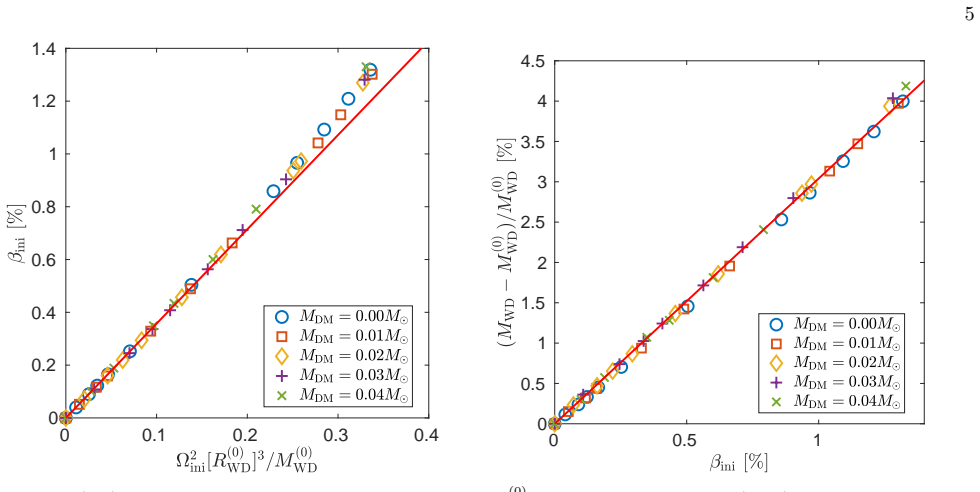
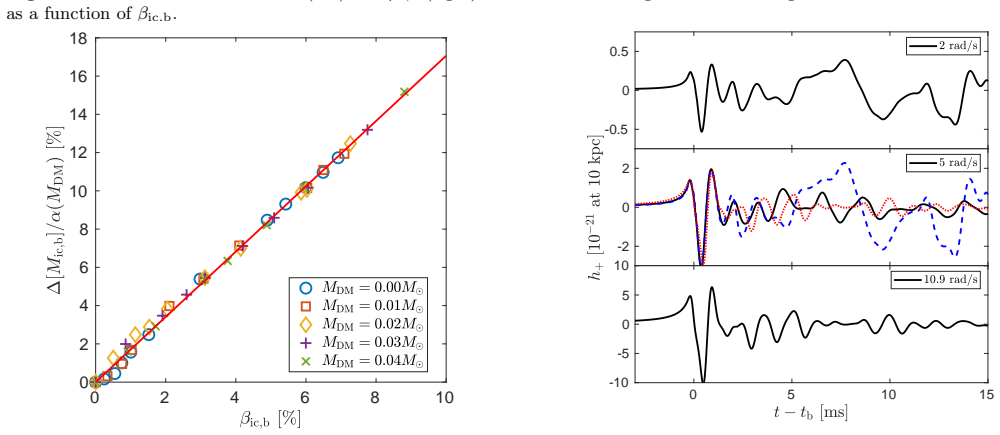
The central machinery is the set of amplitude ratios and rescalings derived from the bounce gravitational-wave spikes. The collapse is simulated with a two-dimensional (axisymmetric) Newtonian hydrodynamics code with an effective general-relativistic potential, a parameterized electron-capture profile, and a degenerate-electron-gas white dwarf; the dark matter is treated as a non-rotating, stationary fluid whose gravity is added to the Poisson equation. From the waveforms, the paper defines $h_1$, $h_2$, $h_3$ as the amplitudes of the three spikes around bounce and shows that $h_2/h_1$ and $h_3/h_1$ depend strongly on $M_\mathrm{DM}$ while being only mildly sensitive to $\beta_\mathrm{ic,b}$; the rescaled quantities $h_1^* \equiv h_1/[1-15.36(M_\mathrm{DM}/M_\odot)]$ and $h_2^* \equiv h_2/[3.24-(1-11.6(M_\mathrm{DM}/M_\odot))^{-1}]$ then each collapse onto a universal curve against $\beta_\mathrm{ic,b}$. This two-step procedure — ratios for detection, rescalings for parameter extraction — is what carries the argument.
What would settle it
A detected accretion-induced-collapse burst whose peak-amplitude ratios match the dark-matter-free values $h_2/h_1=-2.14\pm0.14$ and $h_3/h_1=1.37\pm0.04$ while the absolute amplitudes imply a high $\beta_\mathrm{ic,b}$ would contradict the predicted DM shift; and an event yielding rescaled amplitudes ($h_1^*,h_2^*$) that do not fall on a single universal curve would falsify the parameter-retrieval scheme.
Extended reading notes
Core claim
The paper's central claim is that the collapse-bounce gravitational-wave signal of an accreting white dwarf carries a measurable imprint of an admixed dark-matter core. In the simulations, the quantities that govern the collapse—bounce time, central density at bounce, and proto-neutron-star mass—depend on the dark-matter mass $M_\mathrm{DM}$ and the inner-core rotation parameter $\beta_\mathrm{ic,b}$ in a factorised way, and the amplitudes $h_1$, $h_2$, $h_3$ of the three dominant waveform spikes inherit this dependence. The ratios $h_2/h_1$ and $h_3/h_1$, which are nearly invariant for ordinary white dwarfs (about $-2.14$ and $1.37$), deviate systematically with $M_\mathrm{DM}$, and the rescaled amplitudes $h_1^*$ and $h_2^*$ each follow a universal monotonic relation with $\beta_\mathrm{ic,b}$. The paper concludes that a dark-matter core mass $M_\mathrm{DM} \geq 0.03\,M_\odot$ can be inferred even within nuclear-equation-of-state uncertainties, and that smaller cores could be inferred if the equation of state is better constrained.
Load-bearing premise
The dark matter core is assumed to stay fixed and rigid while the white dwarf collapses around it, pulling on the ordinary matter only through a constant gravitational field; if the collapse compresses, heats, or mixes with that core, the calibrated relations between dark-matter mass, rotation, and wave amplitudes no longer hold.
Editorial extensions
If this is right
- A gravitational-wave detection of an accretion-induced collapse could double as an indirect dark-matter detection from a stellar-scale object, something direct searches cannot probe.
- If the inner-core rotation parameter can be pinned down from the absolute wave amplitude, the peak-amplitude ratios give the dark-matter core mass, breaking the rotation–dark-matter degeneracy.
- The proto-neutron star left behind is lighter when the dark-matter core is heavier, shifting the frequency of post-bounce g-mode gravitational waves by up to roughly 20%; combining bounce and g-mode signals strengthens the inference.
- For dark-matter cores above 0.03 solar masses the identification survives nuclear-equation-of-state uncertainty; below that, it hinges on a better-constrained equation of state.
Reading between the lines
- If the stationary-core assumption is relaxed, the dark-matter core itself would be compressed and heated during collapse, likely raising the bounce density and shrinking the amplitude ratios; two-fluid dynamical simulations would bound this systematic.
- The universal rescaling curves suggest a direct parameter-estimation recipe for future detectors: measure $h_1$ and $h_2$, invert on $h_1^*(\beta)$ and $h_2^*(\beta)$, and the crossing point gives $(M_\mathrm{DM}, \beta_\mathrm{ic,b})$; the recipe's practicality depends on calibrating the electron-capture profile, which neutrino-transport simulations can provide.
- The same ratio-based fingerprint could be searched for in ordinary core-collapse supernova waveforms, where the 'extra central mass' would be the compact remnant itself rather than dark matter; the detection logic transfers.
- The paper's claim that the 0.03 solar-mass threshold is insensitive to equation-of-state choice rests on only three nuclear equations of state; a wider ensemble, including exotic compositions, would map how far the threshold moves.
Signed reviews
Editorial analysis
A structured set of objections, weighed in public.
Referee Report
Summary. The paper presents axisymmetric, Newtonian hydrodynamical simulations of accretion-induced collapse (AIC) of rotating white dwarfs that contain a central, static, non-rotating dark matter core, modeled as 1 GeV fermionic DM. The authors vary the admixed DM mass MDM and the initial rotation rate, and extract the burst gravitational-wave signals using the quadrupole formula. They find that DM delays the plunge and bounce, lowers the central density and inner-core mass at bounce, and reduces the proto-neutron star mass. The gravitational waveforms exhibit three characteristic spikes around bounce; the amplitude ratios h2/h1 and h3/h1 depend on both MDM and the inner-core rotation parameter beta_ic,b, which is used to break the degeneracy between these two parameters. The paper also proposes rescaling relations for h1 and h2 to retrieve MDM and beta_ic,b, discusses the detectability with advanced LIGO, and estimates the effect of DM on PNS g-mode frequencies.
Significance. If the results hold, this is a useful and original contribution to the gravitational-wave literature on AIC: it adds DM admixture as a new physical degree of freedom, proposes a concrete observable (bounce-peak amplitude ratios) for disentangling DM mass from rotation, and connects the result to a possible indirect DM detection channel. The paper includes several checks that strengthen confidence in the core dynamics: convergence tests in Appendix D, comparison of three nuclear EOSs in Appendix B, central-density variation tests in Appendix C, and a waveform comparison with Abdikamalov et al. (2010) in Section 4.1. The peak-amplitude ratios are raw simulation outputs rather than fitted quantities, so the central observable is not circularly defined. The main significance, if the DM+EOS robustness can be established, is a potential new probe of DM in stellar collapse.
major comments (4)
- [Section 2.2 / Section 3.3] The central claim in the abstract that a DM core with MDM >= 0.03 Msun can be inferred 'even within the uncertainties of nuclear matter equation of state' is not directly supported by the simulations as presented. The light-shaded EOS uncertainty bands in Fig. 11 are taken from Appendix B, which compares HShen, LS220, and SFHo only for rotating AIC models without DM admixture. DM changes the bounce conditions substantially (Table E1: for the R5 series, rho_c,b decreases from 3.85e14 to 2.73e14 g/cm3 and tb increases from 33.2 to 93.1 ms as MDM goes from 0 to 0.04 Msun), so there is no demonstrated basis to assume that the EOS sensitivity of h2/h1 and h3/h1 is the same for DM-admixed collapses. The same caveat applies to the central-density robustness test in Appendix C, which appears to vary rho_c only for MDM=0. This is an evidentiary gap rather than a demonstrated failure, but the 0.03 Msun threshold requires either additional DM+EOS simulations or a more limited claim restricted to a fixed EOS.
- [Section 3.3 / Eqs. (17)-(18)] The two-fluid model assumes that the DM core is stationary and non-rotating, affecting the baryons only through a fixed external gravitational potential. Because the DM core's gravitational pull is the physical mechanism that changes the bounce density and the GW peak ratios used for MDM inference, this assumption is load-bearing. A dynamical response of the DM core to the collapsing baryons, or even a different assumed DM density profile, could shift rho_c,b, Mic,b, and hence h1, h2, and h3. I would like to see a concrete robustness test, such as a time-dependent DM potential or an explicit check with an altered DM profile, or at minimum a clear statement in the abstract and conclusions that the inference applies only within this modeling assumption.
- [Section 3.3 / Richers et al. (2017)] The retrieval procedure for MDM and beta_ic,b is calibrated and tested on the same set of simulations from which Eqs. (17) and (18) are fitted. This demonstrates internal consistency but not predictive power: an independent set of simulations, for example with different Ye parameterizations, rotation laws, or mass grids, is needed to establish that the h1* and h2* relations are universal enough for an actual GW observation. As written, the 'in principle' retrieval claim is somewhat stronger than the evidence provided.
- [Section 3.3 / Richers et al. (2017)] The paper cites roughly 30% variations in h2 (and in h1 - h2) with electron-capture rate variations, yet the >0.03 Msun threshold is framed only against EOS uncertainties. Since the DM indicator is built from h2/h1, the electron-capture uncertainty could also overlap the MDM=0 and MDM=0.03 signal separation. A quantitative statement of how much of the h2/h1 difference between MDM=0 and MDM>=0.03 remains after combined EOS and electron-capture uncertainties is needed to support the headline claim.
minor comments (3)
- [Section 2.1 / Eq. (5)] The fitted coefficient in Eq. (5) should specify the fit range and the number of models used, and the sentence containing 'W e found' in Section 2.1 contains a typographical spacing error.
- [Table E1 / Table E2] The model labeling in Tables E1 and E2 should be cross-checked; in particular, the footnote 'aAlso Rmax-DM4' is unclear because R5-DM4 appears in the R5 block and Rmax-DM4 is not listed as a separate row.
- [Appendix C / Fig. C1] The caption of Fig. C1 states that GW amplitudes are multiplied by a constant to match h1, but the constant is not given; please state explicitly that this rescaling does not affect the amplitude ratios used in the analysis.
Circularity Check
No significant circularity: GW peak ratios are raw simulation outputs and the rescaling relations are openly calibrated, not derived from the target claim.
full rationale
The paper's central observable — the ratios h2/h1 and h3/h1 between GW peak amplitudes around bounce — are direct outputs of hydrodynamical simulations, not quantities defined in terms of MDM or beta_ic,b by construction. The degeneracy-breaking claim rests on the simulated dependence of these ratios on MDM at fixed beta_ic,b (Fig. 11), which is an empirical forward-model result. The rescaling relations h*1 and h*2 (Eqs. 17-18) are calibrated fits to the same simulation ensemble; the paper explicitly cautions that the exact functional forms await better-constrained microphysics (Sec. 3.3: 'a firm retrieval of MDM awaits for better constrained microphysics inputs'), so they are not presented as independent predictions. No load-bearing step reduces by definition: Table 2 recomputes, rather than imports, the non-rotating Paper I results, and the Paper I citation is used only for qualitative agreement. The apparent weak point — Appendix B's EOS-uncertainty bands are computed only for MDM=0 and then used to support the MDM >= 0.03 Msun inference threshold — is an evidentiary gap (DM+EOS runs are missing), not a circular argument, so it does not raise the circularity score.
Assumptions & free parameters
free parameters (5)
- DM particle mass m_DM =
1 GeV
- Fitted slope in MWD vs beta_ini =
3.04 +/- 0.02
- alpha(MDM) parameters =
3.24 and 11.6
- h1 rescaling coefficient =
15.36
- h2 rescaling coefficient =
alpha(MDM) of Eq. 11
assumptions (6)
- domain assumption Newtonian hydrodynamics with the Case A effective GR potential approximates general relativistic collapse for these configurations.
- domain assumption Dark matter is a collisionless, non-annihilating ideal Fermi gas of 1 GeV particles, non-rotating, and stationary during collapse.
- domain assumption The progenitor white dwarf rotates uniformly.
- domain assumption Electron capture is parameterized by a universal Ye = Ye(rho) relation from a non-DM GR1D AIC simulation.
- domain assumption Axisymmetry: non-axisymmetric instabilities do not affect the bounce GW signal.
- domain assumption LS220 nuclear EOS is representative for the DM inference; other EOSs are tested only for DM-free models.
Cite this review
Pith. "Pith review of Accretion-Induced Collapse of Dark Matter Admixed White Dwarfs -- II: Rotation and Gravitational-wave Signals." pith.science (2026). https://pith.science/paper/HABBOFTM
@misc{pith2026190805150,
  author       = {Pith},
  title        = {Pith review of: Accretion-Induced Collapse of Dark Matter Admixed White Dwarfs -- II: Rotation and Gravitational-wave Signals},
  year         = {2026},
  howpublished = {\url{https://pith.science/paper/HABBOFTM}},
  note         = {Machine review of arXiv:1908.05150}
}
abstract
We present axisymmetric hydrodynamical simulations of accretion-induced collapse (AIC) of dark matter (DM) admixed rotating white dwarfs (WD) and their burst gravitational-wave (GW) signals. For initial WD models with the same central baryon density, the admixed DM is found to delay the plunge and bounce phases of AIC, and decrease the central density and mass of the proto-neutron star (PNS) produced. The bounce time, central density and PNS mass generally depend on two parameters, the admixed DM mass $M_\mathrm{DM}$ and the ratio between the rotational kinetic and gravitational energies of the inner core at bounce $\beta_\mathrm{ic,b}$. The emitted GWs have generic waveform shapes and the variation of their amplitudes $h_+$ show a degeneracy on $\beta_\mathrm{ic,b}$ and $M_\mathrm{DM}$. We found that the ratios between the GW amplitude peaks around bounce allow breaking the degeneracy and extraction of both $\beta_\mathrm{ic,b}$ and $M_\mathrm{DM}$. Even within the uncertainties of nuclear matter equation of state, a DM core can be inferred if its mass is greater than 0.03 $M_{\odot}$. We also discuss possible DM effects on the GW signals emitted by PNS g-mode oscillations. GW may boost the possibility for the detection of AIC, as well as open a new window in the indirect detection of DM.
Figures


Figures from the paper (8 more)




Reference graph
Works this paper leans on
-
[1]
Abdikamalov, E. B., Ott, C. D., Rezzolla, L., et al. 2010, PhRvD, 81, 044012
work page 2010
- [2]
-
[3]
Antoniadis, J., Freire, P. C. C., Wex, N., et al. 2013, Science, 340, 448
2013
-
[4]
Baiotti, L., de Pietri, R., Manca, G. M., & Rezzolla, L. 2007, PhRvD, 75, 044023
work page 2007
-
[5]
2018, Nature, 555, 71
Barkana, R. 2018, Nature, 555, 71
2018
-
[6]
Barsotti, L., Fritschel, P., Evans, M., & Gras, S. 2018, Tech. Rep. LIGO-T1800042-v5. dcc.ligo.org/LIGO-T1800042/public
work page 2018
- [7]
- [8]
Show all 70 references
-
[9]
2015, PhRvL, 115, 141301
Bramante, J. 2015, PhRvL, 115, 141301
2015
-
[10]
2015, PhRvL, 115, 111301 Cerd´ a-Dur´ an, P., DeBrye, N., Aloy, M
Brito, R., Cardoso, V., & Okawa, H. 2015, PhRvL, 115, 111301 Cerd´ a-Dur´ an, P., DeBrye, N., Aloy, M. A., Font, J. A., &
2015
-
[11]
2013, ApJ, 779, L18 Cerd´ a-Dur´ an, P., Quilis, V., & Font, J
Obergaulinger, M. 2013, ApJ, 779, L18 Cerd´ a-Dur´ an, P., Quilis, V., & Font, J. A. 2007, CoPhC, 177, 288 Cerme˜ no, M., P´ erez-Garc ´ ıa, M.´A., & Silk, J. 2017, PASA, 34, e043
2013
-
[12]
2017, A&A, 605, A106
Choplin, A., Coc, A., Meynet, G., et al. 2017, A&A, 605, A106
2017
-
[13]
D., et al
Dessart, L., Burrows, A., Ott, C. D., et al. 2006, ApJ, 644, 1063
2006
-
[14]
A., & M¨ uller, E
Dimmelmeier, H., Font, J. A., & M¨ uller, E. 2002, A&A, 393, 523
2002
-
[15]
D., Marek, A., & Janka, H.-T
Dimmelmeier, H., Ott, C. D., Marek, A., & Janka, H.-T. 2008, PhRvD, 78, 064056
2008
-
[16]
Einasto, J., Saar, E., Kaasik, A., & Chernin, A. D. 1974, Nature, 252, 111
1974
-
[17]
2018, PhRvD, 97, 123007
Ellis, J., H¨ utsi, G., Kannike, K., et al. 2018, PhRvD, 97, 123007
2018
-
[18]
2019, ApJ, 876, 18
Farrow, N., Zhu, X.-J., & Thrane, E. 2019, ApJ, 876, 18
2019
-
[19]
2018, A&A, 618, A124
Fink, M., Kromer, M., Hillebrandt, W., et al. 2018, A&A, 618, A124
2018
-
[20]
S., & Evans, C
Finn, L. S., & Evans, C. R. 1990, ApJ, 351, 588
1990
-
[21]
Fryer, C., Benz, W., Herant, M., & Colgate, S. A. 1999, ApJ, 516, 892
1999
-
[22]
Fuller, J., & Ott, C. D. 2015, MNRAS, 450, L71
2015
-
[23]
E., Sutton, P., Stuver, A., et al
Gossan, S. E., Sutton, P., Stuver, A., et al. 2016, PhRvD, 93, 042002
2016
-
[24]
2018, PhRvD, 98, 115027 19
Riggins, P. 2018, PhRvD, 98, 115027 19
2018
-
[25]
W., Rajendran, S., & Varela, J
Graham, P. W., Rajendran, S., & Varela, J. 2015, PhRvD, 92, 063007
2015
-
[26]
1986, ApJS, 61, 479
Hachisu, I. 1986, ApJS, 61, 479
1986
-
[27]
J., Primas, F., Hartman, H., et al
Hansen, C. J., Primas, F., Hartman, H., et al. 2012, A&A, 545, A31
2012
-
[28]
2011, CQGra, 28, 094013
Hild, S., Abernathy, M., Acernese, F., et al. 2011, CQGra, 28, 094013
2011
-
[29]
K., & Ruiter, A
Hillebrandt, W., Kromer, M., R¨ opke, F. K., & Ruiter, A. J. 2013, FrPhy, 8, 116
2013
-
[30]
2012, ARNPS, 62, 407
Janka, H.-T. 2012, ARNPS, 62, 407
2012
-
[31]
K., Fryer, C., et al
Jones, S., R¨ opke, F. K., Fryer, C., et al. 2019, A&A, 622, A74
2019
-
[32]
S., Janka, H.-T., & Hillebrandt, W
Kitaura, F. S., Janka, H.-T., & Hillebrandt, W. 2006, A&A, 450, 345
2006
-
[33]
Kouvaris, C., & Nielsen, N. G. 2015, PhRvD, 92, 063526
2015
-
[34]
M., & Swesty, F
Lattimer, J. M., & Swesty, F. D. 1991, NuPhA, 535, 331
1991
-
[35]
2010, ApJ, 718, 60
Lee, J., & Komatsu, E. 2010, ApJ, 718, 60
2010
-
[36]
2011, PhRvD, 84, 107301 —
Leung, S.-C., Chu, M.-C., & Lin, L.-M. 2011, PhRvD, 84, 107301 —. 2015a, ApJ, 812, 110 —. 2015b, MNRAS, 454, 1238
2011
-
[37]
2013, PhRvD, 87, 123506
Leung, S.-C., Chu, M.-C., Lin, L.-M., & Wong, K.-W. 2013, PhRvD, 87, 123506
2013
-
[38]
2018, ApJ, 861, 143 —
Leung, S.-C., & Nomoto, K. 2018, ApJ, 861, 143 —. 2019, arXiv e-prints, arXiv:1901.10007
2018 arXiv
-
[39]
2019, arXiv e-prints, arXiv:1901.11438
Leung, S.-C., Nomoto, K., & Suzuki, T. 2019, arXiv e-prints, arXiv:1901.11438
2019 arXiv
-
[40]
C., Zha, S., Chu, M
Leung, S. C., Zha, S., Chu, M. C., Lin, L. M., & Nomoto, K. 2019, in prep. Liebend¨ orfer, M. 2005, ApJ, 633, 1042
2019
-
[41]
1994, JCoPh, 115, 200
Liu, X.-D., Osher, S., & Chan, T. 1994, JCoPh, 115, 200
1994
-
[42]
G., Stovall, K., Freire, P
Martinez, J. G., Stovall, K., Freire, P. C. C., et al. 2015, ApJ, 812, 143
2015
-
[43]
Moenchmeyer, R., Schaefer, G., Mueller, E., & Kates, R. E. 1991, A&A, 246, 417
1991
-
[44]
2018, ApJ, 861, 10
Morozova, V., Radice, D., Burrows, A., & Vartanyan, D. 2018, ApJ, 861, 10
2018
-
[45]
2016, PhRvD, 93, 083009 M¨ uller, B., Janka, H.-T., & Marek, A
Mukhopadhyay, P., & Schaffner-Bielich, J. 2016, PhRvD, 93, 083009 M¨ uller, B., Janka, H.-T., & Marek, A. 2013, ApJ, 766, 43
2016
-
[46]
W., Ott, C
Murphy, J. W., Ott, C. D., & Burrows, A. 2009, ApJ, 707, 1173
2009
-
[47]
2019, ApJS, 240, 38
Nagakura, H., Furusawa, S., Togashi, H., et al. 2019, ApJS, 240, 38
2019
-
[48]
1991, ApJL, 367, L19 O’Connor, E
Nomoto, K., & Kondo, Y. 1991, ApJL, 367, L19 O’Connor, E. 2015, ApJS, 219, 24
1991
-
[49]
2017, RvMP, 89, 015007
Oertel, M., Hempel, M., Kl¨ ahn, T., & Typel, S. 2017, RvMP, 89, 015007
2017
-
[50]
Ott, C. D. 2009, CQGra, 26, 063001
2009
-
[51]
D., Abdikamalov, E., O’Connor, E., et al
Ott, C. D., Abdikamalov, E., O’Connor, E., et al. 2012, PhRvD, 86, 024026 ¨Ozel, F., Psaltis, D., Narayan, R., & Santos Villarreal, A. 2012, ApJ, 757, 55
2012
-
[52]
A., Couch, S
Pajkos, M. A., Couch, S. M., Pan, K.-C., & O’Connor, E. P. 2019, arXiv e-prints, arXiv:1901.09055
2019 arXiv
-
[53]
M., & Thielemann, F.-K
Pan, K.-C., Liebend¨ orfer, M., Couch, S. M., & Thielemann, F.-K. 2018, ApJ, 857, 13
2018
-
[54]
L., & Kulkarni, S
Piro, A. L., & Kulkarni, S. R. 2013, ApJL, 762, L17
2013
-
[55]
L., & Thompson, T
Piro, A. L., & Thompson, T. A. 2014, ApJ, 794, 28 Planck Collaboration, Aghanim, N., Akrami, Y., et al. 2018, arXiv e-prints, arXiv:1807.06209
2014 arXiv
-
[56]
2019, ApJ, 876, L9
Nagakura, H. 2019, ApJ, 876, L9
2019
-
[57]
2011, Classical and Quantum Gravity, 28, 195015
Reisswig, C., & Pollney, D. 2011, Classical and Quantum Gravity, 28, 195015
2011
-
[58]
2018, PhRvL, 121, 021304
Ren, X., Zhao, L., Abdukerim, A., et al. 2018, PhRvL, 121, 021304
2018
-
[59]
2017, PhRvD, 95, 063019
Sullivan, C. 2017, PhRvD, 95, 063019
2017
-
[60]
J., Ferrario, L., Belczynski, K., et al
Ruiter, A. J., Ferrario, L., Belczynski, K., et al. 2019, MNRAS, 484, 698
2019
-
[61]
2017, MNRAS, 472, 3390
Schwab, J., Bildsten, L., & Quataert, E. 2017, MNRAS, 472, 3390
2017
-
[62]
2010, ApJ, 719, 722
Schwab, J., Podsiadlowski, P., & Rappaport, S. 2010, ApJ, 719, 722
2010
-
[63]
Schwab, J., & Rocha, K. A. 2019, ApJ, 872, 131
2019
-
[64]
2011, ApJS, 197, 20
Shen, H., Toki, H., Oyamatsu, K., & Sumiyoshi, K. 2011, ApJS, 197, 20
2011
-
[65]
A., Burrows, A., & Dolence, J
Skinner, M. A., Burrows, A., & Dolence, J. C. 2016, ApJ, 831, 81
2016
-
[66]
W., Hempel, M., & Fischer, T
Steiner, A. W., Hempel, M., & Fischer, T. 2013, ApJ, 774, 17 Torres-Forn´ e, A., Cerd´ a-Dur´ an, P., Obergaulinger, M., M¨ uller, B., & Font, J. A. 2019, arXiv e-prints, arXiv:1902.10048
2013 arXiv
-
[67]
2019, MNRAS, 482, 351
Dolence, J. 2019, MNRAS, 482, 351
2019
-
[68]
2018, MNRAS, 481, 439
Wang, B. 2018, MNRAS, 481, 439
2018
-
[69]
2014, PhRvC, 89, 025803
Xiang, Q.-F., Jiang, W.-Z., Zhang, D.-R., & Yang, R.-Y. 2014, PhRvC, 89, 025803
2014
-
[70]
2004, A&A, 419, 623
Yoon, S.-C., & Langer, N. 2004, A&A, 419, 623
2004
Reviewed August 14, 2026 · model on record in the stance chip above.
Discussion (0). Continue with ORCID to comment.