Computing canonical labellings of finite solvable groups
Pith reviewed 2026-06-25 19:22 UTC · model grok-4.3
The pith
Finite solvable groups get canonical presentations that match exactly when the groups are isomorphic.
A machine-rendered reading of the paper's core claim, the machinery that carries it, and where it could break.
Core claim
We define a canonical labelling function on the class of finite solvable groups so that two such groups G and H are isomorphic if and only if can(G)=can(H). Specifically, can(G) is a group presentation that describes a group isomorphic to G, and our description explains how to construct an isomorphism G to can(G). The approach combines canonical presentation methods for p-groups with cohomology and automorphism group algorithms.
What carries the argument
The canonical labelling function can(G) that produces a unique group presentation together with an explicit isomorphism to the original group.
If this is right
- Isomorphism of two finite solvable groups reduces to equality of their computed presentations.
- An explicit isomorphism from any given finite solvable group to its canonical form can be constructed.
- All finite solvable groups become comparable by a uniform labelling that supports storage and retrieval.
- The labelling extends the scope of existing presentation methods from p-groups to the full solvable class.
Where Pith is reading between the lines
- The labels could support building searchable collections of solvable groups ordered by their presentations.
- Refinements might reduce computation time for groups of moderate order where current steps are slowest.
- Similar structural decompositions in other group classes could admit parallel labelling constructions.
Load-bearing premise
Techniques for canonical presentations of p-groups can be extended using cohomology and automorphism computations to cover every finite solvable group without obstruction.
What would settle it
Two non-isomorphic finite solvable groups that receive identical canonical presentations, or a concrete finite solvable group on which the labelling procedure cannot be completed.
Figures
read the original abstract
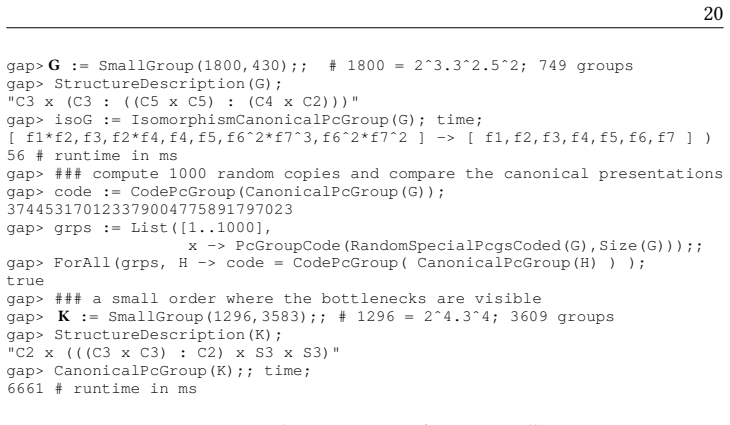
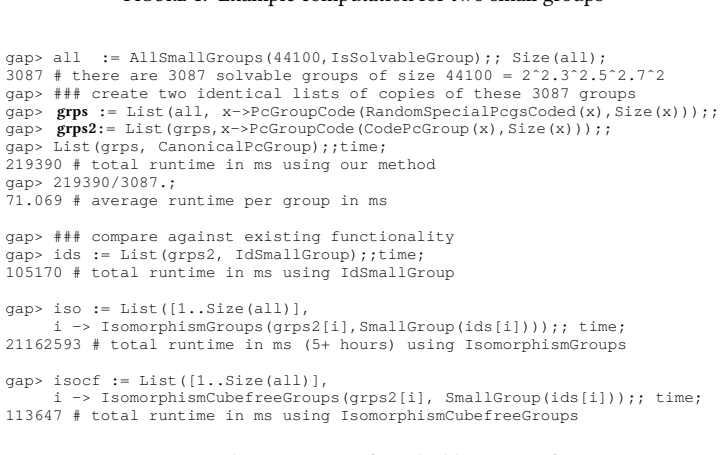
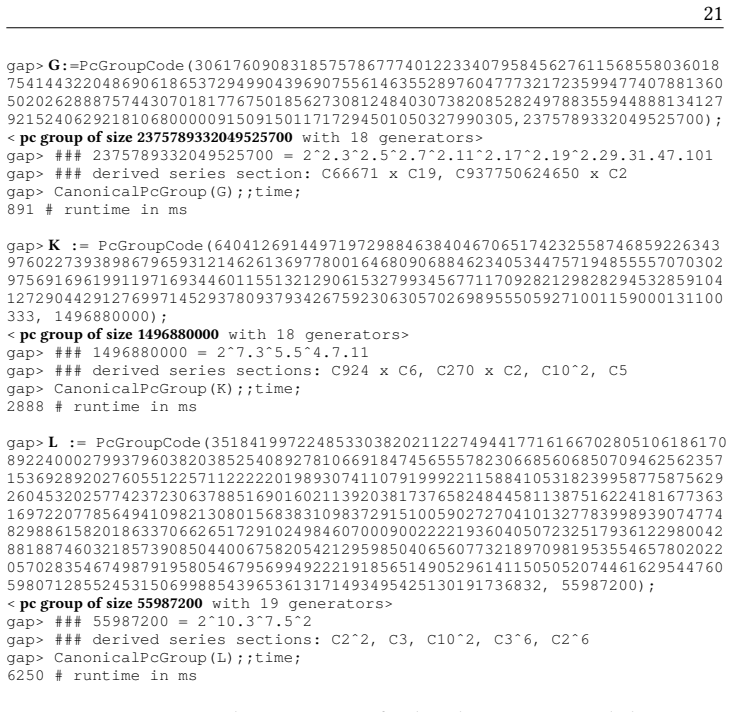
We define a canonical labelling function on the class of finite solvable groups so that two such groups $G$ and $H$ are isomorphic if and only if can$(G)=$can$(H)$. Specifically, can$(G)$ is a group presentation that describes a group isomorphic to $G$, and our description explains how to construct an isomorphism $G\to$can$(G)$. Our approach is motivated by O'Brien's (1993) canonical presentations for finite $p$-groups and utilises ideas from group cohomology first described by Robinson (1982) and automorphism group algorithms developed by Smith (1994), Holt (2001), and others. We also discuss a proof-of-concept implementation for the computer algebra system GAP and comment on the major bottlenecks and open research questions.
Editorial analysis
A structured set of objections, weighed in public.
Referee Report
Summary. The paper defines a canonical labelling function can(G) on finite solvable groups such that G ≅ H iff can(G) = can(H), where can(G) is an explicit group presentation together with a constructive isomorphism G → can(G). The construction proceeds by building a composition series, using Robinson cohomology to solve extension problems and produce canonical presentations at each step, and applying existing automorphism-group algorithms (Smith/Holt style) to resolve choices; it is motivated by O'Brien's 1993 canonical presentations for p-groups and includes a proof-of-concept GAP implementation together with discussion of bottlenecks and open questions.
Significance. If the construction is correct and fully algorithmic, the result would supply a practical canonical form for the important class of finite solvable groups, extending O'Brien-style methods beyond p-groups and enabling direct isomorphism testing by string comparison of presentations. The explicit use of cohomology and aut-group routines, together with the GAP implementation, constitutes a concrete algorithmic contribution that could be adopted in computational group theory libraries.
major comments (2)
- [motivation and approach paragraph] The central construction (composition series + cohomological extension solving + aut-group resolution) is described at a high level in the approach paragraph; a load-bearing gap is the lack of an explicit algorithm or pseudocode showing how the Robinson cohomology cocycle data is converted into a canonical presentation when the extension is non-split (see the paragraph on motivation and approach).
- [discussion of open research questions] The claim that the method 'extends without obstruction' to all finite solvable groups relies on the assumption that the chosen composition series and cohomology computations always terminate with a unique canonical representative; no termination or uniqueness argument is supplied for groups whose composition factors have non-trivial outer automorphisms (see the discussion of open research questions).
minor comments (2)
- [abstract] The abstract cites Robinson (1982), Smith (1994) and Holt (2001) but does not indicate which specific results (e.g., which cohomology theorem or aut-group algorithm) are invoked; adding one-sentence pointers would improve readability.
- [GAP implementation paragraph] The GAP implementation is described only as 'proof-of-concept'; including at least one concrete example (e.g., a small non-p-group solvable group together with its computed can(G)) would make the practicality claim easier to assess.
Simulated Author's Rebuttal
We thank the referee for the careful reading and the identification of areas where additional detail would strengthen the manuscript. We address the two major comments below.
read point-by-point responses
-
Referee: [motivation and approach paragraph] The central construction (composition series + cohomological extension solving + aut-group resolution) is described at a high level in the approach paragraph; a load-bearing gap is the lack of an explicit algorithm or pseudocode showing how the Robinson cohomology cocycle data is converted into a canonical presentation when the extension is non-split (see the paragraph on motivation and approach).
Authors: We agree that the current description of the non-split case remains at a high level. In the revised manuscript we will insert explicit pseudocode (approximately one page) that spells out the conversion from Robinson cocycle data to the canonical presentation, including the steps that invoke the automorphism-group routines to resolve choices. revision: yes
-
Referee: [discussion of open research questions] The claim that the method 'extends without obstruction' to all finite solvable groups relies on the assumption that the chosen composition series and cohomology computations always terminate with a unique canonical representative; no termination or uniqueness argument is supplied for groups whose composition factors have non-trivial outer automorphisms (see the discussion of open research questions).
Authors: The manuscript already frames the extension to arbitrary solvable groups as subject to open questions precisely when outer automorphism groups are non-trivial. We do not assert an unconditional termination or uniqueness proof; the text instead lists the relevant obstructions as topics for further work. We will revise the wording in the open-questions section to remove any phrasing that could be read as claiming an obstruction-free extension. revision: partial
Circularity Check
No significant circularity detected
full rationale
The paper defines an explicit algorithmic construction for a canonical labelling can(G) on finite solvable groups by combining composition series, Robinson cohomology for extensions, and existing automorphism-group algorithms (O'Brien, Smith, Holt). This is a constructive definition rather than a derivation that reduces to its inputs. No equations, fitted parameters, or predictions appear; cited works are independent prior results with no author overlap or load-bearing self-citation chains. The central claim is self-contained as a definition plus construction.
Axiom & Free-Parameter Ledger
Reference graph
Works this paper leans on
-
[1]
Barrera Acevedo, H
S. Barrera Acevedo, H. Dietrich, M. Horn. The GAP packageCanonicalPcPres. gap-packages.github.io/CanonicalPcPres(to appear soon, 2026)
2026
-
[2]
H. U. Besche, B. Eick. Construction of finite groups. J. Symb. Comput. 27:387-404 (1999), DOI: 10.1006/jsco.1998.0258
-
[3]
H. U. Besche, B. Eick, E. A. O’Brien. A millennium project: constructing small groups. Int. J. Algebra Comput. 12:623-644 (2002), DOI: 10.1142/S0218196702001115
-
[4]
The Magma algebra system I: The user language,
W. Bosma, J. Cannon, C. Playoust. The magma algebra system I: the user language. J. Symb. Comput. 24:235-265 (1997), DOI: 10.1006/jsco.1996.0125
-
[5]
P. A. Brooksbank, H. Dietrich, J. Maglione, E. A. O’Brien, J. B. Wilson. Categorification of characteristic structures. Forum Math. Sigma 14:e13 (2026), DOI: 10.1017/fms.2025.10159. 21 gap>G:=PcGroupCode(3061760908318575786777401223340795845627611568558036018 754144322048690618653729499043969075561463552897604777321723599477407881360 502026288875744307018...
-
[6]
J. J. Cannon, B. Eick, C. R. Leedham-Green, Charles. Special polycyclic generating sequences for finite soluble groups. J. Symb. Comput. 38:1445-1460 (2004), DOI: 10.1016/j.jsc.2004.05.003
-
[7]
J. J. Cannon, D. F. Holt. Automorphism group computation and isomorphism testing in finite groups. J. Symb. Comput. 35:241–267 (2003), DOI: 10.1016/S0747-7171(02)00133-5
-
[8]
H. Dietrich, B. Eick. Coclass graphs of finitep-groups. Springer Monographs in Mathematics, Springer, 2026, DOI: 10.1007/978-3-032-17506-9
-
[9]
Dietrich, B
H. Dietrich, B. Eick, H. Schanze. Group identification of groups of orderp 5. In preparation
-
[10]
H. Dietrich, A. Hulpke. Universal covers of finite groups. J. Algebra 596:681-712 (2021) DOI: 10.1016/j.jalgebra.2020.10.032
-
[11]
H. Dietrich, J. B. Wilson. Isomorphism testing of groups of cube-free order. J. Algebra 545:174- 197 (2020), DOI: 10.1016/j.jalgebra.2019.02.008
-
[12]
H. Dietrich, J. B. Wilson. Group isomorphism is nearly-linear time for most orders. 2021 IEEE 62nd Annual Symposium on Foundations of Computer Science-FOCS 2021, 457-467. IEEE Computer Society, Los Alamitos, CA, 2022, DOI: 10.1109/FOCS52979.2021.00053
-
[13]
B. Eick, M. Horn. The construction of finite solvable groups revisited. J. Algebra 408:166-182 (2014), DOI: 10.1016/j.jalgebra.2013.09.028
-
[14]
B. Eick, C. R. Leedham-Green, E. A. O’Brien. Constructing automorphism groups of finite p-groups. Comm. Algebra, 30(5):2271-295 (2002), DOI: 10.1081/AGB-120003468. 22
-
[15]
Gamble, W
G. Gamble, W. Nickel, E. A. O’Brien. ANUPQ - a refereed GAP package. gap-packages.github.io/anupq
-
[16]
GAP – Groups, Algorithms, Programming.www.gap-system.org
-
[17]
D. Holt, B. Eick, E. A. O’Brien. Handbook of Computational Group Theory, Chapman & Hal- l/CRC, Boca Raton, FL, 2005, DOI: 10.1201/9781420035216
-
[18]
D. F. Holt. Computing automorphism groups of finite groups. In: Groups and computation, III, 201-208. Ohio State Univ. Math. Res. Inst. Publ., 8 Walter de Gruyter & Co, 2001, DOI: 10.1515/9783110872743.201
-
[19]
D. J. A. Howden. Computing automorphism groups and isomorphism testing in finite groups. PhD thesis, University of Warwick, 2012,wrap.warwick.ac.uk/50060/
2012
-
[20]
A. Hulpke. The perfect groups of order up to two million. Math. Comp. 91(334), 1007–1017 (2022), DOI: 10.1090/mcom/3684
-
[21]
G. Ivanyos, E. J. Mendoza, Y. Qiao, X. Sun, C. Zhang. Faster Isomorphism Testing ofp-Groups of Frattini Class 2. 2024 65th Annual IEEE Symposium on Foundations of Computer Science- FOCS 1408-1424 (2024), DOI: 10.1137/24M1719839
-
[22]
C. Jefferson, R. Waldecker, W. A. Wilson. Computing canonical images in permutation groups with Graph Backtracking. J. Comp. Algebra 8:100010 (2023), DOI: 10.1016/j.jaca.2023.100010
-
[23]
B. D. McKay, A. Piperno. Practical graph isomorphism, II. J. Symb. Comput. 60:94-112 (2014), DOI: 10.1016/j.jsc.2013.09.003
-
[24]
M ¨uller, M
J. M ¨uller, M. Neunh ¨offer, F. Noeske. The GAP package Orb.gap-packages.github. io/orb/
-
[25]
E. A. O’Brien. Isomorphism testing forp-groups. J. Symb. Comput. 17(2):133-147 (1994), DOI: 10.1006/jsco.1994.1007
-
[26]
E. A. O’Brien. A guide to the ANUp-Quotient Program, Version 1.8. math.rwth-aachen.de/homes/Greg.Gamble/ANUPQ/ standalone-doc/guide.pdf
-
[27]
D. J. S. Robinson. Applications of cohomology to the theory of groups. In: Groups-St. Andrews 1981, 46-80, Cambridge Univ. Press, Cambridge-New York, 1982; London Math. Soc. Lecture Note Ser., 71. Cambridge University Press, Cambridge-New York, 1982, DOI: 10.1017/CBO9780511661884.005
-
[28]
Tight approximation ratio of anonymous pricing , booktitle =
P. Schweitzer, D. Wiebking. A unifying method for the design of algorithms canonizing com- binatorial objects. STOC’19–Proceedings of the 51st Annual ACM SIGACT Symposium on Theory of Computing, 1247–1258. Association for Computing Machinery, New York, 2019, DOI: 10.1145/3313276.3316338
- [29]
-
[30]
M. J. Smith. Computing automorphisms of finite soluble groups. PhD thesis, Australian Na- tional University, 1994, DOI: 10.25911/5d723c5c57106
-
[31]
D. Wiebking. Normalizers and permutational isomorphisms in simply-exponential time. Proceedings of the 2020 ACM-SIAM Symposium on Discrete Algorithms, 230-238. So- ciety for Industrial and Applied Mathematics (SIAM), Philadelphia, PA, 2020, DOI: 10.1137/1.9781611975994.14
-
[32]
Y. Qiao, X. Sun. Canonical Forms for Matrix Tuples in Polynomial Time. 2024 IEEE 65th Annual Symposium on Foundations of Computer Science-FOCS 2024, 780-789, Chicago, IL, USA, 2024, DOI: 10.1109/FOCS61266.2024.00054
discussion (0)
Sign in with ORCID, Apple, or X to comment. Anyone can read and Pith papers without signing in.