Bit Error Probability Instead of Secrecy Rate Criterion to Enhance Performance for Secure Wireless Communication Systems
Pith reviewed 2026-05-25 10:58 UTC · model grok-4.3
The pith
Bit error probability replaces secrecy rate as the criterion for power allocation in physical layer security, allowing lower transmit power while meeting error targets for both users.
A machine-rendered reading of the paper's core claim, the machinery that carries it, and where it could break.
Core claim
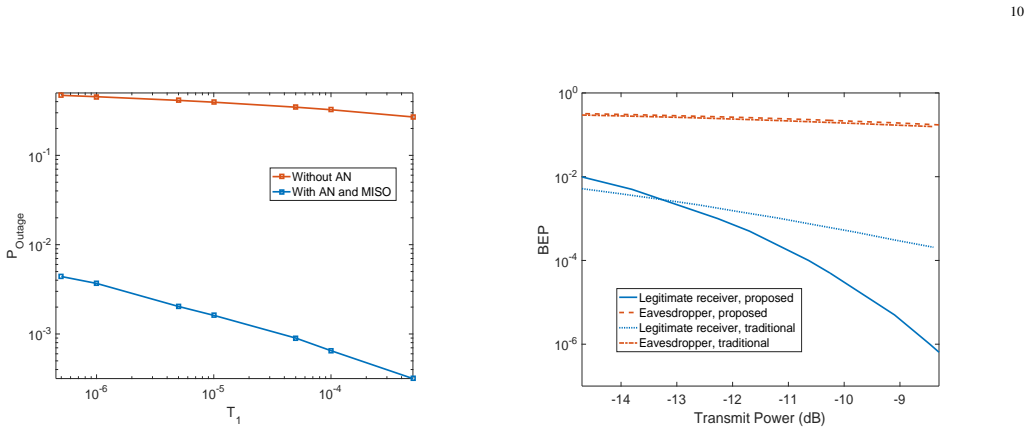
BEP can be better criterion for performance evaluation of the physical layer security systems. Based on BEP, the optimum transmit power is obtained and a new definition for outage probability is proposed and obtained theoretically. The proposed method needs more than 5dB lower power for different scenarios.
What carries the argument
Bit error probability (BEP) computed separately for the legitimate user and the adversary, used to set transmit power and to define a new outage probability.
If this is right
- Optimum transmit power follows directly from chosen BEP thresholds for each user.
- Outage probability is redefined in terms of BEP rather than secrecy rate.
- The BEP method extends without change to unknown-mode and cooperative-adversary settings.
- Power savings greater than 5 dB hold across the tested scenarios.
Where Pith is reading between the lines
- The same BEP targets could be imposed on top of existing secrecy-rate constraints to create a hybrid allocation rule.
- The reported power reduction would directly improve battery lifetime or coverage range in energy-limited secure links.
- Closed-form BEP expressions derived here could be inserted into larger network optimization problems that include multiple users.
Load-bearing premise
Secrecy rate by itself fails to guarantee the actual error performance seen by the legitimate and adversary users.
What would settle it
A direct comparison, in the same channel realizations, of the minimum power needed to reach target BEPs via secrecy-rate optimization versus via BEP optimization; if the secrecy-rate method consistently requires equal or lower power, the claimed advantage disappears.
Figures



read the original abstract
In this paper, we propose a new practical power allocation technique based on bit error probability (BEP) for physical layer security systems. It is shown that the secrecy rate that is the most commonly used in physical layer security systems, cannot be a suitable criterion lonely. Large positive values are suitable for the secrecy rate in physical layer security, but it does not consider the performance of the legitimate and adversary users. In this paper, we consider and analyze BEP for physical layer security systems because based on it, the performance of the legitimate and adversary users are guaranteed and it is needed to use lower power. BEP is calculated for the legitimate and adversary users and it is shown that BEP can be better criterion for performance evaluation of the physical layer security systems. Based on BEP, the optimum transmit power is obtained and a new definition for outage probability is proposed and obtained theoretically. Also, the proposed approach is applied for adversary users with unknown mode and the cooperative adversary users. Simulation results show that the proposed method needs more than 5dB lower power for different scenarios.
Editorial analysis
A structured set of objections, weighed in public.
Referee Report
Summary. The manuscript proposes using bit error probability (BEP) as a performance criterion and power-allocation metric for physical-layer security systems, arguing that the conventional secrecy rate does not guarantee acceptable error performance for the legitimate receiver or the eavesdropper. It derives the optimal transmit power that satisfies BEP targets for both users, introduces a new BEP-based definition of outage probability, extends the framework to adversaries with unknown operating modes and to cooperative adversaries, and reports simulation results claiming that the BEP-based scheme requires more than 5 dB lower transmit power than secrecy-rate-based allocation across the examined scenarios.
Significance. If the BEP targets can be shown to enforce an information-theoretically comparable security level to a positive secrecy-rate threshold, the work would supply a practical, link-level alternative to secrecy-rate optimization that directly controls error performance while reducing required power. The theoretical derivation of optimal power and the new outage definition, together with the extensions to unknown-mode and cooperative-adversary cases, would constitute a concrete contribution provided they are accompanied by an explicit security-equivalence argument.
major comments (3)
- [Abstract] Abstract: the central claim that the BEP-based method achieves equivalent security at >5 dB lower power rests on an unstated mapping between chosen BEP targets for Bob and Eve and the conventional secrecy-rate threshold; without this mapping the reported power saving may reflect a weaker security requirement rather than an improvement.
- [Abstract] Abstract: the new BEP-based outage probability is introduced without an explicit relation to the standard secrecy-outage probability P(R_s < R_th); it is therefore unclear whether the new metric enforces a comparable security guarantee.
- [Abstract] Abstract: the assertion that secrecy rate 'cannot be a suitable criterion lonely' because it ignores user performance is stated without a concrete counter-example in which a positive secrecy rate coexists with unacceptable BEP for the legitimate or eavesdropper link.
Simulated Author's Rebuttal
We thank the referee for the constructive comments highlighting the need for clearer connections between the proposed BEP criterion and conventional secrecy-rate metrics. We agree that the abstract would benefit from explicit mappings and examples, and will revise the manuscript accordingly. Below we respond point by point to the major comments.
read point-by-point responses
-
Referee: [Abstract] Abstract: the central claim that the BEP-based method achieves equivalent security at >5 dB lower power rests on an unstated mapping between chosen BEP targets for Bob and Eve and the conventional secrecy-rate threshold; without this mapping the reported power saving may reflect a weaker security requirement rather than an improvement.
Authors: We acknowledge that the abstract does not provide an explicit mapping. The BEP targets (low for Bob, near 0.5 for Eve) are chosen to enforce reliable decoding at the legitimate receiver and unreliable decoding at the eavesdropper, which is the practical goal of physical-layer security. In the revision we will add a discussion (likely in Section II or a new subsection) showing the relation: for AWGN channels, BEP_Bob ≤ 10^{-3} and BEP_Eve ≥ 0.4 typically requires a positive secrecy rate under the same SNR conditions. This will clarify that the security level is intended to be comparable while directly controlling link-level performance, and the reported power savings are under these equivalent targets. revision: yes
-
Referee: [Abstract] Abstract: the new BEP-based outage probability is introduced without an explicit relation to the standard secrecy-outage probability P(R_s < R_th); it is therefore unclear whether the new metric enforces a comparable security guarantee.
Authors: The new outage is defined as the probability that BEP_Bob exceeds its target or BEP_Eve falls below its target. We agree an explicit relation to P(R_s < R_th) is missing from the abstract and will add it in the revision. Specifically, we will derive the conditions under which the BEP-outage coincides with or bounds the secrecy-outage probability, noting that the BEP formulation directly incorporates the error-performance constraints that secrecy rate alone does not guarantee. revision: yes
-
Referee: [Abstract] Abstract: the assertion that secrecy rate 'cannot be a suitable criterion lonely' because it ignores user performance is stated without a concrete counter-example in which a positive secrecy rate coexists with unacceptable BEP for the legitimate or eavesdropper link.
Authors: We agree a concrete counter-example would strengthen the motivation. In the revised manuscript we will insert an example (e.g., in the introduction) showing a high-SNR regime where secrecy rate is positive yet BEP_Bob remains above 10^{-2} due to insufficient link margin, rendering reliable communication impossible despite the positive secrecy rate. This illustrates the practical limitation of relying solely on secrecy rate. revision: yes
Circularity Check
No circularity: BEP-based power allocation and outage derived independently from explicit calculations
full rationale
The paper treats BEP as a direct, calculable performance metric for legitimate and eavesdropper users, using it to obtain optimum transmit power and define a new outage probability. These steps rely on standard BEP formulas applied to the system model rather than redefining secrecy rate quantities or fitting parameters that are then renamed as predictions. No self-citations are invoked as load-bearing uniqueness theorems, and the critique of secrecy rate is presented as a modeling preference without any definitional loop. The derivation chain remains self-contained against external benchmarks such as explicit BEP expressions and simulation validation.
Axiom & Free-Parameter Ledger
axioms (1)
- domain assumption BEP calculations for legitimate and adversary users accurately reflect system performance and can be used to guarantee both users' error rates
Reference graph
Works this paper leans on
-
[1]
A. D. Wyner, “The wire-tap channel,” Bell Syst. Tech. J., vol. 54, no. 8, pp. 1355-1387, Oct. 1975
work page 1975
-
[2]
Secrecy capacity of wir eless channels,
J. Barros and M. R. D. Rodrigues, “Secrecy capacity of wir eless channels,” in Proc IEEE Int. Symp. Info. Theory Seattle, USA Dec. 2006, pp. 356-360
work page 2006
-
[3]
M.F. Marzban, A. Shafie, N. Dhahir, R. Hamila “Security-E nhanced SC- FDMA Transmissions Using Temporal Artificial-Noise and Sec ret Key Aided Schemes,” . IEEE Access, pp. 14807 - 14824 Jan. 2019
work page 2019
-
[4]
Secure Trans- mission for Differential Quadrature Spatial Modulation Wi th Artificial Noise,
Y . Wang, T.Zhan, W.Y ang, G. Guo, Y . Liu, X. Shang, “Secure Trans- mission for Differential Quadrature Spatial Modulation Wi th Artificial Noise,” IEEE Access, V ol. 7, pp. 7641 7650, Dec. 2019
work page 2019
-
[5]
Secure Transmission D esign of Millimeter-Wave Wiretap Channel with Guard Zone and Arti ficial Noise,
Y . Song, W. Y ang, Z. Xiang, Y . Cai, “Secure Transmission D esign of Millimeter-Wave Wiretap Channel with Guard Zone and Arti ficial Noise,” in proc IEEE International Conference on Wireless Communi- cations, Hangzhou, China, Oct. 2018, pp. 1-6
work page 2018
-
[6]
Relay selection for i mproved security in cognitive relay networks with jamming,
S. Jia, J. Zhang, H. Zhao, R. Zhang, “Relay selection for i mproved security in cognitive relay networks with jamming,” IEEE Wireless Communications Letters , vol. 6, no. 5, pp. 662-665, Oct. 2017
work page 2017
-
[7]
A. Zappone, P . H. Lin, E. A.Jorswieck. “Secrecy Energy Ef ficiency for MIMO Single-and Multi-Cell Downlink Transmission with Con fidential Messages,” IEEE Transactions on Information F orensics and Security , Jan. 2019
work page 2019
-
[8]
Detection of Jamming A ttack in Non-coherent Massive SIMO Systems,
S. Xu, W. Xu, C. Pan, M. Elkashlan. “Detection of Jamming A ttack in Non-coherent Massive SIMO Systems,” IEEE Transactions on Informa- tion F orensics and Security, Feb. 2019
work page 2019
-
[9]
Phy sical Layer Secu- rity in Cell-Free Massive MIMO,
S. Timilsina, D. Kudathanthirige, G.Amarasuriya, “Phy sical Layer Secu- rity in Cell-Free Massive MIMO,” In proc IEEE Global Communications Conference, Abu Dhabi, United Arab Emirates, Dec.2018, pp. 1-7
work page 2018
-
[10]
Frien dly jamming for wireless secrecy
J.P . Vilela, M. Bloch, J. Barros, S. W. Laughlin, “Frien dly jamming for wireless secrecy” in proc IEEE International Conference on Communi- cations, Cape Town, South Africa, May. 2010, pp. 1-6
work page 2010
-
[11]
Physical laye r security in cooperative energy harvesting networks with a friendly jam mer,
T.M. Hoang, T. Q. Duong, V . Son, C. Kundu, “Physical laye r security in cooperative energy harvesting networks with a friendly jam mer,” IEEE Wireless Communications Letters, vol. 6, no. 2, pp. 174-177, Apr. 2017
work page 2017
-
[12]
B. Li, Y . Zou, J. Zhou, F. Wang, W. Cao, Y . D. Y ao, “Secrecy Outage Probability Analysis of Friendly Jammer Selection aided Mu ltiuser Scheduling for Wireless Networks,” IEEE Transactions on Commu- nications, Jan. 2019
work page 2019
- [13]
-
[14]
Solutions for the M IMO Gaussian wiretap channel with a cooperative jammer,
S. A. Fakooria, A. L. Swindlehurst, “Solutions for the M IMO Gaussian wiretap channel with a cooperative jammer,” IEEE Transactions on signal Processing. vol. 59, no. 10, pp. 5013-5022, Oct. 2011
work page 2011
-
[15]
Artificial noise ass isted secure transmission under training and feedback,
H.-M. Wang, C. Wang, and D. W. K. Ng, “Artificial noise ass isted secure transmission under training and feedback,” IEEE Transaction Signal Processing, vol. 63, no. 23, pp. 62856298, Dec. 2015
work page 2015
-
[16]
C ooperative jamming protocols in two hop amplify-and-forward wiretap c hannels,
D. Fang, N. Y ang, M. Elkashlan, P . L. Y eoh, and J. Y uan, “C ooperative jamming protocols in two hop amplify-and-forward wiretap c hannels,” in Proc. IEEE International Conference communication, Budapest, Hun- gary, Nov. 2013, pp. 21882192
work page 2013
-
[17]
Relay s election for secure cooperative networks with jamming,
I. Krikidis, J. S. Thompson, and S. Mclaughlin, “Relay s election for secure cooperative networks with jamming,” IEEE Transaction Wireless Communication, vol. 8, no. 10, pp. 50035011, Oct. 2009
work page 2009
-
[18]
L. Wang, Y . Cai, Y . Zou, W. Y ang, and L. Hanzo, “Joint rela y and jammer selection improves the physical layer security in th e face of CSI feedback delays,” IEEE Transaction V ehicular Technology, vol. 65, no. 8, pp. 62596274, Aug. 2016
work page 2016
-
[19]
Physic al layer security game: Interaction between source, eavesdropper a nd friendly jammer,
Z. Han, N. Marina, M. Debbah, and A. Hjorungnes, “Physic al layer security game: Interaction between source, eavesdropper a nd friendly jammer,” Wireless Communication Network, vol. 2009, pp. 452907 1452907-10, Mar. 2009
work page 2009
-
[20]
Destination assiste d cooperative jam- ming for wireless physical layer security,
Y . Liu, J. Li, and A. P . Petropulu, “Destination assiste d cooperative jam- ming for wireless physical layer security,” IEEE Transaction Information F orensics Security, vol. 8, no. 4, pp. 682694, Apr. 2013
work page 2013
-
[21]
On the secure degrees of freedom of relaying with half-duplex feedback,
T. T. Kim and H. V . Poor, “On the secure degrees of freedom of relaying with half-duplex feedback,” IEEE Transaction Information Theory, vol. 57, no. 1, pp. 291302, Jan. 2011
work page 2011
-
[22]
Secure transmission for multiuser relay networks,
S. I. Kim, I. M. Kim, and J. Heo, “Secure transmission for multiuser relay networks,” IEEE Transaction Wireless Communication, vol. 14, no. 7, pp. 37243737, Jul. 2015
work page 2015
-
[23]
Q. Li, W. K. Ma “Spatially selective artificial-noise ai ded transmit optimization for MISO multi-eves secrecy rate maximizatio n,” IEEE Transactions on Signal Processing , vol. 61, no. 10, pp. 27042717, May. 2013
work page 2013
-
[24]
A novel co operative jamming scheme for wireless social networks without known C SI,
L. Huang, X. Fan, Y . Huo, C. Hu, Y . Tian, J. Qian “A novel co operative jamming scheme for wireless social networks without known C SI, ” IEEE Access , vol. 5, pp. 26476 - 26486, Nov. 2017
work page 2017
-
[25]
J. Taghipour, P . Azmi, N. Mokari, “A novel physical laye r security approach in OFDMAMISO networks in the presence of noncooper ative and cooperative adversary users with unknown mode,” Transactions on Emerging Telecommunications Technologies, vol. 29, no. 6, Jun. 2018
work page 2018
-
[26]
C. Liu, N. Y ang, R. Malaney, J. Y uan “Artificial-noise-aided transmission in multi-antenna relay wiretap channels with spatially ran dom adversary users,” IEEE Transactions on Wireless Communications vol. 15, no. 11, pp. 7444-7456, Nov. 2016
work page 2016
-
[27]
LDPC codes for the Gaussian wiretap channel,
D. Klinc, J. Ha, S. W. McLaughlin, J. Barros, B. J. Kwak, “ LDPC codes for the Gaussian wiretap channel, ” IEEE Transactions on Information F orensics and Security vol. 6, no. 3, pp. 532-540 , Sep. 2011
work page 2011
-
[28]
Physical layer security u sing BCH and LDPC codes with adaptive granular HARQ,
M. H. Taieb, J. Y . Chouinard, “Physical layer security u sing BCH and LDPC codes with adaptive granular HARQ, ” In proc IEEE Communications and Network Security Conference (CNS), Las V egas, NV , USA, Oct. 2019, pp. 564-569
work page 2019
-
[29]
Efficient Secure Channel Coding based on QPP-Block-LDPC Codes,
W. Guan, and L. Liang. , “Efficient Secure Channel Coding based on QPP-Block-LDPC Codes, ” Wireless Personal Communications, vol. 98, no. 1, pp. 1001-1014, 2018
work page 2018
-
[30]
Zhang LTE Optimization Engineering Handbook, John Wiley & Sons, Jan
X. Zhang LTE Optimization Engineering Handbook, John Wiley & Sons, Jan. 2018
work page 2018
-
[31]
G. J. Proakis, M. Salehi, Digital communications, McGraw-Hill; 2008
work page 2008
-
[32]
A. Papoulis, S. U. Pillai, Probability, random variables, and stochastic processes, Tata McGraw-Hill Education; 2002
work page 2002
-
[33]
S. Boyd, and L. V andenberghe, Convex Optimization, Cambridge Uni- versity Press, 2004
work page 2004
discussion (0)
Sign in with ORCID, Apple, or X to comment. Anyone can read and Pith papers without signing in.