REVIEW 4 major objections 5 minor 17 references
A rationality criterion for real Fano threefolds
T0 review · 4 major / 5 minor · reviewed 2026-08-06 · deepseek-v4-flash
Pith's one-line read One connected real locus in every deformation implies rationality
desk verdict The paper deserves a serious referee despite a load-bearing dependency on an unpublished descent lemma. read the letter →
The pith
A machine-rendered reading of the paper's core claim, the machinery that carries it, and where it could break.
The reading
What carries the argument
The proof is carried by three mechanisms. The first is the invariant $s_X=\max\{\#\pi_0(X'(\mathbb{R}))\mid X'_{\mathbb{C}}\stackrel{\mathrm{def}}{\sim} X_{\mathbb{C}}\}$, the largest number of connected components the real locus can have among real forms of any complex deformation of $X$; the criterion thresholds this quantity at one. The second is the Smith--Thom inequality and its Borel--Swan refinement, which yield the global bounds $s_X\le 1+h^{1,2}(X)+\rho(X_{\mathbb{C}})$ and $s_X\le 1+h^{1,2}(X)+\rho(X_{\mathbb{C}})-2\lambda_X$ used to pin down exact values in several families. The third is the Mori--Mukai classification of the 105 families of smooth complex Fano threefolds together with Matsuki's tables of extremal contractions: for each family the authors locate a Galois-invariant birational contraction to a rational target, and the descent lemma of [ACKM24, Lemma 2.5] converts it into a real birational morphism.
What would settle it
A direct counterexample would be a smooth geometrically rational real Fano threefold $X$ with $X(\mathbb{R})\neq\emptyset$, $s_X=1$, and $X$ not rational over $\mathbb{R}$; the theorem says no such threefold exists. Short of that, one can test the inputs: check whether the descent lemma [ACKM24, Lemma 2.5] holds for every contraction used in Propositions 4.8, 4.11, and 4.13, or search the Mori--Mukai and Prokhorov tables for a missing family whose real members would escape the dichotomy.
Extended reading notes
Core claim
The central claim is Theorem 4.3: let $X$ be a smooth geometrically rational real Fano threefold with $X(\mathbb{R})\neq\emptyset$. If $s_X=1$, meaning no complex deformation of $X_{\mathbb{C}}$ admits a real form whose real locus has at least two connected components, then $X$ is rational over $\mathbb{R}$. To prove it, the paper runs through all 105 Mori--Mukai families of smooth complex Fano threefolds and establishes a dichotomy: for every family either $s_{m.n}>1$, with an explicitly constructed real form whose real locus is disconnected, or every real member with nonempty real locus is rational, obtained by exhibiting a Galois-invariant extremal contraction to a variety already known to be rational over $\mathbb{R}$. The families with $s_{m.n}>1$ are assembled in Table 3, with lower bounds from explicit examples and upper bounds from Smith--Thom, Borel--Swan, or classification arguments.
Load-bearing premise
Everything rests on the completeness and correctness of the published classification lists (Mori--Mukai families, Prokhorov's G-Fano table, Matsuki's contraction data) and on the real descent lemma applying to every extremal contraction used in the case analysis.
Editorial extensions
If this is right
- For any smooth geometrically rational real Fano threefold with nonempty real locus, the invariant $s_X$ decides rationality: if $s_X=1$, the threefold is rational over $\mathbb{R}$.
- The families with $s_{m.n}>1$ are identified with explicit real forms realizing the lower bounds, for example $s_{1.14}=2$, $s_{2.18}=3$, and $s_{10.1}=5$.
- The converse of the criterion fails: by Remark 4.16 there are rational real Fano threefolds with $s_X>1$, so the test is sufficient but not necessary.
- For several minimal families the paper combines the criterion with known rationality results to give exact equivalences, such as rationality of a real member of family №1.14 being equivalent to $X(\mathbb{R})\neq\emptyset$ together with $F_1(X)(\mathbb{R})\neq\emptyset$.
Reading between the lines
- A testable extension is to sharpen the entries marked '?' in Table 3, such as families №1.8 and №3.2, by constructing real forms with more connected components; the smoothing techniques used in the paper are a natural source for such examples.
- The paper's dichotomy suggests that for real Fano threefolds, rationality failure is often witnessed by a real form with disconnected real locus inside the same complex deformation class, making $s_X$ a computable obstruction even when other birational invariants are hard to evaluate.
- The higher-dimensional analogue is open: whether $s_X=1$ forces rationality for smooth real rationally connected $n$-folds is not settled by this paper, and the paper itself poses the question for $n\ge 3$.
Editorial analysis
A structured set of objections, weighed in public.
Referee Report
Summary. The paper defines an invariant s_X for a smooth real projective variety X as the maximal number of connected components of X'(R) as X' ranges over real forms whose complexification is deformation equivalent to X_C (Definition 4.1). The main result, Theorem 4.3, states that a smooth geometrically rational real Fano threefold X with X(R) nonempty and s_X = 1 is rational. The proof combines Smith-Thom and Borel-Swan bounds from Section 2 with a case-by-case analysis over the Mori-Mukai classification of the 105 families of smooth complex Fano threefolds. For families with s_{m.n} = 1 the authors prove rationality by descending complex extremal contractions to real birational morphisms, while for families with s_{m.n} > 1 they produce explicit examples with disconnected real locus. The paper also contains new examples in families №1.8, №2.12, №2.16, №3.2, №3.3 and №3.4, and a recap table (Table 3) giving lower and upper bounds for all families with s_{m.n} > 1.
Significance. If the main theorem is correct, it provides a new sufficient criterion for rationality of real Fano threefolds in dimension three, directly analogous to Comessatti's theorem in dimension two but formulated through the deformation-class invariant s_X. The invariant is defined independently of the rationality conclusion, so the argument is not circular. The paper also contributes useful explicit constructions of real Fano threefolds with prescribed numbers of connected components of the real locus, and its Table 3 makes concrete, checkable predictions for the exact values of s_{m.n}. The main proof, however, is heavily dependent on unpublished contraction-descent results and on the completeness of large classification tables, so the result is currently not fully verifiable from the manuscript alone.
major comments (4)
- [§4.3.2, Propositions 4.8, 4.11 and 4.13] The proof of the main theorem relies at a load-bearing point on [ACKM24, Lemma 2.5] to descend complex extremal contractions to real birational morphisms. This lemma is neither stated nor proved in the present paper, and [ACKM24] is an unpublished preprint sharing two authors with this paper. Since every family with s_{m.n} = 1 and ρ(X_C) ≥ 2 is handled through this descent, the reader cannot verify the central implication without access to hypotheses and proof of Lemma 2.5. The authors should state Lemma 2.5 in full and verify its hypotheses in each family where it is used, or replace the appeal with a self-contained argument.
- [§4.3.3, Families №3.9, №3.10 and №3.19] In the Galois-exchange cases for these three families, the text asserts that 'we still obtain a birational morphism g: X → W over R' without giving the construction. When two symmetric contractions f_1 and f_2 are interchanged by complex conjugation, it is not automatic that one obtains a morphism over R with the claimed target; this is precisely the situation that requires a concrete descent argument. The current presentation leaves the key step of the exchange case unsupported, so the proof of rationality for these families is incomplete as written.
- [§4.3.2–§4.3.4, Propositions 4.8, 4.11 and 4.13] The case analysis asserts, family by family, that X_C admits an extremal birational contraction to a specified target or that the Galois action fixes or exchanges certain extremal rays, citing [MM86, MM03, Mat23] and [Mat95] without displaying the relevant data. Because the theorem is proved by exhaustive classification, a missing or misidentified family would directly affect the main claim. The authors should provide an explicit table of the extremal rays, their targets, and the Galois action for all families treated in Propositions 4.8, 4.11 and 4.13, with precise references to the entries in the cited sources.
- [§4.3.4, Proposition 4.13] For the ρ = 4 families №4.2 and №4.7 the proof is particularly terse: for №4.2 it says that intersection numbers in [Mat95, p. 108] show the Galois action cannot exchange the two contractions, and for №4.7 it asserts that 'X admits a real birational map f: X → Y' to family №2.32 without giving the contraction. Since these are the only steps connecting the complex classification to the real descent, the argument needs a fuller explanation or a reference to a precise statement in [ACKM24] that covers these cases.
minor comments (5)
- [Definition 4.4] The displayed formula contains corrupted LaTeX/symbols ('/Leftr⫯g⊸tl⫯ne⇒'), which should be cleaned; the intended equivalence is presumably 'X(R) ≠ ∅ ⇒ X is rational'.
- [§5, Table 3] The row for №4.1 has inconsistent column entries: the values '24 1 2 2 ?' do not align cleanly with the headers 'ι d h1,2 sm.n ≥ sm.n ≤ ∃ IC'. Please reformat the table so that every row has the same number of entries and the meaning of each entry is unambiguous.
- [Throughout] There are numerous typos and repeated words, including 'Secion', 'the the results', 'a theefold', 'numebers', and 'familly'. A careful proofreading pass is needed.
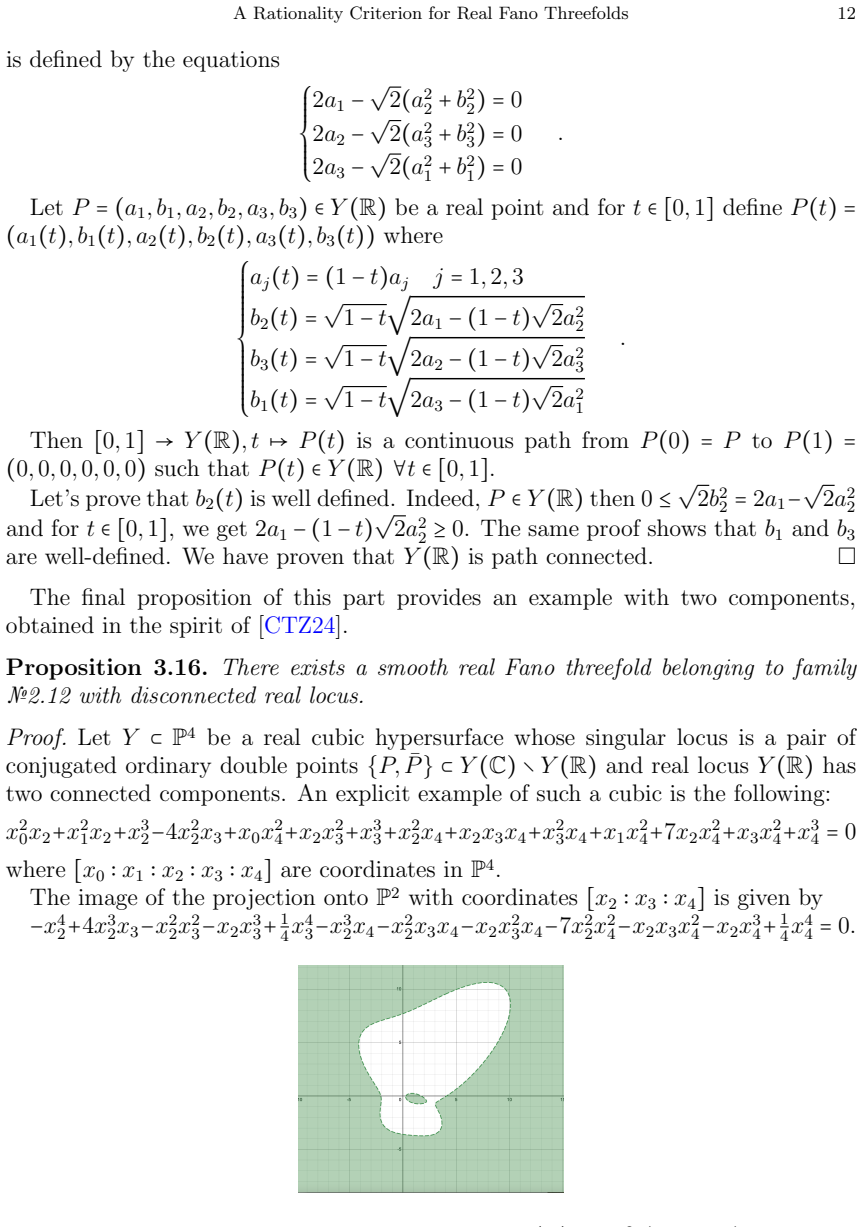
- [§3.3, Proposition 3.16] The explicit cubic polynomial and its projected image are written in a long inline display without line breaks; separating the coordinates and the equations into a displayed multiline format would greatly improve readability.
- [§4.3.3, Family №3.23] The sentence 'Y2 belongs to the family №2.30 and Y2 belongs to family №2.31' should refer to two different targets, presumably Y2 and Y3, so the second occurrence of Y2 is a typo.
Circularity Check
No circularity: s_X is defined independently, rationality is established by a case check over the external Mori–Mukai classification, and the cited descent lemma is an external input rather than a restatement of the conclusion.
full rationale
The invariant s_X is defined in Definition 4.1 as the maximum number of connected components among real forms of complex deformations of X_C; it is not defined in terms of rationality, and the main theorem (Theorem 4.3) is proved by running through the 105 Mori–Mukai families. For each family the paper either exhibits a disconnected real form (Propositions 3.6, 3.9, 3.11, 3.15, 3.16, 4.7, 4.9, 4.12, 4.14, 4.15) or proves that every real member with nonempty real locus is rational using contractions to P^3, quadrics, or other rational targets. The only in-house dependency is [ACKM24, Lemma 2.5], a descent lemma from an unpublished preprint coauthored by one of the present authors, used in Propositions 4.8, 4.11, and 4.13. This is load-bearing and the lemma is not stated or proved in this paper, so its failure would be a correctness risk; however it is not circular, because the lemma is not an input that by construction equals rationality or s_X = 1, and no equation in the paper identifies the conclusion with a hypothesis. The paper also candidly flags its own limitation in Remark 4.17, noting the Fano hypothesis may not be relaxable, and Remark 4.16 records that the converse of Theorem 4.3 is false. The derivation chain is therefore not circular, though it is not fully self-contained.
Assumptions & free parameters
assumptions (6)
- domain assumption The Mori-Mukai/Iskovskikh classification of smooth complex Fano threefolds into 105 deformation families is complete and the invariants (index, degree, Hodge numbers, description of X_C) are correct.
- domain assumption Prokhorov's G-Fano classification [Pro13] correctly lists all complex Fano threefolds with a real involution acting with real Picard rank 1 and geometric Picard rank > 1.
- standard math Namikawa's smoothing theorem [Nam97] applies to real Fano threefolds with ordinary double points, preserving degree and complex Picard number.
- standard math The Smith-Thom inequality (A) and the Borel-Swan inequality (B) are valid for real projective varieties and give the stated bounds (C) and (D).
- domain assumption The rationality criteria of Benoist-Wittenberg, Hassett-Tschinkel, and Kuznetsov-Prokhorov (Theorem 3.3) are correct for the real Fano threefold families in Tables 1-2.
- domain assumption The descent lemma [ACKM24, Lemma 2.5] and the contraction lists in [Mat95] and [Mat23] are complete and valid over R.
invented entities (1)
-
The invariant s_X, the maximal number of connected components of X'(R) over real forms X' with X'_C deformation equivalent to X_C.
independent evidence
Cite this review
Pith. "Pith review of A rationality criterion for real Fano threefolds." pith.science (2026). https://pith.science/paper/HD4QUIWE
@misc{pith2026250704012,
  author       = {Pith},
  title        = {Pith review of: A rationality criterion for real Fano threefolds},
  year         = {2026},
  howpublished = {\url{https://pith.science/paper/HD4QUIWE}},
  note         = {Machine review of arXiv:2507.04012}
}
abstract
We study the connectedness of the real locus of smooth geometrically rational Fano threefolds and prove a sufficient criterion of $\mathbb{R}$-rationality.
Figures
Reference graph
Works this paper leans on
-
[2]
Matematiche (Catania) , 47(1):63–74 (1993),
work page 1993
-
[4]
On the rationality of some real threefolds
[BP24] Olivier Benoist and Alena Pirutka. On the rationality of some real threefolds. Preprint, 2412.13624,
-
[5]
Fano varieties in Mori fibre spaces
[CFST16] Giulio Codogni, Andrea Fanelli, Roberto Svaldi, and Luca Tasin. Fano varieties in Mori fibre spaces. Int. Math. Res. Not. IMRN , pages 2026–2067,
work page 2026
-
[8]
[Deb20] Olivier Debarre. Gushel-Mukai varieties. preprint, arXiv:2001.03485,
arXiv 2001
-
[10]
Conic bundle threefolds differing by a constant brauer class and connections to rationality
[FJS+24a] Sarah Frei, Lena Ji, Soumya Sankar, Bianca Viray, and Isabel Vogt. Conic bundle threefolds differing by a constant brauer class and connections to rationality. preprint, arXiv:2406.13510,
-
[13]
The topology of real algebraic varieties
[Kol01] J´ anos Koll´ ar. The topology of real algebraic varieties. In Current developments in mathematics, 2000 , pages 197–231. Int. Press, Somerville, MA,
work page 2000
-
[1912]
Certaines fibrations en surfaces quadriques r´ eelles.preprint, arXiv:2406.00463,
[CTP24] Jean-Louis Colliot-Th´ el` ene and Alena Pirutka. Certaines fibrations en surfaces quadriques r´ eelles.preprint, arXiv:2406.00463,
-
[1979]
Rationality of real conic bundles with quartic discriminant curve
[JJ24] Lena Ji and Mattie Ji. Rationality of real conic bundles with quartic discriminant curve. Int. Math. Res. Not. IMRN , 2024(1):115–151,
work page 2024
Show all 17 references
-
[1986]
Classification of Fano 3-folds with B2 ≥ 2
[MM03] Shigefumi Mori and Shigeru Mukai. Erratum: “Classification of Fano 3-folds with B2 ≥ 2” [Manuscripta Math. 36 (1981/82), no. 2, 147–162]. Manuscripta Math., 110(3):407,
1981
-
[1987]
Rationality of singular cubic three- folds over R
[CTZ24] Ivan Cheltsov, Yuri Tschinkel, and Zhang Zhijia. Rationality of singular cubic three- folds over R. preprint, arXiv:2411.14379,
-
[1995]
Addendum/Erratum to the paper ”Weyl groups and Birational trans- formations among minimal models”
[Mat23] Kenji Matsuki. Addendum/Erratum to the paper ”Weyl groups and Birational trans- formations among minimal models”. preprint, arXiv:2401.13431,
-
[2000]
[FJ24] Sarah Frei and Lena Ji
GAF A 2000 (Tel Aviv, 1999). [FJ24] Sarah Frei and Lena Ji. A threefold violating a local-to-global principle for rationality. Res. Number Theory, 10(2):Paper No. 39, 9,
2000
-
[2003]
Do uniruled six-manifolds contain Sol Lagrangian submanifolds? Int
[MW12] Fr´ ed´ eric Mangolte and Jean-Yves Welschinger. Do uniruled six-manifolds contain Sol Lagrangian submanifolds? Int. Math. Res. Not. IMRN , 2012(7):1569–1602,
2012
-
[2020]
[Mat95] Kenji Matsuki
Translated from the 2017 French original by Catriona Maclean. [Mat95] Kenji Matsuki. Weyl groups and birational transformations among minimal models. Mem. Amer. Math. Soc. , 116(557):vi+133,
2017
-
[2021]
[HT22] Brendan Hassett and Yuri Tschinkel
With an appen- dix by Jean-Louis Colliot-Th´ el` ene. [HT22] Brendan Hassett and Yuri Tschinkel. Rationality of Fano threefolds of degree 18 over nonclosed fields. preprint, arXiv:1910.13816v1,
1910 arXiv
-
[2023]
K-stability of pointless del Pezzo surfaces and Fano 3-folds
[ACKM24] Hamid Abban, Ivan Cheltsov, Takashi Kishimoto, and Fr´ ed´ eric Mangolte. K-stability of pointless del Pezzo surfaces and Fano 3-folds. preprint, arXiv:2411.00767,
-
[2024]
Smooth Fano 3-folds satisfying Condition (A)
[ACKM25] Hamid Abban, Ivan Cheltsov, Takashi Kishimoto, and Fr´ ed´ eric Mangolte. Smooth Fano 3-folds satisfying Condition (A). Preprint, arXiv:2505.13684,
Reviewed August 6, 2026 · model on record in the stance chip above.
Discussion (0). Continue with ORCID to comment.