REVIEW 2 major objections 4 minor 17 references
On the Computation of Normalized Power Priors
T0 review · 2 major / 4 minor · reviewed 2026-07-11 · grok-4.5
Pith's one-line read MCMC samples from the unnormalized power prior already contain the normalizing constant of the normalized power prior, so NPP can be fit inside ordinary Bayesian software.
desk verdict Portable UnPP-to-mixture pipeline that lets ordinary MCMC software run NPP; identity is sound, binomial check clean, regression tails still the practical soft spot. read the letter →
The pith
A machine-rendered reading of the paper's core claim, the machinery that carries it, and where it could break.
The reading
What carries the argument
The functional identity ˜π(a0|D0) ∝ C(a0) under a uniform prior on a0. It converts the intractable normalizing function into the marginal density of an ordinary MCMC run, so that a mixture (or piecewise mixture-plus-extrapolation) approximation of that density becomes a usable log C(a0) term inside standard Bayesian code.
What would settle it
In a linear-regression setting where the true closed-form C(a0) is known, replace the mixture-plus-extrapolation with pure mixture tails and check whether the resulting NPP posterior for the regression coefficients systematically over-borrows relative to the exact NPP posterior.
Extended reading notes
Core claim
Under a uniform prior on a0, the marginal distribution of a0 induced by the unnormalized power prior (when the powered historical likelihood is treated as a pseudo-likelihood) is functionally proportional to the normalizing constant C(a0) of the normalized power prior. MCMC samples of a0 from that unnormalized model therefore supply a direct Monte-Carlo estimate of C(a0), which can be turned into a parametric plug-in and used inside any generic Bayesian software to fit the fully normalized power prior.
Load-bearing premise
That a mixture fitted only where the unnormalized MCMC places mass, together with a straight-line log-scale extrapolation to a Laplace estimate of C(1), is accurate enough that the final posterior for the scientific parameters is not materially distorted when C(a0) drops off extremely fast.
Editorial analysis
A structured set of objections, weighed in public.
Referee Report
Summary. The paper addresses the practical barrier to using the normalized power prior (NPP): the intractable normalizing function C(a0) = ∫ L(θ|D0)^a0 π0(θ) dθ. It exploits the identity that, under a uniform prior on a0 and treating the powered historical likelihood as a pseudo-likelihood, the marginal of a0 under the unnormalized power prior (UnPP) is proportional to C(a0). MCMC samples from UnPP are therefore used to fit a parametric mixture for C(a0) (or a weighted/transformed version), which is then plugged into a standard NPP analysis inside generic Bayesian software. For the common case of rapid decay of C(a0) near zero, the authors add endpoint anchors (log C(0)=0 and a Laplace estimate of log C(1)) and log-linear extrapolation past a breakpoint a*_0, with optional reparameterization and weighting. Closed-form binomial and conjugate linear-regression examples illustrate agreement when the mixture is adequate and partial recovery of θ posteriors after extrapolation when pure mixtures fail.
Significance. If the approximation is reliable enough for the scientific parameters θ, the contribution is practically important: NPP becomes usable inside PROC MCMC, Stan, JAGS, BUGS, or NIMBLE without external bridge/importance sampling or model-specific marginal-likelihood code. The identity itself is correctly stated and underutilized; the binomial closed-form check and the honest documentation of UnPP skewness and tail failure modes are strengths. The appendix SAS code further lowers the barrier to adoption. The work therefore has clear applied value for dynamic historical borrowing, provided the residual approximation error on θ is shown to be controlled in the hard regime the authors themselves flag.
major comments (2)
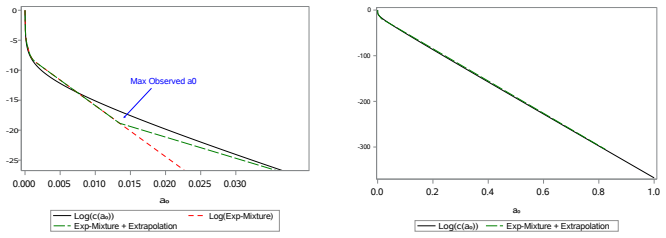
- Sections 3.2–3.4 and Figures 3–6: the central practical claim is that mixture-plus-log-linear extrapolation yields NPP posteriors for θ that are not materially distorted even when C(a0) decays extremely rapidly. Because log C is known to be convex (Carvalho & Ibrahim 2021, cited), a linear bridge from a*_0 (amax0 or 0.9 amax0) to a Laplace log C(1) systematically misspecifies the tail. Figure 6 shows improved visual overlap for regression coefficients relative to the pure-mixture failure in Figure 4, yet the a0 marginal remains visibly off and no quantitative bound (e.g., total-variation or KL distance on the θ marginal, or coverage of credible intervals) is reported. Without such a metric, or a head-to-head comparison against bridge/importance sampling on the same regression example, the statement that “impact on the model parameters is relatively little” remains an unquantified assumpt
- Section 3 and Discussion: empirical support is limited to two conjugate models (binomial with closed-form C(a0) and linear regression with closed-form C(a0)). The method is advertised for generic software and non-conjugate settings, yet no non-conjugate or higher-dimensional example is shown, nor is sensitivity to mixture component count, breakpoint choice, or Laplace accuracy for log C(1) systematically examined. At least one non-conjugate illustration (or a clear statement of the scope limitation) is needed to underwrite the claim of routine applicability.
minor comments (4)
- Throughout (e.g., Abstract, §2.2): “psuedo” should be “pseudo”; several other minor typos (“parametrically”, spacing around a0) should be cleaned.
- Figure captions (Figs. 1–6) are informative but axis labels and legend fonts are small; ensure they remain legible in print.
- §3.5–3.6 introduce transformed-scale sampling and weighting/tempering as remedies, yet provide no numerical illustration; either add a brief example or move the material to a short appendix so the main narrative stays focused on the mixture-plus-extrapolation pipeline that is actually demonstrated.
- Appendix A: the SAS code is valuable; a short note on how the same plug-in would be written in Stan or JAGS would broaden accessibility without lengthening the main text.
Circularity Check
No significant circularity: the core identity is a direct integral consequence of the UnPP definition, and the mixture/extrapolation steps are openly numerical approximations checked against closed forms.
full rationale
The paper’s load-bearing step is the functional identity in Section 2.2: under a uniform prior on a0 and treating L(θ|D0)^a0 as a pseudo-likelihood, the UnPP marginal ˜π(a0|D0) is exactly proportional to C(a0) by construction of the integral definition of C. This is not a self-definitional loop that forces a scientific claim; it is an elementary change of perspective that converts an intractable integral into an ordinary MCMC target. Subsequent steps (fitting an exponential mixture to UnPP draws, anchoring log C(0)=0, Laplace estimate of log C(1), and optional log-linear extrapolation past a*_0) are presented as numerical devices whose accuracy is verified against closed-form C(a0) in the binomial case and against the true NPP posterior in the regression case. No parameter is fitted to current-data outcomes and then re-labeled a prediction; no uniqueness theorem or ansatz is imported via self-citation; the authors’ own prior work is not load-bearing. Residual approximation error when C decays rapidly is acknowledged (Figures 3–6) rather than hidden by circular reasoning. The derivation chain is therefore self-contained and non-circular.
Assumptions & free parameters
free parameters (3)
- mixture component count and exponential scales/weights for ˜C(a0)
- breakpoint a*_0 for switching to log-linear extrapolation
- optional weight w(a0) and tempering τ
assumptions (5)
- standard math With uniform π_A(a0), the UnPP marginal of a0 under the powered historical likelihood as pseudo-likelihood satisfies ˜π(a0|D0) ∝ C(a0).
- standard math C(0)=1 (log C(0)=0) whenever the baseline prior π0(θ) is proper.
- domain assumption log C(1) can be adequately estimated by Laplace/normal approximation from historical-only MCMC (max log-posterior plus log-determinant of posterior covariance).
- ad hoc to paper A parametric mixture (here exponential mixtures on [0,1]) plus optional log-linear tail adequately represents C(a0) for inferential purposes on θ.
- domain assumption log C(a0) is convex, so linear log-extrapolation is only locally accurate.
Cite this review
Pith. "Pith review of On the Computation of Normalized Power Priors." pith.science (2026). https://pith.science/paper/HDB2MUE7
@misc{pith2026260705579,
  author       = {Pith},
  title        = {Pith review of: On the Computation of Normalized Power Priors},
  year         = {2026},
  howpublished = {\url{https://pith.science/paper/HDB2MUE7}},
  note         = {Machine review of arXiv:2607.05579}
}
abstract
The normalized power prior provides a principled framework for incorporating historical data into Bayesian inference while preserving coherence, but its routine application has been hindered by the need to evaluate an intractable normalizing constant function $C(a_{0})$. Existing approaches typically rely on model-specific marginal likelihood calculations, numerical integration over grids, or auxiliary sampling schemes implemented outside standard Bayesian software. In this paper, we present a computational perspective that exploits a simple and underutilized functional identity: under the unnormalized power prior, the marginal distribution of the power parameter is proportional to the normalizing constant of the normalized power prior. Leveraging this relationship, we propose a sampling-based strategy to approximate the normalized power prior using output from generic Markov chain Monte Carlo (MCMC) algorithms. The resulting approximation can be implemented entirely within all general Bayesian software packages (such as PROC MCMC, BUGS, JAGS, Stan, or NIMBLE), without requiring explicit marginal likelihood evaluation. Several illustrative examples demonstrate the practicality of the approach and highlight its potential to facilitate the routine use of normalized power priors in applied settings.
Figures


Figures from the paper (3 more)


Reference graph
Works this paper leans on
-
[1]
and Chen, Ming-Hui , title =
Ibrahim, Joseph G. and Chen, Ming-Hui , title =. Statistical Science , year =
-
[2]
, title =
Duan, Ying and Ye, Kai and Smith, Eric P. , title =. Biometrics , year =
-
[3]
, title =
Neuenschwander, Beat and Branson, Mark and Spiegelhalter, David J. , title =. Statistics in Medicine , year =
-
[4]
Biometrics , year =
Duan, Ying and Wang, Xiaodong and Ye, Kai , title =. Biometrics , year =
-
[5]
and Carlin, Bradley P
Hobbs, Brian P. and Carlin, Bradley P. and Sargent, Daniel J. , title =. Biometrics , year =
-
[6]
Power Priors: A Review and Comparison , journal =
Pawe. Power Priors: A Review and Comparison , journal =. 2020 , volume =
2020
-
[7]
and Ibrahim, Joseph G
Carvalho, Carlos M. and Ibrahim, Joseph G. , title =. Bayesian Analysis , year =
-
[8]
Bayesian Analysis , year =
Ye, Kai and Xie, Fenglong and Deng, Xin and Zhou, Song , title =. Bayesian Analysis , year =
Show all 17 references
-
[9]
Normalized Power Priors Always Down-Weight Historical Information: Theoretical Insights and Practical Implications , journal =
Pawe. Normalized Power Priors Always Down-Weight Historical Information: Theoretical Insights and Practical Implications , journal =. 2023 , volume =
2023
-
[10]
Biometrics , year =
Shen, Rui and Hsu, William and Morris, John and Yuan, Ying , title =. Biometrics , year =
-
[11]
Biostatistics , year =
Han, Liang and Su, Shan and Zhang, Yong and Ning, Jin and Chu, Haitao , title =. Biostatistics , year =
-
[12]
and Chen, Ming-Hui and Sinha, Debajyoti , title =
Ibrahim, Joseph G. and Chen, Ming-Hui and Sinha, Debajyoti , title =. Biometrika , year =
-
[13]
and Chen, Ming-Hui and Guttman, Irwin , title =
Ibrahim, Joseph G. and Chen, Ming-Hui and Guttman, Irwin , title =. Bayesian Analysis , year =
-
[14]
CRC Press , year =
Gelman, Andrew and others , title =. CRC Press , year =
-
[15]
Statistica Sinica , year =
Meng, Xiao-Li and Wong, Wing Hung , title =. Statistica Sinica , year =
-
[16]
Journal of Computational and Graphical Statistics , year =
Meng, Xiao-Li and Wong, Wing Hung , title =. Journal of Computational and Graphical Statistics , year =
-
[17]
and Dey, Dipak K
Gelfand, Alan E. and Dey, Dipak K. , title =. Journal of the Royal Statistical Society B , year =
Reviewed July 11, 2026 · model on record in the stance chip above.
Discussion (0). Sign in to comment.