REVIEW 6 minor 41 references
Quasi-isometry classification of certain graph $2$-braid groups and its applications
T0 review · 0 major / 6 minor · reviewed 2026-08-07 · deepseek-v4-flash
Pith's one-line read This paper proves that 2-braid groups over bunches of grapes are quasi-isometric exactly when their quasi-minimal representatives are isometric, and that the comparison is algorithmic.
desk verdict A genuine advance in quasi-isometry classification of graph 2-braid groups; the invariant-completeness proof holds up, and the paper deserves serious refereeing. read the letter →
The pith
A machine-rendered reading of the paper's core claim, the machinery that carries it, and where it could break.
The reading
What carries the argument
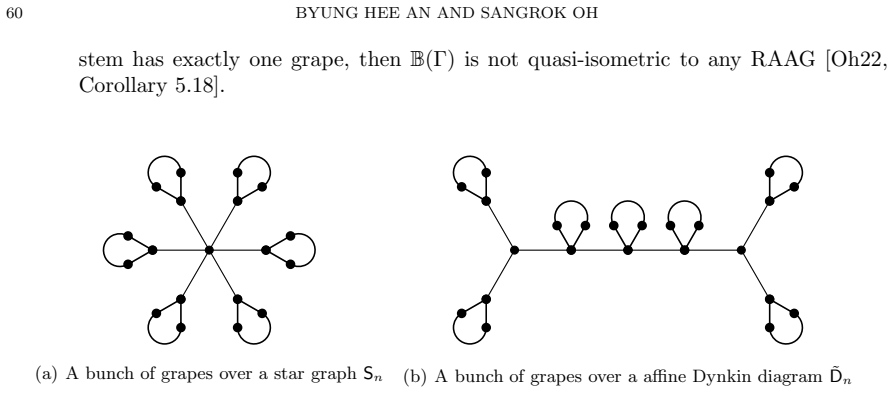
The load-bearing object is the intersection complex, a labelled almost-simplicial complex whose vertices are maximal product subcomplexes of the universal cover (top-dimensional flats), whose simplices record which finite families of such subcomplexes intersect, and whose labels record the product domains of the intersections. For bunches of grapes the paper proves a Helly-type colinearity lemma: any finite family of pairwise-intersecting maximal product subcomplexes of $\widetilde{UP}_2(\Gamma)$ has a common intersection that is itself a standard product subcomplex, corresponding to a colinear set of twigs (path substems of the stem tree). That lemma makes $I(\widetilde{UP}_2(\Gamma))$ a connected, simply connected flag complex and makes the reduced complex $RI(UP_2(\Gamma))$ developable as a complex of groups. The quasi-minimal representative is produced by four operations that induce isomorphisms of intersection complexes and therefore quasi-isometries of the corresponding braid groups.
What would settle it
Build an explicit bunch of grapes and examine the universal cover of $UP_2(\Gamma)$: if one finds a finite family of maximal product subcomplexes that meet pairwise but whose total intersection is empty, or a reduced intersection complex whose universal cover is not simply connected and flag, then the colinearity lemmas are false and the completeness proof of the main rigidity theorem breaks. The paper predicts that no such configuration exists for bunches of grapes; locating one would settle the central claim negatively.
Extended reading notes
Core claim
On the paper's own terms, the discovery is Corollary 6.6: for large bunches of grapes $\Gamma,\Gamma'$, the groups $B_2(\Gamma)$ and $B_2(\Gamma')$ are quasi-isometric if and only if the intersection complexes $I(\widetilde{UP}_2(\Gamma))$ and $I(\widetilde{UP}_2(\Gamma'))$ are isomorphic, if and only if the quasi-minimal representatives $\Gamma_{\min}$ and $\Gamma'_{\min}$ are isometric. Here $\widetilde{UP}_2(\Gamma)$ is the universal cover of the union of all maximal product subcomplexes of the unordered discrete $2$-configuration space of $\Gamma$, and $\Gamma_{\min}$ is obtained by pruning empty twigs, smoothing twigs, picking over-grown grapes, and pruning over-grown substems. The paper further proves that $\Gamma_{\min}$ exists, is unique up to isometry, and is computable in finite time, yielding an algorithm that decides quasi-isometry between any two $2$-braid groups over bunches of grapes.
Load-bearing premise
The classification rests on the claim that pairwise-intersecting maximal product regions in the universal cover always have a common intersection of the same standard product type; this Helly-type behavior fails for general weakly special square complexes, so if it ever failed for bunches of grapes the completeness proof would collapse.
Editorial extensions
If this is right
- Any two bunches of grapes can be fed to a finite algorithm that outputs whether their $2$-braid groups are quasi-isometric.
- Within this class, $2$-braid groups have quasi-isometric rigidity: coarse equivalence is exactly isometry of the quasi-minimal representative.
- The known families of circumference-one graphs whose $2$-braid groups are or are not quasi-isometric to right-angled Artin groups are both strictly enlarged.
- Two $4$-braid groups over trees are decided by the same machinery, because each $B_4$ of a tree is isomorphic up to free factors to $B_2$ of a canonically grown bunch of grapes.
- On quasi-minimal inputs the intersection complex is complete, not just invariant: isomorphic intersection complexes force isometric defining graphs.
Reading between the lines
- If the same Helly-type colinearity lemma holds for wider graph classes such as cacti, the identical scheme would likely give quasi-isometry algorithms there; a single counterexample would delimit the method sharply.
- The paper's sufficient condition comparing $2$-braid groups to right-angled Artin groups invites the conjecture that, within this class, quasi-isometry to a RAAG is characterized by the shape of the quasi-minimal stem; its negative examples suggest the exact obstruction is a four-branched substem.
- The construction of a quasi-isometry from an isomorphism between complexes of groups is a transferable technique: the paper's open Question 2 asks exactly how widely it holds among special square complexes satisfying the flat-intersection hypothesis.
- The tree $4$-braid algorithm could plausibly be iterated, via the same edge-stabilization pattern, to compare $n$-braid groups over trees with $2$-braid groups over larger grape-like graphs; the paper stops at $n=4$.
Editorial analysis
A structured set of objections, weighed in public.
Referee Report
Summary. The paper studies the quasi-isometry classification of 2-braid groups over 'bunches of grapes' (graphs of topological circumference at most one). The main result (Corollary 6.6, Theorems 6.5 and 6.7) is an algorithmic classification: for two bunches of grapes Γ, Λ, the groups B2(Γ) and B2(Λ) are quasi-isometric if and only if the quasi-minimal representatives Γ_min and Λ_min are isometric, if and only if the intersection complexes I(UP2(Γ)) and I(UP2(Λ)) are isomorphic. The proof combines the quasi-isometry invariant introduced by the second author in [Oh22], new graph operations (pruning/smoothing twigs, picking over-grown grapes, pruning over-grown substems) that preserve the quasi-isometry type, and a completeness theorem showing that the intersection complex is a complete invariant on quasi-minimal representatives. Applications include new infinite families of graph 2-braid groups that are / are not quasi-isometric to RAAGs, and an algorithm deciding quasi-isometry of 4-braid groups over trees.
Significance. If correct, this is a significant step in the quasi-isometric classification of graph braid groups. The completeness of the intersection complex invariant for a natural class of 2-dimensional special groups is new and nontrivial, and the algorithmic nature of the classification is a strength. The paper is carefully structured, with explicit algorithms and numerous examples. The main theorems are supported by detailed arguments; the most delicate steps, namely the Helly-type colinearity Lemmas 4.9–4.10 and the iterative gluing in Theorems 5.5 and 5.15, are sound as written, though some auxiliary lemmas (e.g., Lemma 4.18) are stated without proof. The application to 4-braid groups over trees is elegant and gives a new quasi-isometry classification for that class.
minor comments (6)
- [Section 6.2, first paragraph] The sentence 'we assume that Γ = (T,ℓ) and Γ' = (T',ℓ') are in Grapelarge_min but both have two grapes at each vertex which is not a leaf of the stems' is confusing and appears to contradict the definition of Grapelarge_min, where val_T(v) ≥ 2 forces ℓ(v) = 1. Please rephrase the normalization being made.
- [Proof of Theorem 5.5] The statement 'Since N_{n+1}(v)\N_n(v) is countably infinite' is inaccurate: the sphere of radius n+1 in the locally finite complex I(UP2(Γ)) is finite. The induction still works with finite spheres; please correct the sentence.
- [Lemma 4.10] The invocation of the Helly property requires that the p-lifts M(t_i) be convex in UP2(Γ); this follows because they are images of local isometries from products of trees, but the justification should be stated explicitly.
- [Lemma 4.18] This lemma is load-bearing for the proof of Theorem 6.5 (via Lemma 6.12 and Lemma 6.15) but is stated without proof; please provide a proof or a detailed argument that canonical order is preserved by semi-isomorphisms.
- [Section 5.1 and Appendix A] Lemmas 5.2 and 5.7 and the algorithms in Appendix A would benefit from explicit termination and correctness arguments; currently they are stated as obvious.
- [Algorithm 3] The notation 'T_min ← T_min \ T_{v,3}\···\T_{v,m}' is ambiguous; use a union symbol or set-builder notation to indicate removal of the union of the specified stems.
Circularity Check
No significant circularity: the classification is proved from structural lemmas, and the cited Oh22 invariant is independent prior work, not equivalent to the conclusion.
full rationale
Walking the derivation chain: the paper's new results (Main Theorems A, B, C, and E) are proved in Sections 4-7 from structural lemmas such as Lemma 4.6, Lemmas 4.9-4.10, Theorem 4.13, Lemma 4.15, and from explicit quasi-isometry constructions for the graph operations in Theorems 5.3, 5.5, and 5.15. The quasi-isometry invariance of the intersection complex is imported from [Oh22] via Theorem 2.23; this is a genuine prior theorem whose proof is not re-derived here and whose content is not equivalent to the classification being proved. No parameter is fitted to data, and no 'prediction' is a renamed input: the completeness direction (c) implies (b) is established by reconstructing the quasi-minimal bunch of grapes from the labelled intersection complex using the canonical order and deformation retraction argument in Section 6.2. The delicate step Lemma 4.10 uses the CAT(0) Helly property to force common intersections of lifts; if this lemma failed, the flag-complex/developability step (Theorem 4.13) and hence the completeness proof would collapse, but a possible mathematical gap is not circularity. No circular step satisfying the quoted-evidence standard was found.
Assumptions & free parameters
assumptions (6)
- standard math Standard CAT(0) cube complex theory: universal covers of compact special cube complexes are CAT(0), and quasi-isometries map top-dimensional flats to flats (Huang, Theorem 2.10).
- standard math The intersection complex I(Y) is a quasi-isometry invariant for universal covers of compact weakly special square complexes (Oh22, Theorem C, quoted as Theorem 2.23).
- standard math Quasi-isometric invariance of free products with finite-end splitting: for one-ended G1, G2, G1*F_m and G2*F_n are quasi-isometric iff G1 and G2 are (Papasoglu-Whyte, Theorem 2.33).
- standard math The discrete configuration space UD_2(Γ) is a special cube complex and is homotopy equivalent to the continuous unordered configuration space UC_2(Γ) when Γ is simple (Abrams, Theorem 3.1, 3.2).
- domain assumption Restriction to graphs of circumference at most 1, i.e., bunches of grapes, where all cycles are leaf-like loops attached to a tree.
- domain assumption Local convexity of UP_2(Γ) in UD_2(Γ) for bunches of grapes (Proposition 4.7), giving B2(Γ) ≅ π1(UP_2(Γ)) * F_n.
Cite this review
Pith. "Pith review of Quasi-isometry classification of certain graph $2$-braid groups and its applications." pith.science (2026). https://pith.science/paper/HDHGCE25
@misc{pith2026250210366,
  author       = {Pith},
  title        = {Pith review of: Quasi-isometry classification of certain graph $2$-braid groups and its applications},
  year         = {2026},
  howpublished = {\url{https://pith.science/paper/HDHGCE25}},
  note         = {Machine review of arXiv:2502.10366}
}
abstract
In \cite{Oh22}, the second author defined a complex of groups decomposition of the fundamental group of a finitely generated 2-dimensional special group, called an \emph{intersection complex}, which is a quasi-isometry invariant. In this paper, using the theory of intersection complexes, we classify the class of 2-braid groups over graphs with circumference $\leq 1$ up to quasi-isometry. Moreover, we find a sufficient condition when such a graph 2-braid group is quasi-isometric to a right-angled Artin group or not. Finally, by applying the same method, we also find that there is an algorithm to determine whether two 4-braid groups over trees are quasi-isometric or not.
Figures


Figures from the paper (21 more)




Reference graph
Works this paper leans on
-
[1]
Aaron D. Abrams. Configuration spaces and braid groups of graphs . Ph.D thesis, University of California, Berkeley , 2000
work page 2000
-
[2]
Drummond-Cole, and Ben Knudsen
Byung Hee An, Gabriel C. Drummond-Cole, and Ben Knudsen. Edge stabilization in the homology of graph braid groups. Geom. Topol. , 24(1):421--469, 2020
2020
-
[3]
Geometric presentations of braid groups for particles on a graph
Byung Hee An and Tomaszt Maciazek. Geometric presentations of braid groups for particles on a graph. Communications in Mathematical Physics , 384:1109--1140, 2021
work page 2021
-
[4]
Divergence, thick groups, and short conjugators
Jason Behrstock and Cornelia Druţu. Divergence, thick groups, and short conjugators . Illinois Journal of Mathematics , 58(4):939 -- 980, 2014
work page 2014
-
[5]
Thick metric spaces, relative hyperbolicity, and quasi-isometric rigidity
Jason Behrstock, Cornelia Druţu, and Lee Mosher. Thick metric spaces, relative hyperbolicity, and quasi-isometric rigidity. Mathematische Annalen , 344(543), 2008
work page 2008
-
[6]
Hierarchical hyperbolicity of graph products and graph braid groups
Daniel James Solomon Berlyne. Hierarchical hyperbolicity of graph products and graph braid groups. CUNY Academic Works , 2021
work page 2021
-
[7]
Metric Spaces of Non-Positive Curvature
Martin Bridson and Andr\'e Haefliger. Metric Spaces of Non-Positive Curvature . Grundlehren der mathematischen Wissenschaften 319, Springer, 1999
1999
-
[8]
Quasi-hyperbolic planes in hyperbolic groups
Mario Bonk and Bruce Kleiner. Quasi-hyperbolic planes in hyperbolic groups. Proceedings of the American Mathematical Society , 133(9):2491--2494, 2005
work page 2005
Show all 41 references
-
[9]
The asymptotic geometry of right-angled Artin groups, I
Mladen Bestvina, Bruce Kleiner, and Michah Sageev. The asymptotic geometry of right-angled Artin groups, I . Geometry & Topology , 12(3):1653–1699, 2008
2008
-
[10]
Behrstock and Walter D
Jason A. Behrstock and Walter D. Neumann. Quasi-isometric classification of graph manifold groups . Duke Mathematical Journal , 141(2):217 -- 240, 2008
2008
-
[11]
Quasi-isometric rigidity of a class of right-angled Coxeter groups
Jordan Bounds and Xiangdong Xie. Quasi-isometric rigidity of a class of right-angled Coxeter groups . Proc. Amer. Math. Soc. , 148:553--568, 2020
2020
-
[12]
On braid groups and right-angled Artin groups
Francis Connolly and Margaret Doig. On braid groups and right-angled Artin groups . Geometriae Dedicata , 172:179--190, 2014
2014
-
[13]
An introduction to right-angled Artin groups
Ruth Charney. An introduction to right-angled Artin groups . Geometriae Dedicata , 125(1):141 -- 158, 2007
2007
-
[14]
Cashen and Alexandre Martin
Christopher H. Cashen and Alexandre Martin. Quasi-isometries between groups with two-ended splittings. Mathematical Proceedings of the Cambridge Philosophical Society , 162(2):249–291, 2017
2017
-
[15]
Embeddings of graph braid and surface groups in right-angled Artin groups and braid groups
John Crisp and Bert Wiest. Embeddings of graph braid and surface groups in right-angled Artin groups and braid groups . Algebraic & Geometric Topology , 4:439 -- 472, 2004
2004
-
[16]
Bowditch's JSJ tree and the quasi-isometry classification of certain Coxeter groups
Pallavi Dani and Anne Thomas. Bowditch's JSJ tree and the quasi-isometry classification of certain Coxeter groups . Journal of Topology , 10(4):1066--1106, 2017
2017
-
[17]
Quasi-isometries for certain right-angled Coxeter groups
Alexandra Edletzberger. Quasi-isometries for certain right-angled Coxeter groups . Groups Geom. Dyn. , 18(3):1037 -- 1098, 2024
2024
-
[18]
Quasi-isometric properties of graph braid groups
Praphat Xavier Fernandes. Quasi-isometric properties of graph braid groups. Ph.D. thesis, Emory Univ. , 2012
2012
-
[19]
Discrete Morse theory and graph braid groups
Daniel Farley and Lucas Sabalka. Discrete Morse theory and graph braid groups . Algebraic & Geometric Topology , 5(3):1075--1109, 2005
2005
-
[20]
On the cohomology rings of tree braid groups
Daniel Farley and Lucas Sabalka. On the cohomology rings of tree braid groups. Journal of Pure and Applied Algebra , 212(1):53--71, 2008
2008
-
[21]
Presentations of graph braid groups
Daniel Farley and Lucas Sabalka. Presentations of graph braid groups. Forum Mathematicum , 24(4):827--859, 2012
2012
-
[22]
Negative curvature in graph braid groups
Anthony Genevois. Negative curvature in graph braid groups. International Journal of Algebra and Computation , 31(01):81--116, 2021
2021
-
[23]
Hyperbolic groups
Misha Gromov. Hyperbolic groups. In Gersten S.M., editor, Essays in Group Theory . Mathematical Sciences Research Institute Publications, Springer, 1987
1987
-
[24]
Quasi-isometric classification of right-angled A rtin groups, I : The finite out case
Jingyin Huang. Quasi-isometric classification of right-angled A rtin groups, I : The finite out case. Geometry & Topology , 21(6):3467--3537, 2017
2017
-
[25]
Top dimensional quasiflats in CAT(0) cube complexes
Jingyin Huang. Top dimensional quasiflats in CAT(0) cube complexes. Geometry & Topology , 21(4):2281--2352, 2017
2017
-
[26]
Quasi-isometry classification of right-angled Artin groups II: several infinite out cases
Jingyin Huang. Quasi-isometry classification of right-angled Artin groups II: several infinite out cases . arxiv.org/abs/1603.02372 , 2024
2024 arXiv
-
[27]
Fr\'ed\'eric Haglund and Daniel T. Wise. Special cube complexes. Geometric and Functional Analysis , 17(5):1551--1620, 2008
2008
-
[28]
Graph braid groups and right-angled A rtin groups
Jee Hyoun Kim, Ki Hyoung Ko, and Hyo Won Park. Graph braid groups and right-angled A rtin groups. Transactions of the American Mathematical Society , 364(1):309--360, 2012
2012
-
[29]
Graph 4-braid groups and Massey products
Ki Hyoung Ko, Joon Hyun La, and Hyo Won Park. Graph 4-braid groups and Massey products . Topology and its Applications , 197(1):133--153, 2016
2016
-
[30]
Characteristics of graph braid groups
Ki Hyoung Ko and Hyo Won Park. Characteristics of graph braid groups. Discrete and Computational Geometry , 48(4):915--963, 2012
2012
-
[31]
Ian J. Leary. A metric Kan–Thurston theorem . Journal of Topology , 6(1):251--284, 2013
2013
-
[32]
On graphs not containing independent circuits
L\' a szl\' o Lov\' a sz. On graphs not containing independent circuits . Mat. Lapok , 16:289--299, 1965
1965
-
[33]
Quasi-isometry classification of right-angled Artin groups that split over cyclic subgroups
Alexander Margolis. Quasi-isometry classification of right-angled Artin groups that split over cyclic subgroups . Groups Geom. Dyn. , 14(4):1351--1417, 2020
2020
-
[34]
On the coarse geometry of certain right-angled Coxeter groups
Hoang Thanh Nguyen and Hung Cong Tran. On the coarse geometry of certain right-angled Coxeter groups . Algebraic & Geometric Topology , 19(6):3075–--3118, 2019
2019
-
[35]
Quasi-isometry invariants of weakly special square complexes
Sangrok Oh. Quasi-isometry invariants of weakly special square complexes. Topology and its Applications , 307, 2022
2022
-
[36]
Homogeneous trees are bilipschitz equivalent
Panos Papazoglu. Homogeneous trees are bilipschitz equivalent. Geometriae Dedicata , 54(3):301--306, 2002
2002
-
[37]
Abrams's stable equivalence for graph braid groups
Paul Prue and Travis Scrimshaw. Abrams's stable equivalence for graph braid groups. Topology and its Applications , 178:136--145, 2014
2014
-
[38]
Quasi-isometries between groups with infinitely many ends
Panos Papazoglu and Kevin Whyte. Quasi-isometries between groups with infinitely many ends. Commentarii Mathematici Helvetici , 77(1):133--144, 2002
2002
-
[39]
Embedding right-angled A rtin groups into graph braid groups
Lucas Sabalka. Embedding right-angled A rtin groups into graph braid groups. Geometriae Dedicata , 124(1):191 -- 198, 2007
2007
-
[40]
On rigidity and the isomorphism problem for tree braid groups
Lucas Sabalka. On rigidity and the isomorphism problem for tree braid groups. Groups Geom. Dyn. , 3(3):469--523, 2009
2009
-
[41]
D.T. Wise. From Riches to Raags: 3-Manifolds, Right-Angled Artin Groups, and Cubical Geometry: 3-manifolds, Right-angled Artin Groups, and Cubical Geometry . Conference board of the Mathematical Sciences. Regional conference series in mathematics. Conference Board of the Mathe...
2012
Reviewed August 7, 2026 · model on record in the stance chip above.
Discussion (0). Continue with ORCID to comment.