REVIEW 2 major objections 4 minor 13 references
The Delicate Dance of Orbital Rendezvous
T0 review · 2 major / 4 minor · reviewed 2026-08-14 · deepseek-v4-flash
Pith's one-line read For two spacecraft in nearby circular orbit, the Coriolis and tidal forces combine into a spring pulling toward the center of a drifting ellipse, so rendezvous trajectories are elliptical, not straight.
desk verdict Solid AJP-style teaching paper; the Apollo validation holds up when you don't mix first-order and exact expressions. read the letter →
The pith
A machine-rendered reading of the paper's core claim, the machinery that carries it, and where it could break.
The reading
What carries the argument
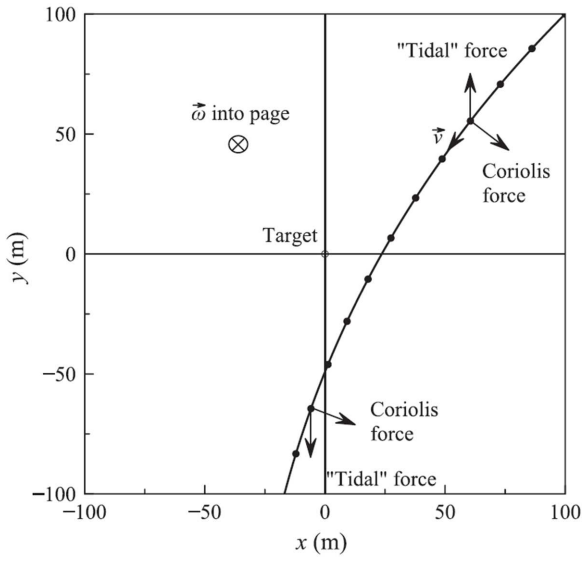
The machinery is the set of linearized relative-motion equations known as the Hill equations, together with their closed-form solution as the Clohessy-Wiltshire equations. In the rotating target frame the out-of-plane motion decouples as a simple harmonic oscillator, while the in-plane motion is described by parametric ellipse solutions with center $(x_c,y_c)$, semimajor axis $a=2\sqrt{C^2+D^2}$, semiminor axis $a/2$, and drift velocity $v_{\text{drift}}=-(3/2)\omega_0 y_c$. The load-bearing identity is the summed force $\vec{F}_{\text{total}}=\vec{F}_{\text{Cor}}+\vec{F}_{\text{tidal}}=-\omega_0^2(\vec{r}-\vec{r}_c)$, where the 'tidal' term is the first-order difference between the gravitational acceleration at the target and at the interceptor. This identity does the work of converting a confusing acceleration balance into a simple spring picture that can be used for trajectory design.
What would settle it
Release a small interceptor at rest 40 meters ahead of a target in a known circular orbit, fire it at 1 m/s directly at the target, and measure the closest approach; the paper's equation $d_{\min}\simeq\omega_0 x_0^2/|\dot{x}_0|$ predicts roughly 1.8 meters within a few percent. A measured miss distance that is several times larger or smaller would falsify the linearized Hooke's-law picture.
Extended reading notes
Core claim
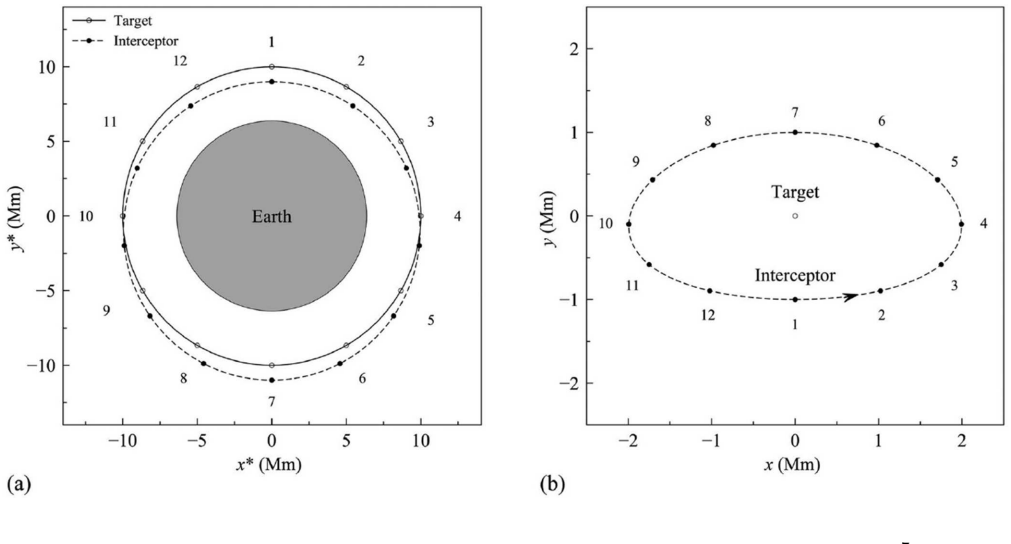
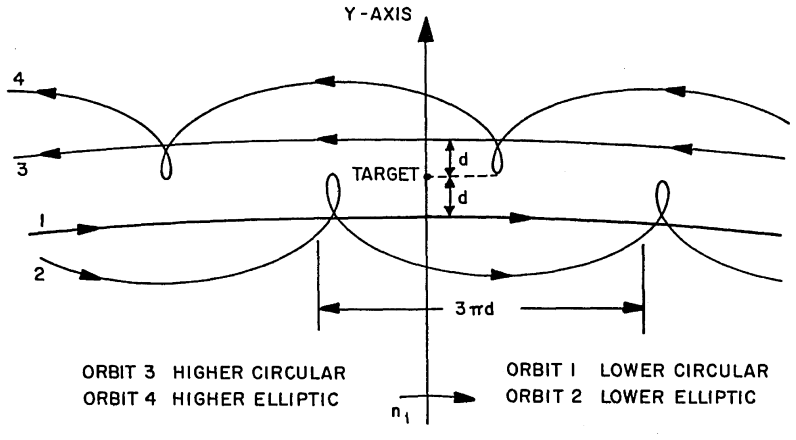
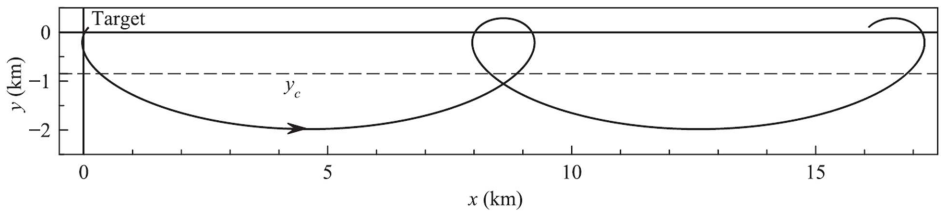
The central result is that, in the target's rotating frame and to first order in the small separation-to-orbit-radius ratio, the total force per unit mass on a coasting interceptor is $\vec{F}=-\omega_0^2(\vec{r}-\vec{r}_c)$, where $\vec{r}_c$ is the instantaneous center of the relative trajectory. The trajectory itself is a drifting ellipse: its along-track semimajor axis $a$ is twice the semiminor axis, its eccentricity is always $\sqrt{3}/2$, and its center drifts along the line $y=y_c$ with speed $v_{\text{drift}}=-(3/2)\omega_0 y_c$. Every coasting rendezvous in this regime is therefore motion around an ellipse whose center is the only point that exerts the effective spring pull, and that is why the intuitive straight-line chase fails.
Load-bearing premise
The entire derivation assumes the interceptor and target are so close that their separation divided by the orbital radius is tiny, namely $x/R_0, y/R_0, z/R_0 \ll 1$; all closed-form results depend on keeping only first-order terms in that ratio.
Editorial extensions
If this is right
- A coasting interceptor with no thrust follows a drifting ellipse, never a straight line, so straight-line chase scenes in films and books are dynamically wrong.
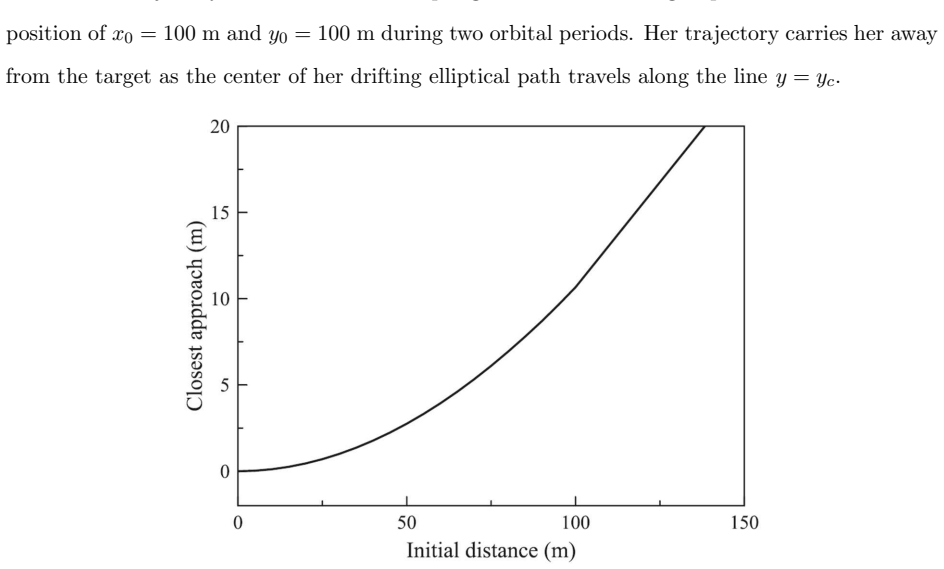
- Line-of-sight aiming becomes accurate only within about 40 meters: for an initial along-track distance $x_0$ and speed $|\dot{x}_0|=1\,\mathrm{m/s}$, the miss distance is $d_{\min}\simeq\omega_0 x_0^2/|\dot{x}_0|$, giving under 2 meters at 40 m and matching the 120-foot rule quoted in the paper.
- A stranded astronaut starting at rest $100\sqrt{2}$ m from her ship should not thrust directly at the ship; a single $1.03\,\mathrm{m/s}$ burn at an aiming angle about $36.7^\circ$ below the negative $x$-axis returns her with a gentle arrival speed near $1\,\mathrm{m/s}$.
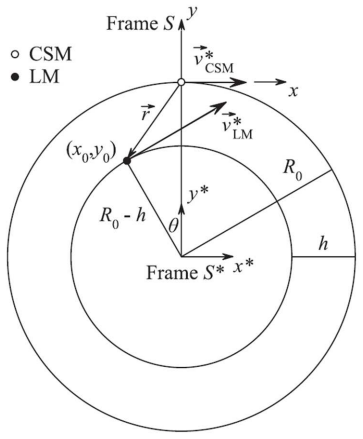
- For Apollo 11, the linearized model gives a Terminal Phase Initiation velocity change of $7.44\,\mathrm{m/s}$ at an aiming angle of $19.8^\circ$, within $0.12\,\mathrm{m/s}$ of the flight plan's nominal $7.56\,\mathrm{m/s}$, while reproducing the slow, gently curving final approach.
- When the lunar module's orbit height varies but the flight time and elevation angle are fixed, the required aiming angle is unchanged, so the astronauts always saw the command module at the same angular position at the same time.
Reading between the lines
- A reader could infer a practical guidance rule for autonomous rendezvous: null the interceptor's velocity relative to the instantaneous ellipse center rather than relative to the target; autopilot implementation is not discussed in the paper.
- Because the 40-meter threshold comes from $d_{\min}\simeq\omega_0 x_0^2/|\dot{x}_0|$, the same line-of-sight rule would shift at other orbital altitudes or around other bodies, so a small formation-flying mission could test the scaling by varying orbital radius and approach speed.
- A natural extension not pursued in the paper is to use the drifting-ellipse solution as a planning tool for multi-burn fuel-optimal rendezvous, treating the ellipse center as a controllable virtual target that the interceptor is always oscillating about.
Signed reviews
Editorial analysis
A structured set of objections, weighed in public.
Referee Report
Summary. The paper considers two spacecraft in nearby circular orbits and derives the Hill/Clohessy-Wiltshire equations for their relative motion in the rotating target frame. It shows that for small separations the combined Coriolis and tidal forces are equivalent to a Hooke's-law force directed toward the instantaneous center of a drifting ellipse, which makes the counter-intuitive rendezvous trajectories easier to understand. Applications include a stranded astronaut returning to a spacecraft with one impulsive burn, line-of-sight targeting at ranges near 40 m, and a reconstruction of the Apollo 11 Terminal Phase Initiation maneuver, for which the paper computes a required Delta-v of 7.44 m/s versus the flight-plan nominal 7.56 m/s.
Significance. The central derivation is standard and appears correct, and the paper's main pedagogical contribution—interpreting the Coriolis-plus-tidal force as a Hooke's-law spring toward the ellipse center—is a genuinely useful way to present relative orbital motion. The closed-form CW solutions, the energy argument, and the application to Apollo 11 are valuable because they make the subject concrete. The paper is not purely expository: it makes a falsifiable quantitative claim (the Apollo 11 Delta-v) and a claimed explanation of Schirra's 40 m rule, and both need to be presented with appropriate caveats. With those caveats addressed, the paper would be a good addition to the pedagogical literature.
major comments (2)
- [Section V, Eqs. (70)-(74)] The claimed 1.6% agreement with the Apollo 11 flight-plan Delta-v depends on setting vpre,y approximately equal to zero in Eq. (72). The exact expression in Eq. (70) gives vpre,y = -(omega_LM - omega_0) x0 approximately +1.1 m/s for the stated Apollo numbers, which is 44% of the computed Delta-v_y = 2.53 m/s. Retaining this term (and evaluating vpre,x from Eq. (70) rather than the leading-order Eq. (71)) changes |Delta-v| from 7.44 m/s to approximately 7.0-7.1 m/s, so the disagreement with the nominal 7.56 m/s is about 6-8%, not 1.6%. Because the quantitative validation of the CW model is a headline result, the manuscript should either use the exact pre-thrust velocity or report the first-order result with the truncation error explicitly quantified.
- [Sections III and IV, Eqs. (54)-(60)] The 'within about 40 m' conclusion for line-of-sight targeting is not a parameter-free prediction. The success threshold is assumed to be 1.83 m in Eq. (60), and the analogous astronaut-reach threshold in Sec. III is also a chosen value; the 40.24 m result is obtained by solving for x0 with that threshold. The paper should state explicitly that the match to Schirra's quoted 40 m depends on these assumed thresholds and ideally show the sensitivity of the range to the threshold choice.
minor comments (4)
- [Eq. (45)] Equation (45) contains a sign typo: the semimajor-axis expression should contain (3y0 + 2 xdot0/omega_0)^2, matching the definition of C in Eq. (38), not (3y0 - 2 xdot0/omega_0)^2.
- [Section IV, text near Fig. 10] The statement that the lower trajectories 'use the same initial velocities as their counterparts in the upper part' conflicts with the immediately following statement that line-of-sight targeting sets ydot0 = 0; please clarify whether the comparison uses the same initial speed rather than the same velocity.
- [Abstract] In the abstract, 'must carefully the balance' should read 'must carefully balance'.
- [Section III] The spelling 'Shirra' in Sec. III should be 'Schirra' to match the rest of the paper and the quoted source.
Circularity Check
No significant circularity: the relative-motion derivation is self-contained and the Apollo 11 validation is compared against an external flight-plan number.
full rationale
The central derivation in Sec. II starts from Newton's second law in an inertial frame, applies the rotating-frame acceleration relation, linearizes under x,y,z << R0, and solves the resulting Hill/Clohessy-Wiltshire equations in closed form (Eqs. (33)-(37)). The Hooke's-law/'drifting ellipse' claims are direct algebraic consequences (Eqs. (42)-(50)), not renamed inputs or fitted outputs. The Apollo 11 TPI calculation in Sec. V uses historical initial conditions (x0 = -55.72 km, y0 = -27.78 km, tf = 42 min) and an independently documented flight-plan Delta-v = 7.56 m/s as a benchmark, so the agreement is not built in. The Sec. III and IV discussions of the 40 m range do use Schirra's quote as a point of comparison, but the success thresholds there (astronaut reach 1.77 m and highway lane half-width 1.83 m) are external physical/engineering standards, not fitted to the quote; those calculations are illustrative consistency checks rather than circular predictions. The only self-citation (Ref. 15, the author's textbook) supplies standard Kepler's third law and is not load-bearing. The dropped vpre,y in Eq. (72) is a disclosed first-order approximation; whether it weakens the numerical agreement is a quantitative accuracy concern, not circularity.
Assumptions & free parameters
free parameters (2)
- Successful rendezvous miss-distance threshold d_success =
1.83 m (half of a 12-ft U.S. highway lane)
- Stranded-astronaut reach threshold =
1.77 m (height of a 5 ft 10 in astronaut)
assumptions (5)
- domain assumption The central body is spherically symmetric and the target follows a circular orbit; only Newtonian gravity acts.
- domain assumption The interceptor-target separation is small compared with the orbit radius (x, y, z << R0), allowing linearization.
- domain assumption The out-of-plane (z) motion has been nulled by prior thruster burns, so the analysis is planar.
- domain assumption For the Apollo 11 case, the CSM orbit is treated as circular at 60.0 nautical miles altitude and the LM is in the same orbital plane.
- domain assumption After each impulsive thruster burn, the non-gravitational forces are zero (F=0) while coasting.
Cite this review
Pith. "Pith review of The Delicate Dance of Orbital Rendezvous." pith.science (2026). https://pith.science/paper/HEKI2ZOJ
@misc{pith2026190802592,
  author       = {Pith},
  title        = {Pith review of: The Delicate Dance of Orbital Rendezvous},
  year         = {2026},
  howpublished = {\url{https://pith.science/paper/HEKI2ZOJ}},
  note         = {Machine review of arXiv:1908.02592}
}
read the original abstract
The meeting of two spacecraft in orbit around a planet or moon involves a delicate dance that must carefully the balance the gravitational, Coriolis, and centrifugal forces acting on the spacecraft. The intricacy of the relative motion between the two spacecraft caused problems for the Gemini missions in the mid-1960s. Although now mastered, the problem of how to bring two orbiting objects together continues to be misrepresented in popular movies and books. In this article, I will consider the case when the two spacecraft are in close proximity (compared with the radii of their orbits), and examine the counter-intuitive trajectories that are needed to bring them together. I will examine how a stranded astronaut might use an impulsive force to return to her ship in Earth orbit, how and when line-of-sight targeting may be used for a rendezvous, and how the Apollo 11 lunar module executed a Terminal Phase Initiation maneuver to rendezvous with the command/service module as they both circled the Moon.
Figures


Figures from the paper (12 more)




Reference graph
Works this paper leans on
-
[2]
can be solved subject to the usual initial conditions that at t = 0, x = x0 and ˙x = ˙x0, and similarly for the y initial conditions. 8 Integrating Eq. (20) with respect to time and applying the boundary conditions to evaluate the constant of integration produces ˙x =−2ω0y + ˙x0 + 2ω0y0. (32) This is used to replace ˙x in Eq. (21). The result is easily so...
work page 1962
-
[3]
Shirra spoke of “driving a car” to rendezvous. The U.S. Interstate Highway System uses a 12 ft (3.66 m) standard lane width. Let us require for a successful rendezvous that the car’s center remain in its lane; that is, the distance by which the interceptor misses the target must satisfy dmin = ω0x2 0 | ˙x0| ≤ 1.83 m. (60) As before, ω0 = 1.13× 10⁻³ rad/s ...
work page 1969
-
[11]
The rendezvous that was almost missed: Lunar orbit rendezvous and the Apollo program,
The author is grateful for the continued support of the Physics Department at Weber State University. Published by the American Journal of Physics 87, 627 (2019); ⟨https://doi.org/10. 1119/1.5115341⟩. ∗ Electronic address: bcarroll@weber.edu 1 James R. Hansen, “The rendezvous that was almost missed: Lunar orbit rendezvous and the Apollo program,” NASA Fac...
work page 2019
-
[27]
Simplified navigation for self- propelled astronauts,
6 Roger A. Freedman, Ibrahim Helmy, and Peter D. Zimmerman, “Simplified navigation for self- propelled astronauts,” Am. J. Phys. 43, 438 – 440 (1975). 7 Eugene I. Butikov, “Relative motion of orbiting bodies,” Am. J. Phys. 69, 63 – 67 (2001). 8 Joseph C. Amato, “Flying in formation: The orbital mechanics of LISA’s three spacecraft,” Am. J. Phys. 87, 18 – 2...
work page 1975
-
[45]
28 20 Michael Collins, Carrying the Fire (Farrar, Straus, and Giroux, New York, NY, 1974), p
work page 1974
-
[49]
Researches in the Lunar Theory,
16 G. W. Hill, “Researches in the Lunar Theory,” Am. J. Math. 1(1), 5 – 26 (1878). 17 W. H. Clohessy and R. S. Wiltshire, “Terminal Guidance System for Satellite Rendezvous,” J. Aerosp. Sci. 27(9), 653 – 658 (1960). 18 Jean Meeus, Astronomical Algorithms, 2nd ed. (Willmann-Bell, Inc., Richmond, VA, 1998), p
work page 1960
-
[89]
5 John E. Prussing and Bruce A. Conway, Orbital Mechanics, 2nd ed. (Oxford U.P., Oxford, UK, 2013), p
work page 2013
-
[209]
Reference frames and orbital rendezvous,
21 Thomas R. Michalik, “Reference frames and orbital rendezvous,” Phys. Teach. 23, 253 – 254 (1985). 22 “Apollo Flight Journal,” ⟨https://www.history.nasa.gov/afj/ap11fj/ 19day6-rendezvs-dock.html⟩ (accessed May 1, 2019). 23 “Project Apollo: ’Lunar Orbit Rendezvous’ (1968) NASA Mission Planning and Analysis Divi- sion,”⟨https://www.youtube.com/watch?v=eo3...
work page 1985
Show all 13 references
-
[237]
Line-of-Sight Guidance Techniques for Manned Orbital Rendezvous,
19 Edwin E. Aldrin, “Line-of-Sight Guidance Techniques for Manned Orbital Rendezvous,” Ph.D. thesis (M.I.T., 1963), p
1963
-
[246]
Hacker and James M
3 Barton C. Hacker and James M. Grimwood,On the Shoulders of Titans, NASA SP-2403 (NASA Science and Technical Information Office, 1977), p
1977
-
[278]
Carroll and Dale A
15 Bradley W. Carroll and Dale A. Ostlie, An Introduction to Modern Astrophysics , 2nd ed. (Addison-Wesley, San Francisco, CA, 2007), p
2007
-
[288]
Wiesel, Spaceflight Dynamics, 3rd ed
27 4 William E. Wiesel, Spaceflight Dynamics, 3rd ed. (Aphelion Press, Beavercreek, OH, 2010), p
2010
-
[2019]
Thousands of factors contributed to the ultimate success of Apollo, but no single factor was more essential than the concept of lunar-orbit rendezvous
Abstract The meeting of two spacecraft in orbit around a planet or moon involves a delicate dance that must carefully the balance the gravitational, Coriolis, and centrifugal forces acting on the space- craft. The intricacy of the relative motion between the two spacecraft cau...
1908 arXiv
Reviewed August 14, 2026 · model on record in the stance chip above.
Discussion (0). Continue with ORCID to comment.