Renormalisation techniques for inflation systems and some of their applications
Pith reviewed 2026-06-26 18:35 UTC · model grok-4.3
The pith
Renormalisation gives exact values for window covariograms and diffraction in inflation systems, including new monotile tilings.
A machine-rendered reading of the paper's core claim, the machinery that carries it, and where it could break.
Core claim
Under primitivity and finite local complexity the renormalisation principle maps the window covariogram of an inflation system to a rescaled copy of itself, thereby converting an erratic integral into a finite computation that yields the exact diffraction measure; the same principle is applied to the new monotile tilings and extended via Lyapunov exponents to exclude absolutely continuous spectrum.
What carries the argument
The renormalisation principle, which equates the window covariogram of an inflation system to a linearly rescaled version of itself after one inflation step.
If this is right
- Diffraction patterns of the new monotile tilings can be computed to arbitrary precision without truncation error.
- The orbit separation dimension is preserved under renormalisation and distinguishes pure-point spectrum systems.
- Renormalisation combined with positive Lyapunov exponents excludes an absolutely continuous part of the diffraction spectrum.
- The same iterative procedure applies to any inflation system meeting the stated structural conditions.
Where Pith is reading between the lines
- The method could be tested on other known aperiodic point sets whose inflation rules are not yet fully classified.
- If the Lyapunov-exponent criterion generalises, it would give a practical test for the absence of continuous spectrum in many substitution systems.
- High-precision diffraction data obtained this way could be compared directly with experimental scattering from candidate physical realisations of the monotile.
Load-bearing premise
The inflation systems must satisfy primitivity and finite local complexity so that the renormalisation identity holds exactly for the covariograms and measures.
What would settle it
A direct numerical integration of the window covariogram for a monotile tiling that differs from the value obtained by iterating the renormalisation map beyond any prescribed error bound.
Figures
read the original abstract
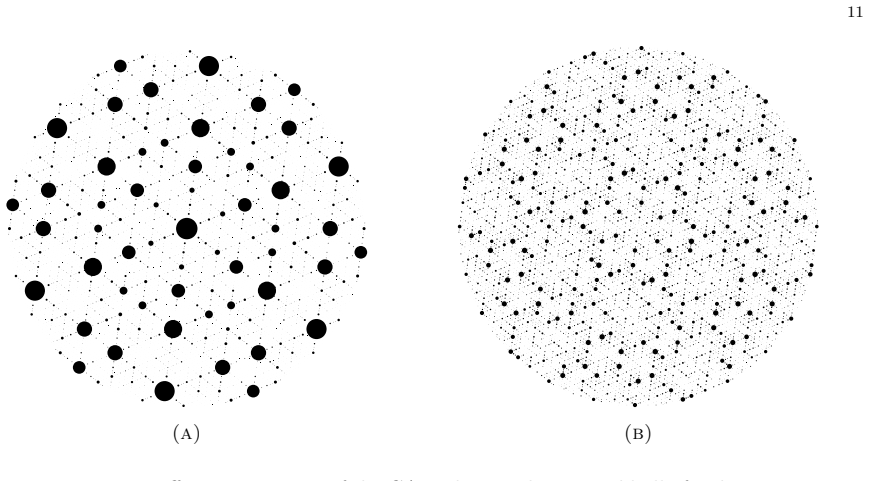
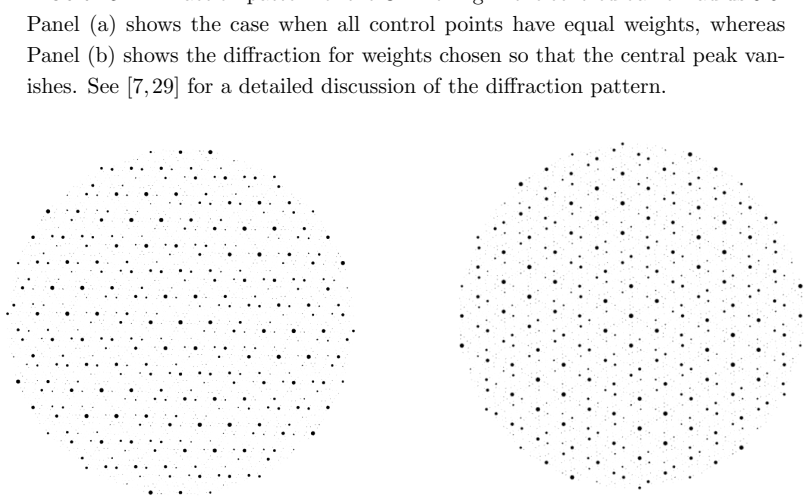
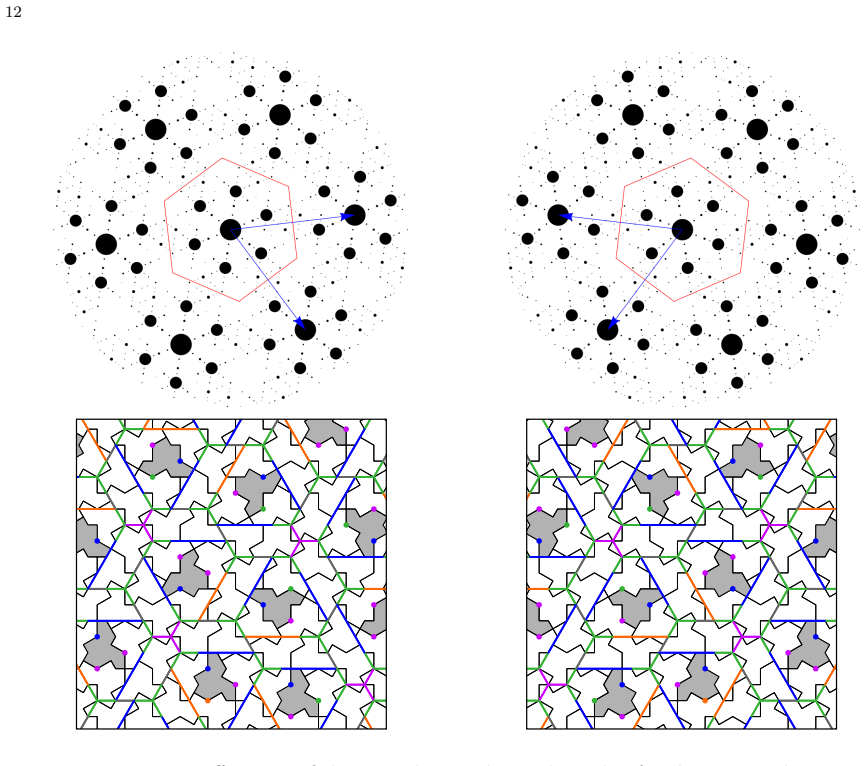
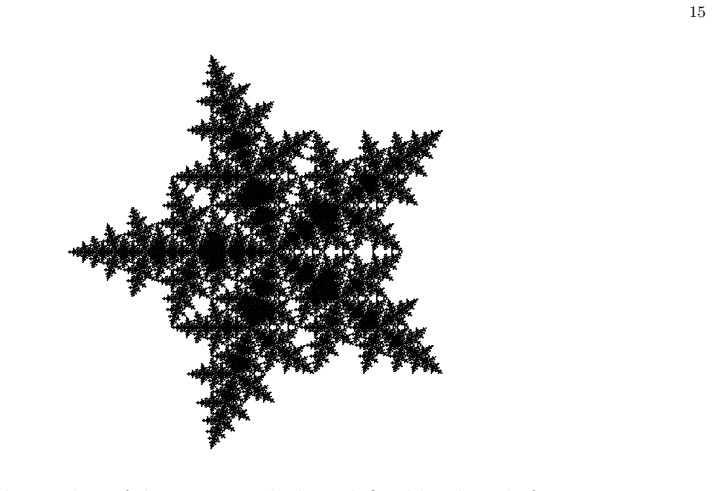
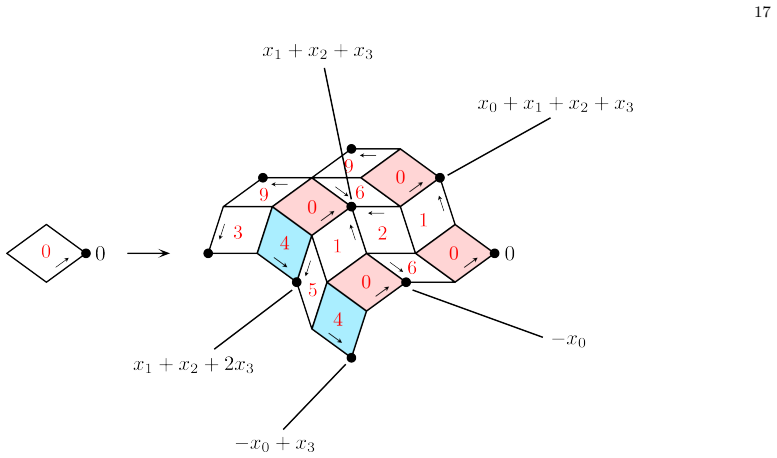
Exact renormalisation techniques are important and powerful, particularly for inflation-generated systems. We review recent results in this direction. We recall the necessary notions for inflation systems and show the renormalisation principle, which allows us to obtain exact values of highly erratic functions, such as window covariograms. We apply these techniques to compute the diffraction pattern of the new monotile tilings with arbitrary precision. We also recall a recent invariant for system with pure-point spectrum, the orbit separation dimension, and its relation to renormalisation. Lastly, we recall results beyond the pure-point spectrum setting and show how renormalisation and Lyapunov exponents can be used to exclude the presence of absolutely continuous part of the spectra.
Editorial analysis
A structured set of objections, weighed in public.
Referee Report
Summary. The manuscript is a review of renormalisation techniques for inflation systems. It recalls the necessary notions and structural hypotheses (primitivity, finite local complexity), states the renormalisation principle for obtaining exact values of window covariograms, applies the principle to compute diffraction patterns of new monotile tilings with arbitrary precision, recalls the orbit separation dimension and its link to renormalisation for pure-point spectrum systems, and discusses extensions beyond pure-point spectrum where renormalisation combined with Lyapunov exponents can exclude absolutely continuous spectral components.
Significance. If the stated hypotheses hold for the monotile examples, the review consolidates recent exact methods for computing diffraction measures in inflation systems and demonstrates their direct applicability to contemporary aperiodic tilings. The emphasis on exact (rather than approximate) values for erratic functions such as covariograms, together with the explicit statement of the structural conditions before application, is a strength for the mathematical diffraction and aperiodic order literature.
minor comments (2)
- [Review of necessary notions] In the section recalling the renormalisation principle, the statement of the structural hypotheses (primitivity, finite local complexity) should be cross-referenced explicitly to the subsequent monotile application so that readers can immediately locate the verification.
- [Application to monotile tilings] The abstract claims 'arbitrary precision' for the monotile diffraction; the corresponding section should clarify whether this is achieved via finite truncation of the renormalisation or via an explicit error bound derived from the principle.
Simulated Author's Rebuttal
We thank the referee for their positive summary of the manuscript, for highlighting its strengths in consolidating exact renormalisation methods for diffraction and spectral analysis, and for recommending minor revision. The referee's description aligns closely with the paper's scope and contributions.
Circularity Check
Review paper with standard self-citations to prior techniques; no load-bearing reduction
full rationale
This manuscript is explicitly a review that recalls the renormalisation principle (under primitivity, finite local complexity, and related structural hypotheses) from prior literature before applying it to the new monotile examples. The central claim—that the recalled principle yields exact window covariograms and diffraction measures once the hypotheses are verified—is presented as a direct consequence rather than a new derivation internal to the paper. No equation or step reduces by construction to a fitted input, self-definition, or unverified self-citation chain; the applications to monotiles constitute independent content once the standard conditions are checked. Minor self-citation is expected in a review but does not render the argument circular.
Axiom & Free-Parameter Ledger
Reference graph
Works this paper leans on
-
[1]
Akiyama, M
S. Akiyama, M. Barge, V. Berth´ e, J-Y. Lee and A. Siegel, On the Pisot substitution conjecture, in:Math- ematics of Aperiodic Order, eds. J. Kellendonk, D. Lenz and J. Savinien, Birkh¨ auser, Basel (2015), pp. 33–72
2015
-
[2]
Anderson and I.F
J.E. Anderson and I.F. Putnam, Topological invariants for substitution tilings and their associatedC ∗- algebras,Ergod. Th. & Dynam. Syst.18(1998), 509–537
1998
-
[3]
M. Baake, N.P. Frank, U. Grimm and E.A. Robinson, Geometric properties of a binary non-Pisot inflation and absence of absolutely continuous diffraction,Studia Math.247(2019), 109–154;arXiv:1706.03976
arXiv 2019
-
[4]
M. Baake and F. G¨ ahler, Pair correlations of aperiodic inflation rules via renormalisation: Some interesting examples,Topol. Appl.205(2016), 4–27;arXiv:1511.00885
Pith/arXiv arXiv 2016
- [5]
- [6]
- [7]
-
[8]
M. Baake, F. G¨ ahler, J. Maz´ aˇ c and L. Sadun, The long-range order of the Spectre tilings,Discr. Comput. Geom., in press (2025);https://doi.org/10.1007/s00454-025-00756-z,arXiv:2411.15503
- [9]
- [10]
-
[11]
Baake and U
M. Baake and U. Grimm,Aperiodic Order. Vol. 1: A Mathematical Invitation, Cambridge University Press, Cambridge (2013)
2013
-
[12]
M. Baake and U. Grimm, Fourier transform of Rauzy fractals and point spectrum of 1D Pisot inflation tilings,Docum. Math.25(2020), 2303–2337;arXiv:1907.11012
arXiv 2020
-
[13]
M. Baake and U. Grimm, Diffraction of a model set with complex windows,J. Phys.: Conf. Ser.1458 (2020), 012006:1–7;arXiv:1904.08285
arXiv 2020
-
[14]
M. Baake, U. Grimm U and N. Ma˜ nibo, Spectral analysis of a family of binary inflation rules,Lett. Math. Phys.108(2018), 1783–1805;arXiv:1709.09083
Pith/arXiv arXiv 2018
-
[15]
M. Baake, A. Haynes and D. Lenz, Averaging almost periodic functions along exponential sequences, In Aperiodic Order. Vol. 2: Crystallography and Almost Periodicity, M. Baake and U. Grimm (eds.), Cambridge University Press, Cambridge (2017), pp. 343–362;arXiv:1704.08120
Pith/arXiv arXiv 2017
-
[16]
M. Baake, A. Klick and J. Maz´ aˇ c, Pair correlations of one-dimensional model sets and monstrous covari- ograms of Rauzy fractals,J. Austral. Math. Soc.120(2026) 305–324;arXiv:2502.20487
Pith/arXiv arXiv 2026
-
[17]
A. Bufetov and B. Solomyak, A spectral cocycle for substitution systems and translation flows,J. Anal. Math.141(2018), 165–205;arXiv:1802.04783
arXiv 2018
-
[18]
Bufetov, J
A. Bufetov, J. Marshall and B. Solomyak, Local spectral estimates and quantitative weak mixing for sub- stitutionZ-actions,J. London Math. Soc.111(2025), e70136, 30 pp
2025
-
[19]
A. Clark and L. Sadun, When shape matters,Ergod. Th. & Dynam. Syst.26(2006), 69–86; arXiv:math.DS/0306214
arXiv 2006
-
[20]
G. Fuhrmann and M. Gr¨ oger, Constant length substitutions, iterated function systems and amorphic com- plexity,Math. Z.295(2020) 1385–1404;arXiv:1812.10789
Pith/arXiv arXiv 2020
-
[21]
G. Fuhrmann, M. Gr¨ oger and T. J¨ ager, Amorphic Complexity,Nonlinearity29(2016) 528–565; arXiv:1503.01036. 19
Pith/arXiv arXiv 2016
-
[22]
Godr` eche and F
C. Godr` eche and F. Lan¸ con, A simple example of a non-Pisot tiling with five-fold symmetry,J. Phys. I. France2(1992) 207–220
1992
-
[23]
Hollander and B
M. Hollander and B. Solomyak, Two-symbol Pisot substitutions have pure discrete spectrum,Ergod. Th. & Dynam. Syst.23(2003), 533–540
2003
-
[24]
Klick,Averaged Shelling of Model Sets via Renormalisation, Master thesis, Univ
A. Klick,Averaged Shelling of Model Sets via Renormalisation, Master thesis, Univ. Bielefeld (2024); available from the author
2024
-
[25]
Lagarias and Y
J.C. Lagarias and Y. Wang, Integral self-affine tiles inR n I. Standard and nonstandard digit sets,J. Lond. Math. Soc.54(1) (1996), 161–179
1996
-
[26]
Lan¸ con and L
F. Lan¸ con and L. Billard, Two-dimensional system with a quasi-crystalline ground state,J. Phys. France 49(1988), 249–256
1988
-
[27]
J.-Y. Lee, R.V. Moody and B. Solomyak, Pure point dynamical and diffraction spectra,Ann. H. Poincar´ e 3(2002), 1003-1013;arXiv:0910.4809
Pith/arXiv arXiv 2002
-
[28]
Ma˜ nibo,Lyapunov Exponents in the Spectral Theory of Primitive Inflation Systems, PhD Thesis, Univ
N. Ma˜ nibo,Lyapunov Exponents in the Spectral Theory of Primitive Inflation Systems, PhD Thesis, Univ. Bielefeld (2019);urn:nbn:de:0070-pub-29359727
2019
-
[29]
Maz´ aˇ c,Fractal and Statistical Phenomena in Aperiodic Order, PhD Thesis, Univ
J. Maz´ aˇ c,Fractal and Statistical Phenomena in Aperiodic Order, PhD Thesis, Univ. Bielefeld (2025); urn:nbn:de:0070-pub-30062996
2025
-
[30]
J. Maz´ aˇ c, Exact renormalisation for patch frequencies in inflation systems,preprint, (2025); arXiv:2507.07753
arXiv 2025
-
[31]
Moody, Uniform distribution in model sets,Can
R.V. Moody, Uniform distribution in model sets,Can. Math. Bull.45(2002), 123–130
2002
-
[32]
Sadun,Topology of Tiling Spaces, Amer
L. Sadun,Topology of Tiling Spaces, Amer. Math. Society, Providence, RI (2008)
2008
-
[33]
A. Say-awen and S. Coates, Octagonal tilings with three prototiles,Acta Cryst.A82(2026) 179–190; arXiv:2502.04133
arXiv 2026
-
[34]
Siegel and J
A. Siegel and J. Thuswaldner,Topological Properties of Rauzy Fractals, Soci´ ete Math´ ematique de France, Paris (2009)
2009
-
[35]
Sing,Pisot Substitutions and Beyond, PhD Thesis, Univ
B. Sing,Pisot Substitutions and Beyond, PhD Thesis, Univ. Bielefeld (2007);urn:nbn:de:hbz:361-11555
2007
-
[36]
D. Smith, J.S. Myers, C.S. Kaplan and C. Goodman-Strauss, An aperiodic monotile,Combin. Th.4(1) (2024), 6:1–91;arXiv:2303.10798
arXiv 2024
-
[37]
D. Smith, J.S. Myers, C.S. Kaplan and C. Goodman-Strauss, A chiral aperiodic monotile,Combin. Th.4(2) (2024), 13:1–25;arXiv:2305.17743
arXiv 2024
-
[38]
Solomyak, Dynamics of self-similar tilings,Ergod
B. Solomyak, Dynamics of self-similar tilings,Ergod. Th. & Dynam. Syst.17(1997), 695–738, andErgod. Th. & Dynam. Syst.19(1999), 1685 (erratum)
1997
-
[39]
B. Solomyak and R. Trevi˜ no, Spectral cocycle for substitution tilings,Ergodic Th. & Dynam. Syst.44(2024), 1629–1672;arXiv:2201.00749
arXiv 2024
-
[40]
Vince, Digit tiling of Euclidean space, InDirections in Mathematical Quasicrystals, eds
A. Vince, Digit tiling of Euclidean space, InDirections in Mathematical Quasicrystals, eds. M. Baake and R. V. Moody, Fields Institute Monographs, vol. 13, Amer. Math. Society, Providence, RI (2000), pp. 329–370. Fakult¨at f¨ur Mathematik, Universit¨at Bielefeld, Postfach 100131, 33501 Bielefeld, Germany Email address:{mbaake,gaehler,aklick,cmanibo,jmazac...
2000
discussion (0)
Sign in with ORCID, Apple, or X to comment. Anyone can read and Pith papers without signing in.